Introduction
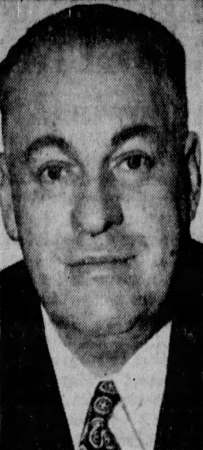
Charles V. Dickinson, 1957
CHARLES V. DICKINSON was born July 26, 1891 to Lewis and Anna Dickinson. A veteran of World War I, by 1925 he had attained the rank of Major in the New Jersey National Guard, serving with the Headquarters Company of Second Battalion, 112th Field Artillery Regiment, which was stationed in the armory on Wright Avenue.
The 1920 Census shows the family living at 570 Mount Vernon Street in South Camden. Besides Charles and his parents, the family included a brother, Mauroce Dickinson and sisters Lillian, Edna May, and Charlotte. Also residing at 570 Mount Vernon Street was brother-in-law Chester J. Andrus, who would go onto a long career with the Camden Fire Department.
Charles V. Dickinson married Lillian Hanson at the age of 22. When the census was taken in April of 1930, Charles V. Dickinson, wife Lillian and daughter Charlotte were living with his parents at 570 Mount Vernon Street in Camden. Also living there was his sister Edna, her husband Chester J. Andrus, and Chester Jr., their son. Charles V. Dickinson was still with the National Guard at that point and was working as a foreman with the State Highway Department. He was named Public Safety Director for the City of Camden not long afterwards. This position took on added responsibilities as Chief of Police Lewis Stehr Jr. suffered a heart attack at the end of April and another on Thanksgiving. Chief Stehr died on December 10, 1930.
Charles V. Dickinson served as the acting chief of the Camden Police Department, succeeding Chief Lewis Stehr Jr., as it was decided that a permanent chief would not be named until after the May 1931 election to decided Camden’s mayor and city commissioners. He was succeeded in turn by Acting Chief John Golden. Charles V. Dickinson was still serving in a law enforcement role in Camden as late as October of 1932. He later moved to Palmyra, New Jersey where he served as Mayor for a time. He was later elected to the Burlington County Board of Freeholders.
When the New Jersey National Guard was mobilized in 1940, Charles V. Dickinson was recalled to active duty. He was sent to Fort Sill, Oklahoma, where he served as inspector general. He had been promoted to full Colonel by war’s end.
Charles V. Dickinson was Director of the Burlington County Board of freeholders when he died in October of 1957. He was survived by his wife, daughter Mrs. Charlotte Snow, brother Maurice E., sister Mrs. Edna Andrus, and three grandchildren.
Dickinson Confers With Lieutenants
Camden Evening Courier —
New Police Deputy Denies ‘Laying Down Law’ to Aides; Shakeup Unlikely
Major Charles V. Dickinson, newly appointed deputy director of public safety, today held a two-hour conference with heads of the city police department.
The meeting between the new police ruler and the commanders of the four districts, the traffic bureau and the mounted squad, was held in the offices of Police Chief Lewis H. Stehr, who is confined to Cooper Hospital.
Although it was rumored about police headquarters prior to the meeting that the “law was to be laid down,” Major Dickinson stated afterward that nothing unusual had taken place.
“I called the men together,” he declared, “so that I could become better acquainted with them and learn the various manipulations of the districts of which they have charge.”
The major in answer to questions by reporters said that no changes had been made in the personnel of the department.
Those attending the conference were Inspector of Traffic Charles T. Humes; Lieutenants Charles Laib, of the traffic bureau; George Ward, of the First District; Ralph Bakley, of the Second; Walter Welch, of the Third, and George Frost, of the Fourth, and Sergeant Clarence Thorn, of the mounted squad.
Cop Asks Job Back Day After He Quit
Camden Evening Courier —
COP ASKS JOB BACK DAY AFTER HE QUIT
Father of Five 'Broke,' Seeks Reinstatement; Phoned in Resignation
Mahlon Allenbach, who was a traffic policeman until he suddenly telephoned Inspector Charles T. Humes yesterday and resigned, turned up at police headquarters today and tried to be reinstated.
Military System Adopted for Cops
Camden Evening Courier —
Dickinson Makes District Heads Responsible for Men; Vice Squad Disbanded
Following closely upon the heels of disbanding the special vice squad, Major C. V. Dickinson, deputy director of public safety, today announced that the commander of each of the four police districts will be responsible for the conduct of the men under him.
The same system of burden of responsibility existing in military services will be in effect in the Camden police department, the major averred. Each patrolman will be responsible to his sergeant, each sergeant to his lieutenant and the lieutenants to the deputy director.
Major Dickinson, Camden’s new “police czar,” also reiterated that he is demanding strict adherence to the police regulations and rules. One rule requires that no member of the police department, whether he is in uniform or plainclothes, on duty or off, may enter a soft-drink parlor or other drinking resorts “except in the strict commission of duty.” He has also informed the police heads to instruct their men to faithfully observe all other rules, including those requiring salutes to superior officers and those regulating neat appearance.
Major Dickinson completely abolished the special vice squad last night, reassigning the remaining five members to other units in the department.
Three of the squad were assigned to special duty and will work directly under Major Dickinson. They will be stationed in his offices at city hall and will take orders from him alone.
They are Detectives Theodore Guthrie, former head of the squad; James Paradise and Clarence Bunker. Guthrie and Paradise both live in the Sixth ward, the home bailliwick of Major Dickinson, while Bunker lives in the Thirteenth ward, within a few blocks of the residence of Dr. Rhone.
Of the two remaining members, Howard Smith is assigned to detective headquarters and Clarence Arthur was ordered to report to the Fourth Police District today in uniform. Smith, a resident of the Second ward, will take up his new position at 4 p. m. today. Arthur was appointed to the police department from the Third ward.
Other Changes Made
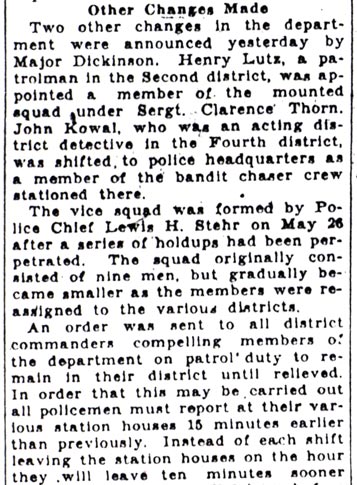
Two other changes in the department were announced yesterday by Major Dickinson. Henry Lutz, a patrolman in the Second district, was appointed a member of the mounted squad under Sergt. Clarence Thorn. John Kowal, who was an acting district detective in the Fourth district, was shifted to police headquarters as a member of the bandit chaser crew stationed there.
The vice squad was formed by Police Chief Lewis H. Stehr on May 26 after a series of holdups had been perpetrated. The squad originally consisted of nine men, but gradually became smaller as the members were reassigned to the various districts.
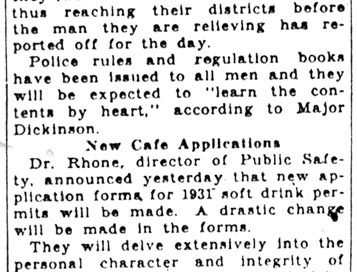
An order was sent to all district commanders compelling members of the department on patrol duty to remain in their district until relieved. In order that this may be carried out all policemen must report at their various station houses 15 minutes earlier than previously. Instead of each shift leaving the station houses on the hour they will leave ten minutes sooner thus reaching their districts before the man they are relieving has reported off for the day.
Police rules and regulation books have been issued to all men and they will be expected to “learn the contents by heart,” according to Major Dickinson.
New Cafe Applications
Dr. Rhone, director of Public Safety, announced yesterday that new application forms for 1931 soft drink permits will be made. A drastic change will be made in the forms.
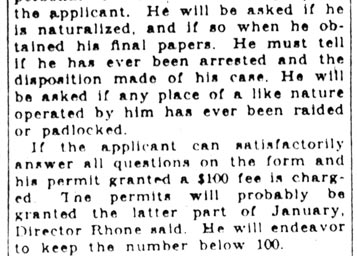
They will delve extensively into the personal character and integrity of the applicant. He will be asked if he is naturalized, and if so when he obtained his final papers. He must tell if he has ever been arrested and the disposition made of his case. He will be asked if any place of a like nature operated by him has ever been raided or padlocked.
If the applicant can satisfactorily answer all questions on the form and his permit granted a $100 fee is charged. The permits will probably be granted the latter part of January, Director Rhone said. He will endeavor to keep the number below 100.
Heart Attack Kills Chief Stehr After Illness of 10 Days
Camden Evening Courier —
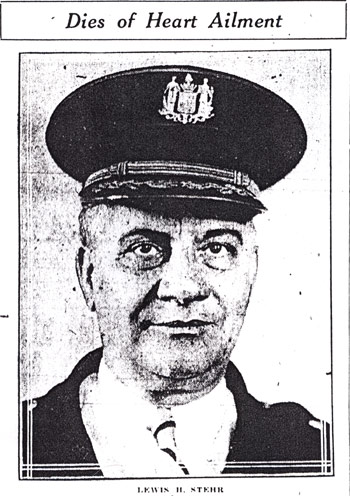
Dies of Heart Ailment
LEWIS H. STEHR
Police Chief Succumbs as He Asks Nurse Time; Had Been in Grave Condition But Was Expected to Recover.
Failing in Health Since Spring; Joined Force in 1905; Elevated From Captaincy to Inspectorship in 1927; Made Chief Year Later.
Chief of Police Lewis H. Stehr died at 11.30 a. m. today in Cooper Hospital.
The Camden police head, who resided at 621 Chestnut street, had been in the hospital since Dec. 1 stricken with a heart disease and kidney trouble. He had a similar attack last April.
His death was unexpected, although his condition was considered grave. He had just asked a nurse what time it was, and as she gave answer, he turned on his side, and his eyes closed. The nurse, alarmed, summoned a physician, who pronounced him dead.
Chief Stehr was 58, and is survived by his widow, Mrs. Anna Stehr They had no children. He was the son of the late Lewis Stehr, city assessor.
Won Several Promotions
The chief was born in the Fifth ward and later moved to the Sixth ward. He was first appointed to the police force as a patrolman on July 1, 1905. His record was one of a steady rise. He was named a sergeant Aug. 1, 1912, and on Feb. 15, 1916, was appointed a captain. He served as commander of the Second District.
On June 23, 1927, Stehr was elevated to the post of police inspector, holding that rank until July 1, 192[8], when he was appointed police chief exactly 23 years after he became a policeman. The appointment was made by Dr. David S. Rhone, director of public safety.
“At the present time Major Dickinson will be in charge of the police department until a temporary chief of police is appointed,” Dr. Rhone stated.
Rhone Expresses Sorrow
Dr. Rhone expressed profound regret when he learned of the chief’s death. He said he and Chief Stehr had been personal friends for years. He noticed, he said, that Chief Stehr was falling in health after the heart attack last spring. Recently, the chief appeared to be in such poor health that his physician, Dr. H. S. Riddle, ordered him to a hospital for a rest.
Dr. Rhone stated that he appointed Major Charles V. Dickinson as deputy director of public safety to take over some of the duties attendant to the office of chief of police, in order to relieve Chief Stehr of some of the pressure of his work, so that his health would not further be impaired.
The decedent was an active member of the Sixth Ward Republican Club, and was well liked not only by members of the police force but throughout the city.
Commissioner Frank B. Hanna, when apprised of the police chief’s death, said:
“The news of Chief Stehr’s death was a terrible shock. I feel a personal loss, as we were close friends. I knew him since I was a young boy, and our contacts in the past two years were most pleasant.”
Lewis H. Stehr, Chief of Police, Dies Suddenly
Camden Morning Post —
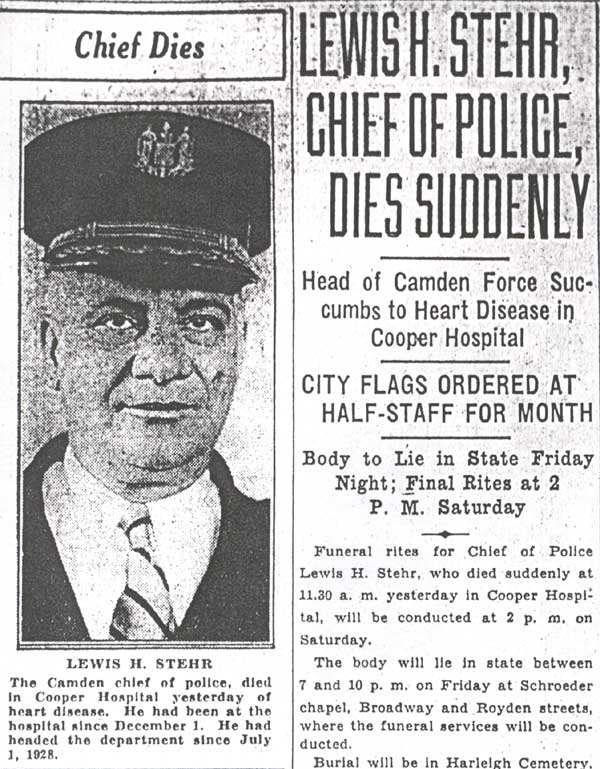
LEWIS H. STEHR — The Camden chief of police, died in Cooper Hospital yesterday of heart disease. He had been at the hospital since December 1. He had headed the department since July 1, 1928.
Head of Camden Force Succumbs to Heart Disease in Cooper Hospital
CITY FLAGS ORDERED AT HALF-STAFF FOR MONTH
Body to Lie in State Friday Night; Final Rites at 2 P. M. Saturday
Funeral rites for Chief of Police Lewis H. Stehr, who died suddenly at 11.30 a. m. yesterday in Cooper Hospital, will be conducted at 2 p. m. on Saturday.
The body will lie in state between 7 and 10 p. m. on Friday at Schroeder chapel, Broadway and Royden streets, where the funeral services will be conducted. Burial will be in Harleigh Cemetery.
The Camden police official, who lived at 621 Chestnut street, had been in the hospital since December 1, suffering from heart and kidney trouble. He suffered an earlier heart attack last April.
Chief Stehr’s death was unexpected, although his condition had been considered grave. He had just asked a nurse what time it was and collapsed as she answered. The nurse, alarmed, summoned a physician, who pronounced him dead.
Chief Stehr, the son of the late Lewis Stehr, city assessor, was 58, and is survived by his widow, Mrs. Anna Stehr. They had no children.
Mrs. Stehr had been at the bedside of her husband constantly since he was stricken Thanksgiving Day. Yesterday nurses assured her her husband’s condition was unchanged and she was making Christmas purchases at Chief Stehr’s request when he died.
Won Several Promotions
The chief was born in the Fifth ward and later moved to the Sixth ward. He was first appointed to the police force as a patrolman on July 1, 1905. His record was one of a steady rise. He was named a sergeant Aug. 1, 1912, and on Feb. 15, 1918, was appointed a captain. He served as commander of the Second District.
On June 23, 1927, Stehr was elevated to the post of police inspector, holding that rank until July 1, 1928, when he was appointed police chief exactly 23 years after he became a policeman. The appointment was made by Dr. David S. Rhone, director of public safety.
“At the present time Major Dickinson will be in charge of the police department until a temporary chief of police is appointed,” Dr. Rhone stated.
Rhone Expresses Sorrow
Dr. Rhone expressed profound regret when he learned of the chief’s death. He said he and Chief Stehr had been personal friends for years. He noticed, he said, that Chief Stehr was failing in health after the heart attack last spring. Recently, the chief appeared to be in such poor health that his physician, Dr. H. S. Riddle, ordered him to a hospital for a rest.
Dr. Rhone stated that he appointed Major Charles V. Dickinson as deputy director of public safety to take over some of the duties attendant to the office of chief of police, in order to relieve Chief Stehr of some of the pressure of his work, so that his health would not further be impaired.
The decedent was an active member of the Sixth Ward Republican Club, and was well liked not only by members of the police force but throughout the city.
Mayor Expresses Sorrow
Mayor Price issued the following statement: “I was very greatly shocked to learn of the death of Chief Stehr. While I understood he was in a serious physical condition, I did not anticipate his death.
“Chief Stehr had devoted practically his entire lifetime to the service of the city, having entered the police department in his early youth, and is entitled to the commendation of his fellow citizens for his efforts in the public service.”
Commissioner Frank B. Hanna, when apprised of the police chief’s death, said: “The news of Chief Stehr’s death was a terrible shock. I feel a personal loss, as we were close friends. I knew him since I was a young boy, and our contacts in the past two years were most pleasant.”
Prosecutor Clifford A. Baldwin declared: “The suddenness of the death of Chief Stehr comes as a shock to those of his friends who were wishing him well in his illness. His passing naturally causes grief to those whose work brought them into close contact with him.”
City Commissioner Clay W. Reesman said: “The passing of Chief Stehr is a great loss to the community. We were all hoping that Chief Stehr was on the road to recovery and only several days ago when I inquired at the hospital, I learned that his condition was greatly improved. His sudden passing is a terrible shock.” City officials last night ordered all flags lowered to half mast on all police stations for 30 days. Deputy Director Dickinson and Captain Arthur Colsey today will convey to Mrs. Stehr the police department’s official condolence.
Funeral for Stehr to Be Held Saturday
Camden Evening Courier —
FUNERAL FOR STEHR TO BE HELD SATURDAY
City in Mourning as Rites are Planned—Burial Will Be in Harleigh
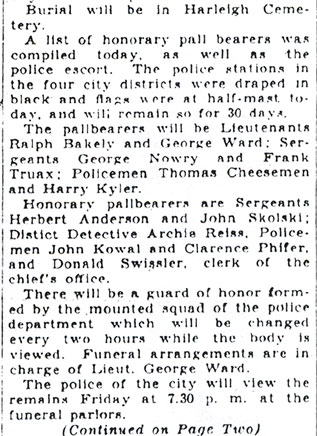
With the city in mourning today, funeral arrangements were being completed for Chief of Police Lewis H. Stehr, who died yesterday in Cooper Hospital. Hundreds of friends will view the body in state tomorrow between 7 and 10 p. m. at the Schroeder Chapel, Broadway and Royden streets. Many others will attend the funeral services, which will be held at 2 p. m. Saturday at the chapel.
Burial will be in Harleigh Cemetery.
A list of honorary pall bearers was compiled today, as well as the police escort. The police stations in the four city districts were draped in black and flags were at half-mast today, and will remain so for 30 days.
The pallbearers will be Lieutenants Ralph Bakely and George Ward; Sergeants George Nowry and Frank Truax; Policemen Thomas Cheeseman and Harry Kyler.
Honorary pallbearers are Sergeants Herbert Anderson and John Skolski; District Detective Archie Reiss, Policemen John Kowal and Clarence Phifer, and Donald Swissler, clerk of the chief’s office.
There will be a guard of honor formed by the mounted squad of the police department which will be changed every two hours while the body is viewed. Funeral arrangements are in charge of Lieut. George Ward.
The police of the city will view the remains Friday at 7.30 p. m. at the funeral parlors.
(Continued on Page Two)
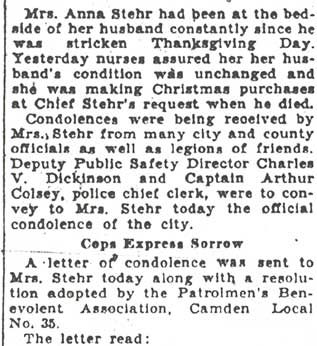
Mrs. Anna Stehr had been at the bedside of her husband constantly since he was stricken Thanksgiving Day. Yesterday nurses assured her her husband’s condition was unchanged and she was making Christmas purchases at Chief Stehr’s request when he died. Condolences were being received by Mrs. Stehr from many city and county officials as well as legions of friends. Deputy Public Safety Director Charles V. Dickinson and Captain Arthur Colsey, police chief clerk, were to convey to Mrs. Stehr today the official condolence of the city.
Cops Express Sorrow
A letter of condolence was sent to Mrs. Stehr today along with a resolution adopted by the Patrolmen’s Benevolent Association, Camden Local No. 35. The letter read:
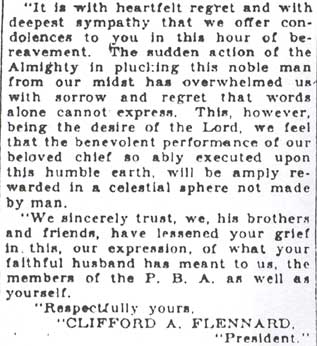
“It is with heartfelt regret and with deepest sympathy that we offer condolences to you in this hour of bereavement. The sudden action of the Almighty in plucking this noble man from our midst has overwhelmed us with sorrow and regret that words alone cannot express. This, however, being the desire of the Lord, we feel that the benevolent performance of our beloved chief so ably executed upon this humble earth, will be amply rewarded in a celestial sphere not made by man.
“We sincerely trust, we, his brothers and friends, have lessened your grief in this, our expression, of what your faithful husband has meant to us, the members of the P. B. A. as well as yourself.
“Respectfully yours, “CLIFFORD A. FLENNARD, “President.”
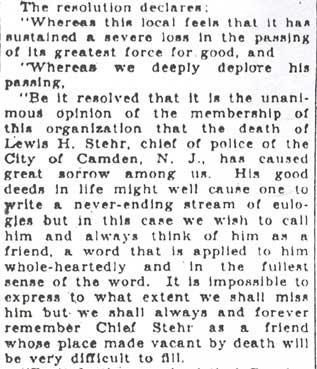
The resolution declares: “Whereas this local feels that it has sustained a severe loss in the passing of its greatest force for good, and “Whereas we deeply deplore his passing, “Be it resolved that it is the unanimous opinion of the membership of this organization that the death of Lewis H. Stehr, chief of police of the City of Camden, N. J., has caused great sorrow among us. His good deeds in life might well cause one to write a never-ending stream of eulogies but in this case we wish to call him and always think of him as a friend, a word that is applied to him whole-heartedly and in the fullest sense of the word. It is impossible to express to what extent we shall miss him but we shall always and forever remember Chief Stehr as a friend whose place made vacant by death will be very difficult to fill.
“Be it further resolved that Camden Local, No. 35, P. B. A., also wishes to extend its sympathies to Mrs. Stehr and to offer whatever assistance possible at this time of her bereavement and at any other time this organization may find it in its power to do so.
“Be it further resolved that we also extend our sympathies to his relatives and friends who are no doubt feeling his passing as deeply as we do so.”
Copies of the resolution were sent to Director of Public Safety David S. Rhone, Mrs. Stehr and the press. The resolution was passed at the regular meeting of the local yesterday. The resolution was signed by Flennard, the president, and Joseph Keefe, the secretary.
Chief George W. Black, secretary of the International Chief of Police Association, sent his regrets and letter of condolence to Captain Arthur Colsey and asking that a floral design be sent to the funeral at the association’s expense.
Mayor Expresses Sorrow
Mayor Price issued the following statement: “I was very greatly shocked to learn of the death of Chief Stehr. While I understood he was in a serious physical condition, I did not anticipate his death.
“Chief Stehr had devoted practically his entire lifetime to the service of the city, having entered the police department in his early youth, and is entitled to the commendation of his fellow citizens for his efforts in the public service.”
Commissioner Frank B. Hanna, when apprised of the police chief’s death, said: “The news of Chief Stehr’s death was a terrible shock. I feel a personal loss, as we were close friends. I knew him since I was a young boy, and our contacts in the past two years were most pleasant.”
Prosecutor Clifford A. Baldwin declared: “The suddenness of the death of Chief Stehr comes as a shock to those of his friends who were wishing him well in his illness. His passing naturally causes grief to those whose work brought them into close contact with him.”
City Commissioner Clay W. Reesman said: “The passing of Chief Stehr is a great loss to the community. We were all hoping that Chief Stehr was on the road to recovery and only several days ago when I inquired at the hospital, I learned that his condition was greatly improved. His sudden passing is a terrible shock.”
6 Men Are Nabbed as Number Writers
Camden Morning Post —
Arrests Lead to Belief Shore Racketeers Are Working Here
Arrest of six alleged number writers here yesterday has spread the belief that Atlantic City racketeers have established “branch offices” on downtown street corners. Four of the accused all of whom were caught by members of the traffic squad, will be given hearings this morning. The other two were sentenced to 60 days each in the Camden county jail, when unable to pay fines of $50 imposed by Police Judge Garfield Pancoast yesterday.
All of the men were arrested while soliciting “business.”
‘Pick Up’ Man Nabbed
One of the six men arrested is believed to be the “pickup man” for the syndicate. He was in an automobile bearing Atlantic county tags and his pockets were filled with number slips and cash, according to the police.
Henry Davis, 36, of 208 Walnut street, and Alonzo Singleton, 20, of 256 Chestnut street, were arrested by Sergeant Jeff Kay and Motorcycle Policeman Thomas Kauffman at Second and Kaighn avenue. One man was standing on the northwest corner and the other on the southwest corner, soliciting business, the police testified. Davis and Singleton pleaded guilty and went to jail for 60 days.
LeRoy Keeler, 20, of 1617 Arctic avenue, Atlantic City, and David Watson, 29, of Second and Mt. Vernon streets, Camden, were arrested at Broadway and Mickle street by Motorcycle Policeman Charles Smith and William Moll. They were held for hearings this morning.
Wesley Edgehill, 35, of 1623½ Arctic avenue, Atlantic City, alleged by the police to be the “pickup man” for the Atlantic City barons, was arrested by Smith and Moll at West and Mickle streets. Edgehill was driving an automobile bearing Atlantic county tags. He had “hundreds of numbers slips and plenty of cash” in his pockets when arrested, according to the police. He also will be given a hearing this morning.
Wilbert William, 20, of 1010 Walnut street, was the sixth man arrested. He was caught selling numbers at Mt. Ephraim and Kaighn avenues, according to Kauffman and Kay. He will face Judge Pancoast today.
No Drive Ordered
Questioned regarding whether the traffic squad was making a drive against numbers game operators in Camden, Police Capt. Charles T. Humes, inspector of traffic, said no orders had been issued for a drive on operators. The motorcycle policemen were only acting in line of regular duty, he said.
Major Charles V. H. Dickinson, deputy director of public safety, stated yesterday that the arrests were not part of a concerted drive against the number “barons.” He said:
“There is no particular drive under way. The first I knew of the matter was when I read of the arrests in the Courier-Post. I questioned one of the men and he stated that he saw the writers selling slips and picked them up. There have been no orders issued except that I will not tolerate any form of gambling and want the city kept clean of it.”
Camden Will Honor Chief Stehr Today
Camden Morning Post —
Thousands Expected to Line Streets on Route of Funeral Procession This Afternoon
Camden will honor the memory of Chief of Police Lewis H. Stehr.
The funeral cortege of Chief Stehr, who died in Cooper Hospital on Wednesday following a heart attack, will leave Schroeder’s Chapel, Broadway and Royden street, shortly after 2 o’clock.
Headed by members of the police mounted squad the procession will move south on Broadway to Kaighn avenue, east to Haddon avenue to Harleigh Cemetery.
Thousands of persons are expected to line the streets along the route to pay a last tribute to “the chief.”
Other thousands formed a steady stream of humanity last night past the bier of the police head as he lay in state at the chapel. Hundreds of floral tributes were banked about the body, while other flowers were stored in two adjoining rooms.
The entire enrollment of the Camden police department marched past the body of their “chief” shortly after 8 o’clock. Dr. David S. Rhone, director of public safety, and Charles V. H. Dickinson, deputy director, headed the policemen.
One of the most beautiful of the floral pieces was from the Policemen’s Beneficial Association. It was in the form of a police badge and consisted of pink and white roses. The word “Chief” was formed, at the centre of the badge, with white roses.
Other floral designs were from each of the four police districts, the traffic squad and the detective bureau. The commissioners also sent a large floral tribute.
Members of the mounted squad formed a guard of honor around the coffin during the night. This same squad, under Sergeant Clarence Thorn, will act as an honorary escort during the funeral.
Final services for Chief Stehr will be held at the Harleigh Mausoleum Chapel, with Rev. Edward Weeks, pastor of Union M. E. Church, Fifth and Mt. Vernon streets, officiating.
Burial will be in the family plot.
Giant Distillery Falls in North Camden
Camden Morning Post —
—Courier-Post Photo
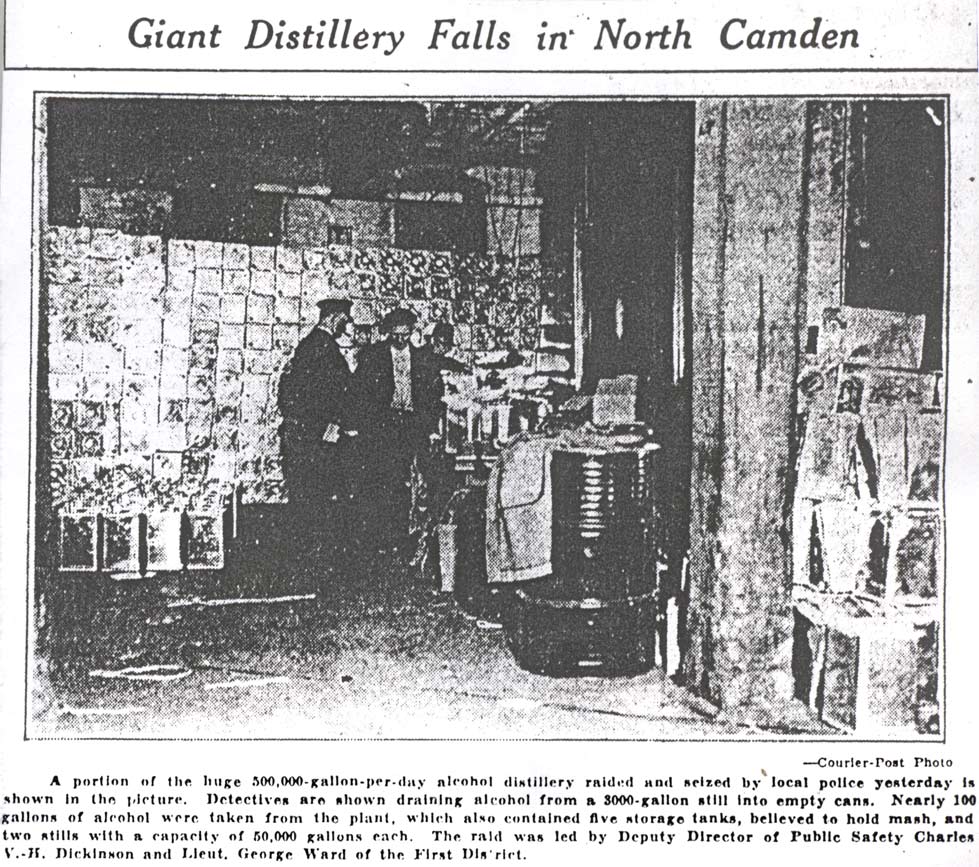
A portion of the huge 500,000-gallon-per-day alcohol distillery raided and seized by local police yesterday is shown in the picture. Detectives are shown draining alcohol from a 3000-gallon still into empty cans. Nearly 100 gallons of alcohol were taken from the plant, which also contained five storage tanks, believed to hold mash, and two stills with a capacity of 50,000 gallons each. The raid was led by Deputy Director of Public Safety Charles V. H. Dickinson and Lieut. George Ward of the First District.
Camden Will Honor Chief Stehr Today
Camden Courier-Post —
Thousands Expected to Line Streets on Route of Funeral Procession This Afternoon
Camden will pay its last respects today to Chief of Police Lewis H. Stehr.
The funeral cortege of Chief Stehr, who died Wednesday in Cooper Hospital after a sudden heart attack, will leave Schroeder’s, 538 Broadway, at 2 p. m. Headed by details of police, the procession will move south on Broadway to Kaighn avenue, east to Haddon avenue to Harleigh Cemetery, where final services will take place in charge of Rev. Edward T. Weeks, pastor of Union M. E. Church.
Several thousand persons viewed the body last night. Hundreds of floral tributes were banked about the body, while other flowers were stored in two adjoining rooms. Members of the mounted squad formed a guard of honor around the coffin during the night.
The entire enrollment of the Camden police department marched past the body of their “chief” shortly after 8 o’clock. Dr. David S. Rhone, director of public safety, and Charles V. Dickinson, deputy director, headed the policemen.
One of the most beautiful of the floral pieces was from the Policemen’s Beneficial Association. It was in the form of a police badge and consisted of pink and white roses. The word “Chief” was formed, at the centre of the badge, with white roses.
Other floral designs were from each of the four police districts, the traffic squad and the detective bureau. The commissioners also sent a large floral tribute.
Probe Started by Dickinson in Raid ‘Leak’
Camden Evening Courier —
Men Fled $250,000 Still Before Cops Arrived, Deputy Learns
Baldwin Gave Clue to Giant Plant
Vast Amount of Rum Supplies Seized in North Camden
Major Charles V. Dickinson, deputy director of public safety, today started an investigation to ascertain how plans for a raid on a $250,000 North Camden distilling plant leaked out more than an hour before the raid was made late yesterday afternoon.
The inquiry to locate the “leak” was prompted by rumors that neighbors saw employes of the distillery running from the plant at Ninth and State streets an hour and 20 minutes before detectives and the police raided it. Major Dickinson, however, insists he and Lieut. George Ward were the only persons in the police department who knew the location of the plant prior to the raid.
Police believe the distillery to be one of a chain of such places operated throughout this state with headquarters in Newark.
The raid was the result of an investigation made by Prosecutor Clifford A. Baldwin after he had heard rumors a large distilling plant was being operated in North Camden. Baldwin assigned Lawrence T. Doran, chief of county detectives, and other county detectives, to make a survey, and men were stationed near the plant.
Baldwin Orders Raid
When Chief Doran reported the results of the survey to Baldwin the prosecutor immediately notified Major Dickinson and ordered him to make the raid. Dickinson called in Lieutenant Ward and plans were made for descending on the plant.
A squad of detectives and patrolmen, led by Dickinson, raided the plant a few minutes before 4 p.m. It was the third raid on the plant within two years, Lieutenant Ward having seized a 1500-gallon still there on March 25, 1929, and federal prohibition agents confiscating $100,000 worth of alcohol distilling equipment about 18 months ago.
“If there was a leak, and if the employes and operators were tipped off, I would like to know how it happened,” Major Dickinson said today. “As soon as I heard of this distilling plant I called Lieutenant Ward into my office and we made arrangements and completed plans to raid the place immediately. The plans, however, were not completed until 3 p.m. about an hour after I was notified of the existence of the plant.”
“All arrangements were made by telephone and there could not have been anyone, to my knowledge, who knew the plans. Detectives and patrolmen were told to assemble at the First District police station. They were not told where they were going or what for. Ward and myself were the only ones in the police department who knew the location of the plant.”
Alcohol Seized
The raiders seized 915 gallons of alcohol in 53 five-gallon cans and 12 50-gallon drums, 1500 pounds of brown sugar, 400,000 gallons of mash, 12 bags of white powder and one bale of hops.
Five steel tanks, each of 80,000 gallons capacity, two stills of 50,000 gallons capacity each, one 3000-gallon still, several large wooden tanks, thousands of feet of piping and coiling equipment were found in the plant. The steel tanks had been built in, a section of one floor having been removed to make room. The plant was located on four floors, the fermentation tanks being on the top floors and pipes arranged so that the products could be “worked down” to the first floor tanks where the alcohol was put in five-gallon cans for shipping.
Baldwin called the plant the largest illicit distillery in the United States and said he believed it to be operated by a big liquor ring. He believed it took several months to install the extensive equipment, which was new. An elaborate system of signal alarms, secret telephones, tunnels for hurried exits and arrangements for lookouts two blocks from the plant were found.
All of the equipment, as well as supplies for the plant, were taken there by boat, Baldwin believes. Arrangements had been made for emptying the mash into Cooper River. The entire plant was surrounded by a high fence.
Plant in Use 10 Days
Dickinson said he believed the plant had been in operation not more than 10 days as the valves, turnhandles, spigots and brass work showed little signs of wear. Preparations had been made against a possible raid. Dickinson learned after visiting the plant, as the names on shipping labels had been torn so they were not readable. Tar paper had been placed over the window. Names had been removed from the lunch boxes of workmen.
Large packing boxes such as used for the shipment of radio and phonograph sets were used to hide the machinery and also for shipping the cans of alcohol.
The stills and steel tanks were dismantled by acetylene torches, the mash and chemicals were dumped in Cooper river and the alcohol was taken to city hall. The alcohol probably will be turned over to hospitals and charitable institutions.
Lessors Sought
Dickinson and Baldwin are making surveys today to ascertain, if possible, who leased the building. Nearby plant owners and neighbors will be questioned.
The building for many years was headquarters of the old Highland Worsted Mills and extends from Ninth street to the Cooper river; on State street, and runs back about a half square to Moore street.
Yesterday the buildings were empty when the big squad of cops swarmed into the place. The lunch baskets of several employes were found on tables in the room and there were other evidences of a hasty exit having taken place. There were rumors that a “tip off” had been given the men in the building, and it was reported they were seen to rush from the building a few minutes before the arrival of the raiders.
Owners Escape
The raid, observers recalled, bears every indication of paralleling that on Chestnut street, near the second district police station, on October 22 when a $200,000 distillery was uncovered. Of nine men arrested there, six were fined $300 each and three were dismissed yesterday. Their attorney declared the men were merely employes and that the “owners have skipped out, leaving these men in the middle.”
Neighbors stated they had smelled peculiar odors in the vicinity for several weeks past but were unable to establish the location of the still until it was uncovered by yesterday’s raid. The raid also brought to climax a series of reports that have been in circulation for several weeks that there was a bigger still in operation in Camden than the one found on Chestnut street.
The raiders entered the building through a tunnel on the banks of Cooper river. The tunnel ended under the building with a trapdoor giving ingress to the basement of the distillery.
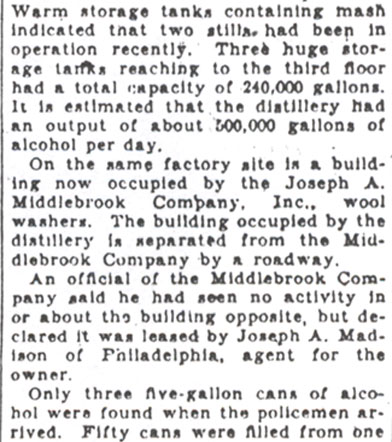
None of the stills was in operation. Warm storage tanks containing mash indicated that two stills had been in operation recently. Three huge storage tanks reaching to the third floor had a total capacity of 240,000 gallons. It is estimated that the distillery had an output of about 500,000 gallons of alcohol per day.
On the same factory site is a building now occupied by the Joseph A. Middlebrook Company, Inc., wool washers. The building occupied by the distillery is separated from the Middlebrook Company by a roadway.
An official of the Middlebrook Company said he had seen no activity in or about the building opposite, but declared it was leased by Joseph A. Madison of Philadelphia, agent for the owner.
Only three five-gallon cans of alcohol were found when the policemen arrived. Fifty cans were filled from one still by the raiders. The distillery was so enveloped in darkness, with few electric lights, that the raiders were forced to use flashlights in inspecting the five floors and locating equipment.
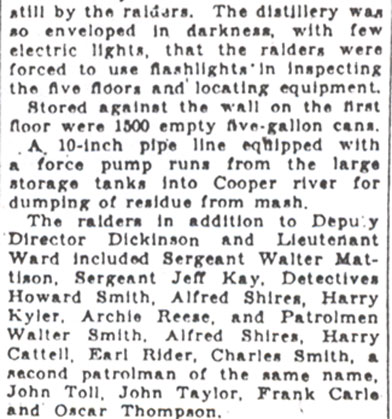
Stored against the wall on the first floor were 1500 empty five-gallon cans.
A 10-inch pipe line equipped with a force pump runs from the large storage tanks into Cooper river for dumping of residue from mash.
The raiders in addition to Deputy Director Dickinson and Lieutenant Ward included Sergeant Walter Mattison, Sergeant Jeff Kay, Detectives Howard Smith, Alfred Shires, Harry Kyler, Archie Reese, and Patrolmen Walter Smith, Alfred Shires, Harry Cattell, Earl Rider, Charles Smith, a second patrolman of the same name, John Toll, John Taylor, Frank Carle and Oscar Thompson.
Job of Police Chief to Remain Vacant
Camden Evening Courier —
Appointment Will Be Delayed Until After Election; Anderson May Be Promoted
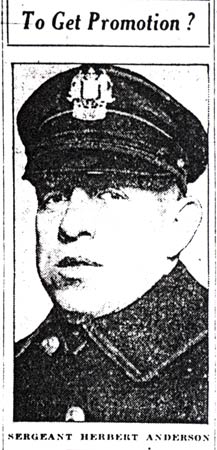
To Get Promotion?
Sergeant Herbert Anderson
By Mercury
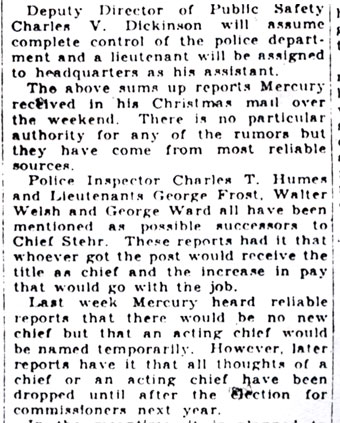
No one will be appointed to succeed the late Lewis H. Stehr as chief of the Camden Police Department at least until after the commission government election next spring.
Deputy Director of Public Safety Charles V. Dickinson will assume complete control of the police department and a lieutenant will be assigned to headquarters as his assistant.
The above sums up reports Mercury received in his Christmas mail over the weekend. There is no particular authority for any of the rumors but they have come from most reliable sources.
Police Inspector Charles T. Humes and Lieutenants George Frost, Walter Welsh [sic] and George Ward all have been mentioned as possible successors to Chief Stehr. These reports had it that whoever got the post would receive the title as chief and the increase in pay that would go with the job.
Last week Mercury heard reliable reports that there would be no new chief but that an acting chief would be named temporarily. However, later reports have it that all thoughts of a chief or an acting chief have been dropped until after the election for commissioners next year.
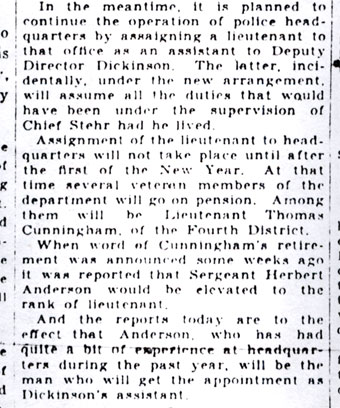
In the meantime, it is planned to continue the operation of police headquarters by assigning a lieutenant to that office as an assistant to Deputy Director Dickinson. The latter, incidentally, under the new arrangement, will assume all the duties that would have been under the supervision of Chief Stehr had he lived.
Assignment of the lieutenant to headquarters will not take place until after the first of the New Year. At that time several veteran members of the department will go on pension. Among them will be Lieutenant Thomas Cunningham, of the Fourth District.
When word of Cunningham’s retirement was announced some weeks ago it was reported that Sergeant Herbert Anderson would be elevated to the rank of lieutenant.
And the reports today are to the effect that Anderson, who has had quite a bit of experience at headquarters during the past year, will be the man who will get the appointment as Dickinson’s assistant.
Camden Father Dies in Fight With His Son; Both Jobless
Camden Courier-Post —

Quarrel Over Youth Getting Work Is Blamed for Street Battle
ACCUSED WILL MAKE SELF-DEFENSE PLEA
Victim’s Head Hits Curb, Physicians Believe He Died Instantly
A quarrel over his son’s failure to obtain work ended fatally last night for the father of five children who was killed when he struck his head on a curb after the son had hit him on the jaw.
The father is Frederick Alanko Thompson, also known as Elanko, 45, of 805 Linden street. His son, Reino Alanko Thompson, who will be 18 in July, will be arraigned today on a charge of murder.
The fight occurred at the southeast corner of Ninth and Kimber streets.
The story of the alleged murder as told by the boy to Prosecutor Clifford A. Baldwin differed from that told by two young witnesses. The boy claimed self-defense while the witnesses said he had struck his father first.
Both Out of Work
Reino said he had been out of work for five months and his father had been unemployed for eight. The boy had worked for Todd Rooney, trucker, of Fern street near Eighth street.
Shortly before 7 p. m. last night, the boy said, his father criticised him for not obtaining work. To end the constant nagging of the father, his mother, Mrs. Rose Thompson, 45, gave her son a quarter and he left the house.
Reino was on his way to Tenth and Market streets to meet friends, he said, when his father followed him.
“He kept cursing me and when we got to Ninth and Kimber streets, my father struck at me. I sidestepped and hit him in the jaw. He fell to the curb and lay there. I shouted to him to get up if he wanted me to hit him again.”
When father failed to get up, Reino became frightened and ran home.
Francis Zoll, 15, of 912 Kimber street, and Herbert Townsend, 16, of 934 Linden street, who saw the fight, told the authorities the father made no effort to hit his son but that the boy hit him “six or seven times.”
Victim Dies Instantly
They notified Detective William Moll, who had the father taken to Cooper Hospital where he was pronounced dead. Coroner Melvin Cain will perform an autopsy today.
Detectives Clifford Carr and Anson Kelly went to the Thompson home where they found the boy hiding in a kitchen alcove. They told the mother that he was wanted for questioning about a fight with his father but did not reveal that the father had been killed until they reached police headquarters. The son himself did not know his blow had proved fatal until later.
Mrs. Thompson and her two older daughters, Rose, 16, and May, 14, accompanied Reino and the detectives to police headquarters. Two other twin daughters, Diamond and Irene, 10, remained at home.
The boy was questioned by Baldwin, Capt. John Golden, of the city detectives, and Maj. Charles V. Dickinson, deputy director of public safety.
The boy broke down when he was charged with murder and was led weeping to a cell. Mrs. Thompson, who had remained calm during the questioning, collapsed after her son was taken away.
Another son, Esel, 22, was arrested eight months ago by Detective Carr and turned over to immigration officials at Gloucester for deportation. He was said to have illegally entered this country from Finland six years ago. The other members of the family came to America some years before. The father was naturalized.
Mayor Orders Cops to Drive All Gangsters From Camden
Camden Courier-Post —
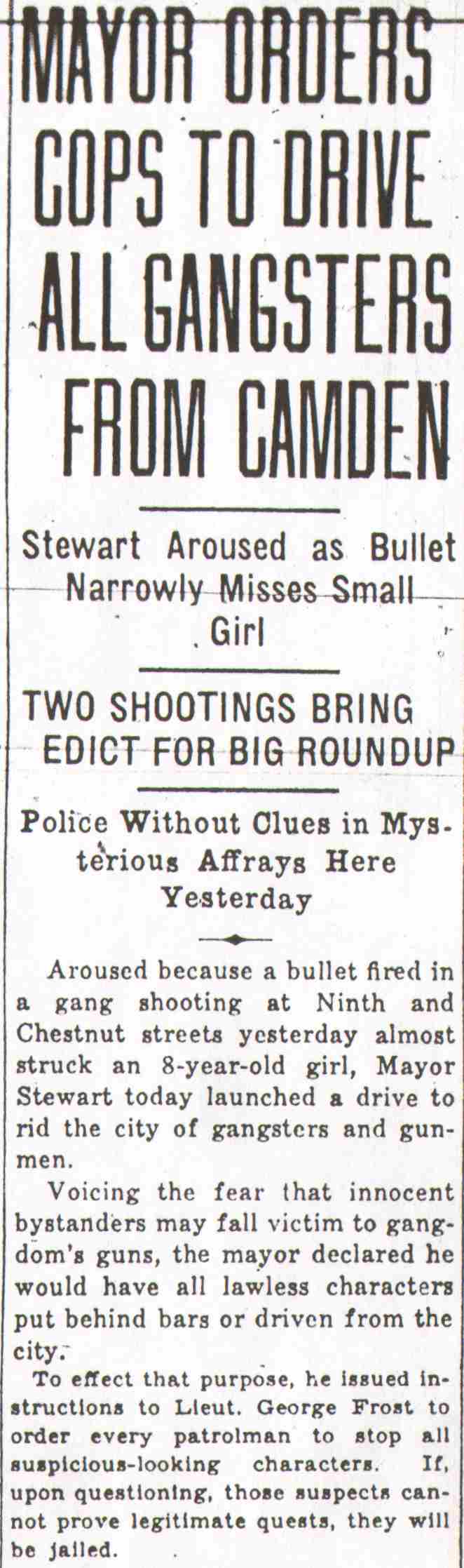
Stewart Aroused as Bullet Narrowly Misses Small Girl
TWO SHOOTINGS BRING EDICT FOR BIG ROUNDUP
Police Without Clues in Mysterious Affrays Here Yesterday
Aroused because a bullet fired in a gang shooting at Ninth and Chestnut streets yesterday almost struck an 8-year-old girl, Mayor Stewart today launched a drive to rid the city of gangsters and gunmen.
Voicing the fear that innocent bystanders may fall victim to gangdom’s guns, the mayor declared he would have all lawless characters put behind bars or driven from the city.
To effect that purpose, he issued instructions to Lieut. George Frost to order every patrolman to stop all suspicious-looking characters. If, upon questioning, those suspects cannot prove legitimate quests, they will be jailed.
Issues Statement
His statement follows:
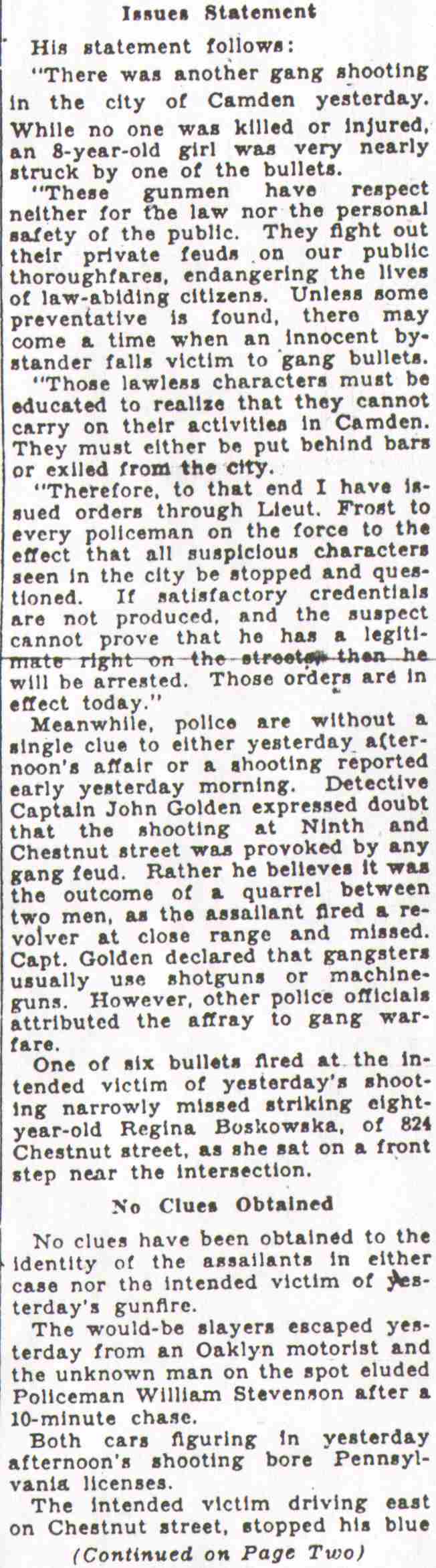
“There was another gang shooting in the city of Camden yesterday. While no one was killed or injured, an 8-year-old girl was very nearly struck by one of the bullets.
“These gunmen have respect neither for the law nor the personal safety of the public. They fight out their private feuds on our public thoroughfares, endangering the lives of law-abiding citizens. Unless some preventative is found, there may come a time when an innocent bystander falls victim to gang bullets.
“Those lawless characters must be educated to realize that they cannot carry on their activities in Camden. They must either be put behind bars or exiled from the city.
“Therefore, to that end I have issued orders through Lieut. Frost to every policeman on the force to the effect that all suspicious characters seen in the city be stopped and questioned. If satisfactory credentials are not produced, and the suspect cannot prove that he has a legitimate right on the streets, then he will be arrested. Those orders are in effect today.”
Meanwhile, police are without a single clue to either yesterday afternoon’s affair or a shooting reported early yesterday morning. Detective Captain John Golden expressed doubt that the shooting at Ninth and Chestnut street was provoked by any gang feud. Rather he believes it was the outcome of a quarrel between two men, as the assailant fired a revolver at close range and missed. Capt. Golden declared that gangsters usually use shotguns or machine-guns. However, other police officials attributed the affray to gang warfare.
One of six bullets fired at the intended victim of yesterday’s shooting narrowly missed striking eight-year-old Regina Boskowska, of 824 Chestnut street, as she sat on a front step near the intersection.
No Clues Obtained
No clues have been obtained to the identity of the assailants in either case nor the intended victim of yesterday’s gunfire.
The would-be slayers escaped yesterday from an Oaklyn motorist and the unknown man on the spot eluded Policeman William Stevenson after a 10-minute chase.
Both cars figuring in yesterday afternoon’s shooting bore Pennsylvania licenses.
The intended victim driving east on Chestnut street, stopped his blue sedan at the intersection when the traffic light turned red.
Raymond Scherneck, of 307 Laurel avenue, Oaklyn, stopped his care [sic] behind the sedan.
“While we were waiting, I saw a gray Ford coupe with Pennsylvania tags,” stated Scherneck. “It pulled up on my left, passed me and slowed down as it drew abreast of the Pennsylvania car ahead of me. The coupe had two men in it, and the man on the right side leaned out. He was bare-headed, and as he put his hand out the window, I saw him holding a blue pistol.
“He fired six times. The fellow in the other car threw himself down toward the floor. The coupe continued to go east, passing the red light. I went after the coupe, but I lost track of it near Chestnut street and Mt. Ephraim avenue.”
Assailant Escapes
Patrolman Stevenson said he was walking on Chestnut between Eighth and Ninth street when he saw a man put his hand out the window of a coupe and start firing. The officer ran to the intersection, but both the coupe and the sedan had gone on, the sedan turning south into Ninth street. Then he ran to Eighth and Sycamore streets, where his car was parked. He drove to Ninth and Chestnut, and saw Thomas Ward, 820 Chestnut street. Ward pointed to a sedan which had stopped on Ninth street, and said it was the sedan at which the assailants had fired. As Stevenson drove toward it, the sedan started up. He pursued it on Ninth to Mechanic, through Mechanic to Haddon avenue and out Haddon avenue to Euclid, where the sedan, a faster car than Stevenson’s, pulled away and escaped.
Ward was sitting on his front steps and saw the shooting. He said the Boskowska girl was sitting on the steps next door, and that a bullet struck the steps near her. The girl, who had run home crying, told police she heard something hit the steps near her.
Two bullets entered the wall of the saloon operated by John Bretschneider, 880 Chestnut street.
A short time after the shooting police arrived in bandit chasers. Armed with revolvers and shotguns, the police scoured the neighborhood but could not find the assailants. Major Charles V. Dickinson led the investigation.
Wilkie to Receive Reprimand on Raid
Camden Courier-Post —
(Continued from Page One)
Wilkie, but he refused to sign it. He was granted an audience by Mayor Stewart yesterday. The “note book cop” told the mayor that the transcript was incomplete and did not include many important things which developed at the hearing. He also advised the mayor that he wanted to be heard on some “other things.” His request that he be permitted to submit a detailed report on those “other things” met with no objections from the mayor.
Mayor’s Statement
Mayor Stewart’s decision follows:
“After reading the transcript of the examination given Patrolman John Wilkie by Major Charles V. Dickinson and staff, I have decided as follows:
“Patrolman John Wilkie be reprimanded for taking independent action in the making of a raid without first reporting to his superior officer and that he be warned that a like occurrence in the future will mean suspension.
“I have further decided to call before me Lt. George Ward and the officers under him to ascertain from them why they did not have knowledge of the violation of law existing at 831-833 Market street and why they failed to make a report of the same to either Major Dickinson or myself so that proper action might have been taken by the police department.
“I want it understood that it is the duty of every officer to report and receive orders from his superiors and it must be understood by all members of the department that the decision rendered in this case is equally applicable to them, the violation of which will be punishable by suspension.
“R. R. STEWART, “Mayor.”
Local Police Heads Greeted at State Prison
Camden Courier-Post —
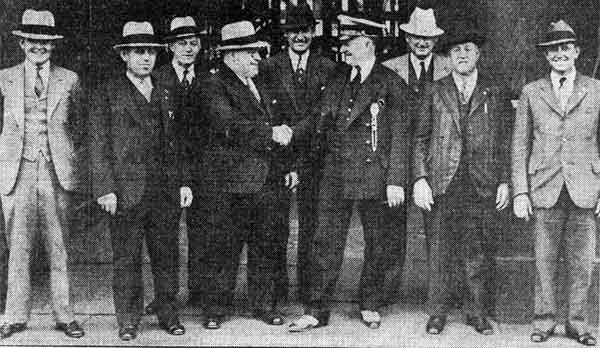
Headed by Major Charles V. Dickinson, local police officials made a tour of inspection of the state prison at Trenton. Photo shows Colonel George L. Selby, chief deputy warden at the prison, greeting Major Dickinson and his companions at the prison gates. Left to right: Patrolman John Stevenson, Lieutenant Herbert Anderson, Captain Arthur Colsey, Major Dickinson, Lieutenant George Frost, Colonel Selby, Lieutenants George Ward, Ralph Bakley and Walter Welch. The police officials were the guests of Colonel Selby at luncheon before the tour.
Wilkie Threatened by Eight Men in Auto
Camden Courier-Post —
Search for a maroon-colored touring car believed by John V. Wilkie, Camden’s “notebook cop,” to contain eight beer runners was made yesterday after Wilkie had been threatened by an occupant of the automobile while in his traffic booth at Baird and Wilson Boulevards.
The car containing the eight men, three in the front and five in the rear, was proceeding northwest on Admiral Wilson boulevard when one of the occupants uttered the threat against Wilkie.
“Come on out and fight; you ____” the stranger shouted. Wilkie said he placed the light at amber and sought to learn the license number of the automobile. The plates however, were indistinguishable, he said, or had been either smeared or turned around to be unrecognizable.
Wilkie said he reported to police headquarters and that Major Charles V. Dickinson, deputy director of public safety, and Motorcycle Police Sergeant Jeff Kay and Policeman Nathan Wine searched and waited for hours for the return of the mysterious car without avail.
G.O.P. Is Charged with ‘Crookedness’
Camden Courier-Post —
“Realizing the utter futility of their efforts to elect David Baird to the governorship, the Republican party in Camden County is resorting to every contemptible means at its command to intimidate the voters.”
This declaration was made last night by Miss Marie V. Kelly, former jury commissioner, at a meeting of 200 voters in the Fourth Ward Democratic Club, 455 Berkley Street.
“At a meeting of election officers,” Miss Kelly said, “William E. A. King, a member of the county board of elections sworn to preserve the sanctity of the ballot box, told these officers that the Republican party has promised Baird a 50,000 majority in Camden County and that they were to get the votes no matter how they got them and that they would be protected. He told them if the Democrats interfered that the Republican police would take care of the Democrats.
“Today Major Dickinson, deputy director of public safety, raised a false howl of gunmen to come here to make a rough house of the city. We know that this is weak propaganda to cover what the Republicans intend to do.”
Points to Murder
“Mr. Dickinson has evidently forgotten the murder committed at Third and Benson Streets on the eve of the city election in May by gunmen imported by the Republican workers to intimidate the voters of that ward—gunmen who remain uncaught and unpunished to this day.
“The most flagrant act on the part of the Republican Party is the removal of the polling place yesterday from the fourth district of the fourth ward from the E. A. Stevens School on Fourth Street to a private residence on Berkley Street. The polling place has been in the school for a number of years and no complaints had been made by Democratic members of the elections board. This change has been made without a meeting of the county elections board.’
“Frank Albright, city clerk, took it upon himself to make the change, basing his action on the statement the school was totally unfit for the board to sit in for a day to conduct the business of election.”
‘Refreshment’ cited
“However, school children are forced to use this building every day of the school year. The residence to which the polling place has been transferred was reconditioned so that it could be used. The real reason for this change was that it will be much easier to dispense liquid refreshment in a private home than in a public school.
“It is a fine state of affairs when the people are called on to build a $10,000,000 city hall within six blocks of a school where children are forced to occupy a school which the city clerk says is in a horrible condition and totally unfit for use.
“I urge the people in the third and fourth wards of Camden to rise in revolt against the Republican organization that is trying by every means to prevent an honest exercise of the franchise at the polls on Tuesday. The protest must be registered by marking every blank on the ballot under the Democratic column.”
Del Duca on Trial in House Raid Case
Camden Courier-Post —
Cops to Testify Prisoner Was Proprietor of Fairview Street Place
Arthur “Gyp” Del Duca went on trial yesterday before a jury of 12 men in Criminal Court before Judge Austin H. Swackhamer on an indictment charging him with operating a disorderly house. The trial will be continued today.
The house, at 674 Farview street, was raided twice in 24 hours last June 29, once by armed bandits, who robbed two sailors of $26, and once by the police.
Del Duca was not in the house when it was raided after the sailors notified the police they had been robbed. A warrant was issued for his arrest, but he surrendered the next day.
The first two witnesses yesterday were Richard Powers, 17, and David Hickman, 21, inmates of the Rahway Reformatory. They were sentenced by Judge Swackhamer in Gloucester County Criminal Court last April 18 after they had admitted participating in robberies in Camden, Gloucester and Burlington counties.
They were brought here by a guard and testified that on several occasions they had gone to the house and had seen Del Duca there.
Anthony Fields, a vacuum cleaner salesman, said he had gone to the house to sell a cleaner and was there when the police raided the place.
Prosecutor Clifford A. Baldwin introduced as evidence a certified copy of a deed in which Del Duca is shown to be the proprietor.
More than 20 Camden policemen are expected to testify for the state. All of them took part in the raid. The first one called was John Kowal, district detective, who testified that six men and three girls were arrested in the place.
Major Charles V. Dickinson, deputy director of public safety, and Lieut. George Frost will be among the witnesses today.
Camden Sleuths Nab Man for State Police
Camden Courier-Post —
Phillip Attardi, 39, of 320 Vine street, was arrested by Detectives Vernon Jones and Thomas Cheesman last night as he was waiting for a bus at Broadway and Line streets.
A charge of “on suspicion” was placed against Attardi. Deputy Director of Public Safety Charles V. Dickinson said Camden police had been requested to look for him by state police. He did not know the nature of the charge they have against him.
2 Cops Go on Trial Tuesday as Echo of Election Row
Camden Courier-Post —
Jersey City Democrat Charges Bakley and Truax Violated Law
2 COURTS IN SESSION
Two Camden police officers, Lieut. Ralph W. Bakley, commander of the Second district, and Sergeant Frank Truax, are scheduled to go on trial in Criminal Court tomorrow on an indictment charging them with violation of the election laws.
The charge resulted from the arrest of Joseph Tumulty, Jersey City attorney and Democratic challenger at the Camden city polls during the gubernatorial election last November. Mayor Roy R. Stewart will be summoned as a defense witness, according to the officers’ counsel, T. Harry Rowland. The latter added that Major Charles V. Dickinson, deputy superintendent of police; Captain Arthur Colsey, business men, several bankers and a score of other character witnesses will be called to the stand.
Two Courts in Session
The case is one of a large number listed for trial, pleas or sentences this week by Prosecutor Clifford A. Baldwin in an attempt to clear up the Criminal Court calendar to permit adjournment in July. Two criminal courts will be in session today, tomorrow and Wednesday. Judge Samuel M. Shay will preside in the fourth-floor courtroom, while Judge Austin H. Swackhamer will hold court on the second floor.
Thirteen defendants will face court today, 11 for trial and two to enter pleas.
One of the two who will enter pleas is Mrs. Mable J. Steyer, of 4603 Conshohocken avenue, Philadelphia, who is under indictment on the charge of manslaughter by automobile. She is charged with the death of William Sharkey, of Berlin, on the White Horse pike last February. Six times Prosecutor Baldwin has endeavored to have the woman in court, but she refused to appear. She visited in the prosecutor’s office several days ago and was released under $1000 bail. She had previously forfeited the same amount of bail. She is charged with driving her automobile on the wrong side of the pike and crashing into the car operated by Sharkey.
The other defendant who is scheduled to appear to plead is Harry Willingmyer, charged with assault and battery.
The 11 defendants who are listed to stand trial today include Dr. C. N. Mason, of 85 Lincoln avenue, Delaware township. Dr. Mason is charged with false pretense in obtaining $1000 from Gustave Huseman, of 616 Rogers avenue, Merchantville. The other defendants are John Uboldi, larceny; Albert Cohen, false pretense; James Jordan, assault and battery; Herman Romaine, statuatory [sic] charge; Harold Nickturn, larceny, and four indictments against the much arrested Howard C. Franklin, Oaklyn automobile dealer who is charged with false pretense.
Tomorrow, Arthur “Gyp” Del Ducca, convicted disorderly house keeper, will be sentenced by Judge Swackhamer. Del Ducca was convicted in the criminal court last Wednesday of operating a resort at 764 Fairview street. Charles Fanelli, of 319 Penn street, who was convicted of holding up John Weeks, of Eighth and Tabor road, Philadelphia, on November 13, last, and robbing him of $50, will also be sentenced on Tuesday.
Several roadhouse proprietors whose establishments were recently raided, are also scheduled to appear in court tomorrow for trial. They include Harry Fleisher, 300 Rand street; John Cernivo, of Camden; Thomas Gibbons, of Gloucester; Walt Mills, alleged proprietor of the Maze Cafe in Stratford; Edward J. Walsh, alleged proprietor of the Little Grill, in West Collingswood Heights; Owen Sweeney, alleged proprietor of the Haddon Lake, at Mt. Ephraim; William Marshall, alleged proprietor of the Royal Haven Inn, at Berlin; Conrad Bittner, 456 Broadway, Gloucester, and Harry Underwood, also of Gloucester. There are two indictments against Underwood.
Walter Kennedy, former Camden boxer who fought under the ring name of Walter West, is also scheduled to go on trial tomorrow on a charge of carrying concealed deadly weapons. Kennedy, who is a shell-shocked World War veteran and former Camden soft drink parlor proprietor, is charged with attempting to hold up a Public Service bus on State street, four months ago.
Other defendants on tomorrow’s trial list are Louis Ward and Dean Kessler, larceny; Pasquale Massi, Jacob Melzer and Frank Atwater, attempted breaking and entering; Louis Scott, Edward Brady, Carl Pisco, Joseph Pisco, carrying concealed deadly weapons; Jim Jackson and Woodrow Stevens, breaking and entering; Frank Mucci, disorderly house; W. H. Seckel, false pretense; Davis Keese, statuatory [sic] charge, and Gustave Seletos, three indictments for false pretense.
On Wednesday ten defendants are scheduled to go on trial in the criminal courts. They are:
Roland Davis, desertion; William Bopergola, Tony Basile, Joseph Gogenti, Frank Carofolo, statuatory [sic] charges; Edward North, larceny; Joseph Carboni, larceny from person; George Huber, larceny; Roland Davis board bill; George Walters, tampering with meter.
Judge Shay will be asked tomorrow to sign court orders authorizing the prosecutor’s office to destroy all the liquors seized in the various roadhouse raids during the past year. The liquor is at present stored in the cellar of the old court house under lock and key.
Bakley and Truax Freed by Court in Election Row Case
Camden Courier-Post —
BAKLEY AND TRUAX FREED BY COURT IN ELECTION ROW CASE
Indictments on Charges by Jersey City Democrats, Quashed at Trial
POLICEMEN EXONERATED
Indictments against Police Lieutenant Ralph W. Bakley and Sergeant Frank Truax, growing out of election disorders last November, were quashed before a crowded Criminal Court yesterday when prosecution was dropped.
Approximately 75 policemen, from Deputy Director Charles V. Dickinson down, business men and others were waiting to testify for the accused officers when the three Democratic attorneys from Hudson county who had preferred the charges asked that the case be dropped.
The latter are Joseph Tumulty, of Jersey City, nephew of the private secretary to President Wilson; his brother, John Tumulty, also of Jersey City, and Charles Rubenstein, of Bayonne. Their charges of assault and battery and false arrest had brought three indictments of four counts each, against the defendants.
T. Harry Rowland, attorney for the policemen, at first objected strenuously to disposing of the case without a jury verdict, but consented to quashing the indictments after a conference with his clients. Judge Austin H. Swackhamer, who came from Gloucester county to assist Judge Samuel M. Shay, then ordered the case dismissed, saving what might have been a lengthy and expensive trial.
Political Sores Healed
The sudden denouement of a case which had attracted statewide attention, indicated that bitter feelings, engendered during the election campaign which sent A. Harry Moore back to the governor’s chair over David Baird, of Camden, had been forgotten.
The Tumultys and Rubenstein were among a score or more of attorneys sent here by the Hudson county Democratic organization on election day last November to aid Camden county Democrats at the polls. The three attorneys were on duty at the Third precinct of the Fifth ward, a difference arose over a point of law and the policemen were called in. The North Jersey men said they were roughly handled and then arrested, later obtaining their release.
When the case was called in court yesterday, the three lawyers conferred with Prosecutor Clifford A. Baldwin for 15 minutes. Baldwin then told the judge the plaintiffs wanted to drop prosecution, since they had no personal grievance against the policemen and felt the officers only were following the orders of superiors.
“I would like to have a jury in the box to hear this, and bring in a verdict of not guilty,” Rowland objected. “We have prepared this case at a great disadvantage, scouring the highways and byways for witnesses, and if these plaintiffs have suffered a change of heart, that does not compensate these policemen for the ridicule and criticism they have suffered on account of these indictments. If they want to drop the case, let it be done before a jury and a verdict of not guilty be returned.”
Judge Questions Request
Judge Swackhamer said, “You don’t expect me to order that, do you?”
“I do not feel I can agree to that, either,” said Baldwin.
“But I want a jury verdict so that these charges cannot be resurrected at some time in the future,” Rowland persisted.
“I cannot guarantee immunity from indictments,” retorted the prosecutor. “These lawyers have assumed a fair attitude. They came here prepared to go ahead and we are ready to do so. But they realize the policemen are merely wage earners, and they bear no malice.”
Rowland conferred with his clients during a five-minute recess while the witnesses were ordered outside. On their return, Rowland addressed the Court.
“I must confess the wisdom of my clients is greater than my own,” he said. “They feel, as I do, it would take a week to try this case and put the county to great expense. I’ve known these men all my life. As a kid I worked in a foundry and Bakley was my foreman. But they are willing to take the criticism as good police officers and co-operate with the prosecutor. We feel we’ve had our day in court, and have no further objection to quashing of the indictments.”
Legion Burial Lots to Be Dedicated
Camden Courier-Post —

City and Veteran Officials Will Speak Tomorrow at Locustwood Ceremony
American Legion and Locustwood Cemetery officials yesterday completed the program for dedication tomorrow afternoon of the first and only burial section set aside exclusively for American Legion members in New Jersey.
The ceremonies will be conducted at Locustwood Memorial Park, Marlton pike, Delaware township, amid impressive military display. Prominent Legion leaders, cemetery officials, and rulers of South Jersey municipalities will attend, with the general public, veterans and Boy Scouts.
The occasion will be the gift of 400 lots in Locustwood Memorial Park to the Legion. The lots are in Section 21 of the park and have an approximate value of $35,000. The gift has been made possible through the efforts of Aaron Heine, president of the Locustwood Cemetery Association; J. E. Laurencelle, chairman of the Memorial Graves Committee of the American Legion of New Jersey, and Martin C. Delaney, president of the Camden Memorial Park Sales Company, which is representing the Locustwood Cemetery Association.
Band Will Play
The dedication program will open with the playing of “America,” by bands composed of Burlington county and Millville veterans, and the advancing and massing of colors. The invocation will be delivered by Rev. John Pemberton, Jr., Centenary Tabernacle M. E. church.
Mayor Roy R. Stewart will deliver the address of welcome, after which Department Commander W. Rex McCrossen, of the American Legion, and Emma Florence Beach, state president of the American Legion Auxiliary, will place a wreath for the Unknown Soldier.
Salute by the battery of the 112th Field Artillery of Camden, accompanied by an air salute, air maneuvers and the dropping of flowers by the 44th Air Squadron of the New Jersey National Guard, under Major Croppsy, will follow. Remembrance will be rendered by the ritual team of the Thoirs Post 47, American Legion, the champion ritual team of the state.
Lt. Commander Thomas B. Mulroy will deliver the message for Gov. A. Harry Moore, who has been suffering from hoarseness due to a recent cold. After this message, Heine will present the deed to the Legion section, with the acceptance speech to be delivered by Department Commander McCrossen. The exercises will close with a band playing the “Star Spangled Banner,” and benediction by R. E. Brestell, D. D., of St. Paul’s Episcopal church.
Reception Committee
The reception committee includes J. E. Laurencelle, chairman; Harry A. Kelleher, Roland Cowan, department adjutant, American Legion; Herbert H. Blizzard, Heine and Delaney.
George W. Harley, of Collingswood, is chairman of the local committee on arrangements. Herbert H. Etter, county Scout executive, will be in charge of the Boy Scouts.
The field piece at the ceremonies will be from the 112th Field Artillery, under direction of Major Charles V. Dickinson, deputy director of public safety. The battery has been obtained through Brigadier Gen. Winfield S. Price and Gen. Frederick W. Gilkyson, of the New Jersey National Guard.
Suspended Jail Sentence is Given Operator Where 17 Were Taken in Raid
Camden Courier-Post —
Pleading non vult to charge of operating a “numbers” headquarters raided by the police last July, Dominic Olivette, 28, of 444 Royden Street, was fined $100 and given a suspended sentence of six months in criminal court yesterday.
Olivette was arrested by a detail of police led by former Director of Public Safety Charles V. Dickinson and Lieutenant George Frost when they captured 17 men in the Royden Street house.
In police court the day following the raid Olivette was fined $100 by Judge Garfield Pancoast on charges of violating Section 422 of the city ordinances prohibiting disorderly persons from congregating in a building.
Olivette paid the fine and was later indicted by the grand jury following an investigation by Prosecutor Clifford A. Baldwin. Judge Shay, in imposing the fine, refused Olivette’s plea that he be allowed to pay the sum on installments.
One other man charged with “numbers’ writing was fined $100 with the privilege of paying at a $2 weekly rate. He is Herbert Lantry, 35, of 519 Ray Street, arrested by Lieutenant Herbert Anderson November 26. He was held for the grand jury by Judge Pancoast when arraigned in police court.
Public Fills City Churches for V Prayers
Camden Courier-Post —
Sharing the joy of a world again at peace, Camden awoke today after a night of jubilant celebration that a war of three years, eight months and seven days was ended.
In sober response to the magnitude of Victory Day thousands early today wended their way to churches to offer prayers of thanksgiving as the dawn of a new era broke over the land.
Mayor Brunner announced the city’s planned celebration of Victory Day will be held today at 2.30 p. m. at Roosevelt plaza, and urged that citizens gather there to share in prayers and inspirational ceremonies.
Many Places Closed
All banks, federal, state, county and municipal offices were closed today.
No mail deliveries are scheduled and postal authorities here awaited orders from Washington on the question of resuming service tomorrow.
War industries abandoned work in compliance with President Truman’s proclamation of a two-day holiday for all personnel except those required for maintenance and other essential jobs.
Many stores are also closed for the entire day
New York Shipyard officials announced the yard and offices will be closed today and tomorrow, and will reopen Friday morning at the usual time. Payday has been set for Friday, a spokesman said.
Radio Condenser Company will be closed today and will resume work at the regular hour tomorrow, a spokesman for that firm announced.
John Trumpy & Sons shipyard at Gloucester will abandon work schedules today and tomorrow.
Big Plants on Holiday
RCA Victor Division of the Radio Corporation of America announced all offices and plants were closed today and will be closed tomorrow.
The Campbell Soup Company is closing its plants today and tomorrow. The company issued this statement:
‘In order to safeguard any loss of food, however, and to cooperate fully with farmers who grow tomatoes, the company announced arrangements have been made to receive any tomatoes delivered on the two days during the regular delivery hours.
“It is expected that the farmers will want to enjoy the celebration of Victory and will probably defer, as far as possible, the picking and delivery of the crop until Friday, when the plants will reopen.”
Saloons Closed Half Day
By decree of Governor Edge, taprooms and package stores were ordered to close at eight o’clock last night and remain closed until noon. ABC Commissioner Driscoll issued a statewide proclamation following the governor’s declaration.
Last night’s celebration broke spontaneously shortly after 7 o’clock, following announcement by the President that Japan had accepted the Potsdam declaration.
An anxious citizenry had waited since Friday morning, when first word of the Jap surrender offer was announced. On Sunday there were false reports that Japan had capitulated and again yesterday conflicting announcements kept the public confused.
Tears of Joy and Sorrow
Already strained nerves broke with the world stirring news and not since Armistice Day closing War I was such wild celebration observed.
Amid tears and shouts of joy, men and women hugged each other and many wept. To thousands it meant their loved ones soon would be home. To many others it re opened wounds of memory and sorrow for the sons and husbands who would not be returning, ever.
Every locomotive whistle on the Pennsylvania-Reading Seashore Lines began blasting at once shortly after 7 p. m. This was followed by every factory whistle being tied down. Then followed shrieks of the air raid warden signals over the city fire houses
Signal for Jubilation
That was the call for real jubilation. Thousands poured into the streets within a few minutes. Hundreds of shouting children, waving flags and blowing horns, ran through the streets.
It seemed as though Broadway was the mecca for the shouting throngs. All the people seemed to surge to City Hall. Every motorist, bus and truck driver was blowing the horn of his vehicle. Thousands milled on the sidewalks, cheering, laughing, blowing horns.
Thousands more went into the churches to thank Almighty God for the greatest victory of all time. The Blessed Sacrament was exposed in the Catholic churches by the direction of Bishop Eustace. Prayers were offered for the repose of the heroic dead, who made the supreme sacrifice that the Allies should triumph over the Nazis and Japanese warlords
Church Bells Toll
The chimes of old St. Mary’s church, Gloucester, and First Methodist in Camden tolled. They played sacred and patriotic selections. Special thanksgiving services were held in the First and the Parkside Methodist churches.
Although Camden streets were packed with noisy, boisterous throngs, Police Chief Frost reported no disorder after several tours of the city. He ordered all taprooms closed at 8 p. m. At the same hour Philadelphia clamped the lid down on the sale of alcoholic beverages.
Frost opened temporary headquarters in the City Hall basement. Every patrolman was called to duty. Auxiliary police organized during the early days of civilian defense augmented the local force. Thirty Military Police reported for duty to Frost. The Shore Patrol also sent 26 men from Eleventh and Winter streets police station, Philadelphia, to help keep order among jubilant servicemen.
City Hall Lights Aglow
For the first time since war was declared in 1941 the lights on the City Hall beamed. When they went on with the lights all over the world a great cheer went up from the thousands milling on Broadway between the Camden bridge plaza and Mickle Street.
A huge cross was formed by lights in windows facing Roosevelt Plaza. Windows were lighted from the eleventh to the sixteenth floors. The cross bar was formed from three windows on the fourteenth floor.
All main roads leading into Camden were clogged, with traffic heading for the City Hall and Broadway. Admiral Wilson Boulevard, Haddon Avenue, Kaighn Avenue, Market and Federal Streets were jammed with buses, trucks and automobiles with gaily singing and cheering crowds. All but the buses were headed for the Broadway parade.
Mayor Brunner announced that today was a holiday for all city employees, while Freeholder J. McCarthy, speaking for the freeholders, announced it was a holiday for all county employees, excepting those engaged in essential services.
“This is the hour of victory for which we have waited with patient hearts for three years,” said Mayor Brunner. “The sacrifice and tears are over for most of us. Let us celebrate the end of bloodshed, and remember with an undying gratitude those who gave their lives,
“It is now up to us to resolve that these men have not died in vain. As we fought the war, so let us fight to establish an America of full employment, a city, state and nation of the Four Freedoms which our late President Franklin D. Roosevelt left us as a heritage to light the way on the path of freedom for all peoples.
“Let us go forward in the faith that undying principles for the right and just is the best character builder that any American can possess. If we are as patient in peace as we were in war, we shall have much to offer to those homecoming men who fought our battle on foreign shores.”
Lt. Col. Charles V. Dickinson, who left Camden with the New Jersey National Guard in 1940 and served as inspector general at Fort Sill, said last night that the agreement of Japan to surrender was great news for the general public but sad for those who lost their sons or loved ones as their loss can never be made up. Colonel Dickinson, who was former deputy director of public safety, participated in exercises last night marking the presentation of medals to war heroes in the City Commission chamber.
Flags were waved from cars.
Hirohito was hanged in effigy from the front of automobiles.
Military Rites Monday for Col. Dickinson
Camden Courier-Post —

Military Rites Monday for Col. Dickinson
Palmyra, Oct. 4—Col. Charles V. Dickinson, 66, freeholder director of Burlington County, former mayor of Palmyra and a veteran of Wars I and II, died Thursday in Zurbrugg Memorial Hospital, Riverside.
Services will be held Monday at 2 p. m. in the Snover Funeral Home, 313 E. Broad st., Palmyra, where friends may call Sunday night. Burial will be in Harleigh Cemetery, Camden.
A military funeral has been planned, with members of the 228th Armored field Artillery Bn., of Camden, acting as pallbearers. Honorary pallbearers named are four freeholders of Burlington County; Col. John H. Ahrens (Ret.), of Princeton, and Lt. Col. J. William Wells (Ret.), of Collingswood.
Ill Since Sept. 21
Surviving are his wife, Lillian Hanson; a daughter, Mrs. Robert K. Snow, of Buffalo, N. Y.; a brother, Maurice E., and a sister, Mrs. Chester J. Andrus, both of Camden, and three grandchildren.
Col. Dickinson had been under an oxygen tent since last Saturday, when he was admitted to the hospital following a heart attack. He had been ill at his home since Sept. 21.
He was born in Camden, but for many years he made his home at 45 Cinnaminson ave., Palmyra.
He enlisted in 1909 in Battery B, First Field Artillery, New Jersey National Guard, and served with the battery on the Mexican border in 1916. Subsequently he served in both World Wars, rising to the rank of colonel.
Served in Camden
In 1931 and 1932, he served as deputy director of public safety for Camden. He was a retired employee of the New Jersey State Highway Department, and was a U. S. Army pensioner.
From 1948 through 1953 he served as mayor of Palmyra and in 1953 he was elected a freeholder. He was reelected in 1956. As a member of the board, he was in charge of administration and finance.
He was active in many civic affairs and groups and was a director of the Burlington County Board of Realtors.
He was a member of the Raymond C. Thoirs Post, 47, American Legion, Camden; of the Armed Forces Advisory Committee of Camden; Military Order of the World Wars; Disabled Officers Association; the Association of the U. S. Army, the Palmyra Republican Club, and was president of the Veteran Guard of Battery B Armory.
Burial Monday for Dickinson
Trenton Evening Times —
PALMYRA—Charles V. Dickinson, 66, director of the Burlington County Board of Freeholders and former Palmyra mayor, died yesterday in Zurbrugg Memorial Hospital, Riverside.
Dickinson, who retired in 1944 as a full colonel from the army after 35 years, was a former public safety director in Camden, a former deputy director of internal revenue and a former supervisor of the New Jersey State Highway Department.
Surviving are his wife, Mrs. Lillian Dickinson; a daughter, Mrs. Charlotte Snow of Buffalo, N. Y.; a brother, Maurice of Camden; a sister, Mrs. Edna Andrus of Camden and three grandchildren.
Services will be held Monday at the Snover Funeral Home, 313 East Broad Street. Interment will be in Harleigh Cemetery, Camden, and friends may call Sunday evening.
P.S. Purifier Detonates in South Camden
Camden Courier-Post —
Explosion at Locust and Cherry Traps Workers in Structure; Victims Mostly Temporary Employees Cleaning Metal Tank
Four Others Injured, One May Die; Poisonous Fumes Hamper Rescue
A terrific explosion in the purifying plant of the Public Service Gas and Electric Company at the Southeast corner of Locust and Cherry Streets killed 14 men today and injured four others, one of whom may die.
All the dead were trapped in a huge box-like tank about 25 feet square. Most of them were neighborhood unemployed who had been given a day’s work scraping off a caked substance which forms during the process purifying illuminating gas.
Poisonous sulfur fumes hampered firemen in the effort to extinguish a blaze which followed the explosion. Two hours were required before the first body could be removed.
The explosion occurred at 7:15 AM. By 11:00 AM two charred and horribly mangled bodies had been taken out by use of a block and tackle. Firemen were digging out the third body buried under smoldering debris.
Six of the known dead were regularly employed by Public Service. They were:
John Albert, of 275 Walnut Street
Domonick Pizzutello, of 1005 South 4th Street
Pasquale Curiale, of 338 Walnut Street
Frank Deluggi, of 324 South 4th Street
Nicholas Tulini, of 208 Benson Street
Nunzio Farrao, of 1131 South 4th Street
The other known dead, who were employed only temporarily were: E. Anderson, colored; George Williams, colored; Tony Bilank, F. Kralich, T. Watson, colored; J. Pollard, colored; T. Coleman, colored, and L. Carcione.
The police and officials of the company were unable to determine the cause of the tragedy but one of the workmen who escaped said that he saw a “little fire” burning in one corner of the tank minutes before the explosion.
One of the Injured May Die
The injured, all of who were taken to Cooper Hospital were:
Spiro Cecich, 37, of 1815 Salem Street, burned over his entire body. Condition so critical he may die.
Hillman Bryant, 29, colored, of 109 Chestnut Street, burned over face, head, eyes.
Harry Read, 27, of 111 Chestnut Street, burned on head and face.
Harry Hall, 37, colored of 718 South 2nd Street, burned on head and face.
Read and Hall were permitted to return to their homes after being treated.
While racing to the hospital with the injured, the patrol car of the Second District collided with a truck at Broadway and Pine and was delayed several minutes. The truck driver, Meyer R. [?], 25 of 1732 South 7th Street, was injured slightly and also treated at the hospital.
Worker Tells of Blast
Rudolph Walker, 40, colored, of 1060 South Front Street, was the only worker to escape unhurt.
“We went in the tank about 7:00 o’clock,” he said. “About 15 minute later I noticed a little fire burning in one corner. I said ‘Come on fellows, let’s get out of here.’ I climbed out and just as I reached the ground I heard an awful explosion.
“I looked up and flames were shooting way up into the air. I didn’t know what to do, so I [?] and notified some other [?]. There were 15 or more other men in the tank with me”
Chemicals Cake On Tank
Workmen who described the purifying box said that a substance consisting of sawdust, sulfur, and noxious chemicals was used to clean gas which was pumped into the tank from storage tanks across the street.
This substance caked upon the sides and girders about halfway down the box, they said, and had to be scraped off with pitchforks about every three or four weeks.
There are, they declared, two tanks in the box, each about 15 feet wide and 20 feet deep. The blast was in the west tank.
According to officials, the tanks are used in a process that has been in operation for only two years.
Access is gained through removal of a large hatch-like lid at top of the box. There is no other entrance or exit.
Walker and the four injured were working on top of the girders. The others were trapped at the bottom without a chance to escape. They probably died instantly.
The entire neighborhood was aroused and more than 1,000 persons gathered around the plant. The police roped off Locust Street between Cherry and Walnut. No windows were broken or other damage caused to private property in the vicinity.
Grocer Saw Man On Fire
Benjamin Plevinsky, a grocer at Locust and Spruce Street, said that he was opening his store when he heard the detonation.
“I looked up and saw a man running down a stairway leading to the top of the tank,” he said. “He was on fire from his feet to his head and looked like a human torch.
“I called the fire department and told them what happened. They asked me if I was sure there was a fire. I told them I was looking right at it. I don’t know whether they thought I was crazy or what, but I certainly think that was a peculiar thing to ask when you’re sending in an alarm.
The crowd which gathered was thrown into intense excitement, when Frank Pizzitilla, Walnut Street near Third, was taken to the top of the tank by firemen; looked in and fainted.
He recovered consciousness while being carried down the stairway, firemen said, and murmured, “My God, my father and father-in-law are in there.”
When the hundreds of persons saw Pizzitilla they believed he was one of the dead and began shouting. One man was seized with a fit and was carried away by firemen.
Rescuers Driven Back
When firemen first arrived they attempted to get into the tank but were driven back by sulfur fumes. They put on gas masks but the poisonous gases penetrated even these and they were unable to reach the bodies.
James Bevan, foreman at the plant, said that 13 of the men were temporarily employed and the others were regularly employed. In all, he said, there were 19 workers in the tank when the blast occurred.
Before the bodies were removed firemen said they counted 12 floating in the water pumped into the tank to extinguish the blaze. Two others were believed hidden by debris.
Coroner Benjamin Denny, Prosecutor Clifford A. Baldwin, Director of Public Safety Charles V. Dickinson and Fire Chief Thomas Nicholas arrived at the scene before the bodies were taken out. They described the sight as “ghastly.”
Coroner Denny announced that he will open an investigation after today in which he will summon officials of the Public Service Company, firemen, workers, and other witnesses. County Prosecutor Edward B. Rodgers also will attend he said.
Denny said that because many of the workers were day laborers, families probably would not know of their deaths until they failed to return home at the end of the working day.