Introduction
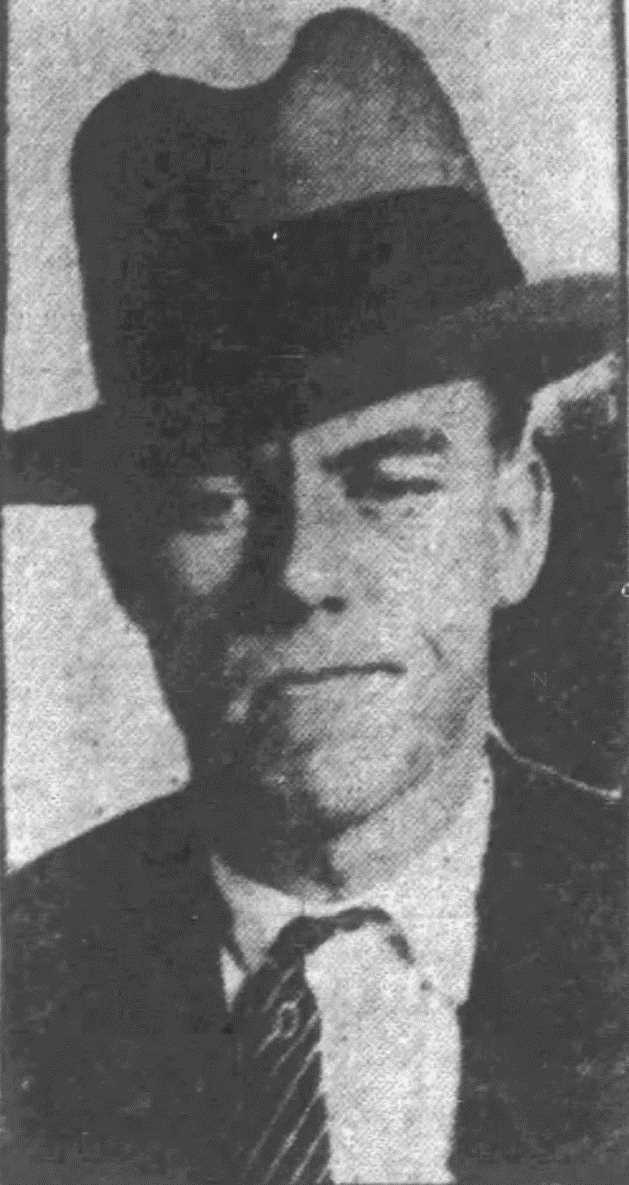
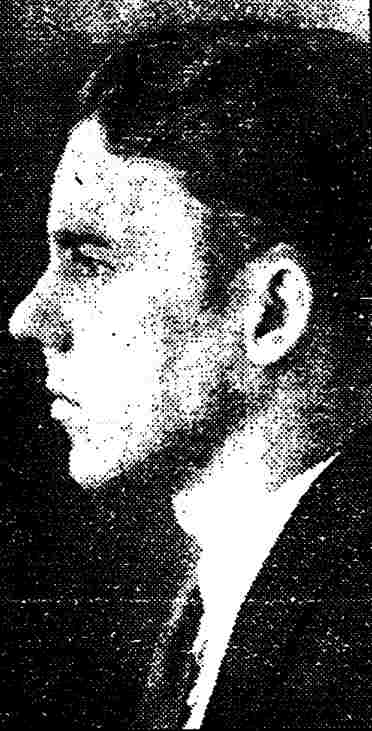
Portrait photograph of John Doris, Camden racketeer, associated with the gang shooting at Second and Kaighn avenue, April 1929.
JOHN DORIS was born in Pennsylvania around 1906 to Joseph Doris Sr. and his wife Mary. His mother's name was reported as Mary in the 1910 Census and as Emma in later records.
The 1910 Census shows the Doris family at 546 Randolph Street in Philadelphia. Of the six children born to the family, five were living, James, 10, Joseph Jr., 9; Frank, 6; John 4, and George, who was 11 months old at the time of the census.
The Census gives Joseph Doris' occupation as “special police” and states that he worked in theatres. Joseph Doris Sr. passed away in February of 1917.
The four of the Doris boys got into trouble as youths, and in the case of Joseph Jr., Frank and John, serious trouble. On December 19, 1918 Joseph Doris Jr. was wounded in a gun battle with Philadelphia police.
Frank Doris was involved in a shooting in 1922, and in 1926 took part in a bank robbery where a Philadelphia policeman was shot and killed. For this offense he and three other members of the gang that robbed the bank were executed in 1927. The gang went to their deaths refusing to give up the name of the man who escaped. John Doris, who had a long record in Philadelphia, began coming over to Camden when his mother and younger brother moved to 132 York Street in the late 1920s. In April of 1929 he got into a fight with a local gangster, Joe O’Connor aka Joseph Connors. John Doris shot and seriously wounded O’Connor. Even though O’Connor refused to testify against him, John Doris was convicted and given a ten year prison sentence.
John Doris was serving his sentence at Trenton State Prison when he was stabbed on April 10, 1930. Mortally wounded, he too refused to name his assailant, and no one was ever charged with his murder.
Younger brother George, who also had a police record in Philadelphia, was arrested on robbery charges in Camden in June of 1930. Both George and his mother were using the surname McGovern when they moved to Camden, this may have been his mother's maiden name.
Trenton Evening Times — April 29, 1929
Trenton Evening Times —
SHOOTING MAY END IN MURDER CHARGE
(United Press)
CAMDEN, N. J., April 29.—John Doris, 24, was held today on the charge of shooting John O’Connor, 28, of Gloucester City.
If O’Connor dies, the Prosecutor said Doris would be charged with murder. Doris’ brother, Frank, was executed several years ago for complicity in a murder committed during the Olney bank robbery. Police said the shooting occurred during an argument over a woman and a $4 liquor bill.
Albany Evening Journal — April 29, 1929
Albany Evening Journal —
Brother Follows Killer’s Footsteps; Held for Shooting
CAMDEN, N. J., April 29 (UP).—Slipping down the same path of crime that led his brother to the electric chair, John Doris, twenty-four, today was held for shooting an underworld character.
The prosecutor declared that if the man shot, John O’Connor, twenty-eight, Gloucester City, died, a murder charge will be preferred against Doris. Doris is a brother of Frank Doris, who was electrocuted for his part in the Olney bank robbery some years ago. Both had criminal records as youths and has long been known as underworld characters, police said.
Police understood the shooting was over a woman or a $4 liquor bill.
Camden Courier-Post — April 29, 1929
Camden Courier-Post —
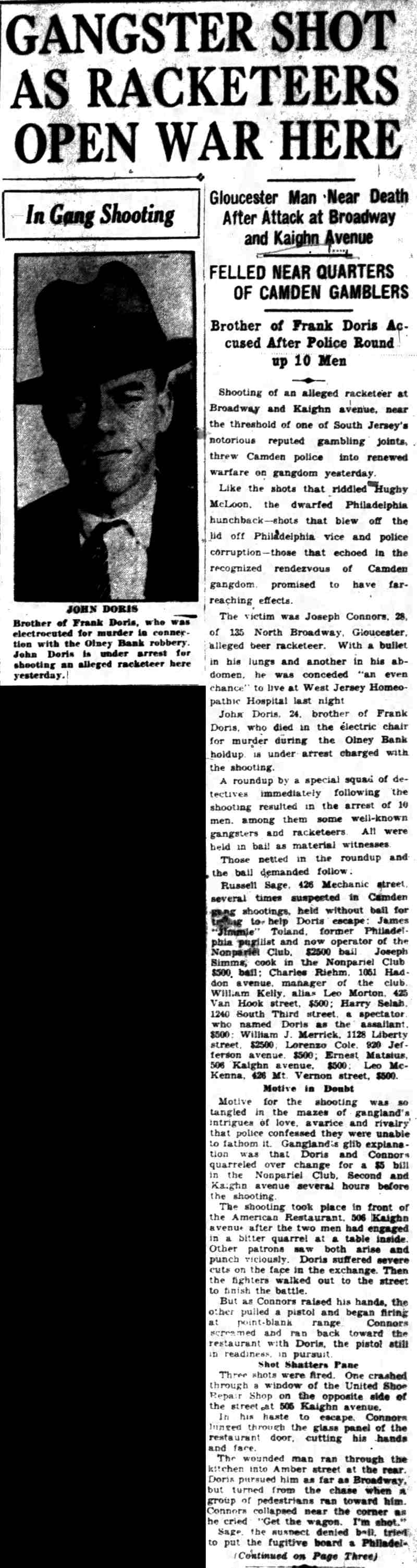

GANGSTER SHOT AS RACKETEERS OPEN WAR HERE
Gloucester Man Near Death After Attack at Broadway and Kaighn Avenue
FELLED NEAR QUARTERS OF CAMDEN GAMBLERS
Brother of Frank Doris Accused After Police Round Up 10 Men
Shooting of an alleged racketeer at Broadway and Kaighn avenue, near the threshold of one of South Jersey’s notorious reputed gambling joints, threw Camden police into renewed warfare on gangdom yesterday.
Like the shots that riddled Hughy McLoon, the dwarfed Philadelphia hunchback—shots that blew off the lid off Philadelphia vice and police corruption—those that echoed in the recognized rendezvous of Camden gangdom promised to have far-reaching effects.
The victim was Joseph Connors, 28, of 135 North Broadway, Gloucester, alleged beer racketeer. With a bullet in his lungs and another in his abdomen, he was conceded “an even chance” to live at West Jersey Homeopathic Hospital last night.
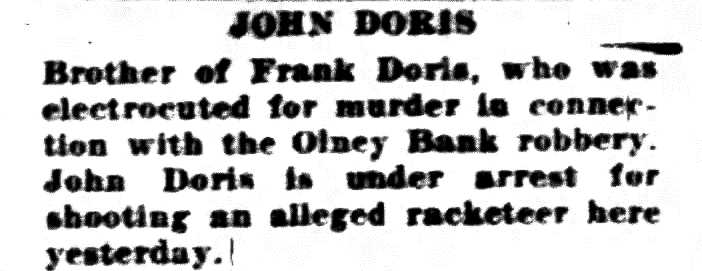
John Doris, 24, brother of Frank Doris, who died in the electric chair for murder during the Olney Bank holdup is under arrest charged with the shooting.
A roundup by a special squad of detectives immediately following the shooting resulted in the arrest of 10 men, among them some well-known gangsters and racketeers. All were held in bail as material witnesses.
Those netted in the roundup and the bail demanded follow:
Russell Sage, 426 Mechanic street, several times suspected in Camden gang shootings, held without bail for trying to help Doris escape; James “Jimmie” Toland, former Philadelphia paplist and now operator of the Nonpareil Club, $2500 bail; Joseph Simms, cook in the Nonpareil Club, $500 bail; Charles Riehm, 1051 Haddon avenue, manager of the club; William Kelly, alias Leo Morton, 425 Van Hook street, $500; Harry Selah, 1240 South Third street, a spectator who named Doris as the assailant; William J. Merrick, 1128 Liberty street, $2500; Lorenzo Cole, 920 Jefferson avenue, $500; Ernest Matsios, 506 Kaighn avenue, $500; Leo McKenna, 426 Mt. Vernon street, $500.
Motive in Doubt
Motive for the shooting was so tangled in the mazes of gangland’s intrigues of love, avarice and rivalry that police confessed they were unable to fathom it. Gangland’s glib explanation was that Doris and Connors quarreled over change for a $5 bill in the Nonpareil Club at Broadway and Kaighn avenue several hours before the shooting.
The shooting took place in front of the American Restaurant, 506 Kaighn avenue after the two men had engaged in a bitter quarrel at a table inside. Other patrons saw both arise and punch viciously. Doris suffered several cuts on the face in the exchange. Then the fighters walked out to the street to finish the battle.
But as Connors raised his hands, the other pulled a pistol and began firing at point-blank range. Connors screamed and ran back toward the restaurant, the pistol still in readiness in pursuit.
Shot Shatters Pane
Three shots were fired. One crashed through a window of the United Shoe Repair Shop on the opposite side of the street at 505 Kaighn avenue.
In his haste to escape, Connors collapsed near the glass pane of the restaurant door, cutting his hands and face.
The wounded man ran through the kitchen into Amber street at the rear. Doris pursued him as far as Broadway but turned from the chase when a group of pedestrians ran toward him.
A few seconds later, Connors staggered into the restaurant, holding onto his stomach, ran through the kitchen into a back room, looking for a way out. And Doris, the gun still in his hand, followed, but tripped and fell, and then got up and continued the chase.
Almost identical testimony was given by James Sims, also a cook.
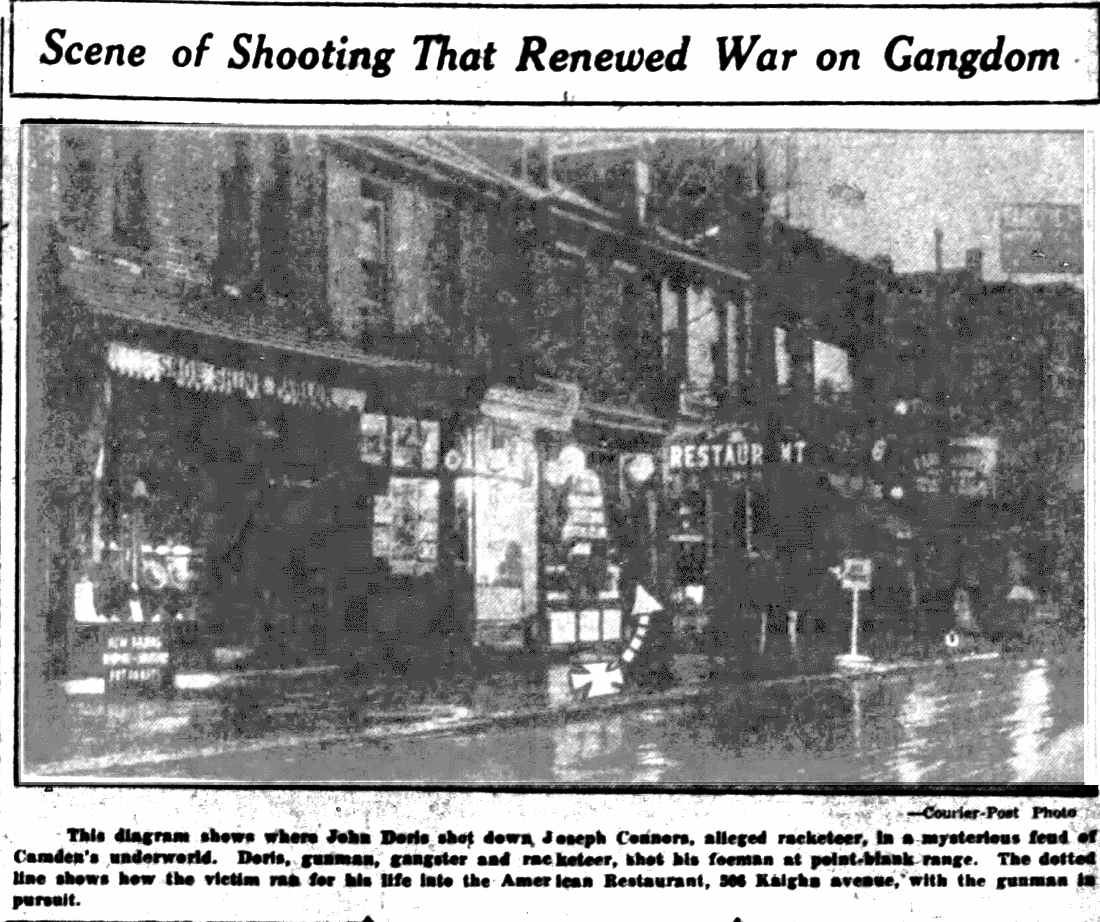
Scene of Shooting That Renewed War on Gangdom
This diagram shows where John Doris shot down Joseph Connors, alleged racketeer, in a mysterious feud of Camden’s underworld. Doris, gunman, gangster and racketeer, shot his foeman at point-blank range. The dotted line shows how the victim ran for his life into the American Restaurant, 306 Kaighn avenue, with the gunman in pursuit.
Racketeer Shot in Gang Outbreak
(Continued from Page One)
He was “sent in” by Patrolman Joseph Leonhardt after telling an incoherent story of “bumping off” a guy. Leonhardt sized him up as helplessly drunk and arrested him near the Nonpareil Club less than 30 minutes after the shooting.
It was not until later, when Doris’ friends, a woman among them, called police headquarters for news of him. Asked for “John King,” the right name except the woman. She asked first for Doris and then for “John King.” This gave Detective Johnson the alias, but it was not until he was actually arrested that police were certain they had the right man.
A squad of detectives Koerner, Cheeseman, Carpani, McGrath and Troncone continued to bring suspects into headquarters for questioning. Selah, one of the first questioned on the night of the shooting, was asked as a detective pointed to Doris: “Is that the man?” Selah nodded.
Records Bad
Doris has a criminal record that dates back to a few days. An attorney, Judge James E. Gorman of Philadelphia, told him he was headed for the electric chair—an end that looms as a distinct possibility since Doris is suspected in the murder of Joseph (Mose) Flannery, in Kaighn avenue, between Front and Second streets, a few years ago.
So far as Camden authorities were able to determine last night, Connors’ place as a peer in the underworld is that of a beer racketeer and is known as a frequenter of gambling joints, police said, but local records show no mark against him.
Machine Gun Helds Mystery
Two mysterious elements stand out. Further doubt as to the motive of the shooting: One is the sudden closing of two South Camden gambling joints—one in a second floor room on Broadway, the other at Tenth street and Kaighn avenue. These places, both operating at full blast, closed their doors today for the first time.
Speculation concerning the closing of the gambling houses jumped from gambler to gambler as rival gangland warnings of a holdup or a police raid. Paraphernalia was removed from the places. One of them was alleged to spread discreet warnings for patrons to keep away. The place at Tenth street on Kaighn avenue was “given the works” three months ago. Its opening was unexplained.
The shooting spurred police officials to clean up in “their district.” Detective Sylvester McGrath said an arrest would be made in a short time. “Orders went out three months ago to close the lid. We have been working hard to keep it on. This shooting may have forced things into the open. There is need to wipe out the practices of carrying weapons.”
Supreme Court Justice Frank T. Lloyd was recently appointed to serve the district in Camden, declared he intends to review the facts in yesterday’s shooting to determine if a general investigation of Camden racketeering is warranted.
Justice Lloyd’s charge to the April grand jury demanding a curb on the carrying of guns launched an earlier campaign to curb the influx of Philadelphia criminals into South Jersey.
Camden Courier-Post — April 30, 1929
Camden Courier-Post —
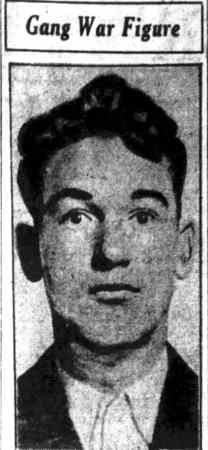

Left: Joseph Connors, who is facing a crisis in West Jersey Hospital from wounds received in a shooting affray early Sunday near Broadway and Kaighn Avenue
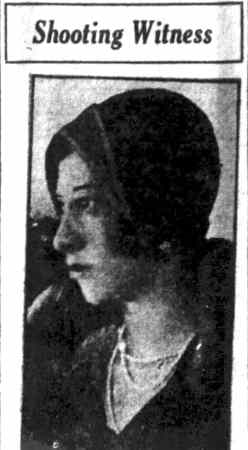
Right: Mrs. Rose Gibbs, who is held as a material witness in shooting of Joseph Connors Sunday night near Broadway and Kaighn Avenue
ACTION DELAYED IN GANG SHOOTING
Indictment of Doris in Flannery Murder Revealed After Arrest
Assistant Prosecutor Rocco Palese was prepared last night to go to the bottom of all charges against John Doris, brother of an executed Philadelphia bandit murderer, in an effort to determine whether to press for his immediate trial on indictments accusing him of the killing of Joseph (Mose) Flannery, or to seek other indictments first on charges of shooting Joseph Connors, at 6 a. m. Sunday.
The condition of Connors, a reputed Gloucester racketeer, remained the same last night in West Jersey Homeopathic Hospital, where doctors said the crisis was not yet passed. He has bullet wounds in the lung, abdomen and the hand, physicians saying it was too soon to predict whether he had a chance for recovery.
Doris Arraigned
Doris was arraigned before Police Judge Pancoast yesterday charged with shooting Connors near Broadway and Kaighn avenue, after a brawl which took them into two resorts and finally ended on the street outside. The judge held him for grand jury action on that charge, and was about to close the case when City Detective J. Wesley McGrath took the stand and revealed that Doris was wanted in the mysterious murder of “Mose” Flannery, Camden racketeer, seven months ago at Front street and Kaighn avenue. Pancoast promptly denied him bail.
Palese Studies Case
The Flannery case was placed before the grand jury by former Assistant Prosecutor Samuel P. Orlando, who left his notes with the indictment in the office when he relinquished his post to Palese.
“I will study the case tomorrow,” Palese said last night. “Until I do, and can learn the strength of the old case against Doris in the Flannery murder, I can’t say which charge I might take before a jury, provided, of course, that we can get an indictment in the Connors case against the youth.”
Connors, who is 28, lives at 135 North Broadway, Gloucester. He has been arrested twice, once in Gloucester for disorderly conduct in 1924, and later on a grand larceny charge, on which he was acquitted.
Doris is a brother of the late Frankie Doris, who with three other youths went to the electric chair for the murder of a policeman in the Olney Bank robbery. (Continued on Page Twenty-one)
Camden Courier-Post — May 1, 1929
Camden Courier-Post —
DORIS INDICTMENT STUDIED BY POLICE
Begins Probe of Flannery Case Records; May Press Connors Charge First
Assistant Prosecutor Rocco Palese yesterday began to prepare his office to take John Doris to a quick trial for the murder of Joseph “Mose” Flannery.
Although uncertain whether to try Doris immediately on the Flannery murder indictment, or to seek an indictment first on charges of shooting Joseph Connors, alleged Gloucester racketeer, at Broadway and Kaighn avenue early Sunday, Palese decided to learn the full strength of the old case against Doris. Connors, 28, appeared on the road to recovery last night, doctors in West Jersey Homeopathic Hospital said.
The Flannery indictment, handed up by the grand jury two days after the killing last September 18, reached Palese from the former regime in the prosecutor’s office. He filed a detainer against Doris as soon as he received a certified copy of the old indictment yesterday. Doris, brother of one of the four executed Olney Bank bandits, is in jail on the Connors charges.
To be certain he would be prepared for either case, Palese also questioned several witnesses who had appeared before the grand jury on the Flannery case. He also said the present grand jury might reopen the Flannery case.
Camden Courier-Post — May 4, 1929
Camden Courier-Post —
SATURDAY, MAY 4, 1929
OUR CRIME WAR FIRMLY LAUNCHED
“Complete co-operation is assured between the Court and the Camden County Prosecutor’s office in a war on crime, vice and gambling.”
Those sentiments, expressed by both Supreme Court Justice Lloyd and Prosecutor Clifford Baldwin, are the encouraging signal that something definite is to be done in checking the inroads of gangland in Camden County.
It is, in short, a start—and a start that augurs well for a program of decisive action against the rackets that have been operating so freely in our midst.
Highly injudicious, therefore, are certain of the remarks made by former Assistant Prosecutor Varbalow in an address before the Camden County Grand Jurors’ Association. Among other things, Mr. Varbalow said:
“Crime is no worse in Camden than in any other county, and in the prosecutor’s office here we have a splendid tradition. We have never lost a murder case or an arson case.”
“I do not favor commencing grand jury investigations or the plans of prosecution with the blare of trumpets. . . . I do not favor special raids and investigations. . . .”
His boast about the traditions of the prosecutor’s office is scarcely convincing. If no murder cases were lost in trial, how many were there that were never permitted to come to trial?
What of the murder of Joseph Flannery? What of the gang killings at Brooklawn? What of the brutal Audia murder? What of the hatchet murder of Gaetano Arcaria in Forest Hill Park? What of the slaying of Joseph Perri at Ancora?
Of course, failure to solve these crimes was not all the fault of the prosecutor’s office. Probably the police and county detective officials were equally responsible. But the fact remains that they were not cleared up.
Camden Courier-Post — May 16, 1929
Camden Courier-Post —
CONNORS REFUSES TO NAME ASSAILANT IN SHOOTING AT CLUB
Fails to Identify Doris, Held on Attempted Murder Charge, After Brawl Over Girl
VICTIM LEAVES HOSPITAL
Clinging to gangland tradition, Joseph Connors, 28, Gloucester, yesterday refused to tell who attempted to murder him at 6 a. m. April 28.
Connors was discharged from West Jersey Homeopathic Hospital yesterday, a shadow of his former self. He was taken to police headquarters and later arraigned before Police Judge Pancoast, who held him without bail.
After the hearing, Connors was quizzed by Assistant Prosecutor Palese and county detectives. He was brought face to face with John Doris, who, witnesses say, wounded him in a brawl over a girl on Broadway near Kaighn avenue.
Fails to Identify Doris
“I cannot identify him as the man who shot me,” was his laconic reply to a question from Palese.
Still suffering from bullet wounds through the lungs, abdomen and hand, he sat pale and seemingly disinterested as the detectives tried to get him to talk.
Prosecutor Baldwin ordered him held in $1500 bail as a material witness. He furnished bond and was permitted to go home.
Brother of Olney Bandit
Doris, who was a brother of the late Frank Doris, one of the four Olney bank bandits who went to the electric chair for killing a Philadelphia policeman, is also under indictment for the murder of Joseph (Mose) Flannery, who was shot in front of a saloon near Front street and Kaighn avenue last September.
About a dozen witnesses are either in jail or out on bail. According to the investigators, several have identified Doris as the man who shot Connors in a quarrel over a girl while attending a party. She is Mrs. Rose Gibbs, 18, of 411 Henry street. She said she went home before the shooting and found the missing money.
Camden Courier-Post — June 12, 1929
Camden Courier-Post —
JOHN DORIS, FUGITIVE
Supreme Court Justice Lloyd is to be congratulated upon his firm and unequivocal handling of the bail application of John Doris, who has been indicted for the murder of Joseph Flannery.
Not only did he refuse the application, but he made plain that no mollycoddling of gangsters or gangster suspects will be tolerated. And to emphasize his point, he rebuked two constables for not handcuffing Doris as a “desperate character.”
John Doris’ police record, a sizeable one, was given in full in these columns some months ago.
But what is one to think when it is revealed that Doris, while technically a fugitive from justice, made virtually no effort to elude Camden police.
Wanted for murder, Doris did not flee to the coast. He did not make for Canada or Mexico. He didn’t even go into hiding.
Wanted for murder, Doris stayed right in Camden, where he was indicted.
A “desperate character” roaming at large among law-abiding citizens. An admitted gangster, he did pretty much what he choose. And when he was arrested, he was arrested on another case.
Just what view will the man on the street take of this case?
Did our county detectives and city police lack means for identifying Doris?
Were they waiting for a formal letter of introduction?
Or weren’t they interested?
Camden Courier-Post — June 25, 1929
Camden Courier-Post —

PRECAUTIONS TAKEN TO PREVENT OUTBREAK BY GANGDOM FRIENDS
Spectators to Be Barred at Hearing Thursday; Gunman Denounced by Justice
JUDGE DENIES FREEDOM
Precautions are being taken by Prosecutor Clifford A. Baldwin to prevent any gangster demonstration Thursday when John Doris, alleged racketeer, goes on trial in Criminal Court on a charge of shooting Joseph Connors, 28, Gloucester, April 28 near Broadway and Kaighn avenue.
The prosecutor said no one will be admitted to the court room without first showing a subpena unless they are court officials, attorneys or newspepermen. He said the court room will be guarded heavily during the trial.
“We are not going to take any chances on Doris,” Baldwin said. “We do not know that Philadelphia gangsters will attempt anything here, but are going to be on guard.”
Doris recently was brought before Supreme Court Justice Lloyd by two constables but not handcuffed. Justice Lloyd branded Doris as a desperate character and ordered him taken from his presence until he could be handcuffed. At that time Doris asked for release on a writ of habeas corpus but the court refused.
The gangster also has been indicted in connection with the murder of Joseph (Mose) Flannery last Fall at Front street and Kaighn avenue. This indictment was disclosed after his arrest in the Connors’ case.
He will go on trial Thursday on a charge of atrocious assault and battery with intent to kill Connors. Connors was in West Jersey Homeopathic Hospital several weeks. When he was released he refused to identify Doris as his assailant. It is alleged the two quarreled over a woman.
Doris is a brother of Frank Doris, one of four bandits executed for the murder of a policeman in the Olney Bank robbery in Philadelphia two years ago. Doris has been living at Front and York streets since the murder of Flannery.
Camden Courier-Post — August 27, 1929
Camden Courier-Post —
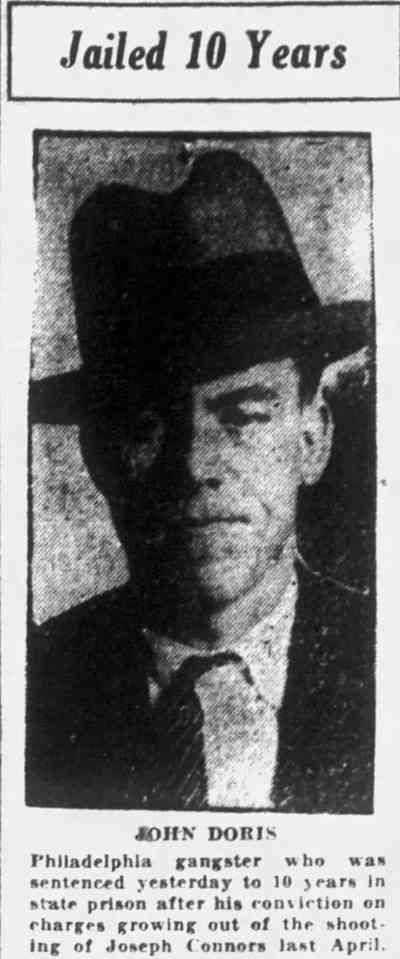
Jailed 10 Years
JOHN DORIS
Philadelphia gangster who was sentenced yesterday to 10 years in state prison after his conviction on charges growing out of the shooting of Joseph Connors last April.
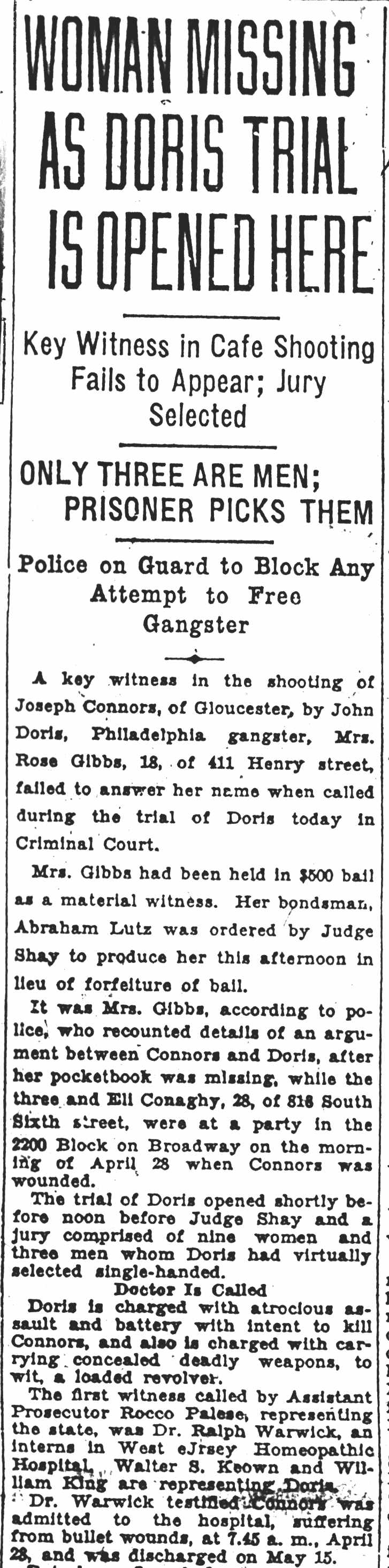
WOMAN MISSING AS DORIS TRIAL IS OPENED HERE
Key Witness in Cafe Shooting Fails to Appear; Jury Selected
ONLY THREE ARE MEN; PRISONER PICKS THEM
Police on Guard to Block Any Attempt to Free Gangster
A key witness in the shooting of Joseph Connors, of Gloucester, by John Doris, Philadelphia gangster, Mrs. Rose Gibbs, 18, of 411 Henry street, failed to answer her name when called during the trial of Doris today in Criminal Court.
Mrs. Gibbs had been held in $500 bail as a material witness. Her bondsman, Abraham Lutz, was ordered by Judge Shay to produce her this afternoon in lieu of forfeiture of bail.
It was Mrs. Gibbs, according to police, who recounted details of an argument between Connors and Doris, after her pocketbook was missing, while the three and Eli Conaghy, 28, of 818 South Sixth street, were at a party in the 2200 Block on Broadway on the morning of April 28 when Connors was wounded.
The trial of Doris opened shortly before noon before Judge Shay and a jury comprised of nine women and three men whom Doris had virtually selected single-handed.
Doctor Is Called
Doris is charged with atrocious assault and battery with intent to kill Connors, and also is charged with carrying concealed deadly weapons, to wit, a loaded revolver.
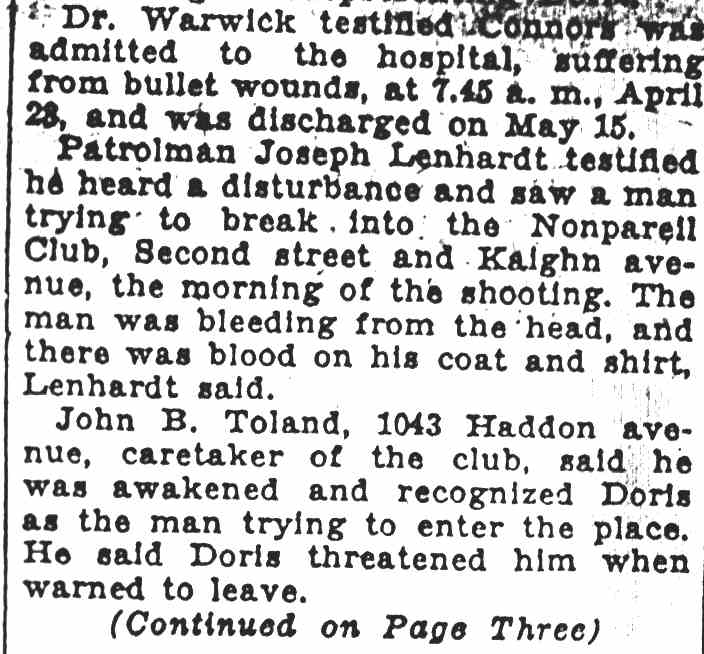
The first witness called by Assistant Prosecutor Rocco Palese, representing the state, was Dr. Ralph Warwick, an interns in West Jersey Homeopathic Hospital. Walter S. Keown and William King are representing Doris.
Dr. Warwick testified Connors was admitted to the hospital, suffering from bullet wounds, at 7.45 a. m., April 28, and was discharged on May 15.
Patrolman Joseph Lenhardt testified he heard a disturbance and saw a man trying to break into the Nonpareil Club, Second street and Kaighn avenue, the morning of the shooting. The man was bleeding from the head, and there was blood on his coat and shirt, Lenhardt said.
John B. Toland, 1043 Haddon avenue, caretaker of the club, said he was awakened and recognized Doris as the man trying to enter the place. He said Doris threatened him when warned to leave.
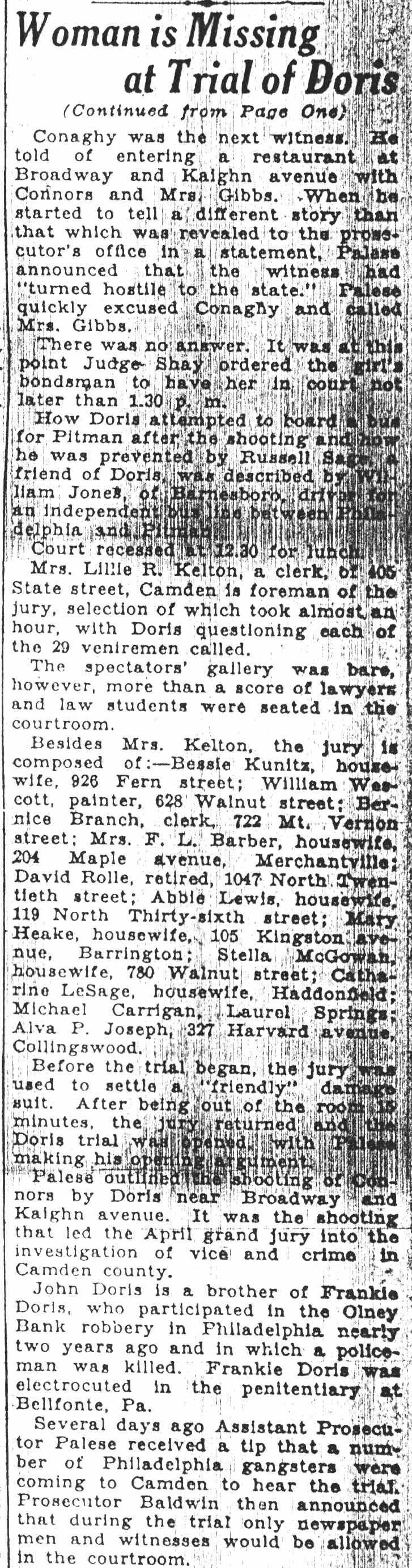
Woman is Missing at Trial of Doris
(Continued from Page One)
Conaghy was the next witness. He told of entering a restaurant at Broadway and Kaighn avenue with Connors and Mrs. Gibbs. When he started to tell a different story than that which was revealed to the prosecutor, Palese announced that the witness had “turned hostile to the state.” Palese quickly excused Conaghy and called Mrs. Gibbs.
Mrs. Lillie R. Kelton, a clerk, of 405 State street, Camden is foreman of the jury, selection of which took almost an hour, with Doris questioning each of the 29 veniremen called.
Spectators’ gallery was bare, however, more than a score of lawyers and law students were seated in the courtroom.
Besides Mrs. Kelton, the jury is composed of:—Bessie Kunitz, housewife; David Rolle, retired, 1047 North Twentieth street; Abbie Lewis, housewife, 119 North Thirty-sixth street; Mary Heake, housewife, 105 Kingston avenue, Barrington; Stella McGowan, housewife, 780 Walnut street; Catherine LeSage, housewife, 722 Mt. Vernon street; Mrs. F.L. Barber, housewife, 628 Walnut street; Bernice Branch, clerk, 722 Mt. Vernon street; Michael Carrigan, Laurel; Alva P. Joseph, 327 Harvard avenue, Collingswood.
Before the trial began, the jury was unable to reach a “friendly” damage suit. After being about a few minutes, Doris trial was opened with him opening argument.
John Doris is a brother of Frankie Doris, who participated in the Olney Bank robbery in Philadelphia nearly two years ago and in which a policeman was killed. Frankie Doris is in the penitentiary in Bellefonte, Pa.
Several days ago Assistant Prosecutor Palese received a tip that a number of Philadelphia gangsters were coming to Camden to hear the trial. Auditor Baldwin then announced that during the trial only newsmen and witnesses would be allowed in the courtroom.
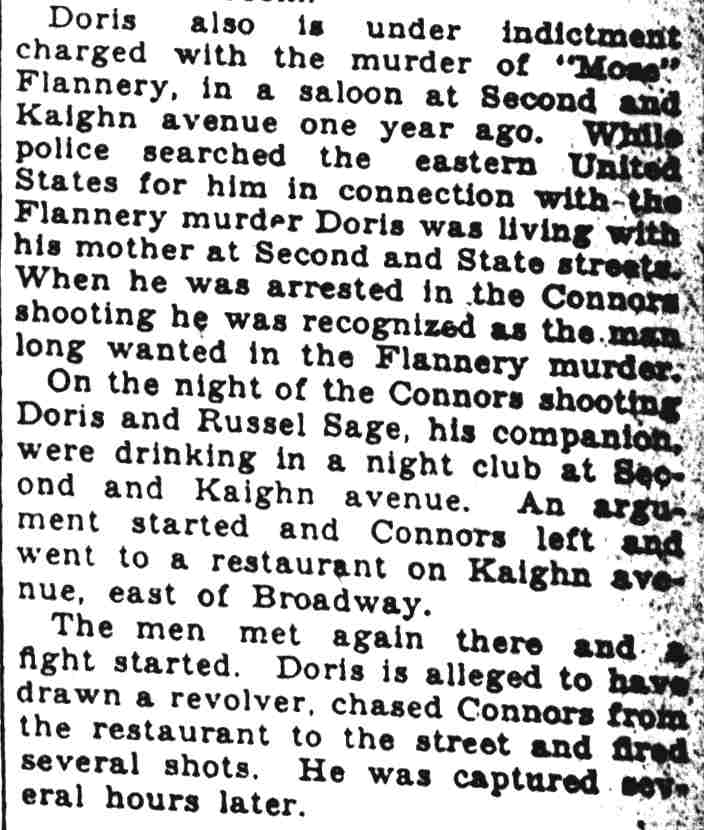
Doris also is under indictment charged with the murder of “Mose” Flannery, in a saloon at Second and Kaighn avenue one year ago. While police searched the eastern United States for him in connection with the Flannery murder Doris was living with his mother at Second and State streets. When he was arrested in the Connors shooting he was recognized as the man long wanted in the Flannery murder.
On the night of the Connors shooting Doris and Russel Sage, his companion, were drinking in a night club at Second and Kaighn avenue. An argument started and Connors left and went to a restaurant on Kaighn avenue, east of Broadway.
The men met again there and a fight started. Doris is alleged to have drawn a revolver, chased Connors from the restaurant to the street and fired several shots. He was captured several hours later.
Camden Courier-Post — September 17, 1929
Camden Courier-Post —


DORIS CONVICTED AT QUICK TRIAL; GETS TEN YEARS
Shay Warns Gangdom Shootings in Camden Must Cease; Jury Out 40 Minutes
WIFE FAINTS IN COURT AS JUDGE SETS PENALTY
Brother of Olney Bank Bandit Acquitted on One Charge in Kaighn Avenue Brawl
Wheels of justice spun quickly yesterday when John Doris, 30, ambitious young Philadelphia gangster, was tried, convicted, and sentenced to 10 years in New Jersey State Prison in the shooting of Joseph Connors, Gloucester, in Kaighn avenue, near Broadway, last April 29.
To the sentence which nips a brief but hectic underworld career in which Doris also faces a murder indictment for another Kaighn avenue gun duel, Judge Shay added a stern ultimatum to gamblers and racketeers that they cannot use Camden streets for their sanguinary warfare.
“There have been too many racketeer shootings in Camden lately,” the jurist declared. “They all seem to have the same code—to shoot it out and then keep silent in the courts. Even Connors, the man who was shot, comes before this court and denies Doris was the guilty man. Fear may silence these witnesses, which in itself is serious, but these shootings must end and they will.”
Tries to Be Tough
Then he sentenced Doris. The young gangster, brother of Frank Doris, executed Olney bank bandit, blanched. The confident air with which he approached this trial, following a disagreement at the first trial of the charges last June, had failed and left him a trembling, shaken boy who tried to be tough.
Pathos was added to the drama as Helen Doris, frail wife of the convicted youth, suddenly seemed to realize what had happened. She screamed. Her slender body sagged perilously toward the floor. Doris’ brother and a friend carried her from the court room.
On the main floor of the building the girl went into a dead faint, from which she was revived by Edward Holloway, custodian. She then became hysterical, in which condition she was taken away.
Guilty on Two Counts
The jury which convicted Doris, the first drawn from the “million dollar” panel, cleared the youth of one count but found him guilty of two after 40 minutes of deliberation.
Deliberations were started at 3.25 p. m., and at 4.06 o’clock Judge Shay was called back to the bench to receive the verdict from Fred Euhenfeld, 3100 Highland avenue, jury foreman.
Solemnly he announced that in the eyes of the jurymen Doris was guilty of atrocious assault and battery, and guilty of carrying concealed deadly weapons, but was not guilty on a third count alleging atrocious assault and battery with intent to kill.
All eyes in the courtroom turned to the immaculately-clad Doris, who started forward in his chair and
Doris Gets 10 Years, Quickly Convicted
(Continued from Page One)
looked appealingly to his counsel, Walter S. Keown.
Assistant Prosecutor Rocco Palese reviewed the briefed points of the case and called upon Judge Shay to give Doris the maximum possible sentence, 15 years.
Attorney Asks Clemency
Keown in his final appeal pointed out Doris should receive mercy as a first offender, that he and Connors had been engaged in a heated fistic combat when Connors was shot, and that the youth’s age should entitle him to consideration.
“The jury gave Doris a ‘break’ in clearing him of the intent to kill charge,” Keown pleaded. “Will the court give him a ‘break’ in its sentence?”
Judge Shay responded with his dramatic broadside against the gun toting of the underworld and gave the defendant a seven-year term for atrocious assault and battery and three additional years for carrying weapons.
Denies Doris Shot Him
“Doris didn’t fought me, that’s true,” testified Connors. “But Doris didn’t shoot me. Somebody, I don’t know who, sneaked up on us during the argument and shot me.”
Eli Conaghy, 29, of 818 South Sixth street, a witness for the state, was present at the Nonpareil Club, Second street and Kaighn avenue on the night of the shooting, with Mrs. Rose Gibbs. He mentioned an argument Doris had “with somebody” over the loss of the Gibbs girl pocketbook.
Thomas Matsios, proprietor of the American Restaurant, testified that at about 5:30 a. m. Connors came into the place, followed by a man who looked like Doris. An argument started and Matsios said he was forced to eject the men. A short time later, he heard shots.
He was followed on the stand by Lorenzo Cole, colored, 904 Jefferson street, a cook in the restaurant. “I saw a gun in Doris’ hand and heard two shots,” Cole said. “A few minutes, Connors ran through the alleyway, known as Amber street, with the gun still in his hand, followed, ran through the kitchen into an alleyway, known as Amber street, and then got up and continued the chase.”
Doris, in addition to being involved in the Broadway and Kaighn avenue shooting, is believed by police to hold the key to solution of the mysterious murder of Joseph “Mose” Flannery, for which he is under indictment.
Camden Courier-Post — September 18, 1929
Camden Courier-Post —
SECRECY HIDES DATE DORIS GOES TO PEN
Trial for Flannery Murder to Be Called Later
Secrecy will conceal the date when John Doris, Philadelphia gangster, who was convicted of shooting Joseph Connors, Gloucester, will be taken to state prison, according to Sheriff Walter T. Gross.
Gross said last night he is taking no chances with Doris, whose brother Frank was electrocuted with three others for the Olney bank robbery and murder. Gross said the prisoner will be taken to state prison any time within the next 21 days heavily guarded.
No attempt will be made by the state to try Doris on an indictment charging him with the murder of Joseph (Mose) Flannery, before he begins serving the sentence of 10 years meted out by Judge Shay yesterday. “The state is not ready to move the murder indictment against Doris,” said County Prosecutor Clifford A. Baldwin yesterday.
Trenton Evening Times — April 10, 1930
Trenton Evening Times —
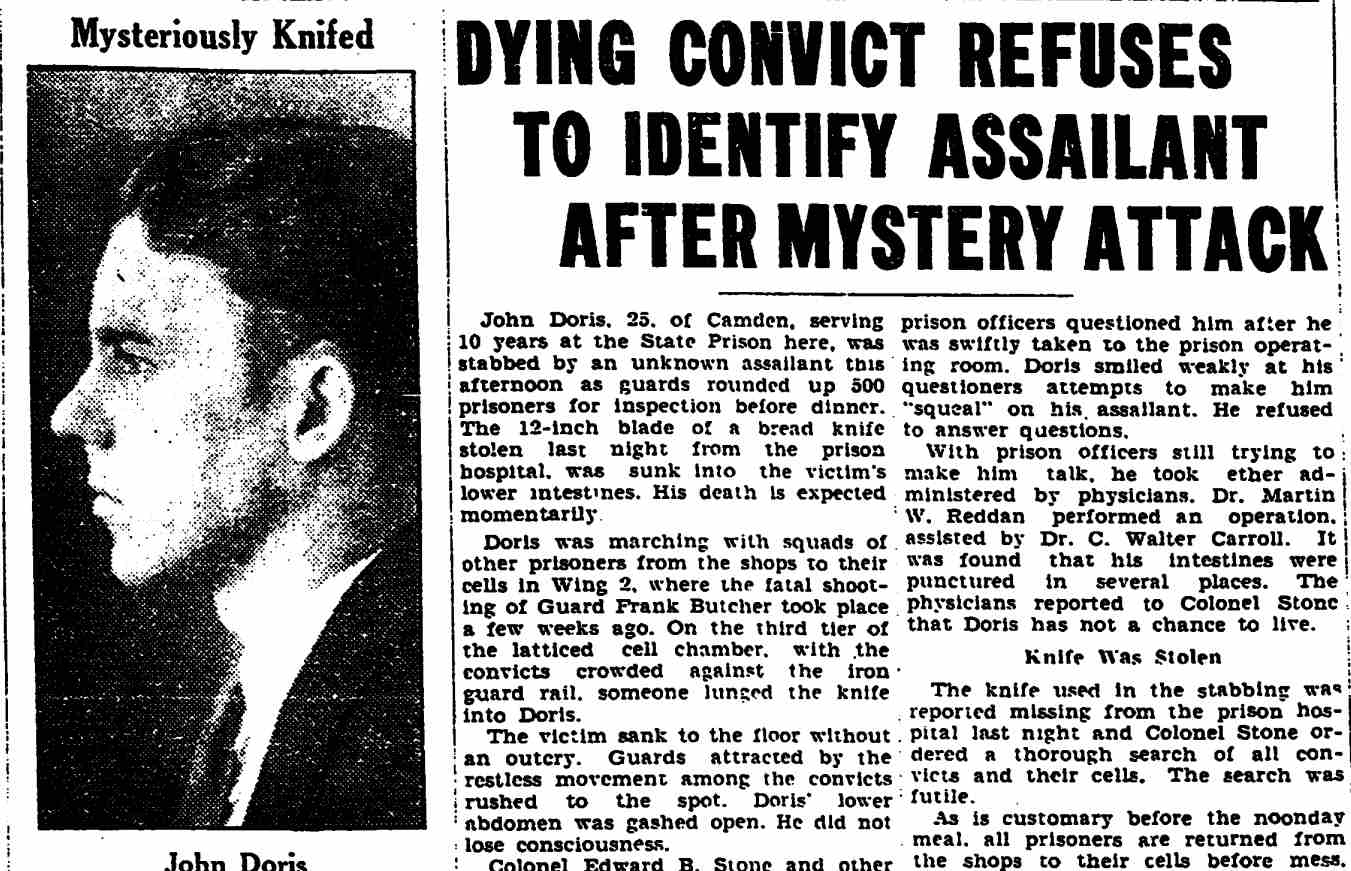
Dying Convict Refuses to Identify Assailant After Mystery Attack
John Doris, 25, of Camden, serving 10 years at the State Prison here, was stabbed by an unknown assailant this afternoon as guards rounded up 500 prisoners for inspection before dinner. The 12-inch blade of a bread knife stolen last night from the prison hospital, was sunk into the victim’s lower intestines. His death is expected momentarily.
Doris was marching with squads of other prisoners from the shops to their cells in Wing 2, where the fatal shooting of Guard Frank Butcher took place a few weeks ago. On the third tier of the latticed cell chamber, with the convicts crowded against the iron guard rail, someone lunged the knife into Doris.
The victim sank to the floor without an outcry. Guards attracted by the restless movement among the convicts rushed to the spot. Doris’ lower abdomen was gashed open. He did not lose consciousness. Colonel Edward B. Stone and other prison officers questioned him after he was swiftly taken to the prison operating room. Doris smiled weakly at his questioners attempts to make him “squeal” on his assailant. He refused to answer questions.
With prison officers still trying to make him talk, he took ether administered by physicians. Dr. Martin W. Reddan performed an operation, assisted by Dr. C. Walter Carroll. It was found that his intestines were punctured in several places. The physicians reported to Colonel Stone that Doris has not a chance to live.
Knife Was Stolen
The knife used in the stabbing was reported missing from the prison hospital last night and Colonel Stone ordered a thorough search of all convicts and their cells. The search was futile.
As is customary before the noonday meal, all prisoners are returned from the shops to their cells before mess, to submit to a count and search. The convict who had the knife probably feared detection in the search and was speeded in his resolve to attack his victim. With Doris’ lips sealed by the underworld code, the motive for the assault is as mysterious as the identity of the assailant.
Doris worked in the print shop of the prison. He “locked” with another prisoner in Wing 2, hotbed of intrigue. His cellmate was already in their cell when Doris was stabbed.
Doris’ brother was electrocuted in Harrisburg last week, for murder. Another brother, George, resides at 132 York Street, Camden. The victim is married and his wife resides at 1105 North Street, Philadelphia. He was received at the prison last September to serve 3 years for carrying a concealed deadly weapon and 7 years for atrocious assault and battery.
The butt and part of a blade stump of the knife used in the attack were found beside Doris. The knife was snapped off and six inches of the blade are believed to be in Doris’ body.
Chief County Detective James Kirkham and Detective Frank Naples went to the prison soon after the stabbing and tried to procure an ante-mortem statement from the dying man before he went under ether. Doris would not talk to them.
Colonel Stone was mystified at the manner in which the knife was concealed during the search for the weapon last night. He was also at a loss for a motive for the assault. Convicts who were well acquainted with Doris shrugged their shoulders and would say nothing about the affair, if they did know anything.
Late this afternoon Colonel Stone was informed by deputies that a clue to the assailant had been found. The identity of the stabber had not been established at the time this edition of The Times went to press.
Trenton Evening Times — April 11, 1930
Trenton Evening Times —
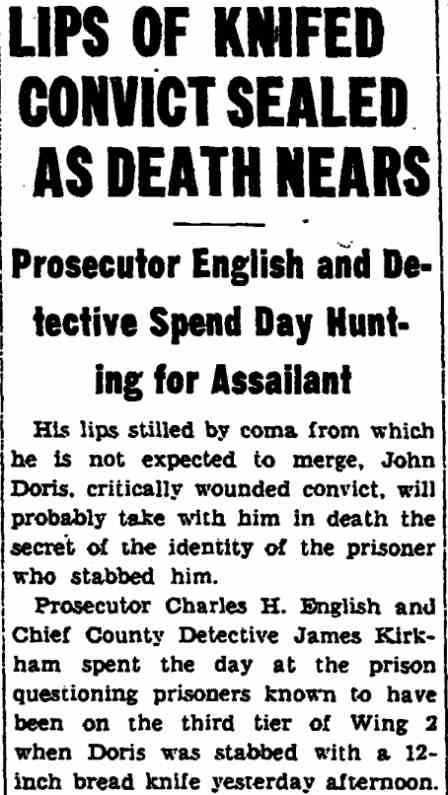
Lips of Knifed Convict Sealed as Death Nears
Prosecutor English and Detective Spend Day Hunting for Assailant
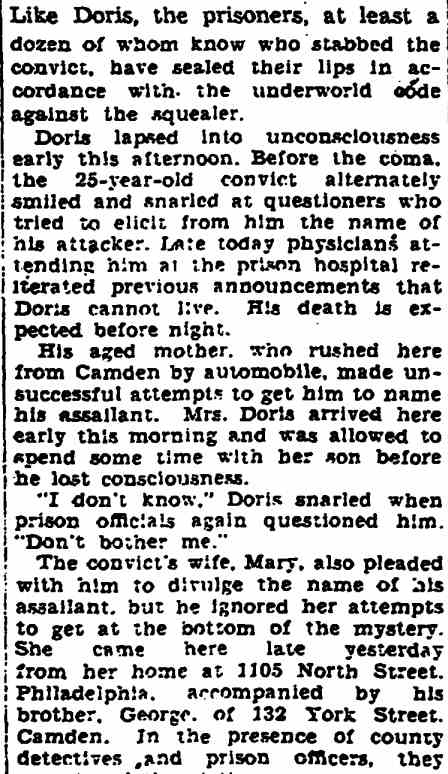
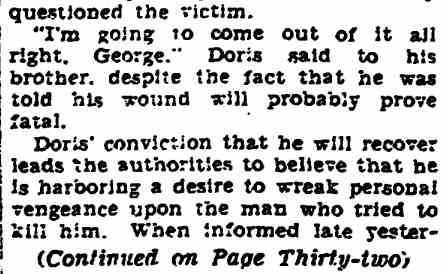
His lips stilled by coma from which he is not expected to emerge, John Doris, critically wounded convict, will probably take with him in death the secret of the identity of the prisoner who stabbed him. Prosecutor Charles H. English and Chief County Detective James Kirkham spent the day at the prison questioning prisoners known to have been on the third tier of Wing 2 when Doris was stabbed with a 12-inch bread knife yesterday afternoon.
Trenton Evening Times — April 12, 1930
Trenton Evening Times —
Prison Closely Watched After Deadly Knifing
Officials Suspicious of Attempt to Avenge Slaying of Convict
Autopsy Results Are Being Awaited
Trenton Evening Times — April 13, 1930
Trenton Evening Times —
Suspicion Closing Around Prisoner
But Prison Stabbing Probe Still Fails to Uncover Definite Evidence
A whisper from the underworld last night narrowed suspicion down to a single State Prison convict as the perpetrator of the knife attack costing the life of John Doris, another inmate.
Unsupported by any evidence to warrant an indictment or trial, prison authorities as well as county officials find themselves at a standstill in their investigation.
Because of the bitter hatreds that exist among the penned up thugs and racketeers, the “tip” from gangland is alternately viewed as a good lead and as a blind “steer.”
Meanwhile, the menace of “Death Valley,” as No. 2 wing of the prison has come to be known because of the tragedies that occur periodically there, is being given renewed consideration. With Doris slain just a month after Frank Butcher, a deputy, was shot down in the same wing, “Death Valley” has been living up to its reputation. In addition, the tragedy which cost the life of Joseph Tinney occurred in the same place.
Another outbreak may be in the making because Doris had many friends among the convicts. According to the prison authorities, Doris had not “squealed” or given any information concerning others in the institution.
The investigation has brought to light that a prisoner, whose name has not been disclosed, was hit over the head in the sight of several prisoners in the yard several days ago. The blow has no serious results but an effort to identify his assailant also failed. Doris did not figure in that offense, the authorities feel certain.
Prosecutor Charles H. English, who went to the prison Friday to aid personally in the inquiry, stated last night that “there doesn’t seem to be much possibility of getting any further information at the present time.”
The wing is said to contain more than 20 killers, although all are not serving time at present for such offenses. Several lifers are also reported included.
Although the total in that wing approximates 450, with the men scattered in four tiers of cells, only two guards are on duty. A suggestion has been made that a “crow’s nest” be built so that a full view of the interior can be commanded.
Doris’ body was transferred from the Swayze & Margerum morgue on Greenwood Avenue yesterday afternoon to Philadelphia. Doris’ mother, who buried another son 10 days ago after he had been electrocuted in Pennsylvania for murder, arranged for the burial with B. H. Cavanaugh, Philadelphia undertaker. The funeral will be held Tuesday, with interment in Holy Cross Cemetery in that city.
Trenton Evening Times — April 14, 1930
Trenton Evening Times —
Five Convicts Are Isolated in Knife Probe
‘Chair for Somebody,’ Warden Comments, As Prison Investigation Continues
Colonel Edward B. Stone, warden of the State Prison, today placed two more prisoners in solitary confinement, making a total of five convicts now in solitary confinement for refusing to “squeal” on the murderer of convict John Doris. “It means the chair for somebody,” said Colonel Stone, “and it will be harder to make them talk. But if it’s possible, we’ll break their ungodly code of honor and make them come through.”
Trenton Evening Times — April 16, 1930
Trenton Evening Times —
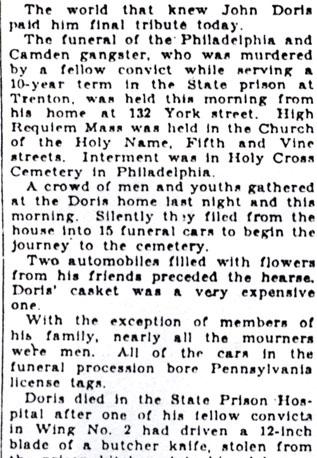
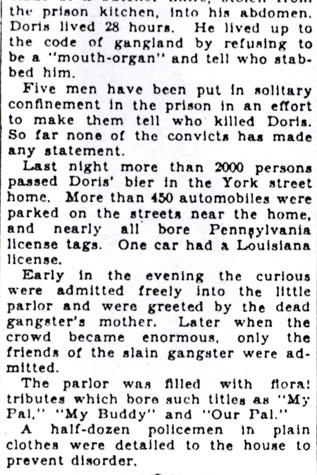
Gangsters Attend Funeral of Doris
Slain Convict Buried in Phila. After 2000 View Body
Camden Courier-Post — June 2, 1930
Camden Courier-Post —
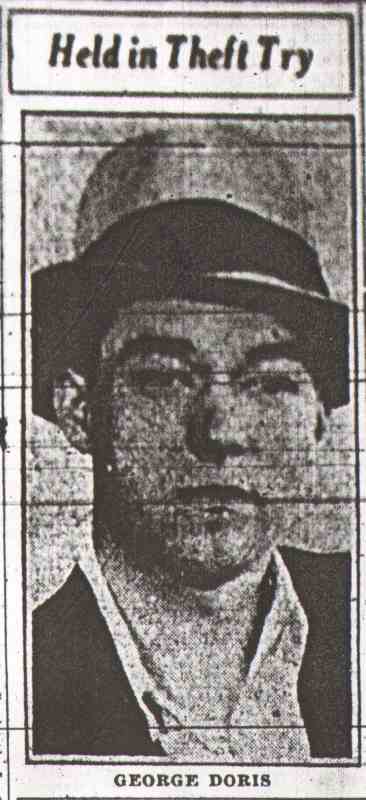
Held in Theft Try — GEORGE DORIS
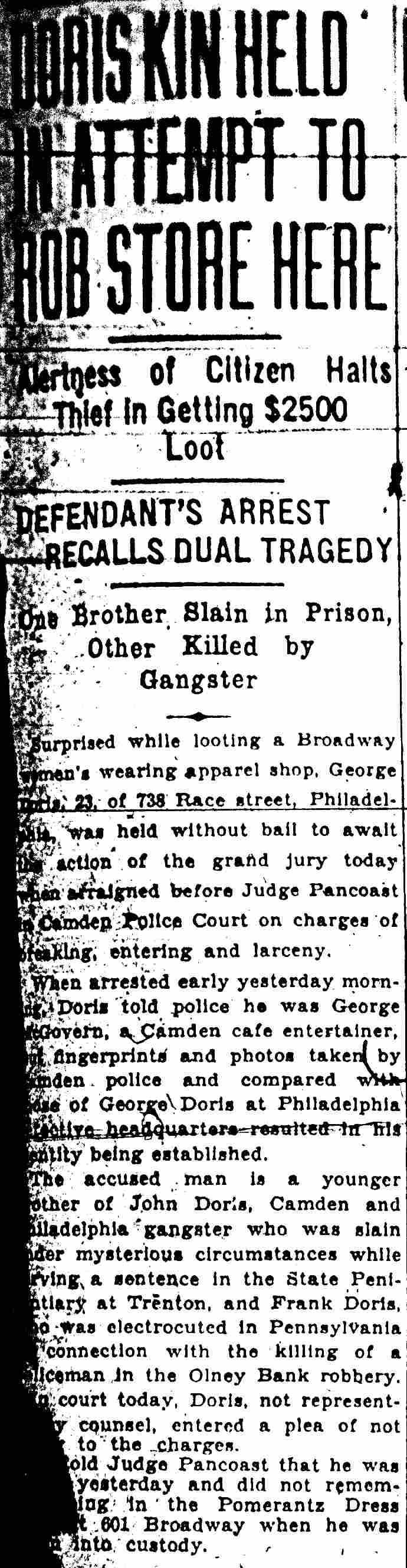
DORIS KIN HELD IN ATTEMPT TO ROB STORE HERE
Alertness of Citizen Halts Thief in Getting $2500 Loot
DEFENDANT’S ARREST RECALLS DUAL TRAGEDY
One Brother Slain in Prison, Other Killed by Gangster
Surprised while looting a Broadway women’s wearing apparel shop, George Doris, 23, of 738 Race street, Philadelphia, was held without bail to await the action of the grand jury today when arraigned before Judge Pancoast on charges of breaking, entering and larceny.
When arrested early yesterday morning, Doris told police he was George McGovern, a Camden cafe entertainer, but fingerprints and photos taken by Camden police and compared with the file of George Doris at Philadelphia detective headquarters resulted in his identity being established.
The accused man is a younger brother of John Doris, Camden and Philadelphia gangster who was slain under mysterious circumstances while serving a sentence in the State Penitentiary at Trenton, and Frank Doris, who was electrocuted in Pennsylvania in connection with the killing of a policeman in the Olney Bank robbery. In court today, Doris, not representing himself by counsel, entered a plea of not guilty to the charges.
He told Judge Pancoast that he was in the store yesterday and did not remember being in the Pomerantz Dress Shop at 601 Broadway when he was taken into custody.
Neighbor Gives Tip
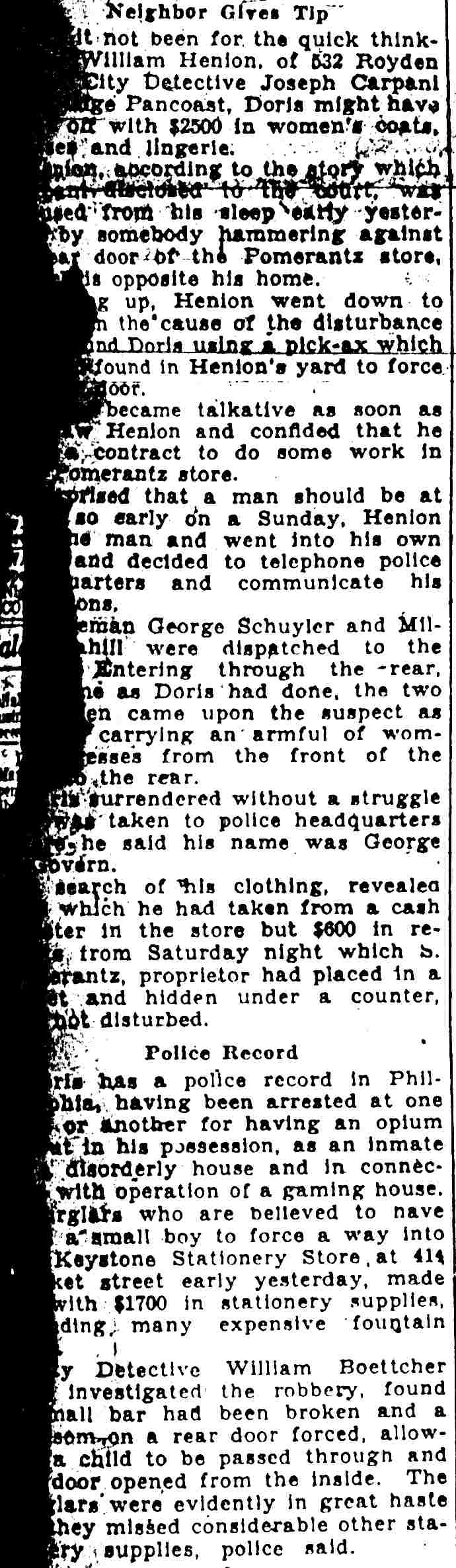
It had not been for the quick thinking of William Henlon, of 532 Royden street, City Detective Joseph Carpani Judge Pancoast, Doris might have gotten off with $2500 in women’s coats, dresses and lingerie.
Henlon, according to the story which was disclosed to the court, was aroused from his sleep early yesterday by somebody hammering against the rear door of the Pomerantz store, which is opposite his home. Getting up, Henlon went down to investigate the cause of the disturbance and found Doris using a pick-ax which he found in Henlon’s yard to force the door.
Patrolman George Schuyler and Milhill were dispatched to the scene. Entering through the rear door as Doris had done, the two men came upon the suspect as carrying an armful of women’s dresses from the front of the store to the rear. He surrendered without a struggle and was taken to police headquarters where he said his name was George McGovern.
A search of his clothing revealed he had taken from a cash register in the store but $600 in returns from Saturday night which S. Pomerantz, proprietor had placed in a box and hidden under a counter, not disturbed.
Police Record: Doris has a police record in Philadelphia, having been arrested at one time or another for having an opium pill in his possession, as an inmate of a disorderly house and in connection with operation of a gaming house. By Detective William Boettcher who investigated a separate robbery at Keystone Stationery Store at 414 Market street, found a small bar had been broken and a screen on a rear door forced, allowing a child to be passed through and the door opened from the inside.
Trenton Evening Times — November 13, 1930
Trenton Evening Times —
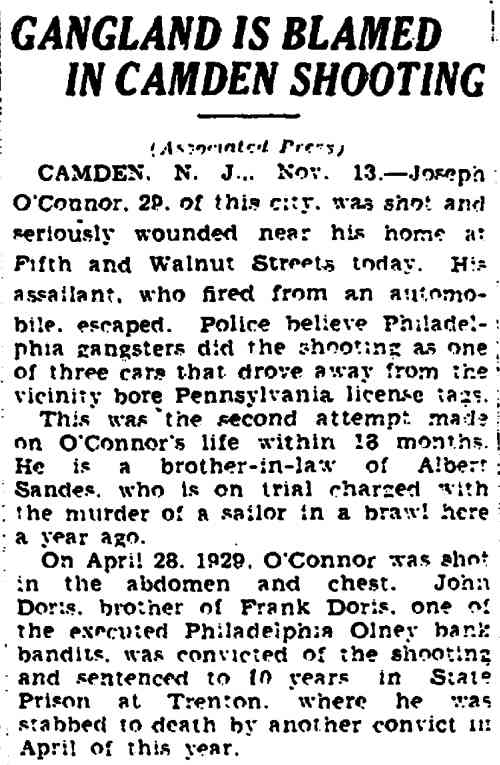
Gangland Is Blamed in Camden Shooting
(Associated Press)
CAMDEN, N. J., Nov. 13.—Joseph O’Connor, 29, of this city, was shot and seriously wounded near his home at Fifth and Walnut Streets today. His assailant, who fired from an automobile, escaped. Police believe Philadelphia gangsters did the shooting as one of three cars that drove away from the vicinity bore Pennsylvania license tags. This was the second attempt made on O’Connor’s life within 18 months. He is a brother-in-law of Albert Sandes, who is on trial charged with the murder of a sailor in a brawl here a year ago. On April 28, 1929, O’Connor was shot in the abdomen and chest. John Doris, brother of Frank Doris, one of the executed Philadelphia Olney bank bandits, was convicted of the shooting and sentenced to 10 years in State Prison at Trenton, where he was stabbed to death by another convict in April of this year.
Camden Morning Post — November 26, 1930
Camden Morning Post —
GANG BULLETS ARE FATAL TO ‘JOE’ O’CONNOR
Another Dead
South Camden Man Dies From Shooting on Street, Nov. 13
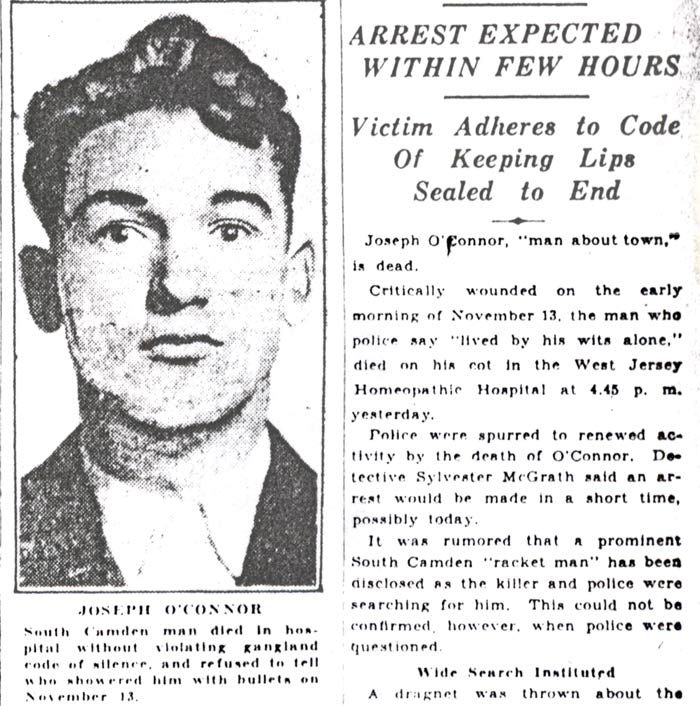
ARREST EXPECTED WITHIN FEW HOURS
Victim Adheres to Code Of Keeping Lips Sealed to End
Joseph O’Connor, “man about town,” is dead.
Critically wounded on the early morning of November 13, the man who police say “lived by his wits alone,” died on his cot in the West Jersey Homeopathic Hospital at 4.45 p. m. yesterday.
Police were spurred to renewed activity by the death of O’Connor. Detective Sylvester McGrath said an arrest would be made in a short time, possibly today.
It was rumored that a prominent South Camden “racket man” has been disclosed as the killer and police were searching for him. This could not be confirmed, however, when police were questioned.
Wide Search Instituted
A dragnet was thrown about the city and all district stations were notified to pick up anyone known to have been friendly with O’Connor with the idea of gaining additional information.
Surrounded by his closest relatives and constantly watched by a police guard, O’Connor breathed his last abiding by the gangland code by which he is alleged to have lived. He would not “squeal” on those who shot him down at Fifth and Walnut streets while he was on his way to his home “from somewhere.” In moments of consciousness he steadfastly refused to name his assailants.
The shooting was the second time in 18 months that O’Connor had been put “on the spot.” He was seriously wounded April 28, 1929, at Broadway and Kaighn avenue by John Doris, notorious gangster. Doris was sentenced to ten years for that crime and subsequently was stabbed to death by a fellow convict at Trenton.
3 Cars in on Kill
O’Connor, who resides at 520 Walnut street, was enroute to his home on the morning of November 13 and was walking in Walnut street, near Fifth, at 3.30 a. m., when a volley of shots rang out. He was struck in the leg and stomach and lost a great amount of blood before his wounds were treated.
Witnesses saw three cars leave the vicinity immediately after the shots were heard. One of the machines bore a Pennsylvania license plate. One man was seen runing west on Walnut street and was picked up by one of the cars after he had traversed about a block. A short time later a stranger appeared at the hospital with O’Connor.
Delivers the Victim
“Take this man and fix him up,” the stranger told attendants. “I’m going and don’t try to stop me.”
Police scouted the theory that O’Connor may have been slain by friends of Doris, seeking revenge. Detective Sylvester McGrath asked O’Connor if the shooting had been done by any of Doris’ friends to which O’Connor replied: “I didn’t squeal on Doris. I never said he shot me.”
Was Known to Police
O’Connor was the brother-in-law of Albert Saunders, who was recently acquitted on a charge of murdering Angelo Solury, a U. S. sailor, at the “Little Club,” a South Camden speakeasy, last June. “I don’t know if O’Connor was a racketeer,” said Detective Captain John Golden, “however, I do know that he didn’t work, so he must have lived by his ‘wits.’”
O’Connor had been arrested twice previous to being shot by Doris. He was arrested in Gloucester on a disorderly conduct charge, and in 1924 he was arrested on a grand larceny charge but acquitted.
O’Connor’s wife, Louise, his parents and a brother, Raymond, were at his bedside when he died. Patrolman Russell Young who was on guard at the bedside said O’Connor was unconscious for an hour before death.
Camden Morning Post — November 27, 1930
Camden Morning Post —
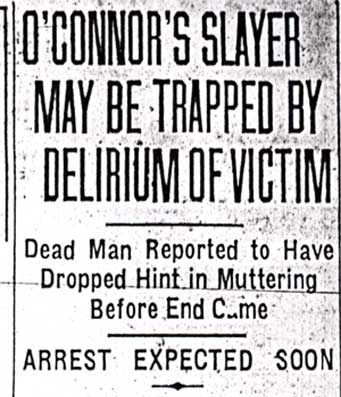
O’CONNOR’S SLAYER MAY BE TRAPPED BY DELIRIUM OF VICTIM
Dead Man Reported to Have Dropped Hint in Muttering Before End Came
ARREST EXPECTED SOON
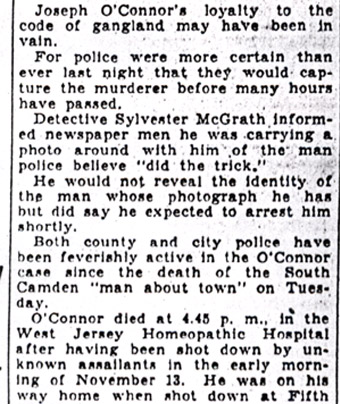
Joseph O’Connor’s loyalty to the code of gangland may have been in vain.
For police were more certain than ever last night that they would capture the murderer before many hours have passed.
Detective Sylvester McGrath informed newspaper men he was carrying a photo around with him of the man police believe “did the trick.” He would not reveal the identity of the man whose photograph he has but did say he expected to arrest him shortly.
Both county and city police have been feverishly active in the O’Connor case since the death of the South Camden “man about town” on Tuesday.
O’Connor died at 4.45 p. m., in the West Jersey Homeopathic Hospital after having been shot down by unknown assailants in the early morning of November 13. He was on his way home when shot down at Fifth and Walnut streets.
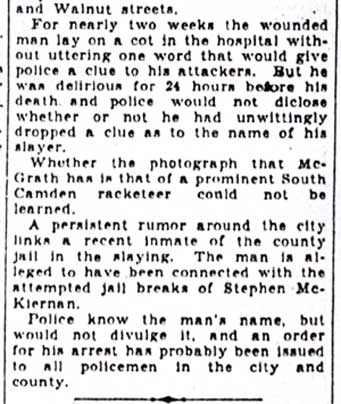
For nearly two weeks the wounded man lay on a cot in the hospital without uttering one word that would give police a clue to his attackers. But he was delirious for 24 hours before his death and police would not disclose whether or not he had unwittingly dropped a clue as to the name of his slayer.
A persistent rumor around the city links a recent inmate of the county jail in the slaying. The man is alleged to have been connected with the attempted jail breaks of Stephen McKiernan.
Police know the man’s name, but would not divulge it, and an order for his arrest has probably been issued to all policemen in the city and county.
Camden Morning Post — November 28, 1930
Camden Morning Post —
JOSEPH O’CONNOR
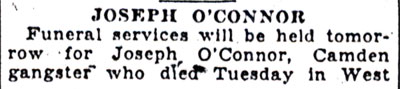
Funeral services will be held tomorrow for Joseph O’Connor, Camden gangster who died Tuesday in West Jersey Homeopathic Hospital, after being shot in the hip by an unidentified gunman two weeks ago.
Services will take place at the home of his parents, Mr. and Mrs. Michael J. O’Connor, 135 North Broadway, Gloucester. Burial will be in New St. Mary’s Cemetery. O’Connor is also survived by his widow, Louise, and a brother, Raymond.
Camden Courier-Post — December 5, 1930
Camden Courier-Post —
DORIS BROTHERS’ PAL IS GIVEN SIX MONTHS
James Trainer Jailed on Charge of Loitering With Intent to Steal
Found guilty of “loitering with intent to steal,” James Trainer, 31, was sentenced to six months in the county jail by Police Judge Garfield Pancoast today. Trainer pleaded not guilty and gave as his address the home of the Doris brothers’ mother, Mrs. Emma McGovern, 132 York street.
Trainer had just left an automobile and started to enter the McGovern home at 3 a. m. yesterday when District Detectives Walter Smith and Alfred Shire arrested him on suspicion.
Mrs. McGovern said Trainer was a friend of her late sons, John and Frank Doris, both underworld figures, and that he occasionally had spent the night at her home. Trainer declared he had been living in the McGovern home for a year.
Frank Doris was one of the four Olney bandits executed several years ago. John Doris was mysteriously stabbed to death in state prison while serving a sentence for wounding Joey O’Connor, man-about-town.
Trainer’s record, produced in police court today, showed 17 arrests and three convictions from 1917 to 1930. It showed that he had served sentences of three years, one year and 30 days. He was shown to have been arrested for larceny, robbery, breaking and entering, and as a suspicious character.