Introduction
DR. WILSON GILL BAILEY was born in Paulsboro NJ on September 2, 1865, one of at least 10 children born to Joseph B. and Amanda Wheeler Bailey. His father was a carter. The 1880 Census shows five younger siblings at home. He graduated from Paulsboro High School and Pierce Business College, then went on to Jefferson Medical College, from which he received his doctorate in 1891. He interned at Cooper Hospital and remained in Camden, practicing general surgery into the 1930s.
Dr. Bailey served during the Spanish-American War with the New Jersey National Guard as an Assistant Surgeon with the rank of First Lieutenant. He was a member of the Camden County Medical Society, the Camden City Medical Society, the Camden City Medical and Surgical Society, the American Medical Association, the Order of Military Surgeons, and the New Jersey Medical and Surgical Society.
The 1900 census shows Dr. Bailey and his wife Anna May at 710 Broadway. Dr. Bailey made his home and had his office at 712 Broadway as early as 1906. He was still at that address in 1910. The 1914–1917 City Directories shows his home at 302 South 5th Street, and his office at 511 Walnut Street. By 1921 he had consolidated home and office at 512 Broadway.
Dr. Bailey was married Anna May Sachse around 1893. This marriage produced two children, Hazel, born in June of 1896 and Orville, born after the 1900 census was taken. Sadly, by 1910 he was a widower. By 1914 there was a second marriage, to Sophie Katherine Gootz, which saw two daughters born, Eva and Minerva.
Dr. Bailey’s life away from medicine was also quite interesting and in his own words full of adventure. A dog fancier, he helped introduce the Borzoi, then known as the Russian Wolfhound, to the United States and was in great part responsible for the breed’s acceptance in this country. He was among the first to own an automobile in Camden and the first Camden resident to own an airplane, which he kept in a hanger near the White Horse Pike and Collings Avenue in West Collingswood.
Dr. Wilson Gill Bailey passed away on August 2, 1937. He was buried at Harleigh Cemetery. Dr. Gill’s nephew, also named Wilson Gill Bailey, born in Camden in 1893, became was a practicing physician in Philadelphia by 1930.
Local Doctor to Become an Airman
Camden Courier —
Dr. Bailey, Famous Dog Fancier, Purchases an Aeroplane
WILL MAKE FLIGHT WEDNESDAY
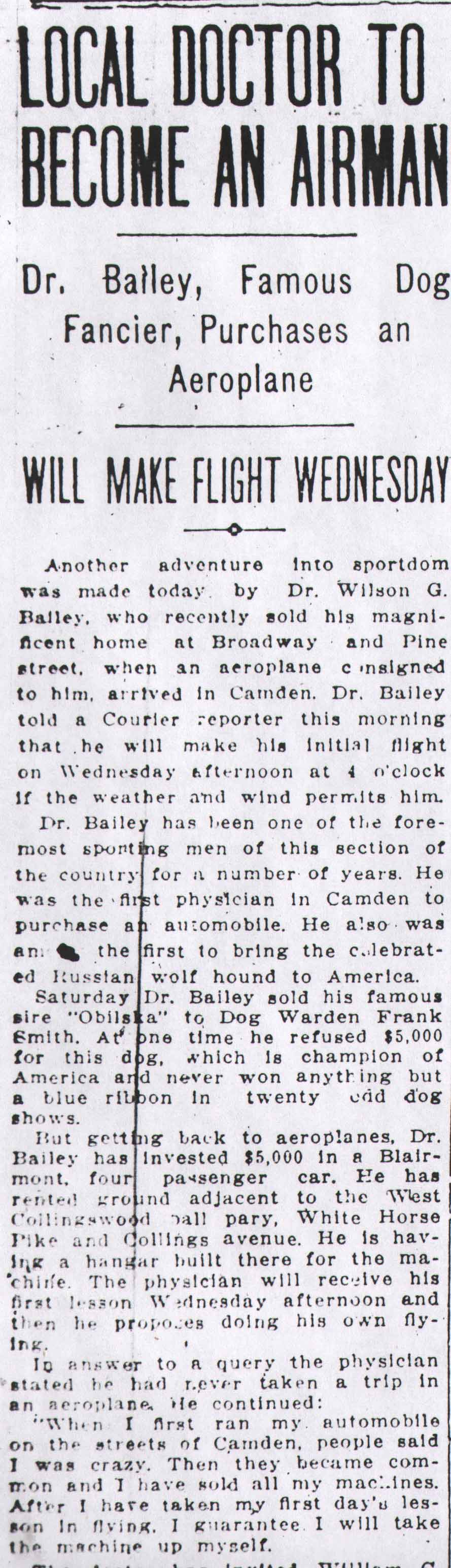
Another adventure into sportdom was made today by Dr. Wilson G. Bailey, who recently sold his magnificent home at Broadway and Pine street, when an aeroplane consigned to him, arrived in Camden. Dr. Bailey told a Courier reporter this morning that he will make his initial flight on Wednesday afternoon at 4 o’clock if the weather and wind permits him.
Dr. Bailey has been one of the most sporting men of this section of the country for a number of years. He was the first physician in Camden to purchase an automobile. He also was among the first to bring the celebrated Russian wolf hound to America. Saturday Dr. Bailey sold his famous sire “Oblisk” to Dog Warden Frank Smith. At one time he refused $5,000 for this dog, which is champion of America and never won anything but a blue ribbon in twenty odd dog shows.
Before getting back to aeroplanes, Dr. Bailey has invested $5,000 in a Blairmount, four passenger car. He has rented ground adjacent to the White Horse Pike and Collings avenue. He is having a hangar built there for the machine. The physician will receive his first lesson Wednesday afternoon and then he proposes doing his own flying.
In answer to a query the physician stated he had never taken a trip in an aeroplane, he continued: “When I first rode my automobile on the streets of Camden, people said I was crazy. Then they became common and I have sold all my machines. After I’ve taken my first day’s lesson in flying, I guarantee I will take the machine up myself.”
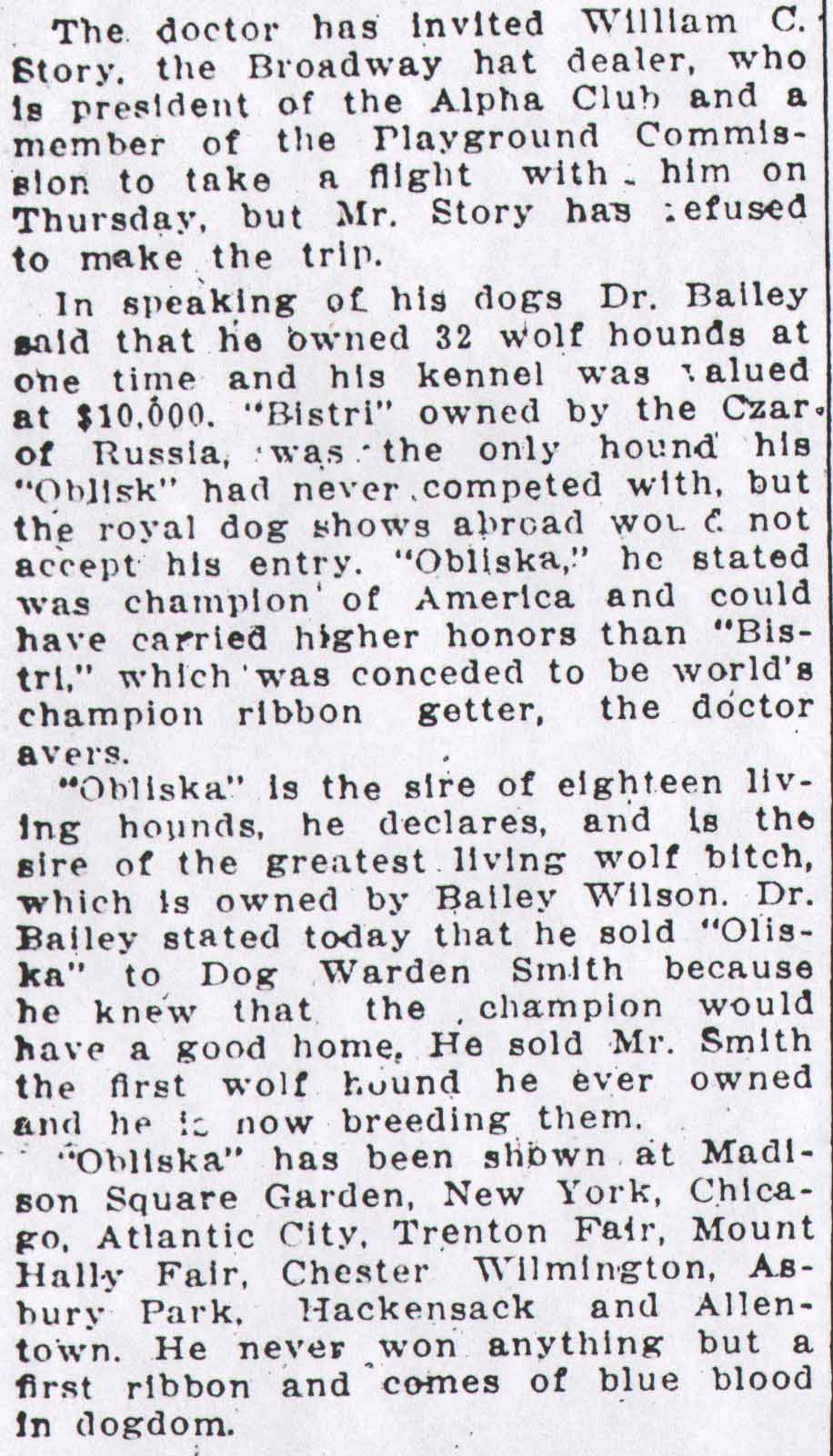
The doctor has invited William C. Story, the Broadway hat dealer, who is president of the Alpha Club and a member of the Playground Commission, to take a flight with him on Thursday, but Mr. Story has refused to make the trip.
In speaking of his dogs Dr. Bailey said that he owned 32 wolf hounds at one time and his kennel was valued at $10,000. “Bistri” owned by the Czar of Russia, was the only hound his “Oblisk” had never competed with, but the royal dog shows abroad would not accept his entry. “Obliska,” he stated was champion of America and could have carried higher honors than “Bistri,” which was conceded to be world’s champion ribbon getter, the doctor avers.
“Obliska” is the sire of eighteen living hounds, he declares, and is the sire of the greatest living wolf bitch, which is owned by Bailey Wilson. Dr. Bailey stated today that he sold “Oliska” to Dog Warden Smith because he knew that the champion would have a good home. He sold Mr. Smith the first wolf hound he ever owned and he is now breeding them.
“Obliska” has been shown at Madison Square Garden, New York, Chicago, Atlantic City, Trenton Fair, Mount Holly Fair, Chester, Wilmington, Asbury Park, Hackensack and Allentown. He never won anything but a first ribbon and comes of blue blood in dogdom.
Asylum Fugitive Fights Detective
Philadelphia Public Ledger —
Camden Woman, Second Time at Large, Caught in Rooming House Here
BARRICADES ROOM DOOR
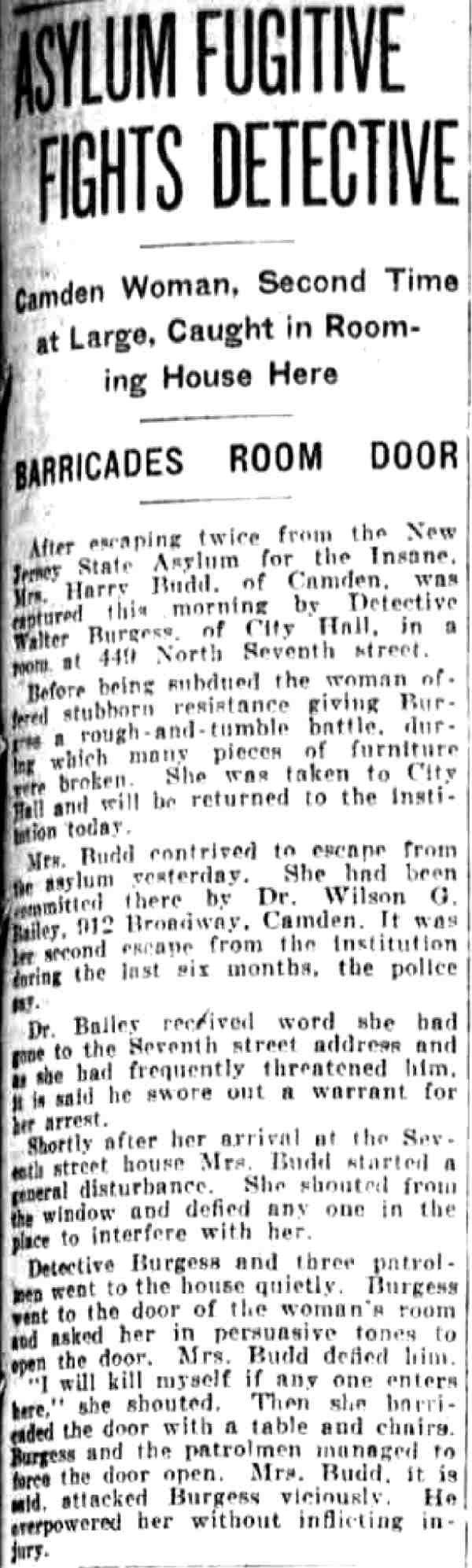
After escaping twice from the New Jersey State Asylum for the Insane, Mrs. Harry Budd, of Camden, was captured this morning by Detective Walter Burgess, of City Hall, in a room at 449 North Seventh street.
Before being subdued the woman offered stubborn resistance giving Burgess a rough-and-tumble battle, during which many pieces of furniture were broken. She was taken to City Hall and will be returned to the institution today.
Mrs. Budd contrived to escape from the asylum yesterday. She had been committed there by Dr. Wilson G. Bailey, 912 Broadway, Camden. It was her second escape from the institution during the last six months, the police say.
Dr. Bailey received word she had gone to the Seventh street address and as she had frequently threatened him, it is said he swore out a warrant for her arrest.
Shortly after her arrival at the Seventh street house Mrs. Budd started a general disturbance. She shouted from the window and defied any one in the place to interfere with her.
Detective Burgess and three patrolmen went to the house quietly. Burgess went to the door of the woman’s room and asked her in persuasive tones to open the door. Mrs. Budd defied him. “I will kill myself if any one enters here,” she shouted. Then she barricaded the door with a table and chairs. Burgess and the patrolmen managed to force the door open. Mrs. Budd, it is said, attacked Burgess viciously. He overpowered her without inflicting injury.
Three to Subdue Woman
Philadelphia Inquirer —
Two Policemen and a Detective Overcome Alleged Inmate of Asylum
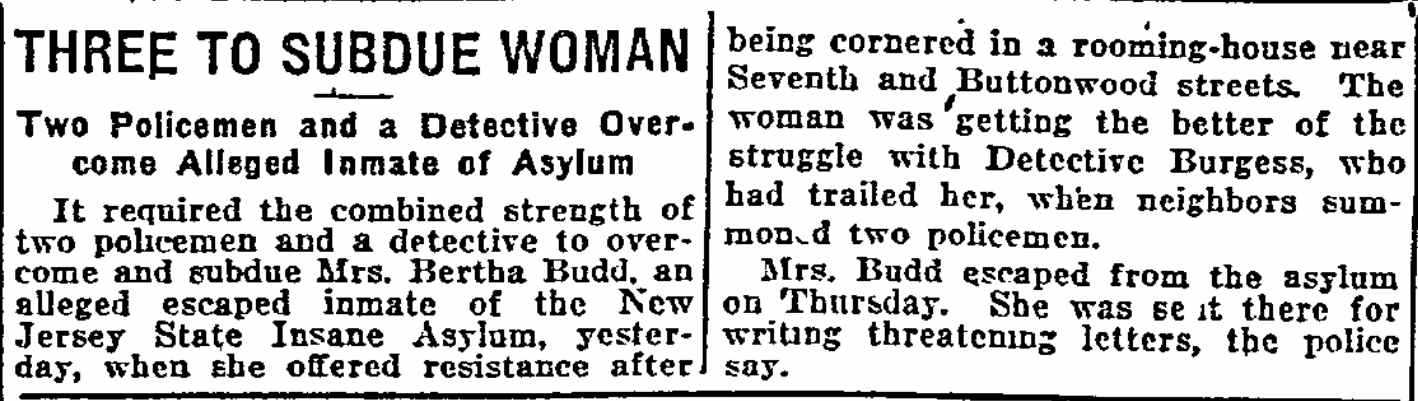
It required the combined strength of two policemen and a detective to overcome and subdue Mrs. Bertha Budd, an alleged escaped inmate of the New Jersey State Insane Asylum, yesterday, when she offered resistance after being cornered in a rooming-house near Seventh and Buttonwood streets. The woman was getting the better of the struggle with Detective Burgess, who had trailed her, when neighbors summoned two policemen.
Mrs. Budd escaped from the asylum on Thursday. She was sent there for writing threatening letters, the police say.
Babe Paradise Admits He Is Narcotic King
Camden Courier-Post —
3 Others Held by Camden Police as Leaders in Dope Peddling Gang
OPERATIONS COVERED ALL OF SOUTH JERSEY
Tell of Making Buys With Auto Used as ‘Silent Salesman’
Captured after a lengthy investigation, Anthony ‘Babe’ Paradise, of Camden has confessed to being the head of a narcotic ring operating throughout South Jersey, it was declared yesterday by Captain John Golden, head of the city detective bureau.
Paradise also admitted that he is a drug addict, Golden said, making the fact known when he became ill in his cell at the city jail and calling for Dr. W.G. Bailey, who has been treating him for the drug habit.
With three other men, who are accused as accomplices, Paradise is being held for a preliminary hearing in Police Court tomorrow morning. The four men, Golden said, will probably be held without bail pending grand jury action and be committed to the Camden County Jail. At the jail, detainers will be lodged against the quartette by Federal narcotics agents, who co-operated with city and county authorities in the investigation, which resulted in the arrests.
Golden declared that city detectives had purchased more than $500 worth of drugs from Paradise and his agents, in obtaining evidence against the ring, which authorities said reaches into Atlantic City and other South Jersey communities as well as Camden.
The three men arrested with Paradise are James Mucci, 18 years old, of 324 Stevens Street, Rocco DeCord, 21 years old, of 221 Spruce Street, and Andrew Hill, of Locust Street, near Kaighn Avenue. According to the detectives, the base of operations of the “ring” was in the Third Ward. Mucci and DeCord were arrested in a barbershop at Third and Locust streets, three blocks from the Wiley M. E. Church where the pastor, Rev. John S. Hackett, recently exposed vice conditions existing in the Third ward and assailed the Department Public Safety for laxity. The arrest of Paradise and the others is believed to be a result of the clergyman’s scathing sermons.
Paradise and Hill were arrested several hours before the other two men. Fearing that they get word to other members of the “ring” police took the two men to Merchantville police headquarters, where Assistant Prosecutor Joseph Varbalow and Chief County Detective Lawrence T. Doran were waiting. Statements were obtained from the two, and meanwhile Mucci and DeCord were taken into custody. Paradise, who is 34 years old, served a year in State Prison five years ago for selling narcotics.
Detectives George Ward, Louis Shaw, and Thomas Cheeseman, of the city, and M.H. Shapiro and J.H. McFadden, of the federal office in Philadelphia, arranged the purchase of a ‘deck” of heroin from Paradise, and ‘caught him with the goods’ when he met them at Nineteenth Street and River Road, near his home at 927 North Nineteenth Street.
Paradise was in his expensive automobile when arrested. It was the machine he had used to distribute narcotics to his agents and addicts during the past few years, the detectives said.
Decks of dope which sold for $1.50 each, police said, were placed in the automobile which was driven to a certain point as prearranged, and then Paradise would leave it parked, the detectives said.
Peddling Scheme Bared
At a stated hour an agent or addict would approach the machine, take the “dope” inside, and leave money as payment. Paradise would return and collect the money received, it was said.
That the ring extended to Philadelphia, New York, and other large Eastern cities was indicated by the many times the automobile was parked at Camden bridge plaza for hours, when exchanges would be made, the detectives said.
Along Memory Lane
Camden Courier-Post —
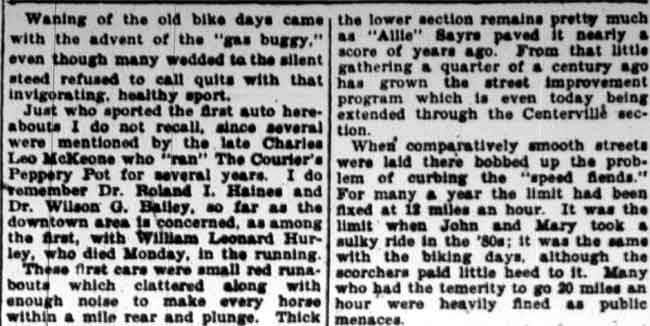
Waning of the old bike days came with the advent of the “gas buggy,” even though many wedded to the silent steed refused to call quits with that invigorating, healthy sport.
Just who sported the first auto hereabouts I do not recall, since several were mentioned by the late Charles Leo McKeone who “ran” The Courier’s Peppery Pot for several years. I do remember Dr. Roland I. Haines and Dr. Wilson G. Bailey, so far as the downtown area is concerned, as among the first, with William Leonard Hurley, who died Monday, in the running.
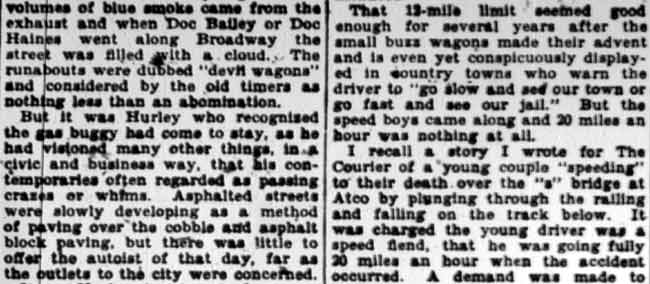
These first cars were small red runabouts which clattered along with enough noise to make every horse within a mile rear and plunge. Thick volumes of blue smoke came from the exhaust and when Doc Bailey or Doc Haines went along Broadway the street was filled with a cloud. The runabouts were dubbed “devil wagons” and considered by the old timers as nothing less than an abomination.
But it was Hurley who recognized the gas buggy had come to stay, as he had visioned many other things, in a civic and business way, that his contemporaries often regarded as passing crazes or whims. Asphalted streets were slowly developing as a method of paving over the cobble and asphalt block paving, but there was little to offer the autoist of that day, far as the outlets to the city were concerned. The lower section remains pretty much as “Allie” Sayrs paved it nearly a score of years ago. From that little gathering a quarter of a century ago has grown the street improvement program which is even today being extended through the Centerville section.
When comparatively smooth streets were laid there bobbed up the problem of curbing the “speed fiends.” For many a year the limit had been fixed at 12 miles an hour. It was the limit when John and Mary took a sulky ride in the ’80s; it was the same with the biking days, although the scorchers paid little heed to it. Many who had the temerity to go 20 miles an hour were heavily fined as public menaces.
That 12-mile limit seemed good enough for several years after the small buzz wagons made their advent and is even yet conspicuously displayed in country towns who warn the driver to “go slow and see our town or go fast and see our jail.” But the speed boys came along and 20 miles an hour was nothing at all.
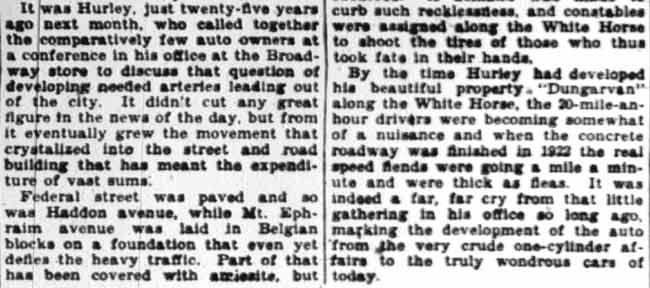
I recall a story I wrote for The Courier of a young couple “speeding” to their death over the “s” bridge at Atco by plunging through the railing and falling on the track below. It was charged the young driver was a speed fiend, that he was going fully 30 miles an hour when the accident occurred. A demand was made to curb such recklessness, and constables were assigned along the White Horse to shoot the tires of those who thus took fate in their hands.
By the time Hurley had developed his beautiful property “Dungarvan” along the White Horse, the 20-mile-an-hour drivers were becoming somewhat of a nuisance and when the concrete roadway was finished in 1922 the real speed fiends were going a mile a minute and were thick as fleas. It was indeed a far, far cry from that little gathering in his office so long ago, marking the development of the auto from the very crude one-cylinder affairs to the truly wondrous cars of today.
It was Hurley, just twenty-five years ago next month, who called together the comparatively few auto owners at a conference in his office at the Broadway store to discuss that question of developing needed arteries leading out of the city. It didn’t cut any great figure in the news of the day, but from it eventually grew the movement that crystallized into the street and road building that has meant the expenditure of vast sums.
Federal street was paved and so was Haddon avenue, while Mt. Ephraim avenue was laid in Belgian blocks on a foundation that even yet defies the heavy traffic. Part of that has been covered with amiesite, but the lower section remains pretty much as “Allie” Sayrs paved it nearly a score of years ago.
‘They Ain’t Done Right by Nell’
Camden Courier-Post —
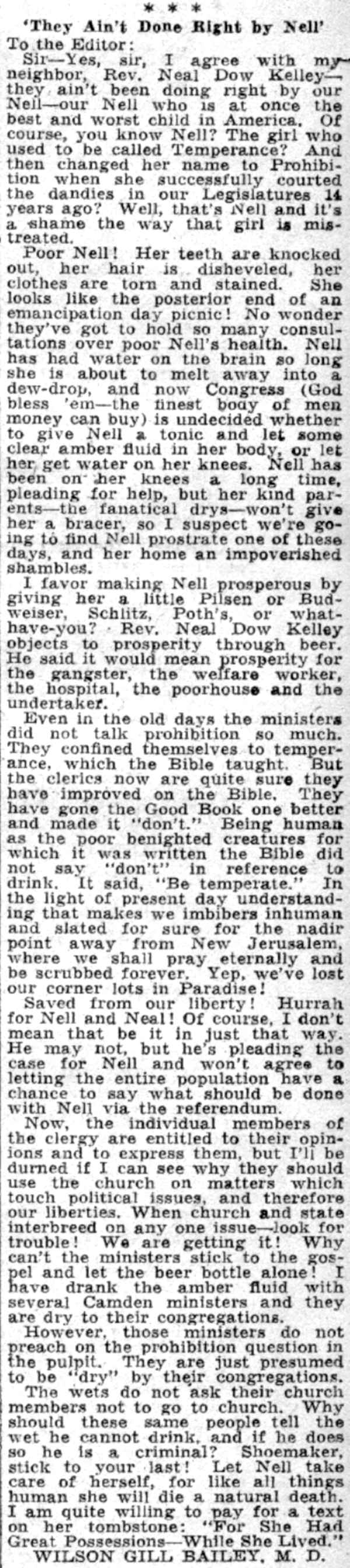
To the Editor:
Sir — Yes, sir, I agree with my neighbor, Rev. Neal Dow Kelly — about Nell — our Nell — who is at once the most anti-prohibition and the most, of course, you know Nell? The girl who used to be cashier at the little shop that changed her name to Prohibition when she could no longer serve the public what they wanted (some fifteen years ago)? Well, that’s nell and it’s a shame the way Nell has been treated.
Poor Nell! Her teeth are knocked out, her hair is disheveled, her clothes look like a slatternly woman, she looks like the posterior end of a travelling circus on parade. And they’ve got to find so many constitutional amendments and things added to their interpretation of the Bible that she is about to melt away into a two-drop-of-beer-at-a-time affair. God bless ’em — the finest body of men and women but will someone advise me to give Nell a tonic and let some dear addled pated woman help get water on her knees. Nell has her hands full, and is actually pleading for help, but her kind parents are disowning her. Someone is going to find Neil prostrate one of these days unless something different is done.
I favor making Nell prosperous by giving her a little Pilsen or Budweiser. Do you have Pils over there, have-you? Rev. Neal Dow Kelly doesn’t seem to know about Pilsen. He said it would mean prosperity for Camden. Prosperity means keeping the hospital, the poorhouse and the jail full.
He preached to his congregation. He did not talk prohibition so much. He preached on God’s loving providence, which the Bible taught. But they were not satisfied and since they have improved on the Bible. They have read the Bible as it was written and made it “don’t.” Being human beings living in the environment in which it was written the Bible did not say “don’t drink.” It was the light of present day understanding as to the effect of drinking that has slated for sure for the nadir step — or more elegant expression, where we shall pray eternally and get our limited felicity digging on our corner lots in Paradise.
But to come to the point. Hurrah for Nell and Nell! Of course, I don’t care a snap for what Kelly says. He may say, but he is pleading the wrong side. Here is where he lost me. He is asking the individual members of his congregation to express that, and also telling them to use the church on matters which should be left to the individual’s own liberation. When church and state are mixed it spells Fascism or Communism or some kind of “ism.” Why can’t the ministers stick to the gospel of Jesus Christ? They should not have drank the amber fluid with several of their brethren and then dare be “dry” to their congregations.
Now, the individual members of his congregation have a right to their opinions and to express them, but I’ll be darned if he should be their tool to use the church on matters which should be left to individual expression of our liberty. When church and state are mixed it spells Fascism or Communism or some kind of “ism.” Why can’t the ministers stick to the gospel of Jesus Christ? They should have drank the amber fluid with several of their brethren and then dare to be “dry” to their congregations.
Now I’ll be honest. I do not preach on the prohibition question in church. Since when is a minister to be “dry” in such matters. A shoemaker, should these same people tell the shoe-maker what to make? If he does he is a criminal. Shoemaker, stick to your last. She can take care of herself, for like all things God provides, with His knowledge. I am quite willing to pay for a test that will demonstrate this principle — Great Possessions — While She Lived — Beautiful Nell.
‘Leave the Beer-Bottle Outside the Church Door’
Camden Courier-Post —
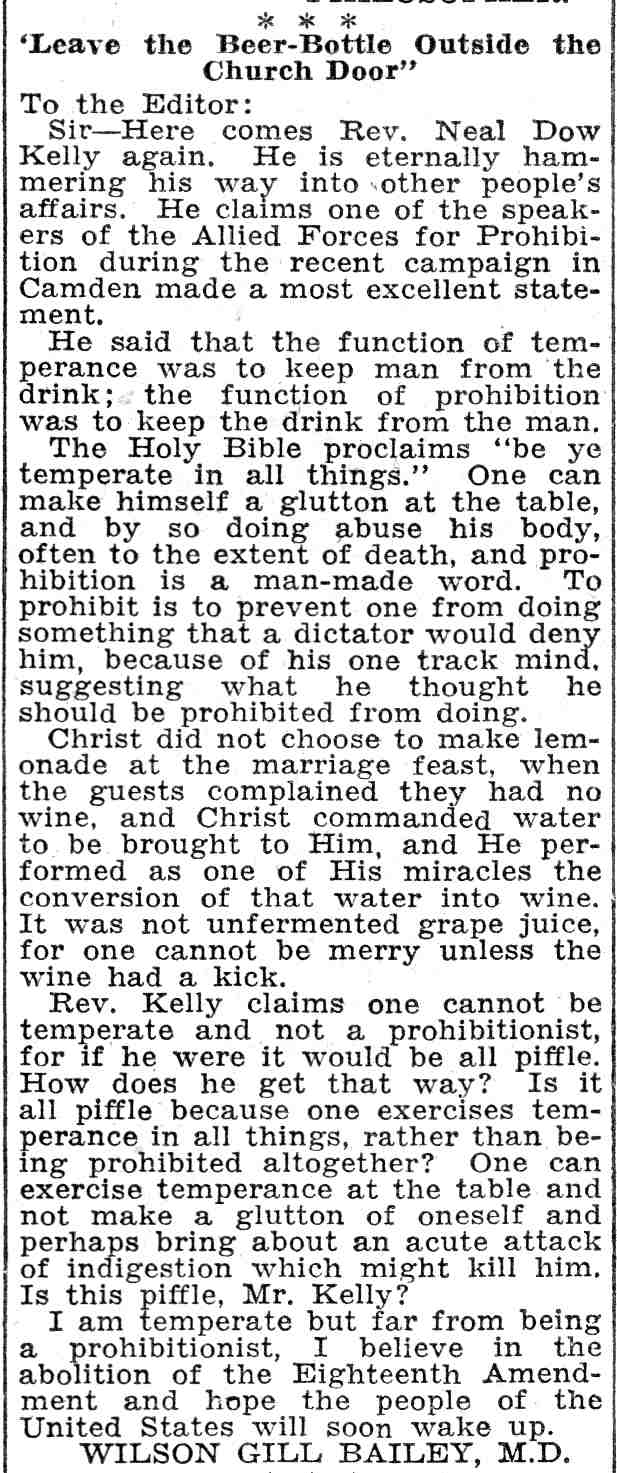
To the Editor:
Sir — Here comes Rev. Neal Dow Kelly again. He is eternally hammering his way into other people’s affairs. He claims one of the speakers of the Allied Forces for Prohibition during the recent campaign in Camden made a most excellent statement.
He said that the function of temperance was to keep man from the drink; the function of prohibition was to keep the drink from the man.
The Holy Bible proclaims “be ye temperate in all things.” One can make himself a glutton at the table, and by so doing abuse his body, often to the extent of death, and prohibition is a man-made word. To prohibit is to prevent one from doing something that a dictator would deny him, because of his one track mind, suggesting what he thought he should be prohibited from doing.
Christ did not choose to make lemonade at the marriage feast, when the guests complained they had no wine, and Christ commanded water to be brought to Him, and He performed as one of His miracles the conversion of that water into wine. It was not unfermented grape juice, for one cannot be merry unless the wine had a kick.
Rev. Kelly claims one cannot be temperate and not a prohibitionist, for if he were it would be all piffle. How does he get that way? Is it all piffle because one exercises temperance in all things, rather than being prohibited altogether? One can exercise temperance at the table and not make a glutton of oneself and perhaps bring about an acute attack of indigestion which might kill him. Is this piffle, Mr. Kelly?
I am temperate but far from being a prohibitionist, I believe in the abolition of the Eighteenth Amendment and hope the people of the United States will soon wake up.
WILSON GILL BAILEY, M.D.
Does Prohibition Prohibit?
Camden Courier-Post —
To the Editor:
Sir — To the writer of a letter, in the Mail Bag and signed a Graduate Nurse I address this letter. What physician can sit idly by and read such haranguing and not answer for the benefit of all whom it may concern?
So the graduate nurse has had vast experience. She does not say in what city, and where all this misery was caused by drink. We have always had our slum districts, but we do not since the prohibition law went into effect. We can go up and down most any street and you will see plenty of intoxication that did not exist prior to prohibition days. Graduate Nurse, have you looked up the statistics on our institutions, namely, the poorhouses, the insane asylums and our prisons? They are all filled to overflowing. No room for any more, and contrary to the prohibitionists’ cry, give us prohibition and we will tear down the prisons and build churches. Instead, we need all the stone and lumber to build more prisons and wings to our older ones.
Nurse, please answer this question in your next letter: Did prohibition ever prohibit? And what is the difference between temperance and prohibition? If I understand humankind, what is denied one, that is just what he or she will have. Be ye temperate in all things is my advice — at the table, etc., etc.
Now, Graduate Nurse, one cannot delve into nursing, economics, sociology and prohibition and do justice to all. I am sure if you would ever be fortunate to nurse for me, you would be called upon to administer alcohol in one form or another, for without whiskey, wine, etc., I would not care to practice medicine, for I have never found any drug equal to whiskey, wine or beer in rundown conditions; nor have I ever seen any evil come of it when properly used and to the patient that requires stimulation or general constructive treatment.
So, in conclusion, Trained Graduate, do not try to prohibit — through a law we call prohibition, for it never has prohibited and never will; but please differentiate between prohibition and temperance.
Poor old prohibition is at present very ill and I prognosticate his demise in less than one year; and may his death be as silent and as peaceful as his birth, for he was born so quietly that we had no chance to protest against him, but I am sure no one will mourn his going but a few who can only see through smoked glasses.
WILSON GILL BAILEY, M.D.
Camden
N.R.A. Praises Bailey’s Plan for Job Rule by Machine Tax
Camden Courier-Post —
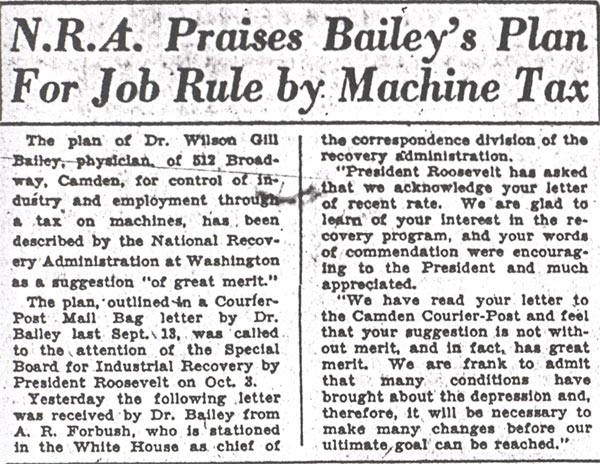
The plan of Dr. Wilson Gill Bailey, physician, of 512 Broadway, Camden, for control of industry and employment through a tax on machines, has been described by the National Recovery Administration at Washington as a suggestion “of great merit.”
The plan, outlined in a Courier-Post Mail Bag letter by Dr. Bailey last Sept. 13, was called to the attention of the Special Board for Industrial Recovery by President Roosevelt on Oct. 3.
Yesterday the following letter was received by Dr. Bailey from A. R. Forbush, who is stationed in the White House as chief of the correspondence division of the recovery administration.
“President Roosevelt has asked that we acknowledge your letter of recent date. We are glad to learn of your interest in the recovery program, and your words of commendation were encouraging to the President and much appreciated.
“We have read your letter to the Camden Courier-Post and feel that your suggestion is not without merit, and in fact, has great merit. We are frank to admit that many conditions have brought about the depression and, therefore, it will be necessary to make many changes before our ultimate goal can be reached.”