Michael “Mikey” Brown
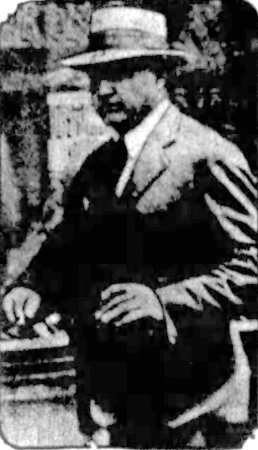
Michael “Mikey” Brown, c. 1933
MICHAEL BROWN was born Michael Cianfrani in Pennsylvania on September 29, 1888, the son of Italian immigrants. He eventually moved to Camden NJ, settling in Camden’s 8th Ward. Known popularly as “Mikey” Brown, he became involved in local politics, he served as a ward leader at one time or another for both the Republican and Democrat Parties. The 1913 City Directory shows him living at 610 Ferry Avenue, and operating a pool hall.
Michael Brown was appointed to the Camden Fire Department in May of 1914, and served with Engine Company 8 and Engine Company 3. The 1915 City Directory put him and his wife Louise at 647 Central Avenue. He resigned from the Fire Department on November 15, 1916. By the end of 1919 Mikey Brown was in business for himself, buying and selling horses. By 1927 he had purchased the bar at 629 Ferry Avenue, which operated under a soft drink license, allowing the sale of near beer. He also operated a stable nearby.
Politics in the Eighth Ward in Mikey Brown’s time was a contact sport, and the ward was known as “the bloody Eighth” for good reason. Joseph ‘Mose’ Flannery, sometimes an ally and sometimes an opponent of Brown, was gunned down at a Kaighn Avenue saloon in September of 1928. A victory parade after a May 1934 primary election ended in a riot outside William Tansky’s saloon South 6th and Viola Streets. Brown himself was charged with assaulting an election official in 1931. He was three times put on trial for election law violations and cleared of charges. In May of 1933 he ran for office as Republican County Committeeman for the Eighth Ward, but was defeated by four votes in an election that may well have been rigged, although it is unclear as to who was doing the rigging. In August of 1933 two shots were fired through the window of Brown’s neighbor and fellow saloon owner, Thomas “Bluch” Golding, at 650 Central Avenue.
The 1930 Census shows him living on premises with his wife Louise, brothers Angelo and Thomas, and his Uncle Edward. Angelo also worked in the business as a bartender, before passing in the 1930s. Michael Brown operated this saloon as late as 1931. Michael Brown operated different saloons in the city before he moved to Runnemede NJ, around 1935, where he engaged in the fertilizer business. He had returned to Camden before Pearl Harbor was attacked in December of 1941. He lived at 1745 Van Buren Street as late as 1947, and kept a stable on the west side of Master Street between Central Avenue and Ferry Avenue. Camden still had milkmen using horse-drawn carts till around 1950.
Michael Brown subsequently moved to the Hilltop section of Gloucester Township NJ, where he sold used trucks and cars. His brother Thomas passed in the middle 1950s. Louise Brown died in June of 1959. Michael Brown passed away on July 3, 1962.
Michael Brown was second cousin to the late Henry J. “Buddy” Cianfrani of South Philadelphia, who was prominent in state and local politics.
Auto Fire Engine Skids Into Window
Philadelphia Inquirer —
Driver of Camden Apparatus Sticks to Post Uninjured—Two Firemen Jump to Safety
Skidding in rounding the corner at Broadway and Kaighn avenue while responding to an alarm yesterday the auto fire engine attached to Company No. 3, of the Camden Fire Department, jumped the curb and crashed into a display window of a department store. The window was wrecked, one of the pillars of the store knocked out of place and the springs of the machine put out of commission. Several persons on the sidewalk narrowly escaped being hit by the apparatus.
Riding on the back of the machine Engineer Daniel Smith and Stoker Arthur Wingate saved themselves by jumping. Driver Michael Brown stuck to his post and escaped injury. In aiding the firemen to back the engine off the sidewalk, Andrew Fritz, aged 50, of 1425 Broadway, crushed one of his fingers so badly that it was amputated at Cooper Hospital. The fire was at Locust street and Kaighn avenue, where a load of hay on a wagon was destroyed.
Man Blames Cop as Home Wrecker
Camden Courier —
Accused of Beating 2 Women After Fighting Way Into House
A policeman, whose name is withheld, was blamed for breaking up the home of Michael Brown, 25 years, 65[?] Ferry avenue, in police court this morning.
Brown was given a hearing and was charged of assault and battery, one preferred by his wife Louise, and the other by Bertha Chamberlin, 6[?]0 Central avenue. He was accused of attacking the two women Sunday night in the home of F. L. Gold[?], where Mrs. Chamberlin is employed as a housekeeper.
Brown’s defense was that he forced his way into the house because he had reason to believe that his wife was there with a police officer, for whom she left him two weeks ago. Both women exhibited bruises on their bodies, alleged to have been inflicted by Brown, and Mrs. Brown collapsed while testifying and had to be revived. Brown asserted he had been informed that the unnamed police officer was with his wife and that he had seen him in the house before he entered. He said Mrs. Chamberlin tried to delay him at the door while the officer slipped out a rear window. He claimed to have witnesses to substantiate this.
Judge Cleary held Brown in $150 bail for court on each charge. He was allowed to sign his own bail bond. He left with the intention of swearing out a warrant for Mrs. Chamberlin on a charge of keeping a disorderly house.
New Jersey Notes
Philadelphia Inquirer —
New Jersey Notes
Approximately 20,000 school children will take part in the Peter Pan Memorial dedication in Johnson Park, Camden on September 24, according to Dr. James E. Bryan, superintendent of schools. The statue is the gift of Eldridge R. Johnson, of the Victor Talking Machine Company.
Although Prosecutor Westcott, of Camden county, asserted that he will make every effort to send to prison those who are responsible for the alleged ballot box frauds during the last primaries in Camden, State Senator Woodruff replied that he would take no interest in the exhaustive probe now under way. He was quoted as saying that the police protected “Mikey” Brown’s gang instead of the downtown voters.
Camden police and Federal dry agents ascended on twelve houses yesterday, but were disappointed with the results which is said to be attributed to “tips” leaking out. The raiders confiscated three stills, forty-five gallons of alleged moonshine and seventeen barrels of mash. In one of the places, a woman, said to be owner of the premises, and three men were arrested and charged with interfering with Federal officers.
Keen desire for newspaper notoriety was blamed by Mrs. William Clark, of Camden, for the action of her sister, who last Friday “borrowed” Peggy Clark, two-and-a-half years old, and returned with the child Tuesday night. The mother of the infant yesterday caused the abduction charges to be dismissed.
4000 More Register in Camden Amid Fights
Philadelphia Inquirer —
Total Voters for May 10 Now 36,000; Eighth Ward Has Battles
More than four thousand unregistered voters in Camden took advantage of the special registration day, which the Walsh act, governing commission form of Government, allowed to take place yesterday.
The heavy enrollment boosted the number of qualified voters who may cast their ballot for a choice of city rulers at the municipal elections on May 10 to more than 36,000.
Incidentally, this is the largest number of voters that has ever signified their intentions of participation in the city elections since the founding of Camden in 1628, according to political leaders. Jubilation was expressed by political officials of the Non-Partisan League and Republican organization, both of whom have announced its candidates for the coming election “battle.”
The Eighth ward of Camden yesterday was the scene of two near-riots which resulted in the arrest of eight men and their subsequent release after a sharp debate between Judge Samuel M. Shap [sic] and city police officials.
The Eighth ward battle was waged with “Mikey” Brown, Republican executive committeeman, aligned against Joseph “Mose” Flannery, Browns’ one-time political lieutenant and present adversary. Flannery and Joseph Scarduzio, one of his cohorts, were twice arrested during the course of the day. Flannery, with four others, was released last night at a special hearing before Criminal Court Judge Samuel M. Shay following issuance of a writ of habeas corpus.
“Mikey” Brown’s Father Dies
Philadelphia Inquirer —
Samuel Brown, 75 years old, 629 Ferry avenue, Camden, father of Michael “Mikey” Brown, Eighth Ward Republican leader, died yesterday in Cooper Hospital following a fall down the stairs of his home.
Enlightened Support for Bill No. 10
Camden Evening Courier — — Editorial Page
ENLIGHTENED SUPPORT FOR SUPPORT FOR BILL NO. 10
Camden may well be proud of its showing in Trenton yesterday.
Camden showed the rest of the State that its leading citizens are intensely interested in civic affairs.
For did not two busloads of them journey up to the State capitol to attend the hearing on Senator Forsyth’s Bill No. 10?
Headed by that outstanding civic leader, “Mikey” Brown, of the Eighth Ward the flower of Camden’s patriotic citizenry, invaded the Senate gallery, and showed their intense interest by cheering or jeering every speaker for or against the bill.
As one of Mr. Brown’s cohorts described it to the editor of The Courier:
“Did we give them Simple Service guys the raspberry—and how.”
“This here Senator Forsyth certainly had the gang with him. ‘Mickey’ is one swell cheerleader. I yelled meself hoarse. An elegant time was had by all.
“And to think I might of missed the whole jamboree if I hadn’t bumped into Mikey at Jones soft drink, emporium when I was getting my morning glass of buttermilk.
“Hello, Foghorn,” says Mikey. “Ain’t you the guy what used to holler ‘Rags-any–old-rags’? How’s the old pipes today?”
“As good as ever when I keeps ‘em moist, but very poor when, they’re dry,” I tells Mikey.
“Come along and we’ll keep ‘em moist,” says me friend Mickey.
“And that was the way I got in on the party.
“You ask me what it was all about. Gosh, you’re ignorant for an editor.
“Senator Forsyth’s Simple Service bill to make it simpler to get jobs for guys what do their bit on election day?.”
The Courier congratulates Senator Forsyth on the enlightened support which his bill has evoked..
Soft Voice Made Mose Like Teacher Of Sunday School
Camden Evening Courier —
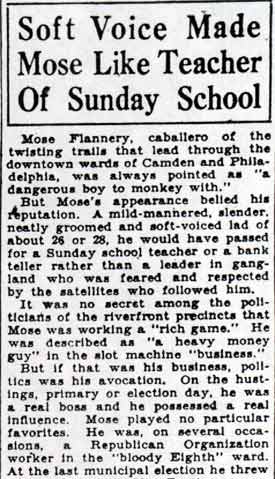
Mose Flannery, caballero of the twisting trails that lead through the downtown wards of Camden and Philadelphia, was always pointed as “a dangerous boy to monkey with.”
But Mose’s appearance belied his reputation. A mild-mannered, slender, neatly groomed and soft-voiced lad of about 26 or 28, he would have passed for a Sunday school teacher or a bank teller rather than a leader in gangland who was feared and respected by the satellites who followed him.
It was no secret among the politicians of the riverfront precincts that Mose was working a “rich game.” He was described as “a heavy money guy” in the slot machine “business.”
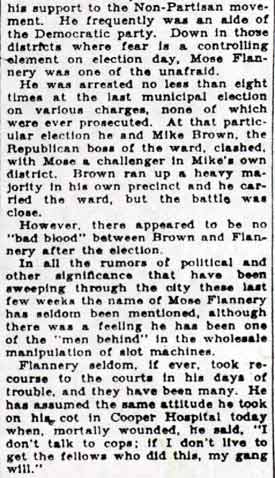
But if that was his business, politics was his avocation. On the hustings, primary or election day, he was a real boss and he possessed a real influence. Mose played no particular favorites. He was, on several occasions, a Republican Organization worker in the “bloody Eighth” ward. At the last municipal election he threw his support to the Non-Partisan movement. He frequently was an aide of the Democratic party.
Down in those districts where fear is a controlling element on election day, Mose Flannery was one of the unafraid. He was arrested no less than eight times at the last municipal election on various charges, none of which were ever prosecuted. At that particular election he and Mike Brown, the Republican boss of the ward, clashed, with Mose a challenger in Mike’s own district. Brown ran up a heavy majority in his own precinct and he carried the ward, but the battle was close.
However, there appeared to be no “bad blood” between Brown and Flannery after the election.
In all the rumors of political and other significance that have been sweeping through the city these last few weeks the name of Mose Flannery has seldom been mentioned, although there was a feeling he has been one of the “men behind” in the wholesale manipulation of slot machines.
Flannery seldom, if ever, took recourse to the courts in his days of trouble, and they have been many. He has assumed the same attitude he took on his cot in Cooper Hospital today when, mortally wounded, he said, “I don’t talk to cops; if I don’t live to get the fellows who did this, my gang will.”
Bandit Given Year in Holdup of ‘Mikey’
Camden Courier-Post —
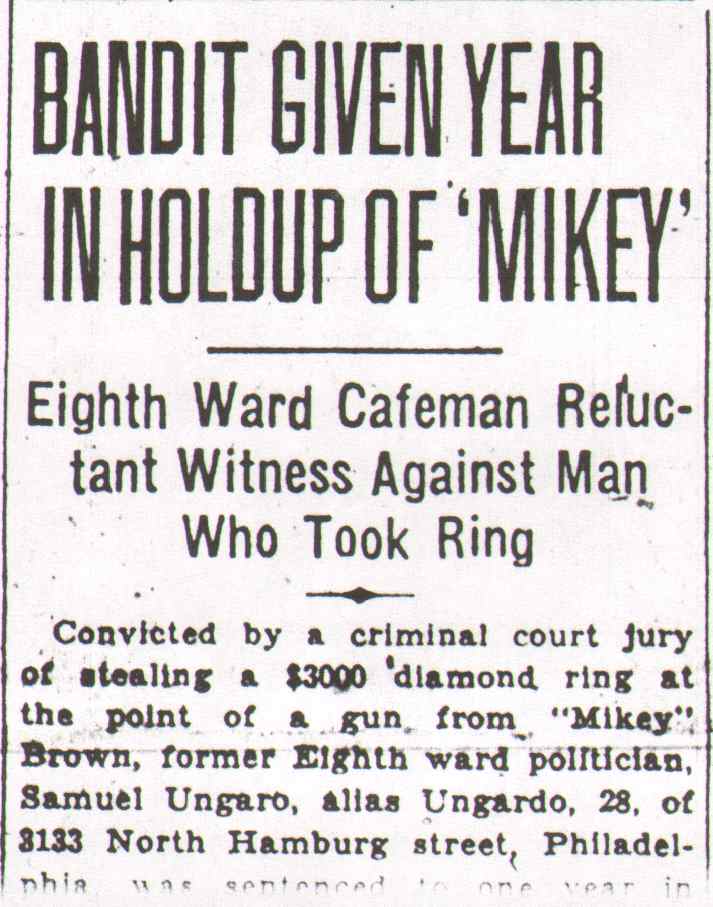
BANDIT GIVEN YEAR IN HOLDUP OF ‘MIKEY’
Eighth Ward Cafeman Reluctant Witness Against Man Who Took Ring
Convicted by a criminal court jury of stealing a $3000 diamond ring at the point of a gun from “Mikey” Brown, former Eighth ward politician, Samuel Ungaro, alias Ungardo, 28, of 3133 North Hamburg street, Philadelphia, was sentenced to one year in state prison today.
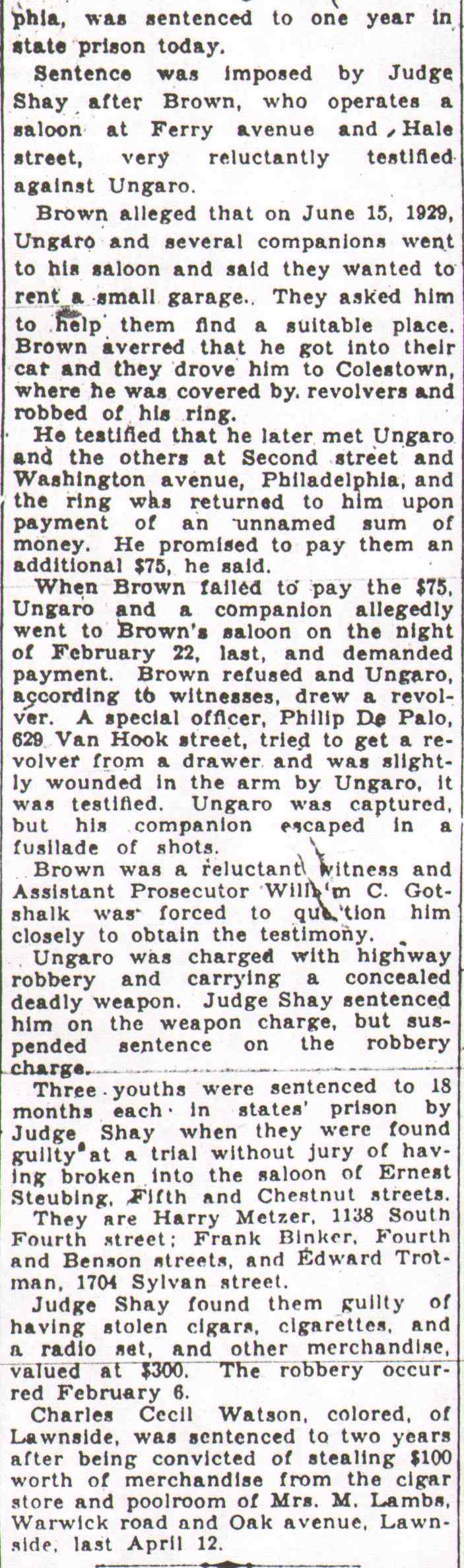
Sentence was imposed by Judge Shay after Brown, who operates a saloon at Ferry avenue and Hale street, very reluctantly testified against Ungaro.
Brown alleged that on June 15, 1929, Ungaro and several companions went to his saloon and said they wanted to rent a small garage. They asked him to help them find a suitable place. Brown averred that he got into their car and they drove him to Colestown, where he was covered by revolvers and robbed of his ring.
He testified that he later met Ungaro and the others at Second street and Washington avenue, Philadelphia, and the ring was returned to him upon payment of an unnamed sum of money. He promised to pay them an additional $75, he said.
When Brown failed to pay the $75, Ungaro and a companion allegedly went to Brown’s saloon on the night of February 22, last, and demanded payment. Brown refused and Ungaro, according to witnesses, drew a revolver. A special officer, Philip De Palo, 629 Van Hook street, tried to get a revolver from a drawer and was slightly wounded in the arm by Ungaro, it was testified. Ungaro was captured, but his companion escaped in a fusillade of shots.
Brown was a reluctant witness and Assistant Prosecutor William C. Gottshalk was forced to question him closely to obtain the testimony.
Ungaro was charged with highway robbery and carrying a concealed deadly weapon. Judge Shay sentenced him on the weapon charge, but suspended sentence on the robbery charge.
Three youths were sentenced to 18 months each in states’ prison by Judge Shay when they were found guilty at a trial without jury of having broken into the saloon of Ernest Steubing, Fifth and Chestnut streets. They are Harry Metzer, 1138 South Fourth street; Frank Binker, Fourth and Benson streets, and Edward Trotman, 1704 Sylvan street.
Judge Shay found them guilty of having stolen cigars, cigarettes, and a radio set, and other merchandise, valued at $300. The robbery occurred February 6.
Charles Cecil Watson, colored, of Lawnside, was sentenced to two years after being convicted of stealing $100 worth of merchandise from the cigar store and poolroom of Mrs. M. Lambs, Warwick road and Oak avenue, Lawnside, last April 12.
Slot Machine Agent Jobless After Talk With Prosecutor
Camden Courier-Post —
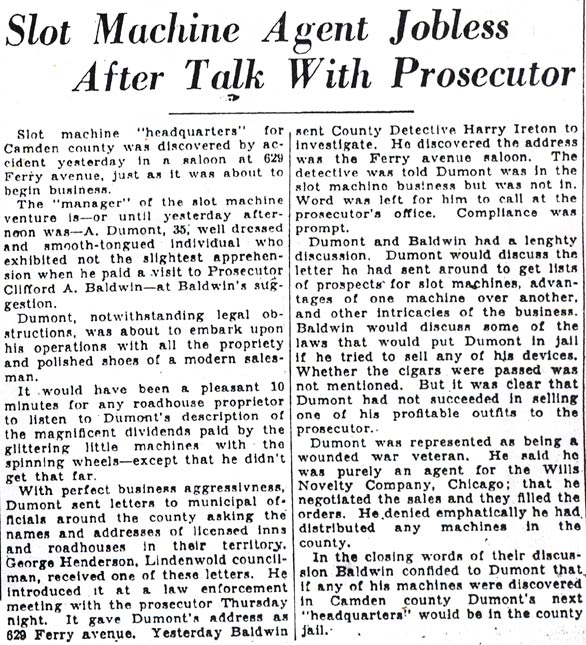
Slot machine “headquarters” for Camden county was discovered by accident yesterday in a saloon at 629 Ferry avenue, just as it was about to begin business.
The “manager” of the slot machine venture is—or until yesterday afternoon was—A. Dumont, 35, well dressed and smooth-tongued individual who exhibited not the slightest apprehension when he paid a visit to Prosecutor Clifford A. Baldwin—at Baldwin’s suggestion.
Dumont, notwithstanding legal obstructions, was about to embark upon his operations with all the propriety and polished shoes of a modern salesman.
It would have been a pleasant 10 minutes for any roadhouse proprietor to listen to Dumont’s description of the magnificent dividends paid by the glittering little machines with the spinning wheels—except that he didn’t get that far.
With perfect business aggressiveness, Dumont sent letters to municipal officials around the county asking the names and addresses of licensed inns and roadhouses in their territory. George Henderson, Lindenwold councilman, received one of these letters. He introduced it at a law enforcement meeting with the prosecutor Thursday night. It gave Dumont’s address as 629 Ferry avenue. Yesterday Baldwin sent County Detective Harry Ireton to investigate. He discovered the address was the Ferry avenue saloon. The detective was told Dumont was in the slot machine business but was not in. Word was left for him to call at the prosecutor’s office. Compliance was prompt.
Dumont and Baldwin had a lengthy discussion. Dumont would discuss the letter he had sent around to get lists of prospects for slot machines, advantages of one machine over another, and other intricacies of the business. Baldwin would discuss some of the laws that would put Dumont in jail if he tried to sell any of his devices. Whether the cigars were passed was not mentioned. But it was clear that Dumont had not succeeded in selling one of his profitable outfits to the prosecutor.
Dumont was represented as being a wounded war veteran. He said he was purely an agent for the Wills Novelty Company, Chicago; that he negotiated the sales and they filled the orders. He denied emphatically he had distributed any machines in the county.
In the closing words of their discussion Baldwin confided to Dumont that if any of his machines were discovered in Camden county, Dumont’s next “headquarters” would be in the county jail.
Mikey Brown Trial Delayed to Feb 14
Camden Courier-Post —
MIKEY BROWN TRIAL DELAYED TO FEB 14
Third Hearing on Election Charges Postponed by Heavy Calendar
The third trial of Mikey Brown on election violation charges, originally scheduled for today, has been postponed until February 14, It was announced Saturday by Prosecutor Clifford A. Baldwin.
The prosecutor stated that when he set Monday as date of trial, he did not know Judge Samuel M. Shay would conduct naturalization court on that day and would hear Orphans Court matters during the remainder of the week.
Criminal court sessions are usually begun on Monday, but Joseph Dillon, U. S. naturalization examiner, will interrogate 84 aliens before Judge Shay today. The jurist stated he has urgent Orphans Court matters which will require hearing on Tuesday, Wednesday, Thursday and Friday of this week, so that the first available day for the Brown trial will be Tuesday of next week, as Monday will be the legal observation of Lincoln’s birthday anniversary. The Eighth Ward Republican leader has twice been acquitted by criminal court juries of charges growing out of the 1931 primary election. The remaining indictment charges that he interfered with and prevented a legal election from being held in the Second precinct of his ward in the general election on November 3, 1931. The indictment, returned by the grand jury on December 1, 1931, also contains a count against Brown of assault and battery upon John F. McGuire, Democratic election officer. Prosecutor Baldwin stated he has two North Jersey attorneys who claim to have witnessed the alleged assault.
Baldwin announced that at the conclusion of the Brown case, he will immediately move for trial the murder indictment against Peter DeVito, alleged slayer of Justice of the Peace Giuseppe Pirella.
26 Men and 6 Women Are Arrested in Raid
Camden Evening Courier —
26 MEN AND 6 WOMEN ARE ARRESTED IN RAID
Lieutenant Herbert Anderson and patrolmen of the Fourth district, raided a house at 1812 Mulford Street early yesterday, held Hobart White, 27, colored, of that address, as the alleged proprietor, and 25 men and 6 women as material witnesses for hearing today.
White was released in $500 bail and the others in $100 bail, which was furnished by Mikey Brown and Jake Foos.
Park Vote Wasn’t Tallied In Eighth Ward Precinct
Camden Courier-Post —
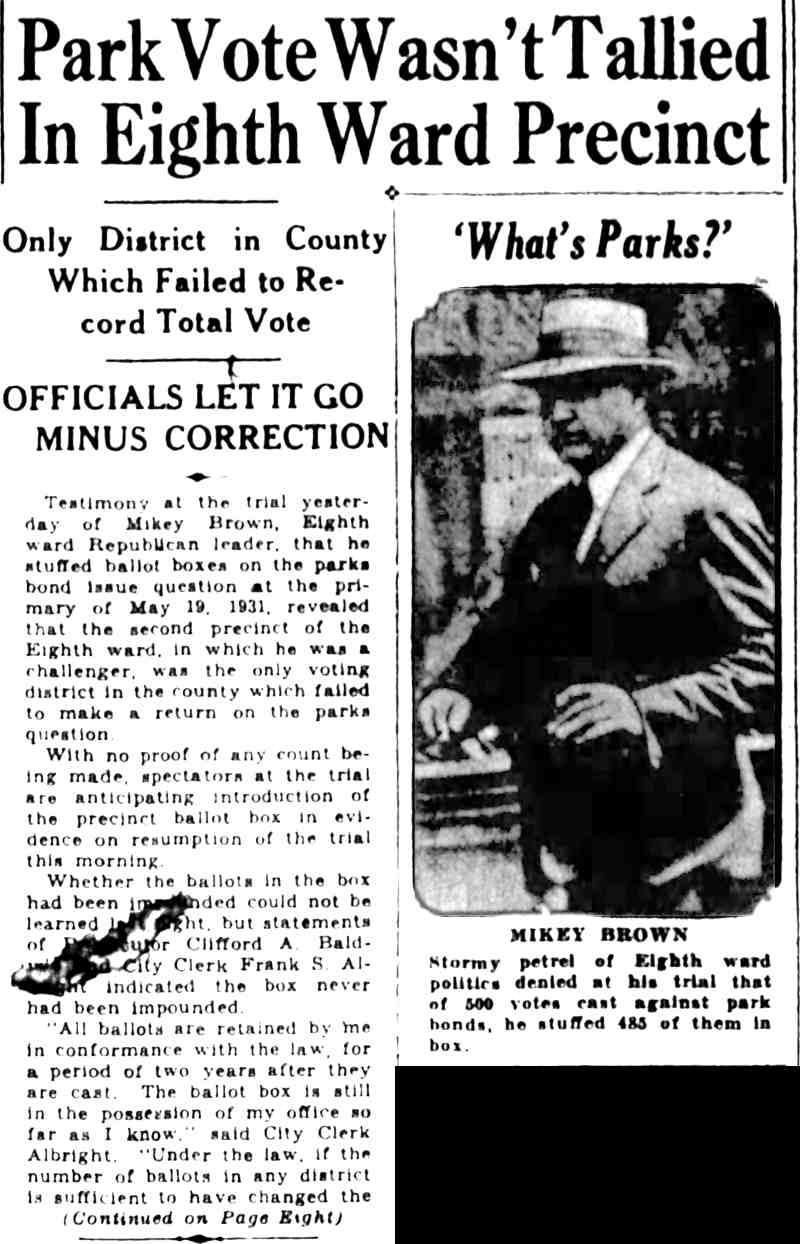
Only District in County Which Failed to Record Total Vote
OFFICIALS LET IT GO MINUS CORRECTION
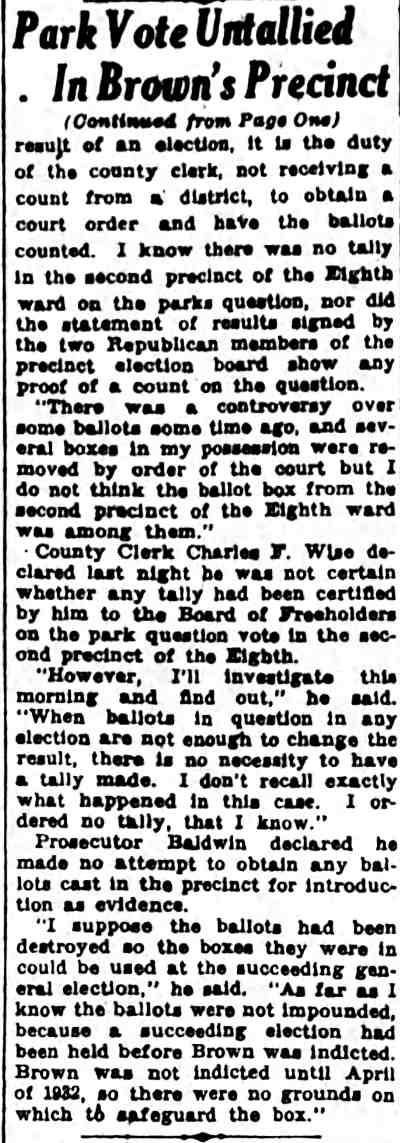
‘What’s Parks?’
MIKEY BROWN
Stormy petrel of Eighth ward politics denied at his trial that of 500 votes cast against park bonds, he stuffed 485 of them in box.
Testimony at the trial yesterday of Mikey Brown, Eighth ward Republican leader, that he stuffed ballot boxes on the parks bond issue question at the primary of May 19, 1931, revealed that the second precinct of the Eighth ward, in which he was a challenger, was the only voting district in the county which failed to make a return on the parks question.
With no proof of any count being made, spectators at the trial are anticipating introduction of the precinct ballot box in evidence on resumption of the trial this morning.
Whether the ballots in the box had been impounded could not be learned last night, but statements of Prosecutor Clifford A. Baldwin and City Clerk Frank S. Albright indicated the box never had been impounded.
“All ballots are retained by me in conformance with the law, for a period of two years after they are cast. The ballot box is still in the possession of my office so far as I know,” said City Clerk Albright. “Under the law, if the number of ballots in any district is sufficient to have changed the (Continued on Page Eight)
Park Vote Untallied In Brown’s Precinct (Continued from Page One)
result of an election, it is the duty of the county clerk, not receiving a count from a district, to obtain a court order and have the ballots counted. I know there was no tally in the second precinct of the Eighth ward on the parks question, nor did the statement of results signed by the two Republican members of the precinct election board show any proof of a count on the question.
“There was a controversy over some ballots some time ago, and several boxes in my possession were removed by order of the court but I do not think the ballot box from the second precinct of the Eighth ward was among them.”
County Clerk Charles F. Wise declared last night he was not certain whether any tally had been certified by him to the Board of Freeholders on the park question vote in the second precinct of the Eighth.
“However, I’ll investigate this morning and find out,” he said. “When ballots in question in any election are not enough to change the result, there is no necessity to have a tally made. I don’t recall exactly what happened in this case. I ordered no tally, that I know.”
Prosecutor Baldwin declared he made no attempt to obtain any ballots cast in the precinct for introduction as evidence.
“I suppose the ballots had been destroyed so the boxes they were in could be used at the succeeding general election,” he said. “As far as I know the ballots were not impounded, because a succeeding election had been held before Brown was indicted. Brown was not indicted until April of 1932, so there were no grounds on which to safeguard the box.”
Baldwin Asks for Conviction of Ward Boss Despite Denial
Camden Courier-Post —

BALDWIN ASKS FOR CONVICTION OF WARD BOSS DESPITE DENIAL
Downtown Leader Says He Had No Interest in Parks Vote
2 WITNESSES TESTIFY TO 485 WRONGLY CAST
Case Before Judge Shay Draws Large Crowds to Court House
A jury in Camden Criminal Court this morning will be given the case of Mikey Brown, Eighth Ward Republican leader, to decide whether he stuffed 485 ballots into a second precinct box at the primary election of May 19, 1931.
On the stand for 13 minutes late yesterday before Judge Samuel M. Shay and the jury, Mikey denied the charge, testified to by two Democratic election board officers and sagely informed the court that he had “no interest in ballot boxes.”
“I got nothing to do with parks. Of what interest to me is parks,” he answered when asked if he stuffed any ballots on the $3,500,000 parks bond issue in the second precinct box of the Eighth Ward.
The referendum on parks was in conjunction with the regular primary election, and was carried.
His denial of ballot-stuffing was corroborated by several witnesses, one of them being Cornelius Rose, 861 Van Hook street, who, with Brown, was a Republican challenger at the election.
When the defense’s final witness, Herbert Hicks, could not be located, the trial was adjourned until 10 a.m. today.
The state “rested” its case at 1:52 p.m. and defense counsel made an unsuccessful bid for a directed verdict of acquittal.
When Judge Samuel M. Shay ordered the trial to continue, the defense then called as its first witness (Continued on Page Eight)
Mikey Brown Jury To Get Case Today (Continued from Page One)
former Prosecutor Ethan P. Wescott, a Democrat and attorney for a defendant indicted with Brown in another alleged election violation.
The purpose of the defense was to show that the two election officials made no complaint of Brown’s alleged ballot box stuffing to Wescott when he entered the polling place several times, but the testimony was not permitted when Judge Shay upheld Prosecutor Clifford A. Baldwin’s contention that Wescott had no official post on those visits and, therefore, the election officers could not complain to him.
Both Saw ‘Stuffing’
The two election officers who were the state’s principal witnesses were John F. McGuire and Wilbert Vennell. Both stated that they saw Brown stuff 485 ballots into the box. McGuire described them as negative ballots, while Vennell did not know whether they were negative or affirmative.
The twice-postponed trial is being heard by Judge Shay and a jury of ten men and two women, none of whom reside in the Eighth ward.
After Victor J. Scharle, registrar at the permanent registration bureau, testified there were only 305 qualified voters in that precinct for that election, McGuire said the board was furnished with 500 “Yes” park ballots and 500 “No” ballots, the voters merely dropping whichever ballot they wished to cast, into the box.
After 15 negative park ballots had been legally cast, McGuire told the court, Brown picked up the remaining 485 “No” ballots, folded them and pushed them into the box. Under direct examination by Prosecutor Clifford A. Baldwin, McGuire said Brown “stuffed” the ballot box three hours after he cast his own vote. But under cross examination by T. Harry Rowland, associate defense counsel, McGuire changed this part of his testimony and said the “stuffing” occurred before Brown cast his own vote.
Later testimony revealed that the tally sheet for the box did not contain any record of a count of the park bond ballots.
No Objection
However, McGuire said that all the “No” ballots, 500 in number, had been placed in the box, so that the number of negative ballots exceeded by nearly 200 the total number of qualified voters in the district.
McGuire testified that neither he nor any other member of the election board made any objection when Brown purportedly stuffed the box.
‘Mikey’ On Stand
Brown went on the stand at 2.55 p. m., and his testimony under direct examination required less than three minutes.
“Are you a resident of the Eighth ward?” Rowland asked him, and Brown replied he had lived in the ward for 38 years. He gave his address as 629 Ferry avenue.
“Do you recall the primary election of 1931?”
“Yes.”
“Did you have an official position then?”
“Yes, I was a Republican challenger.”
“Were you at the polls all day?”
“Yes.”
“Do you know McGuire.”
“Yes.”
Rowland then showed him the poll book and said:
“Is this your signature with ballot No. 364 beside it?”
“Yes, sir.”
“Do you recall at what time of the day you voted?”
Voted Late In Day
“Yes, after I paid my men off—I had men driving teams that day—after I paid them off, I left the stables at 6 p. m. and went around and voted at 6.15 p. m.”
“Were there any park ballots there then?”
“I got one,” replied Brown.
“Mike, did you stuff any ballots in the ballot box on that day?”
“Mr. Rowland,” replied Brown, “I had no interest to stuff ballot boxes. I got nothing to do with parks. What interest to me is parks?”
“McGuire said you did,” pointed out Rowland.
“McGuire said lots of things up here today,” retorted Brown.
“That’s all,” said Rowland.
Prosecutor Baldwin then began cross-examination.
“You were in and out of the polling place several times that day, weren’t you?” asked the prosecutor.
“Yes,” Brown answered.
“What was your purpose of going in and out?”
“I was a challenger.”
“How many hours did you spend at this precinct?”
“Five or six.”
“As a matter of fact, didn’t you withdraw at noon?”
“No, I was at the polls all day.”
“As a matter of fact, didn’t you and your workers agree to —“
Counsel Protests
Rowland jumped to his feet and objected, saying:
“Your Honor, I don’t want to go into the mysteries of Eighth ward politics, but the prosecutor is going unfold.”
Judge Shay ruled that the witness was the defendant in the case and the prosecutor should be allowed latitude. He permitted the question to be continued, whereupon Baldwin resumed:
“Didn’t you and yours workers agree to terminate the contest?”
“Not me,” declared Brown.
“Weren’t you backing a certain candidate for county committee in the Eighth ward?”
Rowland objected but was overruled.
Brown shouted:
“I was there to see that the Republican party got their rights.”
“Isn’t it a fact that during the afternoon you and your workers had a celebration of some kind, a sort of a meeting together because another candidate for county committee had withdrawn?” asked Baldwin.
Rowland’s newest objection was over-ruled. Brown said:
“I’ll tell you about that. The precinct committeeman of the Fourth precinct of the Eighth ward said that the other fellow quit, and I wanted to put a party on at the clubhouse at 4 p.m. I had no beer to give them, so I gave them a donation and told them to go ahead and put on a party.”
“Did you go with them?”
“No.”
Defense Turned Down
Then Baldwin asked Brown if he had visited other districts in the ward during the day and Brown said he had visited at least six precincts in the morning and again in the afternoon.
“When you voted, did they give you two park bond ballots?”
“Yes.”
“Have you ever been convicted of a crime?”
“No, sir.”
“Are you the Michael Brown who was convicted in 1919 of receiving stolen goods?”
“No, sir.”
Brown left the stand.
Rowland based his motion for a directed verdict on his interpretation of the general election laws for New Jersey. He stated that even assuming the state’s testimony was correct, Brown would have committed no crime. He averred the general election laws provide that referendum questions be placed on the regular election ballot so that the two separate park bond ballots were illegal.
Prosecutor Baldwin argued that Chapter 73 of the 1931 laws stipulates that in a referendum the questions “Yes” and “No” be submitted to the voters on separate ballots.
Judge Shay upheld the prosecutor’s contention, whereupon Rowland made a brief address to the jury in which he denied the charges in the indictment.
Hints at Mystery
Rowland also declared at one point of his address that “there may be something back of this and we don’t know what it is.”
Brown was placed on trial on one of three indictments chargnig [sic] him with election law violations in 1931. In addition to the indictment charging the stuffing of ballot boxes in the Second precinct, a second true bill alleges he aided unknown persons in stuffing Third precinct ballot boxes.
A third indictment charges Brown with assault and battery upon McGuire and evicting him from the Second district polling place at the 1931 general election.
According to defense counsel, Brown’s real name is Michael Bruno, and he resides at Ferry and Railroad avenues. He appeared in court today conservatively dressed in a brown suit.
A crowd of spectators gathered in the corridors, which were finally roped off by police, who stood on guard to prevent anyone but witnesses entering the courtroom.
Another man, Jacob Foos, is indicted with Brown in the ejection of the election official and was scheduled to go on trial today.
Only 27 minutes were required to complete the jury. The defense challenged four veniremen and the state challenged one. The latter was George Hughes, painter, 819 Tulip street. It was a pre-emptory challenge, and no reason was given by Baldwin for it.
The Jurors
The jury:
Joseph Scholl, a foreman, Garden Lake, Lindenwold, foreman of the jury.
John Strehle, carpenter, Madison avenue, Magnolia.
Mary C. Wright, housewife, 100 Harvard avenue, Collingswood.
William E. Foster, engraver, 102 South Twenty-seventh street, Camden.
Edgar Brittingham, salesman, 525 Spruce street, Camden.
Lillian Schregler, clerk, Marlton pike, Merchantville.
Harry P. Gardner, insurance, 151 Hawthorne avenue, Haddonfield.
Wallace Warwick, retired, 2514 Morgan boulevard, Camden.
James McGuigan, blacksmith, 208 Bergen street, Brooklawn.
William Downer, printer, 922 North Twenty-eighth street, Camden.
Walter J. Blair, machinist, 300 Cooper street.
Joseph Collins, machinist, 988 Penn street, Camden.
Those challenged by the defense were Mrs. D. F. Beckhardt, housewife, Laurel Springs; Pierce Rotzell, contractor, West End avenue, Pennsauken township; Martin Duddy, farmer, R. F. D. Sicklerville, and Mary Collins, housewife, 510 Gordon terrace, Camden.
Before the jury was sworn to duty, Rowland arose and addressed the court:
“If your honor permits, may I find out from the jury if any of them have had their minds made up about the innocence or guilt of this defendant by reading newspaper articles or by conversation?”
Baldwin Asks Conviction
Judge Shay nodded affirmation, and Rowland said to the jury:
“I am speaking to you now in a spirit of fairness. This defendant is charged with violating the state election laws. There has been considerable newspaper publicity and conversation about the case. I am asking you if there is anything in your minds now that would prevent you from rendering a verdict strictly on the evidence. If any of you have such prejudices, you, in a spirit of fairness, will withdraw now.”
None of the jurors responded and Rowland returned to his place at the defense table.
Prosecutor Baldwin then outlined briefly the charges contained in the indictment. He pointed out that in addition to the regular primary ballots, the voters received two other ballots prtaining [sic] to the referendum on the $3,500,000 park bond issue. One ballot was affirmative and the other was negative, and the voter merely placed whichever one he wanted into the ballot box, discarding the other, so that the voter did not have to mark those ballots.
“We’ll show that Brown introduced more than 100 of these park ballots illegally,” averred the prosecutor, “and when we show that, we’ll ask that you return a verdict of guilty.”
Scharle Called
Scharle, who resides in the Eighth Ward, was called as the first witness. The prosecutor asked him to produce poll books for the Second district of that ward. Rowland was instantly on his feet with the objection that the witness’ testimony would be irrelevant and immaterial. Judge Shay overruled Rowland but granted him an exception. Rowland then asked the prosecutor what his purpose was in producing the poll books, and the prosecutor replied he intended to show the number of qualified voters in the district at that election. Rowland again objected but was overruled. The books were admitted to evidence.
Under questioning by Baldwin, Scharle said there were 286 qualified voters in the Republican book and 19 in the Democratic book. After a slight pause, defense counsel decided not to cross examine Scharle.
McGuire, after giving information concerning his address and service on the election boards for some six years. He then described the park bond ballots over the objections of Rowland. There was no separate box for the park ballots, and by agreement of the board, they were put in the Democratic box.
“We accepted the first 15 park ballots,” he testified, “and put them in the Democratic box as we were directed.”
“How many park ballots were actually cast?” asked Baldwin.
“Only 15,” was the response.
Report Identified
Baldwin asked him to identify a report on the return of the “vote of the Republican party—“ when Rowland objected. McGuire identified the report. Rowland asked for the privilege of cross examining the witness on the report and learned that McGuire had not had the report in his possession since the election. Rowland then objected to such testimony unless the witness could testify the report’s condition today was identical with the report when he last saw it.
“The witness does not know if it was altered or tampered with, or whether any changes were made,” declared Rowland.
Baldwin asked that the report be marked for identification, and such permission was granted by the court.
Further examination by Baldwin revealed that the signature of McGuire and the other Democratic member of the district board, were not on the report.
“What were you doing at the time the count was made?” asked Baldwin.
“I was acting as clerk.”
“Did you see where the park bond ballots came from when the ballots were counted?”
“No, I did not,” admitted the witness.
Baldwin reframed the question several times with the same result. Baldwin then asked:
“Did you see Brown do anything during or prior to the count?”
“I saw Mike Brown put the park bond ballots less 15 into the Democratic box,” was McGuire’s answer.
“What ballots were they?” asked the state.
“They were the negative ballots.”
“Who put them in the box?”
Accuses ‘Mikey’
“Mike Brown.”
“What time of the day was it?”
“Around this time of the day,” replied the witness as he glanced at the courtroom clock, whose hands pointed to the noon hour.
“In what box did he put them?”
“It was agreed that we place them in the Democratic box,” McGuire said, referring to the previous agreement of members of the board.
“Did you agree with the defendant to put these ballots in the box?” asked the prosecutor, to ascertain that McGuire had not agreed to Brown’s placing the ballots in the box.
“No.”
“What box did Mike Brown put them in?”
“I believe in the Democratic box.”
“How did he put them in?”
“He just bundled them up and pushed them in.”
“How many?”
“We were sent 500, and he put in all but 15.”
“You mean that 485 were put in?”
“Yes.”
Job Took Half Hour
“Over what period of time did he put them in?”
“In about a half an hour.”
“Were you present?” McGuire was asked, and he answered “Yes.”
“Didn’t you object?” asked Baldwin.
“No.”
“Did you say anything to the defendant?”
“No, I didn’t.”
“Did any other member or members of the board object?”
“Not to my knowledge.”
“Where did Brown get the ballots?”
“They were placed on the table beside the box.”
“But I asked you where Brown got the ballots?” Baldwin repeated.
“He got them from alongside of the box.”
“What did he do?”
“He just stood there and put them in.”
“How did he put them in? Were they folded or were they put in the box separately?”
“I couldn’t just say whether they were folded or how they were put in.”
Mikey Cast Vote
“Did Brown vote?”
“Yes.”
“When?”
“In the fore part of the morning.”
“Did he put these park ballots in before or after he cast his vote?”
“After.”
McGuire then said Brown placed the extra ballots in the box three hours after he voted.
“After Brown put the 485 ballots in the box, were there any left?”
“Yes.”
“What were they?”
“Only the ‘Yes’ ballots were left.”
“Any ‘No’ ballots left?”
“No.”
Baldwin then asked McGuire, “Did you sign a statement of the result?” The answer was, “No.” McGuire was turned over to Rowland for cross-examination. Rowland carefully arranged some papers on his table, settled himself back in his chair, and, toying with a pencil, said:
“McGuire, are you an election officer in that precinct?” “Yes.”
“Do you reside in that precinct?”
“No, I live in the First precinct.”
“What time did Brown vote that day?”
“I can’t tell you the exact minute.”
“Suppose he voted ballot No. 364—would that help you?”
“No.”
“Wouldn’t it show whether he voted at high noon or late in the day?”
“Yes, late in the day.”
Rowland showed the election book and pointed out where Brown’s ballot was No. 364. Walking back to his table, he said:
“Wouldn’t that cause you to believe he voted late in the day?”
“Yes.”
“Then when you said he voted at noon you were mistaken?”
“Yes.”
“Were the park bond ballots put in the box before or after he voted?”
“I know he put the ballots in the box.”
“But did he vote late in the day?”
“Well, the record shows he voted late.”
“Did he put these ballots in the box before or after he voted?”
“Before!”
“Were other persons present at the time?”
“Yes, quite a number.”
“Are you sure the ballots were put in the box before lunch?”
“Yes, he put ’em in before he voted.”
“How do you know there were 500 ballots and that Brown put 485 in the box?”
“Well, 15 people got ballots, and I know the other 485 were stuffed in—I saw them.”
“You made no complaint?”
“No.”
“How about the agreement the election board made to put these park bond ballots in the Democratic box?”
“Yes, we agreed to put them all in the Democratic box.”
Put In Same Box
“If a Republican or Democrat came in, and wanted to vote a park bond ballot, then that ballot was put in the Democratic box?”
“Yes.”
“How many people voted that day in that precinct?”
“My records show 242 Republicans.”
“That’s all,” said Rowland.
“Did 398 voters vote that day?” asked Baldwin on re-direct examination.
Rowland objected, while McGuire shouted, “No!”
Rowland continued his objection, and Judge Shay said; “Well, he’s a member of the board, and there are such things as fake returns.”
Baldwin said, “Can you tell from the Republican poll books how many did cast their ballots?” and he showed the witness the poll books.
McGuire answered, “272.”
Howard Truax, deputy county clerk, took the stand for questioning by Baldwin.
“Are you the custodian of the results of primary elections?”
“Yes.”
“I show you Exhibit S. 3. and ask you if you were the custodian of this paper?”
“Yes.”
Baldwin offered the statement of results in evidence. He showed the witness the paper and read from it as follows “For park bonds, against park bonds, no vote recorded on tally sheet. F. S. A.” The initials are those of City Clerk Frank S. Albright.
Baldwin asked if that notation was on the paper when Truax received it.
Truax said it was.
Rowland asked Truax:
“There was no return on the park bond vote on this sheet, was there?”
“No, as far as we know.”
“Well, it isn’t on there, is it?”
“No.”
“That’s all.”
Court adjourned at 12.25 until 1.30 p. m.
When court reconvened at 1.35 p. m., Rowland asked the court’s permission to recall McGuire to put to the witness several questions which he had forgotten to include in his cross-examination.
“What time did you go to lunch that day?” Rowland asked when McGuire was told by the court to take the stand.
“I didn’t go to lunch. I went out to vote in my precinct about noontime and was away about 20 minutes,” answered McGuire.
“Weren’t you also an election officer on the next election day following the primary?”
“Yes.”
“Didn’t you have trouble with the defendant on that day?”
Baldwin objected at first and then withdrew his objection.
“Yes, I had Brown arrested,” asserted McGuire.
“Do you know that an indictment was not returned against Brown until April, 1932?”
“That was no fault of mine,” McGuire declared.
“Did you have an augument [sic] with Brown on the general election day in 1931?”
“Yes.”
“Is that indictment still pending?”
“Yes, Rowland answered, and then Rowland turned the witness over to Prosecutor Baldwin, who asked:
“What was the nature of the disturbance that caused you to have Brown arrested?”
“I was a member of the board,” replied McGuire, “and I lost my seat because Brown pushed me off the chair.”
“Didn’t you make an affidavit confirming what you saw on primary day and didn’t you submit that affidavit to the court?” asked Baldwin.
“Yes, to Justice Lloyd.”
“Have you any prejudice against Brown?”
Denies Prejudice
“No, I have no personal prejudice.”
Vennell was then called, and after testifying he knew Brown for 25 years, and that he was a Democratic member of the Second district board, he was asked by state’s attorney:
“Did you see Brown do anything on primary election day in 1931?”
“Yes.”
“What did you see him do?”
“I saw him put the park bond ballots in the box.”
“What kind of ballots were they?”
“I don’t know whether they were ‘yes’ or ‘no.’”
“How many did he put in?”
“He put in all that had been voted, probably four or five hundred.”
“Were there any park ballots left?”
“No.”
“How did Brown put them in the box?”
“In bunches of 10 and 15.”
“Were you present when the ballot box was opened?”
When McGrath [sic] said he was, Baldwin asked him if the park ballots came out separately or in bunches. McGuire said:
“Those park bond ballots were never removed from the box.”
No Canvass Made
“Didn’t you make a canvass of the park bond ballots?”
“No.”
“What was the vote for and against the parks?”
“I don’t know; they didn’t tally them.”
Under cross-examination he was asked when Brown voted. He said it was early in the morning. Rowland pointed out that Brown voted ballot 364, and asked if Brown couldn’t have voted later in the day. Vennell looked at the poll book which Rowland held before him.
“That number might have been put there after Brown voted.”
Vennell again glanced in the book and then exclaimed:
“How did that 17 get in there?”
Rowland walked away, closing the book and throwing it down on the table, said, “That’s all.”
The state then “rested” and Rowland asked permission to make a motion side-bar.
Wescott was the first defense witness. Under direct examination by Rowland, he was asked:
“Were you active in things political on this primary day?”
“Yes, I was very much interested in the outcome of the election.”
“As a member of what party?”
“The Democratic party.”
“Were you interested in the vote in the Second district of the Eighth ward that day?”
“Yes.”
“Did you visit the district?”
Tells of Visit
“I did. I was there twice in the morning and either two or three times that afternoon.”
“Do you know Mr. McGuire.”
“Yes.”
“Did you talk to him?”
“I addressed my remarks generally to the board.”
“Did Mr. McGuire or Mr. Vennell complain to you that this gentleman (pointing to Brown at the defense table) put slips in the ballot box?”
Baldwin objected, arguing that Wescott was not there in any official capacity and therefore was not a person to whom a formal complaint would or should be made. Shay upheld Baldwin.
“When was the last time you were there?”
“About 5 or 5.30 in the afternoon.”
“Were you in the polling place?”
“Yes.”
“Do you know whether the voters were given slips on the park question?”
“I have no recollection of that.”
“How long did you stay there?”
“At no time more than five minutes, although, possibly, 10 minutes.”
“Was Mr. McGuire there each time you visited the place?”
“He was there on my first visit and on my last, but my recollection is that he was not there about noon.”
Saw Mickey There
“Do you recall seeing the defendant around the polls?”
“I saw him there, yes.”
“Did you talk with him?”
“Yes.”
“Did you see any police officers at the polling place?”
“Yes, police officers were inside the place.”
“Did you see Mr. Brown stuff any slips in the ballot box?”
“Not while I was there.”
“Was there any talk about it?”
Baldwin objected to the question as improper, and was sustained.
“Was there any time when you were there when there were no park ballots?”
Baldwin again objected and was sustained.
“Did you hear any objections by voters?”
Baldwin objected and was upheld. Rowland said his purpose was to show that if the election board saw any violation of the law it was the duty of its members to have the person arrested for violating the law. He asserted no such complaint was made in this case and such evidence should be taken into consideration by the jury.
Judge Shay said, “Mr. Wescott was not at the polling place in an official capacity and no formal complaint could have been made to him.”
Rowland resumed questioning Wescott.
“Well, there isn’t any doubt but that Mr. McGuire and Mr. Vennell knew you were there as a representative of the Democratic organization, is there?”
Baldwin objected and was upheld, and the direct examination by the defense was over. Baldwin cross-examined.
“Why were you interested in two districts in the Eighth ward and in districts in the Third and Fifth wards?”
Told to ‘Look In’
“I was requested to see what was going on.”
“Did you do this on your own initiative or after requests?”
“Following requests.”
“You visited the Second precinct four or five times?”
“Yes.”
“Did you direct your remarks to the election board?”
“Yes.”
“What did you say?”
“I asked what was going on, if there was any trouble, the same as I asked at all the places I visited that day.”
“Were you looking for trouble?”
“No.”
“Yet you found occasion to go back there four times that day?”
“I believe I visited each district the same number of times.”
“You were a sort of courier, then, all day, between these places?”
“Yes.”
“You were not essentially interested in the park bond issue, were you?”
“No.”
“But you were interested in other issues?”
“Yes.”
To Rowland Wescott then said he received no complaints of trouble at places he visited. David Fine, 696 Vanhook street, was the next defense witness. He said that he was rejected when he went to vote before noon, when McGuire said his name was not in the poll book. So he went to court to get a certificate and cast his vote in the afternoon. He did not recall McGuire being there when he voted.
He testified he was given park bond referendum slips to vote on that issue, which contradicted McGuire’s testimony that no negative slips were voted in the afternoon. He did not recall if others were given park slips to vote. Fine insisted he referred to the primary election of May 19, and not the city commission election of May 12.
Defense Counsel Named
The mystery which enshrouded the identity of counsel for Brown was cleared up a few minutes before the actual opening of the trial.
Rowland, Republican, counsel for the Delaware River Joint Commission, and Thomas A. Madden, Democrat, stated they represented Brown. It had been previously reported that Rowland would be defense counsel, but when questioned yesterday by reporters, Rowland said merely that he had been called by Brown, but had told the defendants he knew nothing about the case.
As late as an hour before the trial got under way, Prosecutor Baldwin asserted he did not know who would represent Brown.
Prosecutor Baldwin today met criticism of the two previous postponements and the announcing of the date of trial for today with the declaration that “the Brown case is only another case to this office.”
“Perhaps the trial of Brown has special news significance, but to this office it is just another case,” the prosecutor averred.
“Any inuendo that I set today as the date for trial so that the case would not be tried before Judge Shay is untrue. This office is doing its best to conduct criminal cases as they should be conducted.”
Of the three indictments against Brown, one was returned Dec. 8, 1931, charging him with evicting McGuire from the polls during the general election on Nov. 3 of that year.
The other two indictments, returned April 11, 1932, charge Brown with violating the election laws during the primary election on May 19, 1931. One of these true bills alleges that he stuffed more than 100 ballots in the boxes at the Second precinct polling place in the Eighth ward. The other accuses him of “unlawfully and wilfulling [sic] aiding, assisting and abetting” certain persons in adding fraudulent ballots in the boxes of the Third precinct in the Eighth ward at that election.
When Brown was indicted in December of 1931, five election officers of Brown’s own bailiwick were also cited in true bills which accused them of not performing and enforcing certain provisions of the election laws. There are only four officers on a district election board, but two had been removed on general election day in 1931, so that altogether, six served on that day. Only McGuire was not indicted. The others accused are Leon R. Paulichas, Wilbert Vennell, Charles Grazios, John S. Morvay and Herbert G. Hicks.
The indictments were voted after petitions had been presented to Supreme Court Justice Frank T. Lloyd by North Jersey and Camden county Democratic lawyers.
The Brown cases had been twice postponed, once on request of counsel for Brown and the other time because courts were closed in respect to the late Vice Chancellor Edmund B. Leaming. On the occasion of the last postponement, Prosecutor Baldwin stated he would move the Brown case shortly after the first of the year.
Judge Shay announced last week that he would conduct hearings on Orphans Court matters and that Judge Charles A. Riggs, of Burlington county, would preside over Criminal Court here during the first three days of this week. After Prosecutor Baldwin announced he would move the Brown charges today, Judge Shay asserted he would sit in the case, as it would be unfair to ask a visiting judge to handle a case with which he was unfamiliar.
The fact the public was not admitted to the trial brought protest this afternoon from Orville Dunn, of 224 Center street, Haddonfield. Dunn, who said he was one of 75 spectators barred from the courtroom, asked the Evening Courier to publish this statement:
“Why shouldn’t the public be admitted? We are taxpayers. Sheriff Pelouze claims there is no room in the courtroom except for witnesses, but I have my own ideas.” Dunn did not elaborate on the last statement.
Baldwin ‘Aided’ 8th Ward Voting, Witness Testifies
The insistence of a defense witness that Prosecutor Clifford A. Baldwin was not the prosecutor but was an election officer who had testified earlier in the day caused a few moments of merriment yesterday at the trial of Mikey Brown, Eighth ward Republican leader, on election violation charges.
Allen Mitchell, colored, of 630 Van Hook street, who said he had voted at noon May 19, 1931, was asked under cross examination by Baldwin if he had seen John F. McGuire, election officer, at the polls.
“You’re McGuire; you can’t fool me,” laughed the witness.
“What part did I play in the election down there?” grinned Baldwin.
“Lots,” declared Mitchell.
“Did I hand you your ballots?”
“Yes you did, and you know you did,” insisted Mitchell.
“Do you know McGuire?” pursued Baldwin.
“Sure, I know you,” retorted the witness, and he was dismissed.
Grand Jury Probes 8th Ward Stuffing
Camden Evening Courier —
GRAND JURY PROBES 8TH WARD STUFFING
Fifth District Box Had Too Many Ballots, Prosecutor Told
Another investigation into the mysteries of Eighth Ward elections was begun yesterday when the April grand jury probed ballot-box stuffing in the Fifth District at the May 16, primary.
Prosecutor Clifford A. Baldwin requested the investigation after he “couldn’t make head nor tail” of the fact that 25 ballots remained in the box even after 232 Republican ballots the number of persons of that party recorded as voting had been counted.
Although unconfirmed, it was declared that all of the ballots were marked for Edmund A. Walsh, incumbent, who defeated Mikey Brown for election to the G.O.P. Committee.
It is understood the prosecutor pointed out that the ballots were in bundles of five or six, and apparently had not been cast singly.
Baldwin learned that the extra ballots were not counted by the election board, each member of which was called to the grand jury room yesterday afternoon. All expressed ignorance of how the ballots could have been placed in the box, it is understood.
When Baldwin was informed of the mystery he personally inspected the box, which has been impounded in the office of City Clerk Frank S. Albright.
“I couldn’t make head nor tail of it, so I presented the case to the grand jury,” Baldwin said. He refused to comment further.
Mikey Brown Says Jury Has Plenty To Probe In Eighth Ward Voting
Camden Evening Courier —
Principal Figure in Many Battles Welcomes Quiz
‘Stuffing’ of Ballots Reported in Fifth and First Precincts
RUMORS ARE CHECKED
“The prosecutor and the grand jury have plenty to investigate in this ward concerning the last primary election.”
Mikey Brown, central figure in many Eighth Ward election squabbles and thrice accused in election irregularities, had that to say yesterday when informed that Prosecutor Clifford A. Baldwin and the April grand jury is investigating alleged ballot box stuffing in the ward at the last primary, May 16.
Disclosure of ballot box stuffing in the Fifth precinct of the ward, which the prosecutor said he asked the grand jury investigate was followed by reports yesterday that similar irregularities prevailed in the First precinct at the primary, and possibly in other districts.
Reports Checked
In extending his probe of ward political conditions, Baldwin said he is checking reports that a Brown challenger at the May election had refused to let the First precinct election board count what he declared were “stuffed ballots.”
The challenger is reported at close of the polling place to have said as he lifted a ballot box for the election board and spectators to see:
“There are ballots in this box that don’t belong there. They cannot be counted. I won’t permit it. And remember, Mikey Brown didn’t stuff this box today, as he had been accused falsely of doing at previous elections. Mikey wasn’t in this polling place, so you can’t blame him,”
Brown had been three times in Camden County Criminal Court for ballot box stuffing and other alleged election irregularities. He was exonerated twice, and there was a disagreement in the jury in the third case. At the May primary, he opposed Edmund A. Walsh in a contest for Republican county committeeman from the Eighth ward, but was defeated. Walsh was re-elected.
Asked what he knew about the latest Eighth ward situation, Brown said:
“All I can say is that the prosecutor and the grand jury will have plenty to investigate pertaining to the May 16 primary in the ward.”
Box Not Impounded
The first precinct ballot box has not been impounded by City Clerk Frank S. Albright, as was the case of the box of the fifth precinct. Baldwin said he was checking rumors one of the first precinct boxes contained about 50 or 60 stuffed ballots. Baldwin said that if the situation be found by him to be as reported, he will request the grand jury to summon witnesses.
Baldwin said he also is checking reports that the names of dead persons were “voted” at the ward primary.
Mikey Brown in Court on Business Conflict
Camden Courier-Post —
MIKEY BROWN IN COURT ON BUSINESS CONFLICT
When Mikey Brown, former stormy petrel of Eighth ward politics, moved to Runnemede recently he thought his appearances in Camden courts were over. But it was not to be.
Mike, who is engaged in the fertilizer business, appeared before Judge Joseph Varbalow in District Court yesterday on complaint of Ross J. Brown, of Mendenhall, Pa., near Villanova.
The Mendenhall Brown claims that on November 14, 1934, he paid the Runnemede Brown $712 for fertilizer. Mikey delivered $462 worth, and refused to deliver the rest, according to the complainant. Ross Brown demanded his $250 worth of fertilizer or the money back.
Mikey Brown, in a counter-claim, said Ross owes him $489 for fertilizer he delivered and for which he never was paid.
Judge Varbalow dismissed the counter-claim and gave Ross Brown a judgment for the $250.
The Browns, incidentally, are not related.
Blaze Destroys Wooden Garage
Camden Courier-Post —
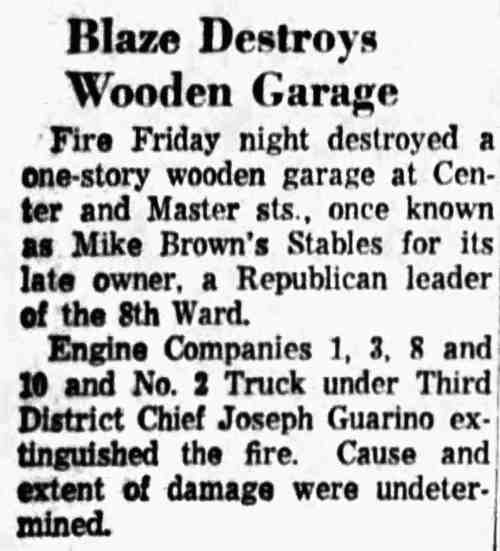
Fire Friday night destroyed a one-story wooden garage at Center and Master sts., once known as Mike Brown’s Stables for its late owner, a Republican leader of the 8th Ward.
Engine Companies 1, 3, 8 and 10 and No. 2 Truck under Third District Chief Joseph Guarino extinguished the fire. Cause and extent of damage were undetermined.