Introduction
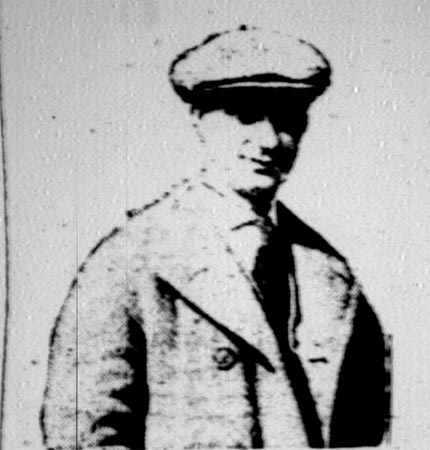
Joseph Deven, 1928
POLACK JOE DEVEN was not Polish at all. He was born to Italian immigrant parents Pietro and Angelina Davino on, according to Social Security records, February 19, 1893. Census records indicate he was born in Pennsylvania, and he apparently fudged a bit when he registered for the draft in June of 1917, not at all surprising considering his known exploits over the next 15 or so years. Pietro Davino was a stone mason by trade. The 1900 Census shows the family which included older siblings Theresa and Frank at 4 Harkins Place in Philadelphia. The family had moved to 326 Spruce Street in South Camden by 1906, father having Americanized his name to Peter Deven, and gone into business as a contractor. A younger brother, Albert, had been born in 1905. The 300 block of Spruce Street, where the Devens lived was a block that produced a number of notorious characters during this period, as well as some families who went on to great success and whose names are still prominent in the area.
The 1914 City Directory shows Peter Deven still at 326 Spruce Streets, and sons Frank and Joseph there as well, both working as stone masons. By 1917, when he registered for the draft Joseph Deven had married and fathered two children. He lived at 318 Joint Alley, around the corner from his parents home on Spruce Street, and was working as a bartender. The 1920 Census shows that his wife had died. He was again working as a stone mason, and had rented a house at 639 Locust Street, a few doors away from the notoriously corrupt police detective and political leader George V. Murry, who quite possibly was also his landlord. While the census record indicates Joseph Deven was working as a stone mason, he may also have been working in part for George V. Murry in some capacity. As part of the charges made against Murry by City Solicitor E.G.C. Bleakly, Joe Deven was alleged to have been involved in selling drugs out a house at 210 Pine Street in November of 1921.
In any event, soon after Murry’s mysterious death on January 29, 1922 the investigation of the late man’s activities ceased and Polack Joe Deven emerged as a political leader. The 1924 City Directory lists Joseph Deven as still living at 639 Locust Street and working as a bartender. The reverse directory for that year, however, indicates that he was operating a saloon at 801 South 2nd Street under a soft drinks permit. 801 South 2nd Street had been operated as a bar since the 1870s by the Gordon family, who apparently still held ownership of the building.
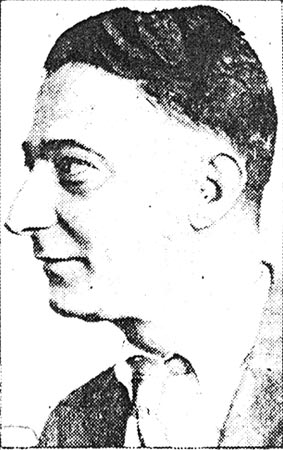
Joseph Deven, November 1930
Joe Deven attracted the attention of the local press in 1925, when at the behest of “prominent Republican leaders” in Camden, primarily William D. Sayrs, then a field agent in the office of the Internal Revenue Department, and later a city commissioner, he was employed by federal authorities as a deputy U.S. Marshal to guard the padlocked Poth brewery at Bulson Street, just off Broadway. This was an ironic situation as at the time Deven had been arrested once or twice for violating the Volstead Act and was also still involved with the bar at South 2nd and Pine Streets. The Camden Courier newspaper publicized the matter, and Joe Deven was fired.
An effort was made after Deven was fired by Sayrs and other Republican leaders to find a job in city government under the Non-Partisan administration of Mayor Victor S. King, but nothing came of it.
In May of 1926 he attempted suicide by shooting himself after he had failed to effect a reconciliation with his estranged wife. At that time, he shot himself but the bullet only grazed his chest. The 1927 City Directory states that Joseph Deven was again working as a stone mason, and had relocated with his wife Anna to 626 North 8th Street.
Sayrs and Deven parted company, politically for a time, but rejoined forces in 1927. A new city administration was elected in the spring of that year, and Deven’s patron William D. Sayrs, was elected to the City Commission. This however, did not translate into a city job for Joe Deven. He was arrested on a charge of drunken driving in 1927, and while influential, may have been considered “too hot to handle” by the local political establishment.
On January 13, 1928 Polack Joe Deven shot Joseph Cimino to death at the Sixth Ward Republican Club on Broadway, while in the company of another politically active crime figure, Joseph “Mose” Flannery. Still a political force, the charges were reduced to manslaughter and he was sentenced to a five year term in prison, which he served at Trenton. Flannery in turn was gunned down in September of 1928.
Joe Devon served two years for the Sixth Ward Republican Club shooting, before being paroled in November of 1930. Less than five months later, he and a companion drove into the yard of an alleged disorderly house at Atco as state troopers were raiding it. Deven, who was driving, attempted to drive away, but troopers stopped the machine. A .38 caliber pistol was found on Deven. He was subsequently sentenced on March 30, 1931, to two and one-half years for carrying the weapon. He was paroled for this offense and for the original parole violation in June of 1933.
Out on parole, he was again arrested in 1933 for carrying a gun and returned to prison.
By 1947 younger brother Albert had founded a printing business, Deven’s Printing Press, on West Street. Joseph Deven spent his last years living with his younger brother. He died in Glendora NJ in April of 1971. Albert Deven had moved to Glendora by the mid-1950s, and resided there for most of the rest of his days. He last lived in Magnolia NJ. Albert Deven died in 1975, survived by his wife, the former Rose Pologruto, who passed in October of 2001.
World War I Draft Card
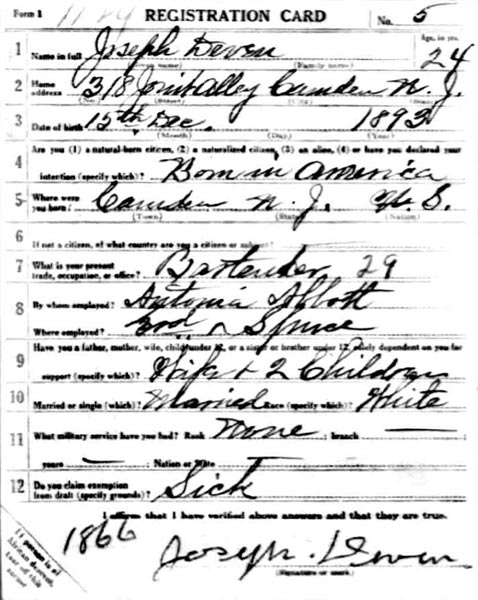
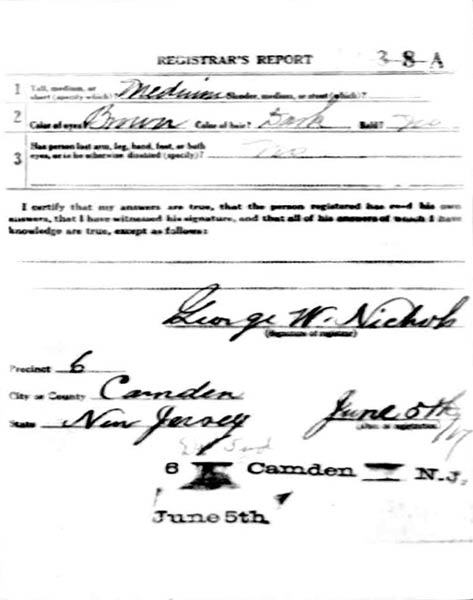
Joseph Deven — World War I Draft Registration Card
Charge Detective Murry Protected Vice
Camden Daily Courier —
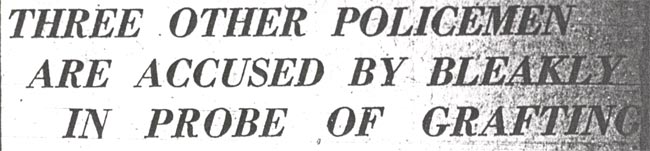

THREE OTHER POLICEMEN ARE ACCUSED BY BLEAKLY IN PROBE OF GRAFTING
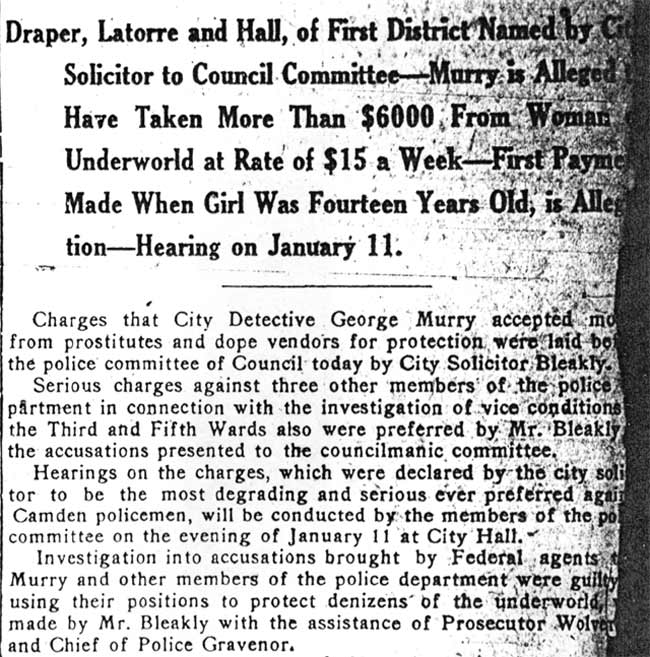
Draper, Latorre and Hall, of First District Named by City Solicitor to Council Committee—Murry is Alleged Have Taken More Than $6,000 From Underworld at Rate of $15 a Week—Hearing on January 11
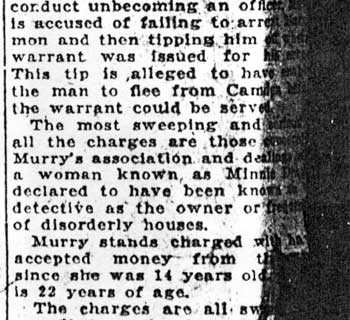
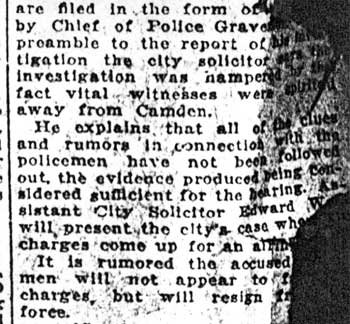
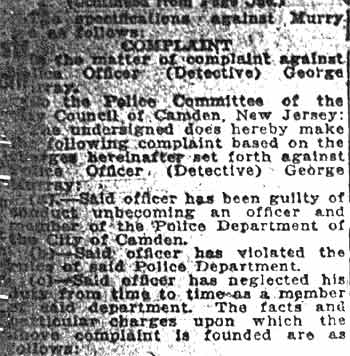
Charges that City Detective George Murry accepted money from prostitutes and dope vendors for protection were laid before the police committee of Council after City Solicitor Bleakly had made an extended investigation into vice conditions in the Third and Fifth Wards. Charges against Policemen William Draper, Latorre and Ira Hall were also preferred. The accusations presented to the councilmanic committee are far-reaching, and the city solicitor announced that a public hearing would be held on January 11.
Murry is attached to headquarters. The other men included in the charges are Policemen William Draper, Tony Latorre and Ira Hall. All are assigned to the First Police District, Fifth street near Arch.
The City Solicitor stated: “From the statements which I obtained it would seem that Murry has been exerting himself as a protector of vice instead of a detective and criminal. If the facts are true, Detective Murry, instead of protecting the good citizens of the city, has been permitting the denizens of the underworld to ply their evil practices.”
The first charge in detail accuses the detective of neglect of conduct unbecoming an officer. It accuses him of failing to arrest a man and then tipping him off, allowing a warrant to go unserved and the man to flee from Camden before the warrant could be executed.
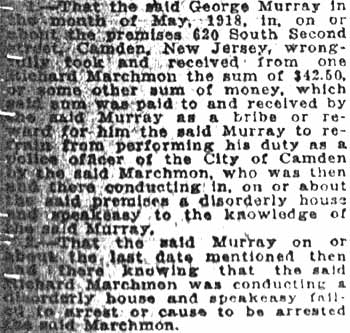
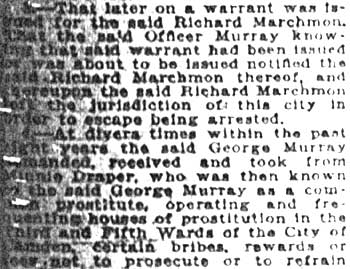
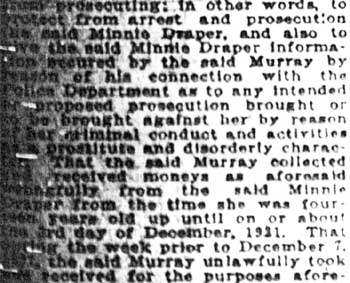
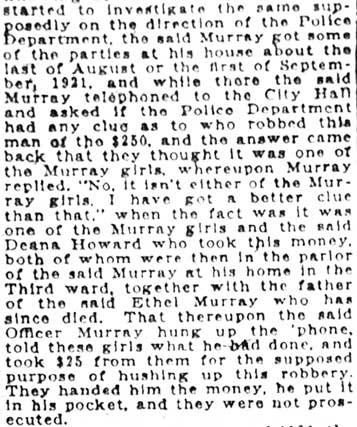
The most sweeping of all the charges are those alleging Murry’s association with a woman known as Minnie Draper, who is declared to have been a disorderly house keeper under his protection since she was about 22 years of age. The charges allege that Murry took $10 or more from Richard Marchmon at 620 South Second street for protection of the disorderly house conducted there. That in the month of May, 1918, on the premises at 620 South Second street, Murry took and received from Marchmon the sum of $10, paid to and received by said Murry as a bribe to refrain from performing his duty as a police officer.
That later on a warrant was issued to one Marchmon, and that said Officer Murry, knowing the warrant was about to be issued, notified Marchmon of the fact, allowing Marchmon to flee from the jurisdiction of the city.
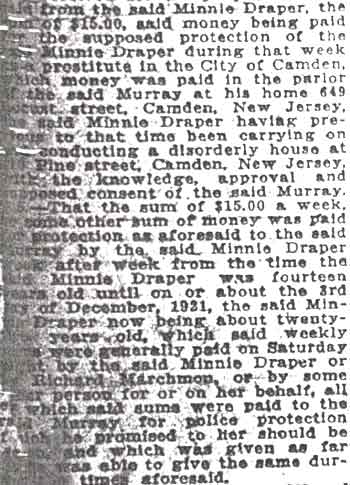
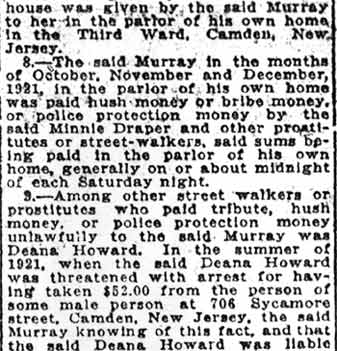
The charges further allege that Murry unlawfully took, from the said Minnie Draper, the sum of $15.00 a week, or some other sum, for the supposed protection of the said Minnie Draper in the conducting of her disorderly house from the time she was about twenty years old until on or about the 3rd of December, 1921—a period of approximately eight years. That the said sum of $15.00 a week was paid to Murry’s own home in the Third Ward, generally on or about midnight of each Saturday night.
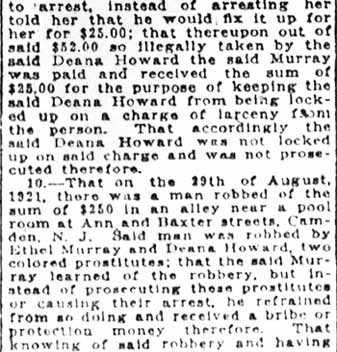
Among other streetwalkers who paid tribute or protection money through Minnie Draper to the said Murry was one Deana Howard. In the month of January, 1921, when Deana Howard was liable to arrest, Murry instead of arresting her told her that he would “do it up for her for $25;” and thereupon took the $25. Deana Howard was accordingly not locked up and was not prosecuted.
On the 29th of August, 1921, a man was robbed of $30 in an alley near Ann and Halsey streets by Ethel Smith and two other colored prostitutes. Murry is charged with knowing about the robbery but instead of prosecuting the robbers, received a bribe. He then started a false investigation, and when the police department telephoned back that they believed it was one of “the Murry girls,” Murry replied, “No, it isn’t either of the Murry girls. I have got a better clue than that,” when in fact it was one of the Murry girls and Deana Howard who took the money—both of whom were then in the parlor of said Murry at his home in the Third ward. That thereupon Murry told these girls what they had done, and took $25 from them for the purpose of keeping up the robbery. They handed him the money and were not prosecuted.
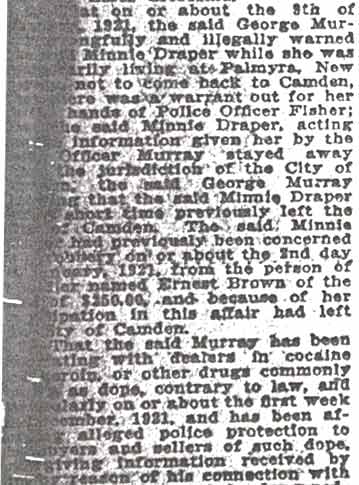
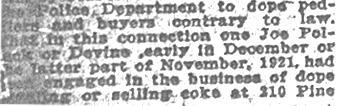
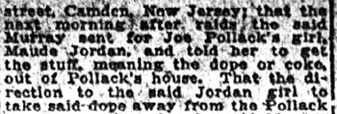
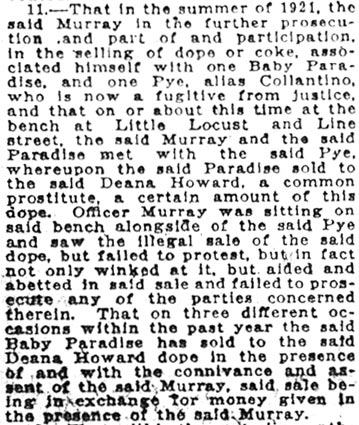
In the summer of 1921, Murry is alleged to have given police protection to “Baby Paradise,” a dope dealer operating at Locust and Line streets. In connection with dope protection, one “Joe Pollack” is mentioned, who in December, 1921, had charged the business of dope selling at 210 Pine street; that Officer Murry sent for Pollack’s girl and told her to “get the stuff, meaning the dope or coke, out of Pollack’s.”
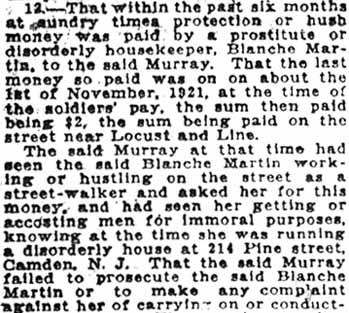
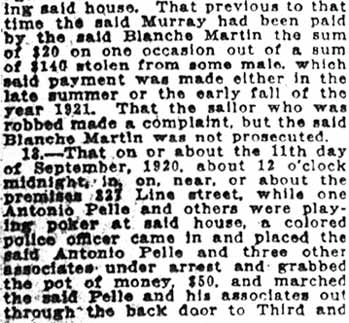
Another prostitute or disorderly housekeeper, Blanche Martin, paid Murry protection money, the last payment being on or about the 1st of November, 1921. The charges allege that Murry failed to prosecute or make any complaint against her for carrying on said house. That previously Murry had been paid by Blanche Martin the sum of $40 on one occasion out of $140 stolen from a male patron.
Charges Against Draper, Hall, and Latorre
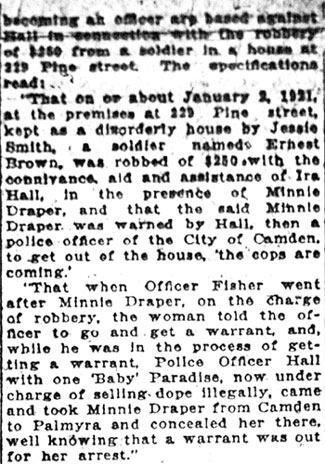
Policeman Hall is charged with theft of $50 from a soldier in a house at 133 Pine street, and of having concealed a woman wanted for arrest. In January 1921, when Officer Fisher went after Minnie Draper on a charge of robbery, she claimed a man had robbed her. Officer Hall thereupon took the woman to Palmyra and concealed her there, hearing that a warrant was out for her arrest.
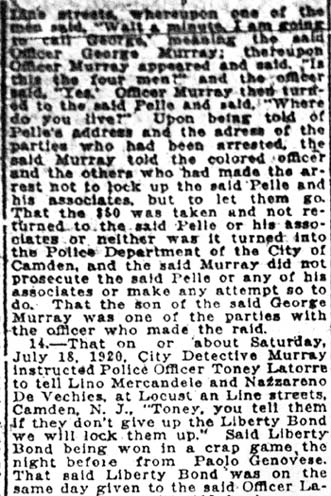
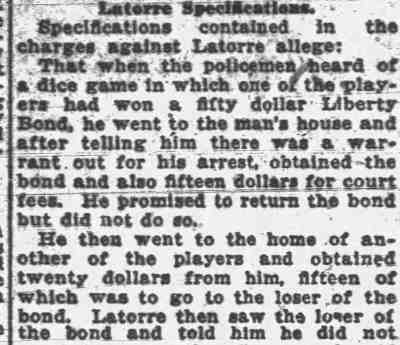
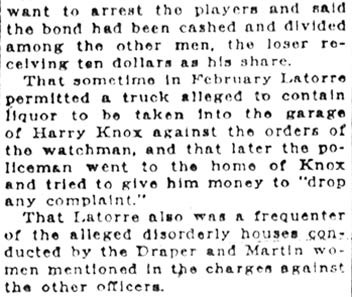
Latorre specifications allege that when he heard of a dice game in which one of the players had won a fifty-dollar Liberty Bond, he went to the man’s house and told him there was a warrant for his arrest, then obtained the bond and also fifteen dollars for court fees, promising to return the bond but not doing so. He then went to the home of another of the players and obtained twenty dollars from him, fifteen of which was to go for the bond. Latorre then told the loser that the bond had been cashed and divided, the loser receiving ten dollars as his share. That Latorre also was a frequenter of the alleged disorderly houses conducted by Draper and the women mentioned in charges against the other officers.
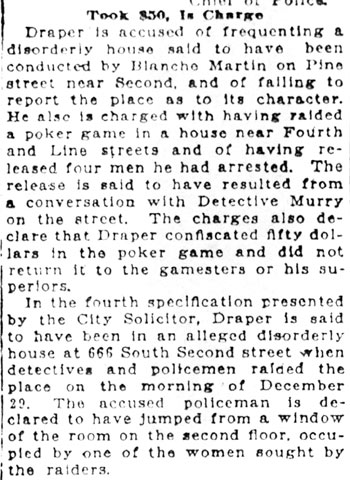
Draper is charged with conduct unbecoming an officer in connection with disorderly houses, and with having confiscated fifty dollars from a card game and not returning it. In another specification, Draper is charged with having raided a house near Fourth and Line streets and permitting the men he had arrested to be released.
City Solicitor Bleakly attached a memorandum to the charges noting the difficulty in obtaining witnesses: “Some have been, we are sure, spirited away. The mouths of others have been suddenly closed. Other sources of information on which we might have relied have been closed up. The investigation has been hampered from the start, but the evidence against the officers has been sufficient to base a number of very serious charges.”
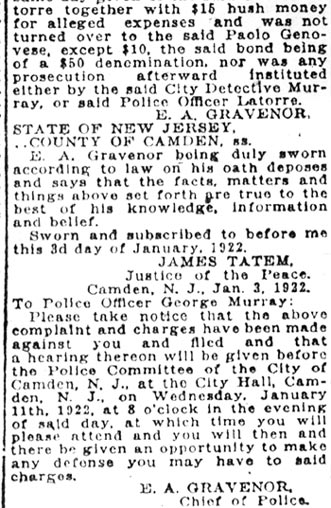
The state affidavit is sworn by E. A. Gravenor. The hearing is set for Wednesday, January 11, 1922, at 2 o’clock P.M. at City Hall, Camden, at which time the accused officers will be given a full and free opportunity to cross-examine any witnesses.
Chief Accuses Four Officers in Vice Probe
Camden Post-Telegram —
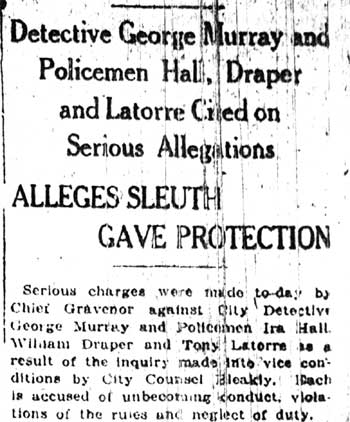
Detective George Murray and Policemen Hall, Draper and Latorre Cited on Serious Allegations
ALLEGES SLEUTH GAVE PROTECTION
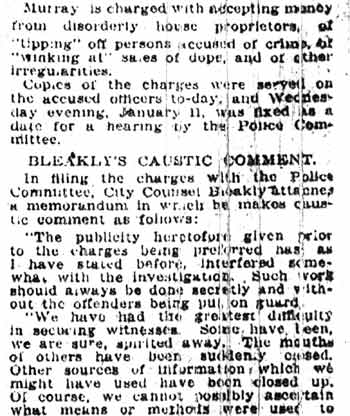
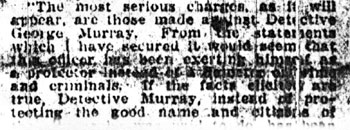
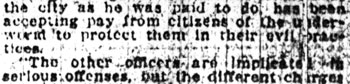
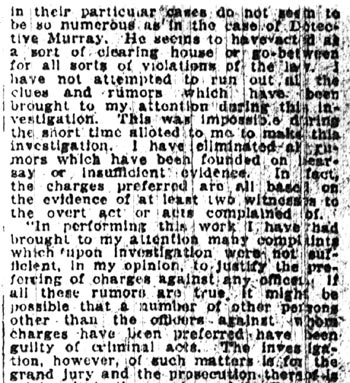
Serious charges were made today by Chief Gravenor against City Detective George Murray and Policemen Ira Hall, William Draper and Tony Latorre as a result of the inquiry made into vice conditions in the city. Each is accused of conduct unbecoming an officer, violations of the rules of the department and neglect of duty.
Murray is charged with accepting money from disorderly house proprietors, of tipping off persons counted on them, of “winking at” snares of dope, and of other irregularities. Copies of the charges were served on the accused officers today, and Wednesday evening, January 11, was fixed as a date for a hearing by the police committee.
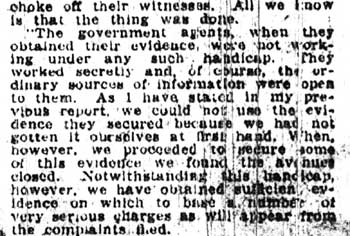
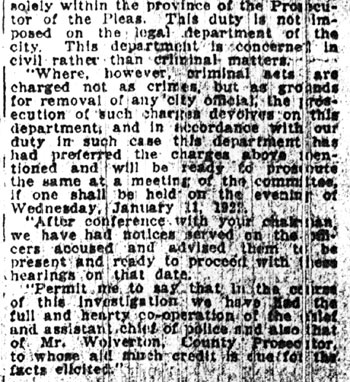
In filing the charges with the Police Commission, Chief Bleakly attached a memorandum in which he makes caustic comment: “The publicity heretofore given prior to the charges being preferred has put every one on guard. We have had the greatest difficulty in securing witnesses. Some have been, we are sure, spirited away. The mouths of others have been suddenly closed. Other sources of information on which we might have relied have been closed up. The investigation has revealed enough, with what appear to be grand jury facts that have resulted in the complaints filed.”
“It is believed that there will be a full and prompt investigation as a result of the work of Mr. Wolverton, County Prosecutor.”
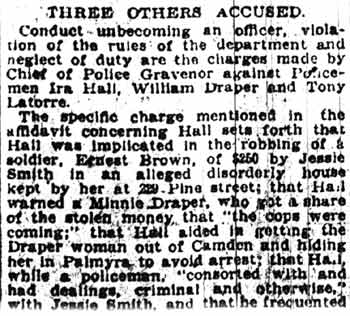
Three Others Accused
The specific charge in the case of Hall relates that he was implicated in the robbing of a soldier at an alleged disorderly house. Hall warned Minnie Draper that police were coming; that Hall warned the woman out of Camden and hid her in Palmyra, to avoid arrest.
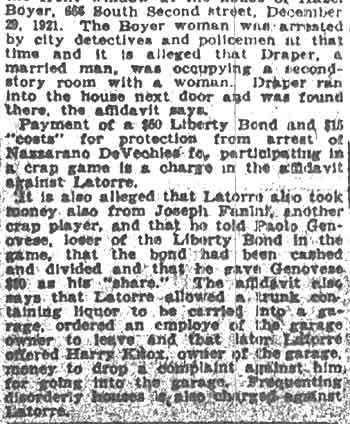
In the case of Draper, it is alleged that he was occupying a second story room with a woman in a disorderly house at 306 South Second street in December 1921, and that when the house was raided by city detectives and policemen, Draper ran into the house next door and was found there. Payment of a fifty dollar Liberty Bond and its “costs” for protection from arrest for violation of the gambling laws in a crap game is a charge in the affidavit against Latorre. It is also alleged that Latorre took money from another crap player, and that he told the keeper of the Liberty Bond that the bond had been cashed and divided.
The affidavit also says that Latorre allowed liquor to be carried into a garage, ordered an employee of the garage to leave, and tried to get the owner to drop a complaint against him after swearing out a statement against the house as disorderly.
Sellers of Dope in Keen Rivalry Slashed Prices
Camden Daily Courier —
Women Say ‘Babe’ Paradise and ‘Pye’ Calletino Did a ‘Cut-throat’ Business
5 GET STIFF SENTENCES
Paradise Arrested Second Time—‘Menace to Community’ Says Kates
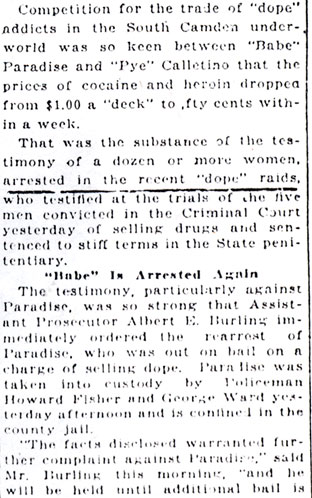
Competition for the trade of “dope” addicts in the South Camden underworld was so keen between “Babe” Paradise and “Pye” Calletino that the prices of cocaine and heroin dropped from $1.00 a “deck” to fifty cents within a week.
That was the substance of the testimony of a dozen or more women, arrested in the recent “dope” raids, who testified at the trials of the five men convicted in the Criminal Court yesterday of selling drugs and sentenced to stiff terms in the State penitentiary.
“Babe” Is Arrested Again
The testimony, particularly against Paradise, was so strong that Assistant Prosecutor Albert E. Burling immediately ordered the rearrest of Paradise, who was out on bail on a charge of selling dope. Paradise was taken into custody by Policeman Howard Fisher and George Ward yesterday afternoon and is confined in the county jail.
“The facts disclosed warranted further complaint against Paradise,” said Mr. Burling this morning, “and he will be held until additional bail is furnished to guarantee his appearance when he is called for trial.”
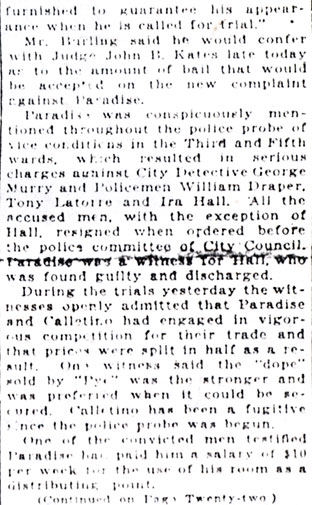
Mr. Burling said he would confer with Judge John B. Kates late today as to the amount of bail that would be accepted on the new complaint against Paradise.
Paradise was conspicuously mentioned throughout the police probe of vice conditions in the Third and Fifth wards, which resulted in serious charges against City Detective George Murry and Policemen William Draper, Tony Latorre and Ira Hall. All the accused men, with the exception of Hall, resigned when ordered before the police committee of City Council. Paradise was a witness for Hall, who was found guilty and discharged.
During the trials yesterday the witnesses openly admitted that Paradise and Calletino had engaged in vigorous competition for their trade and that prices were split in half as a result. One witness said the “dope” sold by “Pye” was the stronger and was preferred when it could be secured. Calletino has been a fugitive since the police probe was begun.
One of the convicted men testified Paradise had paid him a salary of $10 per week for the use of his room as a distributing point.
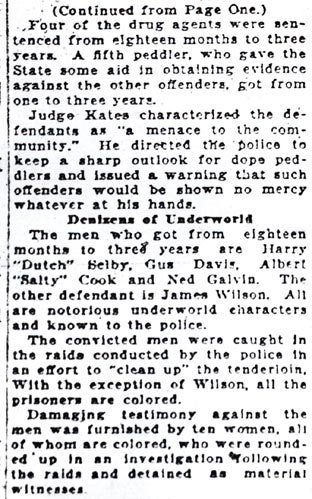
Four of the drug agents were sentenced from eighteen months to three years. A fifth peddler, who gave the State some aid in obtaining evidence against the other offenders, got from one to three years.
Judge Kates characterized the defendants as “a menace to the community.” He directed the police to keep a sharp outlook for dope peddlers and issued a warning that such offenders would be shown no mercy whatever at his hands.
Denizens of Underworld
The men who got from eighteen months to three years are Harry “Dutch” Selby, Gus Davis, Albert “Salty” Cook and Ned Galvin. The other defendant is James Wilson. All are notorious underworld characters and known to the police.
The convicted men were caught in the raids conducted by the police in an effort to “clean up” the tenderloin. With the exception of Wilson, all the prisoners are colored.
Damaging testimony against the men was furnished by ten women, all of whom are colored, who were rounded up in an investigation following the raids and detained as material witnesses.
Asks Stiff Sentences
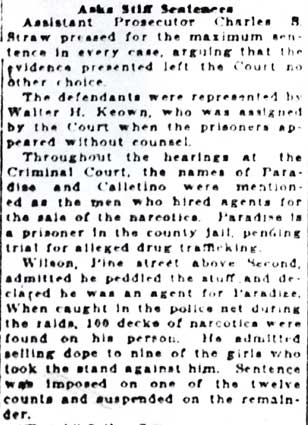
Assistant Prosecutor Charles S. Straw pressed for the maximum sentence in every case, arguing that the evidence presented left the Court no other choice.
The defendants were represented by Walter H. Keown, who was assigned by the Court when the prisoners appeared without counsel.
Throughout the hearings at the Criminal Court, the names of Paradise and Calletino were mentioned as the men who hired agents for the sale of the narcotics. Paradise is a prisoner in the county jail, pending trial for alleged drug trafficking.
Wilson, Pine street above Second, admitted he peddled the stuff and declared he was an agent for Paradise. When caught in the police net during the raids, 100 decks of narcotics were found on his person. He admitted selling dope to nine of the girls who took the stand against him. Sentence was imposed on one of the twelve counts and suspended on the remainder.
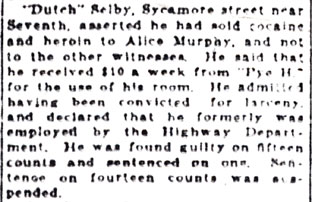
“Dutch” Selby, Sycamore street near Seventh, asserted he had sold cocaine and heroin to Alice Murphy, and not to the other witnesses. He said that he received $10 a week from “Pye H” for the use of his room. He admitted having been convicted for larceny, and declared that he formerly was employed by the Highway Department. He was found guilty on fifteen counts and sentenced on one. Sentence on fourteen counts was suspended.
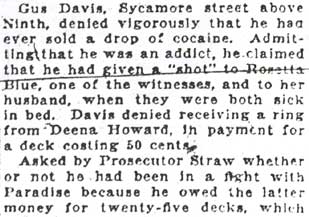
Gus Davis, Sycamore street above Ninth, denied vigorously that he had ever sold a drop of cocaine. Admitting that he was an addict, he claimed that he had given a “shot” to Rosetta Blue, one of the witnesses, and to her husband, when they were both sick in bed. Davis denied receiving a ring from Deena Howard, in payment for a deck costing 50 cents.
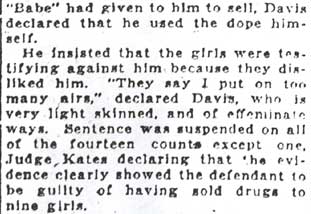
Asked by Prosecutor Straw whether or not he had been in a fight with Paradise because he owed the latter money for twenty-five decks, which “Babe” had given to him to sell, Davis declared that he used the dope himself.
He insisted that the girls were testifying against him because they disliked him. “They say I put on too many airs,” declared Davis, who is very light skinned, and of effeminate ways. Sentence was suspended on all of the fourteen counts except one, Judge Kates declaring that the evidence clearly showed the defendant to be guilty of having sold drugs to nine girls.
$750 Worth Each Month
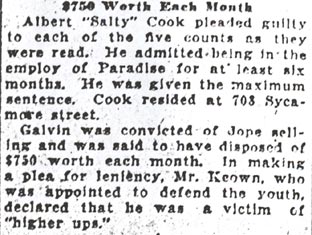
Albert “Salty” Cook pleaded guilty to each of the five counts as they were read. He admitted being in the employ of Paradise for at least six months. He was given the maximum sentence. Cook resided at 708 Sycamore street.
Galvin was convicted of dope selling and was said to have disposed of $750 worth each month. In making a plea for leniency, Mr. Keown, who was appointed to defend the youth, declared that he was a victim of “higher ups.”
Gangster Shot During Melee in Sixth Ward
Camden Courier-Post —
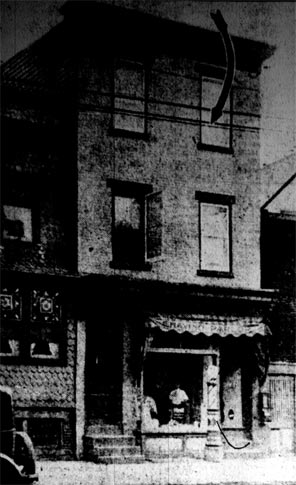
Headquarters of the Sixth Ward Republican Club on Broadway below Spruce Street. The entrance is to the left, the first floor front being occupied by a barber shop. The arrow indicates the room where the shooting occurred.
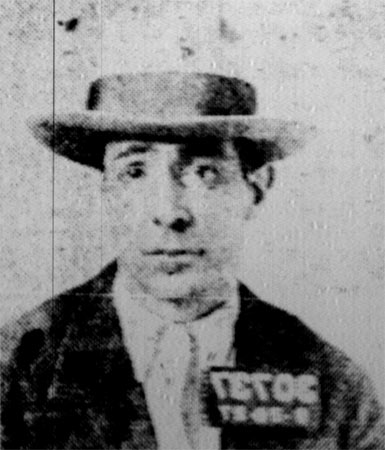
Joseph Deven Held On Murder Charge After Death Boxer’s Brother; ‘Mose’ Flannery and 4 Others Held as Witnesses; Was Craps Game Says County Police
HOLDUP ATTEMPTED CITY COPS DECLARE
Victim of a shot fired in a melee, the exact cause of which remain undetermined, Joseph Cimini, 31 years old, was killed in the Sixth Ward Republican Club, 908 Broadway.
Cimini, declared by police to be a Philadelphia gangster, was killed before the eyes of two district detectives, Clarence Arthur and Clarence Bunker, who had been summoned to the club by warning that a fight was in progress.
Joseph Deven, 28 years old, known to his associates as “Polack Joe” and a colorful figure in Third Ward politics, fired the shot that killed Cimini.
Declaring that he had fired in self-defense, after Cimini struck him with the butt of a revolver, Deven was locked up without bail on a charge of murder.
Joseph ‘Mose’ Flannery, 26 years old, picturesque Eighth ward political worker, was held as a material witness. Detectives had seized Flannery who was to have precipitated the battle by brandishing a revolver just before Cimini was shot. The officers say that Flannery fled –after the shooting and was captured afterward at Broadway and Federal Street.
The name of the dead man was given as Joseph Gannon, but shortly before one o’clock this afternoon, he was identified as Joseph Cimini, 1301 Ellsworth Street, Philadelphia. The identification was made by a brother, William Cimini, a pugilist who has boxed in this city several times under the name of “Billy” Gannon.
Six Others Quizzed
Six other men who were present at the time of the shooting, or when the argument began, were questioned by city and county detectives.
They are Newton Blanchard, 30, 923 St. John Street, former Camden boxing referee and declared by some of the witnesses as the man who conducted the crap game at the club; Michael Dandrea, 26, 1067 Norris Street; Russell Sage, 26 years old, of 1102 Marion Street a taxicab driver who is said to have driven Gannon and Flannery to the club in his car; Maurice O’Brien, 27 years old, of 1429 Bradley Avenue, a former New Jersey State Trooper, Harry Trooper, Harry Waterhouse, 28 years old, whose address was given as the same as Sage’s; and Charles “Chick” Hunt, 27 years old, of 1218 Broadway, a former Camden boxer.
Blanchard and Dandrea were released after questioning and after each had made a statement to Chief of County Detective Lawrence T. Doran. The others were held with Flannery as material witness.
Differences of opinion between county and city detectives investigating the shooting were heightened during the afternoon. The county sleuths insisted upon the theory that the shooting had resulted from a feud between Flannery and Hunt, with Cimini taking the former’s side and Deven the latter and said that the heat of the argument had possibly been heightened by disagreement over a crap game.
The city police, on the other hand, declared that the entire affair was the result of an attempt by Flannery to hold up the other men. Deven’s statement to Chief Doran made no mention of a hold-up.
Building up a case against Flannery, the officers this afternoon lodged charges of attempted hold-up, carrying concealed deadly weapons, atrocious assault and battery and assault to kill against him. The two latter charges were made as the result of identification of Flannery as a participant in two recent robbery attempts. J.E. Feinstein, café proprietor of 508 Kaighn Avenue, declared that Flannery, Cimini, and Sage were thereof four men who held him up on New Year’s Day. He defied them and they left when he said, “Go ahead and shoot,” he asserted. Flannery was also identified, according to police, as the man who had beaten and attempted to rob Henry Mehrer, an Audubon policeman, and his two companions outside the Ringside Inn, on the Black Horse Pike, a fortnight ago. Mehrer and Feinstein were taken to police headquarters by County Detective Howard Smith, who is authority for the statement that they identified Flannery.
Cimini was shot shortly after 3:00 this morning and died almost instantly. Doctors at Cooper Hospital pronounced him dead on arrival. He had been shot just above the heart by a bullet from Deven’s gun.
Events preceding the shooting remain, to some extent clouded today. Chief Doran said he learned of an enmity existing between Flannery and Hunt. Deven appeared to have attempted to quiet “Mose,” the county detectives said. Cimini struck Deven and Deven fired.
Chief John Golden of the Camden city detective bureau stated, on the other hand, that the shooting had apparently followed an attempt to hold up the other men in the room. Golden based his view on the statements of Clarence Arthur, a city sleuth. According to Arthur, when he and Bunker appeared at the door of the room, Flannery and Cimini held revolvers and the other men in the room were standing with their hands upraised.
According to the story pieced together by county detectives from the statements of witnesses, a group of men had apparently gathered at the club for a crap game. Blanchard, it was stated, acts as the “stick man,” the term used in gambling parlance to designate the man who conducts a crap game.
City and County agree that Flannery and Cimini arrived together in Sage’s taxicab. Whether there was an argument, the result of an enmity between Flannery and Hunt, or whether the attempted hold-up theory is correct, remains to be learned by additional official investigation.
Chief Doran stated the witnesses had told him that words passed between Flannery and Hunt and that the former had gone downstairs. Returning he brandished a revolver.
Two Flee Place
It was at this point that Blanchard and Dandrea left the room and fled down the stairs. On the street, they encountered Detectives Arthur and Bunker, who were patrolling Broadway in a police automobile.
In describing the subsequent events today, Arthur declared that Blanchard had informed him that “two Philadelphia gunmen are up in the Sixth Ward Club holding up a bunch of fellows.”
The detectives did not immediately go to the club, but found Patrolman Frank Del Rossi and followed him up the stairs of the building.
“There were about fifteen men in the room,” Arthur asserted. “When we got to the door Flannery and Cimini had their guns out and apparently were about to search the others. The other men had their hands in the air.”
“When they saw us Flannery and Cimini threw their guns down and the others lowered their hands. I went up to Flannery and started to frisk him. Bunker went to another man, whom I don’t know, and started to frisk him.”
It was then he said that he heard the shot. Believing that it was Bunker who was shot, he released his hold on Flannery and swung around. As he did Flannery turned and fled downstairs, Arthur declared.
Bunker said he believed that it was Arthur who had been shot and he too released his grasp on the man he had been searching. The detectives turned in time to see Cimini fall.
“I did it! I shot him!” Deven is declared to have shouted, throwing his revolver on the table.
According to the story told by witnesses to the county detectives, however, Deven had stepped up to Flannery just before the shot was fired and had said “Mose, you can’t get away with this here.”
Flannery is said to have had a gun in his hand at the time.
As Deven spoke, the witnesses say, Cimini stepped behind him and struck him with the butt of a revolver. Just then detectives entered. Devin whirled and, drawing his gun, fired.
Cimini was placed in a police ambulance and taken to the hospital. After he had been pronounced dead his body was taken to the morgue, where it was awaiting identification today. Neatly dressed, Cimini is of Italian extraction. He has coal-black hair, brown eyes and a dark complexion. Coroner Charles T. Murray will perform a post-mortem examination, he said.
Flannery Captured
When he fled from the club, according to Arthur, Flannery jumped on a Public Service bus driven by David Smith, of 423 Haddon Avenue, which was passing at the time.
“Faster! Faster” he is declared to have urged Smith as the latter drove along Broadway in the direction of Federal Street.
At Federal Street and Broadway, Arthur and Bunker caught up to the bus and arrested Flannery as he descended from the vehicle.
“Why don’t you give me a chance to get to Philadelphia?” Arthur declares Flannery asked him. “I can get bail over there.”
Seek Written Statement
Chief Doran stated this afternoon that he was attempting to obtain a written statement from Flannery and would also seek to have Deven sign a statement regarding the shooting. During the morning, Flannery refused to talk while Devin, although admitting that he fired the shot, declared that he shot in self-defense. He made no reference to the hold-up attempt, according to the county detectives.
Cimini has a Philadelphia police record but, according to his pugilist brother, “was not bad but just wild.” He was recently arrested in Philadelphia after a fight with policemen.
“But he never held up or robbed anybody,” his brother declared this afternoon after identifying the body. “He got into a jam now and then. Yes, I know that he knew ‘Mose’ Flannery, but I never mixed with that crowd.”
It was reported at City Hall this afternoon that Samuel Orlando had been retained as attorney for Flannery and that Walter Keown, Camden county solicitor, would represent all the other men. The presence of Keown at detective headquarters, during which he had a conference with Captain Golden, seemed to lend credence to the latter report but neither rumor could be confirmed.
Flannery for years has figured in police cases and in political warfare in the Eighth Ward, where he was sometimes a lieutenant and sometimes an opponent of “Mikey” Brown, the Republican leader of the ward. Last March he was arrested and indicted on charges of atrocious assault and battery on his wife and her mother. At one time he was held as a suspect is a Philadelphia shooting but later was released.
The accused man, Deven, is a short, slim little man with an air of meek complaisance. He has been a taxicab driver and was last arrested on a charge of drunken driving. In May of 1926 he attempted suicide by shooting himself after he had failed to effect a reconciliation with his estranged wife. At that time, he shot himself but the bullet only grazed his chest.
Joe Deven, long a political power in the Third Ward, first flashed into citywide prominence in 1925, when he was employed by federal authorities as a deputy U.S. Marshal to guard the padlocked Poth brewery at Bulson Street, just off Broadway. At the time Deven was thus maintaining the sanctity of the Eighteenth Amendment, he was also operating a bootlegging establishment downtown and had been arrested once or twice for violating the Volstead Act.
The Courier at that time exposed this paradoxical situation, with the result that the U.S. Marshal summarily dismissed Deven. He keenly resented the political chicanery that had been used to put Deven in office. In explaining how Deven was appointed, the Marshal said that he had been recommended by “prominent Republican leaders” in Camden, chief among whom was William D. Sayrs, now a city commissioner but then a field agent in the office of the Internal Revenue Department.
Sought City Job
Not long after Deven’s dismissal as brewery guard, Sayrs and other Republican leaders made strenuous efforts to secure a city job for him under the Non-Partisan administration. They sought to exact a promise from The Courier that this newspaper would remain silent in the event Deven was appointed to a city position. No such promise was made and Deven remained jobless, politically at least.
Then came a humorous twist to the situation. Sayrs disagreed with some of the Organization leaders and, for a time, walked his own political footpath. Some of the leaders, fearful of what Sayrs might attempt politically, killed two birds with one stone by hiring Joe Deven to shadow Sayrs and to report to them the number of times he conferred with Non-Partisans. Thus, Joe had a job and Billy was watched.
Sayrs knew he was being shadowed by his old friend, and apparently he knew who had hired Deven to do the work, but he refused to take the situation seriously and chortled, frequently, when he would see his “Shadow” trailing about town.
In the last year, however, Deven has again been the particular political protégé of Commissioner Sayrs and also has won the friendship of many other political leaders. Nevertheless, he has not been, so far as can be determined, the recipient of any particular political patronage, though his political influence in the Third and Fifth Wards is said to have expanded rapidly under the new administration.
Murder Motive at G.O.P. Club Splits Sleuths
Camden Evening Courier —
County Detectives Contend Philadelphia Gangster Was Slain in Quarrel Over Woman
POLICE CLAIM HOLD-UP ATTEMPT CAUSED FIGHT
Deven Charged With Crime, Flannery and Taxi Driver Held Without Bail
With city and county authorities definitely divided on the motive and circumstance of the Sixth Ward Republican Club slaying, Joseph “Polack Joe” Deven was arraigned in Camden police court today and held without bail on a murder charge.
Through County Solicitor Walter Keown, retained as his attorney, Deven waived a police court hearing and was held to await grand jury action in the slaying of Joseph Cimini, Philadelphia gangster, at the political club early Saturday morning.
At the same time County Prosecutor Ethan P. Wescott announced his operatives had abandoned the theory Cimini was killed as the aftermath of an attempted hold-up, and were concentrating their investigation in the case on an effort to “find the woman.”
Statements of witnesses to the fatal shooting, the prosecutor added, made no mention of a hold-up, but contained the declaration that Cimini had been shot as a result of a feud with Charles “Chick” Hunt, former South Camden pugilist, concerning the affection of “Chick’s girl.”
Police Claim Holdup
On the other hand, Captain John Golden, chief of the city detective bureau, declared he was unable to recall any mention of a girl in the statements obtained from witnesses, and added emphatically that his department still held the shooting had followed an attempted holdup of the club by Cimini and Joseph ‘Mose’ Flannery.
Flannery and Hunt were both witnesses to the shooting by Deven, picturesque figure in Third Ward politics, which occurred at the Sixth Ward Club’s headquarters, 908 Broadway.
After Deven had appeared in Police Court today, Flannery was arraigned as a material witness and as an accessory to the crime, with an additional charge accusing him of carrying concealed deadly weapons. Similar charges were made against Russell Sage, a taxicab driver, who arrived at the club with Flannery and Cimini early Saturday morning. These two were committed to the county jail without any bail by Judge Bernard Bertman.
Hunt, however, was released under $1,000 bail as was Martin O’Brien, 27 years old, a former New Jersey State Trooper, and Harry Waterhouse, 28 years old, 1102 Marion street.
Three Others Arrested
During the day the police continued to build up their case against Flannery by arraigning him on the charges made by Milton Feinstein and Henry Mehrer. They also arrested Joseph Genther, 29 years old, 414 Atlantic Avenue; Robert Wolfe, 21 years old, 1106 Mechanic Street, and Eli Conaghy, 27 years old, 814 South 6th Street. Wolfe, who is Flannery’s brother-in-law, and Genther were held “on suspicion” of having been with “Mose” at the time the latter is declared to have attacked and attempted to rob Mehrer, an Audubon policeman, outside the Ringside Inn, on the Black Horse Pike.
Conaghy, Flannery and Sage were arraigned and held without bail on charges of threatening to kill Feinstein and of carrying concealed deadly weapons. Feinstein declares these three with Cimini, the slain man, entered his cafe on January 2 and attempted to hold him up, threatening to kill him if he refused to “come across.” When he defied them by telling them to “go ahead and shoot,” Feinstein says, they departed.
Wolfe, Genther, and Conaghy were arrested by City Detectives George Ward and Thomas Cheeseman. It was Cheeseman who lodged the formal complaint of murder against Deven.
Two Others Released
Two other men who were questioned in connection with the murder case were in court this morning but neither was held. They are Newton Blanchard, 923 St. John Street, a former boxing referee and alleged “stick man” at the crap game declared to have been in progress at the club before the shooting, and Michael Dandrea, 26 years old, of 1657 Norris Street. Both men had been released after questioning on Saturday. Police say they are the men who told police that trouble was imminent at the club and that “Flannery and another fellow are trying to stick up a bunch of other fellows.”
The city police hold-up theory was further attacked today by Francis J. McCarthy, a Philadelphian, who arrived before noon at the county prosecutor’s office and said he would co-operate with the authorities. He wishes to clear the dead man, he said, of the stigma of suspicion that he was slain while engaged in an attempted robbery.
Hearing in Police Court was brief. There was no testimony and Keown merely announced Deven would waive a hearing. Appearing also as attorney for Hunt, O’Brien, and Waterhouse, he said the other three men were “present at the unfortunate shooting” and thus should be held as material witnesses. He added the prosecutor’s office had permitted the release of the three under $1,000 bail each and requested Judge Bertman follow suit. The court acceded to this request but stipulated that new bail must be provided. The three men were freed shortly afterward when the bond was furnished by James Louis, 603 Kaighn Avenue, who had provided the bail yesterday in the prosecutor’s office.
Despite the declaration by two Camden district detectives who were present at the time and who said there was no evidence that gambling was in progress at the club, county detectives disclosed today that statements of the shooting contained the assertion that the men had gathered for a crap game.
These witnesses also declared the fatal shooting resulted from an argument over a woman for whose attention Cimini and Hunt were rivals.
In circles where the leading figures in the shooting move, it was freely predicted things would be fixed up for Deven and that Flannery, political worker and supposed gangster, was to be “made the goat.”
Flannery is blamed by the city police for precipitating the battle. He has also been identified, according to County Detective Howard Smith, as one of the men who beat and robbed Henry Mehrer, an Audubon policeman, outside the Ringside Inn on the Black Horse Pike a fortnight ago. In addition, he is charged with attempting to hold up Milton Feinstein, cafe proprietor, 508 Kaighn Avenue. Cimini and Sage were also identified by Feinstein, according to Detective Smith.
According to the version of Cimini’s death given in statements by witnesses to county detectives, “Chick” Hunt might have been the victim of the slaying had it not been for Deven’s interference.
Gamble Over Affections
Like actors in a carefully-rehearsed drama, the various witnesses to the shooting made their statements nearly twelve hours after the shooting and, both city and county detectives say they agreed in all important aspects. Prosecutor Wescott declared, however, that no mention of an attempted hold-up was made despite the fact that City Detectives Clarence Arthur and Clarence Bunker—before whose eyes Cimini was shot down—stated Flannery and Cimini were holding the other men at bay when the detectives entered the room.
Instead, the statements of the witnesses described the scene as a dramatic gamble, with death as the stake, over the affections of a woman beloved by both Cimini and Hunt. This woman, who is married and estranged from her husband, is being sought today, Prosecutor Wescott said. According to detectives, Hunt was severely beaten last Wednesday night in a downtown gambling place by members of Cimini’s gang. Cimini, known also as Joseph Gannon, was a brother of William Cimini, a pugilist known in the ring as Billy Gannon.
The stories told by the witnesses place Hunt as one of the players in the crap game which was in progress at the club on Saturday morning. Deven was at the window, looking out, according to the witnesses, when he saw a taxicab draw up in front of the building. Flannery, Cimini and Sage descended and entered the club, it was declared.
“Here comes Mose, Chick, with that guy what’s gunnin’ for you” Deven is declared to have shouted.
A dozen gamesters fled from the room. “Chick” and a few of his friends held their ground and were waiting when the trio entered. Cimini, it is stated, walked over to Hunt.
“I told you,” he said with a sneer, “to stay away from that dame. She’s my girl. You were warned and so you gotta take your medicine.”
Hunt said nothing.
Flannery drew from his pockets two automatics and flung them on the green-topped table, the stories go.
“C’mon, Chick,” he said. “Don’t be yella. He toldja about the broad and he toldja what he’d do. Take your gun and shoot it out.”
“Chick” demurred.
“I don’t want none of that stuff, Mose,” he pleaded. He eyed Cimini carefully as the latter held one hand on the butt of a pistol which protruded from his belt.
Deven Interferes
Hunt made no careless movements toward the pistols on the table. Then Deven is declared to have interfered.
“None of that stuff, Mose,” he said warningly. “Who’s this guy to come here making trouble? He’s no member, is he?”
Cimini moved quickly, the witnesses say. With an upward flip of his hand he brought the barrel of the automatic sharply against Deven’s chin. The latter lurched forward snatching one of the pistols from the table.
The weapon was discharged, the bullet tearing through Cimini’s heart. He died instantly.
The next moment, Arthur and Bunker, district detectives summoned by one of the players who had fled, burst through the door and lined up the men against the wall.
A short time later police arrested Blanchard and Dandrea. Blanchard, police say, was the man who gave them warning of the impending battle. Both men were released after questioning.
Released from Lakeland
The detectives found Deven cringing with fear under the table, the weapon still in his hand. Four other pistols were picked up in different parts of the room.
Deven was identified as a lovesick husband who appeared in the prosecutor’s office several months ago and asked to be “put away.” His wife had left him, he said, and he was afraid he might harm someone.
He was committed to the asylum at Lakeland. When or how he was released is a mystery. Lakeland officials said they had no record of him. Deven once shot himself in a suicide attempt police say, in grief over estrangement from his wife.
Gangdom’s prevailing opinion is that Flannery is “in” for it. Attempts and threats against the blond gangster’s life have furnished many lurid tales for the habitués of downtown hangouts.
Further, Flannery has made many bitter enemies through his political activities. In the last election he worked as a Democrat against “Mikey” Brown in the Eighth Ward. His overbearing tactics and bravado among the other downtown characters has increased the feeling against him, it is said.
Thus far, he has succeeded in keeping out of the toils for any length of time. His police record includes arrests for rum-running, carrying concealed weapons, alleged ballot frauds and attempted murder. His most recent arrest came in Philadelphia when he figured in a pistol battle in which a man was slain.
Love Plot Fades as Motive Behind Clubhouse Killing
Camden Evening Courier —
Mrs. Katherine Rosalie Denies She is “Chick’s Girl” or “Anybody’s Girl,” But Thinks Flannery and Cimini May Have Used Her as Excuse For Starting Fatal Fight
The suspected “love motive” in the Sixth Ward Republican Club slaying broke down today under the glaring light of investigation. It was the second time within two days that the investigation behind the killing of Joseph Cimini, otherwise Joseph Gannon, had been seemingly explained only to have the explanation rejected.
First, Camden city detectives had affirmed their belief that the fatal shooting was the aftermath of a hold-up attempt by Joseph “Mose” Flannery and Cimini. This theory went by the boards when the statements of witnesses, taken by Prosecutor Ethan P. Wescott disclosed no hint that any such hold-up had been attempted.
Then came the confident introduction by authorities of the “love motive.” Charles “Chick” Hunt, former South Camden pugilist and one of those present at the time of the slaying, Mr. Hunt argued with Cimini over a girl the detectives hinted, and this had precipitated the battle.
Woman Reverses Story
But today, from the Cupid’s bow lips of pretty Katherine Rosalie there issued a statement which wrecked the suspected love triangle in the case, so prominently put forward yesterday as “the real solution.”
“I never knew this Cimini,” declared Mrs. Rosalie.
“I’m not Chick Hunt’s girl” added the 22-year-old brunette who, up until that moment, had been called “Chick’s sweetie” by investigators.
“I’m not anybody’s girl,” she asserted positively, her dark eyes flashing in a manner that proved to interviewers she certainly would encounter no difficulty in attaining the status she so decisively denied.
It was yesterday, shortly after Joseph Deven had been committed to jail without bail on a murder charge, that Rosalie went to the County Courthouse and told her story to Assistant Prosecutor Joseph Varbalow.
Search for Husband
Immediately thereafter, County Solicitor Walter Keown, attorney for Deven, Hunt and two of the other witnesses who are ranged on the side of “Polack Joe” in the case, declared his belief “the shooting came as a result of a plot between Cimini and Rosalie, because Rosalie was jealous of Hunt.”
Accepting this version, Varbalow announced that a search would be made for John Rosalie, husband of the young woman who was called “Chick’s girl.” The inferential theory, according to Varbalow, was that Cimini was a friend of Rosalie, and that he had taken up his friend’s cause by calling Hunt to “shoot it out.” A melee had ensued, according to this theory in which Deven had taken Hunt’s side. Then, to continue this line of deduction, Cimini had struck Deven with the butt of a gun and Deven had fired another gun, killing Cimini.
Some of this may have been true, according to Mrs. Rosalie’s assertion. But she does not believe that her husband’s jealousy, linked to his possible acquaintance with Cimini, was the real cause of the shooting. She has heard, she says, that Flannery and Cimini used a previous argument with her husband as “an excuse” to precipitate the argument which resulted in Cimini’s death. But she believes that it was only an excuse.
Denies Knowing Pair
Thus the picture changes and, according to the latest theory, Flannery and Cimini entered the Sixth Ward Republican Club on Saturday and picked a fight with Hunt—ostensibly because of the latter’s acquaintance with Mrs. Rosalie, but actually because of previous ill-feeling between “Mose” and “Chick.”
“I did not know either Flannery or Cimini,” Mrs. Rosalie told the Evening Courier in an exclusive interview today. “In fact, I have never seen either of them and did not know who they were. It’s true that my husband and my brother-in-law, had an argument with Chick Hunt. I have known Hunt for only a short time. Since meeting him I have regarded him as a personal friend, but I certainly do not like the imputation that I’m ‘Chick’s girl.’ I am not anybody’s girl.”
“When I read in the newspapers that they were looking for Chick Hunt’s girl, however, I remembered the argument my husband and my brother-in-law had with Hunt. I did not see how this could have any bearing on the shooting, but I decided to go to the prosecutor’s office and tell them what I knew in the event that it might be some help to them.”
Heard of Old Feud
“I have read that, when Cimini and Flannery went into the club on Saturday morning, they started the trouble by claiming that Chick was crossing up a friend of theirs. I have heard it said they started the argument by recalling an argument between Chick and my husband.”
“If they did this, it was without foundation, as far as I know. I believe that, if this is what they did, they were merely using the argument between my husband and Chick as an excuse to get into a new argument with Hunt. In fact, I have heard that there had been ill feeling between Flannery and Chick long before I ever met Hunt.”
Varbalow said Mrs. Rosalie, who lives at 311 Cooper Street, told him of the jealousy which her husband bore toward Hunt. She and her husband have been estranged for eight months, Varbalow says she told him. For a little more than two months, she has known Hunt. Some weeks ago, she underwent a blood transfusion operation and, when her husband came to the hospital to visit her, he found Hunt there. Later, Rosalie and Howard Churchill, his brother-in-law, set upon Hunt outside Mrs. Rosalie’s former apartment at 500 Broadway and beat him, according to the statement Varbalow says the girl made to him.
Battle Echo of Murder at Club
Camden Evening Courier —
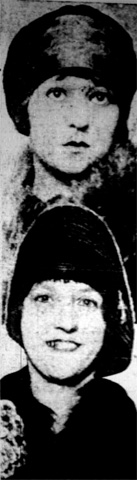
Mrs. Rosalie and Her Rival for ‘Chick’ Hunt Describe Event in Court
Swap Punches In Street
Pretty, piquant Katherine Rosalie—for love of whom men are declared to have fought to the death in the rooms of the Sixth Ward Republican Club—today waged her own fight against her self-avowed rival for the attentions of Charles “Chick” Hunt.
In Camden Police Court this morning, Mrs. Rosalie appeared as complainant against Miss Elsie Berendt, 1901 Broadway, who, by her own assertion, was “Chick’s girl” until Katherine came along.
The court battle, moreover, was merely an aftermath to a hand-to-hand encounter which both declared to have taken place yesterday at the corner of Fourth and Arch Streets. Today’s chapter of the comedy-drama was ended when Judge Bernard Bertman sent both young women home, after chiding Miss Berendt for being “too nervy” and “talking too much.” Miss Berendt was kept in custody by Judge Bertman for about five minutes and then dismissed. Meanwhile Mrs. Rosalie had departed in triumphant possession of Mr. Hunt’s company.
Mrs. Rosalie, 22-year-old brunette, entered the official investigation of the slaying of Joseph Cimini, at the Sixth Ward Republican Club, after county detectives advanced the theory that the fight which resulted in the final shooting had been caused by an argument over “Chick’s girl.” Hunt, a former South Camden pugilist, was in the club at the time of the shooting. According to detectives, the fight had started between Joseph “Mose” Flannery and Hunt; Cimini had entered the argument on behalf of Flannery, and Joseph “Polack Joe” Deven had shot Cimini when the latter struck him with the butt of a revolver.
Both Waiting For Hunt
Mrs. Rosalie, after recounting her story of her friendship with Hunt to Assistant Prosecutor Joseph Varbalow, denied she was “Chick’s girl,” or “anybody’s girl.” But, apparently, Elsie didn’t look at it that way.
According to the testimony of the two young women and of Hunt, in Police Court today, the encounter between the girls took place late yesterday afternoon. Katherine said she was waiting for Hunt at Fourth and Arch Street. Elsie said she was waiting for Hunt at Fourth and Federal Street, a short block distant.
“Chick” arrived, it was testified, and Elsie met him first. She asked the whereabouts of Katherine. Then she saw Katherine and went there. She accused Katherine of having called her a “bum” and of using other uncomplimentary terminology. Katherine promptly denied it.
What happened then depends on whether Katherine’s story or Elsie’s is correct. Katherine said Elsie hit her. Elsie says Katherine hit her. Hunt apparently acted as peacemaker for the nonce and the match wound up in Police Court today.
Girl’s Story Is Denied
There, Elsie earned the disapproval of Judge Bertman by declaring, in great detail and in determined tones, that she had lived with Hunt for seven years as his wife; that she had gone to work as a waitress, and supported him and that he had deserted her several weeks ago when Katherine appeared on the scene.
“Chick” denied all this, declaring he lived at 1213 Broadway and not with Miss Berendt. It was then Elsie received the Court’s opprobrium for “talking too much” and evidencing “too much nerve.” And that was about all there was to it.
Meanwhile, it became increasingly evident that it was a tangled case which Prosecutor Ethan P. Wescott is to present to the Camden County grand jury in connection with the slaying of Cimini, otherwise “Joe Gannon” last Saturday morning.
“Polack Joe” Deven, held on a charge of murder, has admitted firing the shot that killed Cimini before the eyes of two Camden district detectives and nearly a score of other men.
Motive A Mystery
But just how it happened or why, or what led to the argument that seems to have preceded the shooting remained today as much of a mystery as though Cimini had been slain in some lonely DeRussey’s lane instead of in a crowded clubroom.
The investigation so far has focused definitely around the figures of Hunt and Flannery, the latter a storm-center of Eighth Ward politics and police records.
From the tangled web of evidence which county detectives have gathered, it appears only that the argument which resulted in the shooting of Cimini by Deven was caused by ill-feeling between Flannery and Hunt. Whether that ill-feeling had to do with the fading love motive that county detectives so confidently built up until yesterday, whether it was over the crap game supposed to have been in progress at the club, or whether it had a political tinge, is part of the mystery.
Clings to Love Motive
County detectives still cling to a somewhat obscure “love motive,” though it is admitted that they’re not getting very far with it.
The latest development along this line is the arrival in the prosecutor’s office, late yesterday, of John Rosalie, estranged husband of the attractive young woman, who denied that he knew either Flannery or Cimini and stated that he knew nothing whatever concerning the latter’s death.
Assistant Prosecutor Joseph Varbalow, after hearing Mrs. Rosalie’s statement the day before, had announced yesterday that the authorities were “looking for Rosalie.” Mrs. Rosalie had told of the apparent jealousy of her husband—a jealousy which she insists is unfounded—concerning Hunt. She had told how Rosalie and his brother-in-law, Howard Churchill, had set upon Hunt one day at her apartment and had beaten him. She said that she believed her husband might have been acquainted with Cimini.
The theory formed by detectives after that, was that Cimini had gone to the Sixth Ward Republican Club early last Saturday for the purpose of “getting” Hunt because of his, Cimini’s friendship for Rosalie.
Theories Break Down
This was the theory that seemingly broke down when Rosalie appeared and declared he didn’t know either Cimini or Flannery. It apparently broke down just as had a former theory, to the effect that Cimini and Hunt had been rivals for the affections of Mrs. Rosalie, for the latter also declares she knew neither Cimini nor Flannery.
It broke down just as had the city detectives’ theory that it all happened because of an attempted hold-up by Flannery and Cimini, for none of the witnesses mention a hold-up affair in their statements to Wescott. Flannery has made no statement, though apparently he holds the key to the story. His reply to all inquiries is “See my lawyer.” And no one knows who his lawyer may be.
Grand Jury Will Consider Slaying After Probe Ends
Camden Evening Courier —
Investigation in the slaying of Joseph Cimini in the Sixth Ward Republican Club Saturday, is “far from completed,” Assistant Prosecutor Joseph Varbalow announced today.
Although the Camden County grand jury went into session this afternoon, he added, the case will not be presented to that body today.
“We wish to present a complete case to the grand jury,” Varbalow said. “Obviously, we are unable to do that at the present time. There are many ramifications. All we have to present is the declaration of Joseph Deven that he killed Cimini and he did so in self-defense. We are investigating other ramifications and are looking for John Rosalie, husband of the young woman who came to us yesterday and told us of a quarrel between her husband and Charles Hunt, one of the witnesses to the shooting.”
Statements made to Prosecutor Ethan P. Wescott by witnesses have not yet been transcribed by the court stenographer, it was also stated. Joseph “Mose” Flannery, held as a material witness and as an accessory before the crime, has made no statement.
“Mose” Flannery Released On Bail
Camden Evening Courier —
Shay Signs Order After $5000 Bond is Posted in 6th Ward Fuss
Joseph ‘Mose’ Flannery, declared by detectives to have precipitated the battle in the Sixth Ward Republican Club which resulted in the slaying of Joseph Cimini last Saturday, was released from the Camden county jail this afternoon under $5,000 bail.
Samuel Orlando, attorney for Flannery, walked into Camden Criminal Court with an order for Flannery’s release, which was immediately signed by Judge Samuel M. Shay. Bond was furnished by Flannery’s brother, James, who lives at 1123 Princess Avenue.
Flannery has been accused as an accessory to the murder of Cimini by Joseph “Polack Joe” Deven and also as a material witness. He was also charged with carrying concealed deadly weapons and with attempted hold-up and with assault and battery with intent to kill, the latter accusations coming in connection with two other cases. The bail bond signed by Judge Shay covers all the charges.
Alone among those who were taken into custody for the fatal shooting last Saturday morning, Flannery had refused to make any statement to detectives. His reply to all questions has been “See my attorney Sam Orlando.” Until today, however, it was not definitely known if Orlando had been retained to represent Flannery.
Arrested with Flannery and accused on the same charges, Russell Sage, taxicab driver, remains in jail as does Deven, the latter being held on a murder charge. Other material witnesses to the shooting are out on bail of $1,000 each.
The order for bail for Flannery, it was learned, was obtained from Prosecutor Ethan P. Wescott by the accused man’s brother. After his client’s release, Orlando said he had “no comment to make on the case at the present time.”
Flannery Promises to Explain Slaying
Camden Evening Courier —
Statement Will Set Forth Facts of G.O.P. Club Murder, Attorney Says
With Joseph “Mose” Flannery at liberty under $3000 bail, a statement setting forth his part in the Sixth Ward Republican Club affray which resulted in the slaying of Joseph Cimini last Saturday, was promised today by his attorney, Samuel Orlando.
Orlando said he had not discussed the case fully with Flannery, but expected to do so today. Flannery had no statement to county detectives or to County Prosecutor Ethan P. Wescott, although he is generally regarded as holding the key to certain mysterious circumstances surrounding the fatal shooting.
Meanwhile, the text of statements made by other witnesses to the slaying were still being awaited at the Camden courthouse. Copies of these statements were promised to newspapermen early this week and on each day since. Today, however, it was declared by William McDonald, court stenographer, that transcription of the statements had “little more than begun.”
Release of Flannery and of Russell Sage, another witness to the shooting, leaves only Joseph “Polack Joe” Deven in jail. He is awaiting grand jury action on a charge of murdering Cimini, otherwise Joe Gannon. He has admitted the shooting, according to Prosecutor Wescott, but claims that he fired in self-defense after Cimini struck him with the butt of a revolver.
Flannery, in addition to being held as a material witness, was charged with being an accessory to the crime, carrying concealed deadly weapons, attempted robbery, threats to kill and assault and battery. The three latter accusations were made in connection with other cases in which County Detective Howard Smith brought in an Audubon policeman and a Kaighn Avenue café proprietor who identified Flannery as the man who had attempted to hold them up.
Sage was similarly accused. Statements from witnesses of the Sixth Ward Republican Club slaying are said to agree that Sage, a taxicab driver, accompanied Flannery and Cimini to the clubhouse on the morning of the fatal shooting. Bail for Sage was set at $2,000 and was furnished by Alfred Schlorer*, a Camden meat packer.
Flannery’s $5,000 bail bond was furnished by his brother, James, who lives at 1123 Princess Avenue. Other material witnesses, including Charles “Chick” Hunt, who is declared by detectives to have been the intended victim of Flannery and Cimini when they entered the clubhouse, were at liberty under bail of $1,000 each.
Prosecutor Wescott fixed the bail bonds yesterday afternoon after Orlando had made application. Judge Samuel M. Shay signed the orders for bail and the two prisoners were immediately released.
“The $5000 bond was set because of the charge of carrying concealed deadly weapons,” Wescott said later. “There exists no right to hold a material witness without bail, nor does sufficient evidence exist against Flannery in connection with this case to warrant refusing him bail. So far as Sage is concerned, he plays a very minor part in the case.”
*This appears to have been John Adam Schlorer.
‘Chick Hunt’s Girl’ Gone
Camden Courier-Post —
Husband Dismissed When Brunette of Sixth Ward Shooting Fails To Appear in Court
Back into the notice of Camden’s Police Court, but not into its courtroom, Katherine Rosalie came today.
The attractive 23-year-old brunette who was known as “Chick Hunt’s girl” during the investigation of the Sixth Ward Republican Club shooting affray a fortnight ago, was to have appeared before Judge Bernard Bertman today to press charges against her husband, John Rosalie, 30 years old, of 1956 South Sixth street.
On January 10, it was made known; Mrs. Rosalie swore out a warrant charging her husband with threatening to kill her. Rosalie was arrested Monday night by Patrolman John Hollowell and the case scheduled for a hearing yesterday. Katherine didn’t appear and the case was postponed until today.
Today when the case was called Katherine was again absent from the courtroom and Judge Bertman sent Motorcycle Patrolman Heber McCord to the apartment house at 311 Cooper street where the young woman formerly had lived. The officer returned with the information that Katherine had moved, no one at the apartment house knew where. Accordingly Judge Bertman dismissed the complaint against Rosalie.
Polack Joe Out on Bail Despite Murder Charge
Camden Courier-Post —
Slayer in 6th Ward G.O.P. Club Fracas Released From Jail by Varbalow
JUDGE SHAY, WESCOTT NOT CONSULTED IN MOVE
Findings of Grand Jury Will Not be Returned Until Tomorrow
Polack Joe Out on Bail Despite Murder Charge
Although still technically charged with murder, Joseph ("Polack Joe") Devon was released from the Camden county jail last Thursday under $2,000 bail, as it was learned today.
It is generally known around the Camden courthouse that Devon has been indicted for manslaughter, but the grand jury will not make its presentment in the case to Judge Samuel M. Shay until tomorrow afternoon. "It seems very unusual," Judge Shay commented today when information reached him that Devon had been released on bail. "The court usually leaves these matters to the prosecutor, who is thus authorized to fix bail. Otherwise, the court would be constantly interrupted by bail applications.
Katzenbach May Probe Release of ‘Polack Joe’
Camden Courier-Post —
Supreme Court Justice Will ‘Inquire Into’ Granting Bail to Devon on Murder Charge, Week Before Expected Grand Jury Action
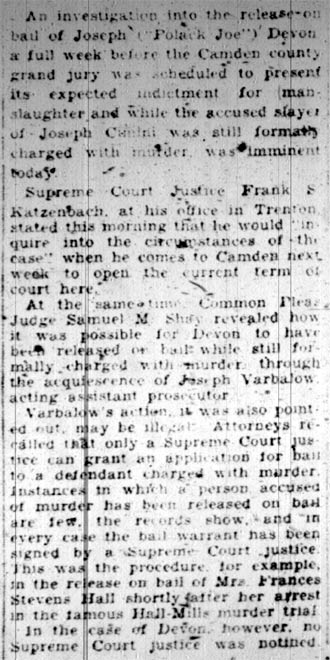
An investigation into the release on bail of Joseph (“Polack Joe”) Devon a full week before the Camden county grand jury was scheduled to present its expected indictment for manslaughter and while the accused slayer of Joseph Cimini was still formally charged with murder, was imminent today.
Supreme Court Justice Frank S. Katzenbach, at his office in Trenton, stated this morning that he would “inquire into the circumstances of the case” when he comes to Camden next week to open the current term of court here.
At the same time Common Pleas Judge Samuel M. Shay revealed how it was possible for Devon to have been released on bail while still formally charged with murder, through the acquiescence of Joseph Varbalow, acting assistant prosecutor. Varbalow’s action, it was also pointed out, may be illegal. Attorneys recalled that only a Supreme Court justice can grant an application for bail to a defendant charged with murder. Instances in which a person accused of murder has been released on bail are few, the records show, and “in every case the bail warrant has been signed by a Supreme Court Justice.” This was the procedure, for example, in the release on bail of Mrs. Frances Stevens Hall shortly after her arrest in the famous Hall-Mills murder trial.
In the case of Devon, however, no Supreme Court justice was notified.
Further than this, Judge Shay, whose signature appears on the bail warrant, was not consulted.
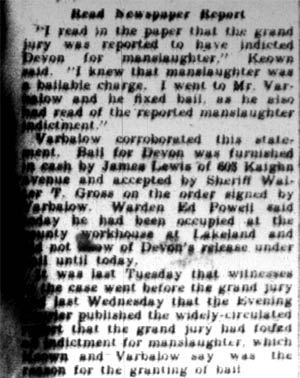
Devon was held without bail on a murder charge after the fatal shooting of Cimini at the Sixth Ward Republican Club last January. On March 27 the case was presented to the grand jury with appearance of witnesses to the shooting before that body. The following day the report was widely circulated around the Camden Courthouse that Devon had been indicted for manslaughter.
Apparently this report, “unofficial” in character, was the only basis for release of Devon on bail. The grand jury will not make its presentment until this afternoon. If the manslaughter indictment has been found, it will thus not be formally recorded until this afternoon. But on Thursday last, while he was still technically held for murder, Devon was freed under $2,000 bail.
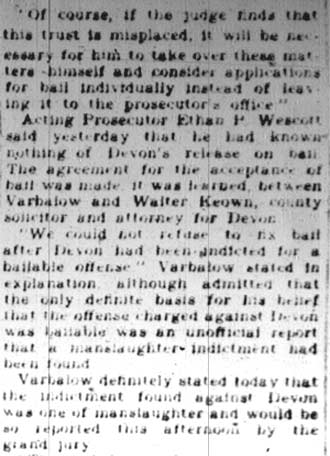
“All bail warrants must be signed by the judge,” it was explained today by Judge Shay, who did not learn of Devon’s release until yesterday, although his name appears on the bail warrant. “For some time, however, the custom has been in this county and I believe in others as well for the judge to sign a number of blank bail warrants in blank and turn them over to the prosecutor’s office. This is done because of the trust placed in the prosecutor’s office by the court, and in order that the judge may not be interrupted during court sessions or at his home with applications for bail.”
“Of course, if the judge finds that this trust is misplaced, it will be necessary for him to take over these matters himself and consider applications for bail individually instead of leaving it to the prosecutor’s office.”
Acting Prosecutor Ethan P. Wescott said yesterday that he had known nothing of Devon’s release on bail. The agreement for the acceptance of bail was made, it was learned, between Varbalow and Walter Keown, county solicitor and attorney for Devon.
“We could not refuse to fix bail after Devon had been indicted for a bailable offense,” Varbalow stated in explanation, although admitted that the only definite basis for his belief that the offense charged against Devon was bailable was an unofficial report that a manslaughter indictment had been found.
Varbalow definitely stated today that the indictment found against Devon was one of manslaughter and would be so reported this afternoon by the grand jury.
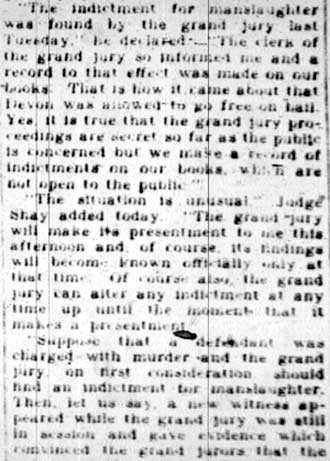
“The indictment for manslaughter was found by the grand jury last Tuesday,” he declared. “The clerk of the grand jury so informed me and a record to that effect was made on our books. That is how it came about that Devon was allowed to go free on bail. Yes, it is true that the grand jury proceedings are secret so far as the public is concerned, but we make a record of indictments on our books, which are not open to the public.”
“The situation is unusual,” Judge Shay added today. “The grand jury will make its presentment to me this afternoon and, of course, its findings will become known officially only at that time. Of course also, the grand jury can alter any indictment at any time up until the moment that it makes a presentment.”
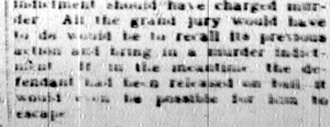
“Suppose that a defendant was charged with murder and the grand jury, on first consideration, should have had an indictment for manslaughter. Then, let us say, a new witness appeared while the grand jury was still in session and gave evidence which convinced the grand jurors that the indictment should have charged murder. All the grand jury would have to do would be to recall its previous action and bring in a murder indictment. If in the meantime the defendant had been released on bail, it would soon be possible for him to escape.”
Sixty-Nine Indicted by Grand Jurors / ‘Polack Joe’ Deven Charged With Manslaughter
Camden Courier-Post —
SIXTY-NINE INDICTED BY GRAND JURORS IN FINAL PRESENTMENT
‘Polack Joe’ Deven Charged With Manslaughter in G.O.P. Club Slaying
‘MOSE FLANNERY’ NAMED
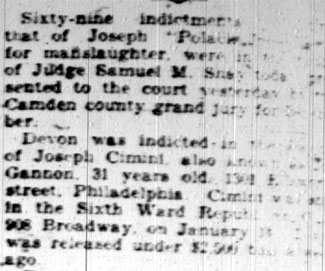
Sixty-nine indictments, that of Joseph “Polack Joe” Devon for manslaughter, were presented to the court yesterday by the Camden county grand jury.
Devon was indicted in the death of Joseph Cimini, also known as Joe Gannon, 31 years old, of Philadelphia. Cimini was shot in the Sixth Ward Republican Club, 905 Broadway, on January 14. Devon was released under $2,500 bail some time ago.
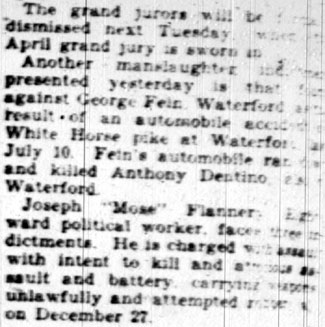
The grand jurors will be formally dismissed next Tuesday, when the April grand jury is sworn in.
Another manslaughter indictment presented yesterday is that brought against George Fein, Waterford, as a result of an automobile accident on the White Horse pike at Waterford, on July 10. Fein’s automobile ran down and killed Anthony Dentino of Waterford.
Joseph “Mose” Flannery, political worker, faces three indictments. He is charged with assault with intent to kill and atrocious assault and battery, carrying weapons unlawfully and attempted robbery, on December 27.
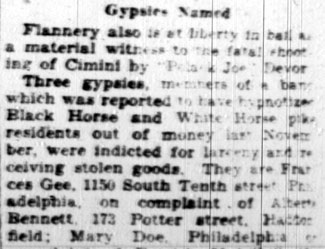
Gypsies Named
Flannery also is at liberty on bail as a material witness to the fatal shooting of Cimini by “Polack Joe” Devon.
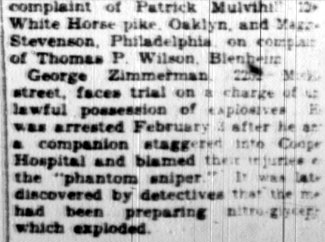
Three gypsies, members of a band which was reported to have hypnotized Black Horse and White Horse pike residents out of money last November, were indicted for larceny and receiving stolen goods. They are Frances Gee, 1150 South Tenth street, Philadelphia, on complaint of Albert Bennett, 173 Potter street, Haddonfield; Mary Doe, Philadelphia, on complaint of Patrick Mulvihill, Oaklyn; and Mary Stevenson, Philadelphia, on complaint of Thomas P. Wilson, Blenheim.
George Zimmerman faces trial on a charge of unlawful possession of explosives. He was arrested February 3 after he and a companion staggered into Cooper Hospital and blamed their injuries on the “phantom sniper.” It was later discovered by detectives that the men had been preparing nitroglycerin which exploded.
Found Wounded on Sidewalk at Kaighn Point
Camden Evening Courier —
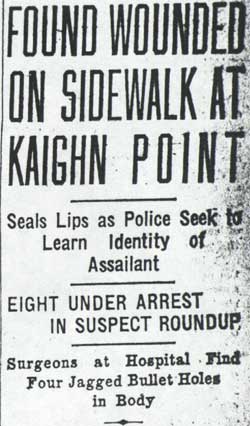
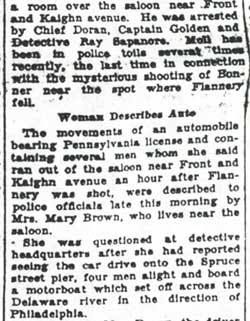
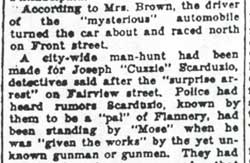
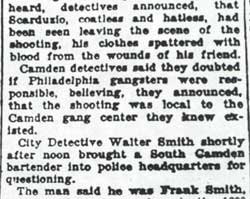
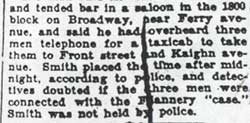
Seals Lips as Police Seek to Learn Identity of Assailant
EIGHT UNDER ARREST IN SUSPECT ROUNDUP
Surgeons at Hospital Find Four Jagged Bullet Holes in Body
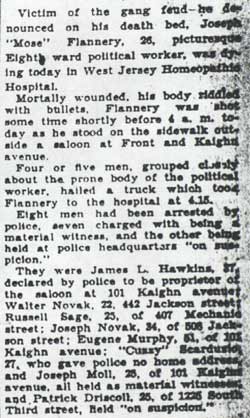
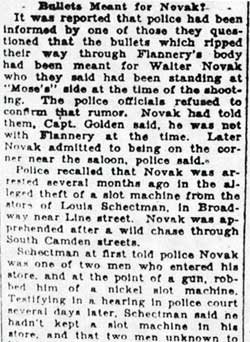
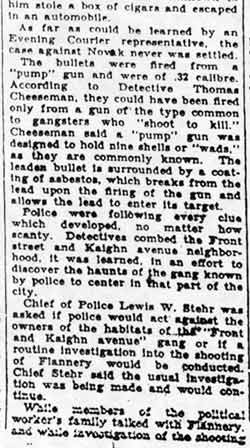
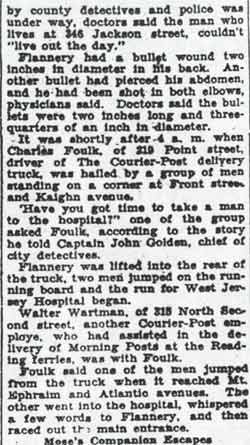
Victim of the gang feud—he denounced on his death bed, Joseph “Mose” Flannery, 26, picturesque Eighth ward political worker, was dying today in West Jersey Homeopathic Hospital.
Mortally wounded, his body riddled with bullets, Flannery was shot some time shortly before 4 a. m. today as he stood on the sidewalk outside a saloon at Front and Kaighn avenue.
Four or five men, grouped closely about the prone body of the political worker, hailed a truck which took Flannery to the hospital at 4.15.
Eight men had been arrested by police, seven charged with being a material witness, and the other being held at police headquarters “on suspicion.”
They were James L. Hawkins, 37, declared by police to be proprietor of the saloon at 101 Kaighn avenue; Walter Novak, 22, 442 Jackson street; Russell Sage, 25, of 407 Mechanic street; Joseph Novak, 34, of 508 Jackson street; Eugene Murphy, 51, of 101 Kaighn avenue; “Cuzzy” Scarduzio, 27, who gave police no home address, and Joseph Moll, 25, of 101 Kaighn avenue, all held as material witnesses; and Patrick Driscoll, 25, of 1225 South Third street, held “on suspicion.”
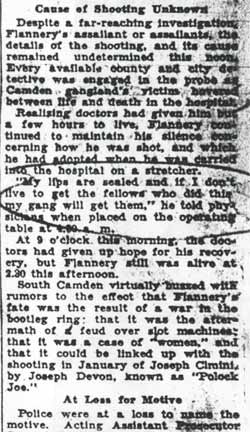
Cause of Shooting Unknown
Despite a far-reaching investigation, Flannery’s assailant or assailants, the details of the shooting, and its cause remained undetermined this noon. Every available county and city detective was engaged in the probe as Camden gangland’s victim hovered between life and death in the hospital.
Realising doctors had given him but a few hours to live, Flannery continued to maintain his silence concerning how he was shot, and which he had adopted when he was carried into the hospital on a stretcher.
“My lips are sealed and if I don’t live to get the fellows who did this my gang will get them,” he told physicians when placed on the operating table at 4:30 a. m.
At 9 o’clock this morning, the doctors had given up hope for his recovery, but Flannery still was alive at 2.30 this afternoon.
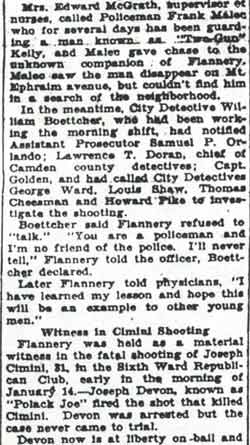
South Camden virtually buzzed with rumors to the effect that Flannery’s fate was the result of a war in the bootleg ring; that it was the aftermath of a feud over slot machines; that it was a case of “women,” and that it could be linked up with the shooting in January of Joseph Cimini, by Joseph Devon, known as “Polack Joe.”
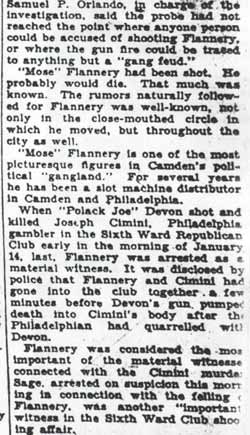
At Loss for Motive
Police were at a loss to name the motive. Acting Assistant Prosecutor Samuel P. Orlando, in charge of the investigation, said the probe had not reached the point where anyone person could be accused of shooting Flannery, or where the gun fire could be traced to anything but a “gang feud.”
“Mose” Flannery had been shot. He probably would die. That much was known. The rumors naturally followed for Flannery was well-known, not only in the close-mouthed circle in which he moved, but throughout the city as well.
“Mose” Flannery is one of the most picturesque figures in Camden’s political “gangland.” For several years he has been a slot machine distributor in Camden and Philadelphia.
When “Polack Joe” Devon shot and killed Joseph Cimini, Philadelphia gambler in the Sixth Ward Republican Club early in the morning of January 14, last, Flannery was arrested as a material witness. It was disclosed by police that Flannery and Cimini had gone into the club together a few minutes before Devon’s gun pumped death into Cimini’s body after the Philadelphian had quarrelled with Devon.
Flannery was considered the most important of the material witnesses connected with the Cimini murder. Sage, arrested on suspicion this morning in connection with the felling of Flannery, was another “important” witness in the Sixth Ward Club shooting affair.
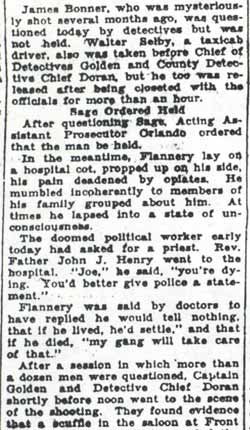
James Bonner, who was mysteriously shot several months ago, was questioned today by detectives but was not held. Walter Selby, a taxicab driver, also was taken before Chief of Detectives Golden and County Detective Chief Doran, but he too was released after being closeted with the officials for more than an hour.
Sage Ordered Held
After questioning Sage, Acting Assistant Prosecutor Orlando ordered that the man be held.
In the meantime, Flannery lay on a hospital cot, propped up on his side, his pain deadened by opiates. He mumbled incoherently to members of his family grouped about him. At times he lapsed into a state of unconsciousness.
The doomed political worker early today had asked for a priest. Rev. Father John J. Henry went to the hospital. “Joe,” he said, “you’re dying. You’d better give police a statement.”
Flannery was said by doctors to have replied he would tell nothing, that if he lived, “he’d settle,” and that if he died, “my gang will take care of that.”
After a session in which more than a dozen men were questioned, Captain Golden and Detective Chief Doran shortly before noon went to the scene of the shooting. They found evidence that a scuffle in the saloon at Front and Kaighn avenue had preceded the shooting.
Tables had been overturned. Glasses had been broken. Forty cents in change was found on a table beside a picture of a small baby. There was an empty glass on one table, another glass half-filled with beer on the bar.
Bullets Meant for Novak?
It was reported that police had been informed by one of those they questioned that the bullets which ripped their way through Flannery’s body had been meant for Walter Novak who they said had been standing at “Mose’s” side at the time of the shooting. The police officials refused to confirm that rumor. Novak had told them, Capt. Golden said, he was not with Flannery at the time. Later Novak admitted to being on the corner near the saloon, police said.
Police recalled that Novak was arrested several months ago in the alleged theft of a slot machine from the store of Louis Schectman, in Broadway near Line street. Novak was apprehended after a wild chase through South Camden streets.
Schectman at first told police Novak was one of two men who entered his store, and at the point of a gun, robbed him of a nickel slot machine. Testifying in a hearing in police court several days later, Schectman said he hadn’t kept a slot machine in his store, and that two men unknown to him stole a box of cigars and escaped in an automobile.
As far as could be learned by an Evening Courier representative, the case against Novak never was settled.
The bullets were fired from a “pump” gun and were of .32 calibre. According to Detective Thomas Cheeseman, they could have been fired only from a gun of the type common to gangsters who “shoot to kill.” Cheeseman said a “pump” gun was designed to hold nine shells or “wads,” as they are commonly known. The leaden bullet is surrounded by a coating of asbestos, which breaks from the lead upon the firing of the gun and allows the lead to enter its target.
Police were following every clue which developed, no matter how scanty. Detectives combed the Front street and Kaighn avenue neighborhood, it was learned, in an effort to discover the haunts of the gang known by police to center in that part of the city.
Chief of Police Lewis W. Stehr was asked if police would act against the owners of the habitats of the “Front and Kaighn avenue” gang or if a routine investigation into the shooting of Flannery would be conducted. Chief Stehr said the usual investigation was being made and would continue.
While members of the political worker’s family talked with Flannery, and while investigation of the shooting by county detectives and police was under way, doctors said the man who lives at 346 Jackson street, couldn’t “live out the day.”
Flannery had a bullet wound two inches in diameter in his back. Another bullet had pierced his abdomen, and he had been shot in both elbows, physicians said. Doctors said the bullets were two inches long and three-quarters of an inch in diameter.
It was shortly after 4 a. m. when Charles Foulk, of 219 Point street, driver of The Courier-Post delivery truck, was hailed by a group of men standing on a corner at Front street and Kaighn avenue.
“Have you got time to take a man to the hospital?” one of the group asked Foulk, according to the story he told Captain John Golden, chief of city detectives.
Flannery was lifted into the rear of the truck, two men jumped on the running board and the run for West Jersey Hospital began.
Walter Wartman, of 315 North Second street, another Courier-Post employe, who had assisted in the delivery of Morning Posts at the Reading Ferries, was with Foulk.
Foulk said one of the men jumped from the truck when it reached Mt. Ephraim and Atlantic avenues. The other went into the hospital, whispered a few words to Flannery, and then raced out the main entrance.
Mose’s Companion Escapes
Mrs. Edward McGrath, supervisor of nurses, called Policeman Frank Malec who for several days has been guarding a man known as “Two-Gun” Kelly, and Malec gave chase to the unknown companion of Flannery. Malec saw the man disappear on Mt. Ephraim avenue, but couldn’t find him in a search of the neighborhood.
In the meantime, City Detective William Boettcher, who had been working the morning shift, had notified Assistant Prosecutor Samuel P. Orlando; Lawrence T. Doran, chief of Camden county detectives; Capt. Golden, and had called City Detectives George Ward, Louis Shaw, Thomas Cheeseman and Howard Pike to investigate the shooting.
Boettcher said Flannery refused to “talk.” “You are a policeman and I’m no friend of the police. I’ll never tell,” Flannery told the officer, Boettcher declared.
Later Flannery told physicians, “I have learned my lesson and hope this will be an example to other young men.”
Witness in Cimini Shooting
Flannery was held as a material witness in the fatal shooting of Joseph Cimini, 31, in the Sixth Ward Republican Club, early in the morning of January 14. Joseph Devon, known as “Polack Joe” fired the shot that killed Cimini. Devon was arrested but the case never came to trial.
Devon now is at liberty on bail and is under indictment for manslaughter in connection with Cimini’s death. Flannery also was released under bail.
While police continued their investigation, Flannery, still determined to refuse information to detectives and doctors, was surrounded by his wife, his 4-year-old son, his mother and father, and his 19-year-old brother James. Calling “Jim” to his side, Flannery, according to physicians, said, “I want you to promise me you’ll never get mixed up in these gang wars.” “Jim” promised, Detective Boettcher said.
Novak Under Suspicion
In their search for the “mysterious” companion of Flannery on the ride to the hospital, police pointed a suspicioning finger at Walter Novak who they had held “on suspicion.”
According to information given them by Foulk, the truck driver, Flannery, during the ride from Front and Kaighn avenue to the hospital, whispered, “Where are you taking me, Walt?” He was told the hospital was the truck’s destination, Foulk told police.
Detectives said Novak might have been the “Walt” to whom Flannery spoke. Novak said he was 22, was a “salesman” and lived at 442 Jackson street.
Taken by Strategy
Scarduzio’s arrest resulted from a piece of strategy on the part of Chief of County Detectives Doran. Doran with several members of his staff and city detectives were in the bar-room of the saloon at 101 Kaighn avenue when the telephone rang before noon.
Doran picked up the receiver and the party on the other end asked if Joseph Moll, son of former Policeman Frank Moll, was there.
Figuring that the persons might be some one who could help the authorities unravel the mystery, Doran answered:
“Yes, this is Joe Moll.”
“Well, I want to see you right away,” continued the other party.
“Will you come right down to 674 Fairview street. I want to see you,” finished the unidentified speaker who then hung up.
Doran with Captain of Detectives Golden hurried down to the address given and there found Scarduzio in the home of Garfield Del Duca.
Scarduzio, it is said, was more surprised to see the authorities than they were to find him as Chief Doran had been searching for “Cuzzie” for several hours.
He said he had nothing to do with the shooting of Flannery. Limping when the detectives escorted him from the house, Scarduzio was first taken to West Jersey Homeopathic Hospital to discover whether or not he was suffering from any bullet wounds in the legs.
Scarduzio Not Shot
Doctors later said Scarduzio had not been shot and the man who had been surprised at the Del Duca home was taken to police headquarters.
He “knew nothing about the shooting,” Scarduzio told Captain Golden and County Detective Chief Doran. There were stains, possibly bloodstains, on Scarduzio’s trousers, the police said. “Cuzzy,” as he is known in police circles, wore a clean white shirt, and that fact sent detectives from headquarters on another tangent in their investigation.
Scarduzio was asked where he had left a “bloody shirt” he was reported to have been wearing early today. According to police, he denied his shirt was bloody, and refused to give them any information.
City Detectives David Hunt, Samuel Johnson, and Walter Smith were dispatched on the “side” investigation.
Detective Thomas Cheesman, of the city hall staff, also holds two warrants for the arrest of Scarduzio in connection with the holdup of a saloon in Gloucester several weeks ago and the theft of an automobile.
Moll was arrested while sleeping in a room over the saloon near Front and Kaighn avenue. He was arrested by Chief Doran, Captain Golden and Detective Ray Sapanore. Moll has been in police tolls several times recently, the last time in connection with the mysterious shooting of Bonner near the spot where Flannery fell.
Woman Describes Auto
The movements of an automobile bearing Pennsylvania license and containing several men whom she said ran out of the saloon near Front and Kaighn avenue an hour after Flannery was shot, were described to police officials late this morning by Mrs. Mary Brown, who lives near the saloon.
She was questioned at detective headquarters after she had reported seeing the car drive onto the Spruce street pier, four men alight and board a motorboat which set off across the Delaware river in the direction of Philadelphia.
According to Mrs. Brown, the driver of the “mysterious” automobile turned the car about and raced north on Front street.
A city-wide man-hunt had been made for Joseph “Cuzzie” Scarduzio, detectives said after the “surprise arrest” on Fairview street. Police had heard rumors Scarduzio, known by them to be a “pal” of Flannery, had been standing by “Mose” when he was “given the works” by the yet unknown gunman or gunmen. They had heard, detectives announced, that Scarduzio, coatless and hatless, had been seen leaving the scene of the shooting, his clothes spattered with blood from the wounds of his friend.
Camden detectives said they doubted if Philadelphia gangsters were responsible, believing, they announced, that the shooting was local to the Camden gang center they knew existed.
City Detective Walter Smith shortly after noon brought a South Camden bartender into police headquarters for questioning.
The man said he was Frank Smith, and tended bar in a saloon in the 1800 block on Broadway, near Ferry avenue, and said he had overheard three men telephone for a taxicab to take them to Front street and Kaighn avenue. Smith placed the time after midnight, according to police, and detectives doubted if the three men were connected with the Flannery “case.” Smith was not held by police.
Camden Evening Courier — September 18, 1928 (continued)
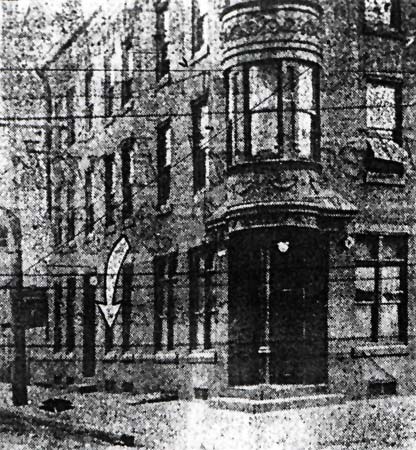
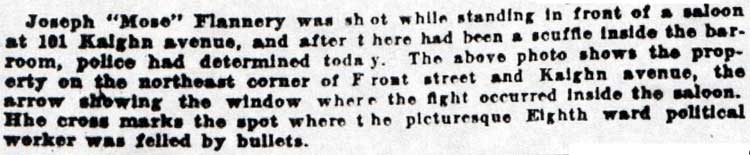
Joseph “Mose” Flannery was shot while standing in front of a saloon at 101 Kaighn avenue, and after there had been a scuffle inside the barroom, police had determined today. The above photo shows the property on the northeast corner of Front street and Kaighn avenue, the arrow showing the window where the fight occurred inside the saloon. The cross marks the spot where the picturesque Eighth ward political worker was felled by bullets.
Soft Voice Made Mose Like Teacher Of Sunday School
“Mose” Flannery, of the twin trail that lead through the underworld of Camden and Philadelphia, was always pointed as a “dangerous boy to monkey with.”
But Mose’s appearance belied his reputation—a slender, neatly groomed and soft-voiced lad of about 28 or 29. He would have passed for a Sunday school teacher or a bank teller rather than a leader in gangland. Residents of the waterfront precincts said Mose was working a “rich game.”
On the hustings, primary or election day, he was a real boss. Mose threw himself into the politics of the ward, frequently an ardent advocate of the Democratic party. Down in those districts where fear is a controlling element on election day, Mose Flannery was one of the unafraid.
He was arrested no less than eight times at the last municipal election. At that particular election he and Mike Brown, the Republican boss of the ward, clashed—with Mose as a challenger in Mike’s own district. Brown ran up a heavy vote in his own precinct and carried the ward, but the battle was close.
However, there appeared to be no “bad blood” between Brown and Flannery. Flannery seldom, if ever, took recourse to the courts in his days of trouble, and they had been many—a man of few words who, dying mortally wounded, said, “If I don’t live to get the fellows who did this, my gang will.”
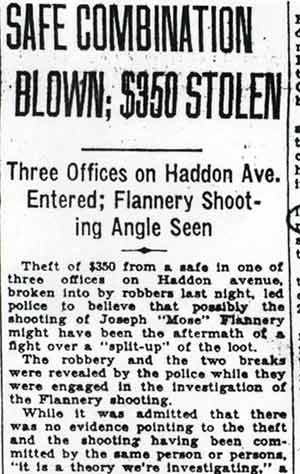
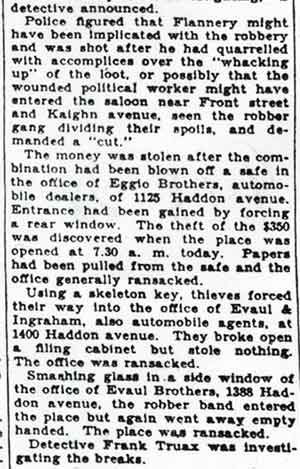
Safe Combination Blown; $350 Stolen
SAFE COMBINATION BLOWN; $350 STOLEN
Three Offices on Haddon Ave. Entered; Flannery Shooting Angle Seen
Theft of $350 from a safe in one of three offices on Haddon avenue, broken into by robbers last night, led police to believe that possibly the shooting of Joseph "Mose" Flannery might have been the aftermath of a fight over a "split-up" of the loot.
The robbery and the two breaks were revealed by the police while they were engaged in the investigation of the Flannery shooting.
While it was admitted that there was no evidence pointing to the theft and the shooting having been committed by the same person or persons, "it is a theory we're investigating."
Camden Evening Courier — September 19, 1928
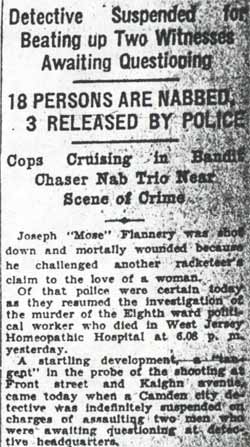


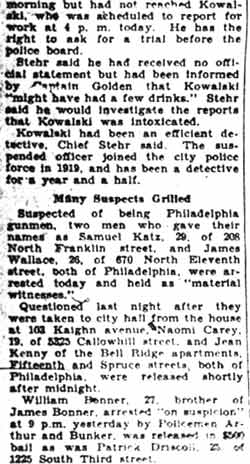

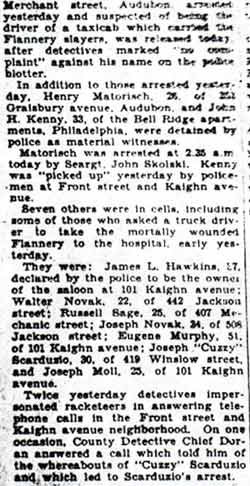
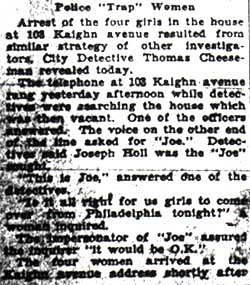
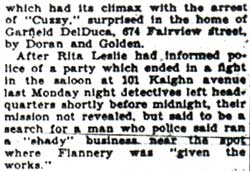
18 Persons Are Nabbed, 3 Released by Police
Detective Suspended for Beating up Two Witnesses Awaiting Questioning
18 PERSONS ARE NABBED, 3 RELEASED BY POLICE
Cops Cruising in Bandit Chaser Nab Trio Near Scene of Crime
Joseph "Mose" Flannery was shot down and mortally wounded because he challenged another racketeer's claim to the love of a woman.
Of that police were certain today as they resumed the investigation of the murder of the Eighth ward political worker who died in West Jersey Homeopathic Hospital at 6:06 p.m. yesterday.
A startling development — "negligent" in the probe of the shooting at Front street and Kaighn avenue came today when a Camden city detective was indefinitely suspended on charges of assaulting two men who were awaiting questioning at detective headquarters.
[Article continues on additional pages — 19 pages total of coverage]
Phila. Suspect Is Grilled in Flannery Case
Camden Evening Courier —
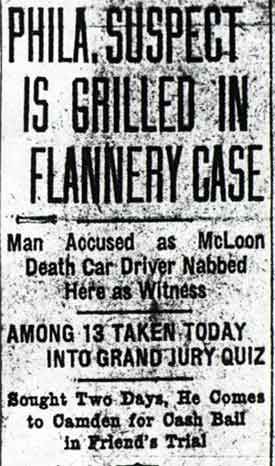
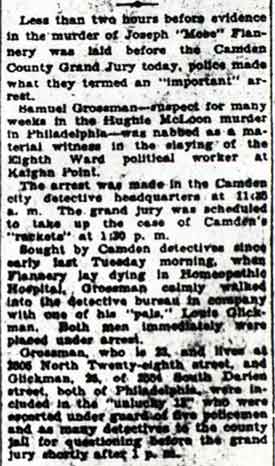
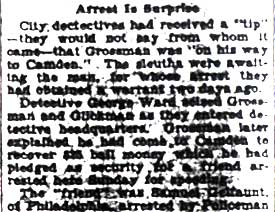
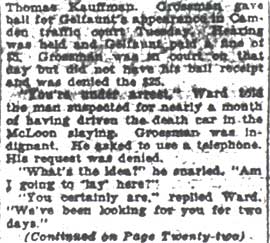
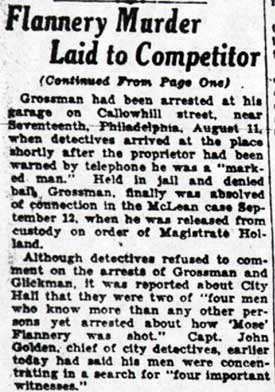
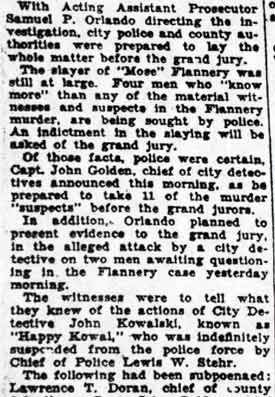
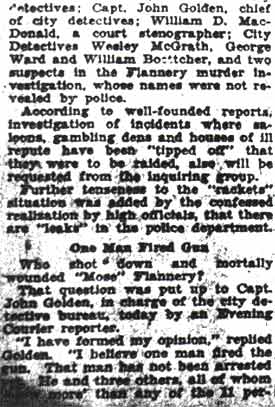
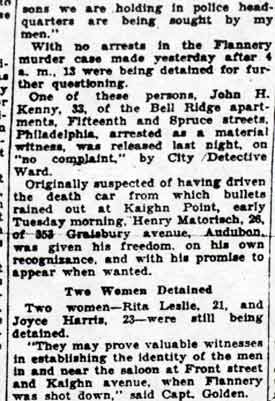
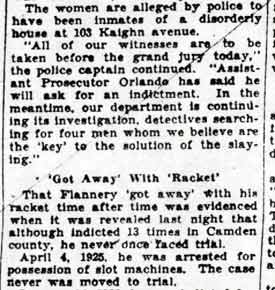
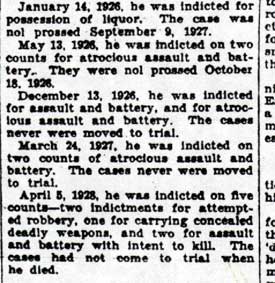
Man Accused as McLoon Death Car Driver Nabbed Here as Witness
AMONG 13 TAKEN TODAY INTO GRAND JURY QUIZ
Sought Two Days, He Comes to Camden for Cash Bail in Friend’s Trial
Less than two hours before evidence in the murder of Joseph “Mose” Flannery was laid before the Camden County Grand Jury today, police made what they termed an “important arrest.”
A man, sought for many weeks in the Hughie McLoon murder investigation, was named a material witness in the slaying of the Eighth Ward political worker at Kaighn Point.
The arrest was made in the Camden city detective headquarters at 11:30 a. m. Groceyman, 66 N. Twenty-eighth street, Philadelphia, calmly walked into the detective bureau on a matter with one of his “pals,” Louis Glickman, and was immediately placed under arrest. Glickman said the Philadelphia man “had related to Camden.” The sleuths were awaiting the man.
Thomas Kauffman—Groceyman had given bail for Glickman, a shopkeeper who had violated traffic court rules relating to an unlicensed driver. Groceyman was on hand for the same reason.
“You are under arrest,” Ward told Groceyman as soon as he ended a telephone call.
“What’s the idea? Am I under arrest?”
“You certainly are,” replied Ward.
“Well, I’ve done nothing in ten days.”
Flannery Murder Laid to Competitor
Although detectives refused to comment on the arrest of Groceyman and Glickman, it was reported about City Hall that they were “key” men—those who knew more than any other persons yet contacted in the Flannery matter.
With Acting Assistant Prosecutor F. P. O’Malley directing the investigation, city police and county authorities cooperated to lay the whole matter before the grand jury. “We have four men who ‘know more’ than any other persons in regard to the murder, who are being sought by police,” said Capt. John Golden, chief of city detectives.
The witnesses to be examined included Capt. John Golden; County Detective Chief Lawrence T. Doran; William D. Donald, court stenographer; City Detectives Wesley McGrath, James Ward, and William Boettcher; and two suspects in the Flannery murder investigation whose names were not revealed.
One of the men held, John H. McMichael, Jr., Bell Ridge apartment, Fifteenth and Spruce street, Philadelphia, arrested as a material witness, was released last night on “no complaint” by Detective Ward.
Two women—Rita Leslie and Joyce Cartin, 22—were still being detained. “They may prove valuable witnesses in establishing the identity of the men in and near the saloon at Front street and Kaighn avenue when Flannery was shot down,” said Capt. Golden.
The women are alleged by police to have been inmates of a disorderly house at 103 Kaighn avenue.
“Got Away” With “Racket”
Mose Flannery’s old connection with the racket was evidenced clearly. Although indicted 13 times in Camden county, he was never tried criminally. On April 4, 1926, he was arrested for possession of slot machines. The case was never moved to trial.
January 16, 1926, he was indicted for possession of liquor. May 13, 1926, he was indicted on two counts for atrocious assault and battery. September 13, 1926, he was indicted for possession of liquor and for atrocious assault and battery. April 4, 1928, he was indicted on five counts—two indictments for attempt to kill and carry concealed deadly weapons, and two for assault and battery with intent to kill. None of the cases had come to trial when he died.
“I have formed my opinion,” said Capt. Golden when asked who shot Flannery. “I believe one man shot the gun. That man has not been arrested, and I do not think he will be under arrest in two or three days.”
Man, 2 Women Ordered Held in Flannery Case
Camden Evening Courier —
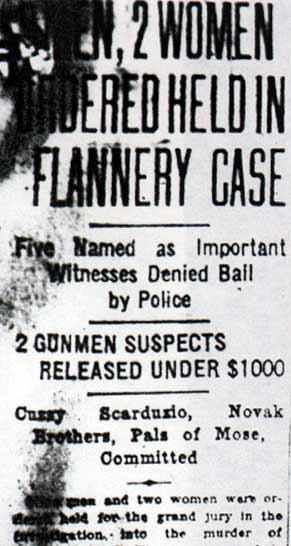
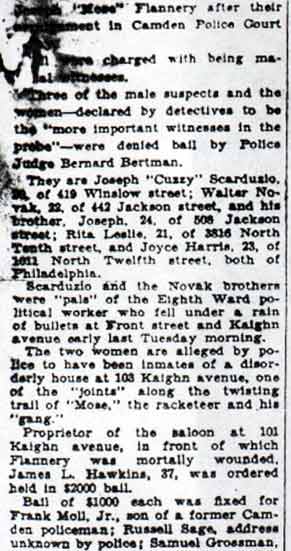
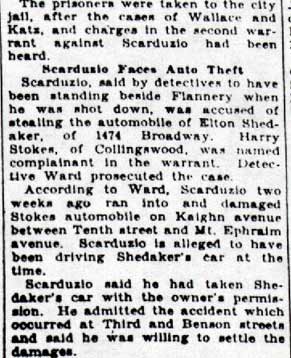
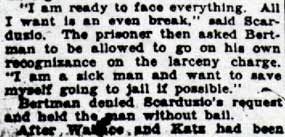
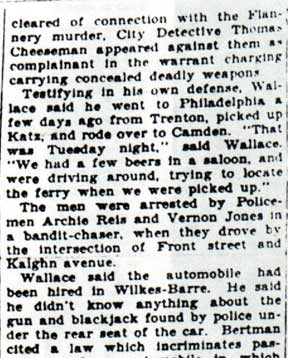
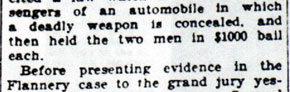
Five Named as Important Witnesses and Denied Bail by Police
2 GUNMEN SUSPECTS RELEASED UNDER $1,000 BAIL
Scardualo, Novak Brothers, Pals of Mose, Committed
Two women were ordered for the grand jury in the investigation into the murder of “Mose” Flannery after their arraignment in Camden Police Court yesterday. They are charged with being material witnesses. Two of the male suspects—associated by detectives with being pals of the slain political worker and “inside” men in the affair—were denied bail by Police Judge Bernard Bertman.
They are Joseph “Cuzzy” Scardualo, friend of the dead man; the Novak brothers, Walter of 442 Jackson street, and his brother Frank, 311 of the same street; Rita Leslie, 21, of 2636 North Eleventh street, and Joyce Harris, 23, of 2211 North Twelfth street, both of Philadelphia.
Scardualo and the Novak brothers were “pals” of the Eighth Ward political worker who fell under a rain of bullets at Front and Kaighn avenue early last Tuesday morning. The two women are alleged by police to have been inmates of a disorderly house at the address, one of the “joints” along the twisting trail of “Mose” the racketeer and his gang.
The proprietor of the saloon at 101 Kaighn avenue, in front of which Flannery was fatally shot, was James L. Hawkins, 31, who was also ordered into court.
The preliminary hearing in police court was brief. The 11 prisoners were arraigned together. City Detective George Ward appeared as complainant. Ward said the nine men and two women had been arrested by the detective bureau, in conjunction with the prosecutor’s office, in the investigation of the murder of Joseph Flannery.
Scardualo Faces Auto Theft
Scardualo, said by detectives to have been standing beside Flannery when the latter was shot, also faced a charge of stealing an automobile. Detective Ward appeared as complainant. Scardualo said he had taken the car with the owner’s permission and admitted an accident, saying he was willing to settle the damages.
“I am ready to face everything. All I want is an open hearing,” said Scardualo. He was held without bail.
Jurors Hear Scardualo
Before presenting evidence in the Flannery case to the grand jury, Assistant Prosecutor Samuel P. Orlando called witnesses in the attack made by City Detective John Kowalski, known as “Happy” Kowal, on two men awaiting questioning in the Flannery case at headquarters. Kowalski beat up Moll in detective headquarters. It was rumored the jury had made a presentment against Kowalski on an assault and battery charge. He had been suspended by Police Chief Louis Stehr.
Joseph “Cuzzy” Scardualo and Walter Novak were the last witnesses called to the grand jury anteroom that afternoon. Both were guarded by patrolmen when they entered the jury room.
At 12:35 p. m., a city patrol wagon, escorted by four motorcycle policemen, rolled up to the Broadway entrance of the courthouse. The prisoners were rushed through a large crowd on the sidewalk and escorted to the third floor, where they were placed in the United States District courtroom, about 30 feet from the entrance to the grand jury chambers.
The two women, Rita Leslie and Joyce Harris, seeing a newspaper photographer at the stairs to the courthouse, emerged from the patrol with their faces covered by black scarves.
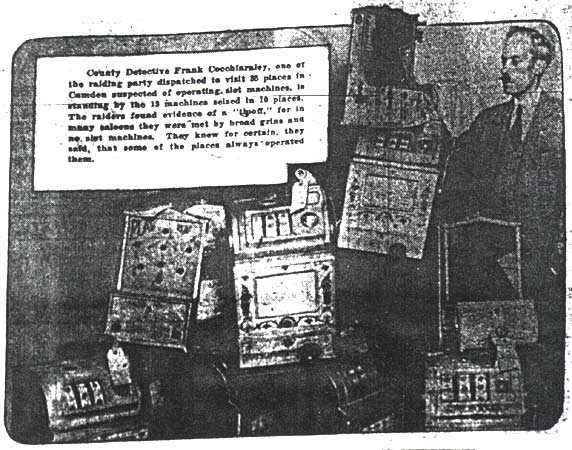
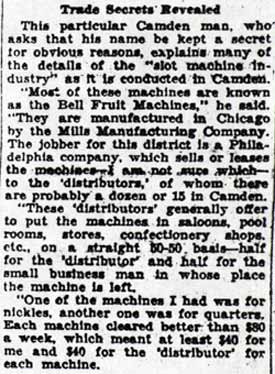
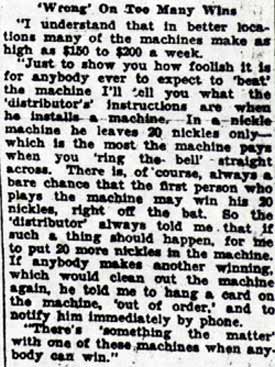
Odds of Winning On Slot Machines Fixed at 15 to 85
Shows some of the slot machines seized in the gambling party dispatched in one apartment a few days ago. Sixty-four machines were found, which had been operating in most of the places roundabout.
When you put a coin in the slot of one of Camden’s many “money machines” and pull the lever, the odds against winning are, roughly, 15 to 85. If you take a dollar, two dollars, or any given amount and decide to “shoot it all,” you are facing only one doubt—and that’s whether you’ll win before all your money is gone. That coin, reckoned by the “law of averages,” is beatable.
These statements were made by a Camden man who has been operating five slot machines in his small business place for the last couple of months. He has thrown off much to say. “Because of ‘the poor boob who puts a hard earned coin into a machine while I stand there and watch his face,’” he philosophizes, he has decided to cooperate.
Trade Secrets Revealed
A distributor who asks that his name be kept a secret from the public has outlined the details of the “slot machine industry” as it is conducted in Camden. “Most of these machines are known as Bell Fruit Machines,” he said. “They are manufactured in Chicago by the Mills Novelty Company. The jobber for this district is a Philadelphia company, which sells or leases the machines to about a dozen or 15 distributors in Camden. The machines are first ‘planted’ in a speakeasy, store, confectionery shop, or saloon. The operator pays about $200 for the machine, and the profits are split between the distributor and the small business man in whose place the machine is left.”
“One of the machines I had was for nickels, another one was for quarters. Each machine cleared better than $5 a week, which meant at least $40 for the distribution and $30 for the ‘distributor’ on each machine.”
‘Wrong’ On Too Many Wins
“If a player is unlucky he won’t be able to get one single nickel back in the machine. If anybody makes a winning, I simply call the machine ‘wrong’ and pull it out. I rather go with one of these machines and one new.”
Warrant Out for Slayer of Mose Flannery
Camden Evening Courier —

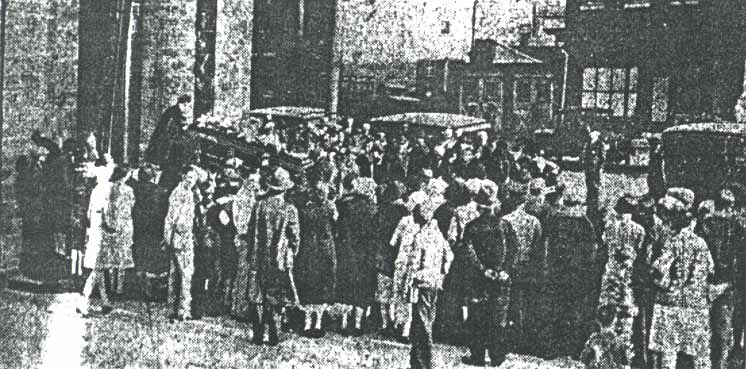

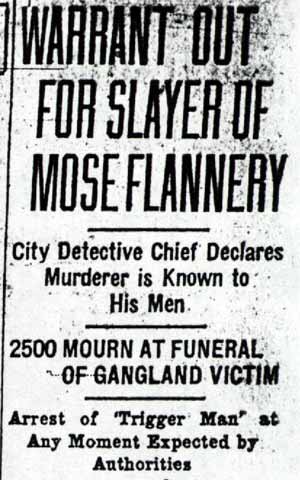
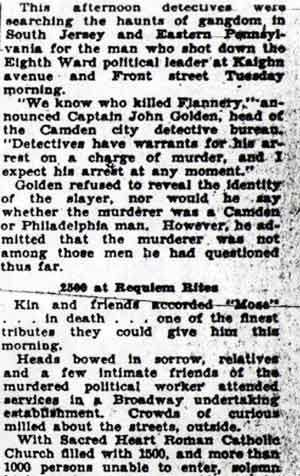
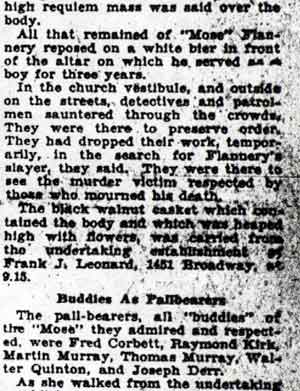
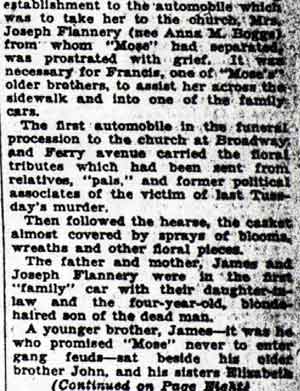
City Detective Chief Declares Murderer is Known to His Men
2500 MOURN AT FUNERAL OF GANGLAND VICTIM
Arrest of “Trigger Man” at Any Moment Expected by Authorities
Showing a small part of the crowd which surrounded Sacred Heart Roman Catholic Church, Broadway and Perry avenue, this morning when the body of Joseph “Mose” Flannery, murdered ex-convict, was being borne into the church by six “pals” of the Eighth Ward political worker. Relatives of the murder victim, heads bowed in grief, are seen about to enter the church, where solemn High requiem mass was said for the body.
This afternoon detectives were searching the haunts of Camden, South Jersey and Eastern Pennsylvania for the man who shot down Joseph “Mose” Flannery at Kaighn Point.
“We know who killed Flannery,” announced Captain John Golden, head of the Camden city detectives bureau. “Detectives have warrants for his arrest and we expect his arrest at any moment.”
Golden refused to reveal the identity of the slayer, nor would he say whether the murderer was a “gangland” or Philadelphia man. However, he admitted that the murderer was not among those men he had questioned so far.
2,500 at Requiem Mass
Heads bowed in sorrow, relatives and intimate friends of the murdered political worker attended the services. Crowds of curious persons milled about the streets outside, while the church filled with 1,500, and more than 1,000 persons sat or stood about the street outside.
High requiem mass was said over the body. All that remained of “Mose” Flannery rested on a white bier in front of the altar at which he had served as an altar boy in this parish.
In the church vestibule, and outside on the streets, detectives and wardmen moved through the crowds, both to preserve order and to observe those who came to mourn.
Buddies As Pallbearers
The pallbearers, all “buddies” of “Mose,” were Fred Corbett, Raymond Kirk, Martin Murray, Thomas Dunn, Joseph Dunn, and Joseph Derry.
The first automobile in the funeral procession to the church at Broadway and Perry avenue carried the casket and floral tributes sent from Kaighn avenue “pals” and former political associates. His mother and father, James and Joseph Flannery, sat in the “family” car with their daughter and young Joseph Flannery, Jr., four-year-old son of the dead man.
A younger brother, James, Jr., who had promised “Mose” never to enter the gang, rode with his sisters Elizabeth and Nellie.
Camden Evening Courier — September 26, 1928
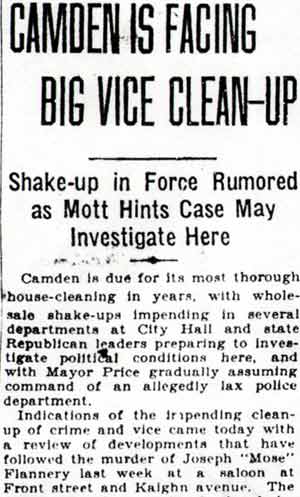
Camden Is Facing Big Vice Clean-Up
CAMDEN IS FACING BIG VICE CLEAN-UP
Shake-up in Force Rumored as Mott Hints Case May Investigate Here
Camden is due for its most thorough house-cleaning in years, with wholesale shake-ups impending in several departments at City Hall and state Republican leaders preparing to investigate political conditions here, and with Mayor Price gradually assuming command of an allegedly lax police department.
Indications of the impending clean-up of crime and vice came today with a review of developments that have followed the murder of Joseph "Mose" Flannery last week at a saloon at Front street and Kaighn avenue. The [...]
Camden Courier-Post — April 23, 1928
Polack Joe' Enters Plea of Not Guilty
'POLACK JOE' ENTERS PLEA OF NOT GUILTY
Arraigned in Court as Echo of Fatal Shooting in G.O.P. Club
Joseph "Polack Joe" Devon, sometimes political worker, who shot and killed Joseph Cimini, of Philadelphia, in the Sixth Ward Republican Club three months ago, today entered a plea of not guilty to a charge of [manslaughter]
Camden Courier-Post — April 30, 1929
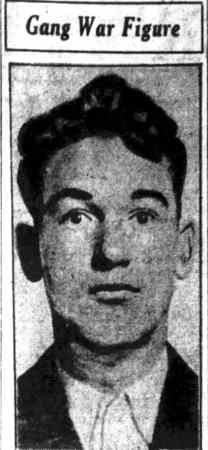
Joseph Connors, who is facing a crisis in West Jersey Hospital from wounds received in a shooting affray early Sunday near Broadway and Kaighn Avenue
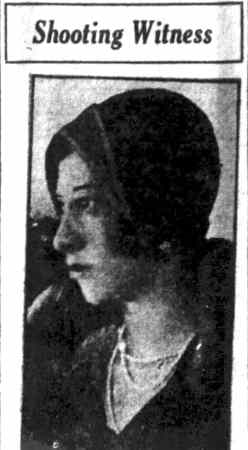
Mrs. Rose Gibbs, who is held as a material witness in shooting of Joseph Connors Sunday night near Broadway and Kaighn Avenue

Action Delayed in Gang Shooting
ACTION DELAYED IN GANG SHOOTING
Indictment of Doris in Flannery Murder Revealed After Arrest
Assistant Prosecutor Rocco Palese was prepared last night to go to the bottom of all charges against John Doris, brother of an executed Philadelphia bandit murderer, in an effort to determine whether to press for his immediate trial on indictments accusing him of the killing of Joseph (Mose) Flannery, or to seek other indictments first on charges of shooting Joseph Connors, at 6 a. m. Sunday.
The condition of Connors, a reputed Gloucester racketeer, remained the same last night in West Jersey Homeopathic Hospital, where doctors said the crisis was not yet passed. He has bullet wounds in the lung, abdomen and the hand, physicians saying it was too soon to predict whether he had a chance for recovery.
Doris Arraigned
Doris was arraigned before Police Judge Pancoast yesterday charged with shooting Connors near Broadway and Kaighn avenue, after a brawl which took them into two resorts and finally ended on the street outside. The judge held him for grand jury action on that charge, and was about to close the case when City Detective J. Wesley McGrath took the stand and revealed that Doris was wanted in the mysterious murder of "Mose" Flannery, Camden racketeer, seven months ago at Front street and Kaighn avenue. Pancoast promptly denied him bail.
Palese Studies Case
The Flannery case was placed before the grand jury by former Assistant Prosecutor Samuel P. Orlando, who left his notes with the indictment in the office when he relinquished his post to Palese.
"I will study the case tomorrow," Palese said last night. "Until I do, and can learn the strength of the old case against Doris in the Flannery murder, I can't say which charge I might take before a jury, provided, of course, that we can get an indictment in the Connors case against the youth."
Connors, who is 28, lives at 135 North Broadway, Gloucester. He has been arrested twice, once in Gloucester for disorderly conduct in 1924, and later on a grand larceny charge, on which he was acquitted.
Doris is a brother of the late Frankie Doris, who with three other youths went to the electric chair for the murder of a policeman in the Olney Bank robbery. (Continued on Page Twenty-one)
Joe Devon Wins Pardon After 2 Years in Prison
Camden Morning Post —
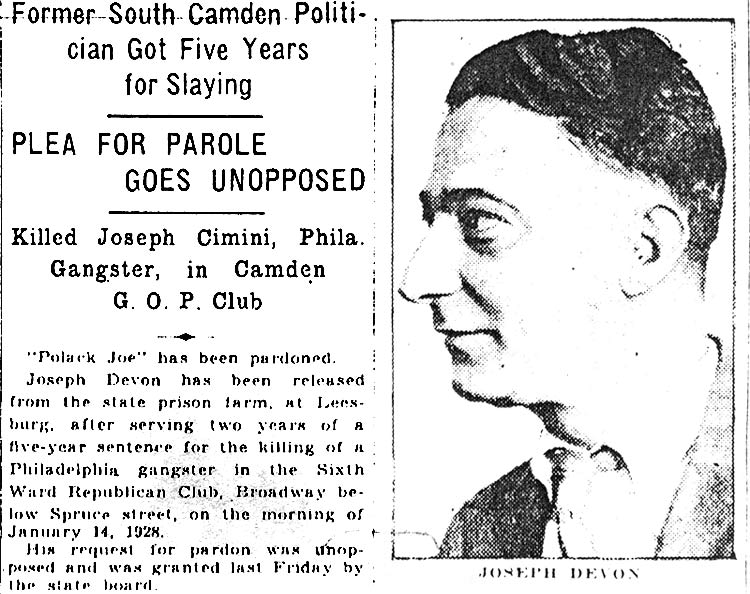
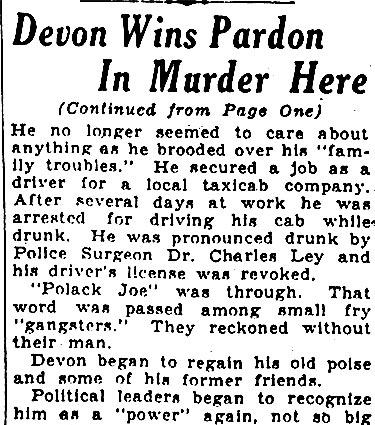
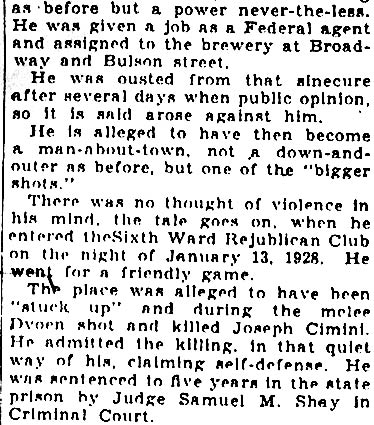
Former South Camden Politician Got Five Years for Slaying
PLEA FOR PAROLE GOES UNOPPOSED
Killed Joseph Cimini, Phila. Gangster, in Camden G.O.P. Club
“Polack Joe” has been pardoned. Joseph Devon has been released from the state prison after serving two years of a five-year sentence for the killing of Joseph Cimini, a Philadelphia gangster, in the Sixth Ward Republican Club on Lower Spruce street, on the morning of January 14, 1928. The pardon was granted last Friday by the state board.
At one time the mere mention of Devon’s name would gain entrance to places forbidden to the average citizen. He rose rapidly in Third Ward politics and finally was recognized as “the power.” He took orders from no one.
Then came a rift between Devon and a “bigger” man, and “Polack Joe” began to slip. He tried on numerous occasions to effect a reconciliation but always met with failure. Finally, on May 11, 1928, after a last desperate effort to restore relations, he attempted suicide by shooting. The bullet only grazed his shoulder and after several days in Cooper Hospital he was released. He was no longer a power in politics.
He took a job as a driver for a taxicab company. After several days at work he was drunk. He was pronounced drunk by Police Surgeon Dr. Charles Levy and his driver’s license was revoked. The word went out among small-time “leaguers” that “Polack Joe” was through. Devon began to regain his old poise, and some of his former friends began to recognize him as a “power” again.
He was given a job at the Federal agent and assigned to the brewery at Broadway and Fulton street. He was then alleged to have become a man-about-town again. There was no thought of violence in his mind, the tale goes on, when he entered the Sixth Ward Republican Club on the night of January 14, 1928. He went for a friendly game. The place was alleged to have been “stuck up” and during the melee Devon shot and killed Joseph Cimini. He admitted the killing, claiming self-defense. He was sentenced to five years in the state prison by Judge Samuel A. Kalisch in Criminal Court.
‘Polack Joe’ Freed; Pardon Unopposed
Camden Evening Courier —
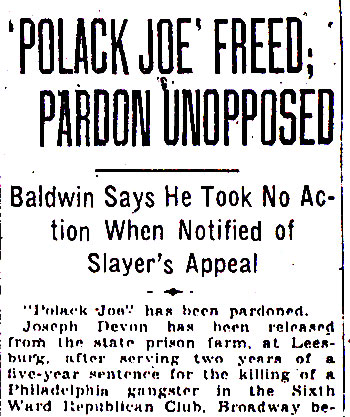
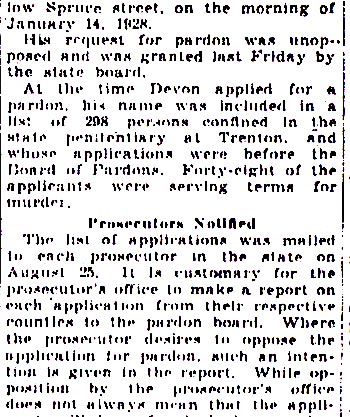
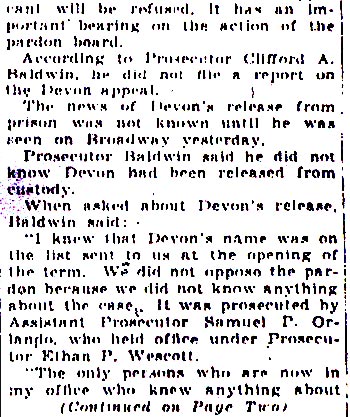
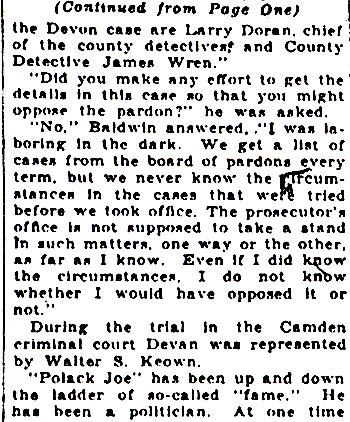
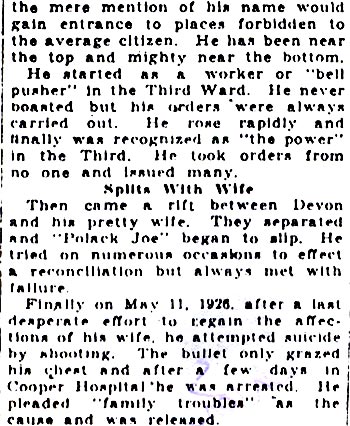
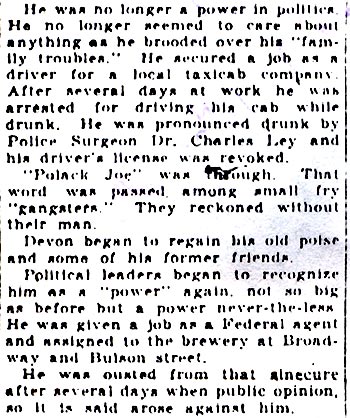
Baldwin Says He Took No Action When Notified of Slayer’s Appeal
“Polack Joe” has been pardoned. Joseph Devon has been released from the state prison farm at Leesburg after serving two years of a five-year sentence for the killing of a Philadelphia gangster in the Sixth Ward Republican Club, Broad and De Law Spruce street, on the morning of January 14, 1928.
His request for pardon was unopposed and was granted on Friday. At the time Devon applied for a pardon, his name was included in a list of 298 persons confined in the state penitentiary whose applications were before the Board of Pardons. Eighty-eight of the applicants were serving terms for murder.
According to Prosecutor Clifford A. Baldwin, he did not file a report on Devon’s case. Devon was not known to have been released until he was seen on Broadway.
“Did you make any effort to get the details in the case so that you might oppose the application?” he was asked.
“No,” Baldwin answered. “It was my impression to see all the cases from the board of pardons every month, but we never know the circumstances in the cases that were tried before we took office. The prosecutor’s office is not supposed to take a stand in such matters, one way or the other, unless under certain circumstances. I do not know whether I could have opposed it or not.”
During the trial in Camden criminal court, Devon was represented by Walter R. Keown. Chief of county detectives in the Devon case were Larry Doran and County Detective James Wren.
“Polack Joe” had been up and down in politics. At one time the mere mention of his name would gain entrance to places forbidden to the average citizen. He had been near the top and nearly near the bottom.
He worked as a driver or “bell pusher” in the Third Ward. He rose rapidly and finally was recognized as “the power” in the Third. He took orders from no one. Then came a rift between Devon and another man, and “Polack Joe” began to slip.
Finally, on May 11, 1928, after a last desperate effort to restore relations, he attempted suicide by shooting. The bullet only grazed his shoulder and he recovered. He was no longer a power in politics. He worried, and at times was drunk. He was pronounced drunk by Police Surgeon Dr. Charles Jay and his driver’s license was revoked.
Devon began to regain his old poise. He is alleged to have become a man-about-town, not a down-and-outer as before, but one of the “bigger shots.”
There was no thought of violence in his mind, the tale goes on, when he entered the Sixth Ward Republican Club on January 13, 1928, for a friendly game. The place was alleged to have been “stuck up” and during the melee Devon shot and killed Joseph Cimini. He admitted the killing, in that quiet way of his, claiming self-defense. He was sentenced to five years in the state prison by Judge Samuel M. Shay in the Criminal Court.
Four Camden Men Are Among Those Who Get Paroles
Camden Courier-Post —
Leslie Orr, ‘Polack Joe’ Deven, Jackie Hindle and Walter Kennedy Freed
PUBLIC NOT INFORMED
Four well-known Camden county men who had been in the state penitentiary at Trenton for at least one year are now at liberty on parole. It was revealed at Trenton yesterday that the State Board of Pardons had granted paroles last week to Leslie W. Orr, Haddonfield real estate broker; Joseph “Polack Joe” Deven, South Camden sportsman, Jackie Hindle, former Camden cop, and Walter Kennedy, formerly a boxer and cafe owner.
The pardons court followed its custom of making no public announcement of the paroles, but admitted upon questioning yesterday that the four local men had been liberated.
Orr, who resided at 112 Avondale avenue, Haddonfield, and had a real estate office in Collingswood, was sentenced May 24, 1932, to two years after he pleaded non vult to 20 allegations that he embezzled a total of $12,000. He had surrendered when a warrant was issued for him on behalf of the widowed mother of seven children. She had charged him with embezzling $1500. Sentence was imposed after Orr had made an abortive effort to make full restitution.
It was Deven’s second parole. He served two years of a five-year “stretch” for manslaughter in the fatal shooting of Joseph Cimini in the Sixth Ward Republican Club, and was paroled in 1930. Less than five months later, he and a companion drove into the yard of an alleged disorderly house at Atco as state troopers were raiding it. Deven, who was driving, attempted to drive away, but troopers stopped the machine. A .38 caliber pistol was found on Deven. He was subsequently sentenced on March 30, 1931, to two and one-half years for carrying the weapon. At that time, it was also believed he would have to serve the remaining three years of his first sentence for violating his parole.
Kennedy was sentenced June 8, 1932, to one year for attempting to rob a bus driver at Sixth and State Streets and also to six months more for carrying a gun.
Hindle and George Schaeffer were each given two and one-half years for breaking into the soft-drink establishment of William Tansky at 1903 South Sixth Street, where a wrist watch was stolen. Sentence was imposed February 2, 1932.