Introduction
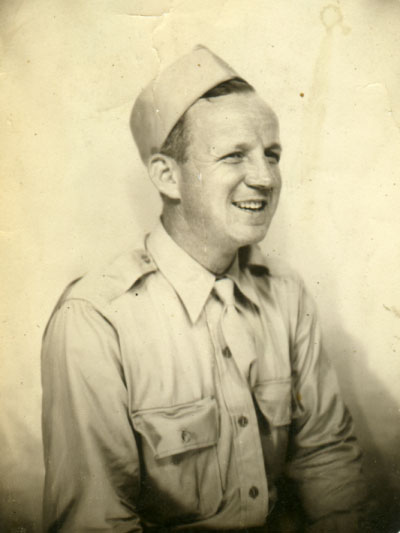
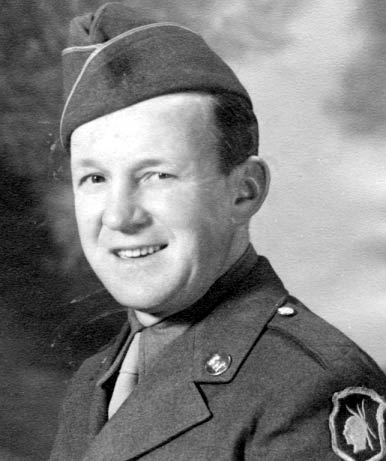
Eli Edward Conaghy, 1942–1943
ELI EDWARD CONAGHY was born in Camden, New Jersey on August 24, 1900. His father, James P. Conaghy, operated a business called the Eagle Coal and Ice Company along with his uncle, Joseph Henry Conaghy. The business was located at 246 Pine Street in 1906.
Theodosia Hunt Conaghy was born in Gloucester City, New Jersey in March of 1875 to James and Mary Hunt. The family was living at 316 Line Street by 1894. James Hunt was then Fish Warden and was later a constable in Camden. Theodosia married coal and ice merchant Joseph Henry Conaghy sometime after 1900. The 1906 City Directory shows the Conaghys living at 246 Pine Street, where Joseph Conaghy also conducted his business, the Eagle Ice & Coal Company.
The 1910 Census shows that Joseph Conaghy had gone into the tavern business. He was then operating a bar at 601–603 Kaighn Avenue, where he and Theodosia made their home. Eli Conaghy’s father James stayed with the Eagle Coal and Ice Company. He also got involved in real estate.
The 1914 City Directory shows that Joseph’s younger brother James P. Conaghy of 812 South 6th Street was then running the Eagle Ice & Coal Company. Joseph and Theodosia Conaghy were living at and operating a bar known, appropriately enough, as Conaghy’s, at 950 South 5th Street. The bar venture did not fare well, however. By September of 1918 Joseph and Theodosia Conaghy had purchased a home at 814 South Sixth Street, next door to James Conaghy, who had moved his home and business to 812 South Sixth Street as far back as 1914.
Joseph Conaghy’s health appears to have began to break down; this may be the reason that Eli Conaghy lived at 814 with his uncle and aunt while his father James lived next door at 812. Joseph Conaghy died shortly after the 1920 Census was enumerated. In 1923 his widow, Theodosia Conaghy, was appointed matron at the Camden County Jail, a post she held until 1950. When he registered for the draft in September of 1918 Eli Conaghy was working at Keystone Leather at South 16th and Mickle Streets in East Camden.
During the late 1910s Eli Conaghy took up boxing, and was good enough at it to turn professional, boxing under the name “Kid Conaghy.” In his later years he jokingly spoke that his name was Kid Linoleum because he found himself getting up off the kitchen floor. His uncle Joseph had also boxed under this name and as Joe Conaghy in the late 1890s and early 1900s.
In the late 1920s Eli Conaghy was running with what can politely be described as some pretty fast company, including Joseph “Mose” Flannery, Russell Sage, Joe O’Connor, and John Doris. In the space of 17 months, from late September 1928 through early April of 1930, Flannery, O’Connor, and Doris were all murdered, all three crimes gangland hits, and in all three cases, the victims refused to name their assailants, taking their killers’ names to their graves.
Eli Conaghy was still living with his Aunt at 814 South Sixth Street as late as April of 1940. Also living at that address was his uncle, Camden fireman Eli M. Hunt, and a cousin, Nellie Conaghy. Eli Conaghy had married Evelyn G. Terrel, but was separated from his wife at the time of the Census enumeration. He was then working at the RCA radio factory in Camden.
Although well past the age of 40, Eli E. Conaghy was drafted into the United States Army at Camden, New Jersey on October 10, 1942. When he was inducted he had been working as a structural ironworker, a trade he returned to after World War II.
When the 1947 Camden City Directory was compiled, Eli Conaghy was living with his wife Evelyn at 558 Line Street. His father, James Conaghy was still living at 812 South Sixth Street. His aunt, Theodosia Hunt Conaghy had moved to 543 Roberts Street.
Mrs. Conaghy retired in 1950 after serving as a matron at the Camden County Jail for 27 years. Although she was about 75 years of age, her retirement was very probably due as much or more to the institution of a mandatory retirement age of 65 in 1950 for police, firemen, and certain other government employees in New Jersey than due to age. There were at least one police officer and one fireman in Camden who were of the same age who retired that year due to the new regulations.
In her later years Theodosia Hunt Conaghy again lived with her nephew Eli. Last a resident of 704 Berkley Street, she died on December 7, 1957, survived by her nephew and a sister, Mrs. Katherine Abrams.
Eli E. Conaghy and his wife divorced during the 1950s. He resided at 704 Berkley Street until about 1958. He had purchased his aunt Theodosia’s property at 543 Roberts Street and moved to that address. Around 1965 he suffered a stroke and was confined to Cooper Hospital for six months, at which time he was moved to the Camden County Hospital at Lakeland where he remained until his death in December of 1968. He was survived by one son and two daughters (daughter Eileen passed in 2007), five grandchildren and 10 great-grandchildren. Eli Conaghy was a member of Ironworkers Local 399 and was a veteran of World War II. He is buried at Harleigh Cemetery.
World War I Draft Card
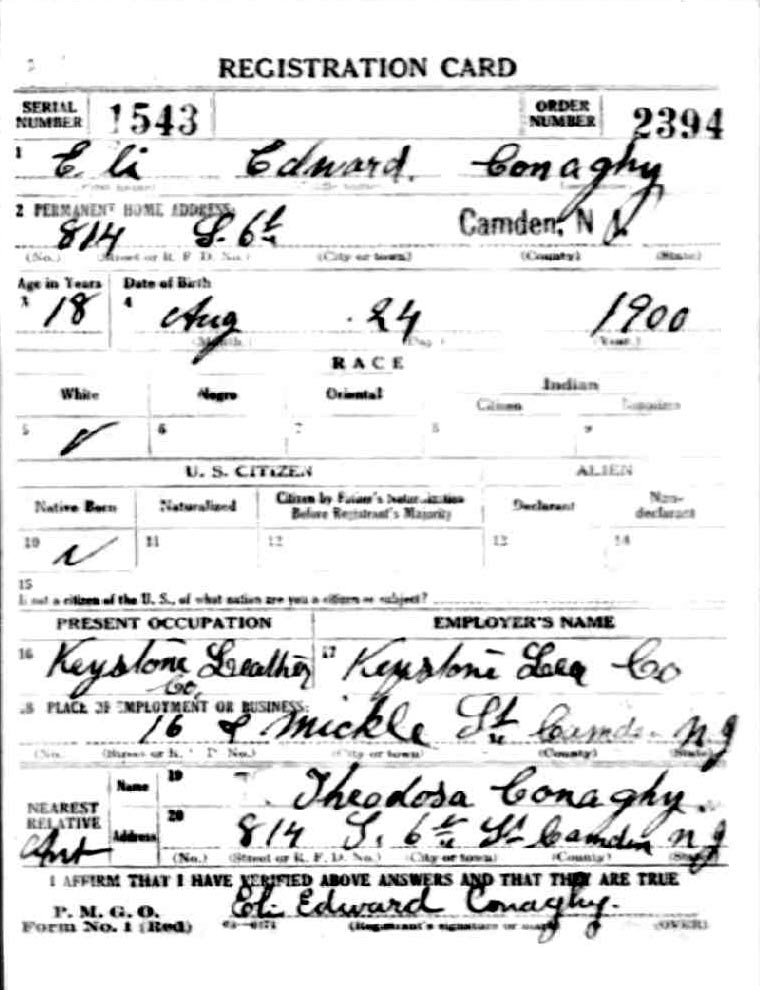
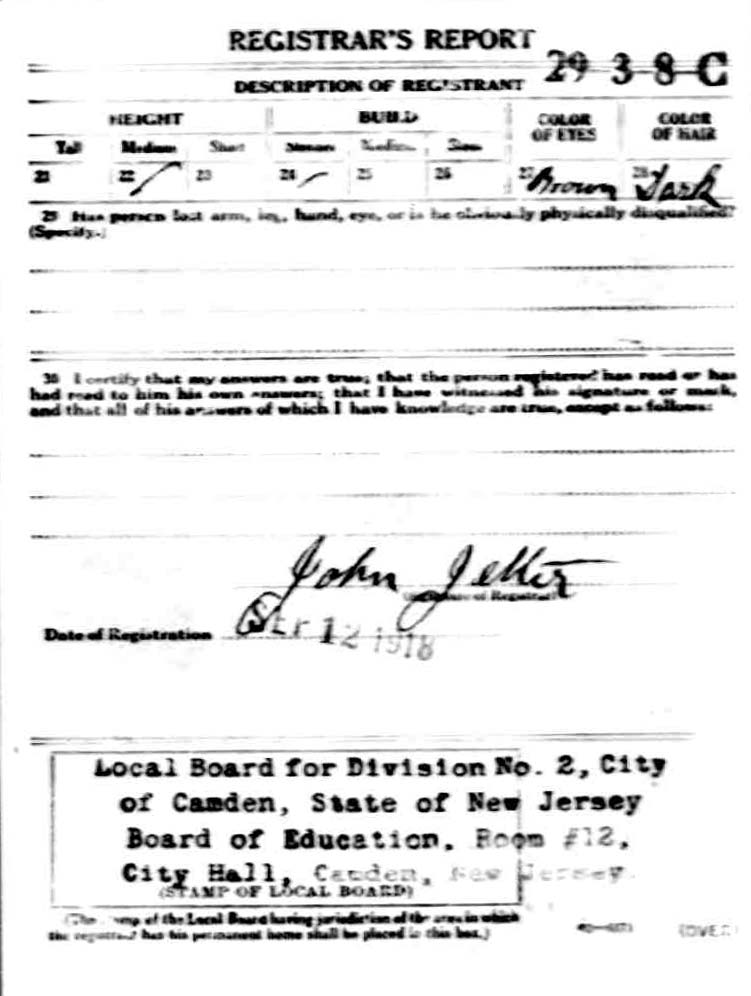
World War I Draft Registration Card – Eli Edward Conaghy
Kid Conaghy
Trenton Evening Times —
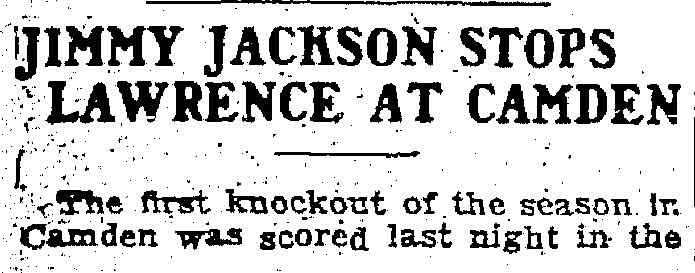
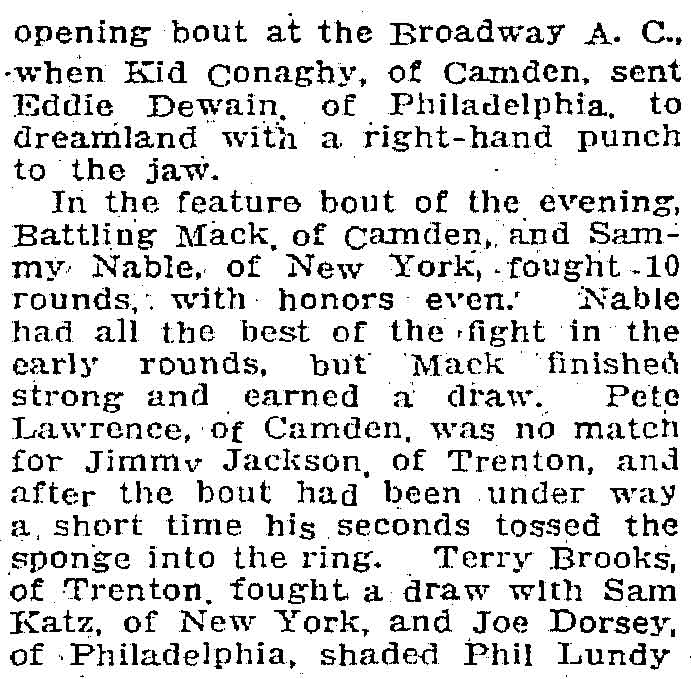
Named: Eli “Kid” Conaghy, Battling Mack, Pete Lawrence, Eddie Dewain, Sammy Nable, Jimmy Jackson, Terry Brooks, Sam Katz, Joe Dorsey, Phil Lundy, and Broadway Athletic Club.
Murder Motive At G.O.P. Club Splits Sleuths
Camden Evening Courier —
County Detectives Contend Philadelphia Gangster Was Slain in Quarrel Over Woman
POLICE CLAIM HOLD-UP ATTEMPT CAUSED FIGHT — Deven Charged With Crime, Flannery and Taxi Driver Held Without Bail
With city and county authorities definitely divided on the motive and circumstance of the Sixth Ward Republican Club slaying, Joseph “Polack Joe” Deven was arraigned in Camden police court today and held without bail on a murder charge.
Through County Solicitor Walter Keown, retained as his attorney, Deven waived a police court hearing and was held to await grand jury action in the slaying of Joseph Cimini, Philadelphia gangster, at the political club early Saturday morning.
At the same time County Prosecutor Ethan P. Wescott announced his operatives had abandoned the theory Cimini was killed as the aftermath of an attempted hold-up, and were concentrating their investigation in the case on an effort to “find the woman.”
Statements of witnesses to the fatal shooting, the prosecutor added, made no mention of a hold-up, but contained the declaration that Cimini had been shot as a result of a feud with Charles “Chick” Hunt, former South Camden pugilist, concerning the affection of “Chick’s girl.”
Police Claim Holdup
On the other hand, Captain John Golden, chief of the city detective bureau, declared he was unable to recall any mention of a girl in the statements obtained from witnesses, and added emphatically that his department still held the shooting had followed an attempted holdup of the club by Cimini and Joseph ‘Mose’ Flannery.
Flannery and Hunt were both witnesses to the shooting by Deven, picturesque figure in Third Ward politics, which occurred at the Sixth Ward Club’s headquarters, 908 Broadway.
After Deven had appeared in Police Court today, Flannery was arraigned as a material witness and as an accessory to the crime, with an additional charge accusing him of carrying concealed deadly weapons. Similar charges were made against Russell Sage, a taxicab driver, who arrived at the club with Flannery and Cimini early Saturday morning. These two were committed to the county jail without any bail by Judge Bernard Bertman.
Hunt, however, was released under $1,000 bail as was Martin O’Brien, 27 years old, a former New Jersey State Trooper, and Harry Waterhouse, 28 years old, 1102 Marion street.
Three Others Arrested
During the day the police continued to build up their case against Flannery by arraigning him on the charges made by Milton Feinstein and Henry Mehrer. They also arrested Joseph Genther, 29 years old, 414 Atlantic Avenue; Robert Wolfe, 21 years old, 1106 Mechanic Street, and Eli Conaghy, 27 years old, 814 South 6th Street. Wolfe, who is Flannery’s brother-in-law, and Genther were held “on suspicion” of having been with “Mose” at the time the latter is declared to have attacked and attempted to rob Mehrer, an Audubon policeman, outside the Ringside Inn, on the Black Horse Pike.
Conaghy, Flannery and Sage were arraigned and held without bail on charges of threatening to kill Feinstein and of carrying concealed deadly weapons. Feinstein declares these three with Cimini, the slain man, entered his cafe on January 2 and attempted to hold him up, threatening to kill him if he refused to “come across.” When he defied them by telling them to “go ahead and shoot,” Feinstein says, they departed.
Wolfe, Genther, and Conaghy were arrested by City Detectives George Ward and Thomas Cheeseman. It was Cheeseman who lodged the formal complaint of murder against Deven.
Two Others Released
Two other men who were questioned in connection with the murder case were in court this morning but neither was held. They are Newton Blanchard, 923 St. John Street, a former boxing referee and alleged “stick man” at the crap game declared to have been in progress at the club before the shooting, and Michael Dandrea, 26 years old, of 1657 Norris Street. Both men had been released after questioning on Saturday. Police say they are the men who told police that trouble was imminent at the club and that “Flannery and another fellow are trying to stick up a bunch of other fellows.”
The city police hold-up theory was further attacked today by Francis J. McCarthy, a Philadelphian, who arrived before noon at the county prosecutor’s office and said he would co-operate with the authorities. He wishes to clear the dead man, he said, of the stigma of suspicion that he was slain while engaged in an attempted robbery.
Hearing in Police Court was brief. There was no testimony and Keown merely announced Deven would waive a hearing. Appearing also as attorney for Hunt, O’Brien, and Waterhouse, he said the other three men were “present at the unfortunate shooting” and thus should be held as material witnesses. He added the prosecutor’s office had permitted the release of the three under $1,000 bail each and requested Judge Bertman follow suit. The court acceded to this request but stipulated that new bail must be provided. The three men were freed shortly afterward when the bond was furnished by James Louis, 603 Kaighn Avenue, who had provided the bail yesterday in the prosecutor’s office.
Despite the declaration by two Camden district detectives who were present at the time and who said there was no evidence that gambling was in progress at the club, county detectives disclosed today that statements of the shooting contained the assertion that the men had gathered for a crap game.
These witnesses also declared the fatal shooting resulted from an argument over a woman for whose attention Cimini and Hunt were rivals.
Gamble Over Affections
Like actors in a carefully-rehearsed drama, the various witnesses to the shooting made their statements nearly twelve hours after the shooting and, both city and county detectives say they agreed in all important aspects. Prosecutor Wescott declared, however, that no mention of an attempted hold-up was made despite the fact that City Detectives Clarence Arthur and Clarence Bunker — before whose eyes Cimini was shot down — stated Flannery and Cimini were holding the other men at bay when the detectives entered the room.
Instead, the statements of the witnesses described the scene as a dramatic gamble, with death as the stake, over the affections of a woman beloved by both Cimini and Hunt. This woman, who is married and estranged from her husband, is being sought today, Prosecutor Wescott said. According to detectives, Hunt was severely beaten last Wednesday night in a downtown gambling place by members of Cimini’s gang. Cimini, known also as Joseph Gannon, was a brother of William Cimini, a pugilist known in the ring as Billy Gannon.
The stories told by the witnesses place Hunt as one of the players in the crap game which was in progress at the club on Saturday morning. Deven was at the window, looking out, according to the witnesses, when he saw a taxicab draw up in front of the building. Flannery, Cimini and Sage descended and entered the club, it was declared.
“Here comes Mose, Chick, with that guy what’s gunnin’ for you,” Deven is declared to have shouted.
A dozen gamesters fled from the room. “Chick” and a few of his friends held their ground and were waiting when the trio entered. Cimini, it is stated, walked over to Hunt.
“I told you,” he said with a sneer, “to stay away from that dame. She’s my girl. You were warned and now you gotta take your medicine.”
Hunt said nothing.
Flannery drew from his pockets two automatics and flung them on the green-topped table, the stories go.
“C’mon, Chick,” he said. “Don’t be yella. He toldja about the broad and he toldja what he’d do. Take your gun and shoot it out.”
“Chick” demurred.
“I don’t want none of that stuff, Mose,” he pleaded. He eyed Cimini carefully as the latter held one hand on the butt of a pistol which protruded from his belt.
Deven Interferes
Hunt made no careless movements toward the pistols on the table. Then Deven is declared to have interfered.
“None of that stuff, Mose,” he said warningly. “Who’s this guy to come here making trouble? He’s no member, is he?”
Cimini moved quickly, the witnesses say. With an upward flip of his hand he brought the barrel of the automatic sharply against Deven’s chin. The latter lurched forward snatching one of the pistols from the table.
The weapon was discharged, the bullet tearing through Cimini’s heart. He died instantly.
The next moment, Arthur and Bunker, district detectives summoned by one of the players who had fled, burst through the door and lined up the men against the wall.
A short time later police arrested Blanchard and Dandrea. Blanchard, police say, was the man who gave them warning of the impending battle. Both men were released after questioning.
Released from Lakeland
The detectives found Deven cringing with fear under the table, the weapon still in his hand. Four other pistols were picked up in different parts of the room.
Deven was identified as a lovesick husband who appeared in the prosecutor’s office several months ago and asked to be “put away.” His wife had left him, he said, and he was afraid he might harm someone.
He was committed to the asylum at Lakeland. When or how he was released is a mystery. Lakeland officials said they had no record of him. Deven once shot himself in a suicide attempt, police say, in grief over estrangement from his wife.
Gangdom’s prevailing opinion is that Flannery is “in” for it. Attempts and threats against the blond gangster’s life have furnished many lurid tales for the habitués of downtown hangouts.
Further, Flannery has made many bitter enemies through his political activities. In the last election he worked as a Democrat against “Mikey” Brown in the Eighth Ward. His overbearing tactics and bravado among the other downtown characters has increased the feeling against him, it is said.
Thus far, he has succeeded in keeping out of the toils for any length of time. His police record includes arrests for rum-running, carrying concealed weapons, alleged ballot frauds and attempted murder. His most recent arrest came in Philadelphia when he figured in a pistol battle in which a man was slain.
Shooting of Joseph Connors
Camden Courier-Post —
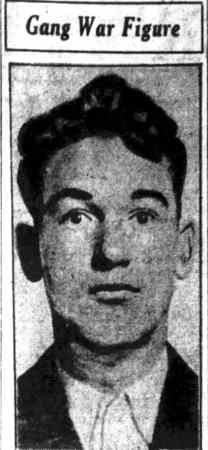
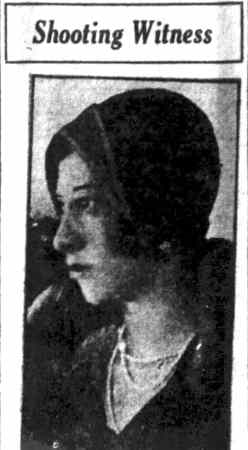
Joseph Connors, who is facing a crisis in West Jersey Hospital from wounds received in a shooting affray early Sunday near Broadway and Kaighn Avenue. – Mrs. Rose Gibbs, who is held as a material witness in the shooting of Joseph Connors Sunday night near Broadway and Kaighn Avenue.

ACTION DELAYED IN GANG SHOOTING
Indictment of Doris in Flannery Murder Revealed After Arrest
Assistant Prosecutor Rocco Palese was prepared last night to go to the bottom of all charges against John Doris, brother of an executed Philadelphia bandit murderer, in an effort to determine whether to press for his immediate trial on indictments accusing him of the killing of Joseph (Mose) Flannery, or to seek other indictments first on charges of shooting Joseph Connors, at 6 a. m. Sunday.
The condition of Connors, a reputed Gloucester racketeer, remained the same last night in West Jersey Homeopathic Hospital, where doctors said the crisis was not yet passed. He has bullet wounds in the lung, abdomen and the hand, physicians saying it was too soon to predict whether he had a chance for recovery.
Doris Arraigned
Doris was arraigned before Police Judge Pancoast yesterday charged with shooting Connors near Broadway and Kaighn avenue, after a brawl which took them into two resorts and finally ended on the street outside. The judge held him for grand jury action on that charge, and was about to close the case when City Detective J. Wesley McGrath took the stand and revealed that Doris was wanted in the mysterious murder of “Mose” Flannery, Camden racketeer, seven months ago at Front street and Kaighn avenue. Pancoast promptly denied him bail.
Palese Studies Case
The Flannery case was placed before the grand jury by former Assistant Prosecutor Samuel P. Orlando, who left his notes with the indictment in the office when he relinquished his post to Palese.
“I will study the case tomorrow,” Palese said last night. “Until I do, and can learn the strength of the old case against Doris in the Flannery murder, I can’t say which charge I might take before a jury, provided, of course, that we can get an indictment in the Connors case against the youth.”
Connors, who is 28, lives at 135 North Broadway, Gloucester. He has been arrested twice, once in Gloucester for disorderly conduct in 1924, and later on a grand larceny charge, on which he was acquitted.
Doris is a brother of the late Frankie Doris, who with three other youths went to the electric chair for the murder of a policeman in the Olney Bank robbery. (Continued on Page Twenty-one)
John Doris Trial
Camden Courier-Post —
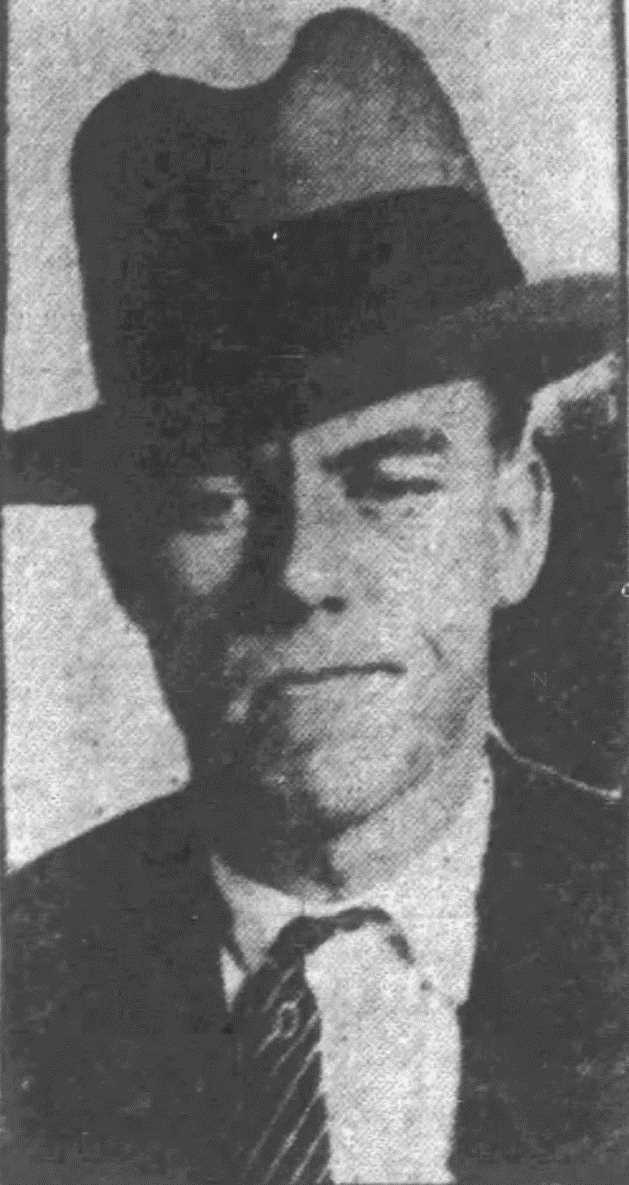
JOHN DORIS – On Trial
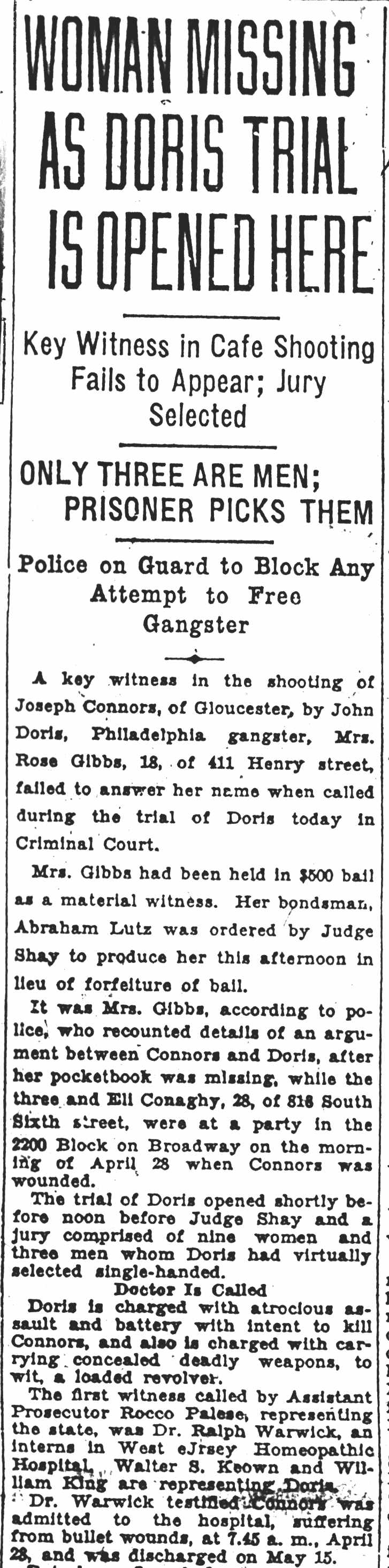
WOMAN MISSING AS DORIS TRIAL IS OPENED HERE
Key Witness in Cafe Shooting Fails to Appear; Jury Selected
ONLY THREE ARE MEN; PRISONER PICKS THEM
Police on Guard to Block Any Attempt to Free Gangster
A key witness in the shooting of Joseph Connors, of Gloucester, by John Doris, Philadelphia gangster, Mrs. Rose Gibbs, 18, of 411 Henry street, failed to answer her name when called during the trial of Doris today in Criminal Court.
Mrs. Gibbs had been held in $500 bail as a material witness. Her bondsman, Abraham Lutz, was ordered by Judge Shay to produce her this afternoon in lieu of forfeiture of bail.
It was Mrs. Gibbs, according to police, who recounted details of an argument between Connors and Doris, after her pocketbook was missing, while the three and Eli Conaghy, 28, of 818 South Sixth street, were at a party in the 2200 Block on Broadway on the morning of April 28 when Connors was wounded.
The trial of Doris opened shortly before noon before Judge Shay and a jury comprised of nine women and three men whom Doris had virtually selected single-handed.
Doctor Is Called
Doris is charged with atrocious assault and battery with intent to kill Connors, and also is charged with carrying concealed deadly weapons, to wit, a loaded revolver.
The first witness called by Assistant Prosecutor Rocco Palese, representing the state, was Dr. Ralph Warwick, an interns in West Jersey Homeopathic Hospital. Walter S. Keown and William King are representing Doris.
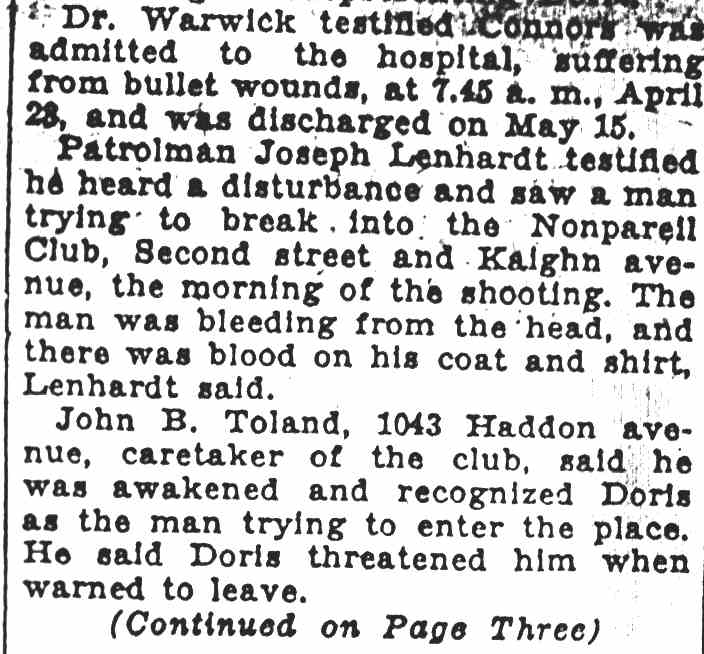
Dr. Warwick testified Connors was admitted to the hospital, suffering from bullet wounds, at 7.45 a. m., April 28, and was discharged on May 15.
Patrolman Joseph Lenhardt testified he heard a disturbance and saw a man trying to break into the Nonpareil Club, Second street and Kaighn avenue, the morning of the shooting. The man was bleeding from the head, and there was blood on his coat and shirt, Lenhardt said.
John B. Toland, 1043 Haddon avenue, caretaker of the club, said he was awakened and recognized Doris as the man trying to enter the place. He said Doris threatened him when warned to leave.
Dr. Warwick testified Connors was admitted to the hospital, suffering from bullet wounds, at 7.45 a. m., April 28, and was discharged on May 15.
Patrolman Joseph Lenhardt testified he heard a disturbance and saw a man trying to break into the Nonpareil Club, Second street and Kaighn avenue, the morning of the shooting. The man was bleeding from the head, and there was blood on his coat and shirt, Lenhardt said.
John B. Toland, 1043 Haddon avenue, caretaker of the club, said he was awakened and recognized Doris as the man trying to enter the place. He said Doris threatened him when warned to leave.
(Continued on Page Three)
Woman is Missing at Trial of Doris
(Continued from Page One)
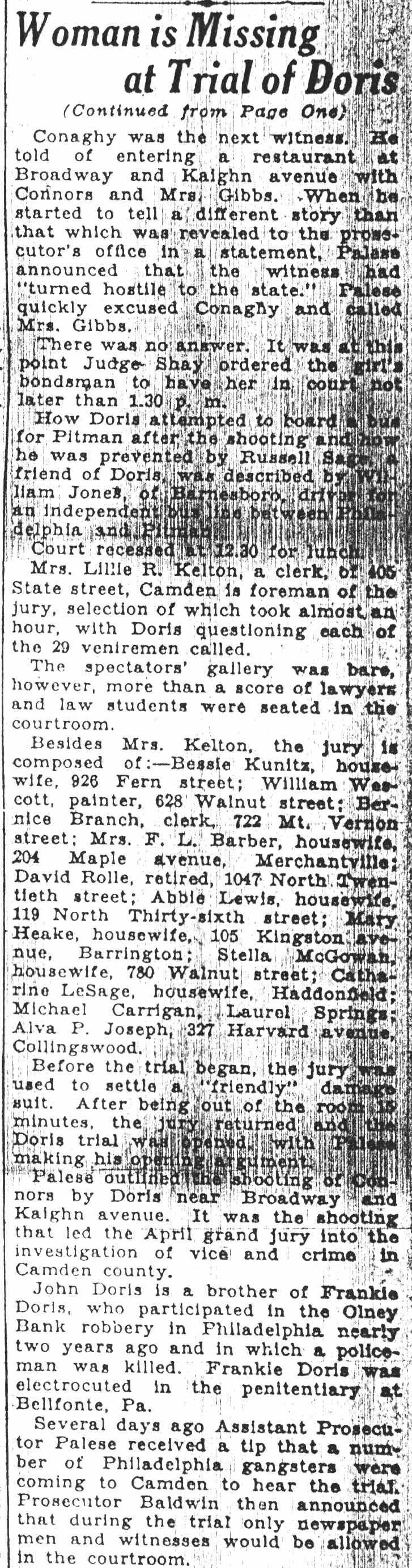
Conaghy was the next witness. He told of entering a restaurant at Broadway and Kaighn avenue with Connors and Mrs. Gibbs. When he started to tell a different story than that which was revealed to the prosecutor, Palese announced that the witness had “turned hostile to the state.” Palese quickly excused Conaghy and called Mrs. Gibbs.
Mrs. Lillie R. Kelton, a clerk, of 405 State street, Camden is foreman of the jury, selection of which took almost an hour, with Doris questioning each of the 29 veniremen called.
Spectators’ gallery was bare, however, more than a score of lawyers and law students were seated in the courtroom.
Besides Mrs. Kelton, the jury is composed of:—Bessie Kunitz, housewife; David Rolle, retired, 1047 North Twentieth street; Abbie Lewis, housewife, 119 North Thirty-sixth street; Mary Heake, housewife, 105 Kingston avenue, Barrington; Stella McGowan, housewife, 780 Walnut street; Catherine LeSage, housewife, 722 Mt. Vernon street; Mrs. F.L. Barber, housewife, 628 Walnut street; Bernice Branch, clerk, 722 Mt. Vernon street; Michael Carrigan, Laurel; Alva P. Joseph, 327 Harvard avenue, Collingswood.
Before the trial began, the jury was unable to reach a “friendly” damage suit. After being about a few minutes, Doris trial was opened with him opening argument.
John Doris is a brother of Frankie Doris, who participated in the Olney Bank robbery in Philadelphia nearly two years ago and in which a policeman was killed. Frankie Doris is in the penitentiary in Bellefonte, Pa.
Several days ago Assistant Prosecutor Palese received a tip that a number of Philadelphia gangsters were coming to Camden to hear the trial. Auditor Baldwin then announced that during the trial only newsmen and witnesses would be allowed in the courtroom.
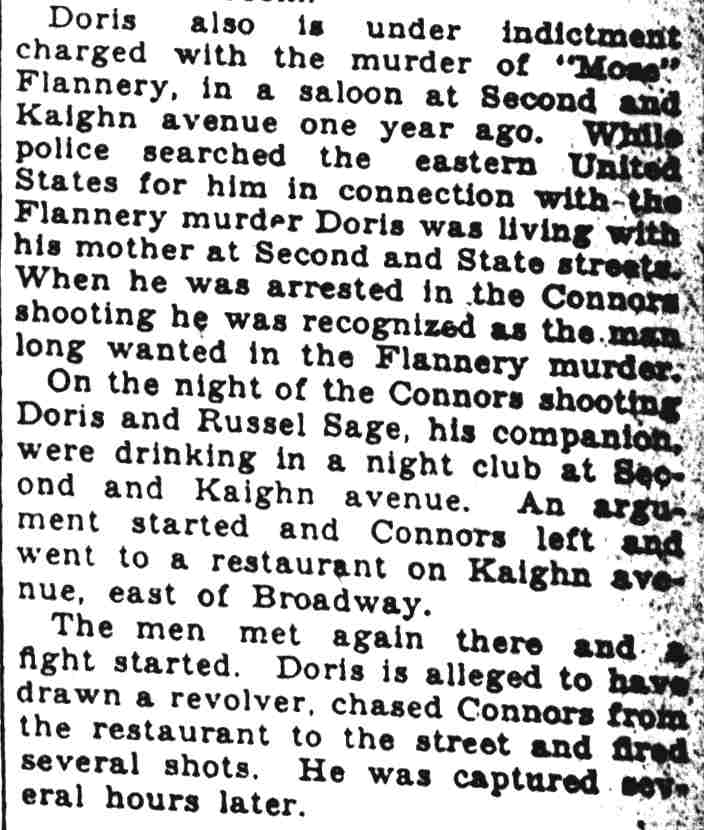
Doris also is under indictment charged with the murder of “Mose” Flannery, in a saloon at Second and Kaighn avenue one year ago. While police searched the eastern United States for him in connection with the Flannery murder Doris was living with his mother at Second and State streets. When he was arrested in the Connors shooting he was recognized as the man long wanted in the Flannery murder.
On the night of the Connors shooting Doris and Russel Sage, his companion, were drinking in a night club at Second and Kaighn avenue. An argument started and Connors left and went to a restaurant on Kaighn avenue, east of Broadway.
The men met again there and a fight started. Doris is alleged to have drawn a revolver, chased Connors from the restaurant to the street and fired several shots. He was captured several hours later.
O’Connor Murder Trial
Camden Courier-Post —


DORIS CONVICTED AT QUICK TRIAL; GETS TEN YEARS
Shay Warns Gangdom Shootings in Camden Must Cease; Jury Out 40 Minutes
WIFE FAINTS IN COURT AS JUDGE SETS PENALTY
Brother of Olney Bank Bandit Acquitted on One Charge in Kaighn Avenue Brawl
Wheels of justice spun quickly yesterday when John Doris, 30, ambitious young Philadelphia gangster, was tried, convicted, and sentenced to 10 years in New Jersey State Prison in the shooting of Joseph Connors, Gloucester, in Kaighn avenue, near Broadway, last April 29.
To the sentence which nips a brief but hectic underworld career in which Doris also faces a murder indictment for another Kaighn avenue gun duel, Judge Shay added a stern ultimatum to gamblers and racketeers that they cannot use Camden streets for their sanguinary warfare.
“There have been too many racketeer shootings in Camden lately,” the jurist declared. “They all seem to have the same code—to shoot it out and then keep silent in the courts. Even Connors, the man who was shot, comes before this court and denies Doris was the guilty man. Fear may silence these witnesses, which in itself is serious, but these shootings must end and they will.”
Tries to Be Tough
Then he sentenced Doris. The young gangster, brother of Frank Doris, executed Olney bank bandit, blanched. The confident air with which he approached this trial, following a disagreement at the first trial of the charges last June, had failed and left him a trembling, shaken boy who tried to be tough.
Pathos was added to the drama as Helen Doris, frail wife of the convicted youth, suddenly seemed to realize what had happened. She screamed. Her slender body sagged perilously toward the floor. Doris’ brother and a friend carried her from the court room.
On the main floor of the building the girl went into a dead faint, from which she was revived by Edward Holloway, custodian. She then became hysterical, in which condition she was taken away.
Guilty on Two Counts
The jury which convicted Doris, the first drawn from the “million dollar” panel, cleared the youth of one count but found him guilty of two after 40 minutes of deliberation.
Deliberations were started at 3.25 p. m., and at 4.06 o’clock Judge Shay was called back to the bench to receive the verdict from Fred Euhenfeld, 3100 Highland avenue, jury foreman.
Solemnly he announced that in the eyes of the jurymen Doris was guilty of atrocious assault and battery, and guilty of carrying concealed deadly weapons, but was not guilty on a third count alleging atrocious assault and battery with intent to kill.
All eyes in the courtroom turned to the immaculately-clad Doris, who started forward in his chair and
Doris Gets 10 Years, Quickly Convicted
(Continued from Page One)
looked appealingly to his counsel, Walter S. Keown.
Assistant Prosecutor Rocco Palese reviewed the briefed points of the case and called upon Judge Shay to give Doris the maximum possible sentence, 15 years.
Attorney Asks Clemency
Keown in his final appeal pointed out Doris should receive mercy as a first offender, that he and Connors had been engaged in a heated fistic combat when Connors was shot, and that the youth’s age should entitle him to consideration.
“The jury gave Doris a ’break’ in clearing him of the intent to kill charge,” Keown pleaded. “Will the court give him a ’break’ in its sentence?”
Judge Shay responded with his dramatic broadside against the gun toting of the underworld and gave the defendant a seven-year term for atrocious assault and battery and three additional years for carrying weapons.
Although Lorenzo Cole, a cook in the American Restaurant, Kaighn avenue, testified Connors ran into the place early in the morning, groaning and holding onto his stomach, with Doris, a gun in his hand, following him.
Denies Doris Shot Him
“Doris didn’t fought me, that’s true,” testified Connors. “But Doris didn’t shoot me. Somebody, I don’t know who, sneaked up on us during the argument and shot me.”
Doris talked with his wife before the case was called. Mrs. Doris was the only woman in the spectators’ section.
Eli Conaghy, 29, of 818 South Sixth street, a witness for the state, was present at the Nonpareil Club, Second street and Kaighn avenue on the night of the shooting, with Mrs. Rose Gibbs. He mentioned an argument Doris had “with somebody” over the loss of the Gibbs girl pocketbook.
Mrs. Gibbs, who said she lived “on Henry street,” was next called. She said she had not met Doris before the night of the shooting. She had gone to the club with Connors and had gone home. Under cross-examination, the Gibbs girl admitted she had stayed on later and that she went to the Nonpareil club at 12:30 a. m. after visiting two “parties,” one in Fairview.
Restaurateur Tells Story
Thomas Matsios, proprietor of the American Restaurant, testified that at about 5:30 a. m. Connors came into the place, followed by a man who looked like Doris. An argument started and Matsios said he was forced to eject the men. A short time later, he heard shots. “That’s all I know about the shooting,” Matsios said.
He was followed on the stand by Lorenzo Cole, colored, 904 Jefferson street, a cook in the restaurant. He testified that at about 5:30 a. m., looking through a window into the restaurant. He heard the argument, saw Doris and Connors leave the place, and saw them “swapping punches” on the sidewalk.
“I saw a gun in Doris’ hand and heard two shots,” Cole said. “A few minutes, Connors ran through the alleyway, known as Amber street, with the gun still in his hand, followed, ran through the kitchen into an alleyway, known as Amber street, and then got up and continued the chase.”
Almost identical testimony was given by James Sims, also a cook.
Doris was the only witness for the defense. He could only “remembered nothing,” other than being “punched in the nose, some place in South Camden.” Doris was on the stand only a few minutes. As he left, Keown rested his case.
Doris first was tried in the Connors’ shooting last June. Arraigned on charges of atrocious assault and battery and carrying concealed deadly weapons, he was returned to the county jail pending a second trial when the jury, although believing him guilty, disagreed as to the charge upon which to convict him. The jury comprised nine women and three men.
Doris, in addition to being involved in the Broadway and Kaighn avenue shooting, is believed by police to hold the key to solution of the mysterious murder of Joseph “Mose” Flannery, for which he is under indictment.
World War II Army Enlistment Record
World War II Army Enlistment Record
U.S. Army enlistment record for Eli E. Conaghy Sr., Camden, New Jersey, 1942
Record
| Field ↕ | Value ↕ |
|---|---|
| Army Serial Number | 32368627 |
| Name | Conaghy, Eli E. |
| Residence: State | New Jersey |
| Residence: County | Camden |
| Place of Enlistment | Camden, New Jersey |
| Date of Enlistment | October 30, 1942 |
| Grade | Private |
| Source of Army Personnel | Civil Life |
| Nativity | New Jersey |
| Education | Grammar school |
| Civilian Occupation | Structural and ornamental metal workers |
| Marital Status | Separated, without dependents |
| Component of the Army | Selectees (Enlisted Men) |