William J. Merrigan
WILLIAM J. MERRIGAN was born June 10, 1891 in Philadelphia to Richard and Annie Kennedy Merrigan. His father had come to America from England in 1885. The family was living in Philadelphia when the census was taken in 1900. William was the oldest child, followed by two brothers, Daniel and Francis. Three more children came in the 1900s, Richard, May, and Margaret. Sadly, the children were orphaned by 1910. William and Daniel went into the world and found work, Francis and Richard were in St. John’s Orphan Asylum in Philadelphia, while the two girls were sent to live with their uncle, William Kennedy and grandmother Mary Kennedy.
At some point after the 1910 Census William Merrigan enlisted in the United States Navy, where he worked as a fireman in a ship’s engine room. A civilian again by 1918, William Merrigan had made his way to Atlantic City, New Jersey where he worked aboard a fishing boat to support his three youngest siblings.
After serving in the military during World War I, William Merrigan married around 1921. He had joined the Camden Fire Department by April of 1922. On April 28, 1922, while serving with Engine Company 7, William Merrigan was taken to Cooper Hospital after being injured while attempting to rescue an 11 year-old boy from a burning building at 1009 Broadway.
The 1924 City Directory reveals that William Merrigan and his wife Florence were living at 1432 South 10th Street. By 1929 the family, which included sons William Jr. and Kenneth P. Merrigan, had moved to 1610 Norris Street. Fire Department records from 1931 show William Merrigan still living at the Norris Street address.
On October 4, 1935 Sergeant George Lee of the New York Shipyard police discovered a fire in a 200 x 70 foot warehouse. As he transmitted the initial alarm from the power house, other yard employees also reported the blaze to security at the main gate. Box 312 was pulled by the officer at the Broadway gate at 12:45 A.M. Chief Lennox ordered a third alarm on his arrival as fire roared from large roof ventilators. Stored at the south end of the warehouse were large quantities of benzene, gasoline and other explosive cleaning solvents. Fire fighters pressed an all out attack and prevented the blaze from spreading to these inflammable stores. Fireman William Merrigan of Engine Company 10 was buried under a falling partition wall. He was rescued by other members of his unit, who had themselves narrowly escaped the collapse. As the wind shifted, acid fumes were carried to a large crowd of spectators causing some panic. Under severe radiant heat, the fronts of fifteen dwellings on the east side of Broadway between Lester and Gordon Terrace became seriously exposed. These properties were saved only through the tenacious efforts of Camden’s Bravest. Within forty-five minutes the spectacular blaze was contained to the warehouse but not before imposing a $50,000 property loss.
While assigned to Engine Company 3, located at 1819 Broadway, Fire Fighter Merrigan died of a heart attack induced by heat exhaustion on July 30th, 1940, while fighting the fire at the Hollingshead factory at north 9th and Market Streets.
William J. Merrigan was survived by his wife, Florence and sons William James Merrigan Jr. and Kenneth P. Merrigan. William J. Merrigan Jr. served as a member of the Hi Nella NJ fire department from 1960 to 1985.
Iron Bars Prevent Rescue of Boy Who Dies in Camden Fire
Philadelphia Inquirer —
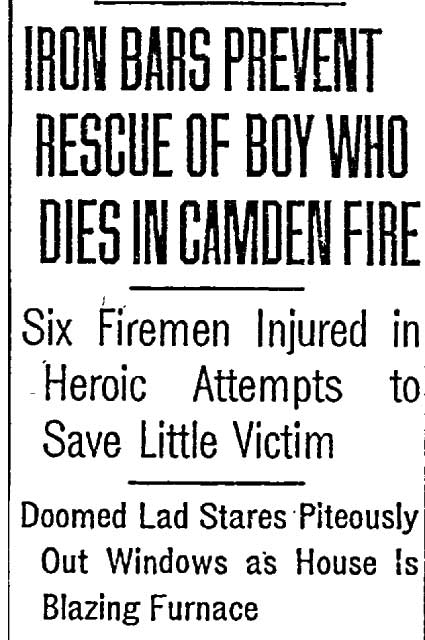
Six Firemen Injured in Heroic Attempts to Save Little Victim
Doomed Lad Stares Piteously Out Windows as House Is Blazing Furnace
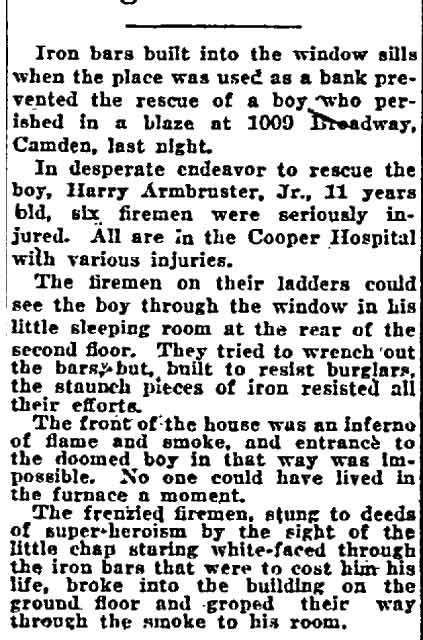
Iron bars built into the window sills when the place was used as a bank prevented the rescue of a boy who perished in a blaze at 1009 Broadway, Camden, last night.
In desperate endeavor to rescue the boy, Harry Armbruster, Jr., 11 years old, six firemen were seriously injured. All are in the Cooper Hospital with various injuries.
The firemen on their ladders could see the boy through the window in his little sleeping room at the rear of the second floor. They tried to wrench out the bars, but, built to resist burglars, the staunch pieces of iron resisted all their efforts.
The front of the house was an inferno of flame and smoke, and entrance to the doomed boy in that way was impossible. No one could have lived in the furnace a moment.
The frenzied firemen, stung to deeds of super-heroism by the sight of the little chap staring white-faced through the iron bars that were to cost him his life, broke into the building on the ground floor and groped their way through the smoke to his room.
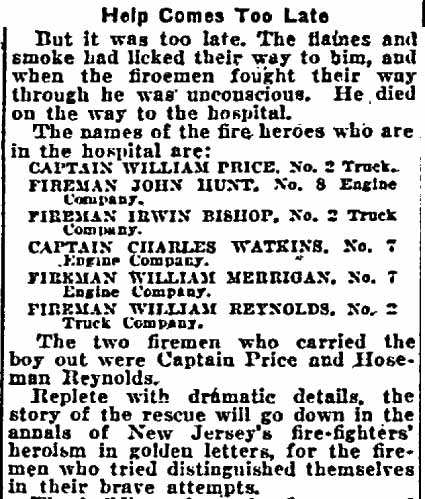
Help Comes Too Late
But it was too late. The flames and smoke had licked their way to him, and when the firemen fought their way through he was unconscious. He died on the way to the hospital.
The names of the fire heroes who are in the hospital are:
CAPTAIN WILLIAM PRICE, No. 2 Truck.
FIREMAN JOHN HUNT, No. 8 Engine Company.
FIREMAN IRWIN BISHOP, No. 2 Truck Company.
CAPTAIN CHARLES WATKINS, No. 7 Engine Company.
FIREMAN WILLIAM MERRIGAN, No. 7 Engine Company.
FIREMAN WILLIAM REYNOLDS, No. 2 Truck Company.
The two firemen who carried the boy out were Captain Price and Hoseman Reynolds.
Replete with dramatic details, the story of the rescue will go down in the annals of New Jersey’s fire-fighters’ heroism in golden letters, for the firemen who tried distinguished themselves in their brave attempts.
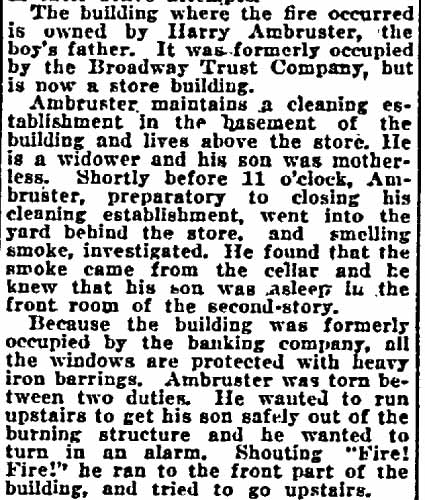
The building where the fire occurred is owned by Harry Ambruster, the boy’s father. It was formerly occupied by the Broadway Trust Company, but is now a store building.
Ambruster maintains a cleaning establishment in the basement of the building and lives above the store. He is a widower and his son was motherless. Shortly before 11 o’clock, Ambruster, preparatory to closing his cleaning establishment, went into the yard behind the store, and smelling smoke, investigated. He found that the smoke came from the cellar and he knew that his son was asleep in the front room of the second-story.
Because the building was formerly occupied by the banking company, all the windows are protected with heavy iron barrings. Ambruster was torn between two duties. He wanted to run upstairs to get his son safely out of the burning structure and he wanted to turn in an alarm. Shouting “Fire! Fire!” he ran to the front part of the building, and tried to go upstairs.
Staircase Mass of Flames
The staircase was in the midst of a roaring mass of flames, however, and he could not get upstairs. Distraught, the father frantically ran hither and thither outside. The fire engines had been summoned and firemen had raised ladders to the second story window, having been told of the presence of the sleeping boy.
The bars were immovable. Captain Price pried with an iron crowbar, but in vain. In the meantime Firemen Hunt, Bishop and Merrigan and Captain Watkins had tried to make their way through the burning first floor to the staircase and the sleeping boy.
Two Overcome in Building
Bishop and Merrigan were overcome and lay inside the burning building unknown to the firemen on the outside. It looked as though the floor would collapse at any minute.
Captain Price and Reynolds, staggering through the hall with the almost dead boy, passed the unconscious Bishop and Merrigan on the way.
Price Goes It Alone
At the foot of the stairs, Reynolds, overcome by the dense smoke, collapsed. Captain Price continued alone, carrying the boy over his shoulder.
The lad’s father was by this time frantic with excitement. When Price appeared in the doorway framed against a background of rolling flames, he ran forward and seized his son. They were placed in an ambulance and rushed to the Cooper Hospital. There doctors pronounced the boy dead.
Captain Price in the meantime had told of the three unconscious firemen inside the burning building who were in imminent danger of death should the floor fall in.
Rescuers immediately dashed into the burning structure and brought out their comrades and all were rushed to the hospital.
The building, a two-story brick edifice, was directly behind the Lyric Theatre, where a crowded audience was witnessing a motion picture performance. Realizing the proximity of the fire, and fearing a panicky stampede, the orchestra continued to play, and the operator was given orders to continue the picture then showing for ten minutes. Then the smoke became noticeable within the theatre, and the performance was ended. The audience left the theatre quietly, without any sign of fear or panic.
Three alarms were turned in during the fire, and the building was practically destroyed.
Cops and Firemen in First Practice
Camden Post-Telegram —

Bluecoats and Ladder Climbers Get Ready for Field Day
MR. YOUNGER IN CHARGE
Firefighters Have Large Team of Athletes
Charles Younger, physical director of the Camden Y. M. C. A. and in charge of the candidates for the police and firemen teams which will compete in the first annual police and fire field day on September 19 at Forest Hill Park, sends his proteges through their stiffest workout of the season yesterday morning with several of the committee in attendance.
Plans were arranged between Younger and Captain Stehr, of the First district, to build a temporary track around the local high school’s gridiron. Meanwhile, both the police and fire candidates will do their stuff under the watchful eye of Professor Younger on the Forest Hill track, outside of the enclosed athletic field.
In a confab over the arrangement of the cinder track, Stehr suggested that a 100 and 220-yard straightaway be constructed on the west side of the field.
Joe Connell, of the Highway Department, also gave the field a once-over, as did Captains Golden and Humes. After the members of the committee had inspected the grounds, they witnessed the candidates going through the paces.
Archie Riess, who is in full charge of the “cops,” declared that but nineteen men would be candidates for his team while Walter A. Mertz, of Engine Company No. 1, acting as manager for the firemen, declared he had twenty-nine candidates on his list. These men will compete next Tuesday, but first they will have an opportunity for field day. The events will be run off separately, that is, the “cops” in division and the firemen in another. The bluecoats who will compete this Tuesday are as follows: Everett Joslin, Joseph McDonald, Vernon Jones, Frank Nelson, Bill Rogers, Harold Dunnit, John Bright, Edyard Callahan, Walter Larson, Gus Pfliderer, Clarence Phifer, Thomas Welch, Stanley Wirts, Charles Naylor, George Rothwell, Richard Donnelly, Lester Gleason and Joe Keefe.
The firemen who will also attempt qualification for field day include Fred Schacker, Harry Wagner, Chris Moll, Harry Huda, Arthur Laird, Herman Havercamp, Frank Huda, Harry Kleinfelder, William Poeble, Tom Shanley, Harrison Pike, William Hood, Lester Anderson, William Wood, George Townsend, Allen Palmer, William Mertz, Nelson Hubbs, James Mogan, John Strauss, Frank Oberman, Edward Mensales, John Mulligan, Frank Kates, William Hare, Joseph Andrews and Harry Leigh. From the present outlook, “Cops” appear strongest, coming out second best. The firemen are confident of finishing once more in front of the bluecoats. The leader will be Stehr’s cohorts at the last Armory meet.
The tug-of-team of eight men will also be selected by the firemen’s leader. Merts will choose his varsity from Layton, Smith, Lennox, Walker, Pike, Palmer, Moll, Greenan, Laird, Mulligan, Haver, Merigan and Camp.
The Camden Athletic Club may stage a free exhibition of a motorcycle polo game during the meet. Stehr favors this arrangement, as no extra minutes of actual time is taken up. The local club is willing to donate their services without charge. Nelson Hubbs, local manager, has dates at the Trenton, Long Harbor, Allentown and Bridgeton fairs, while his riders have already performed in many eastern states. The “Camden Blue Devils,” as they are known, will furnish more thrills in the forty minutes than sport lovers have ever seen in the east, declares Nelson Hubbs. If they are on the bill at the games, they will also give an exhibition of trick and exhibition stunt.
Blue Devils No. 1 — Joseph Bernurt, captain; Frank De Vivey, Carl Preisman and Edward Moll.
Blue Devils No. 2 — Charles Ellis, captain; George Gummel, Bennett Arnold, Clayton Alberson.
Camden Ship Plant Is Visited by Fire
Trenton Times —
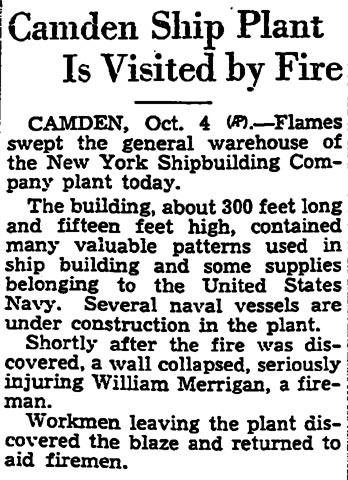
CAMDEN, Oct. 4 (AP).—Flames swept the general warehouse of the New York Shipbuilding Company plant today.
The building, about 300 feet long and fifteen feet high, contained many valuable patterns used in ship building and some supplies belonging to the United States Navy. Several naval vessels are under construction in the plant.
Shortly after the fire was discovered, a wall collapsed, seriously injuring William Merrigan, a fireman.
Workmen leaving the plant discovered the blaze and returned to aid firemen.
Death Certificate
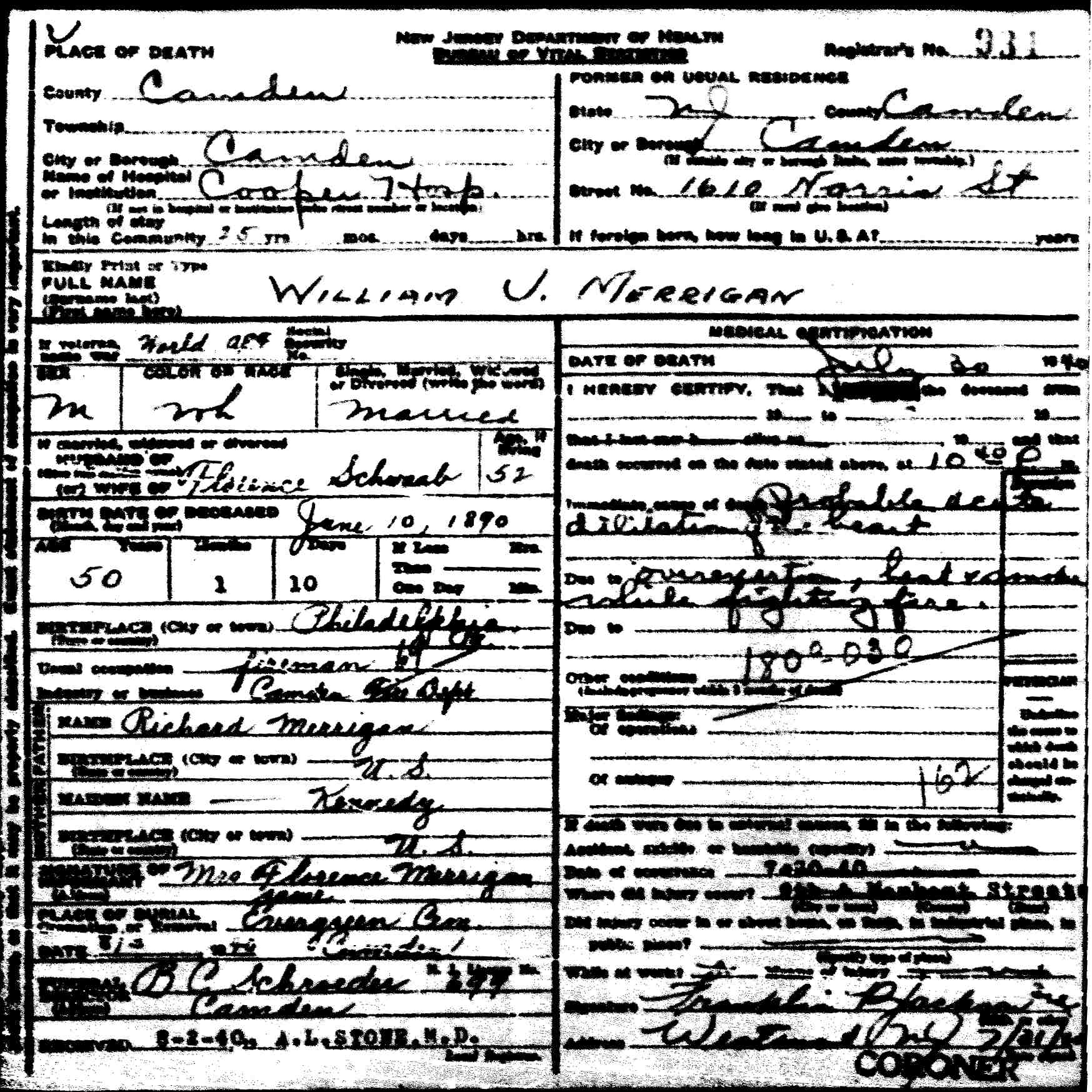
Death certificate — William J. Merrigan, July 30, 1940
Related
The Hollingshead Fire — July 30, 1940
The Hollingshead Fire — N.F.P.A. Report
Camden Fire Fighters Fallen in the Line of Duty
Camden Fire Department — Complete Roster of Uniformed Fire Personnel 1869–1994