Everett Joslin
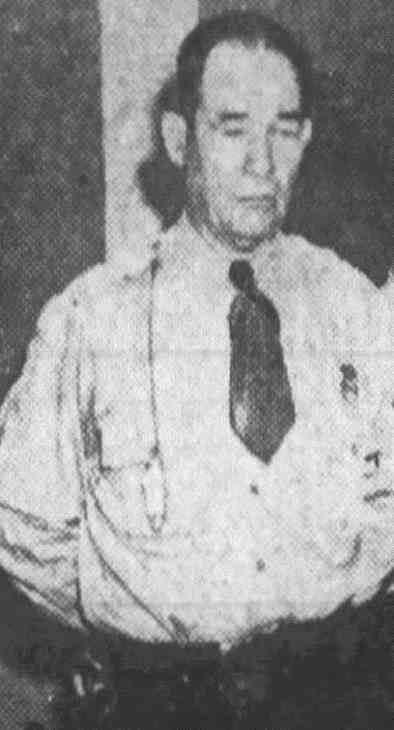
Everett Joslin
Cops and Firemen in First Practice
Camden Post-Telegram —

Bluecoats and Ladder Climbers Get Ready for Field Day
MR. YOUNGER IN CHARGE
Firefighters Have Large Team of Athletes
Charles Younger, physical director of the Camden Y. M. C. A. and in charge of the candidates for the police and firemen teams which will compete in the first annual police and fire field day on September 19 at Forest Hill Park, sends his proteges through their stiffest workout of the season yesterday morning with several of the committee in attendance.
Plans were arranged between Younger and Captain Stehr, of the First district, to build a temporary track around the local high school’s gridiron. Meanwhile, both the police and fire candidates will do their stuff under the watchful eye of Professor Younger on the Forest Hill track, outside of the enclosed athletic field.
In a confab over the arrangement of the cinder track, Stehr suggested that a 100 and 220-yard straightaway be constructed on the west side of the field.
Joe Connell, of the Highway Department, also gave the field a once-over, as did Captains Golden and Humes. After the members of the committee had inspected the grounds, they witnessed the candidates going through the paces.
Archie Riess, who is in full charge of the “cops,” declared that but nineteen men would be candidates for his team while Walter A. Mertz, of Engine Company No. 1, acting as manager for the firemen, declared he had twenty-nine candidates on his list. These men will compete next Tuesday, but first they will have an opportunity for field day. The events will be run off separately, that is, the “cops” in division and the firemen in another. The bluecoats who will compete this Tuesday are as follows: Everett Joslin, Joseph McDonald, Vernon Jones, Frank Nelson, Bill Rogers, Harold Dunnit, John Bright, Edyard Callahan, Walter Larson, Gus Pfliderer, Clarence Phifer, Thomas Welch, Stanley Wirts, Charles Naylor, George Rothwell, Richard Donnelly, Lester Gleason and Joe Keefe.
The firemen who will also attempt qualification for field day include Fred Schacker, Harry Wagner, Chris Moll, Harry Huda, Arthur Laird, Herman Havercamp, Frank Huda, Harry Kleinfelder, William Poeble, Tom Shanley, Harrison Pike, William Hood, Lester Anderson, William Wood, George Townsend, Allen Palmer, William Mertz, Nelson Hubbs, James Mogan, John Strauss, Frank Oberman, Edward Mensales, John Mulligan, Frank Kates, William Hare, Joseph Andrews and Harry Leigh. From the present outlook, “Cops” appear strongest, coming out second best. The firemen are confident of finishing once more in front of the bluecoats. The leader will be Stehr’s cohorts at the last Armory meet.
The tug-of-team of eight men will also be selected by the firemen’s leader. Merts will choose his varsity from Layton, Smith, Lennox, Walker, Pike, Palmer, Moll, Greenan, Laird, Mulligan, Haver, Merigan and Camp.
The Camden Athletic Club may stage a free exhibition of a motorcycle polo game during the meet. Stehr favors this arrangement, as no extra minutes of actual time is taken up. The local club is willing to donate their services without charge. Nelson Hubbs, local manager, has dates at the Trenton, Long Harbor, Allentown and Bridgeton fairs, while his riders have already performed in many eastern states. The “Camden Blue Devils,” as they are known, will furnish more thrills in the forty minutes than sport lovers have ever seen in the east, declares Nelson Hubbs. If they are on the bill at the games, they will also give an exhibition of trick and exhibition stunt.
Blue Devils No. 1 — Joseph Bernurt, captain; Frank De Vivey, Carl Preisman and Edward Moll.
Blue Devils No. 2 — Charles Ellis, captain; George Gummel, Bennett Arnold, Clayton Alberson.
Garage Watchman Foils Whiskey Theft
Camden Courier-Post —
Tells Police of Man With Box; Liquor From Drugstore Found
A second attempt within ten days by thieves to steal whisky valued at several thousands of dollars from the drug store of George Beringer, Fifth and Federal streets, was frustrated over the week-end by the alertness of a night attendant at a garage at Fifth and Arch streets.
It was about 2 o’clock Sunday morning when James Robertson, night attendant at the garage of Herman Z. Cutler, Fifth and Arch streets, saw a man carrying a box up an alley almost directly opposite the garage. Robertson, suspicious, telephoned police headquarters at city hall.
“Come to Fifth and Arch streets right away,” Robertson urged the police sergeant on duty. “A man is acting suspiciously in this neighborhood. He looks like a thief.”
Policemen Joslin, Cattel, Reese, Jones, Petit and Carroll were dispatched to the scene. When they arrived, the mysterious stranger sighted by Robertson had disappeared.
Further search proving unavailing, the police sought the box the man had carried into the alleyway. They found it in the establishment at 503 Federal street, occupied by a washing machine company. The thief had entered the place by forcing a side window, and left the box, a case of whisky, inside.
Further investigation revealed that the thief and possible accomplices had entered the drug establishment by climbing a shed in the rear to the second floor. They then lifted themselves to the third floor. There they broke open a shutter on one of the windows and entered. Going to the cellar, the thieves broke open a closet where the whisky was stored. They apparently aimed to remove one case of liquor at a time.
Ten days ago both the Beringer establishment and the washing machine firm’s headquarters adjoining were broken into and robbed.
Normal Middleton, 308 Penn street, manager of the place next to the Beringer store, said nothing was stolen from there in the weekend robbery. A check-up is being made by Beringer employees today to determine what was taken at that establishment.
300 Police Officials of State Meet Here
Camden Courier-Post —
78 Departments Represented at Benevolent Association Session
More than 300 state officers and delegates representing 78 New Jersey police departments were present yesterday at a meeting of the State Patrolmen’s Benevolent Association at Tenth Street and Kaighn Avenue yesterday.
All state officers were present at the afternoon meeting, including State President Dennis Byrne, of New Brunswick; First Vice President Henry Miller, of Rahway; Second Vice president, August Harasdzira, of Garfield; Recording Secretary Michael McKeever, of Trenton; Financial Secretary Thomas Higgins, of West Orange, and State Treasurer William Mallon, of West New York.
Police work used in various cities was discussed. Plans were made for the state convention in Wildwood September 14, 15 and 16. Everett Joslin, Herbert Bott and George Weber were named local delegates to represent the local union, No. 35 at the Wildwood convention.
Chief of Police Lewis H. Stehr welcomed the delegates. A telegram of welcome was read from Director of Public Safety David S. Rhone, who is in Washington.
The committee in charge of yesterday’s meeting consisted of Clifford Flenard, president of Local No. 35; Stanley Wirtz, Edward Cahill, Frank Wilmot, John McTaggart, James McTaggart and Howard Henery.
Larceny Try Charged to 2 Paroled Boys
Camden Courier-Post —
Two 15-year-old boys on parole from the Camden County Detention Home were held by the police yesterday pending action by Mrs. Grace A. Riggins, superintendent of the home.
They are Fred Powell, 1025 Carpenter Street, and John McCloskey, 33 North Twenty-fifth street, who were arrested on charge of breaking and entering and attempted larceny by Patrolmen Everett Joslin and John Taylor Sunday. The policemen said the boys broke off a section of the roof of a store operated by William L. Rice at Point and Pearl Streets and were about to enter when arrested.
Taps Sound for Jack Airedale, Canine Mascot of Fire Laddies
Camden Courier-Post —
Taps Sound for Jack Airedale, Canine Mascot of Fire Laddies
By BOB COLLINS
Camden firemen and policemen paid their final respects to stout-hearted Jack Airedale yesterday.
The beloved mascot of Headquarters Fire Company, Fifth and Arch streets, whose life was crushed out under the wheels of truck No. 2, his own wagon, Monday, was accorded a hero's funeral. His body was interred in the cemetery at the rear of St. Paul's and the First Baptist churches, close by his fire station home, and taps were sounded at 5 p. m., just as the sun was setting in the west.
People from every station of life visited the fire station to pay homage to the doughty fire-fighter, who was killed answering his last call. Senator Albert S. Woodruff, City Commissioner Harold W. Bennett, Miss Florence Hughes, chairman of the Camden County Society for Prevention of Cruelty to Animals; Fire Chief John S. Lennox and Deputy Chief William Hearn were among the estimated throng of 3500 who passed his bier.
Letters and telegrams of sympathy poured into the headquarters company throughout the day. There were more than 10 offers of dogs to serve as mascots and take Jack's place. These were kindly but firmly rejected by members of the headquarters company. “There will only be one Jack,” they said. “We appreciate all these offers, but we don't want another mascot right now.”
The funeral rites for the dog were impressive.
Active bearers included Raymond Stark, John K. Taylor and Everett Joslin, members of the Camden police department; William Spencer and John Strouss, of fire truck No. 1; John McKay, Lester Anderson and Chester Andrews, of truck No. 2.
The honorary members were Captain Van Phefferts, Russell Anderson, Harry Haines and Charles Edwards, of truck No. 1; Nelson Andrews, Christopher Moll, Arthur Batten, George Boone and Rox Abbott, of truck No. 2.
At the appointed hour a dummy alarm was sounded. Jack Airedale was carried to his favorite place on fire truck No. 2. The vehicle moved slowly along Fifth street to Federal, then to Fourth and back to Arch street. When it passed the fire station the bells in the tower tolled.
At the cemetery Jack was placed alongside his predecessors, Alva and Gimp, dogs, and Skibby and Old Black Bill, cats, who were at one time mascots at the fire station.
Bed Sheet Rips to Fail Attempt at Suicide
Camden Courier-Post —
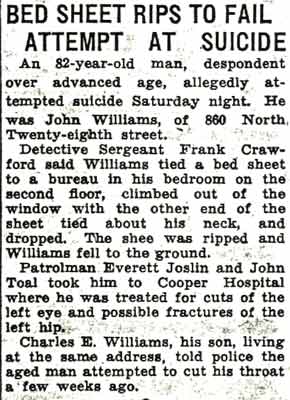
An 82-year-old man, despondent over advanced age, allegedly attempted suicide Saturday night. He was John Williams, of 860 North Twenty-eighth street.
Detective Sergeant Frank Crawford said Williams tied a bed sheet to a bureau in his bedroom on the second floor, climbed out of the window with the other end of the sheet tied about his neck, and dropped. The sheet was ripped and Williams fell to the ground.
Patrolman Everett Joslin and John Toal took him to Cooper Hospital where he was treated for cuts of the left eye and possible fractures of the left hip.
Charles E. Williams, his son, living at the same address, told police the aged man attempted to cut his throat a few weeks ago.
Accused Officer Studies Payroll
Camden Courier-Post —
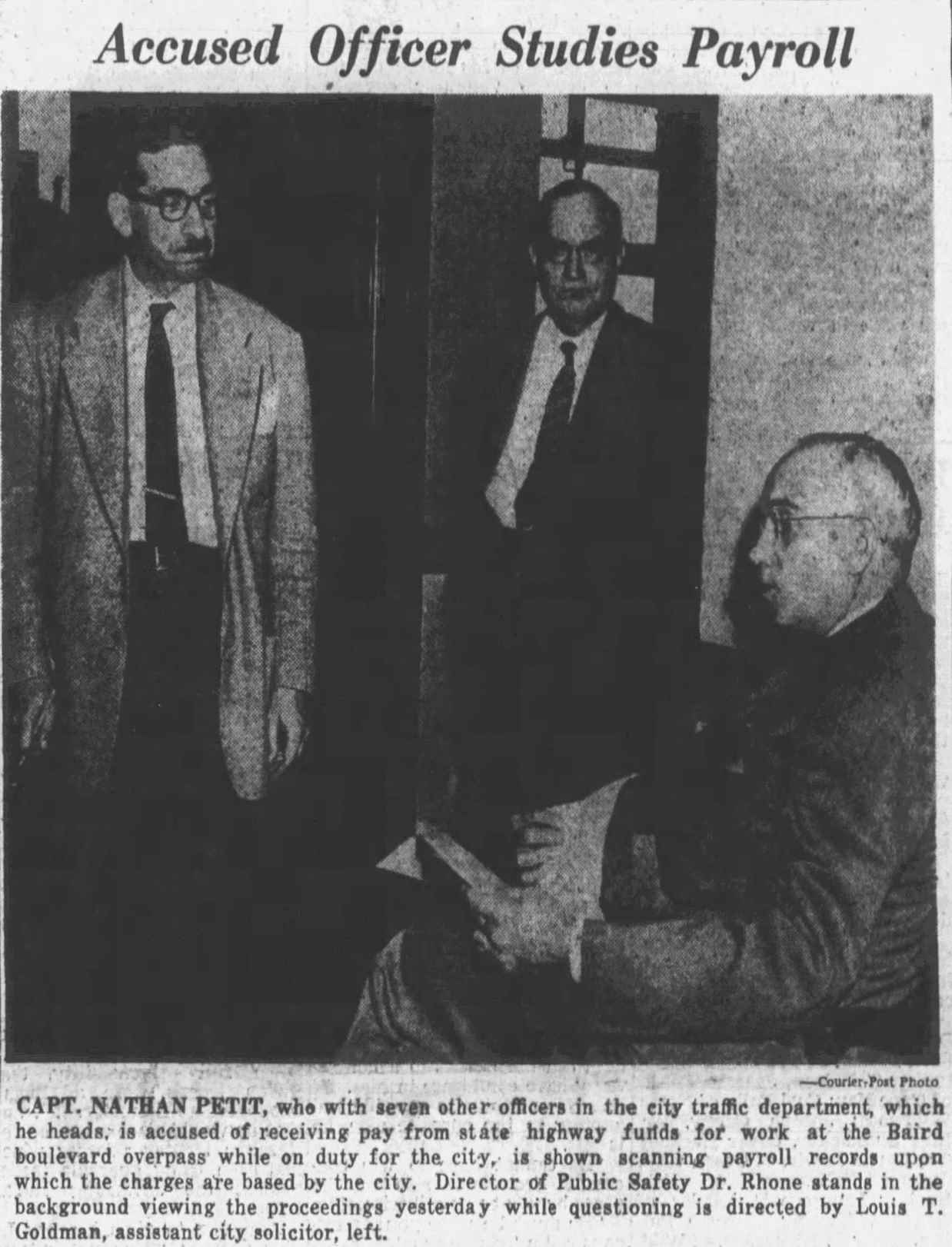
CAPT. NATHAN PETIT, who with seven other officers in the city traffic department, which he heads, is accused of receiving pay from state highway funds for work at the Baird boulevard overpass while on duty for the city, is shown scanning payroll records upon which the charges are based by the city. Director of Public Safety Dr. Rhone stands in the background viewing the proceedings yesterday while questioning is directed by Louis T. Goldman, assistant city solicitor, left.

Director of Public Safety Rhone soon will be asked to “completely exonerate” five of eight Camden traffic officers who have been accused of accepting pay from the state for traffic duty at the Baird boulevard overpass during their regular city hours.
State Senator Wallace made that announcement today on behalf of Sgt. Anthony Skolski and Traffic Patrolmen Charles Hance, Martin Nelson, George Getley and Everett Joslin.
Wallace said he would base his appeal to Dr. Rhone on testimony produced at a preliminary hearing held yesterday on orders of Dr. Rhone for all eight men, including Captain Nathan Petit, and Sgts. James Wilson and Walter Vecander.
“There is no question that the payroll records which were the basis for the accusations against the five men I represent, were falsified,” Wallace said. “Sergeant Wilson, who kept the records admitted frequently in his testimony yesterday the records were ‘mistakes, errors and not based on actual time put in.’”
‘Charges Groundless’
“The whole hearing proved without doubt that the charges against the five men were groundless and I will ask Dr. Rhone to make a public statement that the records were falsified and these five men were blameless and not guilty of accepting state pay for work on city time.”
Wilson admitted at the hearing he did not pay the traffic men the full time recorded for them on the overpass payroll records. He was asked by Assistant City Solicitor Goldman: “Then it comes down to the fact that the men in the traffic bureau only worked on their off hours. That the reports are mistakes. They only received the money to which they were entitled. You got more money than they were entitled to but you won’t tell us where that money went to, is that correct?”
“Yes,” Wilson answered. Wilson said the hours marked on the payroll were a mistake.
ALL of the officers were fully exonerated of ANY wrongdoing.
Nathan Petit – David S. Rhone
Louis T. Goldman – Bruce A. Wallace
Anthony Skolski – Charles Hance
Martin Nelson – George Getley
Everett Joslin – James Wilson
Walter Vecander – Anthony Palese
Edward Garrity – Samuel E. Johnson
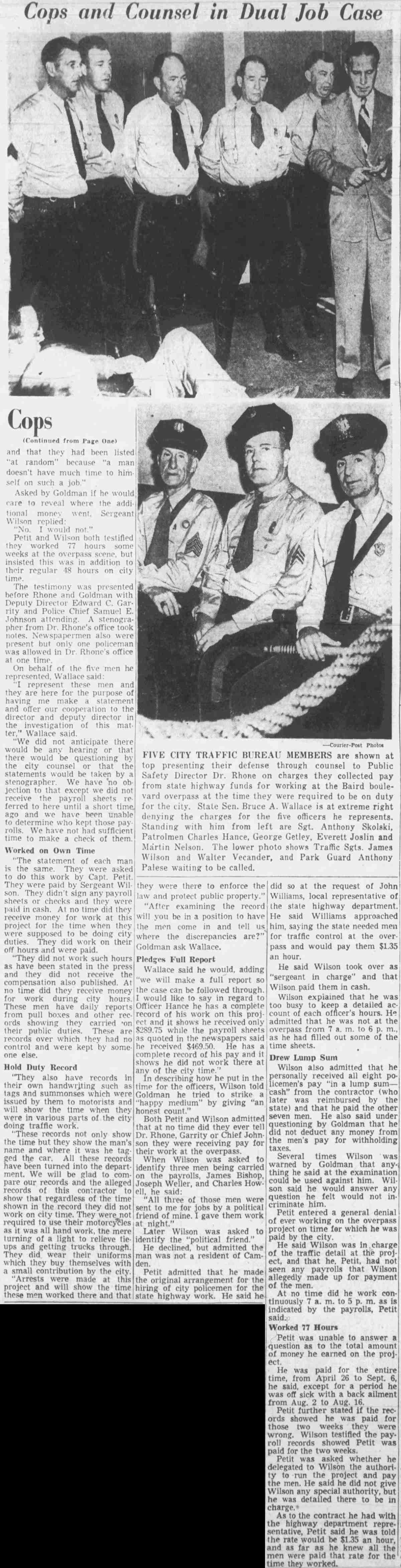
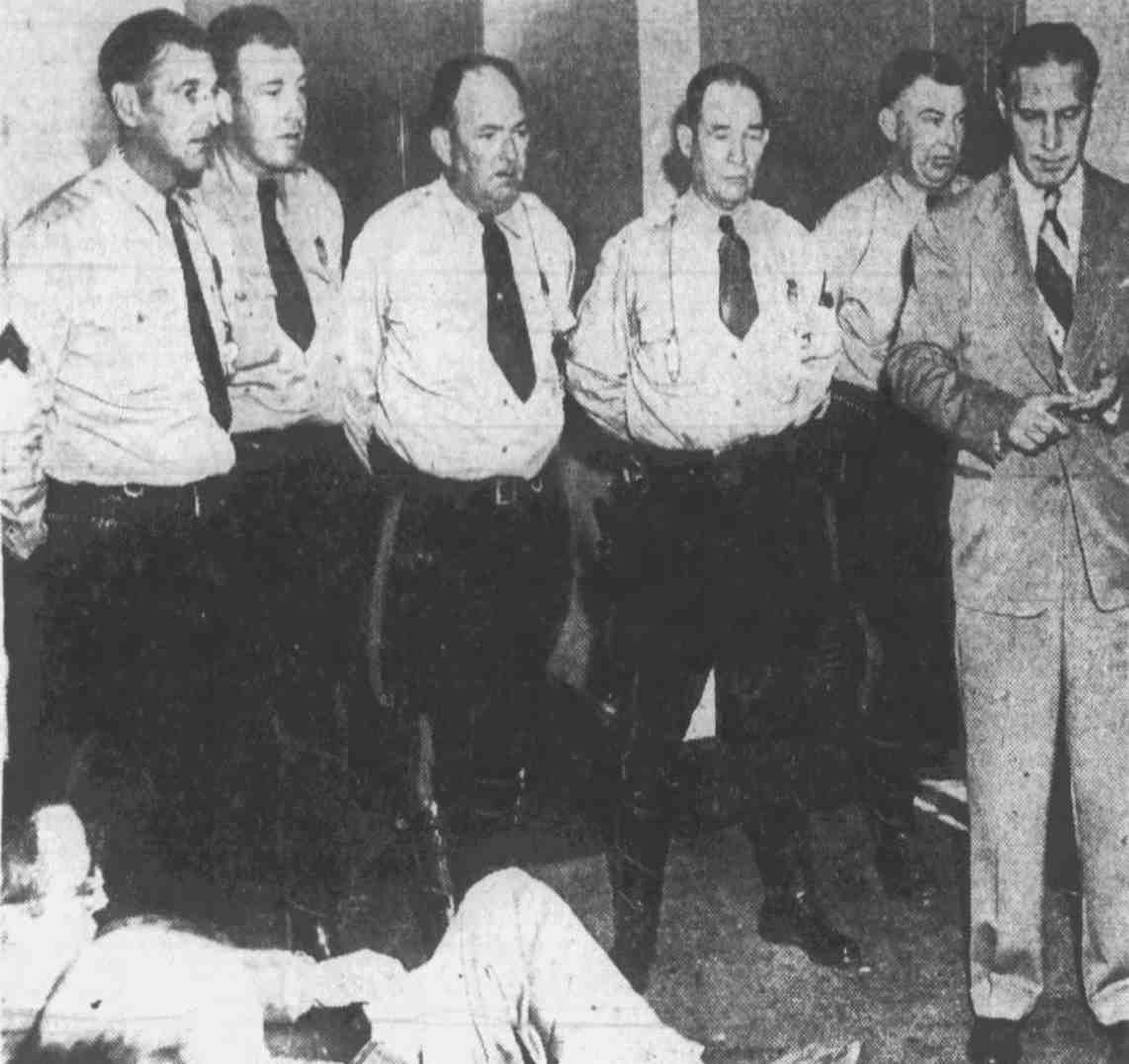
FIVE CITY TRAFFIC BUREAU MEMBERS are shown at top presenting their defense through counsel to Public Safety Director Dr. Rhone on charges they collected pay from the state for traffic duty at the Baird boulevard overpass at the time they were required to be on duty for the city. State Sen. Bruce A. Wallace is at extreme right denying the charges for the five officers he represents. Standing with him from left are Sgt. Anthony Skolski, Patrolmen Charles Hance, George Getley, Everett Joslin and Martin Nelson. The lower photo shows Traffic Sgt. James Wilson and Walter Vecander, and Park Guard Anthony Palese waiting to be called.
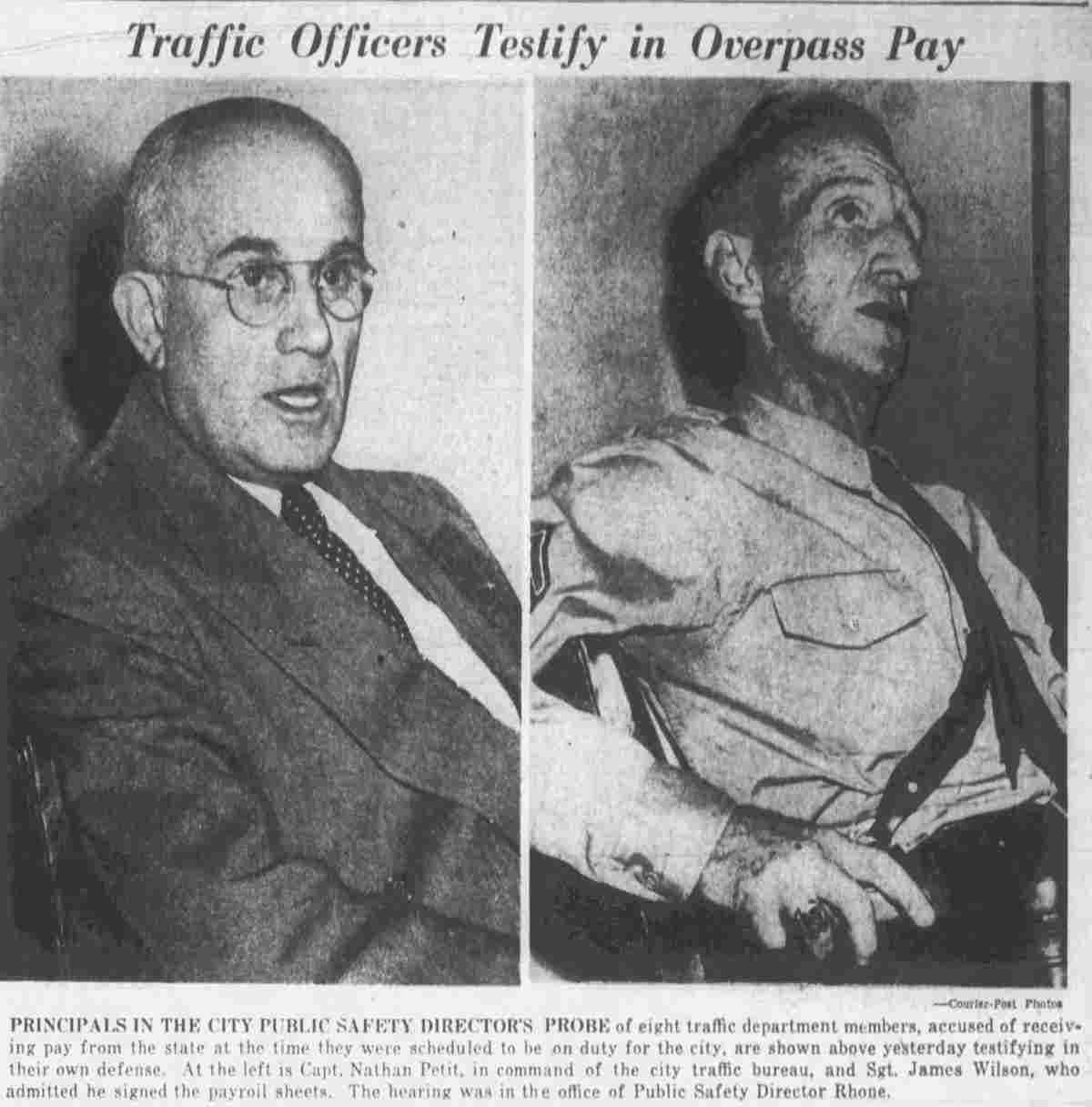
PRINCIPALS IN THE CITY PUBLIC SAFETY DIRECTOR’S PROBE of eight traffic department members, accused of receiving pay from the state at the time they were scheduled to be on duty for the city, are shown above yesterday testifying in their own defense. At the left is Capt. Nathan Petit, in command of the city traffic bureau, and Sgt. James Wilson, who admitted he signed the payroll sheets. The hearing was in the office of Public Safety Director Rhone.
Down Memory Lane
Camden Courier-Post —
Life Hereabouts by Charley Humes
Life Hereabouts
BY CHARLEY HUMES
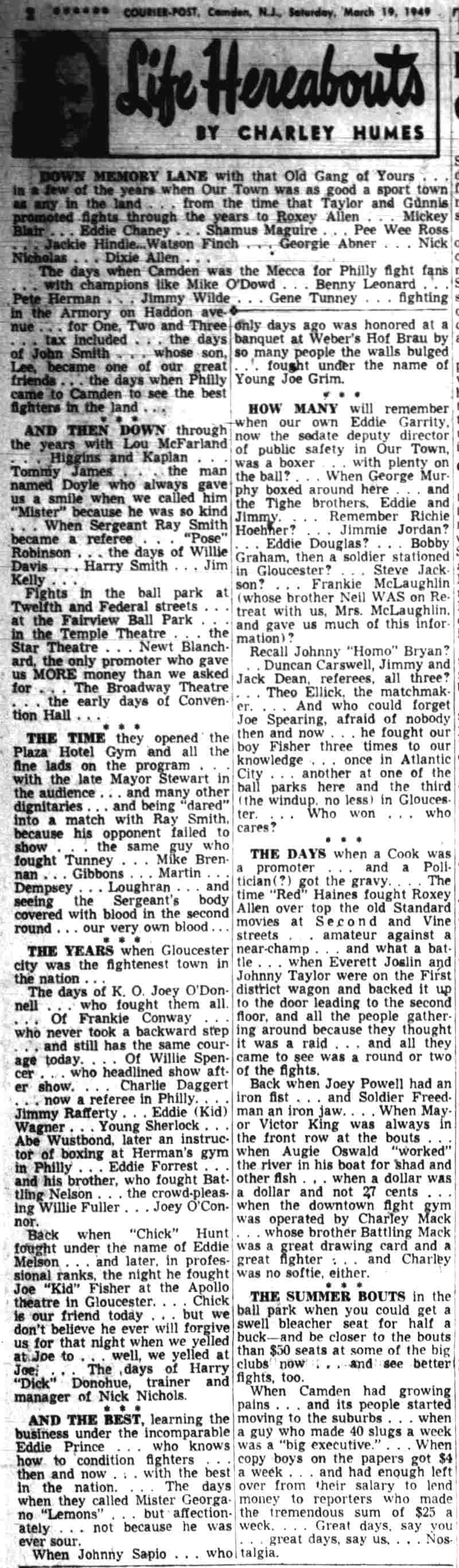
DOWN MEMORY LANE with that Old Gang of Yours . . . in a few of the years when Our Town was as good a sport town as any in the land . . . from the time that Taylor and Gunnis promoted fights through the years to Roxey Allen . . . Mickey Blair . . . Eddie Chaney . . . Shamus Maguire . . . Pee Wee Ross . . . Jackie Hindle . . . Watson Finch . . . Georgie Abner . . . Nick Nicholas . . . Dixie Allen . . .
The days when Camden was the Mecca for Philly fight fans . . . with champions like Mike O’Dowd . . . Benny Leonard . . . Pete Herman . . . Jimmy Wilde . . . Gene Tunney . . . fighting in the Armory on Haddon avenue . . . for One, Two and Three . . . tax included . . . the days of John Smith . . . whose son, Lee, became one of our great friends . . . the days when Philly came to Camden to see the best fighters in the land . . .
AND THEN DOWN through the years with Lou McFarland . . . Higgins and Kaplan . . . Tommy James . . . the man named Doyle who always gave us a smile when we called him “Mister” because he was so kind . . . When Sergeant Ray Smith became a referee . . . “Pose” Robinson . . . the days of Willie Davis . . . Harry Smith . . . Jim Kelly . . .
Fights in the ball park at Twelfth and Federal streets . . . at the Fairview Ball Park . . . in the Temple Theatre . . . the Star Theatre . . . Newt Blanchard, the only promoter who gave us MORE money than we asked for . . . The Broadway Theatre . . . the early days of Convention Hall . . .
THE TIME they opened the Plaza Hotel Gym and all the fine lads on the program . . . with the late Mayor Stewart in the audience . . . and many other dignitaries . . . and being “dared” into a match with Ray Smith, because his opponent failed to show . . . the same guy who fought Tunney . . . Mike Brennan . . . Gibbons . . . Martin . . . Dempsey . . . Loughran . . . and seeing the Sergeant’s body covered with blood in the second round . . . our very own blood . . .
THE YEARS when Gloucester city was the fightenest town in the nation . . .
The days of K. O. Joey O’Donnell . . . who fought them all. . . Of Frankie Conway . . . who never took a backward step . . . and still has the same courage today. . . . Of Willie Spencer . . . who headlined show after show. . . . Charlie Daggert . . . now a referee in Philly. . . . Jimmy Rafferty . . . Eddie (Kid) Wagner . . . Young Sherlock . . . Abe Wustbond, later an instructor of boxing at Herman’s gym in Philly . . . Eddie Forrest . . . and his brother, who fought Battling Nelson . . . the crowd-pleasing Willie Fuller . . . Joey O’Connor.
Back when “Chick” Hunt fought under the name of Eddie Melson . . . and later, in professional ranks, the night he fought Joe “Kid” Fisher at the Apollo theatre in Gloucester. . . . Chick is our friend today . . . but we don’t believe he ever will forgive us for that night when we yelled at Joe to . . . well, we yelled at Joe . . . The days of Harry “Dick” Donohue, trainer and manager of Nick Nichols.
AND THE BEST, learning the business under the incomparable Eddie Prince . . . who knows how to condition fighters . . . then and now . . . with the best in the nation. . . . The days when they called Mister Georgano “Lemons” . . . but affectionately . . . not because he was ever sour.
When Johnny Sapio . . . who only days ago was honored at a banquet at Weber’s Hof Brau by so many people the walls bulged . . . fought under the name of Young Joe Grim.
HOW MANY will remember when our own Eddie Garrity, now the sedate deputy director of public safety in Our Town, was a boxer . . . with plenty on the ball? . . . When George Murphy boxed around here . . . and the Tighe brothers, Eddie and Jimmy . . . Remember Richie Hoehner? . . . Jimmie Jordan? . . . Eddie Douglas? . . . Bobby Graham, then a soldier stationed in Gloucester? . . . Steve Jackson? . . . Frankie McLaughlin (whose brother Neil WAS on Retreat with us, Mrs. McLaughlin, and gave us much of this information)?
Recall Johnny “Homo” Bryan? . . . Duncan Carswell, Jimmy and Jack Dean, referees, all three? . . . Theo Ellick, the matchmaker. . . . And who could forget Joe Spearing, afraid of nobody then and now . . . he fought our boy Fisher three times to our knowledge . . . once in Atlantic City . . . another at one of the ball parks here and the third (the windup, no less) in Gloucester. . . . Who won . . . who cares?
THE DAYS when a Cook was a promoter . . . and a Politician(?) got the gravy. . . . The time “Red” Haines fought Roxey Allen over top the old Standard movies at Second and Vine streets . . . amateur against a near-champ . . . and what a battle . . . when Everett Joslin and Johnny Taylor were on the First district wagon and backed it up to the door leading to the second floor, and all the people gathering around because they thought it was a raid . . . and all they came to see was a round or two of the fights.
Back when Joey Powell had an iron fist . . . and Soldier Freedman an iron jaw. . . . When Mayor Victor King was always in the front row at the bouts . . . when Augie Oswald “worked” the river in his boat for shad and other fish . . . when a dollar was a dollar and not 27 cents . . . when the downtown fight gym was operated by Charley Mack . . . whose brother Battling Mack was a great drawing card and a great fighter . . . and Charley was no softie, either.
THE SUMMER BOUTS in the ball park when you could get a swell bleacher seat for half a buck—and be closer to the bouts than $50 seats at some of the big clubs now . . . and see better fights, too.
When Camden had growing pains . . . and its people started moving to the suburbs . . . when a guy who made 40 slugs a week was a “big executive.” . . . When copy boys on the papers got $4 a week . . . and had enough left over from their salary to lend money to reporters who made the tremendous sum of $25 a week. . . . Great days, say you . . . great days, say us. . . . Nostalgia.
Life Hereabouts by Charley Humes
Camden Courier-Post —
“KIDS…LITTLE KIDS…murdered in their own home.”
Tears were streaming down the face of a lovely little lady as she spoke those words.
In front of her, in the middle of the carpet, was a spot, sort of whitish, where someone had tried to remove the blood of a little boy…a little boy who was “going on three”…a little boy who never harmed no one…
Just down the block a bit, people were perring through a big plate glass window, looking at a “hobby horse” in a barber shop that is closed.
At the base of the standard which held the wooden horse in place was another blotch of blood…the blood of another little boy “just past six” who was having his hair cut in preparation for his first trip to school the next day….
In the back seat of an automobile parked a little farther away was another great stain…where another boy died.
And the killer says: “I’m glad I did it, but I’m sorry about the children.”
WE ARRIVED at the scene of the Mad Mission of Cramer Hill after all of the shooting was over. Walt Carley and Jake Weiner, Courier-Post scribes, had arrived with the cops. They witnessed the capture and went on to do a great job of reporting the terrible tragedy.
We walked along the street peering in windows where only minutes before, people were happy and gay—and now they were dead.
Two holes showed in the front screen of a home near the center of the block. Detectives Stanley Bobiak and William Deery, identification chief, approached and Bobiak looked into the home.
“Was anyone shot in here?” Bobiak queried through the window.
“My little boy was killed,” replied the tearful voice of a mother whose anguish was pitiful to see and hear.
This was a terrible thing that happened in Our Town.
HUMAN beings are a funny bunch. And cops are human beings. The shooting was over and there was this bluecoat and that bluecoat insisting that he was “first on the scene.” You could have had a couple of dozen “firsts” if you were interested in that. And all those who said they were first and were not given credit for it would have been sore.
But that was after the shooting was over. When the chips were down, when a maniac was shooting innocent men, women and children and was still on the loose with that big Luger, that is when the cops of Our Town proved they rank right up there with the best in the world.
Through the years, there has been many an occasion where we witnessed the bravery of Camden policemen.
This time we missed, but we know what happened from the lips of reliable newspapermen and other witnesses.
We know that Russ Maurer stepped out into the clear, while other cops covered him with their guns, to hurl tear gas into the home of the man who was bent on kill. Russ could have paid with his life, because the killer seldom missed. That was a brave act.
THERE were Charley Hance, Ev Joslin, Cecil Picou, Tommy Carr, Bill Moll, Sid Nelson, Barney Tracy, Bill Kelly, Marshall Thompson, Vince Conley, Lennie Andruzza and dozens of others closing in on the killer, inch by inch.
Kelley and Tracy on a roof, moving in, Bill with a machinegun, Barney with gun in hand…exposed like the other cops for a quick shot that might mean death.
Picou and Bill Rogers…moving the wounded and the dead…with the killer still free…Johnny Ferry stepping into the clear to keep the slayer from shooting from the upper front windows of his home.
NO WORDS of ours can give comfort to those families which suffered so much with the loss of dear ones. We can only say that everyone we met throughout Our Town mourned with them.
But we can say a word about the police and the manner in which they tackled this job.
And of all them there we will take Ev Joslin and say that Ev will never be outdone where courage is concerned. We have seen that courage through the years and we have heard many a cop say they will take Ev as their sidekick in a tough situation any day.
So the only way we can give Our Cops their proper due is to say that every one of them who participated in the Mad Mission of Cramer Hill was just as courageous, just as mindful of their sworn duty, just as concerned over the safety of others, forgetting themselves as the man we picked as a symbol of courage.
And whointhehell cares who got here first or who struck the killer?
Camden, N.J., Sept. 6
New York Times —
For a distinguished example of local reporting during the year, The New York Times submits the story by Meyer Berger of the mass shootings in Camden, New Jersey on September 6, 1949. Mr. Berger was assigned to the story by The Times City Desk shortly before 11 A.M. He caught the first available train to Camden; personally covered the story and filed approximately 4,000 words. The last of his copy reached The Times office at 9:20 P.M., about one hour before the first edition closing. In the opinion of the editors of The New York Times, Mr. Berger’s story was a brilliant example of thorough, accurate reporting and skillful writing, under pressure. Mr. Berger subsequently received the 1950 Pulitzer Prize for local reporting.
CAMDEN, N.J., Sept. 6—Howard B. Unruh, 28 years old, a mild, soft-spoken veteran of many armored artillery battles in Italy, France, Austria, Belgium and Germany, killed twelve persons with a war souvenir Luger pistol in his home block in East Camden this morning. He wounded four others.
Unruh, a slender, hollow-cheeked six-footer paradoxically devoted to scripture reading and to constant practice with firearms, had no previous history of mental illness but specialists indicated tonight that there was no doubt that he was a psychiatric case, and that he had secretly nursed a persecution complex for two years or more.
Blood Betrays His Wound
The veteran was shot in the left thigh by a local tavern keeper but he kept that fact secret, too, while policemen and Mitchell Cohen, Camden County prosecutor, questioned him at police headquarters for more than two hours immediately after tear gas bombs had forced him out of his bedroom to surrender.
The blood stain he left on the seat he occupied during the questioning betrayed his wound. When it was discovered he was taken to Cooper Hospital in Camden, a prisoner charged with murder.
He was as calm under questioning as he was during the twenty minutes that he was shooting men, women and children. Only occasionally excessive brightness of his dark eyes indicated that he was anything other than normal.
He told the prosecutor that he had been building up resentment against neighbors and neighborhood shopkeepers for a long time. “They have been making derogatory remarks about my character,” he said. His resentment seemed most strongly concentrated against Mr. and Mrs. Maurice Cohen who lived next door to him. They are among the dead.
Mr. Cohen was a druggist with a shop at 3202 River Road in East Camden. He and his wife had had frequent sharp exchanges over the Unruhs’ use of a gate that separates their back yard from the Cohens’. Mrs. Cohen had also complained of young Unruh’s keeping his bedroom radio tuned high into the late night hours. None of the other victims had ever had trouble with him. Unruh, a graduate of Woodrow Wilson High School here, had started a GI course in pharmacy at Temple University in Philadelphia some time after he was honorably discharged from the service in 1945, but had stayed with it only three months. In recent months he had been unemployed, and apparently was not even looking for work.
Mother Separated From Husband
His mother, Mrs. Rita Unruh, 50, is separated from her husband. She works as a packer in the J. Evanson Soap Company in Camden and hers was virtually the only family income. James Unruh, 25 years old, her younger son, is married and lives in Haddon Heights, N.J. He works for the Curtis Publishing Company.
On Monday night, Howard Unruh left the house alone. He spent the night at the Family Theater on Market Street in Philadelphia to sit through several showings of the double feature motion picture there—“I Cheated the Law” and “The Lady Gambles.” It was past three o’clock this morning when he got home.
Prosecutor Cohen said that Unruh told him later that before he fell asleep this morning he had made up his mind to shoot the persons who had “talked about me,” that he had even figured out that 9:30 A.M. would be the time to begin because most of the stores in his block would be open at that hour.
His mother, leaving her ironing when he got up, prepared his breakfast in their drab little three-room apartment in the shabby gray two-story stucco house at the corner of River Road and Thirty Second Street. After breakfast, he loaded one clip of bullets into his Luger, slipped another clip into his pocket, and carried sixteen loose cartridges in addition. He also carried a tear-gas pen with six shells and a sharp six-inch knife.
He took one last look around his bedroom before he left the house. On the peeling walls he had crossed pistols, crossed German bayonets, pictures of armored artillery in action. Scattered about the chamber were machetes, a Roy Rogers pistol, ash trays made of German shells, clips of 30-30 cartridges for rifle use and a host of varied war souvenirs.
Mrs. Unruh had left the house some minutes before, to call on Mrs. Caroline Pinner, a friend in the next block. Mrs. Unruh had sensed, apparently, that her son’s smoldering resentments were coming to a head. She had pleaded with Elias Pinner, her friend’s husband, to cut a little gate in the Unruhs’ backyard so that Howard need not use the Cohen gate again. Mr. Pinner finished the gate early Monday evening after Howard had gone to Philadelphia.
At the Pinners’ house at 9 o’clock this morning, Mrs. Unruh had murmured something about Howard’s eyes: how strange they looked and how worried she was about him.
A few minutes later River Road echoed and re-echoed to pistol fire. Howard Unruh was on the rampage. His mother, who had left the Pinners’ little white house only a few seconds before, turned back. She hurried through the door.
She cried, “Oh, Howard, oh, Howard, they’re to blame for this.” She rushed past Mrs. Pinner, a kindly gray-haired woman of 70. She said, “I’ve got to use the phone; may I use the phone?”
But before she had crossed the living room to reach for it she fell on the faded carpet in a dead faint. The Pinners lifted her onto a couch in the next room. Mrs. Pinner applied aromatic spirits to revive her.
Panic Grips Entire Block
While his mother writhed on the sofa in her house dress, and worn old sweater, coming back to consciousness, Howard Unruh was walking from shop to shop in the “3200 block” with deadly calm, spurting Luger in hand. Children screamed as they tumbled over one another to get out of his way. Men and women dodged into open shops, the women shrill with panic, man hoarse with fear. No one could quite understand for a time. what had been loosed in the block.
Unruh first walked into John Pilarchik’s shoe repair shop near the north end of his own side of the street. The cobbler, a 27-year-old man who lives in Pennsauken Township, looked up open-mouthed as Unruh came to within a yard of him. The cobbler started up from his bench but went down with a bullet in his stomach. A little boy who was in the shop hid behind the counter and crouched there in terror. Unruh walked out into the sunlit street.
“I shot them in the chest first,” he told the prosecutor later, in meticulous detail, “and then I aimed for the head.” His aim was devastating—and with reason. He had won marksmanship and sharpshooters’ ratings in the service, and he practiced with his Luger all the time on a target set up in the cellar of his home.
Unruh told the prosecutor afterward that he had Cohen the druggist, the neighborhood barber, the neighborhood cobbler and the neighborhood tailor on his mental list of persons who had “talked about him.” He went methodically about wiping them out. Oddly enough, he did not start with the druggist, against whom he seemed to have the sharpest feelings, but left him almost for the last.
Newlywed Wife Shot Dead
From the cobbler’s he went into the little tailor shop at 3214 River Road. The tailor was out. Helga Zegrino, 28 years old, the tailor’s wife was there alone. The couple, incidentally, had been married only one month. She screamed when Unruh walked in with his Luger in his hand. Some people across the street heard her. Then the gun blasted again and Mrs. Zegrino pitched over, dead. Unruh walked into the sunlight again.
All this was only a matter of seconds and still only a few persons had begun to understand what was afoot. Down the street at 3210 River Road is Clark Hoover’s little country barber shop. In the center was a white-painted carousel-type horse for children customers. Orris Smith, a blonde boy only 6 years old, was in it, with a bib around his neck, submitting to a shearing. His mother, Mrs. Catherine Smith, 42, sat on a chair against the wall and watched.
She looked up. Clark Hoover turned from his work, to see the six-footer, gaunt and tense, but silent, standing in the driveway with of the Luger. Unruh’s brown tropical worsted suit was barred with morning shadow. The sun lay bright in his crew-cut brown hair. He wore no hat. Mrs. Smith could not understand what was about to happen.
Unruh walked to “Brux”—that is Mrs. Smith’s nickname for her little boy—and put the Luger to the child’s chest. The shot echoed and reverberated in the little 12 by 12 shop. The little boy’s head pitched toward the wound, his hair, half-cut, stained with red. Unruh said never a word. He put the Luger close to the shaking barber’s hand. Before the horrified mother, Unruh leaned over and fired another shot into Hoover.
The veteran made no attempt to kill Mrs. Smith. He did not seem to hear her screams. He turned his back and stalked out, unhurried. A few doors north, Dominick Latela, who runs a little restaurant, had come to his shop window to learn what the shooting was about. He saw Unruh cross the street toward Frank Engel’s Tavern. Then he saw Mrs. Smith stagger out with her pitiful burden. Her son’s head rolled over the crook of her right arm.
Mrs. Smith screamed, “My boy is dead. I know he’s dead.” She stared about her, looking in vain for aid. No one but Howard Unruh was in sight, and he was concentrating on the tavern. Latela dashed out, but first he shouted to his wife, Dora, who was in the restaurant with their daughter Eleanor, 6 years old. He hollered, “I’m going out. Lock the door behind me.” He ran for his car, and drove it down toward Mrs. Smith as she stood on the payment with her son.
Latela took the child from her arms and placed him on the car’s front seat. He pushed the mother into the rear seat, slammed the doors and headed for Cooper Hospital. Howard Unruh had not turned. Engel, the tavern keeper, had locked his own door. His customers, the bartender and a porter made a concerted rush for the rear of the saloon. The bullets tore through the tavern door paneling. Engel rushed upstairs and got out his .38 caliber pistol, then rushed to the street window of his apartment.
Unruh was back in the center of the street. He fired a shot at an apartment window at 3208 River Road. Tommy Hamilton, 2 years old, fell back with a bullet in his head. Unruh went north again to Latela’s place. He fired a shot at the door, and kicked in the lower glass panel. Mrs. Latela crouched behind the counter with her daughter. She heard the bullets, but neither she nor her child was touched. Unruh walked back toward Thirty-second Street, reloading the Luger.
Now, the little street—a small block with only five buildings on one side, three one-story stores on the other—was shrill with women’s and children’s panicky outcries. A group of six or seven little boys or girls fled pass Unruh. They screamed, “Crazy man!” and unintelligible sentences. Unruh did not seem to hear, or see, them.
Autoist Goes to His Death
Alvin Day, a television repair man, who lives in the near-by Mantua, had heard the shooting, but driving into the street he was not aware of what had happened. Unruh walked up to the car window as Day rolled by, and fired once through the window, with deadly aim. The repair man fell against the steering wheel. The front wheels hit the opposite curb and stalled. Day was dead.
Frank Engel had thrown open his second-floor apartment window. He saw Unruh pause for a moment in a narrow alley between the cobbler’s shop and a little two-story house. He aimed and fired. Unruh stopped for just a second. The bullet had hit, but he did not seem to mind, after the initial brief shock. He headed toward the corner drugstore, and Engel did not fire again.
“I wish I had,” he said, later. “I could have killed him then. I could have put a half-dozen shots into him. I don’t know why I didn’t do it.”
Cohen, the druggist, a heavy man of 40, had run into the street shouting, “What’s going on here? What’s going on here?” but at sight of Unruh hurried back into his shop. James J. Huttton, 45, an insurance agent from Westmont, N.J., started out of the drug shop to see what the shooting was about. Like so many others he had figured at first that it was some car backfiring. He came face to face with Unruh.
Unruh said quietly, “Excuse me, sir,” and started to push past him. Later, Unruh told the police: “That man didn’t act fast enough. He didn’t get out of my way.” He fired into Hutton’s head and body. The insurance man pitched onto the sidewalk and lay still.
Cohen had run to his upstairs apartment and had tried to warn Minnie Cohen, 63, his mother, and Rose, his wife, 38, to hide. His son, Charles, 14, was in the apartment, too.
Mrs. Cohen shoved the boy into a clothes closet, and leaped into another closet herself. She pulled the door to. The druggist, meanwhile had leaped from the window onto a porch roof. Unruh, a gaunt figure at the window behind him, fired into the druggist’s back. The druggist, still running, bounded off the roof and lay dead in Thirty-second Street.
Unruh fired into the closet, where Mrs. Cohen was hidden. She fell dead behind the closed door, and he did not bother to open it. Mrs. Minnie Cohen tried to get to the telephone in an adjoining bedroom to call the police. Unruh fired shots into her head and body and she sprawled dead on the bed. Unruh walked down the stairs with his Luger reloaded and came out into the street again.
A coupe had stopped at River Road, obeying a red light. The passengers obviously had no idea of what was loose in East Camden and no one had a chance to tell them. Unruh walked up to the car, and though it was filled with total strangers, fired deliberately at them, one by one, through the windshield. He killed the two women passengers, Mrs. Helen Matlack Wilson, 43, of Pennsauken, who was driving, and her mother, Mrs. Emma Matlack, 66. Mrs. Wilson’s son John, 12, was badly wounded. A bullet pierced his neck, just below in the jawbone.
Earl Horner, clerk in the American Stores Company, a grocery opposite the drugstore, had locked his front door after several passing men, women and children had tumbled breathlessly into the shop panting “crazy man***killing people.***” Unruh came up to the door and fired two shots through the wood panelling. Horner, his customers, the refugees from the veteran’s merciless gunfire, crouched, trembling, behind the counter. None there was hurt.
“He tried the door before he shot in here,” Horner related afterward. “He just stood there, stony-faced and grim, and rattled the knob, before he started to fire. Then he turned away.”
Charlie Petersen, 18, son of a Camden fireman [John M. Peterson], came driving down the street with two friends when Unruh turned from the grocery. The three boys got out to stare at Hutton’s body lying unattended on the sidewalk. They did not know who had shot the insurance man, or why and, like the women in the car, had no warning that Howard Unruh was on the loose. The veteran brought his Luger to sight and fired several times. Young Petersen fell with bullets in his legs. His friends tore pell-mell down the street to safety.
Mrs. Helen Harris of 1250 North Twenty-eighth Street with her daughter, Helen, a 6-year-old blonde child, and a Mrs. Horowitz with her daughter, Linda, five, turned into Thirty-second Street. They had heard the shooting from a distance but thought is was auto backfire.
Unruh passed them in Thirty-second Street and walked up the sagging four steps of a little yellow dwelling back of his own house. Mrs. Madeline Harrie, a woman in her late thirties, and two sons, Armand, 16, and Leroy, 15, were in the house. A third son, Wilson, 14, was barricaded in the grocery with other customers.
Unruh threw open the front door and, gun in hand, walked into the dark little parlor. He fired two shots at Mrs. Harrie. They went wild and entered the wall. A third shot caught her in the left arm. She screamed. Armand leaped at Unruh, to tackle him. The veteran used the Luger butt to drop the boy, then fired two shots into his arms. Upstairs Leroy heard the shooting and the screams. He hid under a bed.
By this time, answering a flood of hysterical telephone calls from various parts of East Camden, police radio cars swarmed into River Road with sirens wide open. Emergency crews brought machine guns, shotguns and tear gas bombs.
Sergeant Earl Wright, one of the first to leap to the sidewalk, saw Charles Cohen, the druggist’s son. The boy was half out the second-floor apartment window, just above where his father lay dead. He was screaming “He’s going to kill me. He’s killing every body.” The boy was hysterical.
Wright bounded up the stairs to the druggist’s apartment. He saw the dead woman on the bed, and tried to soothe the druggist son. He brought him downstairs and turned him over to other policemen, then joined the men who had surrounded the two-story stucco house where Unruh lived. Unruh, meanwhile, had fired about 30 shots. He was out of ammunition: Leaving the Harrie house, he had also heard the police sirens. He had run through the back gate to his own rear bedroom.
Guns Trained on Window
Everett Joslin, a motorcycle policeman, scrambled to the porch roof under Unruh’s window. He tossed a tear-gas grenade through a pane of glass. Other policemen, hoarsely calling on Unruh to surrender, took positions with their machine guns and shotguns. They trained them on Unruh’s window.
Meanwhile a curious interlude had taken place. Philip W. Buxton, an assistant city editor on the Camden Evening Courier had looked Unruh’s name up in the telephone book. He called the number, Camden 4-2490W. It was just after 10 A.M. and Unruh had just returned to his room. To Mr. Buxton’s astonishment Unruh answered. He said hello in a calm, clear voice.
“This Howard?” Mr. Buxton asked.
“Yes, this is Howard. What’s the last name of the party you want?”
“Unruh.”
The veteran asked what Mr. Buxton wanted.
“I’m a friend,” the newspaper man said. “I want to know what they’re doing to you down there.”
Unruh thought a moment. He said, “They haven’t done anything to me—yet. I’m doing plenty to them.” His voice was still steady without a trace of hysteria.
Mr. Buxton asked how many persons Unruh had killed.
The veteran answered: “I don’t know. I haven’t counted. Looks like a pretty good score.”
“Why are you killing people?”
“I don’t know,” came the frank answer. “I can’t answer that yet. I’ll have to talk to you later. I’m too busy now.”
The telephone banged down.
Unruh was busy. The tear gas was taking effect and police bullets were thudding at the walls around him. During a lull in the firing the police saw the white curtains move and the gaunt killer came into plain view.
“Okay,” he shouted. “I give up, I’m coming down.”
“Where’s that gun?” a sergeant yelled.
“It’s on my desk, up here in the room,” Unruh called down quietly. “I’m coming down.”
Thirty guns were trained on the shabby little back door. A few seconds later the door opened and Unruh stepped into the light, his hands up. Sergeant Wright came across the morning-glory and aster beds in the yard and snapped handcuffs on Unruh’s wrists.
“What’s the matter with you,” a policeman demanded hotly. “You a psycho?”
Unruh stared into the policeman’s eyes—a level, steady stare. He said, “I’m no psycho. I have a good mind.”
Word of the capture brought the whole East Camden populace pouring into the streets. Men and women screamed at Unruh, and cursed him in shrill accents and in hoarse anger. Someone cried “lynch him” but there was no movement. Sergeant Wright’s men walked Unruh to a police car and started for headquarters.
Shouting and pushing men and women started after the car, but dropped back after a few paces. They stood in excited little groups discussing the shootings, and the character of Howard Unruh. Little by little the original anger, born of fear, that had moved the crowd, began to die.
Men conceded that he probably was not in his right mind. Those who knew Unruh kept repeating how close-mouthed he was, and how soft spoken. How he took his mother to church, and how he marked scripture passages, especially the prophecies.
“He was a quiet one, that guy,” a man told a crowd in front of the tavern. “He was all the time figuring to do this thing. You gotta watch them quiet ones.”
But all day River Road and the side streets talked of nothing else. The shock was great. Men and women kept saying: “We can’t understand it. Just don’t get it.”
Gold Badges To Be Given 15 City Cops
Camden Courier-Post —
Fifteen retired Camden City policemen will be honored by the Patrolmen’s Benevolent Association, Local 35, Wednesday night at the Police and Fire Club, 1175 Whitman Avenue.
Police Chief William H. Neale, will present awards. The awards will be gold retirement badges mounted in wallets. The men receiving them will have served 20 or more years.
According to Patrolman Robert Mentz, PBA secretary, this is the first time since 1960 that retirement badges have been presented. The ceremonies will follow the organization’s business meeting.
Awards will be made to: Edward Suski, Harry Cattell, Clifford DelRossi, Frank Gutherman, John Houston, Thomas Kauffman, William Stibi, Leon Feltz, Russell Young, Henry Leutz, George Ellis, Everett Joslin, Ralph Cline, John Kaighn and former Chief Gustav Koerner.