John H. Taylor
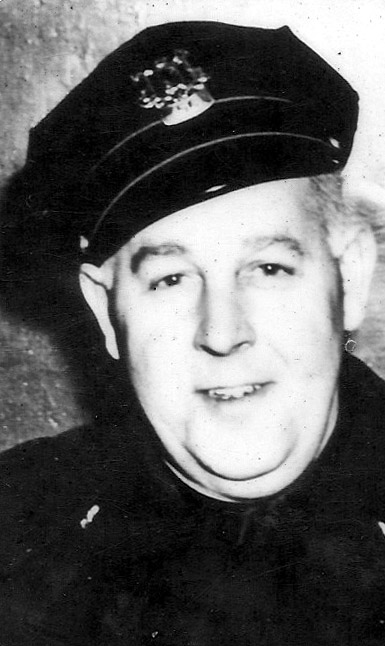
John H. Taylor
JOHN HENRY TAYLOR was born in Philadelphia on December 21, 1903. His father John “Buck” Taylor served with the Camden Police Department from 1912 until his death from influenza in March of 1927. John H. Taylor was appointed to the Camden Police Department on April 1, 1928. He passed away after a long illness on June 2, 1954 at the age of 50.
In 1931 John H. Taylor was commended for valor for his actions during the saloon holdup at Front and Pearl Streets. Officer Taylor was also cited for heroism when he disarmed a suspect who had slashed several persons in a house on Taylor Avenue. Officer Taylor himself was slashed, his injuries causing him to spend several days in hospital.
When he registered for the draft in 1940 John H. Taylor lived at 857 North 33rd Street in Cramer Hill.
Probe Started by Dickinson in Raid ‘Leak’
Camden Evening Courier —
PROBE STARTED BY DICKINSON IN RAID 'LEAK
PROBE STARTED BY DICKINSON IN RAID 'LEAK'
Men Fled $250,000 Still Before Cops Arrived, Deputy Learns
Baldwin Gave Clue to Giant Plant
Vast Amount of Rum Supplies Seized in North Camden
Major Charles V. Dickinson, deputy director of public safety, today started an investigation to ascertain how plans for a raid on a $250,000 North Camden distilling plant leaked out more than an hour before the raid was made late yesterday afternoon.
The inquiry to locate the “leak” was prompted by rumors that neighbors saw employes of the distillery running from the plant at Ninth and State streets an hour and 20 minutes before detectives and the police raided it. Major Dickinson, however, insists he and Lieut. George Ward were the only persons in the police department who knew the location of the plant prior to the raid.
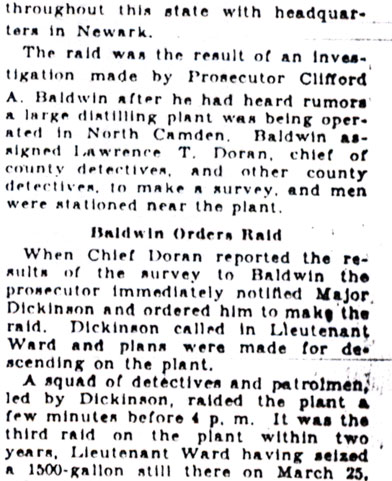
Police believe the distillery to be one of a chain of such places operated throughout this state with headquarters in Newark.
The raid was the result of an investigation made by Prosecutor Clifford A. Baldwin after he had heard rumors a large distilling plant was being operated in North Camden. Baldwin assigned Lawrence T. Doran, chief of county detectives, and other county detectives, to make a survey, and men were stationed near the plant.
Baldwin Orders Raid
When Chief Doran reported the results of the survey to Baldwin the prosecutor immediately notified Major Dickinson and ordered him to make the raid. Dickinson called in Lieutenant Ward and plans were made for descending on the plant.
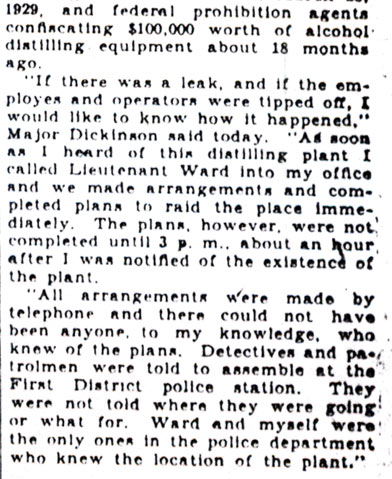
A squad of detectives and patrolmen, led by Dickinson, raided the plant a few minutes before 4 p.m. It was the third raid on the plant within two years, Lieutenant Ward having seized a 1500-gallon still there on March 25, 1929, and federal prohibition agents confiscating $100,000 worth of alcohol distilling equipment about 18 months ago.
“If there was a leak, and if the employes and operators were tipped off, I would like to know how it happened,” Major Dickinson said today. “As soon as I heard of this distilling plant I called Lieutenant Ward into my office and we made arrangements and completed plans to raid the place immediately. The plans, however, were not completed until 3 p.m. about an hour after I was notified of the existence of the plant.”
“All arrangements were made by telephone and there could not have been anyone, to my knowledge, who knew the plans. Detectives and patrolmen were told to assemble at the First District police station. They were not told where they were going or what for. Ward and myself were the only ones in the police department who knew the location of the plant.”
Alcohol Seized
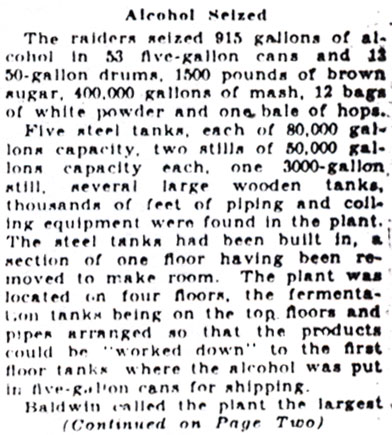
The raiders seized 915 gallons of alcohol in 53 five-gallon cans and 12 50-gallon drums, 1500 pounds of brown sugar, 400,000 gallons of mash, 12 bags of white powder and one bale of hops.
Five steel tanks, each of 80,000 gallons capacity, two stills of 50,000 gallons capacity each, one 3000-gallon still, several large wooden tanks, thousands of feet of piping and coiling equipment were found in the plant. The steel tanks had been built in, a section of one floor having been removed to make room. The plant was located on four floors, the fermentation tanks being on the top floors and pipes arranged so that the products could be “worked down” to the first floor tanks where the alcohol was put in five-gallon cans for shipping.
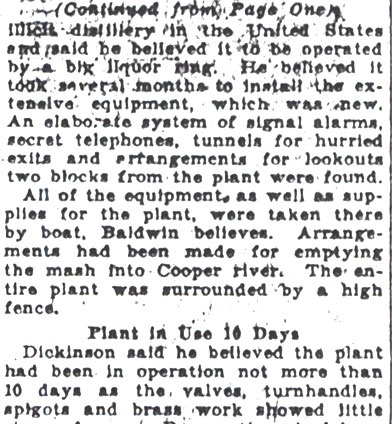
Baldwin called the plant the largest illicit distillery in the United States and said he believed it to be operated by a big liquor ring. He believed it took several months to install the extensive equipment, which was new. An elaborate system of signal alarms, secret telephones, tunnels for hurried exits and arrangements for lookouts two blocks from the plant were found.
All of the equipment, as well as supplies for the plant, were taken there by boat, Baldwin believes. Arrangements had been made for emptying the mash into Cooper River. The entire plant was surrounded by a high fence.
Plant in Use 10 Days
Dickinson said he believed the plant had been in operation not more than 10 days as the valves, turnhandles, spigots and brass work showed little signs of wear. Preparations had been made against a possible raid. Dickinson learned after visiting the plant, as the names on shipping labels had been torn so they were not readable. Tar paper had been placed over the window. Names had been removed from the lunch boxes of workmen.
Large packing boxes such as used for the shipment of radio and phonograph sets were used to hide the machinery and also for shipping the cans of alcohol.
The stills and steel tanks were dismantled by acetylene torches, the mash and chemicals were dumped in Cooper river and the alcohol was taken to city hall. The alcohol probably will be turned over to hospitals and charitable institutions.
Lessors Sought
Dickinson and Baldwin are making surveys today to ascertain, if possible, who leased the building. Nearby plant owners and neighbors will be questioned.
The building for many years was headquarters of the old Highland Worsted Mills and extends from Ninth street to the Cooper river; on State street, and runs back about a half square to Moore street.
Yesterday the buildings were empty when the big squad of cops swarmed into the place. The lunch baskets of several employes were found on tables in the room and there were other evidences of a hasty exit having taken place. There were rumors that a “tip off” had been given the men in the building, and it was reported they were seen to rush from the building a few minutes before the arrival of the raiders.
Owners Escape
The raid, observers recalled, bears every indication of paralleling that on Chestnut street, near the second district police station, on October 22 when a $200,000 distillery was uncovered. Of nine men arrested there, six were fined $300 each and three were dismissed yesterday. Their attorney declared the men were merely employes and that the “owners have skipped out, leaving these men in the middle.”
Neighbors stated they had smelled peculiar odors in the vicinity for several weeks past but were unable to establish the location of the still until it was uncovered by yesterday’s raid. The raid also brought to climax a series of reports that have been in circulation for several weeks that there was a bigger still in operation in Camden than the one found on Chestnut street.
The raiders entered the building through a tunnel on the banks of Cooper river. The tunnel ended under the building with a trapdoor giving ingress to the basement of the distillery.
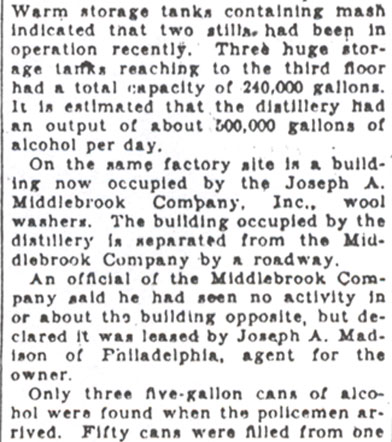
None of the stills was in operation. Warm storage tanks containing mash indicated that two stills had been in operation recently. Three huge storage tanks reaching to the third floor had a total capacity of 240,000 gallons. It is estimated that the distillery had an output of about 500,000 gallons of alcohol per day.
On the same factory site is a building now occupied by the Joseph A. Middlebrook Company, Inc., wool washers. The building occupied by the distillery is separated from the Middlebrook Company by a roadway.
An official of the Middlebrook Company said he had seen no activity in or about the building opposite, but declared it was leased by Joseph A. Madison of Philadelphia, agent for the owner.
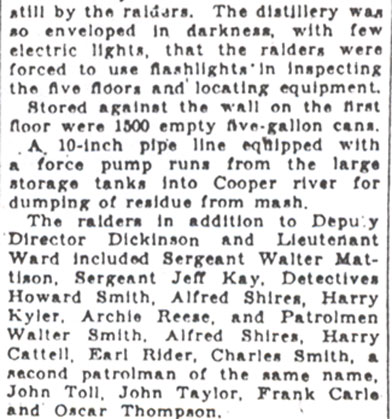
Only three five-gallon cans of alcohol were found when the policemen arrived. Fifty cans were filled from one still by the raiders. The distillery was so enveloped in darkness, with few electric lights, that the raiders were forced to use flashlights in inspecting the five floors and locating equipment.
Stored against the wall on the first floor were 1500 empty five-gallon cans.
A 10-inch pipe line equipped with a force pump runs from the large storage tanks into Cooper river for dumping of residue from mash.
The raiders in addition to Deputy Director Dickinson and Lieutenant Ward included Sergeant Walter Mattison, Sergeant Jeff Kay, Detectives Howard Smith, Alfred Shires, Harry Kyler, Archie Reese, and Patrolmen Walter Smith, Alfred Shires, Harry Cattell, Earl Rider, Charles Smith, a second patrolman of the same name, John Toll, John Taylor, Frank Carle and Oscar Thompson.
Larceny Try Charged to 2 Paroled Boys
Camden Courier-Post —
Two 15-year-old boys on parole from the Camden County Detention Home were held by the police yesterday pending action by Mrs. Grace A. Riggins, superintendent of the home.
They are Fred Powell, 1025 Carpenter Street, and John McCloskey, 33 North Twenty-fifth street, who were arrested on charge of breaking and entering and attempted larceny by Patrolmen Everett Joslin and John Taylor Sunday. The policemen said the boys broke off a section of the roof of a store operated by William L. Rice at Point and Pearl Streets and were about to enter when arrested.
Pancoast Frees Nude Bathers, Scores Those Causing Arrest
Camden Courier-Post —
Boys and Young Men, However, Are Asked to Carry Bathing Suits on Next Visit To Cooper River
Fourteen boys and young men arrested as nude bathers Thursday as the sequel to a city commission meeting, were freed yesterday by Judge Garfield Pancoast with the advice that they wear bathing suits when swimming.
The nude bathers were apprehended in Cooper river in the vicinity of Tenth and Pearl streets after Frank J. Hartmann, Jr., secretary of the New Jersey Congress of Civic Associations and of the North Camden Civic Association, complained at the commission meeting Thursday that shocking conditions exist among the male bathers in the river, causing women in the neighborhood to protest.
With two of the youthful bathers excused because they had to attend the final classes of the term in school, Police Judge Garfield Pancoast suspended sentence on the others at a hearing yesterday after advising them to wear bathing suits when swimming again. The boys had been released in their own recognizance after their arrest late Thursday by John Taylor, a policeman, who was sent to the bathing spot by Acting Chief Golden.
Pancoast Sarcastic
Taylor, under questioning of the court, testified that the nearest house to where the youths swam was a block away, and that while there were boathouses across the creek, he did not know whether they are occupied. The boys themselves testified that no women pass the “swimming hole,” which, they said, is three blocks from State Street and almost two squares from Tenth street.
After Taylor informed the court he did not know who made the complaint to Mayor Stewart, Pancoast said the complainant “is probably the same man who, at the age of these boys, did nothing in the Summer but read the New Testament.”
“He probably is the same man who never went swimming when the temperature went up to 92 degrees,” the court commented, “and is probably the same man who does not know that the cost to the taxpayers for every arrest in the city averages $3.87.”
Appeals to Boys
“I have nothing to say to you boys, but appeal to you to take a bathing suit with you the next time you go swimming, because someone might be passing who does not like to see your nude figure.”
The bathers: Leslie Bayne, 26, of 503 Royden Street; Harvey Howell, 16, of 429 Washington Street; John Grady, 19, of 578 Benson Street; Roscoe Davis, 15, of 253 North Eleventh street; James Evans, 15, of 601 North Second Street; William Dempsey, 12, of 1030 Lawrence Street; Albert MacFarland, 13, of 1112 Federal Street; Roland Garber, 15, of 537 Birch Street; Edgar Grundlock, 14, of 318 North Tenth Street; Frank Garwood, 13, of 717 Bailey Street; Eugene Dodelin, 13, of 309 Cole Street; Ralph Skill, 13, of 512 North Seventh street; Robert Rudd, 15, of 642 Linwood Street, and Richard Evans, 14, of 601 North Second Street.
Rudd and Garwood were the boys excused by Judge Pancoast from appearing in court so they would not lose credit for being absent from school.
Taps Sound for Jack Airedale, Canine Mascot of Fire Laddies
Camden Courier-Post —
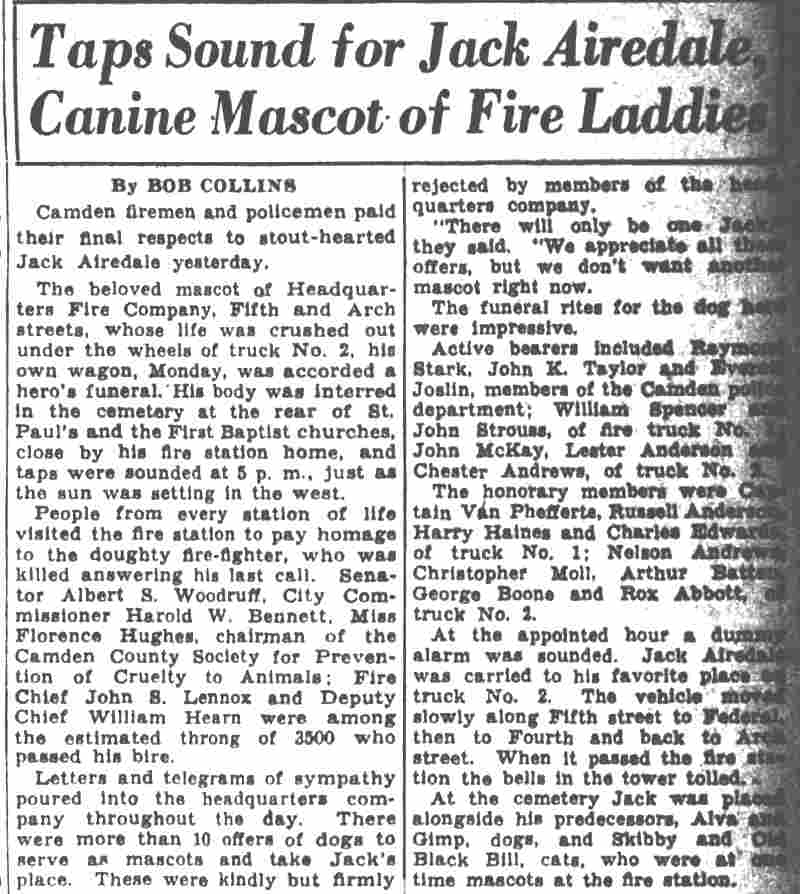
Camden firemen and policemen paid their final respects to stout-hearted Jack Airedale yesterday.
The beloved mascot of Headquarters Fire Company, Fifth and Arch streets, whose life was crushed out under the wheels of truck No. 2, his own wagon, Monday, was accorded a hero’s funeral. His body was interred in the cemetery at the rear of St. Paul’s and the First Baptist churches, close by his fire station home, and taps were sounded at 5 p. m., just as the sun was setting in the west.
People from every station of life visited the fire station to pay homage to the doughty fire-fighter, who was killed answering his last call. Senator Albert S. Woodruff, City Commissioner Harold W. Bennett, Miss Florence Hughes, chairman of the Camden County Society for Prevention of Cruelty to Animals; Fire Chief John S. Lennox and Deputy Chief William Hearn were among the estimated throng of 3500 who passed his bier.
Letters and telegrams of sympathy poured into the headquarters company throughout the day. There were more than 10 offers of dogs to serve as mascots and take Jack’s place. These were kindly but firmly rejected by members of the headquarters company. “There will only be one Jack,” they said. “We appreciate all these offers, but we don’t want another mascot right now.”
The funeral rites for the dog were impressive.
Active bearers included Raymond Stark, John K. Taylor and Everett Joslin, members of the Camden police department; William Spencer and John Strouss, of fire truck No. 1; John McKay, Lester Anderson and Chester Andrews, of truck No. 2.
The honorary members were Captain Van Phefferts, Russell Anderson, Harry Haines and Charles Edwards, of truck No. 1; Nelson Andrews, Christopher Moll, Arthur Batten, George Boone and Rox Abbott, of truck No. 2.
At the appointed hour a dummy alarm was sounded. Jack Airedale was carried to his favorite place on fire truck No. 2. The vehicle moved slowly along Fifth street to Federal, then to Fourth and back to Arch street. When it passed the fire station the bells in the tower tolled.
At the cemetery Jack was placed alongside his predecessors, Alva and Gimp, dogs, and Skibby and Old Black Bill, cats, who were at one time mascots at the fire station.
John H. Taylor and Neighborhood Friends — April 3, 1947
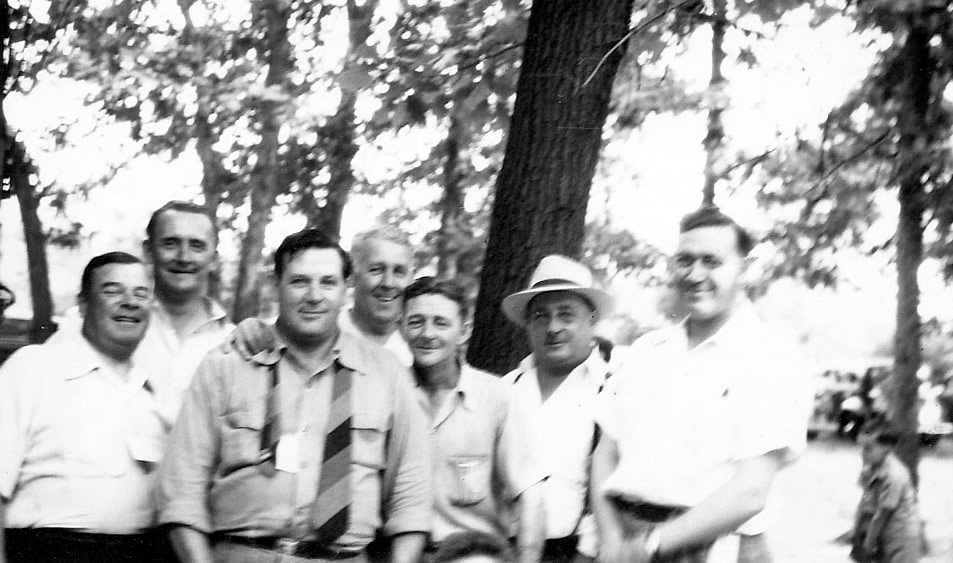
Named: From Left: Unknown, Morris Odell, Francis Vecander (with tie), John Taylor, Unknown, Unknown, and Unknown. The man in the hat might be Sam Bates, from North 27th Street..
Life Hereabouts by Charley Humes
Camden Courier-Post —
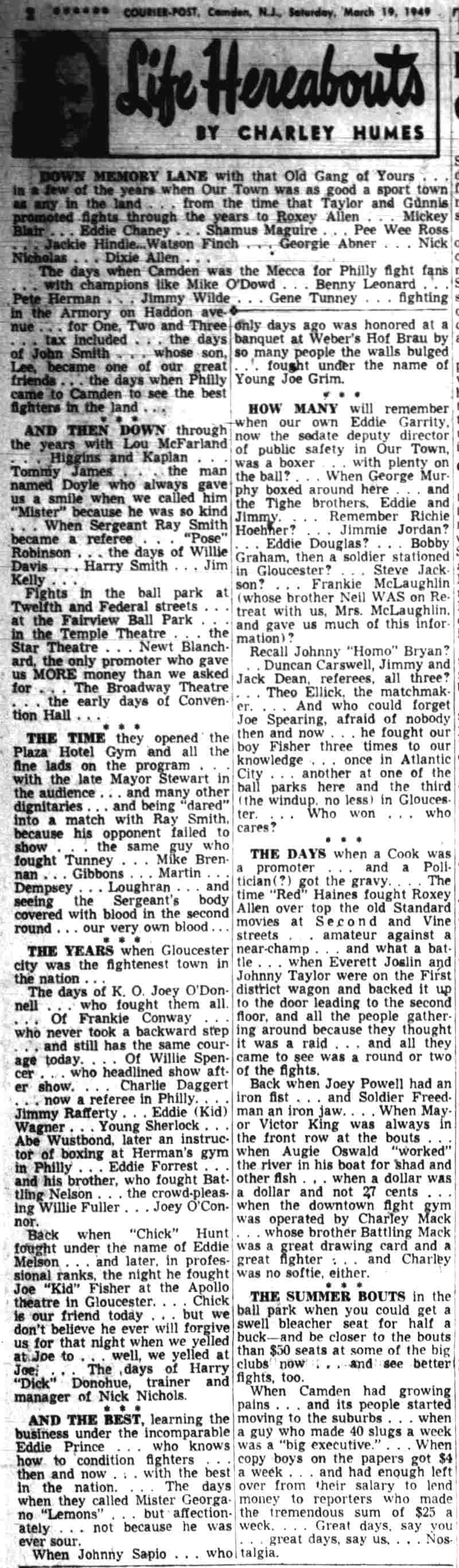
DOWN MEMORY LANE with that Old Gang of Yours is a few of the guys who’ll tell you Tatum was as good as or the best man in the land … from the time that Taylor and Glimits managed Rocky Robinson, … the days of Johnny Allen … Rocky Eddie Chaney … Shamus Maguire … Pee Wee Ross … Jabbering Jackie Hindle … Watson Finch … lots and lots of fun.
The days when Camden was the Mecca for Philly fight fans getting the paper with Rocky Robinson as challenger, Benny Leonard, Pete Herman … Jimmy Wilde … Gene Tunney … fighting in the Arena on all given Wednesday nights.
HOW MANY will remember when our own Eddie Garrity, who now occupies an important post in the city government, was a boxer … with plenty on the ball … boxing out of a big gym around here … fighting at the Thirteenth Ward Republic Club … trying for fame on Louis Street, Whitman Avenue section
THEN AND THEY DOWN the memory lane again when a man named Dopey John and a man named Kaplan … a fighter … and there was a guy boxing around here named Mickey Blair … When Sergeant Ray Smith is Robinson … the days of Willie Robinson … the days of Willie Graham, then a wider stationed right here … the days of Young Jordan … Frankie McLaughlin … Neil McLaughlin … and gave us much of this informational … Joe Spearing did.