Introduction
Euclid Avenue is in the Parkside section of Camden. It runs northeast from Haddon Avenue to Bradley Avenue, then turns north for one block before terminating at Kaighn Avenue. The southeastern side of Euclid Avenue from Haddon Avenue to Ormond Avenue features a tall stone wall that concealed the grounds of the Shrine of the Perpetual Rosary and its attached convent for many years. Although there are only ten dwellings on Euclid that bear addresses, there are two other significant buildings on the avenue, Cooper B. Hatch Junior High School on the western corner of Euclid and Park Boulevard, and the Camden County Historical Society on the eastern corner.
1500 Block of Euclid Avenue — Occupants
City directory records, 1942.
1590 Euclid Avenue
| Year ↕ | Name ↕ |
|---|---|
| 1942 | No information available |
1592 Euclid Avenue
| Year ↕ | Name ↕ |
|---|---|
| 1942 | No information available |
1594 Euclid Avenue
| Year ↕ | Name ↕ |
|---|---|
| 1942 | No information available |
1596 Euclid Avenue
| Year ↕ | Name ↕ |
|---|---|
| 1942 | No information available |
1598 Euclid Avenue
| Year ↕ | Name ↕ |
|---|---|
| 1942 | No information available |
1599 Euclid Avenue
| Year ↕ | Name ↕ |
|---|---|
| 1942 | No information available |
1615 Euclid Avenue
| Year ↕ | Name ↕ |
|---|---|
| 1942 | No information available |
1617 Euclid Avenue
| Year ↕ | Name ↕ |
|---|---|
| 1942 | William Bernard McConnell & Family |
1619 Euclid Avenue
| Year ↕ | Name ↕ |
|---|---|
| 1942 | No information available |
1621 Euclid Avenue
| Year ↕ | Name ↕ |
|---|---|
| 1942 | No information available |
1623 Euclid Avenue
| Year ↕ | Name ↕ |
|---|---|
| 1942 | No information available |
Related: Ramsey F. McConnell — 1617 Euclid Avenue, World War II.
Ramsey F. McConnell
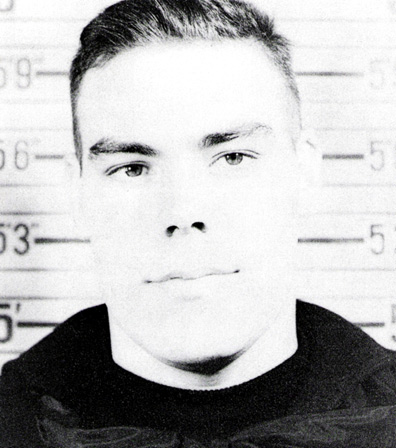
Electrician’s Mate Third Class Ramsey F. McConnell, United States Navy, World War II. Family residence at 1617 Euclid Avenue, Camden.
Walt Whitman Acclaimed as ‘International Prophet’
Camden Courier-Post —
Wescott Recalls Friendship with Poet at Ceremonies Here Marking 120th Anniversary of his birth; Donaldson Tells of Buggy Gift
By Walter B. Batezel
Acknowledged by the world as the poet of democracy, Camden’s own Walt Whitman was acclaimed here yesterday on the 120th anniversary of his birth as the “prophet of a new internationalism.”
This interpretation of Whitman and his famous “Leaves of Grass,” which introduced free verse to the world and the rugged liberty loving character of America so lustily praised in his songs, was offered by Ralph W. Wescott, of Haddonfield.
Wescott was one of three speakers for the Walt Whitman Foundation which is charged with maintenance of the Whitman home at 330 Mickle Street as a literary shrine. Also speaking on Whitman were Thomas B. Donaldson, Philadelphia insurance man, who as a boy knew Whitman, and Mrs. Elizabeth Cady Conover, also of Philadelphia.
The meeting was held at the headquarters of the Camden County Historical Society, Euclid Avenue and Park Boulevard. Wescott, former comptroller of customs of the Port of Philadelphia and son of the late Judge John W. Wescott, who was an intimate friend of Whitman in Camden and who twice nominated Woodrow Wilson for the presidency, based his lauding of Whitman as an “international prophet” upon excerpts from Whitman’s books.
Urged Universal Freedom
“It is the very catholicity of the man which causes us to celebrate his birthday anniversary,” said Wescott. “He has been seen as the precursor of socialism and the completely going anti-socialist.”
“We almost shrink from news abroad, and we are bound to consider what Whitman’s response would have been. In his poem ‘Salutation,’ I think we find in Whitman the prophecy of a new internationalism, a poem in which he asked for universal freedom against slavery, and called for an international brotherhood.”
“It is unique and significant that on this 120th anniversary of Whitman the New York World’s Fair acclaims him by statue and adulation, and in 1876 during the Centennial Exposition in Philadelphia Whitman indited a poem addressed to foreign readers in which he directed their attention to ‘the peculiar glory of the United States’ as something ‘vaster, saner, more splendid in comradeship, knitting closer all nations and humanity.’”
“Whitman himself wrote poets were necessary to fulfillment of a world brotherhood because their work was needed to vitalize the message of statesmen.”
Preached Good Will
“In the British-written preface to Whitman’s ‘Specimen Days in America,’ which he wrote in Camden and Laurel Springs, there occurred the sentence ‘Whitman preached goodwill between common people of all nations.’ In all the things written of him, Whitman said he liked that description best.”
“So, in Whitman’s own words we find the real message, and as expressed in one of his poems, and so which was an obsession with him in his declining days—we instinctively seek a ‘universal, comprehensive solidarity of man.’ There was no braver or more humanistic American writer than Whitman, nor more humanistic statement for the world than his ‘Leaves of Grass.’”
“Boyhood Recollections of Whitman,” by Donaldson, whose father Blaine Donaldson, of Philadelphia, was a benefactor and fast friend of Whitman, regaled the little literary group of 40 which appeared to honor the birthday of the “Good Gray Poet.”
It was Donaldson’s father who, anxious to aid the paralytic poet in reaching the outdoors, wrote to all of America’s most famous writers and asked they subscribe to a fund to purchase a pony and buggy for Whitman.
Great Writers Gave
The contributors to the fund, Donaldson said, included Ralph Waldo Emerson, John Greenleaf Whittier, John Burroughs, Robert W. Ingersoll, Rutherford B. Hayes, General Phil Sheridan and Oliver Wendell Holmes.
“Hayes and Sheridan were frequent visitors to our home,” said Donaldson, “as was Henry Irving, the actor. Sheridan came often to sniff brandy and Whitman met these men there, but Walt came chiefly for mental regalement and food, because my mother was a good cook.”
“I was a lad of eight to eleven years when Whitman made his visits, and no matter who was there Whitman always dominated the room. In fact, he loved my father so much that he requested that my father be a pallbearer for him.”
“My sister and I sat in his lap often, and we liked that because he looked like Santa Claus, and most children were drawn naturally toward him. He was different and comradely. I can pay tribute to Walt’s whiskers because he didn’t chew tobacco, not then anyway, if later.”
“Walt had the eyes of a stage manager and nothing escaped and no matter how distinguished the audience, Whitman was the boss. His favorite pastime at our home was dipping bananas into sherry wine and eating them as though they were lollypops.”
“It was in 1885 that my father decided to get Walt a pony and buggy, and when the outfit was purchased as a gift from America’s greatest writers to Walt. I was commissioned with a guardian to drive it to Camden.”
Pony Was Groggy
“When I got the pony there in the afternoon Whitman came out and said: ‘Bless me,’ and got in right away. Walt then took to the open in later days, but he soon began to complain the pony was ‘groggy and too slow.’ A few days later Walt turned up at home with a three-gaited horse.”
“The horse obviously was too spirited for Whitman’s crippled condition, and when this was drawn to his attention he said, ‘There is no sense in giving me a crippled horse. What does a helpless hulk like me want with another cripple? This horse is lithesome.’”
“I have some mementos from Whitman which I cherish, but most interesting of all was his personality. To know him was better than any souvenir of him, and in the language of today he had ‘umph!’”
“Mrs. Davis, who took him and who loved him as a mother would, caring for his every wish, was a kind, genial soul, and she in fact, supported Whitman while he saved his money for a monument to himself.”
Full of People
“I recall Whitman’s last days, when my father visited him. Father came home and said the house in Camden was full of people hovering over him with pencil and paper to catch his last words, and that few of them had gone down into their jeans to give him a cent.”
“But over all, I think our attitude toward Whitman must be an offering of our mentality, and our tribute is one of admiration and affection.”
Mrs. Conover paid memorial tribute to Dr. Alexander Macalister, former physician to Whitman, who died last November, and who was president of the Walt Whitman Foundation; Mrs. Sarah D. Wolverton, also a member of the foundation, who died last year; Mrs. Alice Walker Griffiths who lived in Camden at the George Whitman home while Walt lived there, and Mrs. Ruth Stafford Goldy, both of whom died last year. It was at the Stafford home in Laurel Springs that Whitman recuperated from his paralytic stroke.
Mrs. Conover said she was not “impressed by recent documents on Whitman” which she generally described as “insolent,” and said “nearness of approach and intimacy are necessary to get to a cosmic soul.”
“The most direct way to Whitman is through ‘Leaves of Grass,’” she said.
She then told of a recent incident on the finding of a first edition of “Leaves of Grass,” owned by “an unappreciative New York bootlegger,” and in which was found a manuscript of one of Whitman’s poems, “A Backward Glane O’re Traveled Road,” and the title of which had been written and changed three times by the poet on the manuscript.
Cites Honors to Poet
Mrs. Conover also called attention to the Sprague collection of Whitmania on exhibit this year in the Library of Congress, dedication of the Whitman statue at the World’s Fair yesterday, and issuance of a postage stamp in his honor.
“Whitman sailed his ship in deep waters,” she said, “and paid no attention to the shallows. He was the world’s greatest optimist, and under these tremulous, troubled and fear-filled times we should follow as Americans his words, ‘My foothold is tenoned and mortised in granite.’”
Mrs. Conover lauded Mrs. Martha Davis, curator of the Whitman house, as “a stout-hearted disciple of Walt Whitman.”
Wescott, in behalf of the Whitman foundation, presented to the Camden County Historical Society a picture of the Walt Whitman home for its archives. The picture was received for the society by Mrs. A. Haines Lippincott.
Mayor Orders Cops to Drive All Gangsters From Camden
Camden Courier-Post —
Stewart Aroused as Bullet Narrowly Misses Small Girl
TWO SHOOTINGS BRING EDICT FOR BIG ROUNDUP
Police Without Clues in Mysterious Affrays Here Yesterday
Aroused because a bullet fired in a gang shooting at Ninth and Chestnut streets yesterday almost struck an 8-year-old girl, Mayor Stewart today launched a drive to rid the city of gangsters and gunmen.
Voicing the fear that innocent bystanders may fall victim to gangdom’s guns, the mayor declared he would have all lawless characters put behind bars or driven from the city.
To effect that purpose, he issued instructions to Lieut. George Frost to order every patrolman to stop all suspicious-looking characters. If, upon questioning, those suspects cannot prove legitimate quests, they will be jailed.
Issues Statement
His statement follows:
“There was another gang shooting in the city of Camden yesterday. While no one was killed or injured, an 8-year-old girl was very nearly struck by one of the bullets.
“These gunmen have respect neither for the law nor the personal safety of the public. They fight out their private feuds on our public thoroughfares, endangering the lives of law-abiding citizens. Unless some preventative is found, there may come a time when an innocent bystander falls victim to gang bullets.
“Those lawless characters must be educated to realize that they cannot carry on their activities in Camden. They must either be put behind bars or exiled from the city.
“Therefore, to that end I have issued orders through Lieut. Frost to every policeman on the force to the effect that all suspicious characters seen in the city be stopped and questioned. If satisfactory credentials are not produced, and the suspect cannot prove that he has a legitimate right on the streets, then he will be arrested. Those orders are in effect today.”
Meanwhile, police are without a single clue to either yesterday afternoon’s affair or a shooting reported early yesterday morning. Detective Captain John Golden expressed doubt that the shooting at Ninth and Chestnut street was provoked by any gang feud. Rather he believes it was the outcome of a quarrel between two men, as the assailant fired a revolver at close range and missed. Capt. Golden declared that gangsters usually use shotguns or machine-guns. However, other police officials attributed the affray to gang warfare.
One of six bullets fired at the intended victim of yesterday’s shooting narrowly missed striking eight-year-old Regina Boskowska, of 824 Chestnut street, as she sat on a front step near the intersection.
No Clues Obtained
No clues have been obtained to the identity of the assailants in either case nor the intended victim of yesterday’s gunfire.
The would-be slayers escaped yesterday from an Oaklyn motorist and the unknown man on the spot eluded Policeman William Stevenson after a 10-minute chase.
Both cars figuring in yesterday afternoon’s shooting bore Pennsylvania licenses.
The intended victim driving east on Chestnut street, stopped his blue sedan at the intersection when the traffic light turned red.
Raymond Scherneck, of 307 Laurel avenue, Oaklyn, stopped his care [sic] behind the sedan.
“While we were waiting, I saw a gray Ford coupe with Pennsylvania tags,” stated Scherneck. “It pulled up on my left, passed me and slowed down as it drew abreast of the Pennsylvania car ahead of me. The coupe had two men in it, and the man on the right side leaned out. He was bare-headed, and as he put his hand out the window, I saw him holding a blue pistol.
“He fired six times. The fellow in the other car threw himself down toward the floor. The coupe continued to go east, passing the red light. I went after the coupe, but I lost track of it near Chestnut street and Mt. Ephraim avenue.”
Assailant Escapes
Patrolman Stevenson said he was walking on Chestnut between Eighth and Ninth street when he saw a man put his hand out the window of a coupe and start firing. The officer ran to the intersection, but both the coupe and the sedan had gone on, the sedan turning south into Ninth street. Then he ran to Eighth and Sycamore streets, where his car was parked. He drove to Ninth and Chestnut, and saw Thomas Ward, 820 Chestnut street. Ward pointed to a sedan which had stopped on Ninth street, and said it was the sedan at which the assailants had fired. As Stevenson drove toward it, the sedan started up. He pursued it on Ninth to Mechanic, through Mechanic to Haddon avenue and out Haddon avenue to Euclid, where the sedan, a faster car than Stevenson’s, pulled away and escaped.
Ward was sitting on his front steps and saw the shooting. He said the Boskowska girl was sitting on the steps next door, and that a bullet struck the steps near her. The girl, who had run home crying, told police she heard something hit the steps near her.
Two bullets entered the wall of the saloon operated by John Bretschneider, 880 Chestnut street.
A short time after the shooting police arrived in bandit chasers. Armed with revolvers and shotguns, the police scoured the neighborhood but could not find the assailants. Major Charles V. Dickinson led the investigation.
Cemetery Cave Raided by City’s Notebook Cop
Camden Courier-Post —
Author Patrolman Reads Thrilling Narrative of Capture
MAN AND ‘VISITOR’ FOUND ASLEEP
Third Prisoner Nabbed by Second Policeman; All Get Jail
In the rear of Harleigh Cemetery, Haddon and Euclid avenues, there is a cave, which today is uninhabited.
And if Camden policemen—John V. Wilkie, famed as the “notebook cop,” in particular, have their say, it will stay unoccupied.
For, today, Wilkie added another “one for the book,” in which he has recorded his activities since he became a member of the force four short weeks ago.
Wilkie, first plain rookie-policeman, then author-policeman, then sleuth and samaritan combined, now has turned explorer and discoverer, it would appear. For it was Policeman Wilkie who found the cave.
With the capture by him of two of its occupants and the lodging of them and another man arrested by Policeman Joseph Ward in jail, the story of this dugout may be told today.
But this story had its beginning many, many months ago. Wilkie—referring occasionally to his little red notebook, became its narrator this morning. Ward proved Wilkie’s collaborator.
Audience Attentive
Their listeners were Police Judge Bernard Bertman, three prisoners who already knew quite a little of the story and a score of court hangers-on.
Policeman Wilkie read from the book:
“For months, the police have received complaints that persons were destroying headstone markers and trampling over graves in Harleigh Cemetery.”
The officer then related how he had searched the grounds, and finally about to give up, just before dusk, discovered the opening to the cave in a plot at the rear of the cemetery.
“It was large enough for a man to crawl into it, on his hands and knees. Inside, apparently asleep, but from closer observation, decidedly intoxicated, were two men. They are here in court today.”
And with that, Wilkie pointed a finger at his two prisoners. They gave their names as John Helm, 40 years old, and James Callahan, 45 years old. Helm said he had no home. Callahan said he lived at Ninth and Spruce and was “just visiting Helm.”
Asked if they had built the cave behind the cemetery grounds, the men replied in the negative. They said they knew nothing about the place and disclaimed ownership of the four gallons of alcohol which Wilkie said he found inside the dugout.
The “notebook cop” testified he understood his prisoners had been in the habit of siphoning alcohol from automobile radiators, and then storing it away as “stock on hand” for future drinking bouts. This, too, the men denied.
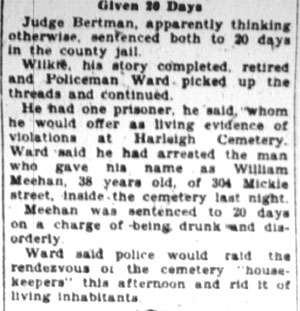
Given 20 Days
Judge Bertman, apparently thinking otherwise, sentenced both to 20 days in the county jail.
Wilkie, his story completed, retired and Policeman Ward picked up the threads and continued.
He had one prisoner, he said, whom he would offer as living evidence of violations at Harleigh Cemetery. Ward said he had arrested the man who gave his name as William Meehan, 38 years old, of 304 Mickle street, inside the cemetery last night.
Meehan was sentenced to 20 days on a charge of being drunk and disorderly.
Ward said police would raid the rendezvous of the cemetery “housekeepers” this afternoon and rid it of living inhabitants.