Frank C. Carle
FRANK C. CARLE appears to have been born in Bridgeton NJ around 1878 to William and Lizzie Carle. In 1921 he became a member of the Camden Police Department. At the time of the 1930 Census, he made his home at the corner of 339 North Eighth, the corner of North Eighth and Linden Streets. His mother, brother William, and sister Elizabeth lived around the corner, at 728 Linden Street, Elizabeth being the wife of James J. Daly, who owned and operated Daly’s Cafe at 800 Linden Street. Another sister, Mrs. Mary Kelley, lived at 333 North Eighth, and two other sisters, Mrs. Rose Martin and Mrs. Clara Bennett, lived in the area. The 1930 census states that Frank Carle was living with his wife Lillian, a nephew, Clarence Barnes, and also rented rooms to two boarders.
Frank C. Carle served as a member of the Camden Police Department until stricken by a paralyzing disease (a stroke, polio or ALS) on October 15, 1940. He applied for his disability pension on November 30, after 19 years and three months on the force. Officer Carle passed away on December 3, 1940. He was buried at Calvary Cemetery in what was then Delaware Township (present day Cherry Hill) NJ. He was survived by his widow, Mrs. Hannah Carle, his mother, brother, and sisters.
Birthday Party for Anson Kelly
Camden Daily Courier —
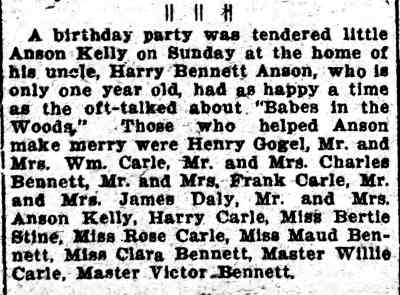
A birthday party was tendered little Anson Kelly on Sunday at the home of his uncle, Harry Bennett Anson, who is only one year old, had as happy a time as the oft-talked about “Babes in the Woods.” Those who helped Anson make merry were Henry Gogel, Mr. and Mrs. Wm. Carle, Mr. and Mrs. Charles Bennett, Mr. and Mrs. Frank Carle, Mr. and Mrs. James Daly, Mr. and Mrs. Anson Kelly, Harry Carle, Miss Bertie Stine, Miss Rose Carle, Miss Maud Bennett, Miss Clara Bennett, Master Willie Carle, Master Victor Bennett.
Camden to Improve 2 City Departments
Philadelphia Inquirer —
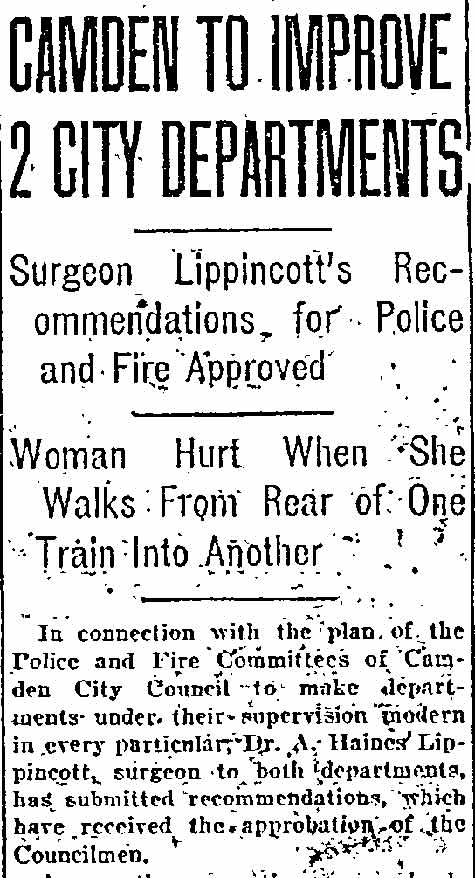
Surgeon Lippincott’s Recommendations for Police and Fire Approved
In connection with the plan of the Police and Fire Committees of Camden City Council to make departments under their supervision modern in every particular, Dr. A. Haines Lippincott, surgeon to both departments, has submitted recommendations, which have received the approbation of the Councilmen.
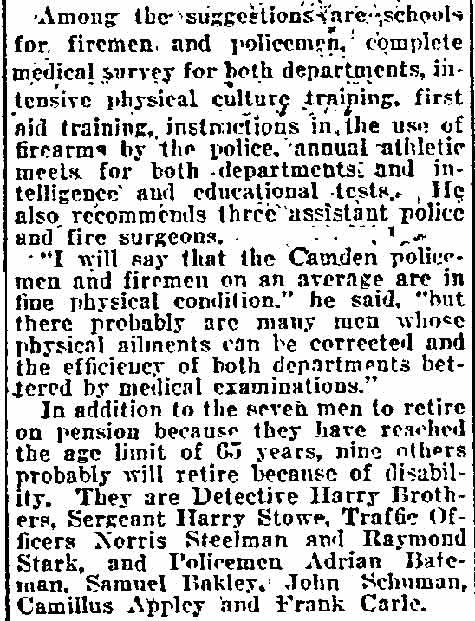
Among the suggestions are schools for firemen and policemen, complete medical survey for both departments, intensive physical culture training, first aid training, instructions in the use of firearms by the police, annual athletic meets for both departments and intelligence and educational tests. He also recommends three assistant police and fire surgeons.
“I will say that the Camden policemen and firemen on an average are in fine physical condition,” he said, “but there probably are many men whose physical ailments can be corrected and the efficiency of both departments bettered by medical examinations.”
In addition to the seven men to retire on pension because they have reached the age limit of 65 years, nine others probably will retire because of disability. They are Detective Harry Brothers, Sergeant Harry Stowe, Traffic Officers Norris Steelman and Raymond Stark, and Policemen Adrian Bateman, Samuel Bakley, John Schuman, Camillus Appley and Frank Carle.
Broken Bottle Maims Officers Quelling Fight
Camden Courier-Post —
Hurlock Severs Artery in Thrilling Battle to Subdue Men Engaged in Raid in East Camden
Five Under Arrest Awaiting Hearing
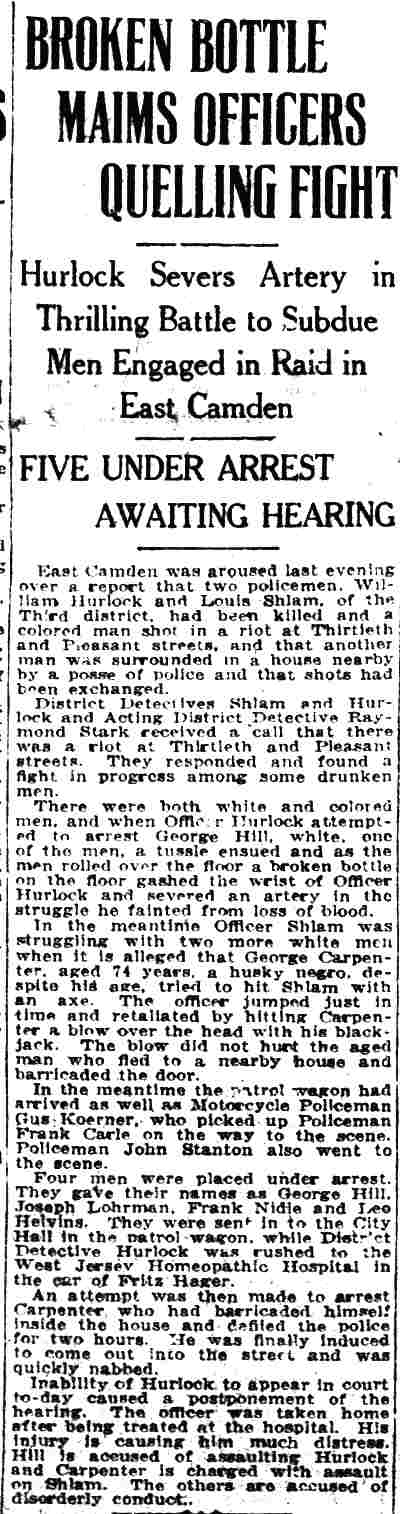
East Camden was aroused last evening over a report that two policemen, William Hurlock and Louis Shlam, of the Third district, had been killed and a colored man shot in a riot at Thirtieth and Pleasant streets, and that another man was surrounded in a house nearby by a posse of police and that shots had been exchanged.
District Detectives Shlam and Hurlock and Acting District Detective Raymond Stark received a call that there was a riot at Thirtieth and Pleasant streets. They responded and found a fight in progress among some drunken men.
There were both white and colored men, and when Officer Hurlock attempted to arrest George Hill, white, one of the men, a tussle ensued and as the men rolled over the floor a broken bottle on the floor gashed the wrist of Officer Hurlock and severed an artery in the struggle he fainted from loss of blood.
In the meantime Officer Shlam was struggling with two more white men when it is alleged that George Carpenter, aged 74 years, a husky negro, despite his age, tried to hit Shlam with an axe. The officer jumped just in time and retaliated by hitting Carpenter a blow over the head with his blackjack. The blow did not hurt the aged man who fled to a nearby house and barricaded the door.
In the meantime the patrol wagon had arrived as well as Motorcycle Policeman Gus Koerner, who picked up Policeman Frank Carle on the way to the scene. Policeman John Stanton also went to the scene.
Four men were placed under arrest. They gave their names as George Hill, Joseph Lohrman, Frank Nidle and Leo Helvins. They were sent in to the City Hall in the patrol wagon, while District Detective Hurlock was rushed to the West Jersey Homeopathic Hospital in the car of Fritz Heger.
An attempt was then made to arrest Carpenter, who had barricaded himself inside the house and defied the police for two hours. He was finally induced to come out into the street and was quickly nabbed.
Inability of Hurlock to appear in court to-day caused a postponement of the hearing. The officer was taken home after being treated at the hospital. His injury is causing him much distress. Hill is accused of assaulting Hurlock and Carpenter is charged with assault on Shlam. The others are accused of disorderly conduct.
Probe Started by Dickinson in Raid ‘Leak’
Camden Evening Courier —
Men Fled $250,000 Still Before Cops Arrived, Deputy Learns
Baldwin Gave Clue to Giant Plant
Vast Amount of Rum Supplies Seized in North Camden
Major Charles V. Dickinson, deputy director of public safety, today started an investigation to ascertain how plans for a raid on a $250,000 North Camden distilling plant leaked out more than an hour before the raid was made late yesterday afternoon.
The inquiry to locate the “leak” was prompted by rumors that neighbors saw employes of the distillery running from the plant at Ninth and State streets an hour and 20 minutes before detectives and the police raided it. Major Dickinson, however, insists he and Lieut. George Ward were the only persons in the police department who knew the location of the plant prior to the raid.
Police believe the distillery to be one of a chain of such places operated throughout this state with headquarters in Newark.
The raid was the result of an investigation made by Prosecutor Clifford A. Baldwin after he had heard rumors a large distilling plant was being operated in North Camden. Baldwin assigned Lawrence T. Doran, chief of county detectives, and other county detectives, to make a survey, and men were stationed near the plant.
Baldwin Orders Raid
When Chief Doran reported the results of the survey to Baldwin the prosecutor immediately notified Major Dickinson and ordered him to make the raid. Dickinson called in Lieutenant Ward and plans were made for descending on the plant.
A squad of detectives and patrolmen, led by Dickinson, raided the plant a few minutes before 4 p.m. It was the third raid on the plant within two years, Lieutenant Ward having seized a 1500-gallon still there on March 25, 1929, and federal prohibition agents confiscating $100,000 worth of alcohol distilling equipment about 18 months ago.
“If there was a leak, and if the employes and operators were tipped off, I would like to know how it happened,” Major Dickinson said today. “As soon as I heard of this distilling plant I called Lieutenant Ward into my office and we made arrangements and completed plans to raid the place immediately. The plans, however, were not completed until 3 p.m. about an hour after I was notified of the existence of the plant.”
“All arrangements were made by telephone and there could not have been anyone, to my knowledge, who knew the plans. Detectives and patrolmen were told to assemble at the First District police station. They were not told where they were going or what for. Ward and myself were the only ones in the police department who knew the location of the plant.”
Alcohol Seized
The raiders seized 915 gallons of alcohol in 53 five-gallon cans and 12 50-gallon drums, 1500 pounds of brown sugar, 400,000 gallons of mash, 12 bags of white powder and one bale of hops.
Five steel tanks, each of 80,000 gallons capacity, two stills of 50,000 gallons capacity each, one 3000-gallon still, several large wooden tanks, thousands of feet of piping and coiling equipment were found in the plant. The steel tanks had been built in, a section of one floor having been removed to make room. The plant was located on four floors, the fermentation tanks being on the top floors and pipes arranged so that the products could be “worked down” to the first floor tanks where the alcohol was put in five-gallon cans for shipping.
Baldwin called the plant the largest illicit distillery in the United States and said he believed it to be operated by a big liquor ring. He believed it took several months to install the extensive equipment, which was new. An elaborate system of signal alarms, secret telephones, tunnels for hurried exits and arrangements for lookouts two blocks from the plant were found.
All of the equipment, as well as supplies for the plant, were taken there by boat, Baldwin believes. Arrangements had been made for emptying the mash into Cooper River. The entire plant was surrounded by a high fence.
Plant in Use 10 Days
Dickinson said he believed the plant had been in operation not more than 10 days as the valves, turnhandles, spigots and brass work showed little signs of wear. Preparations had been made against a possible raid. Dickinson learned after visiting the plant, as the names on shipping labels had been torn so they were not readable. Tar paper had been placed over the window. Names had been removed from the lunch boxes of workmen.
Large packing boxes such as used for the shipment of radio and phonograph sets were used to hide the machinery and also for shipping the cans of alcohol.
The stills and steel tanks were dismantled by acetylene torches, the mash and chemicals were dumped in Cooper river and the alcohol was taken to city hall. The alcohol probably will be turned over to hospitals and charitable institutions.
Lessors Sought
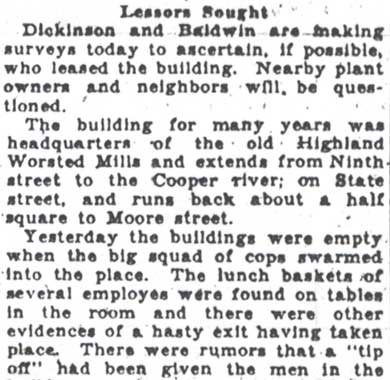
Dickinson and Baldwin are making surveys today to ascertain, if possible, who leased the building. Nearby plant owners and neighbors will be questioned.
The building for many years was headquarters of the old Highland Worsted Mills and extends from Ninth street to the Cooper river; on State street, and runs back about a half square to Moore street.
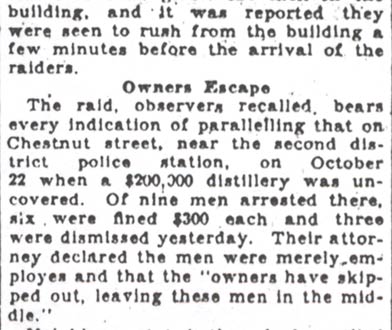
Yesterday the buildings were empty when the big squad of cops swarmed into the place. The lunch baskets of several employes were found on tables in the room and there were other evidences of a hasty exit having taken place. There were rumors that a “tip off” had been given the men in the building, and it was reported they were seen to rush from the building a few minutes before the arrival of the raiders.
Owners Escape
The raid, observers recalled, bears every indication of paralleling that on Chestnut street, near the second district police station, on October 22 when a $200,000 distillery was uncovered. Of nine men arrested there, six were fined $300 each and three were dismissed yesterday. Their attorney declared the men were merely employes and that the “owners have skipped out, leaving these men in the middle.”
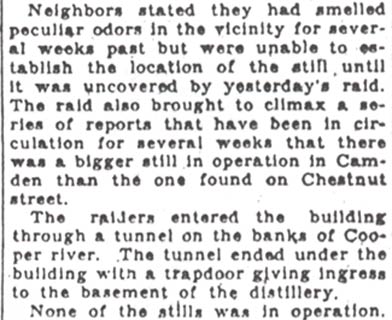
Neighbors stated they had smelled peculiar odors in the vicinity for several weeks past but were unable to establish the location of the still until it was uncovered by yesterday’s raid. The raid also brought to climax a series of reports that have been in circulation for several weeks that there was a bigger still in operation in Camden than the one found on Chestnut street.
The raiders entered the building through a tunnel on the banks of Cooper river. The tunnel ended under the building with a trapdoor giving ingress to the basement of the distillery.
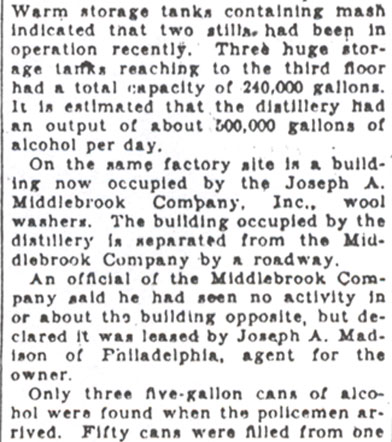
None of the stills was in operation. Warm storage tanks containing mash indicated that two stills had been in operation recently. Three huge storage tanks reaching to the third floor had a total capacity of 240,000 gallons. It is estimated that the distillery had an output of about 500,000 gallons of alcohol per day.
On the same factory site is a building now occupied by the Joseph A. Middlebrook Company, Inc., wool washers. The building occupied by the distillery is separated from the Middlebrook Company by a roadway.
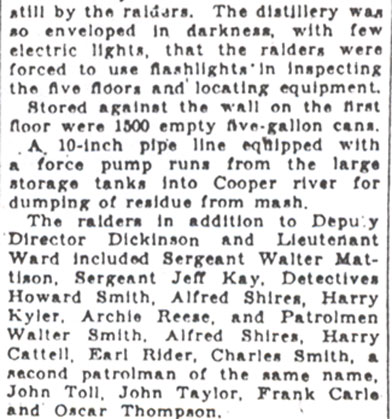
Only three five-gallon cans of alcohol were found when the policemen arrived. Fifty cans were filled from one still by the raiders. The distillery was so enveloped in darkness, with few electric lights, that the raiders were forced to use flashlights in inspecting the five floors and locating equipment.
Stored against the wall on the first floor were 1500 empty five-gallon cans. A 10-inch pipe line equipped with a force pump runs from the large storage tanks into Cooper river for dumping of residue from mash.
The raiders in addition to Deputy Director Dickinson and Lieutenant Ward included Sergeant Walter Mattison, Sergeant Jeff Kay, Detectives Howard Smith, Alfred Shires, Harry Kyler, Archie Reese, and Patrolmen Walter Smith, Alfred Shires, Harry Cattell, Earl Rider, Charles Smith, a second patrolman of the same name, John Toll, John Taylor, Frank Carle and Oscar Thompson.
Harry Carle
Camden Courier-Post —
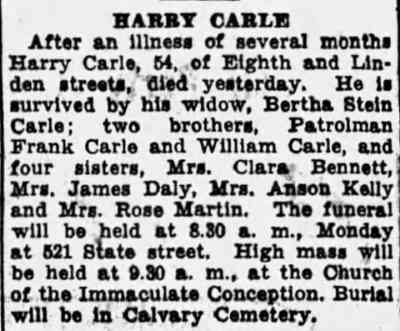
After an illness of several months Harry Carle, 54, of Eighth and Linden streets, died yesterday. He is survived by his widow, Bertha Stein Carle; two brothers, Patrolman Frank Carle and William Carle, and four sisters, Mrs. Clara Bennett, Mrs. James Daly, Mrs. Anson Kelly and Mrs. Rose Martin. The funeral will be held at 8:30 a.m. Monday at 521 State street. High mass will be held at 9:30 a.m. at the Church of the Immaculate Conception. Burial will be in Calvary Cemetery.
Patrolman Carle Dies of Paralysis
Camden Courier-Post —
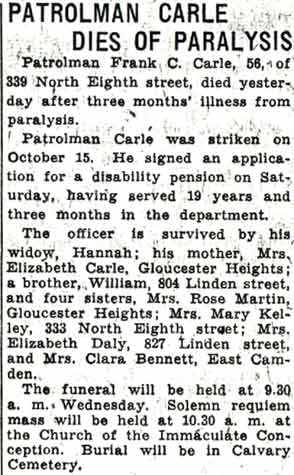
Patrolman Frank C. Carle, 56, of 339 North Eighth street, died yesterday after three months’ illness from paralysis.
Patrolman Carle was stricken on October 15. He signed an application for a disability pension on Saturday, having served 19 years and three months in the department.
The officer is survived by his widow, Hannah; his mother, Mrs. Elizabeth Carle, Gloucester Heights; a brother, William, 804 Linden street, and four sisters, Mrs. Rose Martin, Gloucester Heights; Mrs. Mary Kelley, 333 North Eighth street; Mrs. Elizabeth Daly, 827 Linden street, and Mrs. Clara Bennett, East Camden.
The funeral will be held at 9:30 a.m. Wednesday. Solemn requiem mass will be held at 10:30 a.m. at the Church of the Immaculate Conception. Burial will be in Calvary Cemetery.