Introduction
Another plant that employed many people in North Camden, the history of Highland Worsted Mills dates back to the time of the Civil War. The building of the Camden Woolen Mill started in September 1863, and the plant was completed and in full operation by January 1865. It was operated until March 18, 1893, when it was placed in the hands of J. Willard Morgan as Receiver.
In 1884 the Highland Worsted Mills were erected within the Camden Woolen Mills grounds; and in 1896 the buildings of the old Camden Woolen Mills were also occupied by the Highland Mills. The Highland Worsted Mills operated under that name through at least 1915.
By 1924 a wool combing firm, Joseph A. Middlebrook Inc., occupied the site. The Middlebrook firm was there through at least 1947, when it and the Norr-Bridge Yarn Company are listed in the City Directory as occupants of the site. The old mill was still in use at the outbreak of the Korean War, but was vacant shortly afterwards. The mill stood vacant through the 1950s into the 1960s before falling victim to fire and demolition.
During Prohibition, the old Highland Mill was also used for other purposes. A December 1930 raid disclosed that one of the buildings had been converted into a distillery for the manufacture of bootleg liquor, with an estimated output of 500,000 gallons per day. Newspapers accounts valued the still at $250,000.
The site was redeveloped late in the 20th century, when new townhouses were built.
1915 Advertisement
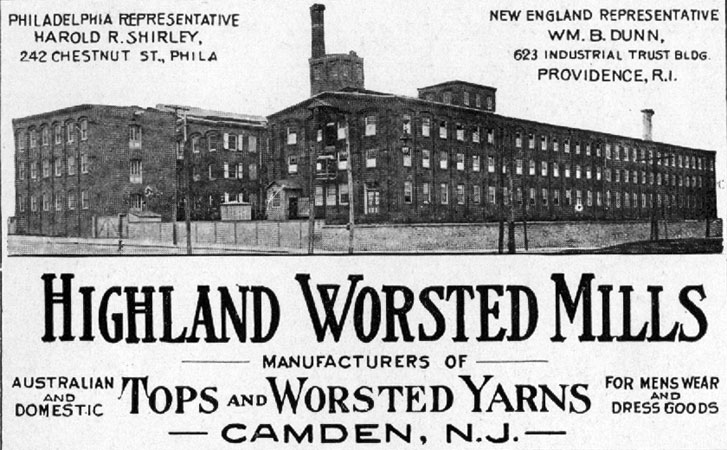
1915 advertisement for the Highland Worsted Mills.
Giant Distillery Falls in North Camden
Camden Morning Post —
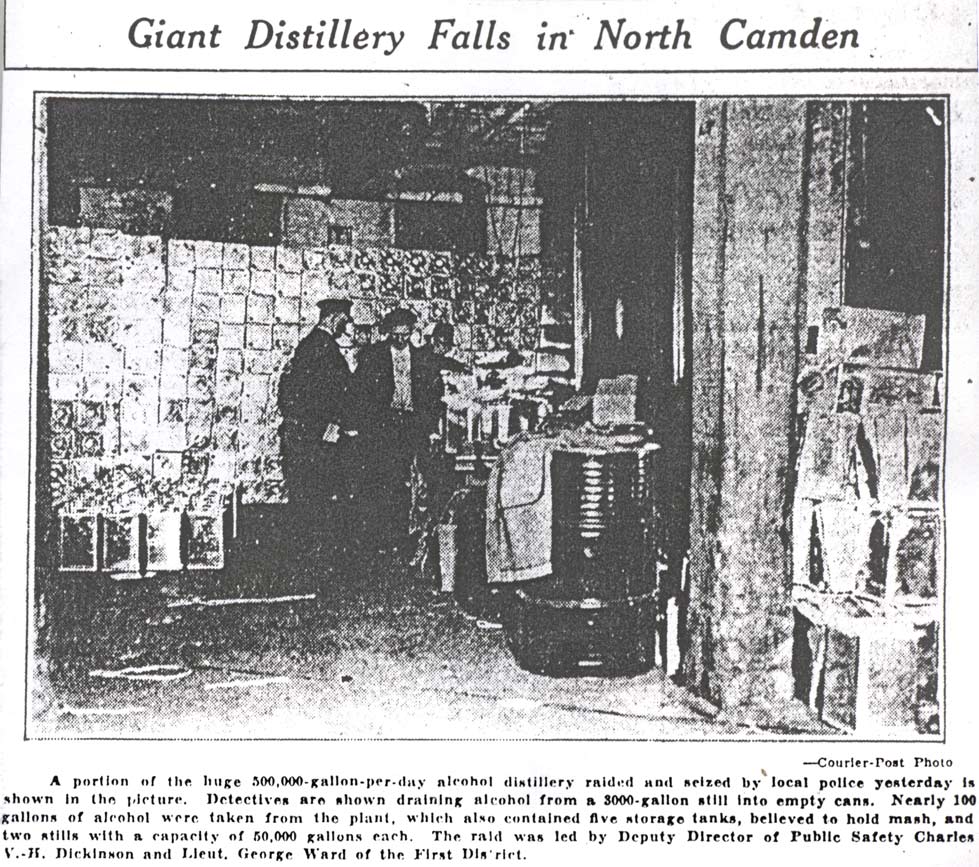
A portion of the huge 500,000-gallon-per-day alcohol distillery raided and seized by local police is shown in the picture. Detectives are shown draining alcohol from a 3000-gallon still into empty cans. Nearly 100 gallons of alcohol were taken from the plant, which also contained five storage tanks, believed to hold mash, and two stills with a capacity of 50,000 gallons each. The raid was led by Deputy Director of Public Safety Charles V.H. Dickinson and Lieut. George Ward of the First District.
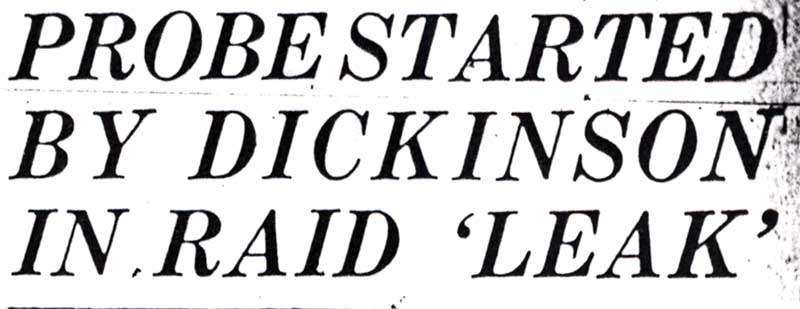
Probe Started by Dickinson in Raid ‘Leak’
Camden Evening Courier —
Men Fled $250,000 Still Before Cops Arrived, Deputy Learns
Baldwin Gave Clue to Giant Plant
Vast Amount of Rum Supplies Seized in North Camden
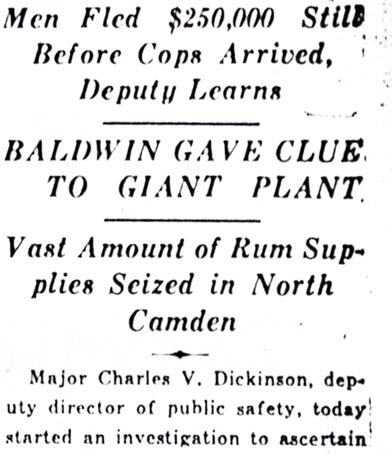
Major Charles V. Dickinson, deputy director of public safety, today started an investigation to ascertain how plans for a raid on a $250,000 North Camden distilling plant leaked out more than an hour before the raid was made late yesterday afternoon.
The inquiry to locate the “leak” was prompted by rumors that neighbors saw employes of the distillery running from the plant at Ninth and State streets an hour and 20 minutes before detectives and the police raided it. Major Dickinson, however, insists he and Lieut. George Ward were the only persons in the police department who knew the location of the plant prior to the raid.
Police believe the distillery to be one of a chain of such places operated throughout this state with headquarters in Newark.
The raid was the result of an investigation made by Prosecutor Clifford A. Baldwin after he had heard rumors a large distilling plant was being operated in North Camden. Baldwin assigned Lawrence T. Doran, chief of county detectives, and other county detectives, to make a survey, and men were stationed near the plant.
Baldwin Orders Raid
When Chief Doran reported the results of the survey to Baldwin the prosecutor immediately notified Major Dickinson and ordered him to make the raid. Dickinson called in Lieutenant Ward and plans were made for descending on the plant.
A squad of detectives and patrolmen, led by Dickinson, raided the plant a few minutes before 4 p.m. It was the third raid on the plant within two years, Lieutenant Ward having seized a 1500-gallon still there on March 25, 1929, and federal prohibition agents confiscating $100,000 worth of alcohol distilling equipment about 18 months ago.
“If there was a leak, and if the employes and operators were tipped off, I would like to know how it happened,” Major Dickinson said today. “As soon as I heard of this distilling plant I called Lieutenant Ward into my office and we made arrangements and completed plans to raid the place immediately. The plans, however, were not completed until 3 p.m. about an hour after I was notified of the existence of the plant.”
“All arrangements were made by telephone and there could not have been anyone, to my knowledge, who knew the plans. Detectives and patrolmen were told to assemble at the First District police station. They were not told where they were going or what for. Ward and myself were the only ones in the police department who knew the location of the plant.”
Alcohol Seized
The raiders seized 915 gallons of alcohol in 53 five-gallon cans and 12 50-gallon drums, 1500 pounds of brown sugar, 400,000 gallons of mash, 12 bags of white powder and one bale of hops.
Five steel tanks, each of 80,000 gallons capacity, two stills of 50,000 gallons capacity each, one 3000-gallon still, several large wooden tanks, thousands of feet of piping and coiling equipment were found in the plant. The steel tanks had been built in, a section of one floor having been removed to make room. The plant was located on four floors, the fermentation tanks being on the top floors and pipes arranged so that the products could be “worked down” to the first floor tanks where the alcohol was put in five-gallon cans for shipping.
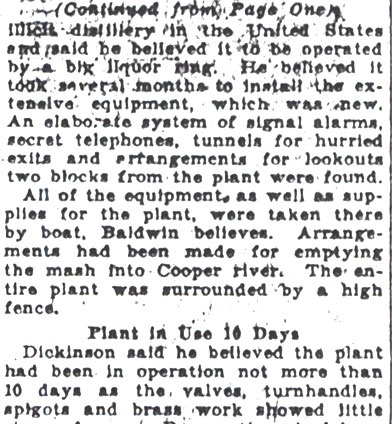
Baldwin called the plant the largest illicit distillery in the United States and said he believed it to be operated by a big liquor ring. He believed it took several months to install the extensive equipment, which was new. An elaborate system of signal alarms, secret telephones, tunnels for hurried exits and arrangements for lookouts two blocks from the plant were found.
All of the equipment, as well as supplies for the plant, were taken there by boat, Baldwin believes. Arrangements had been made for emptying the mash into Cooper River. The entire plant was surrounded by a high fence.
Plant in Use 10 Days
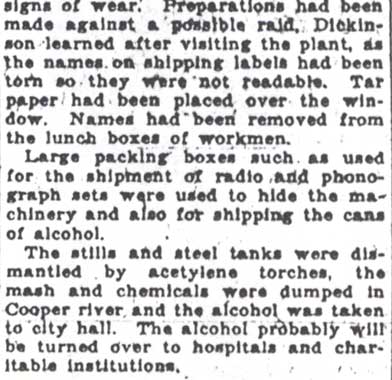
Dickinson said he believed the plant had been in operation not more than 10 days as the valves, turnhandles, spigots and brass work showed little signs of wear. Preparations had been made against a possible raid. Dickinson learned after visiting the plant, as the names on shipping labels had been torn so they were not readable. Tar paper had been placed over the window. Names had been removed from the lunch boxes of workmen.
Large packing boxes such as used for the shipment of radio and phonograph sets were used to hide the machinery and also for shipping the cans of alcohol.
The stills and steel tanks were dismantled by acetylene torches, the mash and chemicals were dumped in Cooper river and the alcohol was taken to city hall. The alcohol probably will be turned over to hospitals and charitable institutions.
Lessors Sought
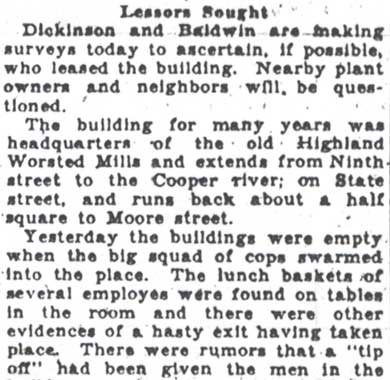
Dickinson and Baldwin are making surveys today to ascertain, if possible, who leased the building. Nearby plant owners and neighbors will be questioned.
The building for many years was headquarters of the old Highland Worsted Mills and extends from Ninth street to the Cooper river; on State street, and runs back about a half square to Moore street.
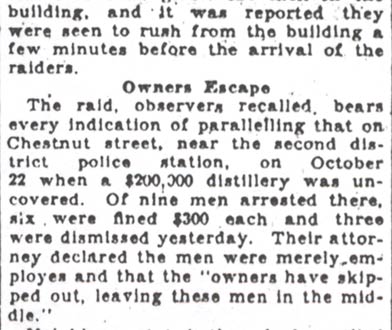
Yesterday the buildings were empty when the big squad of cops swarmed into the place. The lunch baskets of several employes were found on tables in the room and there were other evidences of a hasty exit having taken place. There were rumors that a “tip off” had been given the men in the building, and it was reported they were seen to rush from the building a few minutes before the arrival of the raiders.
Owners Escape
The raid, observers recalled, bears every indication of paralleling that on Chestnut street, near the second district police station, on October 22 when a $200,000 distillery was uncovered. Of nine men arrested there, six were fined $300 each and three were dismissed yesterday. Their attorney declared the men were merely employes and that the “owners have skipped out, leaving these men in the middle.”
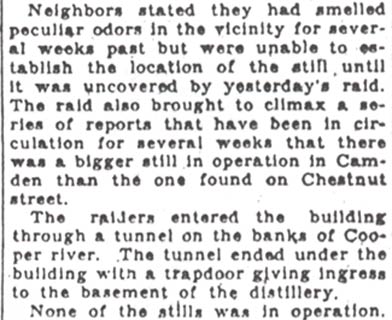
Neighbors stated they had smelled peculiar odors in the vicinity for several weeks past but were unable to establish the location of the still until it was uncovered by yesterday’s raid. The raid also brought to climax a series of reports that have been in circulation for several weeks that there was a bigger still in operation in Camden than the one found on Chestnut street.
The raiders entered the building through a tunnel on the banks of Cooper river. The tunnel ended under the building with a trapdoor giving ingress to the basement of the distillery.
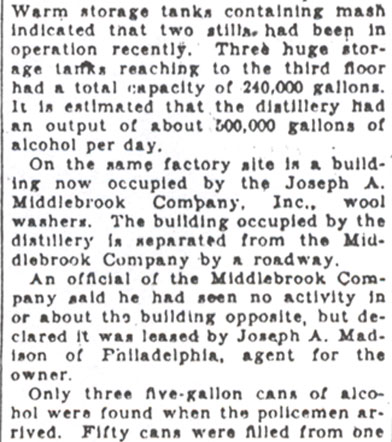
None of the stills was in operation. Warm storage tanks containing mash indicated that two stills had been in operation recently. Three huge storage tanks reaching to the third floor had a total capacity of 240,000 gallons. It is estimated that the distillery had an output of about 500,000 gallons of alcohol per day.
On the same factory site is a building now occupied by the Joseph A. Middlebrook Company, Inc., wool washers. The building occupied by the distillery is separated from the Middlebrook Company by a roadway.
An official of the Middlebrook Company said he had seen no activity in or about the building opposite, but declared it was leased by Joseph A. Madison of Philadelphia, agent for the owner.
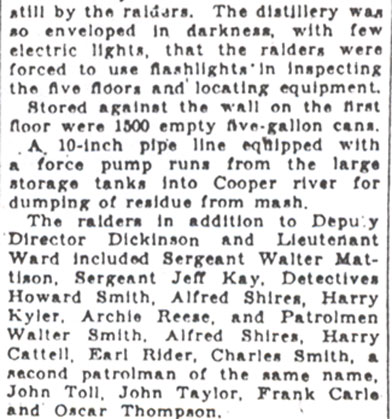
Only three five-gallon cans of alcohol were found when the policemen arrived. Fifty cans were filled from one still by the raiders. The distillery was so enveloped in darkness, with few electric lights, that the raiders were forced to use flashlights in inspecting the five floors and locating equipment.
Stored against the wall on the first floor were 1500 empty five-gallon cans.
A 10-inch pipe line equipped with a force pump runs from the large storage tanks into Cooper river for dumping of residue from mash.
The raiders in addition to Deputy Director Dickinson and Lieutenant Ward included Sergeant Walter Mattison, Sergeant Jeff Kay, Detectives Howard Smith, Alfred Shires, Harry Kyler, Archie Reese, and Patrolmen Walter Smith, Alfred Shires, Harry Cattell, Earl Rider, Charles Smith, a second patrolman of the same name, John Toll, John Taylor, Frank Carle and Oscar Thompson.