Introduction
Dr. Clarence Bernard Donges was born in Donaldson, Schuylkill County PA to Dr. John Washington Donges and his wife Rose Marguerite Renaud Donges. His father was a Civil War veteran and graduate of the University of Pennsylvania who practiced in Pennsylvania before coming to Camden. His mother was born in France. Clarence Donges was the oldest of five children, coming before Ralph, Miriam, Raymond, and Evelyn Donges. Dr. John Donges brought his family to Camden in 1875, purchasing a home at 1801 Broadway, the corner of Broadway and Ferry Avenue, where he set up practice. It was here where Clarence Donges spent his youth.
Dr. Clarence Donges graduated from the Jefferson Medical College, and served his internship at the University of Pennsylvania Hospital. He became an eye specialist and also served as a general practitioner. Dr. Donges, who lived at 442 Chambers Avenue in Camden NJ, served his community for 57 years, and was active up until his death on the morning of October 6, 1947. Dr. Donges was married, and his wife was a member of the Woman’s Club of Camden, N.J. in 1919. By 1930 Dr. Donges was a widower. He remarried at some point after the April 1930 census.
Clarence B. Donges passed away on October 6, 1947. He was survived by his brother, Ralph Waldo Emerson Donges, then a New Jersey Supreme Court justice, his sister, Mrs. Miriam Kirk, and his wife, Hilda Donges. Brother Raymond Donges, who had died in 1937, was also a well-known attorney in Camden’s legal circles. Dr. Donges was buried at Harleigh Cemetery in Camden NJ on October 9, 1947.
Aged Man’s Sanity Debated as Nephew Contests His Will
Camden Courier-Post —
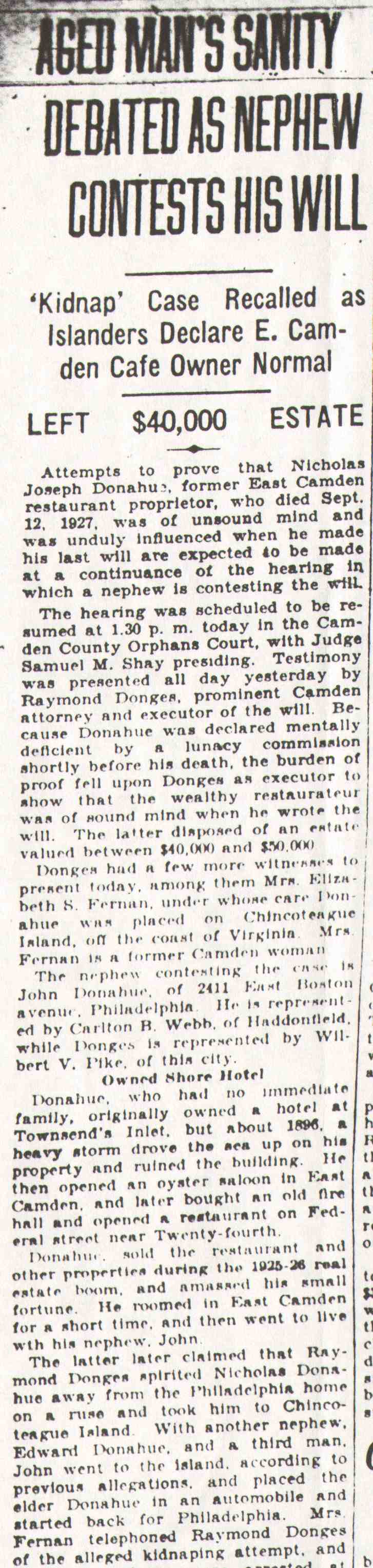
‘Kidnap’ Case Recalled as Islanders Declare E. Camden Cafe Owner Normal
LEFT $40,000 ESTATE
Attempts to prove that Nicholas Joseph Donahue, former East Camden restaurant proprietor, who died Sept. 12, 1927, was of unsound mind and was unduly influenced when he made his last will are expected to be made at a continuance of the hearing in which a nephew is contesting the will.
The hearing was scheduled to be resumed at 1.30 p. m. today in the Camden County Orphans Court, with Judge Samuel M. Shay presiding. Testimony was presented all day yesterday by Raymond Donges, prominent Camden attorney and executor of the will. Because Donahue was declared mentally deficient by a lunacy commission shortly before his death, the burden of proof fell upon Donges as executor to show that the wealthy restaurateur was of sound mind when he wrote the will. The latter disposed of an estate valued between $40,000 and $50,000.
Donges had a few more witnesses to present today, among them Mrs. Elizabeth S. Fernan, under whose care Donahue was placed on Chincoteague Island, off the coast of Virginia. Mrs. Fernan is a former Camden woman.
The nephew contesting the case is John Donahue, of 2411 East Boston avenue, Philadelphia. He is represented by Carlton B. Webb, of Haddonfield, while Donges is represented by Wilbert V. Pike, of this city.
Owned Shore Hotel
Donahue, who had no immediate family, originally owned a hotel at Townsend’s Inlet, but about 1896, a heavy storm drove the sea up on his property and ruined the building. He then opened an oyster saloon in East Camden, and later bought an old fire hall and opened a restaurant on Federal street near Twenty-fourth.
Donahue sold the restaurant and other properties during the 1925-26 real estate boom, and amassed his small fortune. He roomed in East Camden for a short time, and then went to live with his nephew, John.
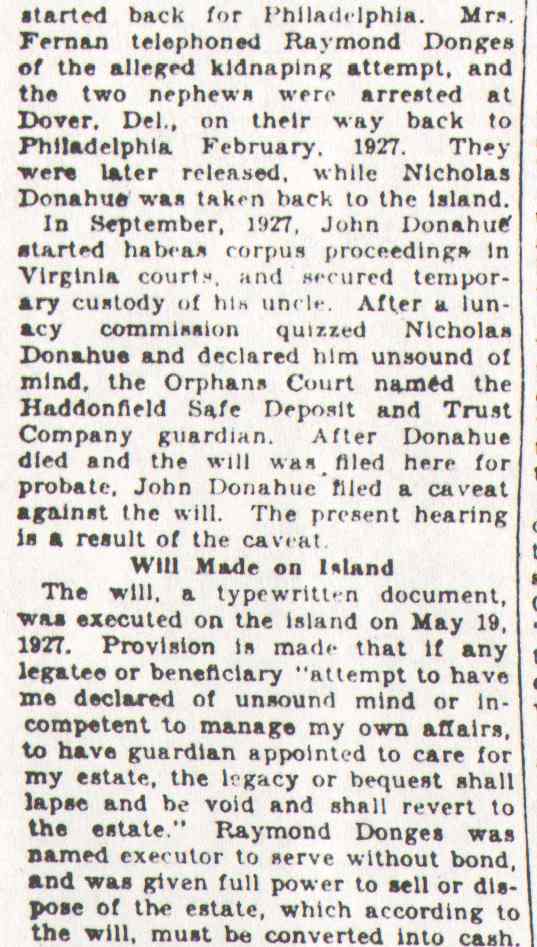
The latter later claimed that Raymond Donges spirited Nicholas Donahue away from the Philadelphia home on a ruse and took him to Chincoteague Island. With another nephew, Edward Donahue, and a third man, John went to the island, according to previous allegations, and placed the elder Donahue in an automobile and started back for Philadelphia. Mrs. Fernan telephoned Raymond Donges of the alleged kidnaping attempt, and the two nephews were arrested at Dover, Del., on their way back to Philadelphia February, 1927. They were later released, while Nicholas Donahue was taken back to the island.
In September, 1927, John Donahue started habeas corpus proceedings in Virginia courts, and secured temporary custody of his uncle. After a lunacy commission quizzed Nicholas Donahue and declared him unsound of mind, the Orphans Court named the Haddonfield Safe Deposit and Trust Company guardian. After Donahue died and the will was filed here for probate, John Donahue filed a caveat against the will. The present hearing is a result of the caveat.
Will Made on Island
The will, a typewritten document, was executed on the island on May 19, 1927. Provision is made that if any legatee or beneficiary “attempt to have me declared of unsound mind or incompetent to manage my own affairs, to have guardian appointed to care for my estate, the legacy or bequest shall lapse and be void and shall revert to the estate.” Raymond Donges was named executor to serve without bond, and was given full power to sell or dispose of the estate, which according to the will, must be converted into cash.
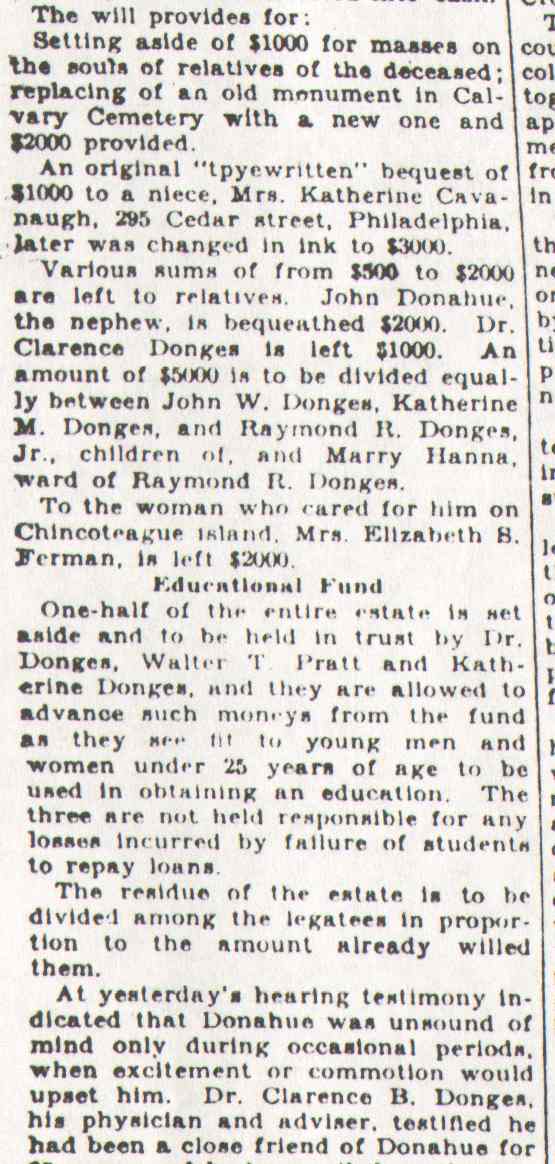
The will provides for:
Setting aside of $1000 for masses on the souls of relatives of the deceased; replacing of an old monument in Calvary Cemetery with a new one and $2000 provided.
An original “tpyewritten” [sic] bequest of $1000 to a niece, Mrs. Katherine Cavanaugh, 295 Cedar street, Philadelphia, later was changed in ink to $3000.
Various sums of from $500 to $2000 are left to relatives. John Donahue, the nephew, is bequeathed $2000. Dr. Clarence Donges is left $1000. An amount of $5000 is to be divided equally between John W. Donges, Katherine M. Donges, and Raymond R. Donges, Jr., children of, and Marry [sic] Hanna, ward of Raymond R. Donges.
To the woman who cared for him on Chincoteague Island, Mrs. Elizabeth S. Ferman [sic], is left $2000.
Educational Fund
One-half of the entire estate is set aside and to be held in trust by Dr. Donges, Walter T. Pratt and Katherine Donges, and they are allowed to advance such moneys from the fund as they see fit to young men and women under 25 years of age to be used in obtaining an education. The three are not held responsible for any losses incurred by failure of students to repay loans.
The residue of the estate is to be divided among the legatees in proportion to the amount already willed them.
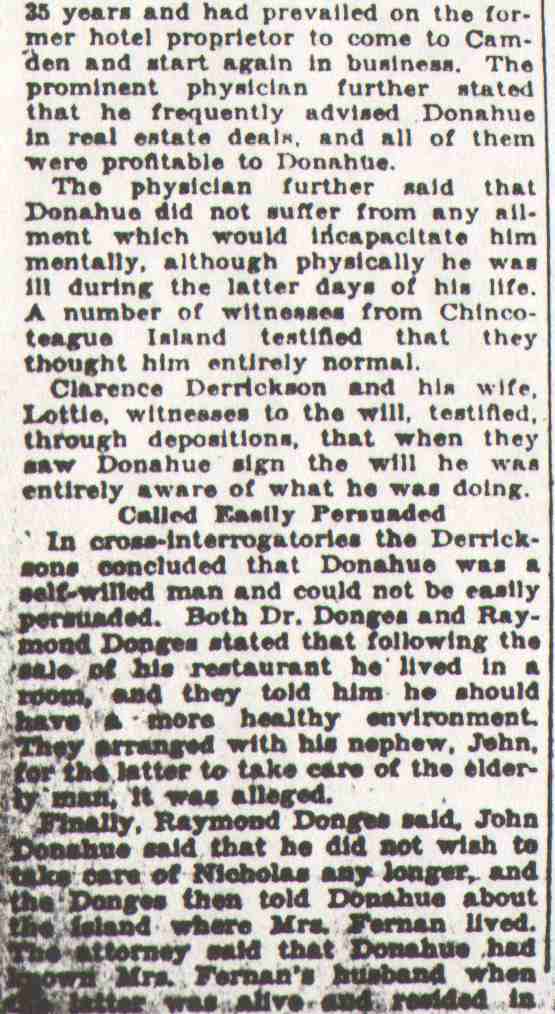
At yesterday’s hearing testimony indicated that Donahue was unsound of mind only during occasional periods, when excitement or commotion would upset him. Dr. Clarence B. Donges, his physician and adviser, testified he had been a close friend of Donahue for 35 years and had prevailed on the former hotel proprietor to come to Camden and start again in business. The prominent physician further stated that he frequently advised Donahue in real estate deals, and all of them were profitable to Donahue.
The physician further said that Donahue did not suffer from any ailment which would incapacitate him mentally, although physically he was ill during the latter days of his life. A number of witnesses from Chincoteague Island testified that they thought him entirely normal.
Clarence Derrickson and his wife, Lottie, witnesses to the will, testified, through depositions, that when they saw Donahue sign the will he was entirely aware of what he was doing.
Called Easily Persuaded
In cross-interrogatories the Derricksons concluded that Donahue was a self-willed man and could not be easily persuaded. Both Dr. Donges and Raymond Donges stated that following the sale of his restaurant he lived in a room, and they told him he should have a more healthy environment. They arranged with his nephew, John, for the latter to take care of the elderly man, it was alleged.
Finally, Raymond Donges said, John Donahue said that he did not wish to take care of Nicholas any longer, and the Donges then told Donahue about the island where Mrs. Fernan lived. The attorney said that Donahue had known Mrs. Fernan’s husband when the latter was alive and resided in Camden and agreed to the change. So did the nephew agree, said Donges. There was no ruse or secrecy about taking the semi-invalid to the island, where he could get the proper food and surroundings, the Donges said.
Donges also introduced a letter purported to have been written by Donahue on the island and addressed to Raymond Donges a short time before the will was made. In the letter Donahue urged his attorney to complete the will. Donges said that for nearly a year before May of 1927 the former restauranteur discussed various terms of the will.
In the present will a bequest of $1000 to a niece was changed by pen to $3,000. Donges said that in a former will Donahue gave the woman $3000, then wrote to Donges asking him to change it to $1000. However, when the drafted testament was ready to be signed Donahue himself increased the bequest to its original figure, it was stated.
Throngs Mourn as W.L. Hurley Is Laid to Rest
Camden Courier-Post —
Thousands Pay Tribute To Merchant Prince at Home In Collingswood
SOLEMN REQUIEM MASS AT ST. JOHN’S CHURCH
Many Follow Funeral Cortege to Mausoleum in Calvary Cemetery
By BEN COURTER
William Leonard Hurley, merchant prince, was buried today in the family mausoleum at Calvary Cemetery, beside the son whom he cherished, now gone these many years.
Camden paid honor to its distinguished merchant son for out of the tall tower of city hall the bell tolled rhythmically from 10.30 to 10.[?]0 this morning. That is a tribute seldom paid, only to the most distinguished of Camden’s citizenry, only to those whom it holds in highest regard.
In addition Mayor Price ordered all city flags lowered half mast while the funeral was under way, itself a high mark indicating municipal regard and sorrow in the passing of an eminent son.
The burial came after tribute that seldom comes to any man. There was no pomp with the glitter and glare that usually comes to the military great. There was none of the evidence of the peculiar fealty that comes with the close of a great political leader’s career.
But there was in evidence, last night and again today, something suggestive of a community paying full and really heart-felt tribute to one who had lived with lasting benefit to his fellow-man. “Dungarvan,” the home of the merchant prince, last night was the scene of an outpouring of the friends gained through the years who took farewell of one whom they had held in highest regard. Nor was it merely a formal viewing of one who had passed on, nor idle curiosity, nor a perfunctory performance of mere duty.
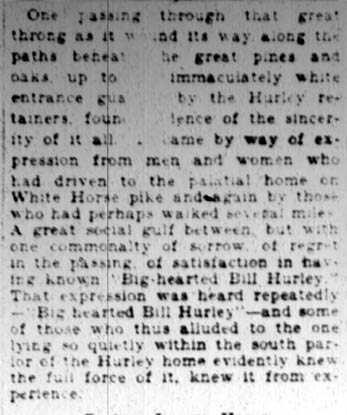
One passing through that great throng as it wound its way along the paths beneath the great pines and oaks, up to the immaculately white entrance guarded by the Hurley retainers, found evidence of the sincerity of it all. It came by way of expression from men and women who had driven to the palatial home on White Horse pike and again by those who had perhaps walked several miles. A great social gulf between, but with one commonalty of sorrow, of regret in the passing, of satisfaction in having known “Big-hearted Bill Hurley.” That expression was heard repeatedly—“Big hearted Bill Hurley”—and some of those who thus alluded to the one lying so quietly within the south parlor of the Hurley home evidently knew the full force of it, knew it from experience.
Cortege Under Way
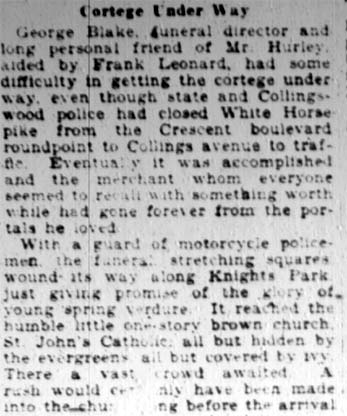
George Blake, funeral director and long personal friend of Mr. Hurley, aided by Frank Leonard, had some difficulty in getting the cortege under way, even though state and Collingswood police had closed White Horse pike from the Crescent boulevard roundpoint to Collings avenue to traffic. Eventually it was accomplished and the merchant whom everyone seemed to recall with something worth while had gone forever from the portals he loved.
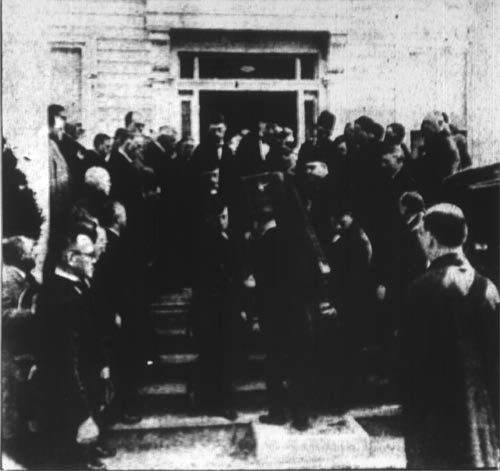
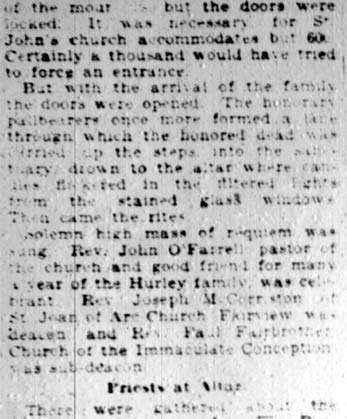
With a guard of motorcycle policemen, the funeral stretching squares wound its way along Knights Park just giving promise of the glory of young spring verdure. It reached the humble little one-story brown church, St. John’s Catholic, all but hidden by the evergreens, all but covered by ivy. There a vast crowd awaited. A rush would certainly have been made into the church before the arrival of the mourners, but the doors were locked. It was necessary for St. John’s church accommodates but 60[?]. Certainly a thousand would have tried to force an entrance.
But with the arrival of the family the doors were opened. The honorary pallbearers once more formed a lane through which the honored dead was carried up the steps, into the sanctuary, drawn to the altar where candles flickered in the filtered lights from the stained glass windows. Then came the rites.
A solemn high mass of requiem was sung. Rev. John O’Farrell, pastor of the church and good friend for many a year of the Hurley family, was celebrant. Rev. Joseph M. Corriston of St. Joan of Arc Church, Fairview, was deacon, and Rev. Paul Fairbrother, Church of the Immaculate Conception, was sub-deacon.
Priests at Altar
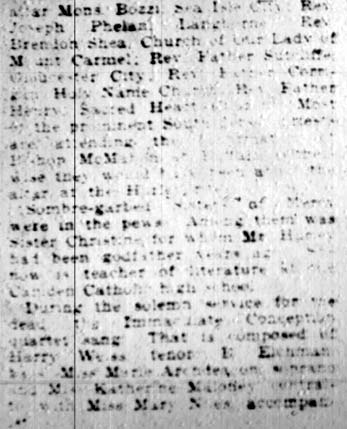
There were gathered about the altar Msgr. Bozzi, Sea Isle City, Rev. Joseph Phelan, Langhorne, Rev. Father Brendon Shea, Church of Our Lady of Mount Carmel, Rev. Father Sutcliffe, Gloucester City, Rev. Father Corrigan, Holy Name Church, Rev. Father Henry, Sacred Heart, [blacked out] Most [blacked out] of the prominent South [blacked out] were attending the [blacked out] Bishop McMa[blacked out] otherwise they would have been at the [blacked out] altar at the Hu[blacked out]. Sombre-garbed Sisters of Mercy were in the pews. Among them was Sister Christine, for whom Mr. Hurley had been godfather years ago [blacked out] now is teacher of literature at [blacked out] Camden Catholic high school.
During the solemn service for the dead, the Immaculate Conception quartet sang. That is composed of Harry Weiss, tenor; E. Ehrman, bass; Miss Marie Archer, soprano, and Mrs. Katherine Maloney, contralto, with Miss Mary Niles, accompanist.
Funeral Reaches Cemetery
The solemn ritual over the cortege bearing the dead proceeded to Calvary Cemetery. Long before its arrival hundreds had gathered along Marlton pike—hundreds who were undismayed by a keen, cutting north wind, even though the majority were elderly women. It was apparent they were, as a rule, the old, old patrons of the Hurley store, those whom the founder ever served. They braved the wind and the discomfort to pay their tribute to the dead.
Whether it was by coincidence or otherwise, two airplanes circled over the cemetery when the cortege arrived and continued until the mourners had left. They seemed like two great birds on guard. Some thought it a symbol significant to the occasion.
Headed by motorcycle policemen from the state, Camden, Collingswood and Delaware township, the funeral arrived, passed the guarded entrance.
Thousands Pass Bier
Last night they paid tribute to an old friend and chieftain—thousands of them. Seemingly there was a never-ending stream of notables, of the lowly, those in every walk of life. They came in limousines, in trolleys and many walked, but all were imbued with one object, to take parting of “Big-hearted Bill Hurley,” whom they had known through the years [blacked out] to increase their regard with mellow [blacked out].
There was Ben Maloney, pal of many [blacked out] a year in the hunting field, who made [blacked out] the trip to the Hurley h[blacked out] enough because of [blacked out] F[blacked out] strong was Maloney [blacked out] times when he and his old [blacked out] had trod the wood and fields. Tears came unrestrained.
There was venerable Philip M[blacked out]Mann, who came down from R[blacked out] to take parting with his old chief. F[blacked out] Mann is the oldest [blacked out] of the Hurley organiza[blacked out] many a year he trod the [blacked out] a collector. He has long [blacked out] pensioned.
There was a long, long line of Hurley employes who wound about the path leading to the home, who met by the bier while the son of the family, Jerome, and Harry and James Moran, executives, stood by the door.
There were plain Mr. and Mrs. John Smith and their more exalted neighbors, too, who passed through the room holding the honored dead.
Elks Hold Services
And there was Camden Lodge of Elks there to hold the memorial service for one who exemplified the principles of that great American order in an exalted degree. They were there, these Elks, to write the faults on the sands, the virtues on the tablets of loving memory.
There was Phil Wilson, for many a year close associate of Mr. Hurley, who had known him all through the years that brought success. And William J. Lorigan whose father had long been associated with Mr. Hurley in building enterprises and former Prosecutor William J. Kraft, nephew and good friend of the family.
But by far the most [blacked out] memory of the man who lay so quiet [blacked out] and still were the flowers [blacked out] Mr. Hurley in life loved the [blacked out] springtime of summer and of [blacked out] Dungarvan had ever been a [blacked out] estate under his direction with [blacked out] grand old trees but there were [blacked out] splashes of color, the great [blacked out] rhododendrons along the [blacked out] dary yet recalcitrant but with [blacked out] ising buds. There was the garden [blacked out] of fresh of flowers now but with [blacked out] secret expanses—the roses and [blacked out] gardens and the peonies [blacked out] host yet to put forth their splendor [blacked out]
Bower of Beauty
[blacked out] of Dungarvan within it was [blacked out] of blossoms [blacked out] and the [blacked out] life of revived nature. Dungarvan within was a veritable living bower of beauty, exquisite [blacked out] that surrounded the bier that mounted [blacked out] the walls to the ceiling. Under the light of the candles in golden [blacked out] the color was one wonderful [blacked out] of red and pink and garnet with [blacked out] roses [blacked out] everywhere. [blacked out] [blacked out] [blacked out]
These were the [blacked out] that [blacked out] friends who [blacked out] passing tributes that came from all parts of the city, the county, even from far parts of the country.
There was a great basket of American beauty roses and [blacked out] Mrs. Hurley [blacked out] [blacked out] [blacked out] [blacked out] [blacked out] [blacked out] island estate [blacked out] a long time [blacked out].
The Camden employes with a [blacked out] heart. From the staff of the Hurley-Loughran store at Wilkes-Barre came a perpetual membership in the purcha[blacked out] society, and win[blacked out]dre[blacked out] designs from the stores at Bridgeton, Trenton and Atlantic City.
Organizations Send Blossoms
There was a great wreath of acanthus leaves from the Chamber of Commerce, a cross from the Broadway Business Men’s Association, the cloak of purple and white from Camden Lodge of Elks, snapdragons from the banks with which he had been affiliated, a basket from the Cities Corporation Company, which controls the Hotel Walt Whitman, a basket from Wyoming Tribe of Red Men.
Others who sent their tribute of beauteous blossoms were Mr. and Mrs. J. Walter Staats, white lilies and lilacs; John Schlorer, calla lilies; A. J. Henderson, “spring garden flowers”; Mr. and Mrs. J. David Stern, roses, lilies and snapdragons; John Croft and family, spring flowers; Mrs. Gertrude McNichol, Jerome Hurley’s fiancee, a great basket of lilies, roses and white lilacs; her father, Daniel Dever, basket of flowers; Col. T. R. Donovan, a four-foot pillow of flowers.
Mr. and Mrs. Walter L. Tushingham, a spray of white lilies; Mr. and Mrs. Philip Wilson, lilies and roses; Mr. and Mrs. S. Canning Childs, spray of lilies and lilies of the valley; Dr. Harris, Savannah, Ga., spray of American beauty roses; J. B. Van[blacked out], basket of flowers; Howard E. Hemphill, basket; Robert Stecker, spray of lilies.
Flowers, Still More Flowers
Mr. and Mrs. Charles W. Auster[blacked out], spray of lilies; Camden Lions Club; Theodore Tiedeken and Brother, basket; Arthur Moffett, spray; J. C. Ra[blacked out], basket; H. Black, of the T[blacked out]n Upholstering Company, basket; [blacked out] Beau & Company, spray; Endowment B. & L., basket; Argonne B. & L., basket; St. John’s Men’s Club, Collingswood, basket; Charles Cramer, basket; Harry Pinsky, basket; Home Furniture Association, basket; Mr. and Mrs. J. A. Murphy, [blacked out] basket, cut flowers; Dr. [blacked out] Edward Mallon, Philadelphia; [blacked out] and Mrs. Charles [blacked out], spray of American [blacked out]
Mr. and Mrs. J. Thompson of Hotel [blacked out] Atlantic City, pillow of American beauty roses; Mr. and Mrs. David [blacked out], basket; Miss Bessie Hun[blacked out], [blacked out] former stenographer, spray of [blacked out]; [blacked out] D. Sadowsky, N. Y., spray [blacked out] spring flowers; Jack and Jules [blacked out]man, basket; Mr. and Mrs. J. A. [blacked out], spray; Mr. and Mrs. John [blacked out], spray; Mr. and Mrs. John [blacked out], spray; Mr. and Mrs. H. J. [blacked out]; Dr. and Mrs. W. J. McKin[blacked out]; Mr. and Mrs. James Mallon, [blacked out] Britton, J. P. King, sprays; Mr. and Mrs. Michael Collins, wreath; [blacked out] W. We[blacked out], wreath; Michael [blacked out], Lindenwold, basket; Elisha [blacked out] Jr., Lawrence Hurley, sprays of American Beauties; Mrs. Margaret Lorigan, widow of his former partner in the building of homes, spray of [blacked out]; Richard M. Alister, a great basket of flowers; Judge and Mrs. Ralph W. E. Donges, basket; James D[blacked out]ney, of Newark, spray of American Beauties; George Gibson, spray; Charles T. Busch, basket; William H. S[blacked out], spray; Edward J. Mulligan, spray.
Old Friends Send Tokens
[blacked out]s Margaret Ludwick and Mrs. [blacked out], spray; J. S. Haskell, wreath; Mr. and Mrs. George Lockerman, spray; Mr. and Mrs. Elmer E. Thomas, wreath; E. J. and William H. [blacked out], basket; Mr. and Mrs. Arthur [blacked out], basket; Mr. and Mrs. E. H. [blacked out], spray; Dr. and Mrs. Alexander MacAlister, basket; Mrs. Nellie Cavata, basket; Dr. Clarence Donges; Ben Maloney and John Donahue, old friends, a basket; Theodore L. Kausel, spray of American Beauties; Mr. and Mrs. Carl Dellmuth, spray; Mr. and Mrs. Charles [blacked out], spray; Mr. and Mrs. Edward Windust, basket; Mr. and Mrs. Arthur Garet, spray.
Mr. and Mrs. J. J. McArdle, basket; [blacked out] Smith, spray; Mr. and Mrs. [blacked out]; Peter Gross, spray; Mr. and Mrs. George W. Bradley, [blacked out]; Mr. and Mrs. J. J. Loughry, [blacked out]; Mr. and Mrs. Joseph Hoover, [blacked out]; Mr. and Mrs. Edward P[blacked out]nton, wreath; Mr. and Mrs. Charles Hinkel, [blacked out]; L. M. Nelson, John Weber, [blacked out]; [blacked out] Clare and A. [blacked out] Farley, [blacked out]; Mr. and Mrs. W. N. Morrow, [blacked out]
The staff employed on the Hurley estate gave as their tribute a great [blacked out] of [blacked out]. They are Walter [blacked out], E. P. Haven, Edward Grant and [blacked out] Howard. And from Mr. and Mrs. [blacked out] Mathis came a basket of [blacked out] flowers. Mathis had been Mr. Hurley’s chauffeur for many years.
Old Centreville Families
Camden Courier-Post —
Dr. Donges, Mills, Schepperkittes, Covely and Other Men Wrought Through Years to Bring Needed Improvements to District
WHEN a larger community annexes an adjoining district the newer area is generally regarded, for a time at least, as a step-child. Older residents of East Camden will bear out that truism when they recall how difficult it was to obtain improvements. Years before, Newton Township which became part of Camden, had had the same experience. Under such circumstances, it requires tireless energy on the part of leading men to get what their district needs. Demands often go unheeded unless the community is fortunate in having those of spirit who insist on street improvements, water extension, lighting facilities and schools. That was more in evidence half a century ago than now, of course, for Camden itself was little more than a large village.
Down in Centreville there were men who looked after the interests of their constituents, who slowly but surely obtained improvements and who insisted on being recognized by the powers that be. No one may think of old Centreville without thought of Dr. John W. Donges, whose value to not only that section but Camden at large, has been expatiated upon in these annals. He was not only a leading physician, with a practice extending into Camden, but a leader in many civic movements, and any article on that era would be incomplete without allusion again to the doctor whose services as a real family physician are part of the traditions of many old families.
Came Here In 1872
He came here in 1872 from Schuylkill County, Pennsylvania, when his health was affected by overwork through loyalty to his patients. He bought the drugstore at Ferry Avenue and Broadway, remaining there for many years. It was there Supreme Court Justice Ralph W. E. Donges spent his boyhood.
There, too, Dr. Clarence B. Donges and Attorney Raymond Donges were boys. Grant E. Kirk, clerk in his store, later becoming a physician and for several years a member of council and at one time being prominently boomed for mayor, married their sister. Dr. Donges was elected to council in 1878 on the Democratic ticket, itself an evidence of the high regard in which he was held, for the Eighth Ward generally was rock-ribbed Republican. Until the early part of this century he resided in his old place, but later went to Broadway and Clinton Streets. In later years, after he had retired, he was city assessor, “just to keep busy.” He died a few years ago, well in his 80s, mourned by a great host of Camdenites.
There was another widely known Centreville family of the old days, that of Samuel Mills, who had his own abattoir at Broadway and Jackson Street, where city-dressed meats were provided before the days of car refrigeration brought supplies from the great packing places in Chicago. His son, Charlie, was long a member of the Board of Education, while another, William, was a city councilman. Edward Mills, another son, was excise commissioner 35 years ago in the days when there was plenty of trouble with Sunday sellers.
Cornelius Schepperkotter was a factor in politics down that way, too, having a grocery store on Ferry Avenue at Ninth, later moving to the southwest corner when the Charles Sumner School was built. That school was torn down two years ago for the recreation center. Schepperkotter was a member of the old Board of Public Instruction in the late 90’s, named by Mayor Cooper B. Hatch. In later years and until his death, he was superintendent of Evergreen Cemetery. He was father of Mrs. Frank S. Albright, wife of City Clerk Albright.
Frank Covely
Shortly after the New York shipyard was opened, there moved to the “Hill” Frank D. L. Covely, who became a joiner and for years was foreman of the joiner shop. He was widely known as a secret society man and also as an effective campaign speaker for the G. O. P. He was a member of the Board of Education.
He sought to go to council, but that was at the time Kirk was a power in the ward. Covely laughingly used to tell of a meeting all set for him from which all save the colored folk were drawn away through strategy of his party opponents. But for ten years he was a member of the Board of Recreation Commissioners.
That movement owed much to his work. Nor did he forget his colored friends, for he had a playground established for them at Ferry Avenue and Phillips Street and the large one [Staley Park] at Seventh and Jefferson Streets. Long afterward that was named for another city official, but Covely’s friends said it should have been for him, as a monument to his services for the boys and girls of Centreville. He died a few years ago at Bellmawr in his 70s, after a hectic experience as a chicken raiser at Port Norris.
There, too, was William Dorrell, superintendent of the old “Narrow Gauge” who was one of the leading spirits in the paving of Broadway, nearly 60 years ago the big issue of that section. He lived in a house along the railroad still standing, as the hospital and dispensary of the shipyard.
Mention has been made of the Ferrises, the Helmbolds, the Yeagers, of Squire James D. Chester and Squire F. Joseph Rouh. There was also William O. Thompson, the leading contractor down that way for many years and Theodore Tiedeken, who established the wagon works on Van Hook Street, Martin Ewe, who had the hotel at Broadway and Emerald, and down the street a bit James Croker, who operated Tammany Hall. Forty years ago there was one of the best young athletes of the city, Thomas Nicholas, now retired Camden fire chief. He was down in old No. 3 with Bill Rose, long a fire captain, Bill Miller, Al James, Sam Lodge, Gus Dold and Jim Ware.
Many of these old timers have passed on, but others are still in the flesh but scattered to all parts of the city but it may be said the survivors look back on the days that were down there in Centreville with an interest that does not dim with the passing years.
Dr. Donges Dies; Judge's Brother
Camden Courier-Post —
Dr. Clarence B. Donges, 78, brother of Supreme Court Justice Ralph W. E. Donges, died early today in Cooper hospital.
Dr. Donges complained of feeling ill at 2 a.m. at his home, 442 Chambers avenue, after which he collapsed and was removed to the hospital, where he died at 4:30 o’clock.
A graduate of the Jefferson Medical College, Dr. Donges was an eye specialist and general practitioner in Camden 57 years. He served his internship in the University of Pennsylvania hospital.
Dr. Donges, who was born in Donaldson, Pa., began his practice at 408 South Fifth street, then moved his offices to Broadway, south of Washington street, and finally to the Chambers avenue address.
He was the son of the late Dr. John W. Donges, a graduate of the University of Pennsylvania Medical school who practiced for a time in Pennsylvania and then came to Camden.
Dr. Clarence Donges continued his practice until his death. He was active in examination and treatment of veterans of both War I and II.
He was a member of the Camden County Medical Society and Trimble lodge 117, FAM.
Also surviving are his widow, Hilda, and a sister, Mrs. Miriam Kirk.
Services will be held Thursday at 2 p.m. in a funeral home at 418 Chambers avenue. Burial will be in Harleigh cemetery.
Dr. Clarence B. Donges
Camden physician for 57 years, who died yesterday. He was a brother of Supreme Court Justice Donges. Dr. Donges was 78 and resided at 442 Chambers avenue. Services will be held Thursday at 2 p.m. in a funeral home at Chambers avenue and Washington street. Burial will be in Harleigh cemetery.
1801 Broadway
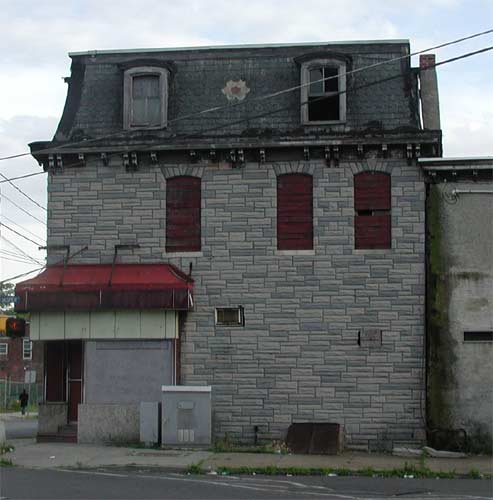
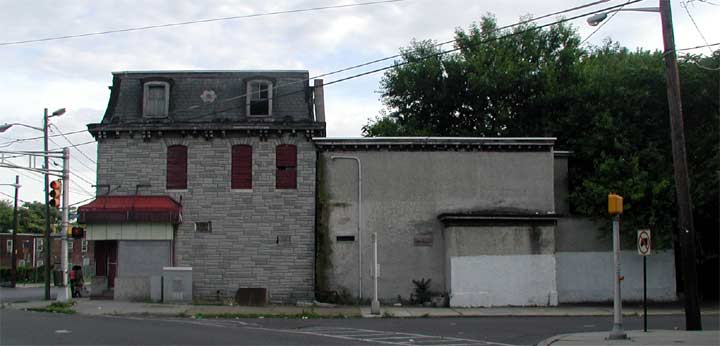
1801 Broadway — Where Dr. John W. Donges and family lived and practiced from 1875 through the early 1890s
Woman Gains Annulment
Gettysburg Times —
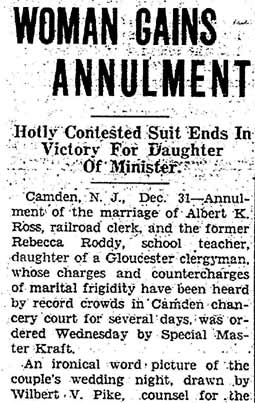
Hotly Contested Suit Ends In Victory For Daughter Of Minister.
Camden, N. J., Dec. 31—Annulment of the marriage of Albert K. Ross, railroad clerk, and the former Rebecca Roddy, school teacher, daughter of a Gloucester clergyman, whose charges and countercharges of marital frigidity have been heard by record crowds in Camden chancery court for several days, was ordered Wednesday by Special Master Kraft.
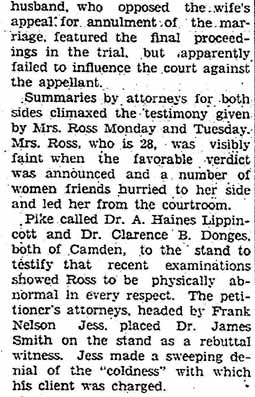
An ironical word picture of the couple’s wedding night, drawn by Wilbert V. Pike, counsel for the husband, who opposed the wife’s appeal for annulment of the marriage, featured the final proceedings in the trial, but apparently failed to influence the court against the appellant.
Summaries by attorneys for both sides climaxed the testimony given by Mrs. Ross Monday and Tuesday. Mrs. Ross, who is 28, was visibly faint when the favorable verdict was announced and a number of women friends hurried to her side and led her from the courtroom.
Pike called Dr. A. Haines Lippincott and Dr. Clarence B. Donges, both of Camden, to the stand to testify that recent examinations showed Ross to be physically abnormal in every respect. The petitioner’s attorneys, headed by Frank Nelson Jess, placed Dr. James Smith on the stand as a rebuttal witness. Jess made a sweeping denial of the “coldness” with which his client was charged.
Gettysburg (PA) Times, December 31, 1931