Introduction
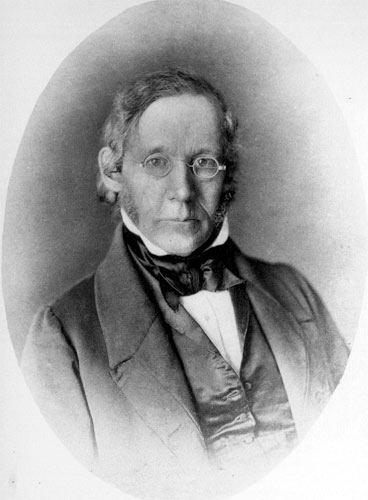
Richard Fetters
Richard Fetters was for many years one of Camden’s leading citizens. Born in Camden on January 19, 1791… before there was Camden to be born in… he was one of the leaders in the movement that effected the incorporation of Camden in 1828. A Quaker, Richard Fetters was a political and civic leader light years ahead of his time in his commitment to address the needs of his fellow citizens.
In 1833 he purchased land from Charity and Grace Kaighn and founded Fettersville. Fettersville originally embraced the land lying between Line and Cherry Streets, extending from Third Street to the Delaware River. The town of Fettersville grew rapidly, and in 1835 an additional tract was purchased from the Kaighn family extending south to Mount Vernon Street.
Lots originally laid out by Fetters measured 30×200 feet and in 1835 were assessed at $50 each. These low rates attracted many buyers of modest mean, a large portion of them South Jersey and Philadelphia blacks. He platted these lands into lots and sold them for $125 for a lot 40×100 feet. Fetter’s plan placed the fronts on the streets running east and west in consideration of his design for a ferry to be located at the foot of Spruce Street.
Richard Fetters also served Camden as a volunteer fireman, serving with the Fairmount Fire Company as early as 1831. Elias Kaighn was another of the members that year.
Richard Fetters passed away on July 3, 1863, in his 72nd year. His grandson, Richard F. Smith, also had a long career in the civic life of Camden, serving as city treasurer and Sheriff of Camden County in the 1880s.
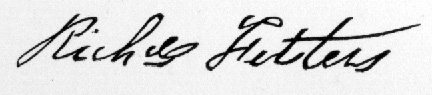
Signature of Richard Fetters
Richard Fetters
The History of Camden County New Jersey — George Reeser Prowell, 1886
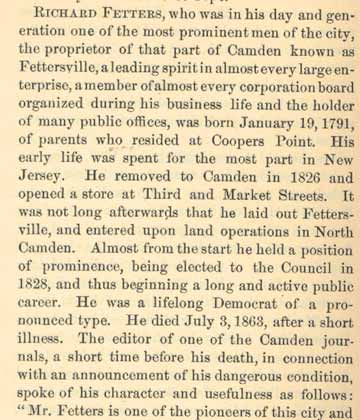
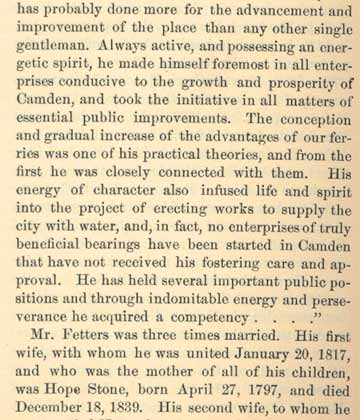
RICHARD FETTERS, who was in his day and generation one of the most prominent men of the city, the proprietor of that part of Camden known as Fettersville, a leading spirit in almost every large enterprise, a member of almost every corporation board organized during his business life and the holder of many public offices, was born January 19, 1791, of parents who resided at Coopers Point. His early life was spent for the most part in New Jersey. He removed to Camden in 1826 and opened a store at Third and Market Streets. It was not long afterwards that he laid out Fettersville, and entered upon land operations in North Camden. Almost from the start he held a position of prominence, being elected to the Council in 1828, and thus beginning a long and active public career. He was a lifelong Democrat of a pronounced type. He died July 3, 1863, after a short illness. The editor of one of the Camden journals, a short time before his death, in connection with an announcement of his dangerous condition, spoke of his character and usefulness as follows: “Mr. Fetters is one of the pioneers of this city and has probably done more for the advancement and improvement of the place than any other single gentleman. Always active, and possessing an energetic spirit, he made himself foremost in all enterprises conducive to the growth and prosperity of Camden, and took the initiative in all matters of essential public improvements. The conception and gradual increase of the advantages of our ferries was one of his practical theories, and from the first he was closely connected with them. His energy of character also infused life and spirit into the project of erecting works to supply the city with water, and, in fact, no enterprises of truly beneficial bearings have been started in Camden that have not received his fostering care and approval. He has held several important public positions and through indomitable energy and perseverance he acquired a competency…”
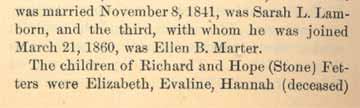
Mr. Fetters was three times married. His first wife, with whom he was united January 20, 1817, and who was the mother of all of his children, was Hope Stone, born April 27, 1797, and died December 18, 1839. His second wife, to whom he was married November 8, 1841, was Sarah L. Lamborn, and the third, with whom he was joined March 21, 1860, was Ellen B. Marter.
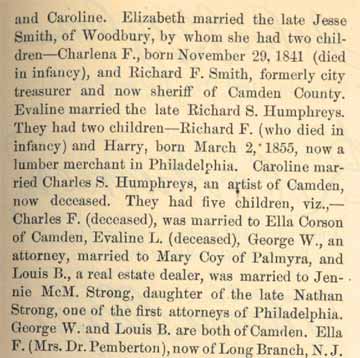
The children of Richard and Hope (Stone) Fetters were Elizabeth, Evaline, Hannah (deceased) and Caroline. Elizabeth married the late Jesse Smith, of Woodbury, by whom she had two children—Charlena F., born November 29, 1841 (died in infancy), and Richard F. Smith, formerly city treasurer and now sheriff of Camden County. Evaline married the late Richard S. Humphreys. They had two children—Richard F. (who died in infancy) and Harry, born March 2, 1855, now a lumber merchant in Philadelphia. Caroline married Charles S. Humphreys, an artist of Camden, now deceased. They had five children, viz.,—Charles F. (deceased), was married to Ella Corson of Camden, Evaline L. (deceased), George W., an attorney, married to Mary Coy of Palmyra, and Louis B., a real estate dealer, was married to Jennie McM. Strong, daughter of the late Nathan Strong, one of the first attorneys of Philadelphia. George W. and Louis B. are both of Camden. Ella F. (Mrs. Dr. Pemberton), now of Long Branch, N. J.
1861 — The First War Meeting in Camden
On the 16th of April, 1861, three days after the Confederates fired upon Fort Sumter, at the entrance of Charleston Harbor, a large number of loyal and patriotic citizens of Camden City and County issued the following vigorous and spirited response to the President’s proclamation:
To the President Of the United States:
“The unparalleled events of the last week have revealed to the citizens of the United States, beyond question or the possibility of a doubt, that peaceful reconciliation upon the form of our Constitution is repelled and scorned, and secession means, in the hearts of its supporters, both Treason and war against our Country and Nation.
“We, therefore, the undersigned Loyal Citizens of the United States, and inhabitants of the city of Camden, in the State of New Jersey, responding to the proclamation of the President of the United States, hereby declare our unalterable determination to sustain the government in its efforts to maintain the honor, the integrity and the existence of our National Union and the perpetuity of the popular Government, and to redress the wrongs already long enough endured; no differences of political opinion; no badge of diversity upon points of party distinction, shall restrain or withhold us in the devotion of all we have or can command to the vindication of the Constitution, the maintenance of the laws and the defense of the Flag Of our Country.
I. S. Mulford
Richard Fetters
Charles C. Reeves
S. H. Grey
N. B. Stokes
S. O. Wright
Joseph Dlinston
David Creary
John R. Barber
James H. Denny
William R. Maxwell
Robert Wible
Hamilton William
George W. Jackson
Joseph Maurer
Joseph D. Brown
William S. Scull
Daniel Witham
Isaac Shreeve
Adam Hare
George Wardell
Joseph Coffman
George W. Conrow
Joshua Howell
Martin Grey
S. L. Wayne
Abner Sparks
Van T. Shivers
Westcott Campbell
William J. Taylor
Isaiah Norcross
Alden O. Scovel
Philip J. Gray
George W. Gilbert
Charles D. Hineline
Thomas H. Davis
Charles De Haven
Thomas Ackley
John Gill
James B. Dayton
James M. Stevens
Joseph French
George Campbell
A. A. Merry
E. Wells
William D. Clark
William B. Hatch
E. O. Jackson
A. B. Martin
Richard O. Robertson
Timothy O. Moore
George W. Stanley
Robert Schall
Reynell Coates
Aaron Hewit
Henry Shuster
William Hartsgrove
William B. French
W. A. Winchester
John M. Natty
In response to a call, on the 18th of April an enthusiastic meeting was held in the county court-house, which was formed of a large collection of prominent citizens. The court-room was decorated with flags and mottoes. John W. Mickle was chosen president and Samuel C. Harbert and Thomas G. Rowand secretaries. The president addressed the meeting first and Rev. Mr. Monroe offered a prayer. Hon. Thomas B. Atkinson (mayor) and Joseph Painter were appointed a committee on resolutions. Judge Philip J. Grey addressed the meeting, after which the committee adopted a long series of patriotic resolutions. The Washington Grays, Stockton Cadets and the Zouaves marched into the room and were received with cheers, Samuel Hufty read a resolution which was signed by many persons, who immediately formed the Home Brigade. David M. Chambers, Captain Stafford, Benjamin M. Braker, John H. Jones and E. A. Acton each addressed the meeting. James M. Scovel was then called upon and responded in eloquent terms and with patriotic energy. S. H. Grey offered a resolution, which was adopted, that the City Council and the Freeholders of the county be requested to appropriate money for the equipment of persons who may volunteer in defense of the country, and S. H. Grey, James M. Cassady and Joseph Painter were appointed a committee to look after the interests of the resolution. The meeting continued in session until eleven p.m.
A City of the Dead
Camden Courier-Post —
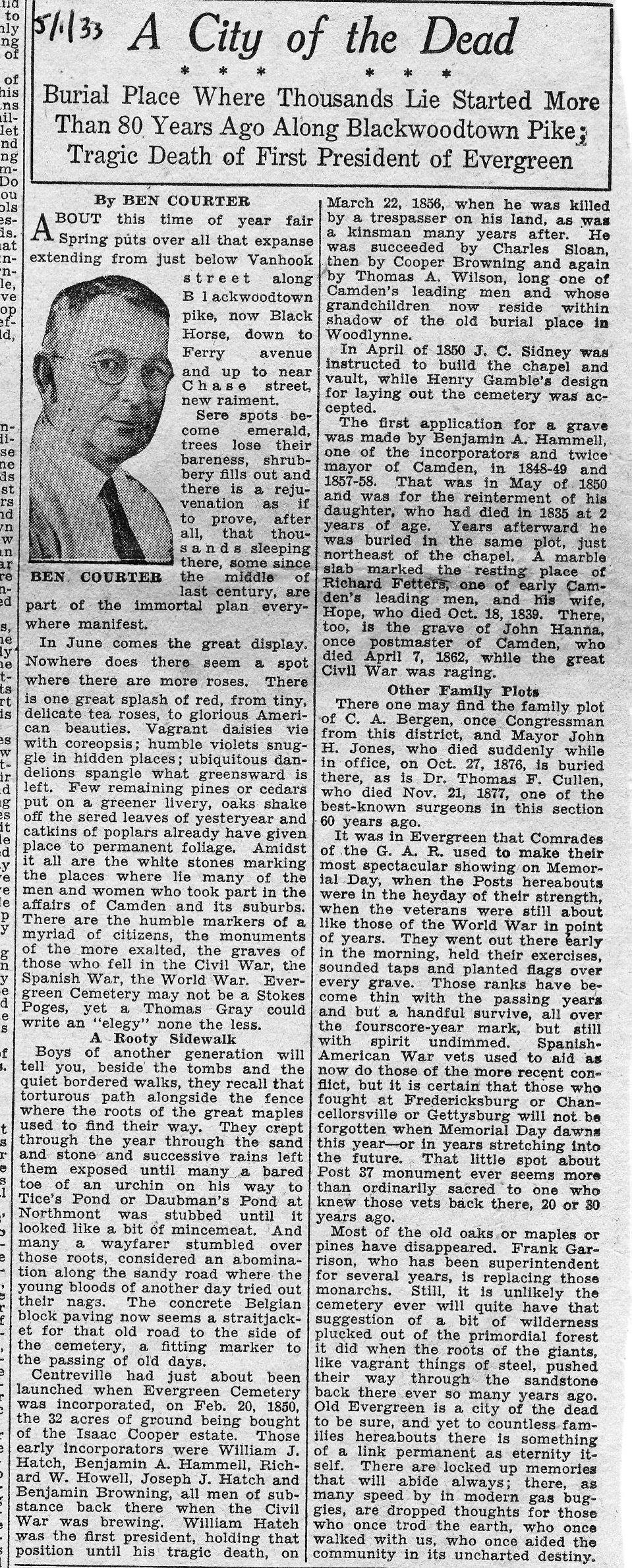
A City of the Dead
Burial Place Where Thousands Lie Started More Than 80 Years Ago Along Blackwoodtown Pike; Tragic Death of First President of Evergreen
BY BEN COURTER
About this time of year fair Spring puts over all that expanse extending from just below Vanhook street along Blackwoodtown pike, now Black Horse, down to Ferry avenue and up to near Chase street, new raiment.
Sere spots become emerald, trees lose their bareness, shrubbery fills out and there is a rejuvenation as if to prove, after all, that thousands sleeping there, some since the middle of last century, are part of the immortal plan everywhere manifest.
In June comes the great display. Nowhere does there seem a spot where there are more roses. There is one great splash of red, from tiny, delicate tea roses, to glorious American beauties. Vagrant daisies vie with coreopsis; humble violets snuggle in hidden places; ubiquitous dandelions spangle what greensward is left. Few remaining pines or cedars put on a greener livery, oaks shake off the sered leaves of yesteryear and catkins of poplars already have given place to permanent foliage. Amidst it all are the white stones marking the places where lie many of the men and women who took part in the affairs of Camden and its suburbs. There are the humble markers of a myriad of citizens, the monuments of the more exalted, the graves of those who fell in the Civil War, the Spanish War, the World War. Evergreen Cemetery may not be a Stokes Poges, yet a Thomas Gray could write an “elegy” none the less.
A Rooty Sidewalk
Boys of another generation will tell you, beside the tombs and the quiet bordered walks, they recall that torturous path alongside the fence where the roots of the great maples used to find their way. They crept through the year through the sand and stone and successive rains left them exposed until many a bared toe of an urchin on his way to Tice’s Pond or Daubman’s Pond at Northmont was stubbed until it looked like a bit of mincemeat. And many a wayfarer stumbled over those roots, considered an abomination along the sandy road where the young bloods of another day tried out their nags. The concrete Belgian block paving now seems a straitjacket for that old road to the side of the cemetery, a fitting marker to the passing of old days.
Centreville had just about been launched when Evergreen Cemetery was incorporated, on Feb. 20, 1850, the 32 acres of ground being bought of the Isaac Cooper estate. Those early incorporators were William J. Hatch, Benjamin A. Hammell, Richard W. Howell, Joseph J. Hatch and Benjamin Browning, all men of substance back there when the Civil War was brewing. William Hatch was the first president, holding that position until his tragic death, on March 22, 1856, when he was killed by a trespasser on his land, as was a kinsman many years after. He was succeeded by Charles Sloan, then by Cooper Browning and again by Thomas A. Wilson, long one of Camden’s leading men and whose grandchildren now reside within shadow of the old burial place in Woodlynne.
In April of 1850 J. C. Sidney was instructed to build the chapel and vault, while Henry Gamble’s design for laying out the cemetery was accepted.
The first application for a grave was made by Benjamin A. Hammell, one of the incorporators and twice mayor of Camden, in 1848-49 and 1857-58. That was in May of 1850 and was for the reinterment of his daughter, who had died in 1835 at 2 years of age. Years afterward he was buried in the same plot, just northeast of the chapel. A marble slab marked the resting place of Richard Fetters, one of early Camden’s leading men, and his wife, Hope, who died Oct. 18, 1839. There, too, is the grave of John Hanna, once postmaster of Camden, who died April 7, 1862, while the great Civil War was raging.
Other Family Plots
There one may find the family plot of C. A. Bergen, once Congressman from this district, and Mayor John H. Jones, who died suddenly while in office, on Oct. 27, 1876, is buried there, as is Dr. Thomas F. Cullen, who died Nov. 21, 1877, one of the best-known surgeons in this section 60 years ago.
It was in Evergreen that Comrades of the G. A. R. used to make their most spectacular showing on Memorial Day, when the Posts hereabouts were in the heyday of their strength, when the veterans were still about like those of the World War in point of years. They went out there early in the morning, held their exercises, sounded taps and planted flags over every grave. Those ranks have become thin with the passing years and but a handful survive, all over the fourscore-year mark, but still with spirit undimmed. Spanish-American War vets used to aid as now do those of the more recent conflict, but it is certain that those who fought at Fredericksburg or Chancellorsville or Gettysburg will not be forgotten when Memorial Day dawns this year—or in years stretching into the future. That little spot about Post 37 monument ever seems more than ordinarily sacred to one who knew those vets back there, 20 or 30 years ago.
Most of the old oaks or maples or pines have disappeared. Frank Garrison, who has been superintendent for several years, is replacing those monarchs. Still, it is unlikely the cemetery will quite have that suggestion of a bit of wilderness plucked out of the primordial forest it did when the roots of the giants, like vagrant things of steel, pushed their way through the sandstone back there ever so many years ago. Old Evergreen is a city of the dead to be sure, and yet to countless families hereabouts there is something of a link permanent as eternity itself. There are locked up memories that will abide always; there, as many speed by in modern gas buggies, are dropped thoughts for those who once trod the earth, who once walked with us, who once aided the community in its uncharted destiny.