Herbert Manderson Carr
Herbert Manderson Carr was born in Pennsylvania around 1874, the son of William and Susan Carr. The Carr family moved to Camden in the mid-1880s, and eventually made their home at 1002 South 2nd Street. Herbert Carr entered the United States Navy at the age of 16, and rose through the ranks. Assigned to the USS Maine, he was killed when the ship was destroyed by an explosion while anchored at Havana, Cuba on February 15, 1898. The destruction of the Maine was the spark that touched off the Spanish-American War.
Entered the Service from: New Jersey
Died: February 15, 1898
Buried at Sea
Along Memory Lane
Camden Courier-Post —

Twenty minutes to 10 o’clock tonight marks the thirtieth anniversary of the destruction of the U. S. battleship Maine in Havana harbor.
Of the 373 officers and crew, 266 were killed. The bodies of many were never recovered.
The disaster stunned the country. Then came reaction and war with Spain with quick victory that Americans regarded retributive justice.
In the early 90’s there was a plaintive popular air, “The Ship That Never Returned.”
Herbert Manderson Carr, son of Mr. and Mrs. William Carr, of 1004 South Second street, enlisted at 16 in the old Philadelphia Navy Yard, went to Potsmouth as an apprentice and successively became able seaman, gunner’s mate, chief gunner’s mate and gunner.
He sailed with the famous White Squadron, visited ports on either side of the Atlantic, went over to Mare Island, made a wonder trip to the Orient.
And infrequently he returned on furlough, bronzed, carefree, jauntily displaying his sealegs, proudly relating experiences in foreign ports, ever remembering the old folks at home with souvenirs.
“The Ship That Never Returned” and its melancholy burden ever made the mother apprehensive when he left on a new voyage, but he kissed away her tears with hearty, derisive laughter, even as he did when he left one morning in the midwinter of 97–98 after a party given in his honor.
For he was gunner aboard the gallant Maine and he was coming home, perhaps to stay, on February 14.
Thirty years ago tomorrow morning the father, an invalided veteran of the Civil War, sat in his reclining chair reading the morning paper.
“Why, I declare, mother, here’s a little item that says there is a rumor the Maine has been blown up.”
And he read a brief cable that was portentious, but which said little.
Fielder D. Carr, a younger son, now a mailman in the Camden postoffice, went to Philadelphia to get the latest news.
And he found it only too true. The Maine had been blown up and in that long list of the missing was the name of Herbert, his brother.
He returned with the dire news. The parents, hoping vainly, refused to accept it as final. Later dispatches but confirmed it.
Nor was anything ever heard from Herbert, not even the satisfaction of his body being found. His fate ever remained a mystery, although later, when Captain Sigsbee visited Cramps, the mother interviewed him and learned her boy had been sleeping just above where the full force of the blast had driven the steel hull of the battleship.
Herbert Carr was Camden’s sacrifice aboard “the ship that never returned.”
During the Spanish-American war, for years after, he was the hero of that conflict.
There was talk of rearing a memorial, but sometimes heroes are forgotten in the moil of prosaic life.
So Herbert was forgotten except in the memory of friends, acquaintances now rapidly dwindling.
USS Maine Entering Havana Harbor
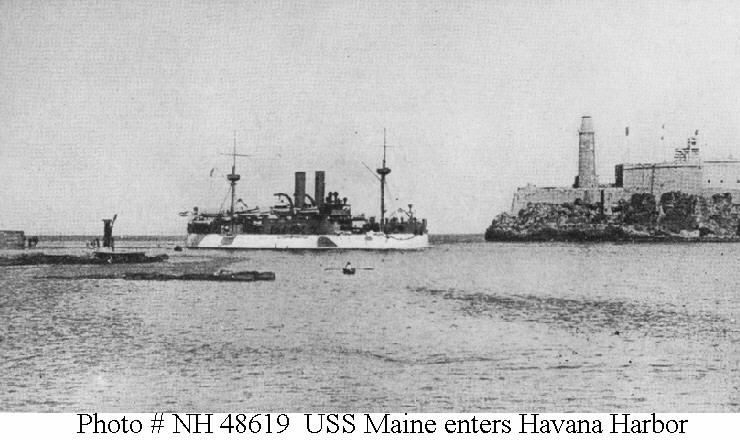
Passing Morro Castle as she entered Havana harbor, Cuba, on 25 January 1898. She was destroyed by explosion there some three weeks later, on 15 February.