Introduction
CHARLES LEO McKEONE was a well-known and much loved reporter in Camden, whose career spanned four decades. He was born in Philadelphia in 1867 and first started in journalism there. His father, Irish born Charles McKeone, was a graduate of Trinity College in Dublin who had come to Philadelphia and became wealthy as a soap manufacturer. The elder McKeone, in his later years, dabbled in journalism and as a war correspondent, wrote for The Freeman’s Journal from India and Sudan.
Charles Leo McKeone was afforded a college education but did not follow his father’s wishes to go into business. Instead he followed the path of the reporter, first in Philadelphia. He came to Camden in the late 1880s and wrote at one time or another for all of the major daily papers in the city, The Post, The Daily Telegram, The Post-Telegram, The Daily Courier, and in the last year of his life after the acquisition of the Post-Telegram by the Courier, the Courier-Post, which published two editions, the Morning Post and the Evening Courier.
In the late 1910s… the first found as of this writing is from January of 1919… Charles L. McKeone began writing a column called “Out of the Peppery Pot,” which soon became a daily feature. He was soon given the “by Mack” by-line for his column. In December of 1920 or January of 1921 the column became “The Peppery Pot—By Mack.” He also wrote a column from 1925 to 1927 called “Do You Remember” recounting events that happened 20 years previously.
The Peppery Pot was filled with McKeone’s reminisces of bygone days in Camden. As his obituary, which is immediately below, relates, he covered everything from sports to hangings, was well known and knew just about everybody. The Peppery Pot set the example for a host of men whose writings about Camden’s past graced the Courier-Post for the next 83 years, including Ben Courter, Dan McConnell, Frank Sheridan, Charley Humes, James O’Neill, Stephen O’Keefe, and Tom Bergbauer, whose last column appeared in 2010.
Charles L. McKeone passed away on December 16, 1927 at Cooper Hospital, he had been ill and in pain for quite some time, but had continued writing his daily column until shortly before his death, with one appearing on December 7, 1927. As no papers from the next 8 days are currently on-line, it is not known if that was the last “Peppery Pot.” What is known is that when it did not appear, the Courier-Post received many inquiries as to where their beloved Peppery Pot was.
Charles L. McKeone was buried at Calvary Cemetery in what was then Delaware Township (present-day Cherry Hill), New Jersey after services at the Church of the Holy Name in North Camden. His funeral was the first requiem mass held at Holy Name’s new building which was also dedicated that day. His pall bearers were Will Paul, Ben Courter, Stephen O’Keefe, Edward Teall, Frank Sheridan, and Benjamin Zorek, all members of the Courier’s staff.
Charles L. McKeone was a life-long bachelor. When he passed, his parents were long gone and it is unknown if any surviving relatives were located.
He also wrote a daily column from 1925 to 1927 called “Do You Remember,” recalling events that had happened twenty years before the then-current date. Two examples of the column can be found below.
‘Peppery Pot’ Mack Passes in Hospital
Camden Courier-Post —
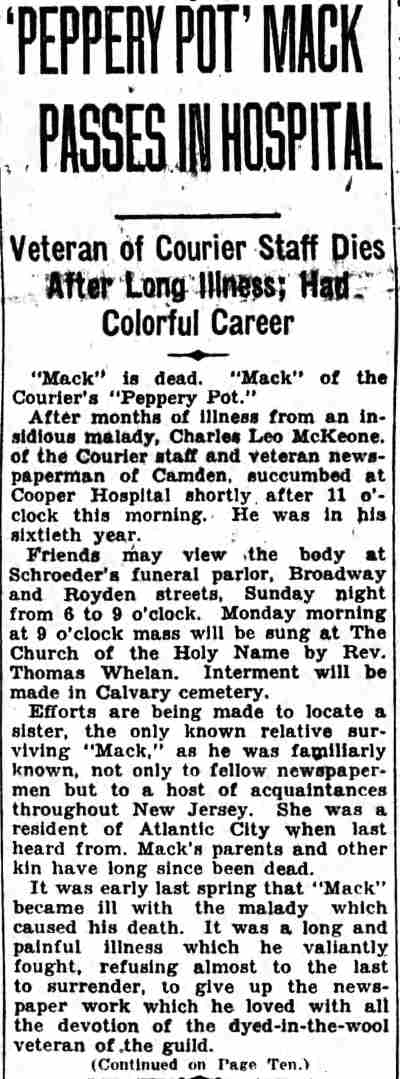

“Peppery Pot” Mack Passes in Hospital.
Veteran of Courier Staff Dies After Long Illness; Had Colorful Career.
“Mack” is dead. “Mack” of the Courier’s “Peppery Pot.”
After months of illness from an insidious malady, Charles Leo McKeone, of the Courier staff and veteran newspaperman of Camden, succumbed at Cooper Hospital shortly after 9 o’clock this morning. He was in his sixtieth year.
Friends may view the body at Schroeder’s Funeral parlor, Broadway and Royden streets, Sunday night from 6 to 9 o’clock. Monday morning at 9 o’clock mass will be sung at The Church of the Holy Name by Rev. Thomas Whelan. Interment will be made in Calvary cemetery.
Efforts are being made to locate a sister, the only known relative surviving “Mack,” a fact which was not generally known, not only to fellow newspapermen but to a host of acquaintances throughout New Jersey. She was a resident of Atlantic City when last heard from. Mack’s parents and other kin have long since been dead.
It was early last spring that “Mack” became ill with the malady which caused his death. It was a long and painful illness which he valiantly fought, refusing almost to the last to surrender, to give up the newspaper work which he loved with all the devotion of the dyed-in-the-wool veteran of the guild.
“Mack of the Courier”
Camden Courier-Post — (Editorial)
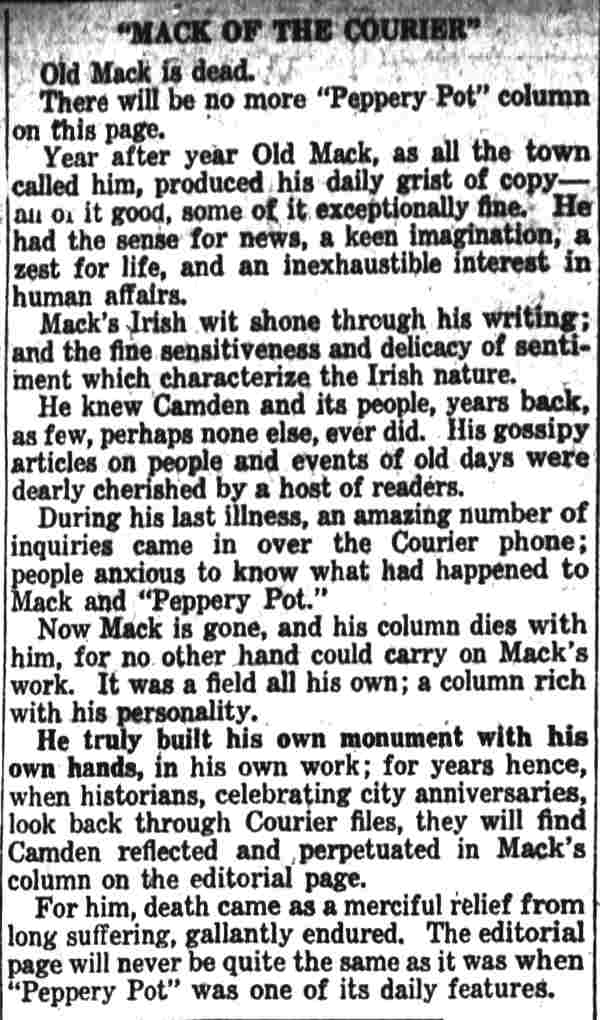
Old Mack is dead. There will be no more “Peppery Pot” column on this page.
Year after year Old Mack, as all the town called him, produced his daily grist of copy—all of it good, some of it exceptionally fine. He had the sense for news, a keen imagination, a zest for life, and an inexhaustible interest in human affairs.
Mack’s Irish wit shone through his writing; and the fine sensitiveness and delicacy of sentiment which characterize the Irish nature.
He knew Camden and its people, years back, as few, perhaps none else, ever did. His gossipy articles on people and events of old days were dearly cherished by a host of readers.
During his last illness, an amazing number of inquiries came in over the Courier phone; people anxious to know what had happened to Mack and “Peppery Pot.”
Now Mack is gone, and his column dies with him, for no other hand could carry on Mack’s work. It was a field all his own; a column rich with his personality.
He truly built his own monument with his own hands, in his own work; for years hence, when historians, celebrating city anniversaries, look back through Courier files, they will find Camden reflected and perpetuated in Mack’s column on the editorial page.
For him, death came as a merciful relief from long suffering, gallantly endured. The editorial page will never be quite the same as it was when “Peppery Pot” was one of its daily features.
Chas. L. M’Keone Dies Here After Long Suffering
Camden Courier-Post —

‘Mack’ of ‘Peppery Pot’ Fame, Friend of Oppressed, is Newspaper Veteran.
RITES SET FOR MONDAY.
After months of suffering and disease, “Mack” of “Peppery Pot” fame is dead.
Charles Leo McKeone, veteran newspaper reporter of Camden and veteran writer of the popular “Peppery Pot” column on the Courier’s editorial page, died in Cooper Hospital Friday after months of illness. He was in his sixtieth year.
Funeral services will be held Monday morning at 9 o’clock in the Church of the Holy Name. Interment will be made in Calvary Cemetery.
‘Peppery Pot Mack’ Laid to Rest Today
Camden Courier-Post —
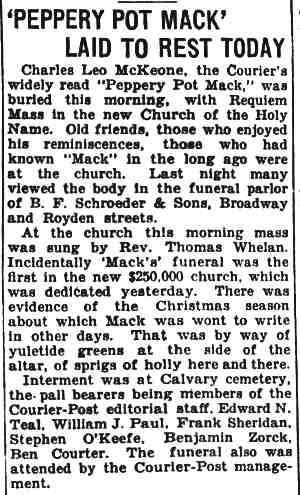
Charles Leo McKeone, the Courier’s widely read “Peppery Pot Mack,” was buried this morning, with Requiem Mass in the new Church of the Holy Name. Old friends, those who enjoyed his reminiscences, those who had known “Mack” in the long ago were at the church. Last night many viewed the body in the funeral parlor of B. F. Schroeder & Sons, Broadway and Royden streets.
At the church this morning mass was sung by Rev. Thomas Whelan. Incidentally “Mack’s” funeral was the first in the new $250,000 church, which was dedicated yesterday. There was evidence of the Christmas season about which Mack was wont to write in other days. That was by way of yuletide greens at the side of the altar, of sprigs of holly here and there.
Interment was at Calvary cemetery, the pall bearers being members of the Courier-Post editorial staff: Edward N. Teal, William J. Paul, Frank Sheridan, Stephen O’Keefe, Benjamin Zorck, Ben Courter. The funeral also was attended by the Courier-Post management.
Dan McConnell’s Scrapbook
Camden Courier-Post —
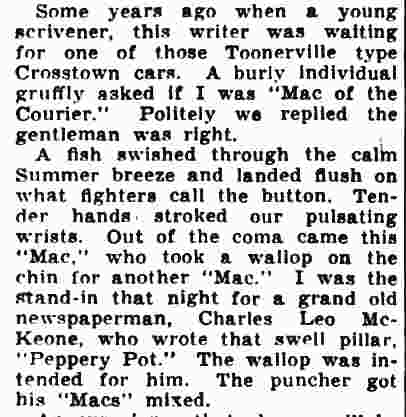
Excerpt from Dan McConnell’s Scrapbook — Camden Courier-Post, January 11, 1938
Dan McConnell’s Scrapbook
Camden Courier-Post —
Not forgetting a friend since boyhood days as an embryo news gatherer— the revered Charles Leo McKeone, of “peppery pot” fame.
Back in the days when this young scrivener wrote one of the pioneer columns, “The Razzberry Chorus,” it was “Old Mac” who when meeting him on our Police Court beat would chuckle at something we had written.
They were days when we sported those tortoise shell spectacles and our hirsutal adornment consisted of a wavy, pompadour. Mac repeating our resemblance to Harold Lloyd, the screen comic who was then earning possibly $100,000 a year and our pay check was for all of $15.
— Dan McConnell’s Scrapbook, Camden Courier-Post, February 22, 1938
The White Horse Piker
Camden Courier-Post —
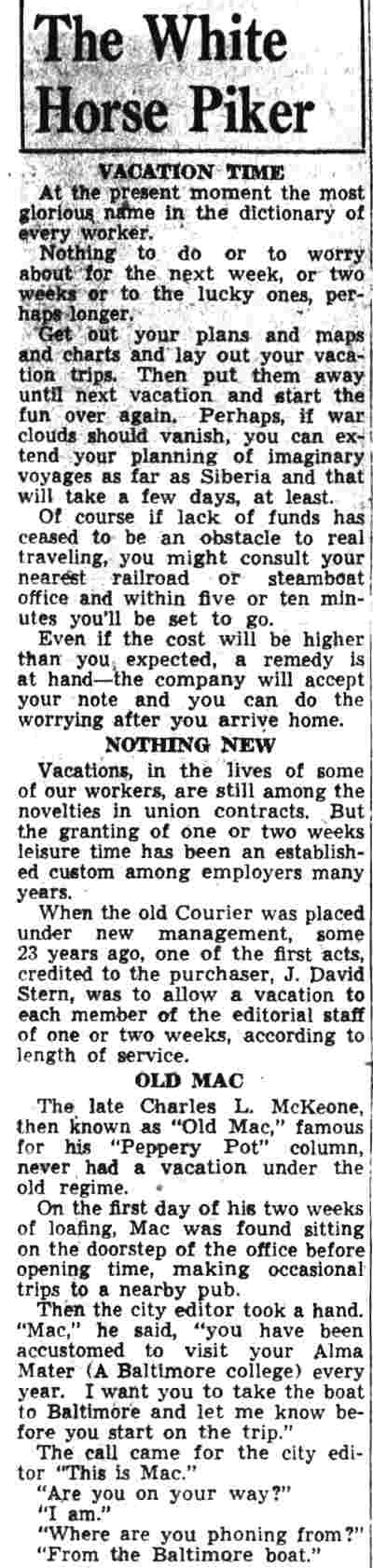
J. David Stern — Camden Courier-Post, June 20, 1941
Out of the Peppery Pot & The Peppery Pot by Mack
Column Index
The following dates represent issues of the column that have been located. Many additional issues exist; this index is a work in progress.
- 1919: January 23 – February 2 – March 10 – April 3 – May 10 – June 20 – July 10 – August 3 – September 10 – October 20 – November 10 – December 20
- 1924: March 17 – August 22 – October 7
- 1926: May 10
- 1927: March 29 – October 27 – December 7
Out of the Peppery Pot
Camden Daily Courier —
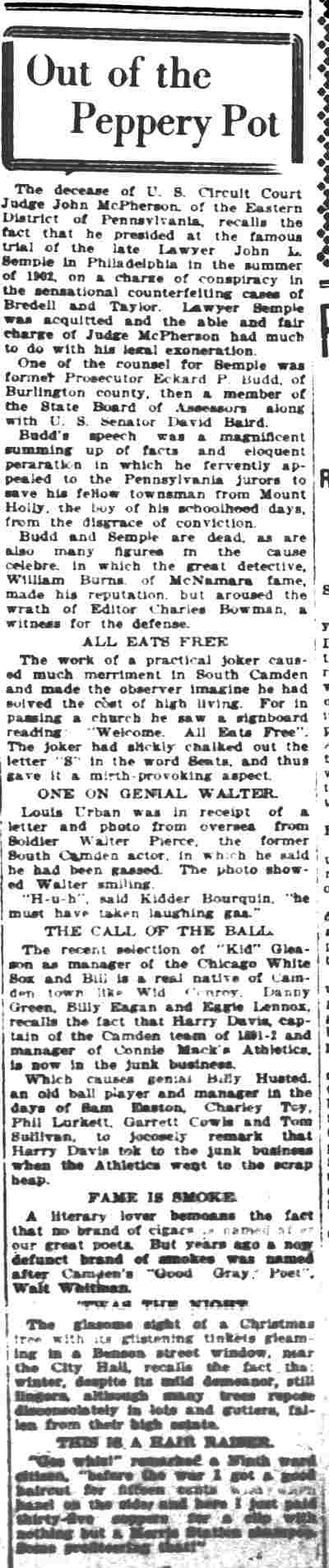
Budd’s speech was a magnificent summing up of facts and eloquent appeal in which he fervently appealed to the Pennsylvania Jurers to save his fellow townsman from Mount Holly, the boy of his neighborhood, from the disgrace of conviction.
Budd and Semple are dead, as are many other figures in the cause celebre in which the great detective, William Burns of McNamara fame, made his reputation, but aroused the wrath of Editor Charles Bowman, a witness for the defense.
All Ears Free
The work of a practical joker caused much merriment in South Camden and everywhere else he had edited the chat of high living. For in passing a church he saw a signboard reading “Welcome, All Ears Free”.
The joker had slickly chalked out the letter “S” in the word “Seats,” and thus produced a mirth-provoking aspect.
One on Genial Walter
Louis Urban was in receipt of a card and photo of the overdraw from Soldier Walter Pierce, the former South Camden actor. In which he said he had been praised. The photo showed a smiling Walter smiling “H-u-b”, said Kidder Bourquin, “be must have taken laughing gas”.
The Call of the Ball
The recent selection of “Kid” Gleason as Manager of the Chicago White Sox and Bill is a real native of Camden town like Wid Conroy, Danny Green, Billy Eagan and Eddie Lennox, recalls the fact that Harry Davis, captain of the Camden team of that manager of Connie Mack Athletics, is now in the junk business.
Danny Green knew young Billy Husted, an old ball player and manager in the days of Sam Easton, Charles Toy, Phil Lurkett, Garrett Cowls, Tom Sullivan, to jocosely remark that Harry Davis took to the junk business to exchange old scrap heap.
Fame is Smoke
A literary lover bemoans the fact that no brand of cigars is named after our great poets. “Bad years ago a new defunct brand of cigars was named “Good Gray Poet” – Walt Whitman.
On Christmas
One told of a Christmas tree with its glistening tinsel shaming in a Boston street window, near the open fire, where the passer-by, a winter, despite his mild demeanor, still lingered, struck with the beauty and grace of it slowly in late afternoon fall-to from their high estate.
Peppery Pot in Pamphlet Form
Camden Courier-Post —
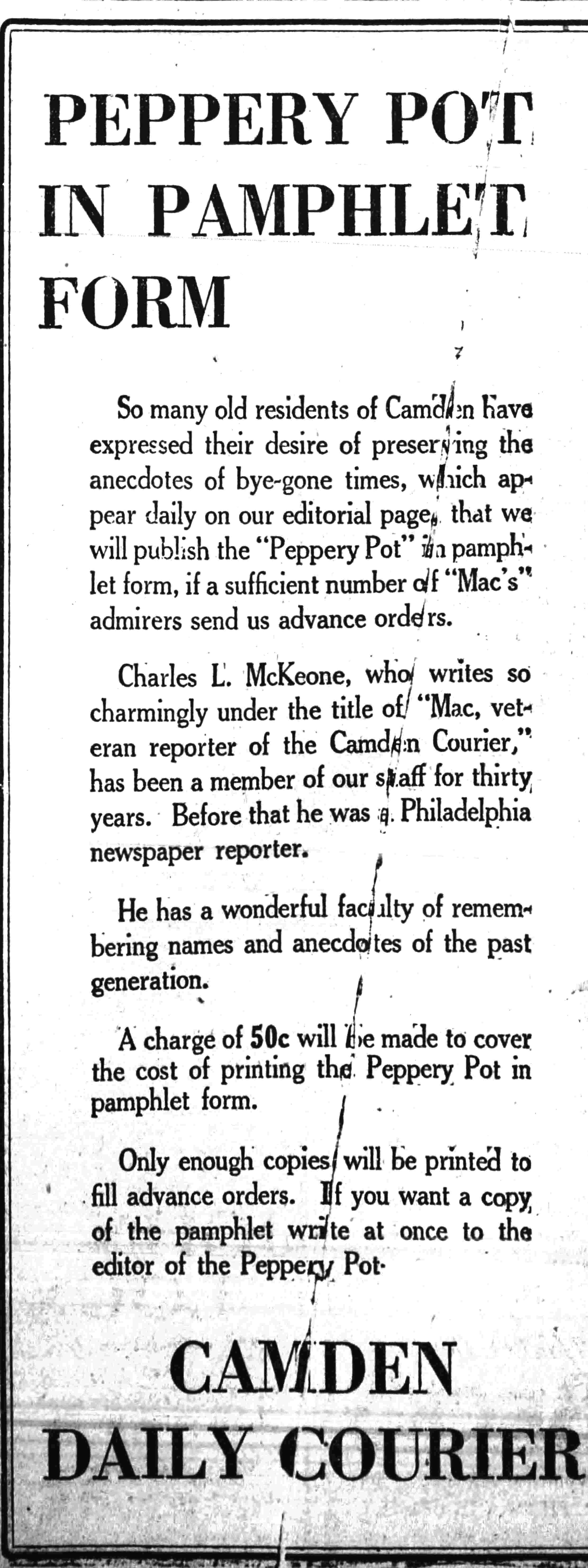
So many old residents of Camden have expressed their desire for preserving the anecdotes of bye-gone times, which appear daily on our editorial pages, that we will publish the “Peppery Pot” in pamphlet form, if a sufficient number of “Mac’s” admirers send us advance orders.
Charles L. McKeone, who writes so charmingly under the title of “Mac,” veteran reporter of the Camden Courier, has been a member of our staff for thirty years. Before that he was a Philadelphia newspaper reporter. He has a wonderful faculty of remembering names and anecdotes of the past generation.
A charge of 50¢ will be made to cover the cost of printing the Peppery Pot in pamphlet form. Only enough copies will be printed to fill advance orders. If you want a copy of the pamphlet write at once to the editor of the Peppery Pot in: Camden Daily Courier.
The Peppery Pot by Mack
Camden Courier-Post —
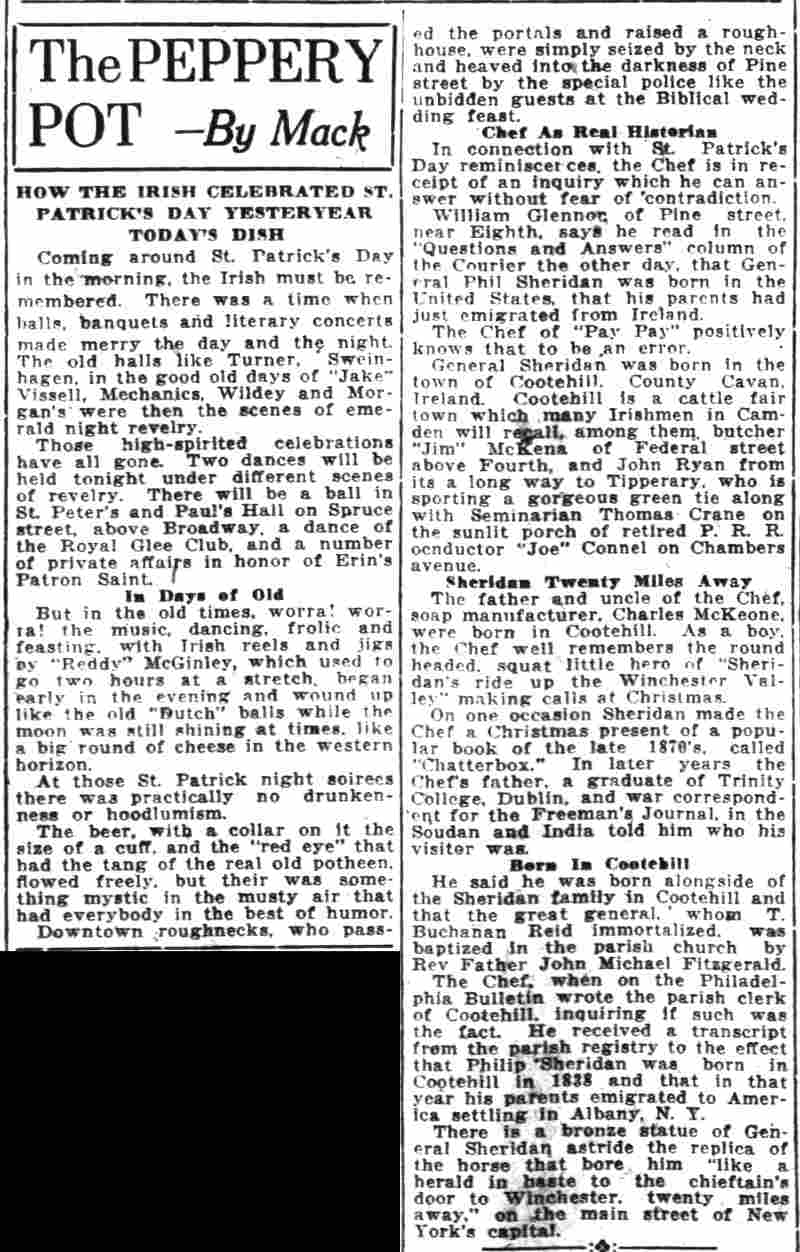
This Peppery Pot column discusses the history of various entertainment halls and venues in Camden including Turner Hall, Morgan Hall, Wildey Hall, Sweinhagen Hall, Mechanic’s Hall, and Ss. Peter & Paul’s Hall. The column also references notable figures such as Jake Vissell, William Glennon, General Philip Sheridan, John Ryan, James McKenna, John “Reddy” McGinely, Thomas Crane, Joseph Connell, and Chambers Avenue.
The column maintains McKeone’s typical style of reminiscing about Camden’s entertainment and social history, describing the various halls and their importance to the city’s cultural life and the people who patronized them.
The Peppery Pot by Mack
Camden Daily Courier —
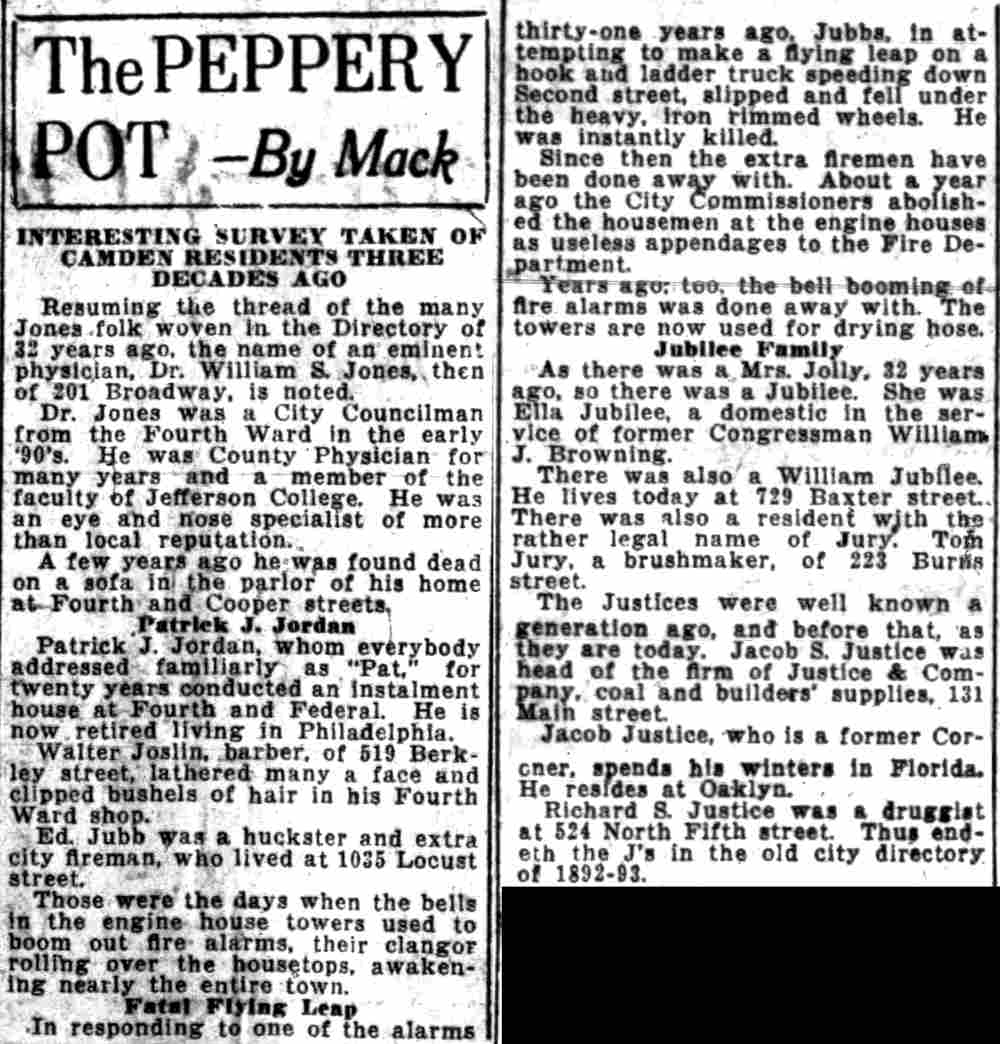
This Peppery Pot column contains reminiscences and references to notable Camden citizens including Dr. William S. Jones, Patrick J. Jordan, Ed Jubb, Mrs. Jolly, Ella Jubilee, William J. Browning, William Jubilee, and various Camden streets including Locust Street, Berkley Street, Burns Street, Baxter Street, Jacob Justice, Richard S. Justice, Main Street, and North 5th Street.
The column discusses various historical events, personalities, and street life in Camden from earlier periods, maintaining McKeone’s characteristic style of reminiscence and social commentary on the city’s past.
The Peppery Pot by Mack
Camden Daily Courier —
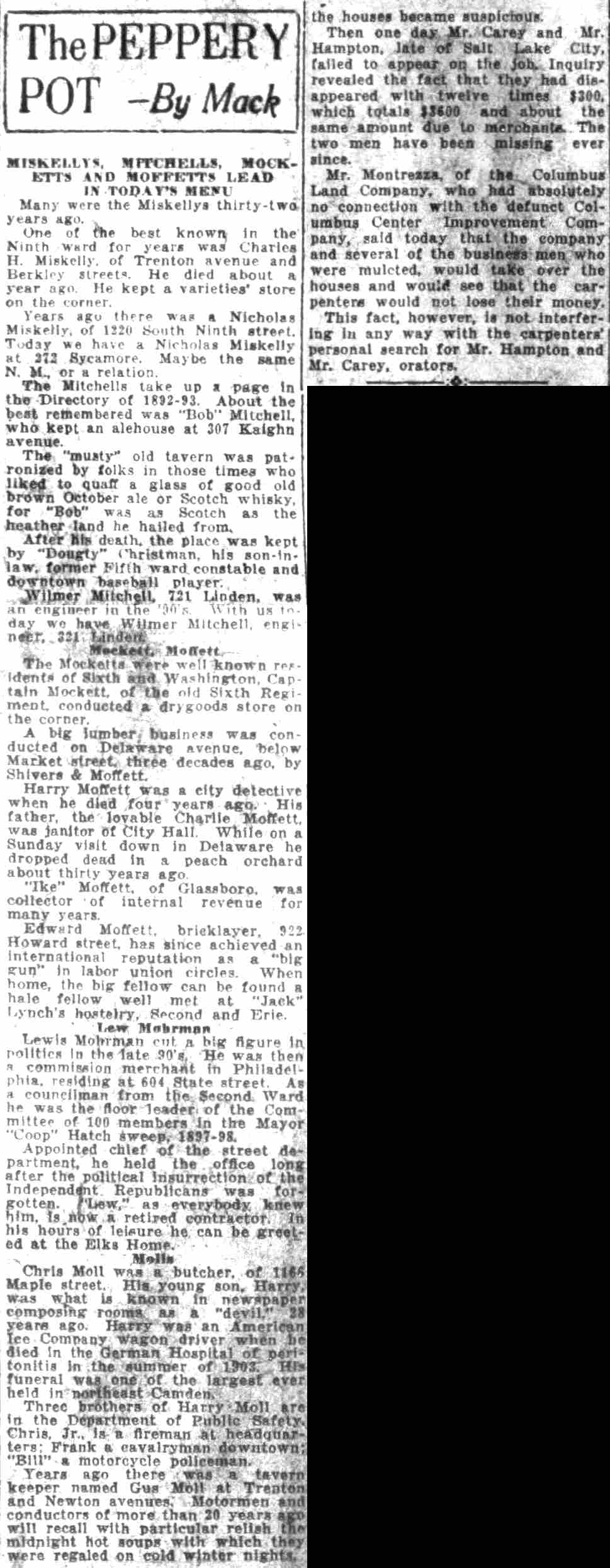
Miskellys, Mitchells, Mocketts and Moffetts Lead in Today’s Menu
Many were the Miskellys thirty-two years ago.
One of the best known in the Ninth ward for years was Charles H. Miskelly, of Trenton avenue and Berkley streets. He died about a year ago. He kept a varieties’ store on the corner.
Years ago there was a Nicholas Miskelly, of 1220 South Ninth street. Today we have a Nicholas Miskelly at 272 Sycamore. Maybe the same N. M., or a relation.
The Mitchells take up a page in the Directory of 1892-93. About the best remembered was “Bob” Mitchell, who kept an alehouse at 307 Kaighn Avenue.
The “musty” old tavern was patronized by folks in those times who liked to quaff a glass of good old brown October ale or Scotch whisky, for “Bob” was as Scotch as the heather land he hailed from.
After his death, the place was kept by “Dougty” Christman, his son-in-law, former Fifth ward constable and downtown baseball player.
Wilmer Mitchell, 721 Linden, was an engineer in the ’90’s. With us today we have Wilmer Mitchell, engineer, 321 Linden.
Mockett, Moffett
The Mocketts were well known residents of Sixth and Washington. Captain Mockett, of the old Sixth Regiment, conducted a drygoods store on the corner.
A big lumber business was conducted on Delaware avenue, below Market street, three decades ago, by Shivers & Moffett.
Harry Moffett was a city detective when he died four years ago. His father, the lovable Charlie Moffett, was janitor of City Hall. While on a Sunday visit down in Delaware he dropped dead in a peach orchard about thirty years ago.
“Ike” Moffett, of Glassboro, was collector of internal revenue for many years.
Edward Moffett, bricklayer, 922 Howard street, has since achieved an international reputation as a “big gun” in labor union circles. When home, the big fellow can be found a hale fellow well met at “Jack” Lynch’s hostelry, Second and Erie.
Lew Mohrman
Lewis Mohrman cut a big figure in politics in the late 90’s. He was then a commission merchant in Philadelphia, residing at 604 State street. As a councilman from the Second Ward he was the floor leader of the Committee of 100 members in the Mayor “Coop” Hatch sweep, 1897-98.
Appointed chief of the street department, he held the office long after the political insurrection of the Independent Republicans was forgotten. “Lew,” as everybody knew him, is now a retired contractor. In his hours of leisure he can be greeted at the Elks Home.
Molls
Chris Moll was a butcher, of 1165 Maple street. His young son, Harry, was what is known in newspaper composing rooms as a “devil,” 28 years ago. Harry was an American Ice Company wagon driver when he died in the German Hospital of peritonitis in the summer of 1903. His funeral was one of the largest ever held in northeast Camden.
Three brothers of Harry Moll are in the Department of Public Safety. Chris, Jr., is a fireman at headquarters; Frank a cavalryman downtown; “Bill” a motorcycle policeman.
Years ago there was a tavern keeper named Gus Moll at Trenton and Newton avenues. Motormen and conductors of more than 20 years ago will recall with particular relish the midnight hot soups with which they were regaled on cold winter nights.
The Peppery Pot by Mack
Camden Daily Courier —

Fogarty Avenue, the Shortest Street
Fogarty Avenue, Camden, N.J., is the shortest and narrowest street in the United States, if not in the world. It is one block long and five feet four inches in width. The street is paved, houses face the curb on each side and it is located in one of the most densely populated tenement sections of the city.
Camden Has No Seething Tenements
From the reading of that paragraph one would picture merely an avenue as something like Avenue A, or the Bowery, in New York. The fact is there is not a teeming or any other kind of a public tenement in all that section of Camden. Not a dwelling towering high enough to require fire escapes. All two- and three-story buildings on Fogarty Street between Federal and the railroad, which is none other than the “Mackerelville” made famous by that county Cavan lad, Martin Kenney.
How “Mackerelville” Got Named
Fogarty Avenue is what, and has been for half a century, the boulevard of that section of Captain Ulie Lee’s old 8th ward ballwick, known as “Mackerelville.” which runs from Haddon Avenue and Andy Lyons’ old marble yard to the 10th street junction with Federal street and former Bridge avenue, flanxing the settlement on either side, north and south. Populated almost entirely by Irish folks, Pennsylvania Railroad men and families, it was jocularly dubbed “Mackerelville” on account of the Celts’ love for fish.
But there was no poor fish among those hardworking, honest, hearty-souled sons of Erin, as thanks to the Bishop Bailey Building and Loan Association, every mother’s son of the pioneer residents’ left houses and bank accounts, although their average weekly wages didn’t range over twelve or fifteen dollars at the most. And all with big families, too.
Doesn’t Average More Palatably
But the Chef is digressing from what he started out to state in his second “call-down” of the Bloomington “Blade and Ledger.” That was as to Fogarty Avenue being the shortest and narrowest street in the United States.
Far from it. Excluding the United States even, the Chef of Pep Pep can, right out of memory, mention a dozen highways in Camden, N.J., shorter and narrower than far famed Fogarty Avenue.
Most all short and narrow thoroughfares in Camden bear the aristocratic appellation of avenue. But among some of the shorter and narrower streets than Fogarty Avenue, some only running a third of a square, the Chef mentions: Bella Place; Pennsylvania Avenue; Columbia Avenue; Coates Avenue; Pavonia Street; Centennial Avenue; Wagner Court; Cleveland Terrace; Ann Street; Hyde Park; Segal Street (old “Battle Ax Row”); and maybe Joint Alley and Old Buzzard’s Glory, which is only half of it besides itself, to say nothing of disjointed...
The Peppery Pot by Mack
Camden Daily Courier —

Distinguished Citizens of Alien Birth
Oh, yes, we had foreign born citizens within our time, and mighty useful and distinguished adopted citizens they were, too. Who held the highest office in the gift of the sovereign people of the state, United States Senator. One was Hon. David Baird, born in county Derry, Ireland, 88 years ago, and who was only recently laid to rest in his Haileigh Cemetery mausoleum while the entire city, regardless of creed or politics, mourned. The other was a fellow countryman of former Senator Baird. Hon. William Joyce Sewell, born in county Down, Ireland, in 1835, came to America in his youth, and after sailing the four oceans and seven seas of the globe, emerged from the Civil War a major general by brevet for gallantry at Chancellorsville, and was at the time of his death in 1901 United States Senator from New Jersey, a vice president of the Pennsylvania Railroad, Republican czar of the state, and brigadier general of the National Guard of N.J.
Two U.S. Senators and a Mayor
The Chef of Peppery Pot cannot recall or learn of any other high officials of Camden city or county, past or present, who were born on alien soil outside of former United States Senators David Baird and William J. Sewell, and the 26th Mayor of Camden, Claudius W. Bradshaw, 1880-86. Born in Sheffield, England, “Claudie” Bradshaw was the first adopted alien to be elected Mayor of an American city. He served three terms of two years each, and was after a fourth when defeated by Mayor Jesse Frech, Republican-Prohibition candidate in 1886.
Policeman Who Was College Graduate
True there were a number of minor officials, clerks, policemen, firemen and the like, who were naturalized from other lands. One died within the year, pensioned Policeman Rudolphus Climes, who passed away on his lonely little farm near Marlton. Having a wife and very large family, Captain Lewis Stehr used to take him down at Christmas time a wagonload of clothing, household utensils, provisions for the pantry, goodies for the little ones, needs and implements for the farm, along with a fat purse of gold, and Johnny Currin helped wonderfully too by making Farmer Climes a present of a fine big, strapping steed. Climes was said to have been a graduate of a college in Warsaw, Poland, and as a policeman proved a valuable aid to the department in unraveling crimes among the polyglot populations of South Camden, and asmoothing over their feuds and troubles.
“Joe” Potter Might Have Been
There was another English born citizen of Camden who aspired to be mayor of Camden town. He was the late councilman and Assemblyman Joseph Potter, who first saw the light of day in the Northamptonshire hills of merrie England. A straw hat manufacturer, and a most genial, popular and polished gentleman, Billy “Joe” Potter put an unconscious crimp in his own boom for mayor by his habit for many years of taking a summer trip to his native heath on the eve of the Fourth of July. To many residents that did not look the grateful thing for an English born citizen to do, although “Joe” Potter meant to cast no aspersion on the great American holiday in so acting, but it appeared never as if the Republican leaders could be induced to name Joseph Potter, estimable citizen and publicist as he was in all other particulars, candidate for mayor. The political realized his mistake, but did not sulk under his keen disappointment, and was as stalwart a Republican as ever up to his untimely taking off in an automobile accident a few years ago.
Pattern Up On Cornmeal and Cider
“Back from up the Cherry Valley of Pa., and heftier by pounds I’ll swear, after fattening platters of mush, scrapple, corndodger and slapjacks washed down by 10 percent hard cider, brought home from the old Rubberneck as he again began the day to the cheering jangling of the Broadway chimes.”
The Peppery Pot by Mack
Camden Daily Courier —
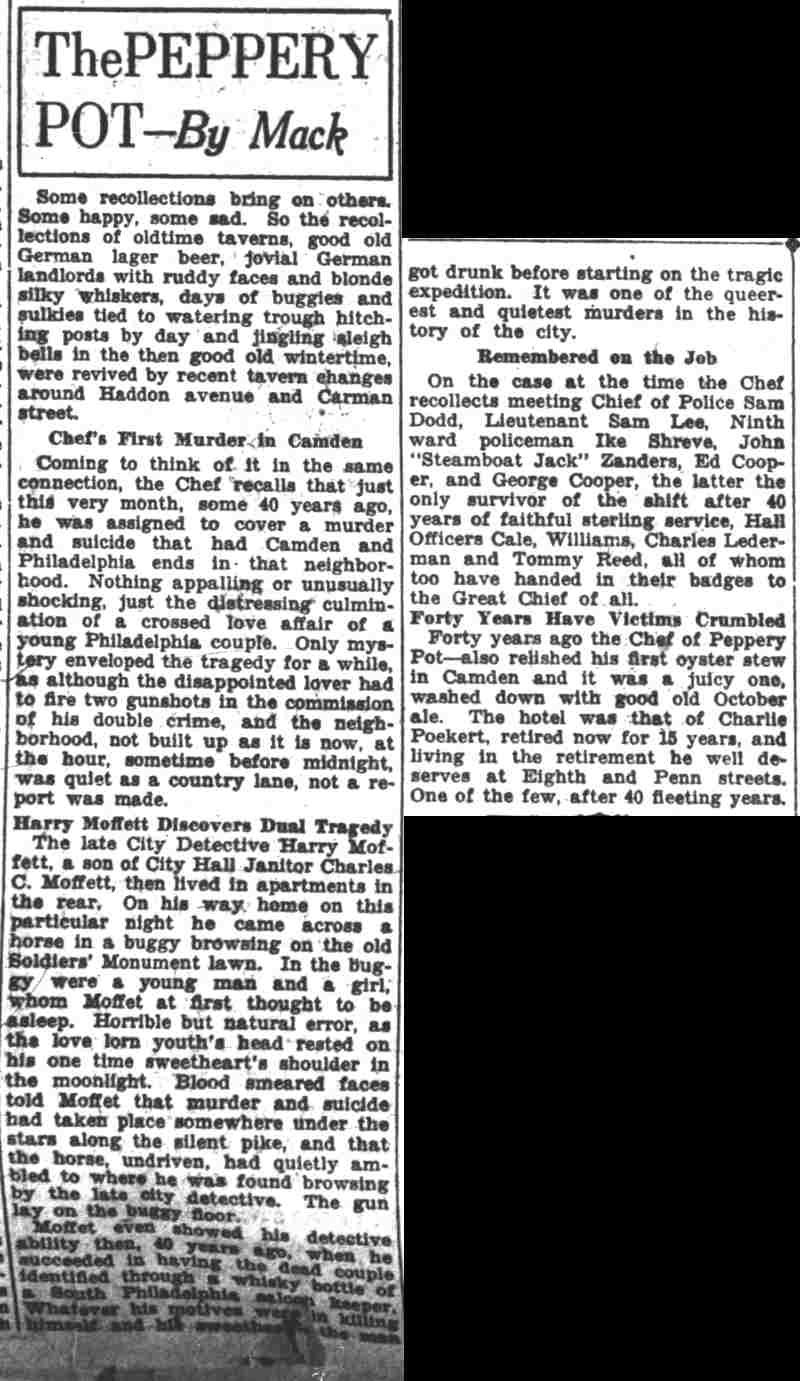
Chef’s First Murder in Camden
Coming to think of it in the same connection, the Chef recalls that just prior, very month, some 40 years ago, he was assigned to cover a murder and suicide that had Camden and Philadelphia as the scene of that neighborhood. Nothing appalling or unusually absorbing, just the distressing culmination of a crossed love affair of a young Philadelphia couple. Only a mystery enveloped the tragedy for a while, as although the disappointed lover had to five two chapters in the commission of his double crime, and the neighborhood, not built up as it is now, at the hour, sometime before midnight, made the quiet as a country lane, not a report was made.
Harry Moffett Discovers Dual Tragedy
The late City Detective Harry Moffett, a son of City Hall Janitor Charles C. Moffett, then lived a partnership in the rear. On his way home on this particular night he came across a horse in a buggy browsing on the old Soldiers’ Monument lawn. In the buggy were a young man and a girl, whom Moffett thought to be asleep. Horrible but painful error, as the love born youth’s head rested on his one time sweetheart’s shoulder in the moonlight. Blood smeared faces told Moffett that murder and suicide had taken place somewhere under the stars and in full pike, and that the horse, undriven, had quietly untied to where he was found browsing by the nearby objectives. The gun that had done his detective business was lying in having the dead couple.
Remembered on the Job
On the case at the time the Chef recollects meeting Chief of Police Sam Dodd. Lieutenant Sam Lee, ward policeman Ike Shrieve, John “Steamboat Jack” Zanders, Ed Cooper, and George Cooper, the latter the only survivor of the shift after 40 years of faithful sterling services, Hall Officers Cale Williams, Charles Lederman, and Tommy Reed, all of whom too have handed in their badges to the Great Chief of all.
Forty Years Have Victims Crumbled
Forty years ago the Chef of Peppery Pot—also relished his first oyster stew in Camden and it was a juicy one, washed down with good old October ale. The hotel was that of Charlie Pockert, retired now for 15 years, and living as a gentleman at Eighth and Penn streets. One of the few, after 40 fleeting years...
The Peppery Pot by Mack
Camden Daily Courier —
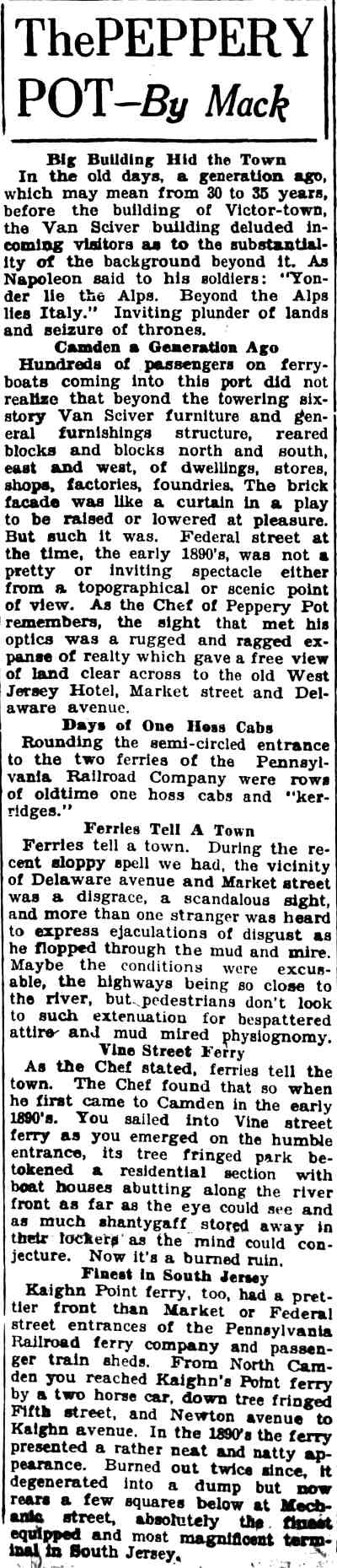
Big Building Hid the Town
In the old days, a generation ago, which may mean from 30 to 35 years, before the building of Victor-town, the Van Sciver building deluded incoming visitors as to the substantiality of the background beyond it. As Napoleon said to his soldiers: “Yonder lie the Alps. Beyond the Alps lies Italy.” Inviting plunder of lands and seizure of thrones.
Camden a Generation Ago
Hundreds of passengers on ferryboats coming into this port did not realize that beyond the towering six-story Van Sciver furniture and general furnishings structure, reared blocks and blocks north and south, east and west, of dwellings, stores, shops, factories, foundries. The brick facade was like a curtain in a play to be raised or lowered at pleasure. But such it was. Federal street at the time, the early 1890’s, was not a pretty or inviting spectacle either from a topographical or scenic point of view. As the Chef of Peppery Pot remembers, the sight that met his optics was a rugged and ragged expanse of realty which gave a free view of land clear across to the old West Jersey Hotel, Market street and Delaware avenue.
Days of One Hoss Cabs
Rounding the semi-circled entrance to the two ferries of the Pennsylvania Railroad Company were rows of oldtime one hoss cabs and “kerridges.”
Ferries Tell A Town
Ferries tell a town. During the recent sloppy spell we had, the vicinity of Delaware avenue and Market street was a disgrace, a scandalous sight, and more than one stranger was heard to express ejaculations of disgust as he flopped through the mud and mire. Maybe the conditions were excusable, the highways being so close to the river, but pedestrians don’t look to such extenuation for bespattered attire and mud mired physiognomy.
Vine Street Ferry
As the Chef stated, ferries tell the town. The Chef found that so when he first came to Camden in the early 1890’s. You sailed into Vine street ferry as you emerged on the humble entrance, its tree fringed park betokened a residential section with boat houses abutting along the river front as far as the eye could see and as much shantygaff stored away in their lockers as the mind could conjecture. Now it’s a burned ruin.
Finest in South Jersey
Kaighn Point ferry, too, had a prettier front than Market or Federal street entrances of the Pennsylvania Railroad ferry company and passenger train sheds. From North Camden you reached Kaighn’s Point ferry by a two horse car, down tree fringed Fifth street, and Newton avenue to Kaighn avenue. In the 1890’s the ferry presented a rather neat and natty appearance. Burned out twice since, it degenerated into a dump but now rears a few squares below at Mechanic street, absolutely the finest equipped and most magnificent terminal in South Jersey.
Do You Remember — July 15, 1906
Camden Courier-Post —
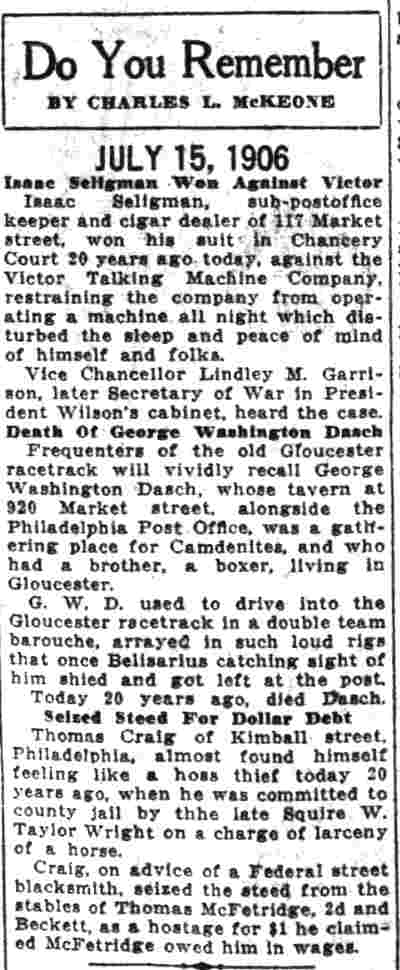
Isaac Seligman Won Against Victor
Isaac Seligman, sub-postoffice keeper and cigar dealer of 117 Market street, won his suit in Chancery Court 20 years ago today, against the Victor Talking Machine Company, restraining the company from operating a machine all night which disturbed the sleep and peace of mind of himself and folks.
Vice Chancellor Lindley M. Garrison, later Secretary of War in President Wilson’s cabinet, heard the case.
Death Of George Washington Dasch
Frequenters of the old Gloucester racetrack will vividly recall George Washington Dasch, whose tavern at 920 Market street, alongside the Philadelphia Post Office, was a gathering place for Camdenites, and who had a brother, a boxer, living in Gloucester. G. W. D. used to drive into the Gloucester racetrack in a double team barouche, arrayed in such loud rigs that once Belisarius catching sight of him shied and got left at the post. Today 20 years ago, died Dasch.
Seized Steed For Dollar Debt
Thomas Craig of Kimball street, Philadelphia, almost found himself feeling like a horse thief today 20 years ago, when he was committed to county jail by the late Squire W. Taylor Wright on a charge of larceny of a horse. Craig, on advice of a Federal street blacksmith, seized the steed from the stables of Thomas McFettridge, 2d and Beckett, as a hostage for $1 he claimed McFettridge owed him in wages.
Do You Remember — March 29, 1907
Camden Courier-Post —
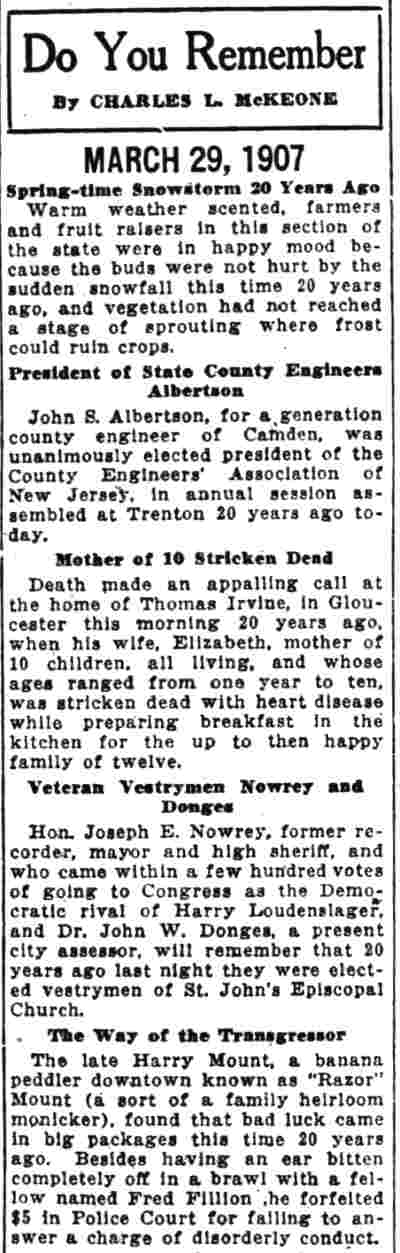
Spring-time Snowstorm 20 Years Ago
Warm weather scented, farmers and fruit raisers in this section of the state were in happy mood because the buds were not hurt by the sudden snowfall this time 20 years ago, and vegetation had not reached a stage of sprouting where frost could ruin crops.
President of State County Engineers Albertson
John S. Albertson, for a generation county engineer of Camden, was unanimously elected president of the County Engineers’ Association of New Jersey, in annual session assembled at Trenton 20 years ago today.
Mother of 10 Stricken Dead
Death made an appalling call at the home of Thomas Irvine, in Gloucester this morning 20 years ago, when his wife, Elizabeth, mother of 10 children, all living, and whose ages ranged from one year to ten, was stricken dead with heart disease while preparing breakfast in the kitchen for the up to then happy family of twelve.
Veteran Vestrymen Nowrey and Donges
Hon. Joseph E. Nowrey, former recorder, mayor and high sheriff, and who came within a few hundred votes of going to Congress as the Democratic rival of Harry Loudenslager, and Dr. John W. Donges, a present city assessor, will remember that 20 years ago last night they were elected vestrymen of St. John’s Episcopal Church.
The Way of the Transgressor
The late Harry Mount, a banana peddler downtown known as “Razor” Mount (a sort of a family heirloom monicker), found that bad luck came in big packages this time 20 years ago. Besides having an ear bitten completely off in a brawl with a fellow named Fred Fillion, he forfeited $5 in Police Court for failing to answer a charge of disorderly conduct.