Introduction
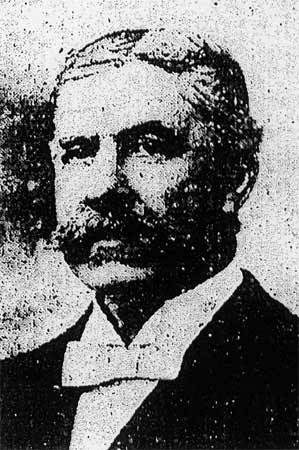
Aaron Ward
Aaron Ward was born November 26, 1834 to Mason and Hannah Barton Ward in what was then Newton Township, Gloucester County, New Jersey. This location is presently within the borders of the City of Camden. He was the youngest of eight children, and interestingly enough, the second child born to Mason and Hannah Ward named Aaron. A brother named Aaron had been born in 1829 but died before his third birthday.
Aaron Ward was educated at Westtown Academy, Westtown, Pennsylvania. He married Anna Bates on November 8, 1854. A daughter, Lettie Allen Ward, was born March 3, 1859. Son Franklin was born August 12, 1860. Another daughter, Hannah, arrived shortly thereafter. At the time of the 1860 Census the Ward family was living in Camden's North Ward. Aaron Ward was then earning a living as a house carpenter, as was his brother E. Allen Ward. In 1861 he was elected to Camden's City Council.
During the War Between the States, Aaron Ward answered his country's call. He enlisted on September 3, 1862. On the 16th of September, at Camp Cadwalader in Beverly, New Jersey, he mustered in as Captain of Company D, Twenty-fourth Regiment, New Jersey Volunteers, one of eleven regiments raised in response to President Lincoln's call for 300,000 troops to serve for a nine-month's enlistment. Company D had men from Camden, Gloucester City, and Glassboro.
Serving under Lieutenant Colonel Frank L. Knight, Captain Ward's company arrived in Washington, D.C. on October 1st, 1862. The Twenty-fourth Regiment was placed in the Provisional Brigade of General Carey's division. On December 9th they reached the Rappahannock opposite Fredericksburg, and was transferred to the First Brigade, under Brigadier General Nathan Kimball, part of Major General William H. French's Third Division, Second Army Corps. During the December 13th, 1862 assault on Fredericksburg, the raw troops of the Twenty-fourth Regiment advanced nearer the Confederate defenses than any other command save the Irish Regiments, and paid for that ground grievously, losing 160 killed and wounded.
George Reeser Prowell wrote of the Twenty-fourth New Jersey's actions at Fredericksburg in 1880, “They held the ground tenaciously until relieved, but even then were compelled to seek refuge in and about the burning buildings where, prostrate on the earth, they were exposed to the shot and shell.”
Company D lost three killed and twelve wounded during this battle. Captain Aaron Ward was shot through the lungs, a wound that for most in the Civil War would have proved fatal. He was fortunate and made a full recovery.
The Twenty-Fourth New Jersey Regiment went into camp for four months after Fredericksburg. On April 2, 1863 copies of the “Peace Resolutions” which had been passed by the New Jersey state legislature, reached camp. Mass meetings were held where the soldiers in Prowell's words, “indignantly denounced” them.
On May 3rd, 1863 the Twenty-Fourth New Jersey Regiment took part in the Battle of Chancellorsville. During that action forty men were either killed, wounded or listed as missing. Captain Aaron Ward may have been there, but most likely was not. He was discharged from service on May 31, 1863, and returned to his wife and family in Camden.
On his return to home and hearth in Camden Aaron Ward returned to his seat on City Council. In 1864 it is known that he was, as a member of City Council, serving on the Committee on Accounts. The Aaron Ward family were then living at 323 Plum Street. Plum Street was later renamed Arch Street. He was involved in real estate and insurance by the time of the 1870 Census. Around 1874 he established a business as a “street and road” Contractor. The Ward family then lived at 821 South 8th Street between Pine and Division Streets. Aaron Ward also operated his business out of this location.
Aaron Ward enjoyed great success as a Contractor, and was awarded several government projects. He built the first bridge across the Cooper River at Baird Avenue in 1903, and he also built another at Kaighn Avenue to cross the river, then known as Cooper's Creek. He built a concrete wharf at the foot of Cooper Street that was utilized for many decades, and in South Camden Aaron Ward's firm built the Line Ditch sewer. His obituary read “…that his greatest achievement was the Line Ditch sewer in which he saved the city thousands of dollars after numerous other contractors cited the difficulties of such a sewer at this place because of quicksands. Mr. Ward mastered these difficulties and the sewer is a memorial to his worth as a Contractor.”
Annie Ward passed away after 1880. Aaron Ward would remarry twice afterwards, and lived to his eightieth year. He passed away on June 26, 1915, survived by his then wife Sarah W. H. Ward, son Franklin, daughters Dr. Lettie Ward, Mrs. Hannah Bardo, and Elizabeth Ward, a child of his third marriage.
Aaron Ward was buried at Harleigh Cemetery in Camden. Well known and respected in the city, his pallbearers were David Baird, Levi Farnham, Sidney P. McCord, Isaiah Hatch, Frank S. Heisler, and William C. Riggs.
On his father's passing, Franklin Ward continued in the construction business. Oldest daughter Lettie Allen Ward after teaching until her 30s, became a physician in 1897, gaining distinction as being one of Camden's first female doctors. She lived and practiced general medicine at 704 Broadway, and also was known as a specialist in ailments of the ear, nose, and throat. Elizabeth Ward would also become a physician. Aaron Ward's older brother E. Allen Ward was also a Contractor, and is noted as the man who built the Camden City Hall which stood on Haddon Avenue, and served as Camden's seat of government from 1876 through 1930.
Aaron Ward was a member of the Thomas M. K. Lee Post No. 5, Grand Army of the Republic; a member of Camden Lodge No. 15, Free and Accepted Masons. The Ward family were also members of the Broadway Methodist Episcopal Church.
Thanks to Aaron Ward's great-grand-daughter for her help in building this page.
Regimental History — New Jersey Twenty-Fourth Infantry
The Union Army, vol. 3
Regimental History — New Jersey Twenty-Fourth Infantry (Nine Months)
Twenty-fourth Infantry — Colonel William B. Robertson, Lieutenant Colonel Franklin L. Knight, Major Joel A. Fithian.
This regiment was mustered into the U.S. service at Camp Cadwalader, Beverly, Sept. 16, 1862. Four companies of the regiment, B, F, G and H, were from the county of Cumberland; three, A, C and K, from Salem; one, E, and parts of D and I, from Gloucester; and the remaining men of the two latter companies were from Camden. Of the members of Company B, about an equal number were enlisted from the city and townships of Millville and Maurice River. Of Company F the city of Bridgeton furnished about 30, the township of Greenwich 15, while the remainder, with the exception of 1 man from Deerfield, were equally divided between Hopewell and Doune. Of Company G, not less than 20 were from Bridgeton, 30 from Deerfield, 10 from Stoe Creek, and the rest hailed from Doune. Company H, officered exclusively by Bridgeton men, comprised about 75 from the city of Bridgeton, while the remainder were from Hopewell, Deerfield and Stoe Creek. In Companies A and C, there were a large number of men from the city of Salem, though the surrounding townships were nearly all represented in them, and also in Company K. Company E comprised men principally from Woodbury, Paulsboro, and the upper townships of Gloucester. Company D had men from Camden, Gloucester City, and Glassboro, and Company I, mainly from Clayton township, Gloucester county, and several of the townships of Camden county.
On September 28, the regiment was equipped with Belgian rifles and other necessary accouterments for service, and on Tuesday, the 30th, broke camp and departed for Washington, going by steamer to Philadelphia and thence by rail. It was brigaded with the 28th New Jersey and 128th Pennsylvania regiments, under the colonel of the former, acting Brigadier General Abercrombie having command of the division, which occupied the extreme right of the brigade on the Leesburg road. It was afterward permanently brigaded with the 4th and 8th Ohio, 14th Indiana, 7th Virginia, and 28th New Jersey regiments under the charge of Brigadier General Kimball, in French's division, Couch's corps. It participated in the fighting at Fredericksburg, and the loss of the regiment, which behaved admirably throughout, was severe, amounting in all to 160. Sergeant Henry S. Spaulding, Company B, afterward promoted to the Second Lieutenantcy of Company I, received a musket ball in his shoulder; Captain Aaron Ward, Company D, a ball through his left lung; Second Lieutenant George D. Brittain, Company D, and Captain Samuel Harris, Company F, were shocked by explosions of shells; Second Lieutenant William Pepper, Company F, was wounded in leg and head; Sergeant H. R. Pierson, Company G, afterward promoted to Second Lieutenant, Company F, was wounded in the side; Sergeant John Springer, Company B, afterward Second Lieutenant of Company B, was wounded in the hip; 2nd Lieutenant James J. Reeves, Company H, was wounded in the left arm above the elbow; and Captain William C. Shinn, Company I, was wounded in the right eye, the sight of which was lost.
The regiment also participated in the battle of Chancellorsville, where the loss in killed and wounded in the regiment was comparatively small, not exceeding 40 all told. The withdrawal of the army having been determined upon, the 24th, with the rest of the brigade, made its way back to the United States ford, where it crossed on the 6th and proceeded to its old camp, where it continued to do picket-duty until ordered to Washington. Proceeding thence in due time to Beverly, the regiment was mustered out and the men as they were paid off returned to their homes. The total strength of the regiment was 994, and it lost during service, by resignation 5, by discharge 108, by promotion 8, by transfer 1, by death 92, by desertion 8, not accounted for 1, mustered out, 771.
Source: The Union Army, vol. 3
Battles Fought
Fought on 13 December 1862 at Fredericksburg, VA.
Fought on 03 May 1863 at Chancellorsville, VA.
Paving Contracts Approved
Philadelphia Inquirer —
The Street Committee of Camden City Councils have approved the contracts of J.K. Blyber & Co. for paving Fourth street, from Market to Cooper, with asphaltum blocks, and Aaron Ward for the grading of Liberty street.
Sixth Street Sewer Completed
Philadelphia Inquirer —
Contractor Aaron Ward yesterday completed the big sewer on Sixth street, when he built the last part under the Pennsylvania Railroad tracks.
Broadway Repaving Notice
Philadelphia Inquirer —
Camden's Street Committee last night ordered a notice served on Aaron Ward & Co. and the National Surety Company, to commence the repaving of Broadway from Federal street to Emerald street and Kaighn avenue from Front street to the Mt. Ephraim Pike, thence to Haddon avenue with sheet asphalt, according to contract, within ten days, or the contract will be annulled.
"L" Bubble Bursts
Philadelphia Inquirer —
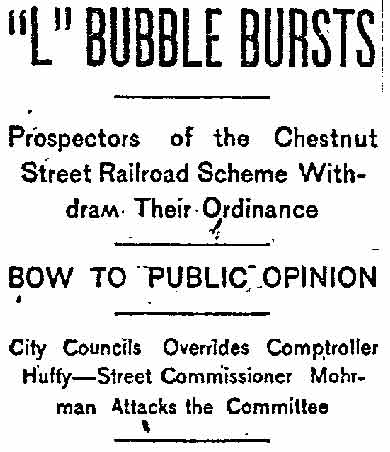
Prospectors of the Chestnut Street Railroad Scheme Withdraw Their Ordinance
BOW TO PUBLIC OPINION
City Councils Overrides Comptroller Hufty — Street Commissioner Mohrman Attacks the Committee
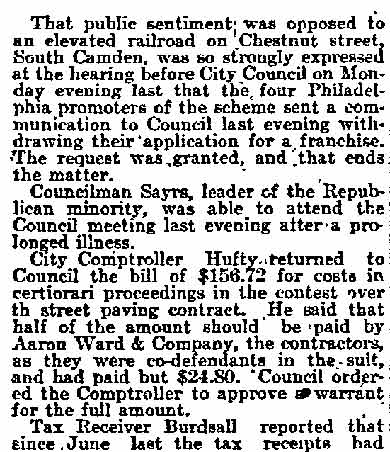
That public sentiment was opposed to an elevated railroad on Chestnut street, South Camden, was so strongly expressed at the hearing before City Council on Monday evening last that the four Philadelphia promoters of the scheme sent a communication to Council last evening withdrawing their application for a franchise. The request was granted, and that ends the matter.
Councilman Sayrs, leader of the Republican minority, was able to attend the Council meeting last evening after a prolonged illness.
City Comptroller Hufty returned to Council the bill of $156.72 for costs in certiorari proceedings in the contest over the street paving contract. He said that half of the amount should be paid by Aaron Ward & Company, the contractors, as they were co-defendants in the suit, and had paid but $24.80. Council ordered the Comptroller to approve a warrant for the full amount.
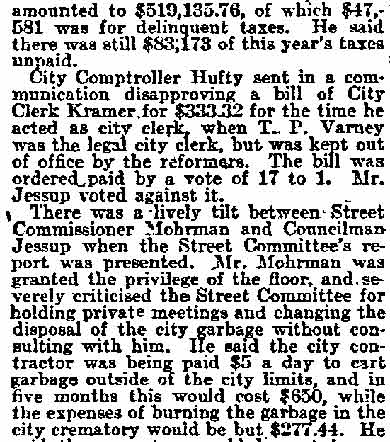
Tax Receiver Burdsall reported that since June last the tax receipts had amounted to $519,135.76, of which $47,581 was for delinquent taxes. He said there was still $83,173 of this year’s taxes unpaid.
City Comptroller Hufty sent in a communication disapproving a bill of City Clerk Kramer for $333.32 for the time he acted as city clerk, when T. P. Varney was the legal city clerk, but was kept out of office by the reformers. The bill was ordered paid by a vote of 17 to 1. Mr. Jessup voted against it.
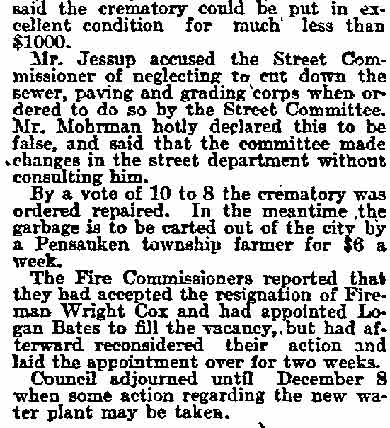
There was a lively tilt between Street Commissioner Mohrman and Councilman Jessup when the Street Committee’s report was presented. Mr. Mohrman was granted the privilege of the floor, and severely criticised the Street Committee for holding private meetings and changing the disposal of the city garbage without consulting with him. He said the city contractor was being paid $5 a day to cart garbage outside of the city limits, and in five months this would cost $650, while the expenses of burning the garbage in the city crematory would be but $277.44. He said the crematory could be put in excellent condition for much less than $1000.
Mr. Jessup accused the Street Commissioner of neglecting to cut down the sewer, paving and grading corps when ordered to do so by the Street Committee. Mr. Mohrman hotly declared this to be false, and said that the committee made changes in the street department without consulting him.
By a vote of 10 to 8 the crematory was ordered repaired. In the meantime the garbage is to be carted out of the city by a Pensauken township farmer for $6 a week.
The Fire Commissioners reported that they had accepted the resignation of Fireman Wright Cox and had appointed Logan Bates to fill the vacancy, but had afterward reconsidered their action and laid the appointment over for two weeks.
Council adjourned until December 8 when some action regarding the new water plant may be taken.
Camden News Notes
Philadelphia Inquirer —
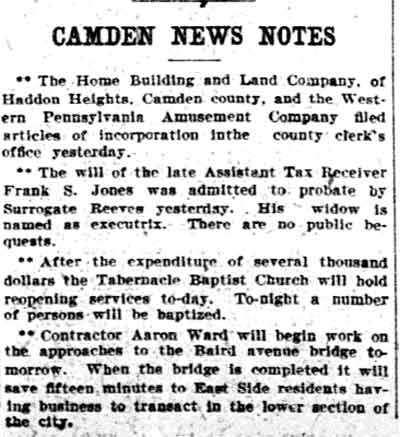
CAMDEN NEWS NOTES
** The Home Building and Land Company, of Haddon Heights, Camden county, and the Western Pennsylvania Amusement Company filed articles of incorporation in the county clerk's office yesterday.
** The will of the late Assistant Tax Receiver Frank S. Jones was admitted to probate by Surrogate Reeves yesterday. His widow is named as executrix. There are no public bequests.
** After the expenditure of several thousand dollars the Tabernacle Baptist Church will hold reopening services to-day. To-night a number of persons will be baptized.
** Contractor Aaron Ward will begin work on the approaches to the Baird avenue bridge to-morrow. When the bridge is completed it will save fifteen minutes to East Side residents having business to transact in the lower section of the city.
Camden Contractor Dies
Philadelphia Inquirer —
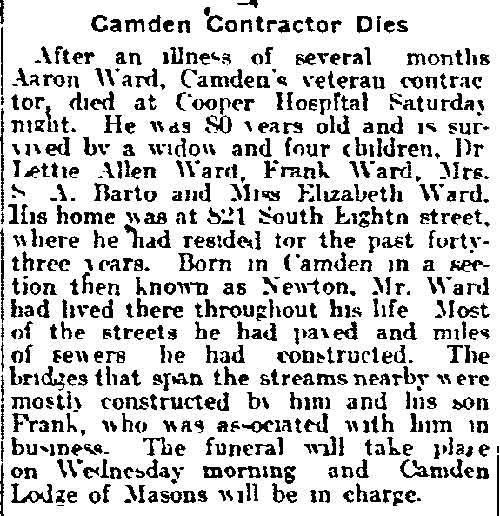
Camden Contractor Dies
After an illness of several months Aaron Ward, Camden's veteran contractor, died at Cooper Hospital Saturday night. He was 80 years old and is survived by a widow and four children, Dr. Lettie Allen Ward, Frank Ward, Mrs. S. A. Barto and Miss Elizabeth Ward. His home was at 821 South Eighth street, where he had resided for the past forty-three years. Born in Camden in a section then known as Newton, Mr. Ward had lived there throughout his life. Most of the streets he had paved and miles of sewers he had constructed. The bridges that span the streams nearby were mostly constructed by him and his son Frank, who was associated with him in business. The funeral will take place on Wednesday morning and Camden Lodge of Masons will be in charge.
Aaron Ward Dies at 4-Score Mark
Camden Courier or Camden Post-Telegram —
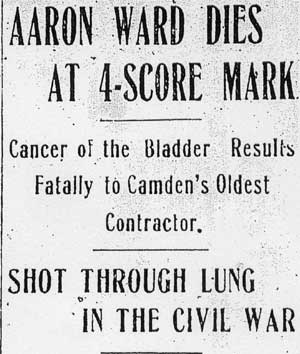

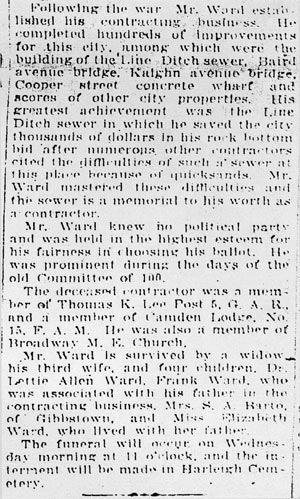
AARON WARD DIES AT 4-SCORE MARK — Cancer of the Bladder Results Fatally to Camden's Oldest Contractor. SHOT THROUGH LUNG IN THE CIVIL WAR
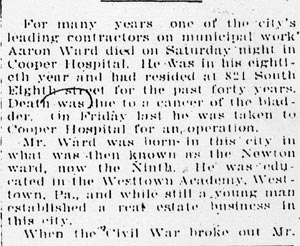
For many years one of the city's leading contractors on municipal work, Aaron Ward died on Saturday night in Cooper Hospital. He was in his eightieth year and had resided at 821 South Eighth street for the past forty years. Death was due to a cancer of the bladder. On Friday last he was taken to Cooper Hospital for an operation. Mr. Ward was born in this city in what was then known as the Newton ward, now the Ninth. He was educated in the Westtown Academy, Westtown, Pa., and while still a young man established a real estate business in this city. When the Civil War broke out Mr.
Ward was one of the first local citizens to offer to volunteer. At the battle of Fredericksburg he was shot through a lung.
Following the war Mr. Ward established his contracting business. He completed hundreds of improvements for this city, among which were the building of the Line Ditch sewer, Baird avenue bridge, Kaighn avenue bridge, Cooper street concrete wharf, and scores of other city properties. His greatest achievement was the Line Ditch sewer in which he saved the city thousands of dollars in his rock bottom bid after numerous other contractors cited the difficulties of such a sewer at this place because of quicksands. Mr. Ward mastered these difficulties and the sewer is a memorial to his worth as a contractor.
Mr. Ward knew no political party and was held in the highest esteem for his fairness in choosing his ballot. He was prominent during the days of the old Committee of 100.
The deceased contractor was a member of Thomas K. Lee Post 5, G.A.R., and a member of Camden Lodge, No. 15, F.A.M. He was also a member of Broadway M.E. Church.
Mr. Ward is survived by a widow, his third wife, and four children, Dr. Lettie Allen Ward, Frank Ward, who was associated with his father in the contracting business, Mrs. S. A. Barto, of Gibbstown, and Miss Elizabeth Ward, who lived with her father. The funeral will occur on Wednesday morning at 11 o'clock, and the interment will be made in Harleigh Cemetery.
Prominent Men at Mr. Ward's Funeral
Camden Courier or Camden Post-Telegram —
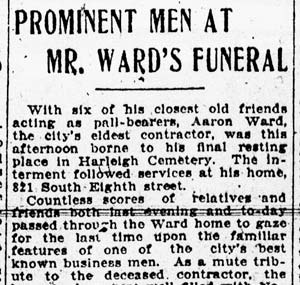
PROMINENT MEN AT MR. WARD'S FUNERAL
With six of his closest old friends acting as pall-bearers, Aaron Ward, the city's eldest contractor, was this afternoon borne to his final resting place in Harleigh Cemetery. The interment followed services at his home, 821 South Eighth street. Countless scores of relatives and friends both last evening and today passed through the Ward home to gaze for the last time upon the familiar features of one of the city's best known business men. As a mute tribute to the deceased contractor, the
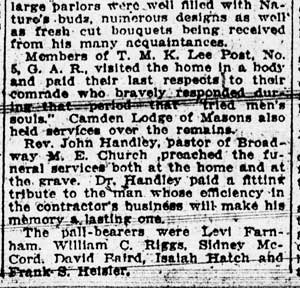
large parlors were well filled with Nature's buds, numerous designs as well as fresh cut bouquets being received from his many acquaintances.
Members of T.M.K. Lee Post, No. 5, G.A.R., visited the home in a body and paid their last respects to their comrade who bravely responded during that period that tried men's souls. Camden Lodge of Masons also held services over the remains.
Rev. John Handley, pastor of Broadway M.E. Church, preached the funeral services both at the home and at the grave. Dr. Handley paid a fitting tribute to the man whose efficiency in the contractor's business will make his memory a lasting one.
The pall-bearers were Levi Farnham, William C. Riggs, Sidney McCord, David Baird, Isaiah Hatch and Frank S. Heisler.
Report of Brig. Gen. Nathan Kimball
O.R. — Series I — Volume XXI [S# 31] — December 11–15, 1862
Report of Brig. Gen. Nathan Kimball, U.S. Army, Commanding First Brigade.
DECEMBER 11-15, 1862. — Battle of Fredericksburg, Va.
WASHINGTON, D.C., December 22, 1862.
Lieut. J. W. PLUME,
Aide-de-Camp and Assistant Adjutant-General, Third Division.
SIR: I have the honor to report that, in obedience to your orders, I moved my command, on the morning of the 11th instant, at daybreak, from the camp of the division to the front, opposite Fredericksburg, and halted at 8 o'clock in a ravine near the railroad, to the right of General Sumner's headquarters.
At 3 p.m. I moved to the bank of the river, near the Lacy house, expecting to cross, but at sundown, being then under fire from the enemy's batteries, I was ordered back, and bivouacked on the hill, about half a mile from the river, for the night.
At sunrise on the morning of the 12th, I was ordered forward again, and, crossing the pontoon bridge, entered Fredericksburg and formed my brigade on Sophia street; my right at Hanover street, and my left on Princess Anne street.
At 11 o'clock, I moved forward and formed on Caroline street, opposite my first position, where I remained during the afternoon and night, the troops sleeping on their arms.
At 10 o'clock on the morning of the 13th, I received the order to lead the advance in an attack on the enemy's works in rear of the city. The First Regiment Delaware Volunteers having been ordered to report to me, I placed them on the center, the Eighth Ohio on the right, and the Fourth Ohio on the left, the whole under the command of Col. John S. Mason, of the Fourth Ohio, and sent them forward as skirmishers. The Eighth Ohio passed out Hanover street until it crossed the canal in rear of the town, when it deployed to the left, until it connected with the Fourth Ohio and First Delaware, which passed out Princess Anne street; crossed the canal near the depot buildings, and deployed to the right. This movement commenced at 11.30 o'clock.
At a few minutes before 12 o'clock, I moved my brigade, which had already been formed on Caroline street, with the Seventh [West] Virginia on the right, the Fourteenth Indiana on the left, and the Twenty-fourth and Twenty-eighth New Jersey in the center, by the right flank, out Princess Anne street; crossed the open space near the depot buildings and the canal bridge near there; filed to the right, and formed line of battle under cover of the low bluff, on which my skirmishers had deployed, my right resting on Hanover street, and my left on the so-called Telegraph road.
From the time my column came in sight at the depot buildings all these movements were executed under a most murderous fire from the enemy's artillery, several shells bursting in the ranks and destroying a company at a time. Yet all the regiments, without an exception, moved steadily forward without confusion, those in the rear quickly closing up the gaps left by their fallen comrades.
My skirmishers having already driven the enemy's pickets from the plain in front of their position, I moved rapidly forward in line of battle. As soon as my line came in sight on the top of the small hill, under cover of which it was formed, it was met by a deadly fire from the enemy's batteries in front and on each flank, but in the face of this it moved steadily forward with fixed bayonets, and without firing a gun, over rough and muddy ground, through fences and all other obstacles, until, reaching the enemy's rifle-pits, it was met by his infantry, posted behind stone walls and earthworks, and in cover of a small ravine, in superior numbers, and by a fire so fierce as to compel it to halt and open fire upon him.
The right of my line then occupied a small village at the forks of the Hanover road, and my left rested at the Telegraph road. A fourth of my command had fallen while crossing the plain, and those left with me were exhausted by the fatigue of clearing away fences and marching so far at double-quick over rough and muddy ground; and they were exposed to a most murderous fire of grape and musketry. The support had not then come up from under cover of the bluff. My command held its ground, but could advance no farther.
At this moment I was severely wounded in the thigh, and was soon after carried from the field, after sending orders to Colonel Mason to take command of the brigade. I respectfully refer you to the report of this officer for the subsequent action of my brigade, and for lists of killed and wounded.
My command, both officers and men, behaved with the most determined bravery and coolness.
I cannot speak too highly of the skill and gallantry with which Colonel Mason, of the Fourth Ohio, commanding the skirmishers; Colonel Snider, of the Seventh West Virginia; Colonel Wisewell, of the Twenty-eighth, and Colonel Robertson, of the Twenty-fourth New Jersey; Lieutenant Colonels Godman, of the Fourth Ohio, Sawyer, of the Eighth Ohio, and Lockwood, of the Seventh West Virginia, and Majors Cavins, commanding the Fourteenth Indiana, and Smyth, the First Delaware, managed their several commands. Colonels Snider and Wisewell, and Lieutenant-Colonel Godman, were dangerously wounded while leading their regiments.
My staff, Capt. E. D. Mason, assistant adjutant-general, and Lieuts. J. R. Swigart and John G. Burrill, aides-de-camp, by my orders reported to Colonel Mason on the field when he took command, and remained with him until after the evacuation of Fredericksburg. I am deeply indebted to them for the prompt and fearless manner in which they performed their perilous duties. Lieutenant Swigart was wounded while carrying dispatches to you.
I desire to call your special attention to the conduct of Private M. A. Wixon, of Company B, Twenty-third New York Volunteers, whom you sent as guide, and who performed his duties with intelligence and skill, faithfully bearing important information on the field, and bearing himself in a manner deserving distinguished notice.
I have the honor to be, very respectfully, your obedient servant,
NATHAN KIMBALL,
Brigadier-General.