Introduction
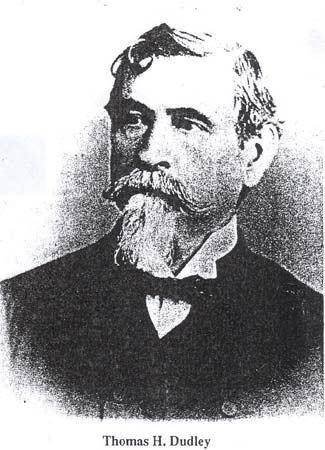
Thomas Haines Dudley (1819–1893)
THOMAS H. DUDLEY had a long and interesting career, both in service in Camden and in service of the Federal Government. He was born in Camden on October 9, 1819, the son of Evan and Ann (Haines) Dudley; grandson of Thomas and Martha (Evans) Dudley; and great-grandson of Francis and Rachel (Wilkins) Dudley, who emigrated from the parish of St. Peter, Wolverhampton, Staffordshire, England, about 1730, and settled in New Jersey.
Thomas H. Dudley was admitted to the New Jersey Bar in 1845; he was serving as Camden County Clerk when called upon to write a City Charter for Camden. The “Dudley Charter” would serve Camden until 1871. A member of the Whig Party until it dissolved, he became a Republican when that party formed. Thomas Dudley was a delegate to the Republican national convention in Chicago in 1860, and was instrumental in securing the presidential nomination for Abraham Lincoln.
In his own words, Thomas Dudley wrote, “I was appointed Consul for Liverpool by Mr. Lincoln in 1861, and remained there for eleven years, when I resigned and came home. I am a lawyer by profession, and was in the convention that nominated A. Lincoln in 1860.”
Thomas Dudley went to Europe when the Civil War broke out, returning in the fall of 1861. He was then appointed as the United States Consul at Liverpool, England. In this capacity he was charged with stemming the flow of military supplies to the Confederacy from ostensibly neutral England. With a force of 100 agents he covered the United Kingdom, often traveling incognito as he was a marked man in certain pro-Confederate quarters.
In 1862 Dudley brought legal action in British courts concerning the steamship Alexandra, being built in a Liverpool shipyard with private funds and intended for the Confederate Navy. The attention attracted in this case gave cause to the British government to somewhat more strictly enforce their own laws regarding neutrality.
Dudley and his agents noted all activity in shipyards in Liverpool and its environs, and reported such activity to United States naval authorities. Of 324 ships built either to run the blockade of the Confederacy or as commerce raiders, 126 were sunk, in great part due to the intelligence reports of Thomas Dudley.
After the war Thomas Dudley returned to America, only to be sent back to Europe to settle the Alabama Claims, where the arbitration decided the extent of British liability for damage done by the U.K.-built commerce-raiders CSS Alabama and CSS Florida during the Civil War. He finally came home in 1872. He was elected a member of the Historical Society of Pennsylvania in 1886, and was a member of the council in the American Philosophical Society in 1887, 1890 and 1893.
Thomas Dudley owned a large estate along Federal Street in what is now East Camden, centered by his mansion and known as Dudley Grange. A small village, known as Dudley, sprang up in the late 1870s and early 1880s within the bounds of Stockton Township.
Thomas H. Dudley passed away on April 15, 1893. Parts of his estate were sold to real estate developers, who built many residences along Federal Street and Westfield Avenue. The remainder of his estate, lying between those two roads and east of Dudley Street, in which lay his home, was eventually acquired by Victor S. King, who served as Camden’s Mayor in the years 1923 through 1927. He sold the land to the city, and it became Dudley Grange Park. The Dudley home was converted into use as a branch of the Camden Free Public Library during the 1920s. Sadly, the home of Thomas Dudley was neglected by city government and allowed to burn in 1980.
The History of Camden County, New Jersey
George Reeser Prowell — 1886
History of Camden County, New Jersey, George Reeser Prowell — 1886
Thomas H. Dudley was born in Evesham township, Burlington County, New Jersey, October 9, 1819, being the descendant of an English family resident in this country since the latter part of the seventeenth century. His early education was obtained in the schools near the vicinity of his birth, and he grew to manhood on his father’s farm. Determining upon law as a profession, he entered the office of the late William N. Jeffers, in Camden, and in 1845 was admitted to the New Jersey bar. From the outset of his legal life he held a conspicuous place in his profession, his sound training in the principles and the practice of law uniting to make him successful. Until the dissolution of the Whig party he was one of its stanchest members. Since that event he has been a no less earnest Republican. Elected in 1860 a delegate at large to the Chicago Convention, he occupied a prominent position in it and was greatly instrumental through his energy and tact, in the committee on doubtful States, in securing the nomination of Abraham Lincoln for President. In 1861 Mr. Dudley went to Europe, and returned in the fall of the same year, and soon thereafter was appointed by Mr. Lincoln as consul to Liverpool.
The position of our consul at this port then was one of great consequence and of the greatest delicacy, for from this centre radiated the substantial aid tendered to the Confederates by their British supporters. In his efforts to enforce the maintenance of the neutrality professed by the government to which he was accredited, the utmost diplomacy was necessary to avoid bringing to open war the expressed hostility between the two countries. Everywhere his endeavor to check the flow of supplies to the Confederacy met with a determined resistance. With a force of one hundred men he policed the ship-yards of England and Scotland, he himself incognito, constantly visiting every shipping centre and registering every keel laid down upon the books of the Liverpool consulate. Nor was his zeal unattended with danger. Again and again he received anonymous letters warning him that unless he ceased his opposition to the extension of assistance to the Confederate government, that his life would be taken, and if found in certain designated spots he would be shot on sight. But these threats had small effects upon his stern nature. He had been charged with a high duty and that duty he fulfilled with a calm determination.
He remained at his post until November, 1868, when he returned to the United States for a brief visit. He resumed his duties in Liverpool, and three years later he again returned to America, and, wearied by his decade of arduous official life, tendered his resignation of his consulate. The government, however, requested his services in the case of the United States to be laid before the Joint High Commission at Geneva, and he assisted in the compilation of the case to go before the Geneva tribunal, supplying the material upon which the judgment in favor of the United States was rendered. In 1872 he again returned to the United States and tendered his resignation, to take effect upon the appointment of his successor.
Since his return to America Mr. Dudley has been engaged in the practice of his profession in Camden, New Jersey, residing upon his beautiful country-seat, three miles from the city. He has been president of the Pittsburgh, Titusville and Buffalo Railroad Company, and of the New Jersey Mining Company, besides being a member of the boards of direction of the Camden and Atlantic Railroad Company, West Jersey Railroad Company, Camden and Philadelphia Ferry Company and People’s Gas Light Company, of Jersey City.
Dudley Village
The History of Camden County, New Jersey — George Reeser Prowell, 1886
History of Camden County, New Jersey — 1886
Dudley is a small village southeast from Cramer Hill, and on the line of the Burlington County Railroad. It takes its name from the Hon. Thomas H. Dudley. There are from twelve to fifteen fine residences in the village, including the large mansion and buildings of the Hon. Thomas H. Dudley, and known as “The Grange,” also one church, one store and one physician’s office. The general store was started by the present owner, J. S. Corkhill, in 1885. Dr. Jerome L. Artz, who located in Dudley in 1885, was born in Ganges, Richland County, Ohio, in 1859; was educated in the schools of his native place; commenced the study of medicine with Dr. G. W. Kester in 1875, and entered the Homoeopathic Hospital College at Cleveland, Ohio, in 1877; in 1878 removed to Philadelphia and entered the Hahnemann Medical College, and graduated therefrom in the class of 1881. He was assistant at this college and the Children’s Hospital until 1885, when he removed to Dudley.
The cemetery belonging to the Church of the Immaculate Conception of Camden is located in the western portion of Dudley, between the Moorestown pike and Westfield Avenue. The area is about six acres, neatly inclosed and handsomely laid out in square lots, and wide avenues leading to the main drive.
Dudley Grange
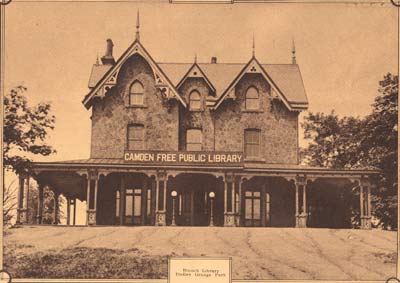
Dudley Grange as it appeared in 1926, serving as a branch of the Camden Free Public Library. The mansion was demolished after a fire in 1980.
Alexandra, 1862–1863
Marauders of the Sea, Confederate Merchant Raiders During the American Civil War
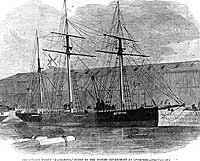
The question over ownership of the 300 ton steamer Alexandra goes to Court. Ever since Captain James Bulloch, Naval Agent of the Confederate States, had moved into England to facilitate ship building for the South, he had been constantly dogged by the agents of the American consul at Liverpool, Thomas H. Dudley.
As 1862 was drawing to a close, Dudley was convinced that he had found yet another Confederate ship being built at Liverpool in the yards of W.C.Miller and Son; it must be remembered that this yard had built Florida, and in Thomas’ mind were guilty by this association.
This ship, Alexandra, was a small 300 ton screw steamer, and bore very distinct lines to that of Florida.
In fact, Bulloch had nothing to do with the commissioning of the construction of this ship, nor anything to do with her, and was unaware of the owner’s intentions.
A Charles K. Prioleau had signed the contract to build her at his expense, and his intention was to run the blockade, sail her to Charleston, and make a gift of Alexandra to the Confederate administration.
Three of Dudley’s agents had signed sworn statements to the effect that Alexandra was a new Confederate Cruiser; in turn Dudley harried his US Minister to England, Charles Adams, to act.
Adams had long been a public critic of Britain’s failure to curb their ship building yards assisting the Southern cause; he now petitioned the British Foreign Secretary to bring a test case to trial.
Britain on one hand needed to protect their legitimate ship building industry, and on the other hand had to properly discharge its obligations under International Law.
There was conflicting advice emanating from the British Foreign Office personnel. Edwards, the Customs Collector, stated he believed this ship “Was intended for the Confederate Government” and should be officially detained.
But treasury inspectors thought “the ship more strongly built than customary in merchant vessels,” but violated no rules, there being no law forbidding the construction of specially reinforced vessels.
Two of Britain’s leading legal minds carried the day; Roundell Palmer and Robert Phillimore both recommended: “The Alexandra be seized, the ship’s structure providing suitable grounds.”
There were no precedents to guide any legal action on behalf of the British Government, and the Foreign Enlistment Act thus needed to be tested in court.
Lord Russell now acted and ordered “The ship be seized on suspicion that her owners intended to use Alexandra against the United States.”
The Surveyor of Customs at Liverpool, on the 5th of April 1863 ordered that “The King’s Broad arrow be marked on one of her masts, and that Alexandra be seized under the Foreign Enlistment Act.”
The Times now got into the act, reporting: “The ship is a fine tidy looking craft, nicely coppered and copper fastened, projecting an impression of speed, but no gunports or shell room. The engines had not been fitted, but she presents the appearance of a fast schooner-rigged steam yacht.”
Adams was delighted, and expressed his “lively satisfaction” to Lord Russell; he also sent off a note to Secretary Seward in the States: “I think we may now infer from this act that the government is really disposed to maintain its neutrality.”
Liverpool ship builders were not enamoured with their government’s actions, viewing it as a threat to their livelihood, and the government moved the court case to London.
Until this case was tested in court, Naval contractors throughout Britain paused, unsure about continuing to carry out work on any contract for the Confederate South; for four months there was a stalemate, until at last, on the 22nd of June in 1863, the British Court of the Exchequer opened the trial of the Alexandra, at Westminster, charging Fawcett, Preston and its agents with violating 96 counts of the Foreign Enlistment Act.
The Court told the Crown to prove, first, that the vessel was built for the purpose of being equipped for war; second, that she was intended at some stage of her construction for the service of the Confederate States.
This would appear to be a difficult assignment for the Crown, and as the trial rolled on, so it proved.
Sir Hugh Cairns, a gifted attorney, and George Mellish, a well known trial lawyer, appeared for the defence; the Crown case essentially relied on the evidence of the three spies on Dudley’s pay roll.
Sir Hugh soon demolished any credibility of the evidence submitted by any of these three witnesses, and by the time he had destroyed the last of these, Clarence R. Yonge, who had worked for Bulloch and Semmes, the latter discharging Yonge for embezzlement, the case for the Crown was well and truly lost.
After a three day trial, the Judge, Sir Jonathan Pollack, instructed the jury: “If you think the object was to build a ship in obedience to an order, and in compliance with a contract, leaving it to those who bought it to make what use they felt fit of it, then it appears to be that the Foreign Enlistment Act has not been in any degree broken.”
The only possible verdict was an acquittal. The chief juror declined to accept a trial transcript, and “Without hesitating more than half a minute, returned a verdict against the Crown.”
Fawsett, Preston made an application for the restoration of Alexandra, but the Crown had filed an appeal with the House of Lords.
A year after the ship’s seizure, this appeal failed, and her owners settled for damages, accepting the sum of 3,700 Pounds, although their original claim was for 6,370 Pounds.
Alexandra never sailed under that name; she was sold, renamed Mary, and modified as a blockade runner.
Although Dudley lost his case against Alexandra, he did succeed in alerting the British government to the multitude of Confederate ship building going on in British shipyards.
Two ironclad cruisers only identified at Birkenhead as 294 and 295, but known locally as the Laird Rams, were part of a number of ironclads being constructed for the South in both British and French ship yards.
These ships were capable of attacking, and hopefully for the South, destroying the Union blockading fleet — the last Confederate hope of keeping open Southern ports, so they might receive essential war supplies to maintain the war against the North.
For Britain, if the South lost, these ships and others under construction loomed as a potential time bomb.
Another potential cruiser, a larger ship based on the Alabama, was being progressed in the Scottish yard of J. and G. Thomson and Company of Glasgow.
It was the intention of Lieutenant George T. Sinclair to commission her as CSS Pampero.
As she was nearing completion, the American Consul at Glasgow began agitating for her detention.
The British Foreign Secretary, on learning that this ship had yet to apply for a Certificate of Registration and a Declaration of Nationality, ordered two gunboats alongside her, waiting for someone to make the required disclosure to comply with the Merchant Shipping Act. Nothing happened, so he ordered the Glasgow Collector of Customs on the 10th of December 1863 to seize the ship, and hold it until the case was brought to court.
This hearing was now delayed until after the war was lost to the South.
In fact Alexandra acted as the factor in hardening the British stance against the Confederates; it looked as if they might lose, and Russell and the British government were placing their bets on the Unionists winning the Civil War.
Under her new name of Mary, after arriving in Halifax, the ship was reported to be seeking out arms, but went off to Nassau, where revenue agents detained her after finding a 12 pound rifled gun, plus cases of shells in a hold. This gun was embossed “Fawsett, Preston and Co. 1862” and had been placed aboard during a stop at Bermuda.
The court at Nassau took a look at the case against Mary, released the ship — all too late, the war was now over.
Thomas Haines Dudley Led a Remarkable Life
Page 1
Pages 2–3
Conclusion
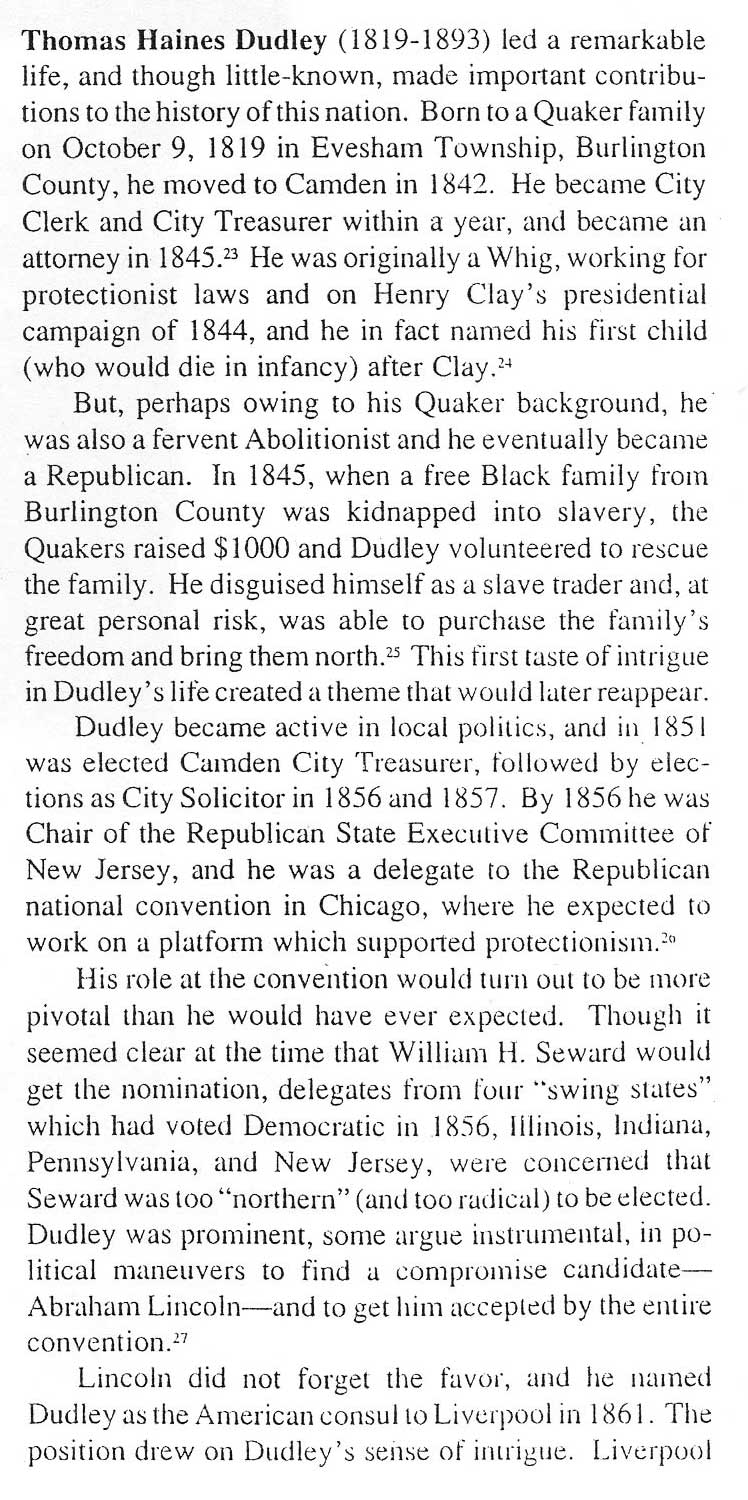
Thomas Haines Dudley (1819–1893) led a remarkable life, and though little-known, made important contributions to the history of this nation. Born to a Quaker family on October 9, 1819 in Evesham Township, Burlington County, he moved to Camden in 1842. He became City Clerk and City Treasurer within a year, and became an attorney in 1845. He was originally a Whig, working for protectionist laws and on Henry Clay’s presidential campaign of 1844, and he in fact named his first child (who would die in infancy) after Clay.
But, perhaps owing to his Quaker background, he was also a fervent Abolitionist and he eventually became a Republican. In 1845, when a free Black family from Burlington County was kidnapped into slavery, the Quakers raised $1000 and Dudley volunteered to rescue the family. He disguised himself as a slave trader and, at great personal risk, was able to purchase the family’s freedom and bring them north. This first taste of intrigue in Dudley’s life created a theme that would later reappear.
Dudley became active in local politics, and in 1851 was elected Camden City Treasurer, followed by elections as City Solicitor in 1856 and 1857. By 1856 he was Chair of the Republican State Executive Committee of New Jersey, and he was a delegate to the Republican national convention in Chicago, where he expected to work on a platform which supported protectionism.
His role at the convention would turn out to be more pivotal than he would have ever expected. Though it seemed clear at the time that William H. Seward would get the nomination, delegates from four “swing states” which had voted Democratic in 1856 — Illinois, Indiana, Pennsylvania, and New Jersey — were concerned that Seward was too “northern” (and too radical) to be elected. Dudley was prominent, some argue instrumental, in political maneuvers to find a compromise candidate — Abraham Lincoln — and to get him accepted by the entire convention.
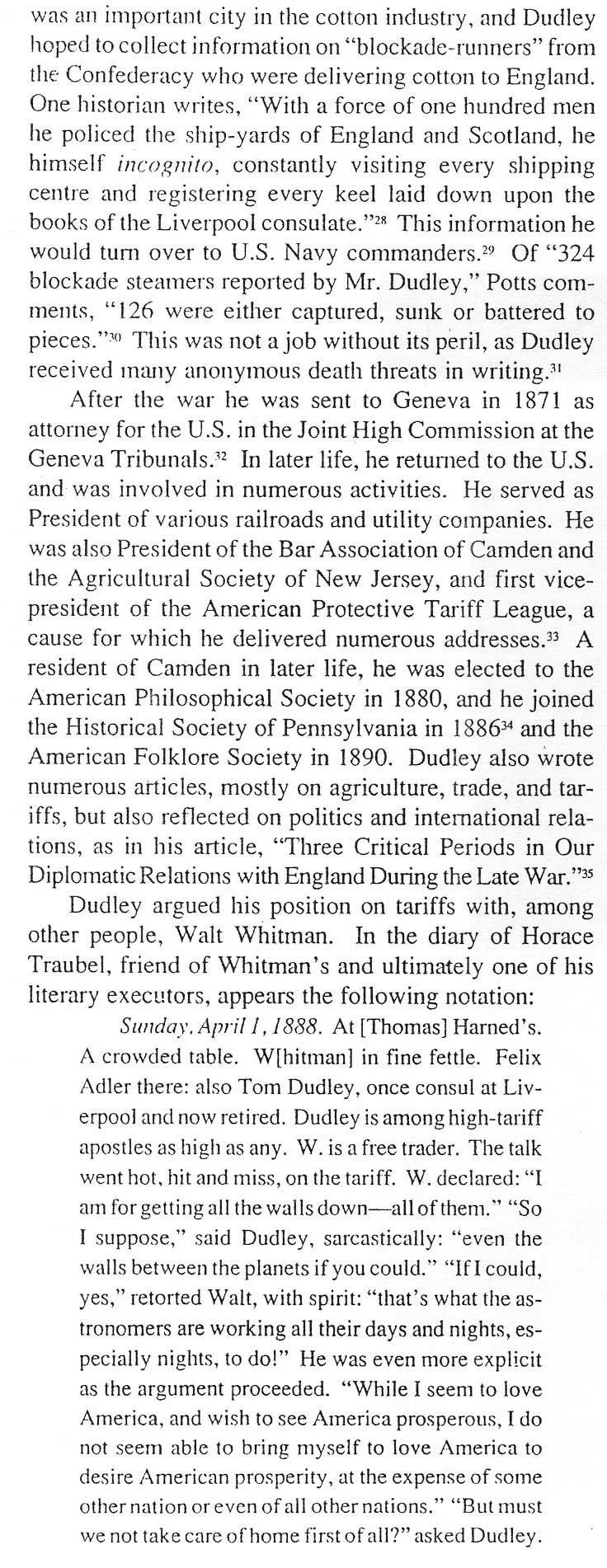
Lincoln did not forget the favor, and he named Dudley as the American consul to Liverpool in 1861. The position drew on Dudley’s sense of intrigue. Liverpool was an important city in the cotton industry, and Dudley hoped to collect information on “blockade-runners” from the Confederacy who were delivering cotton to England. One historian writes, “With a force of one hundred men he policed the ship-yards of England and Scotland, he himself incognito, constantly visiting every shipping centre and registering every keel laid down upon the books of the Liverpool consulate.” Of “324 blockade steamers reported by Mr. Dudley,” Potts comments, “126 were either captured, sunk or battered to pieces.” This was not a job without its peril, as Dudley received many anonymous death threats in writing.
After the war he was sent to Geneva in 1871 as attorney for the U.S. in the Joint High Commission at the Geneva Tribunals. In later life he returned to the U.S. and was involved in various activities. He served as President of various railroads and utility companies. He was also President of the Bar Association of Camden and the Agricultural Society of New Jersey, and first vice-president of the American Protective Tariff League, a cause for which he delivered numerous addresses. A resident of Camden in later life, he was elected to the American Philosophical Society in 1880, and he joined the Historical Society of Pennsylvania in 1886 and the American Folklore Society in 1890. Dudley also wrote numerous articles, mostly on agriculture, trade, and tariffs, but also reflected on politics and international relations, as in his article, “Three Critical Periods in Our Diplomatic Relations with England During the Late War.
Dudley argued his position on tariffs with, among other people, Walt Whitman. In the diary of Horace Traubel, friend of Whitman’s and ultimately one of his literary executors, appears the following notation:
Sunday, April 1, 1888. At [Thomas] Harned’s. A crowded table. W[hitman] in fine fettle. Felix Adler there; also Tom Dudley, once consul at Liverpool and now retired. Dudley is among high-tariff apostles as high as any. W. is a free trader. The talk went hot, hit and miss, on the tariff. W. declared: “I am for getting all the walls down — all of them.” “So I suppose,” said Dudley, sarcastically: “even the walls between the planets if you could.” “If I could, yes,” retorted Walt, with spirit: “that’s what the astronomers are working all their days and nights, especially nights, to do!” He was even more explicit as the argument proceeded. “While I seem to love America, and wish to see America prosperous, I do not seem to be able to bring myself to love America to desire American prosperity, at the expense of some other nation or even of all other nations.” “But must we not take care of home first of all?” asked Dudley.
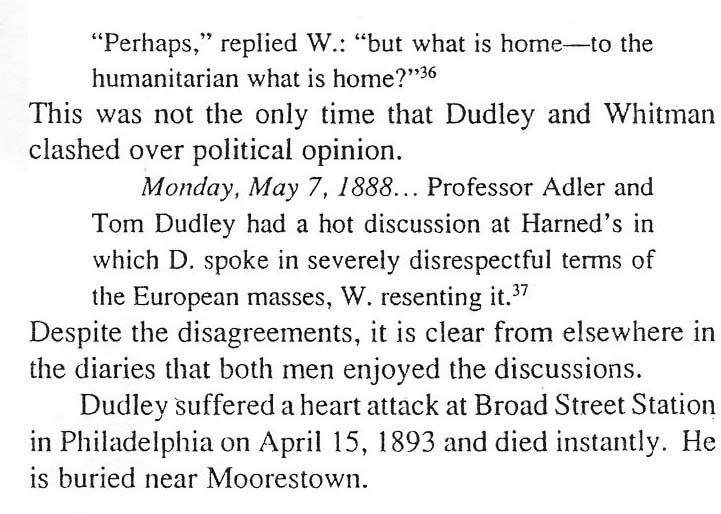
Perhaps,” replied W.: “but what is home — to the humanitarian what is home?
This was not the only time that Dudley and Whitman clashed over political opinion.
Monday, May 7, 1888… Professor Adler and Tom Dudley had a hot discussion at Harned’s in which D. spoke in severely disrespectful terms of the European masses, W. resenting it.
Despite the disagreements, it is clear from elsewhere in the diaries that both men enjoyed the discussions.
Dudley suffered a heart attack at Broad Street Station in Philadelphia on April 15, 1893 and died instantly. He is buried near Moorestown.
1861 — The First War Meeting in Camden
On the 16th of April, 1861, three days after the Confederates fired upon Fort Sumter, at the entrance of Charleston Harbor, a large number of loyal and patriotic citizens of Camden City and County issued the following vigorous and spirited response to the President’s proclamation:
To the President Of the United States:
“The unparalleled events of the last week have revealed to the citizens of the United States, beyond question or the possibility of a doubt, that peaceful reconciliation upon the form of our Constitution is repelled and scorned, and secession means, in the hearts of its supporters, both Treason and war against our Country and Nation.
“We, therefore, the undersigned Loyal Citizens of the United States, and inhabitants of the city of Camden, in the State of New Jersey, responding to the proclamation of the President of the United States, hereby declare our unalterable determination to sustain the government in its efforts to maintain the honor, the integrity and the existence of our National Union and the perpetuity of the popular Government, and to redress the wrongs already long enough endured; no differences of political opinion; no badge of diversity upon points of party distinction, shall restrain or withhold us in the devotion of all we have or can command to the vindication of the Constitution, the maintenance of the laws and the defense of the Flag Of our Country.
E. R. Johnson
Louis L. Scovel
Joseph C. Nichols
Elwood C. Fortiner
Joseph Vautier
Edmund Brewer
Uriah Norcross
Isaac L. Lowe
Henry B. Goodwin
Richard W. Test
John Duprey
Hamilton Johnston
Charles P. Dickinson
Charles J. Sanders
Samuel S. E. Cowperthwait
James M. Scovel
S. C. Harbert
John S. Read
D. H. Erdman
Adam Angel
George W. Vanhorn
Charles S. Garrett
Thomas M. Barracliff
W. H. Saunders
Jacob Harman, Jr.
Charles K. Horsfall
William W. Sloan
Charles Cloud
A. W. Test
C. A. S. Driesback
Henry Schock
Walter Patton
Azael Roberts
Thomas Jeffries
O. Gilbert Hannah
J. C. De Lacour
Edward T. Andrews
Conclin Mayhey
William Reynolds
Simon Rammell
H. H. Goldsmith
John Horsfall
Thomas H. Dudley
Robert Folwell
Edw. H. Saunders
James O. Morgan
David H. Sheppard
Charles C. Reeves
S. H. Grey
N. B. Stokes
S. O. Wright
Joseph Dlinston
David Creary
John R. Barber
James H. Denny
Robert Wible
Hamilton William
George W. Jackson
Joseph Maurer
Joseph D. Brown
William S. Scull
Daniel Witham
Isaac Shreeve
Adam Hare
George Wardell
Joseph Coffman
George W. Conrow
Joshua Howell
Martin Grey
S. L. Wayne
Abner Sparks
Van T. Shivers
Westcott Campbell
William J. Taylor
Isaiah Norcross
Alden O. Scovel
Philip J. Gray
George W. Gilbert
Charles D. Hineline
Thomas H. Davis
Charles De Haven
Thomas Ackley
John Gill
James M. Stevens
Joseph French
George Campbell
A. A. Merry
E. Wells
William D. Clark
E. O. Jackson
A. B. Martin
Richard O. Robertson
Timothy O. Moore
George W. Stanley
Robert Schall
Reynell Coates
Aaron Hewit
Henry Shuster
William Hartsgrove
William B. French
W. A. Winchester
John M. Natty
In response to a call, on the 18th of April an enthusiastic meeting was held in the county court-house, which was formed of a large collection of prominent citizens. The court-room was decorated with flags and mottoes. John W. Mickle was chosen president and Samuel C. Harbert and Thomas G. Rowand secretaries. The president addressed the meeting first and Rev. Mr. Monroe offered a prayer. Hon. Thomas P. Carpenter, Thomas B. Atkinson (mayor) and Joseph Painter were appointed a committee on resolutions. Judge Philip J. Grey addressed the meeting, after which the committee adopted a long series of patriotic resolutions. The Washington Grays, Stockton Cadets and the Zouaves marched into the room and were received with cheers. Samuel Hufty read a resolution which was signed by many persons, who immediately formed the Home Brigade. David M. Chambers, Captain Stafford, Benjamin M. Braker, John H. Jones and E. A. Acton each addressed the meeting. James M. Scovel was then called upon and responded in eloquent terms and with patriotic energy. S. H. Grey offered a resolution, which was adopted, that the City Council and the Freeholders of the county be requested to appropriate money for the equipment of persons who may volunteer in defense of the country, and S. H. Grey, James M. Cassady and Joseph Painter were appointed a committee to look after the interests of the resolution. The meeting continued in session until eleven p.m.
The Young Syndicate
Camden Courier-Post —
FROM AN OLD DIRECTORY
‘Coop’ Carman and Willard Morgan Led Movement for New Blood in G.O.P. Culminating in Bitter Battles of Race Track Days
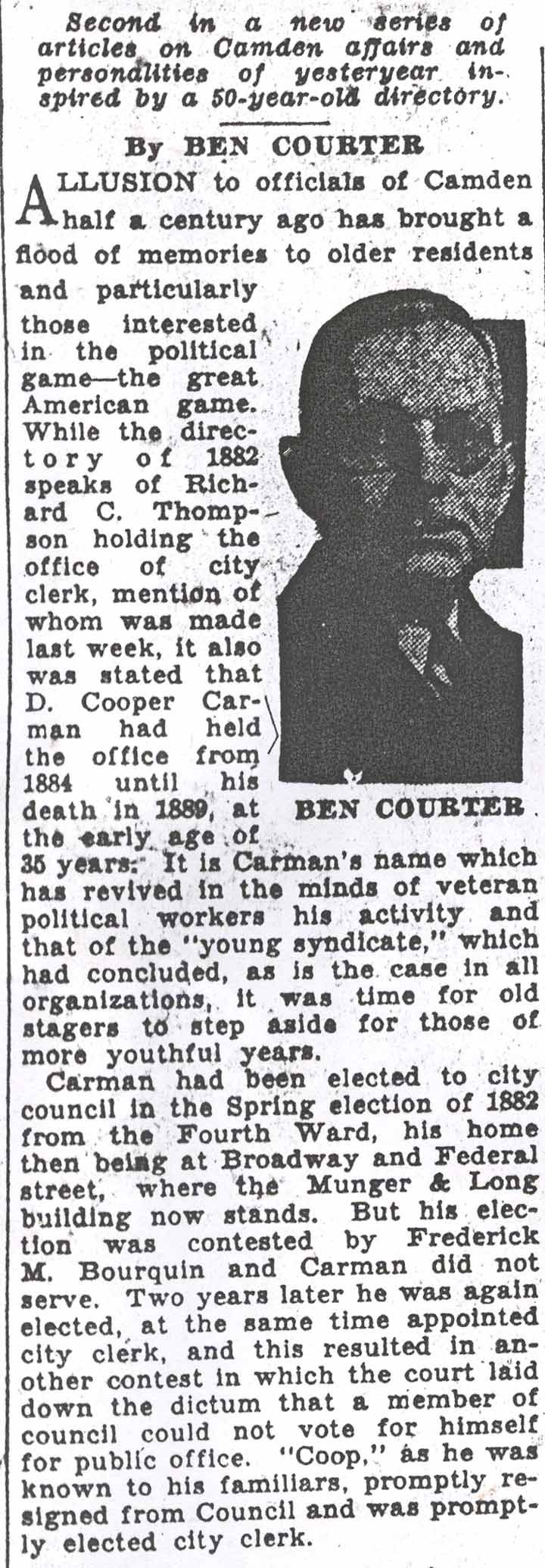
Second in a new series of articles on Camden affairs and personalities of yesteryear inspired by a 50-year-old directory.
By BEN COURTER
Allusion to officials of Camden half a century ago has brought a flood of memories to older residents and particularly those interested in the political game—the great American game. While the directory of 1882 speaks of Richard C. Thompson holding the office of city clerk, mention of whom was made last week, it also was stated that D. Cooper Carman had held the office from 1884 until his death in 1889, at the early age of 35 years. It is Carman’s name which has revived in the minds of veteran political workers his activity and that of the “young syndicate,” which had concluded, as is the case in all organizations, it was time for old stagers to step aside for those of more youthful years.
BEN COURTER
Carman had been elected to city council in the Spring election of 1882 from the Fourth Ward, his home then being at Broadway and Federal street, where the Munger & Long building now stands. But his election was contested by Frederick M. Bourquin and Carman did not serve. Two years later he was again elected, at the same time appointed city clerk, and this resulted in another contest in which the court laid down the dictum that a member of council could not vote for himself for public office. “Coop,” as he was known to his familiars, promptly resigned from Council and was promptly elected city clerk.
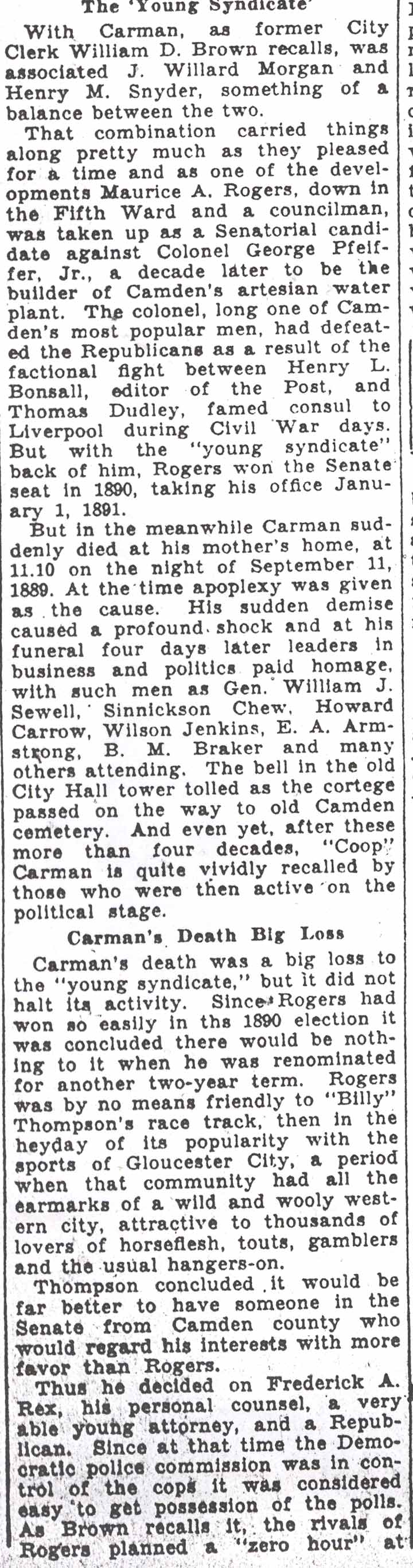
The ‘Young Syndicate’
With Carman, as former City Clerk William D. Brown recalls, was associated J. Willard Morgan and Henry M. Snyder, something of a balance between the two.
That combination carried things along pretty much as they pleased for a time and as one of the developments Maurice A. Rogers, down in the Fifth Ward and a councilman, was taken up as a Senatorial candidate against Colonel George Pfeiffer, Jr., a decade later to be the builder of Camden’s artesian water plant. The colonel, long one of Camden’s most popular men, had defeated the Republicans as a result of the factional fight between Henry L. Bonsall, editor of the Post, and Thomas Dudley, famed consul to Liverpool during Civil War days. But with the “young syndicate” back of him, Rogers won the Senate seat in 1890, taking his office January 1, 1891.
But in the meanwhile Carman suddenly died at his mother’s home, at 11.10 on the night of September 11, 1889. At the time apoplexy was given as the cause. His sudden demise caused a profound shock and at his funeral four days later leaders in business and politics paid homage, with such men as Gen. William J. Sewell, Sinnickson Chew, Howard Carrow, Wilson Jenkins, E. A. Armstrong, B. M. Braker and many others attending. The bell in the old City Hall tower tolled as the cortege passed on the way to old Camden cemetery. And even yet, after these more than four decades, “Coop” Carman is quite vividly recalled by those who were then active on the political stage.
Carman’s Death Big Loss
Carman’s death was a big loss to the “young syndicate,” but it did not halt its activity. Since Rogers had won so easily in the 1890 election it was concluded there would be nothing to it when he was renominated for another two-year term. Rogers was by no means friendly to “Billy” Thompson’s race track, then in the heyday of its popularity with the sports of Gloucester City, a period when that community had all the earmarks of a wild and wooly western city, attractive to thousands of lovers of horseflesh, touts, gamblers and the usual hangers-on.
Thompson concluded it would be far better to have someone in the Senate from Camden county who would regard his interests with more favor than Rogers.
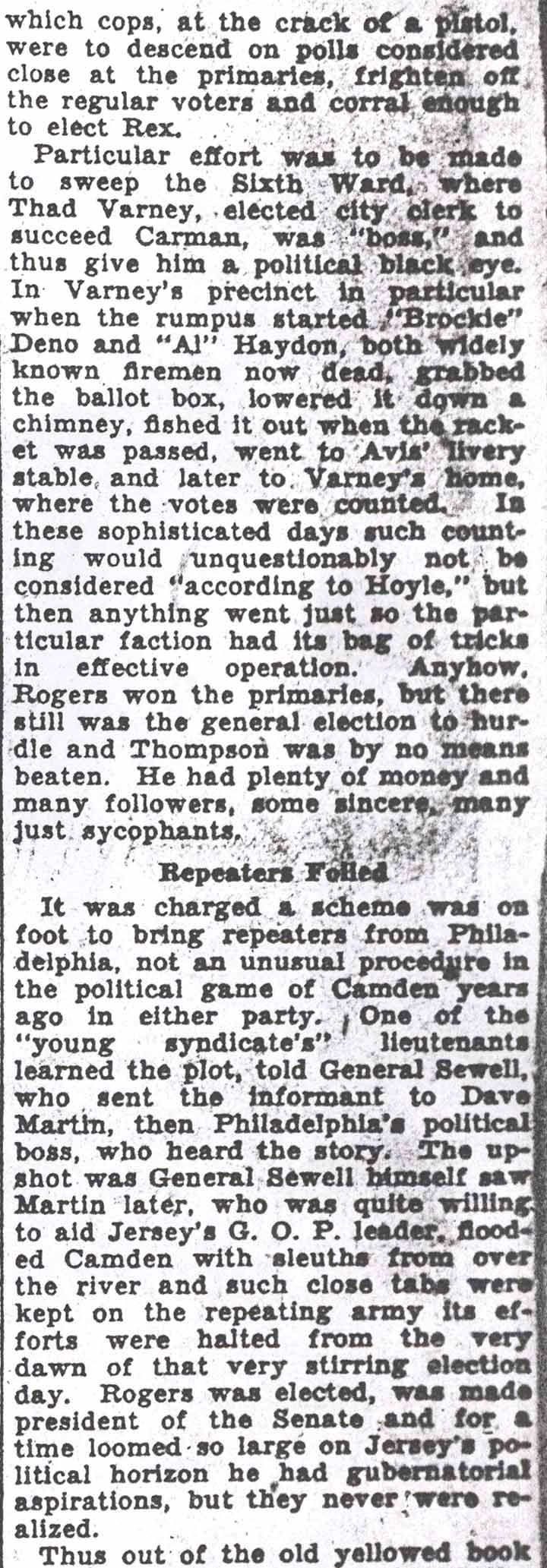
Thus he decided on Frederick A. Rex, his personal counsel, a very able young attorney, and a Republican. Since at that time the Democratic police commission was in control of the cops it was considered easy to get possession of the polls. As Brown recalls it, the rivals of Rogers planned a “zero hour” at which cops, at the crack of a pistol, were to descend on polls considered close at the primaries, frighten off the regular voters and corral enough to elect Rex.
Particular effort was to be made to sweep the Sixth Ward, where Thad Varney, elected city clerk to succeed Carman, was “boss,” and thus give him a political black eye. In Varney’s precinct in particular when the rumpus started “Brockie” Deno and “Al” Haydon, both widely known firemen now dead, grabbed the ballot box, lowered it down a chimney, fished it out when the racket was passed, went to Avis’ livery stable, and later to Varney’s home, where the votes were counted. In these sophisticated days such counting would unquestionably not be considered “according to Hoyle,” but then anything went just so the particular faction had its bag of tricks in effective operation. Anyhow, Rogers won the primaries, but there still was the general election to hurdle and Thompson was by no means beaten. He had plenty of money and many followers, some sincere, many just sycophants.
Repeaters Foiled
It was charged a scheme was on foot to bring repeaters from Philadelphia, not an unusual procedure in the political game of Camden years ago in either party. One of the “young syndicate’s” lieutenants learned the plot, told General Sewell, who sent the informant to Dave Martin, then Philadelphia’s political boss, who heard the story. The upshot was General Sewell himself saw Martin later, who was quite willing to aid Jersey’s G.O.P. leader, flooded Camden with sleuths from over the river and such close tabs were kept on the repeating army its efforts were halted from the very dawn of that very stirring election day. Rogers was elected, was made president of the Senate and for a time loomed so large on Jersey’s political horizon he had gubernatorial aspirations, but they never were realized.
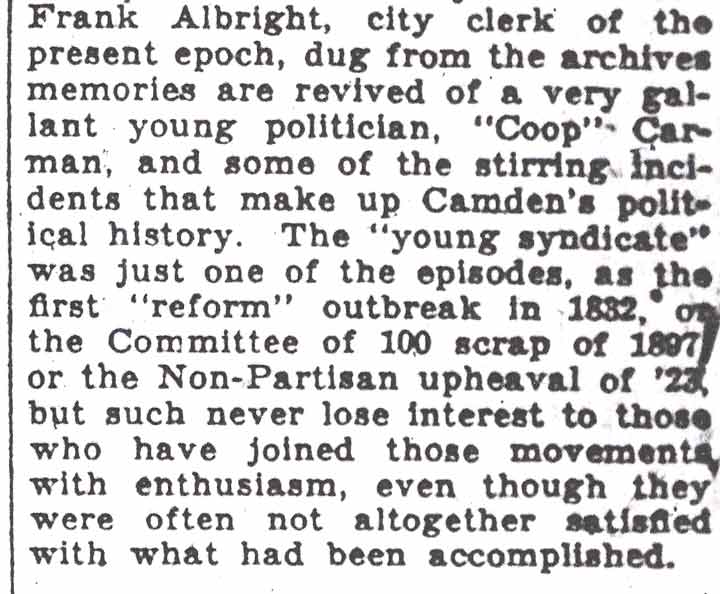
Thus out of the old yellowed book Frank Albright, city clerk of the present epoch, dug from the archives memories are revived of a very gallant young politician, “Coop” Carman, and some of the stirring incidents that make up Camden’s political history. The “young syndicate” was just one of the episodes, as the first “reform” outbreak in 1882, or the Committee of 100 scrap of 1897, or the Non-Partisan upheaval of ‘23, but such never lose interest to those who have joined those movements with enthusiasm, even though they were often not altogether satisfied with what had been accomplished.
The First New Jersey District.
Philadelphia Inquirer —
The Election of Congressional Delegates in Robeson’s Old District.
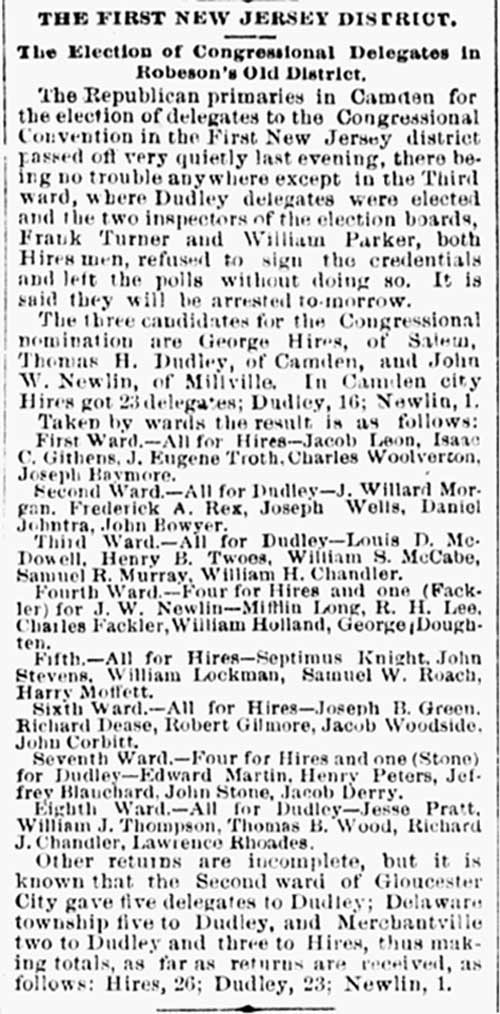
The Republican primaries in Camden for the election of delegates to the Congressional Convention in the First New Jersey district passed off very quietly last evening, there being no trouble anywhere except in the Third ward, where Dudley delegates were elected and the two inspectors of the election boards, Frank Turner and William Parker, both Hires men, refused to sign the credentials and left the polls without doing so. It is said they will be arrested to-morrow.
The three candidates for the Congressional nomination are George Hires, of Salem, Thomas H. Dudley, of Camden, and John W. Newlin, of Millville. In Camden city Hires got 23 delegates; Dudley, 16; Newlin, 1.
Taken by wards the result is as follows:
First Ward.—All for Hires—Jacob Leon, Isaac C. Githens, J. Eugene Troth, Charles Woolverton, Joseph Baymore.
Second Ward.—All for Dudley—J. Willard Morgan, Frederick A. Rex, Joseph Wells, Daniel Johntra, John Bowyer.
Third Ward.—All for Dudley—Louis D. McDowell, Henry B. Twoes, William S. McCabe, Samuel R. Murray, William H. Chandler.
Fourth Ward.—Four for Hires and one (Fackler) for J. W. Newlin—Mifflin Long, R. H. Lee, Charles Fackler, William Holland, George Doughten.
Fifth.—All for Hires—Septimus Knight, John Stevens, William Lockman, Samuel W. Roach, Harry Moffett.
Sixth Ward.—All for Hires—Joseph B. Green, Richard Dease, Robert Gilmore, Jacob Woodside, John Corbitt.
Seventh Ward.—Four for Hires and one (Stone) for Dudley—Edward Martin, Henry Peters, Jeffrey Blanchard, John Stone, Jacob Derry.
Eighth Ward.—All for Dudley—Jesse Pratt, William J. Thompson, Thomas B. Wood, Richard J. Chandler, Lawrence Rhoades.
Other returns are incomplete, but it is known that the Second ward of Gloucester City gave five delegates to Dudley; Delaware township five to Dudley, and Merchantville two to Dudley and three to Hires, thus making totals, as far as returns are received, as follows: Hires, 26; Dudley, 23; Newlin, 1.
In the Political Whirl
Philadelphia Inquirer —
Camden in a Lively Congressional Contest.
ANTI-GRATZ WORKERS ENCOURAGED
Campaign Jottings of Interest Gathered at the City and State Committee Headquarters of Both Parties.
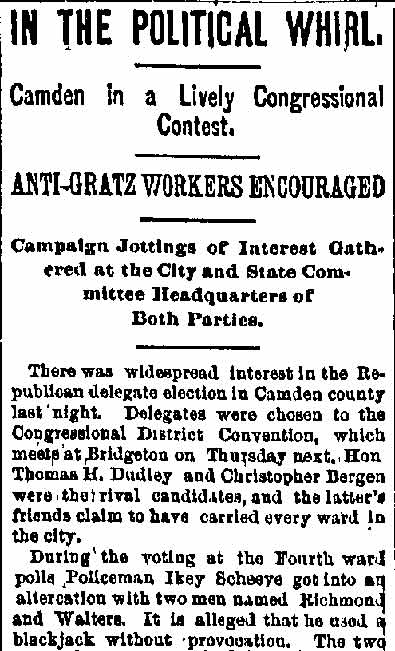
There was widespread interest in the Republican delegate election in Camden county last night. Delegates were chosen to the Congressional District Convention, which meets at Bridgeton on Thursday next. Hon. Thomas H. Dudley and Christopher Bergen were the rival candidates, and the latter’s friends claim to have carried every ward in the city.
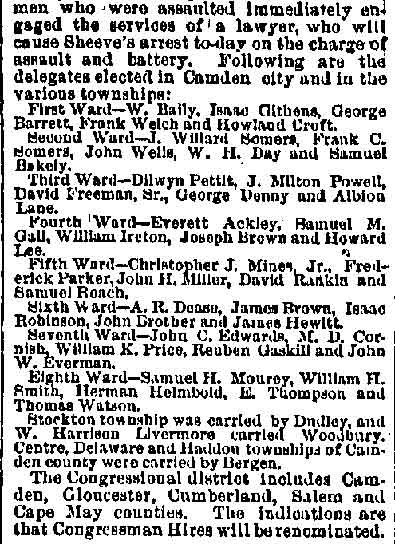
During the voting at the Fourth ward polls Policeman Ikey Scheeve got into an altercation with two men named Richmond and Walters. It is alleged that he used a blackjack without provocation. The two men who were assaulted immediately engaged the services of a lawyer, who will cause Sheeve’s arrest to-day on the charge of assault and battery. Following are the delegates elected in Camden city and in the various townships:
First Ward—W. Baily, Isaac Githens, George Barrett, Frank Welch and Howland Croft.
Second Ward—J. Willard Somers, Frank C. Somers, John Wells, W. H. Day and Samuel Bakely.
Third Ward—Dilwyn Pettit, J. Milton Powell, David Freeman, Sr., George Denny and Albion Lane.
Fourth Ward—Everett Ackley, Samuel M. Gall, William Ireton, Joseph Brown and Howard Lee.
Fifth Ward—Christopher J. Mines, Jr., Frederick Parker, John H. Miller, David Rankin and Samuel Roach.
Sixth Ward—A. R. Dease, James Brown, Isaac Robinson, John Brother and James Hewitt.
Seventh Ward—John C. Edwards, M. D. Cornish, William K. Price, Reuben Gaskill and John W. Everman.
Eighth Ward—Samuel H. Mourey, William H. Smith, Herman Helmbold, E. Thompson and Thomas Watson.
Stockton township was carried by Dudley, and W. Harrison Livermore carried Woodbury. Centre, Delaware and Haddon townships of Camden county were carried by Bergen.
The Congressional district includes Camden, Gloucester, Cumberland, Salem and Cape May counties. The indications are that Congressman Hires will be renominated.