Introduction
CHRISTOPHER J. MINES SR. was born around 1822. He came to Camden in 1837 from Philadelphia, settling in South Camden. A carpenter by trade, he went into business for himself after having served an apprenticeship for the contracting firm of Shaw & Bennett. He remained in business until retiring in 1873.
Active in civic and political affairs, Christopher J. Mines Sr. was elected to City Council in 1850, serving three consecutive terms. He subsequently was simultaneously elected to the Camden County Board of Chosen Freeholders and the Camden City Board of Education. He was also the city’s collector, being elected to that office in 1850 and in 1852. In 1859 he joined the Board of Directors of the Camden Fire Insurance Association, and served on that board until the time of his passing. He also was vice-president of the Mechanics and Workingmen’s Building & Loan Association.
The 1880 Census shows Christopher Mines Sr. living at 254 Line Street with his wife Sarah and three of their eleven children—George, Kate, and Henry. He was then working as a “house inspector.”
Christopher J. Mines Sr. was a member of the William B. Hatch Post No. 37 of the Grand Army of the Republic, also known as the G.A.R.
Christopher J. Mines Sr. died at his home, 254 Line Street, on the morning of October 7, 1895 at the age of 73. Among his survivors were at least one daughter, Rachel Mines Milliette, and at least two sons, William W. Mines, and Christopher J. Mines Jr. Both had long and distinguished careers in Camden civic affairs. Christopher Mines Jr. was the Superintendent of the city of Camden’s Water Department at the time of his father’s death. Grandson Dr. Marcus K. Mines, son of Christopher Mines Jr., practiced medicine in Camden for many years.
William B. Hatch Post No. 37, G.A.R.
History of Camden County, N.J. — George Reeser Prowell, 1886
WILLIAM B. HATCH POST No. 37, of Camden, was instituted and chartered November 25, 1879, with eighty-one members and the following named Post officers:
Post Commander, John E. Grubb; Senior Vice-Commander, Richard J. Robinson; Junior Vice-Commander, Daniel J. Fullen; Surgeon, Thomas G. Rowand, M.D.; Chaplain, John Quick; Officer of the Day, John A. Dall; Officer of the Guard, Edmund G. Jackson, Jr.; Quartermaster, Christopher J. Mines, Jr.; Adjutant, Benjamin J. Pierce; Sergeant-Major, William A. Tatem; Quartermaster-Sergeant, William B. E. Miller.
At the first meeting of the Post it was decided by a unanimous vote to name it in honor of the late Colonel William B. Hatch, of the Fourth Regiment. When Mrs. C. Hatch, the mother of the colonel was informed that the post had honored the memory of her son by naming it after him, she sent to the Post the following response:
Camden N. J., November 26th, 1879
John E. Grubb, Post Commander
Dear Sir, It will afford me much pleasure to be identified with Post 37, G. A. R., named in honor of my son, William B. Hatch, by allowing me to present to the same its colors. The memory of my son is ever dear to me, and, while at the same moment I may have thought the sacrifice too great an affliction, yet I was consoled by the fact that I gave him up that this Union might be preserved. It was duty and patriotism that called him, and while I mourn him as a mother for a well-beloved son, yet I would not have stayed him, for the love of country and the upholding of this glorious Republic is what every mother should instill into her sons, as the purest and holiest spirit.
Yours truly, C. Hatch
The following is a complete roster of this post for 1886:
Post Commander, Benjamin H. Connelly; Senior Vice-Commander, Adam C. Smith; Junior Vice-Commander, William Haegele; Surgeon, George Pfau; Chaplain, Samuel Gaul; Officer of the Day, Robert Crawford; Officer of the Guard, John D. Cooper; Quartermaster, Samuel J. Fenner; Adjutant, William B. Summers; Sergeant-Major, Stacy H. Bassett; Quartermaster-Sergeant, Otto K. Lockhart.
Comrades: Philip Achenbach, George L. Allchin, Isaac Albertson, Joseph Applegate, John W. Barclay, Martin M. Barney, Joseph Baxter, William W. Bennett, Charles L. Bennett, Henry Bickering, Abel Biddle, George K. Biddle, John Bieri, Robert M. Bingham, Socrates T. Bittle, George W. Bittle, Benjamin F. Blizzard, Joseph Borton, Frederick Bowers, Benjamin M. Braker, John Breyer, William H. Brians, Wm. J. Broadwater, William Broadwater, John Brown, Harris Brooks, William H. Brooks, Joseph F. Bryan, Joseph Buddew, J. Q. Burniston, George Burton, Frederick Buser, Thomas L. Bush, William Butcher, Isaac B. Buzby, Edward C. Cattell, Joseph Cameron, James H. Carey, William Carey, James Chadwick, James Chafey, George M. Chester, James D. Chester, Lewis L. Chew, Henry S. Chew, John W. Churn, Andrew B. Cline, Charles Clarke, Samuel J. Cook, Levi E. Cole, John J. Collins, John C. Cooper, John W. Cotner, Thomas L. Conly, Harvey M. Cox, Jason S. Cox, Harris Crane, Charles Cress, Joel G. Cross, O. C. Cunningham, John A. Dall, John Dalby, John H. Damon, Westley Dare, John E. Dawson, Adam T. Dawson, James L. Davis, William Davis, Amos R. Dease, Henry Deford, Lewis F. Derousse, Michael Devinney, Glendora Devo, John Digney, Joseph Dilks, William A. Dobbins, George W. Dunlap, Aaron B. Eacritt, John J. Early, Christopher Ebele, Godfrey Eisenhart, John Elberson, Charles Elwell, Charles Eminecker, John Esler, John H. Evans, Charles S. Fackler, James Fanington, James A. Farraday, John H. Farry, John Faughey, Wm. H. Fenlin, George G. Felton, George W. Ferguson, Charles W. Fish, Israel L. Fish, James Finnan, Samuel B. Fisher, Edward L. Fisher, Ephraim B. Fithian, Jacob T. Fisher, Edward Fitzer, Samuel Flock, Leonard Flor, John Fox, John S. Fox, H. H. Franks, Chas. B. Frazer, Thomas J. Francis, Samuel W. Gahan, Chas. H. Gale, James Galbraith, Thomas Garman, Harry Garren, John W. Garwood, Josiah Garrison, John B. Gaskill, Richard Gaunt, Wm. German, Christopher Getsinger, Christopher Gifney, Jacob Giffens, Albert Gilbert, James Gillen, Wm. Giffins, C. C. Greany, Charles Green, W. H. Griffin, Louis Grosskops, William Grindrod, John B. Grubb, Mark H. Guest, John Guice, Alfred Haines, Charles G. Haines, Japhet Haines, George F. Hammond, Charles Hall, Solon B. Hankinson, Samuel P. Hankinson, James Hanson, Charles Hannans, H. A. Hartranft, Mahlon E. Harden, William F. Harper, George W. Hayter, Samuel B. Harbeson, J. T. Hazleton, H. Heinman, James Henderson, William H. Heward, Franklin Hewitt, James T. Hemmingway, Charles Hewitt, Edward K. Hess, Samuel B. Hickman, George Higgens, Ephraim Hillman, C. M. Hoagland, Guadaloupe Holl, William A. Holland, Isaac K. Horner, Count D. G. Hogan, William H. Howard, Baxter Howe, Alien Hubbs, Charles G. Hunsinger, Presmel D. Hughes, I. N. Hugg, Sebastian Hummell, Edward Hutchinson, C. Innes, Alfred Ivins, Benjamin Ivins, E. G. Jackson Sr., E. G. Jackson Jr., Thomas Jameson, George Jauss, William P. Jenkins, James L. Johnson, Alfred Jones, B. F. Jones, William Joline, Charles Joseph, Charles Justice, C. H. Kain, E. E. Kates, Benjamin Kebler, Frank Kebler, Peter Keen, Henry N. Killian, J. W. Kinsey, C. H. Knowlton, Thomas W. Krips, Joseph H. Large, John E. Leake, John Lecroy, Charles Leonhart, George W. Locke, E. J. Long, Charles L. Lukens, J. H. Lupton, Valentine Machemer, Edward Macloskey, Edward A. Martin, William P. Marsh, John Mapes, William Mead, William Metcalf, E. A. Meyer, C. Meyers, George Meilor, C. A. Michener, William B. E. Miller, Jacob Miller, W. D. Miller, Samuel Mills, William W. Mines, Christopher J. Mines, George Molesbury, William Moran, Edward More, Richard Morgan, John F. Moore, S. H. Moyer, Jacob L. Morton, John Muir, John J. Murphy, Isaac Murray, Charles Myers, W. H. McAllister, James McCracken, Edward C. McDowell, Hugh McGrogan, H. M. Mcllvaine, W. F. McKillip, W. J. McNeir, Lewis McPherson, E. McPherson, Jacob Naglee, William Naphas, Antonio Nosardi, Robert O’Keefe, John S. Owens, Robert Owens, Edward H. Pancoast, James Pancoast, Robert B. Patterson, William Patterson, E. W. Pease, John B. Pepper, Joel Perrine, John Peterson, D. E. Peugh, Frederick Phile, Samuel B. Pine, William M. Pine, Adon Powell, John Powell, John Portz, J. B. Prucelle, John Quick, S. E. Radcliffe, I. C. Randolph, James A. Regens, Philip Reilly, Charles P. Reynolds, Alexander Rhodes, Benjamin F. Richard, Andrew Ridgway, Benjamin Robbins, Edward C. Roberts, James Roberts, Richard J. Robinson, William B. Robertson, Isaac Rogers, John Rogers, William H. Rogers, Thomas G. Rowand, Sebastian Schaub, Maurice Schmidt, Christian K. Schallers, James Schofield, George W. Scott, John E. Scott, John M. Shemelia, Edward M. Siemers, John Simmons, Benjamin F. Shinn, Thomas Sheeran, James Shield, Charles Smith, George H. Smith, William W. Smith, Charles S. Small, Adolph Snow, W. Souder, Francis Senders, Robert Sparks, David C. Sprowl, Alfred L. Sparks, Abraham Springer, George W. Stewart, William L. Stevenson, Thomas G. Stephenson, Samuel R. Stockton, Thomas Stockton, Thomas H. Stone, Henry Strick, E. J. Strickland, Charles String, George F. Stull, George W. Swaney, Crosby Sweeten, William F. Tarr, William A. Tatem, Thomas S. Tanier, George Rudolph Tenner, Charles L. Test, Leonard Thomas, Benjamin Thomas, Henry C. Thomas, George F. Thorne, Wesley Thorn, Thomas W. Thornley, Alexander W. Titus, Joseph Tompkins, J. E. Troth, Isaac C. Toone, Samuel Tyier, Jacob M. Van Nest, Albert Vansciver, Joseph Wakeman, Theodore F. Walker, Charles Walton, George Walton, Joseph Welsh, David Watson, George W. Wentling, Edward West, Elmer M. West, George Weyman, Wilmer Whillden, James Whittaker, Samuel Wickward, Calvin T. Williams, George W. Williams, William H. Williams, John Williams, Samuel Winner, Amos P. Wilson, D. H. Wilson, G. A. Wilson, Richard Wilson, George Wispert, John W. Wood, Joseph Woodfield, Walter Wolfkill, E. W. Wolverton, Elijah Worthington, C. M. Wright, George B. Wright, Henry S. Wright, Wesley T. Wright, William Zane.
As of 1886, the Hatch Post met every Thursday evening in their own G. A. R. Hall, on Stevens Street, below Fifth Street. This same building had been used in the late 1870s as the original home of the congregation that formed the Tabernacle Baptist Church. The Hatch Post was affiliated with Hatch League No. 2, of the Loyal Ladies League, their auxiliary, which met at the Post Hall.
Over the River
Philadelphia Inquirer —
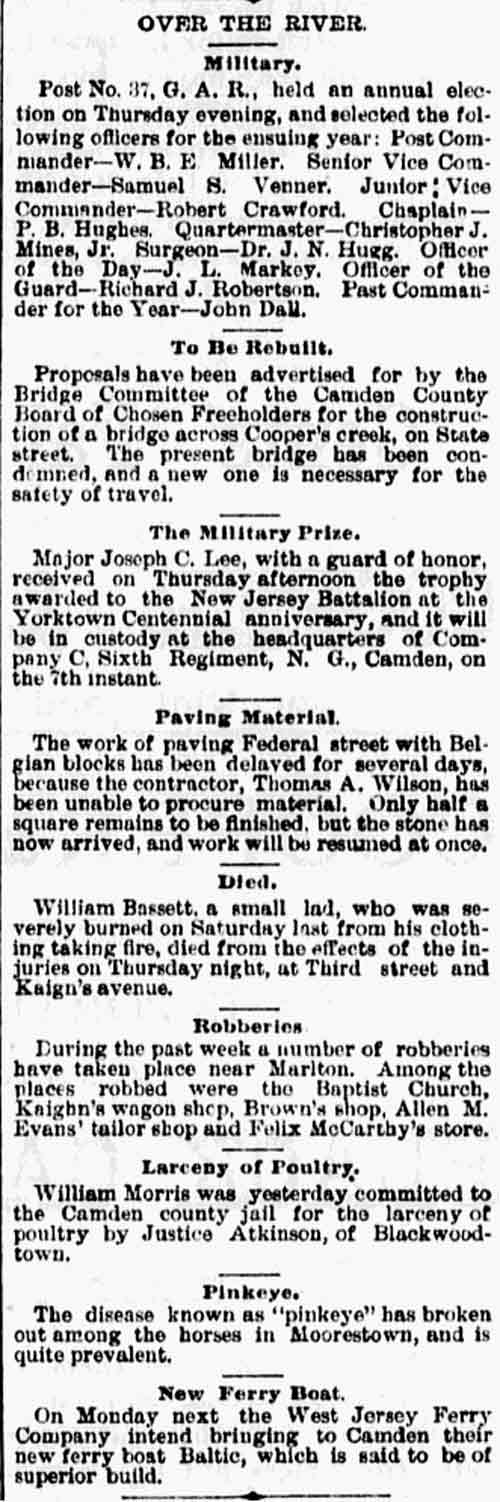
Military.
Post No. 37, G. A. R., held an annual election on Thursday evening, and selected the following officers for the ensuing year: Post Commander—W. B. E. Miller. Senior Vice Commander—Samuel S. Venner. Junior Vice Commander—Robert Crawford. Chaplain—P. B. Hughes. Quartermaster—Christopher J. Mines, Jr. Surgeon—Dr. J. N. Hugg. Officer of the Day—J. L. Markey. Officer of the Guard—Richard J. Robertson. Past Commander for the Year—John Dall.
To Be Rebuilt.
Proposals have been advertised for by the Bridge Committee of the Camden County Board of Chosen Freeholders for the construction of a bridge across Cooper’s creek, on State street. The present bridge has been condemned, and a new one is necessary for the safety of travel.
The Military Prize.
Major Joseph C. Lee, with a guard of honor, received on Thursday afternoon the trophy awarded to the New Jersey Battalion at the Yorktown Centennial anniversary, and it will be in custody at the headquarters of Company C, Sixth Regiment, N. G., Camden, on the 7th instant.
Paving Material.
The work of paving Federal street with Belgian blocks has been delayed for several days, because the contractor, Thomas A. Wilson, has been unable to procure material. Only half a square remains to be finished, but the stone has now arrived, and work will be resumed at once.
Died.
William Bassett, a small lad, who was severely burned on Saturday last from his clothing taking fire, died from the effects of the injuries on Thursday night, at Third street and Kaign’s avenue.
Robberies
During the past week a number of robberies have taken place near Marlton. Among the places robbed were the Baptist Church, Kaighn’s wagon shop, Brown’s shop, Allen M. Evans’ tailor shop and Felix McCarthy’s store.
Larceny of Poultry.
William Morris was yesterday committed to the Camden county jail for the larceny of poultry by Justice Atkinson, of Blackwoodtown.
Pinkeye.
The disease known as “pinkeye” has broken out among the horses in Moorestown, and is quite prevalent.
New Ferry Boat.
On Monday next the West Jersey Ferry Company intend bringing to Camden their new ferry boat Baltic, which is said to be of superior build.
Over the River
Philadelphia Inquirer —
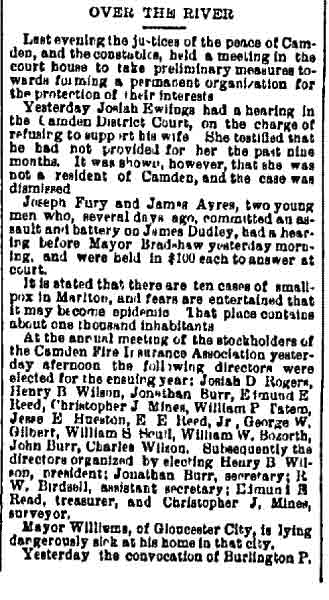
Last evening the justices of the peace of Camden, and the constables, held a meeting in the court house to take preliminary measures for the wards forming a permanent organization for the protection of their interests
Yesterday Josiah Ewinga had a hearing in the Camden District Court, on the charge of refusing to support his wife. She testified that he had not provided for her the past nine months. It was shown, however, that she was not a resident of Camden, and the case was dismissed
Joseph Fury and James Ayres, two young men who, several days ago, committed an assault and battery on James Dudley, had a hearing before Mayor Bradshaw yesterday morning, and were held in $100 each to answer at court.
It is stated that there are ten cases of smallpox in Marlton, and fears are entertained that it may become epidemic. That place contains about one thousand inhabitants.
At the annual meeting of the stockholders of the Camden Fire Insurance Association yesterday afternoon the following directors were elected for the ensuing year: Josiah D. Rogers, Henry B. Wilson, Jonathan Burr, Edmund E. Reed, Christopher J. Mines, William P. Tatem, Jesse E. Hueston, E. E. Reed, Jr., George W. Gilbert, William B. Scull, William W. Bozarth, John Burr, Charles Wilson. Subsequently the directors organized by electing Henry B. Wilson, president; Jonathan Burr, secretary; R. W. Birdsell, assistant secretary; Edmund R. Read, treasurer, and Christopher J. Mines, surveyor.
Mayor Williams, of Gloucester City, is lying dangerously sick at his home in that city.
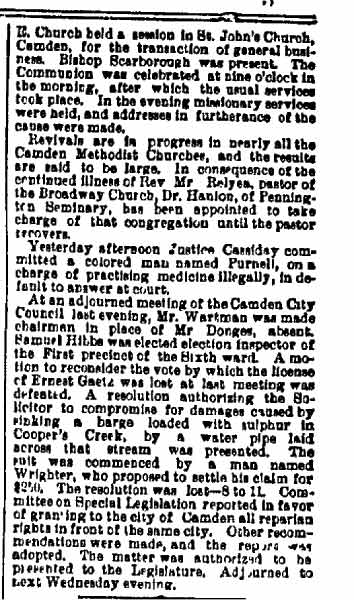
Yesterday the convocation of Burlington P. E. Church held a session in St. John’s Church, Camden, for the transaction of general business. Bishop Scarborough was present. The Communion was celebrated at nine o’clock in the morning, after which the usual services took place. In the evening missionary services were held, and addresses in furtherance of the cause were made.
Revivals are in progress in nearly all the Camden Methodist Churches, and the results are said to be large. In consequence of the continued illness of Rev. Mr. Relyes, pastor of the Broadway Church, Dr. Hanlon, of Pennington Seminary, has been appointed to take charge of that congregation until the pastor recovers.
Yesterday afternoon Justice Cassaday committed a colored man named Purnell, on a charge of practising medicine illegally, in default to answer at court.
At an adjourned meeting of the Camden City Council last evening, Mr. Wartman was made chairman in place of Mr. Donges, absent. Samuel Hibbs was elected election inspector of the First precinct of the Sixth ward. A motion to reconsider the vote by which the license of Ernest Gaetz was lost at last meeting was defeated. A resolution authorizing the Solicitor to compromise for damages caused by sinking a barge loaded with sulphur in Cooper’s Creek, by a water pipe laid across that stream was presented. The suit was commenced by a man named Wrigbteer, who proposed to settle his claim for $250. The resolution was lost—8 to 11. Committee on Special Legislation reported in favor of granting to the city of Camden all riparian rights in front of the same city. Other recommendations were made, and the report was adopted. The matter was authorized to be presented to the Legislature. Adjourned to next Wednesday evening.
When G.O.P. Battled G.O.P.
Camden Courier-Post —
Typical Convention Rumpus Stirred ‘Regular’ and ‘True’ Republicans as Gibbs and Morgan Were Nominated for Sheriff in ‘81
By Ben Courter
Rival factions in the political conventions of long ago were more bitter toward one another than toward the common foe. So-called “rump” conventions were by no means exceptions. By “rump” was meant merely those who refused to play with the regulars and who set up the nominations, as did the Bull Moose on the national scale in the historic scrap of 1912 which resulted in the three-cornered battle of Wilson, Roosevelt and Taft, giving the Princeton professor the start that was to make him a world figure. Factions we still have, of course, and it is quite proper, since too much regularity often breeds party decay. But present-day political methods are certainly lacking in the spectacular rumpuses that stirred the rank and file in the period when delegates met and made their nominations.
In a recent article allusion was made to the Democratic convention of September 20, 1878, when Nathan T. Stratton, of Millville, was nominated for Congress by the Democrats in the midst of downright fisticuffs, when “liar” and “hypocrite” and worse was hurled about the hall.
Lest it may be assumed the party of Jefferson and Jackson only was given to such methods, it is fitting to give a picture on the other side of the political house. Dr. William H. Iszard’s inexhaustible scrap book, loaned me by his son, former Assemblyman Iszard comes across with a copy of a tabloid political sheet, “The True Republican,” which gives a recital of a battle royal in the G.O.P. ranks which will be of interest to some old-timers I know are still about.
Rival Conventions
That was the convention to nominate a sheriff called at Gloucester City Hall on Saturday, October 8, 1881, where we find the redoubtable Colonel James Matlack Scovel once more a moving factor, but this time in the ranks of the “regular Republicans” or at least so they called themselves as opposed to the “rump” set up by a rival group. Christopher J. Mines, long Fifth ward leader and later sheriff, apparently had been selected as temporary chairman with William A. Husted, who died last year well in his 70’s, as secretary. But when that part of the delegation marched up to city hall, like the famed king’s horses—they marched down again.
As a matter of fact, not much marching was done in the hall—for it was asserted by the “true Republicans” that when they essayed to enter the portals they found Colonel Scovel and Henry M. Jewett, father of Harry Jewett, a Camden newspaperman of the long ago and for years later Jersey editor of the Inquirer, in command. More, it was charged “people representing the worst elements of society” were on guard and presented a phalanx which even the huskies of the opposing force could not break. Mines was strong-armed by the minions of Scovel and Jewett and there was so much hooting and yelling and cussin’ that the “true” part of the outfit walked out, all 29 of them, over to Moss’ hall where they proceeded to carry on their convention to their own taste.
And all 29 of these valiant Republicans voted for Eli B. Morgan as their candidate for sheriff. You old timers will be interested in recalling these delegates who refused to kowtow to ‘Colonel Jim.’ In the Third ward there was James M. Lane, Charles S. Cotting and George Martin, in the Fourth, Husted, the Sixth, C. C. Smith, Thad Varney, Charles A. Sawyer; in the Seventh, Stephen Walters, Charles Lederman, William Simpson; in Gloucester, John W. Wright, David Anderson, Frank Mills, Robert Lafferty, Richard Allen, Jesse Daisey, Samuel Wood; in Haddon, Charles M. Macready, Elwood J. Haines: in Delaware, William Brick, William Graff, Isaac Coles; in Merchantville, Matthias Homer, William Naylor, and in Center, James Davis, Garrett Patton and Gilbert Shaw.
Hot Statement
These “true Republicans” in a statement to the party rank and file, under the Algeresque title of “Now or Never,” scathingly said: “It becomes the duty of every Republican voter of Camden county, who has the future interest of the party at heart, to administer a severe and lasting rebuke to all candidates who employ the element and encourage the means that were used in controlling the Sheriff’s convention at City Hall, Gloucester City. It discounted anything within the memory of the oldest Democrat inhabitant. What with Col. Joseph Nichols urging the crowd to go elsewhere and nominate Gibbs, and the immaculate Billy Warner of the Fifth ward ordering them to burst the door in, coupled with the commanding voice of that great patriot and life-long Republican, James M. Scovel, alias Mountain Partridge, together with the curses and threats from John Furey, Jack Quigley, Pud Young, Bill Derr, ‘Tar Heel’ Jim Hayes, the able city solicitor, and a gang of Philadelphia roughs, a beautiful spectacle was presented.”
The “Gibbs” mentioned was Theodore B. Gibbs who long lived in the white mansion on the banks of Clementon lake and whose ancient grist mills ground the grain for farmers from miles around. None in the county was held in higher esteem and in later years most of the valiant 29 were among his closest friends, unnecessary proof the political animosities are, as a rule, not very enduring. Gibbs was nominated by the “regular” Convention which ousted the 29 and a mighty hot shrievalty campaign ended on November 10 with his ejection, in spite of the “now or never” demand of his opponents headed by Eli Morgan.
The latter was a real estate man, son of Randall Morgan, elected sheriff by a whisker over “Ham” Bitten in 1869, and brother of J. Willard Morgan, long a Republican chieftain. It was the elder Morgan who defeated Bitten, a rough and ready character nominated as a joke, by a narrow squeak.
In the shrievalty scrap of 1881. Gibbs received 5381 and Morgan, 1189. Angus Camerson, the Democratic candidate was given 4450 votes. Nor did the “true” nominees for coroner fare any better. Sam Bennett, William Thompson and Alexander Powell being defeated by ‘Doc’ John D. Leckner, Jacob Justice and William Duble.
But the “true” Republicans licked their wounds and most of them were ready to “yen their heads off” when Colonel Scovel in later campaigns made the welkin ring with his call from the rostrum to wallop the enemy. If you now come across any of the few actors of that period still in the flesh an allusion to that “spectacle” of half century ago will sure bring one big chuckle with the declaration “them was the days.”
C. J. Mines Dead
Camden Post-Telegram —
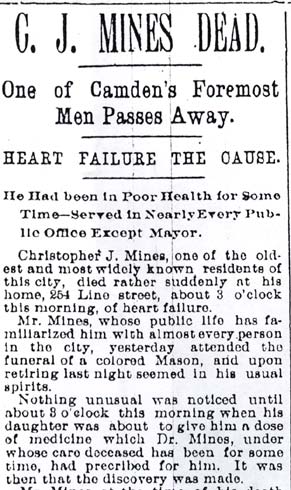
Christopher J. Mines, one of the oldest and most widely known residents of this city, died rather suddenly at his home, 254 Line street, about 3 o’clock this morning, of heart failure.
Mr. Mines, whose public life has familiarized him with almost every person in the city, yesterday attended the funeral of a colored Mason, and upon retiring last night seemed in his usual spirits.
Nothing unusual was noticed until about 3 o’clock this morning when his daughter was about to give him a dose of medicine which Dr. Mines, under whose care deceased has been for some time, had prescribed for him. It was then that the discovery was made.
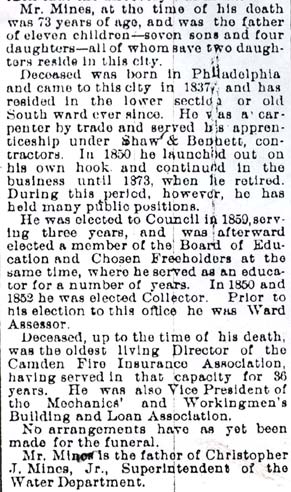
Mr. Mines, at the time of his death, was 73 years of age, and was the father of eleven children—seven sons and four daughters—all of whom save two daughters reside in this city.
Deceased was born in Philadelphia and came to this city in 1837, and has resided in the lower section or old South ward ever since. He was a carpenter by trade and served his apprenticeship under Shaw & Bennett, contractors. In 1850 he launched out on his own hook and continued in the business until 1873, when he retired. During this period, however, he has held many public positions.
He was elected to Council in 1850, serving three years, and was afterward elected a member of the Board of Education and Chosen Freeholders at the same time, where he served as an educator for a number of years. In 1850 and 1852 he was elected Collector. Prior to his election to this office he was Ward Assessor.
Deceased, up to the time of his death, was the oldest living Director of the Camden Fire Insurance Association, having served in that capacity for 36 years. He was also Vice President of the Mechanics’ and Workingmen’s Building and Loan Association.
No arrangements have as yet been made for the funeral.
Mr. Mines is the father of Christopher J. Mines, Jr., Superintendent of the Water Department.