Introduction
CHRISTOPHER AUGUSTUS BERGEN and his brother Martin V. Bergen were prominent lawyers in Camden for many years in Camden.
He was a member of the First Presbyterian Church in Camden.
After declining invitations to run for elected office for several years, Christopher Bergen answered his party’s call and was elected as a Republican to the Fifty-first and Fifty-second Congresses (March 4, 1889–March 3, 1893). He was an unsuccessful candidate for re-nomination in 1892. He resumed the practice of law. In 1903 moved to Haverford, Pennsylvania, where he died on February 18, 1905, and was interred in Evergreen Cemetery, Camden, New Jersey.
The C.A. Bergen School, which stood at 419 Mount Vernon Street in South Camden from 1891 through 1948, was named in his honor; the surrounding neighborhood is to this day known as Bergen-Lanning.
Christopher A. Bergen’s son Martin V. “Mike” Bergen was nationally known in sports circles in the 1890s and early 1910s as a baseball and football player at Princeton and as college football coach. Coach Bergen led teams at Grinnell College and the University of Virginia, compiling a record of 38–22–6.
From George R. Prowell’s History of Camden County, New Jersey
1886
Christopher A. Bergen, Esq., whose ancestry and parentage are given in the sketch of his brother, [Martin V. Bergen] was born at Bridge Point, Somerset County, N. J., August 2, 1841. He obtained his preparatory education at Edge Hill Classical School, Princeton, and entered Princeton College in the fall of 1860, graduating there from, with his brother, in the class of 1863. Afterwards he taught school,—first a country school at Hopewell, N. J., and later a private classical school of his own at Princeton,—pursuing at the same time law studies under the direction of Peter L. Voorhees, Esq., of Camden. In November, 1866, he was licensed as an attorney by the New Jersey Supreme Court, and in the fall of 1869 as counselor-at-law by the same court. Mr. Bergen’s mental activity, onerous as are his professional duties, is by no means confined to them. He is a student of general literature, keeps fully abreast of the times in political, philosophical and popular scientific information and continues his classical studies, reading extensively in Latin and Greek.
Christopher A. Bergen has been twice married. He was united with his first wife, Harriet, daughter of Thomas D. and Augusta S. James, August, 1869. Two sons were the offspring of this union. His second wife, to whom he was united January 26, 1886, was Fannie C, daughter of William L. and Adele C. Hirst, of Philadelphia.
The firm of Bergen & Bergen (M. V. & C. A.) has been quite uniformly and steadily successful, and probably has as large and as widespread a clientage and correspondence as any law firm in Camden. They have been frequently opposed by the best legal talent in the county and State, and have fully as often been victors as vanquished, and enjoy a high reputation. Two of the most notable cases in which they have won success were those of the Marshall estate, and the Jesse W. Starr Camden Iron-Works case in bankruptcy.
The former, which aroused much interest in the southern part of the county, was an action charging breach of trust on the part of the executors, and involved the title to five farms and a large part of the village of Blackwood. Bergen & Bergen appeared for the creditors against the executors, who were represented by S. H. Grey, and Peter L. Voorhees, Esqs. In the bankruptcy suit against Jesse W. Starr, above alluded to, in which about three hundred thousand dollars were involved, Bergen Brothers were also successful in forcing the creditors of Mr. Starr, to terms. Christopher A. Bergen, as a rule, attends to the court business and Martin V. devotes his attention more particularly to that department of practice which is the function of the counsel, though he also appears frequently in court. Both are well-read lawyers and able advocates.
Both of the brothers are pronounced Republicans, though neither is an active politician. Christopher A. in 1884 was the choice of a large section of his party for the position of State Senator, but declined making any effort to secure the nomination. He was elected president of the Camden County Republican Club in 1886. Martin V. Bergen has also been named as a candidate for legislative honors, but has held no offices of consequence other than the school superintendency.
1893
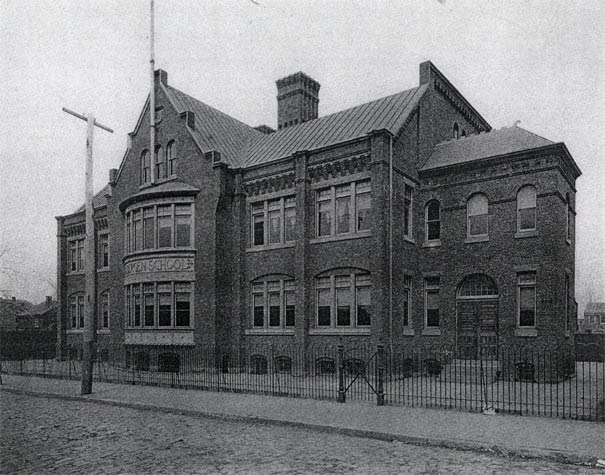
Christopher A. Bergen – 1893
In the Political Whirl
Philadelphia Inquirer —
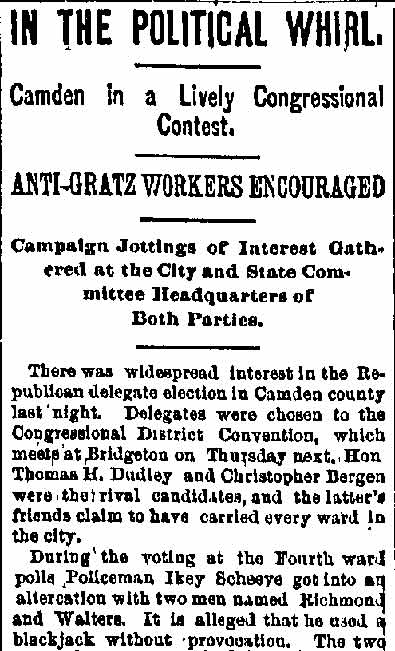
Camden in a Lively Congressional Contest.
ANTI-GRATZ WORKERS ENCOURAGED
Campaign Jottings of Interest Gathered at the City and State Committee Headquarters of Both Parties.
There was widespread interest in the Republican delegate election in Camden county last night. Delegates were chosen to the Congressional District Convention, which meets at Bridgeton on Thursday next. Hon. Thomas H. Dudley and Christopher Bergen were the rival candidates, and the latter’s friends claim to have carried every ward in the city.
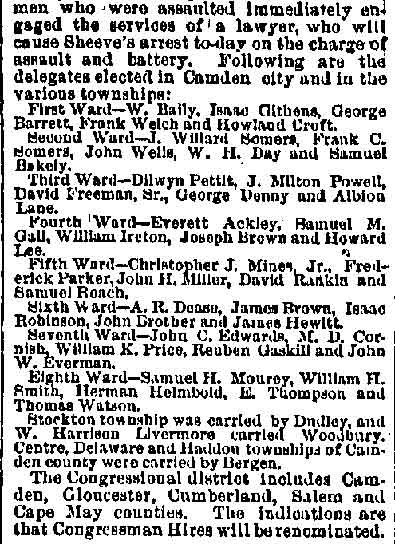
During the voting at the Fourth ward polls Policeman Ikey Scheeve got into an altercation with two men named Richmond and Walters. It is alleged that he used a blackjack without provocation. The two men who were assaulted immediately engaged the services of a lawyer, who will cause Sheeve’s arrest to-day on the charge of assault and battery. Following are the delegates elected in Camden city and in the various townships:
First Ward—W. Baily, Isaac Githens, George Barrett, Frank Welch and Howland Croft.
Second Ward—J. Willard Somers, Frank C. Somers, John Wells, W. H. Day and Samuel Bakely.
Third Ward—Dilwyn Pettit, J. Milton Powell, David Freeman, Sr., George Denny and Albion Lane.
Fourth Ward—Everett Ackley, Samuel M. Gall, William Ireton, Joseph Brown and Howard Lee.
Fifth Ward—Christopher J. Mines, Jr., Frederick Parker, John H. Miller, David Rankin and Samuel Roach.
Sixth Ward—A. R. Dease, James Brown, Isaac Robinson, John Brother and James Hewitt.
Seventh Ward—John C. Edwards, M. D. Cornish, William K. Price, Reuben Gaskill and John W. Everman.
Eighth Ward—Samuel H. Mourey, William H. Smith, Herman Helmbold, E. Thompson and Thomas Watson.
Stockton township was carried by Dudley, and W. Harrison Livermore carried Woodbury. Centre, Delaware and Haddon townships of Camden county were carried by Bergen.
The Congressional district includes Camden, Gloucester, Cumberland, Salem and Cape May counties. The indications are that Congressman Hires will be renominated.
Camden Politics
Philadelphia Inquirer —
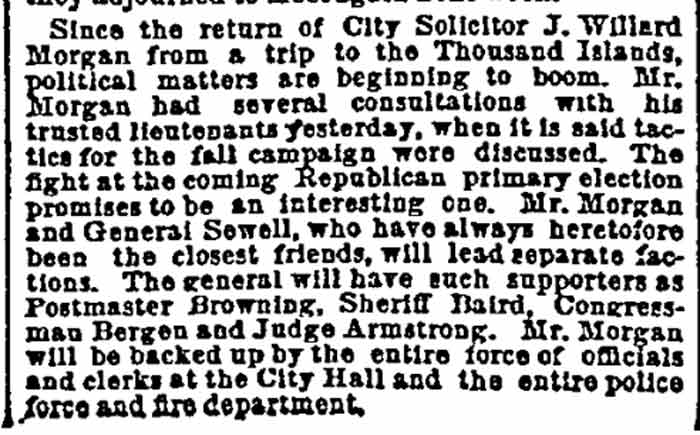
Since the return of City Solicitor J. Willard Morgan from a trip to the Thousand Islands, political matters are beginning to boom. Mr. Morgan had several consultations with his trusted lieutenants yesterday, when it is said tactics for the fall campaign were discussed. The fight at the coming Republican primary election promises to be an interesting one. Mr. Morgan and General Sewell, who have always heretofore been the closest friends, will lead separate factions. The general will have such supporters as Postmaster Browning, Sheriff Baird, Congressman Bergen and Judge Armstrong. Mr. Morgan will be backed up by the entire force of officials and clerks at the City Hall and the entire police force and fire department.
Brief ‘Cross River Notes.
Philadelphia Inquirer —
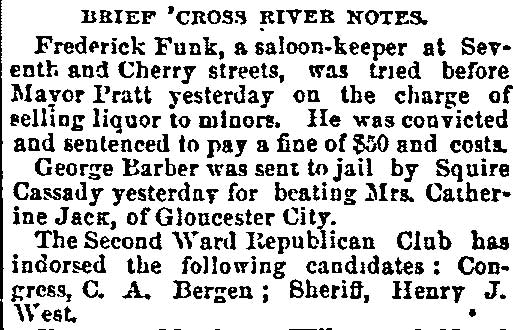
Frederick Funk, a saloon-keeper at Seventh and Cherry streets, was tried before Mayor Pratt yesterday on the charge of selling liquor to minors. He was convicted and sentenced to pay a fine of $50 and costs.
George Barber was sent to jail by Squire Cassady yesterday for beating Mrs. Catherine Jack, of Gloucester City.
The Second Ward Republican Club has indorsed the following candidates: Congress, C. A. Bergen; Sheriff, Henry J. West.
Camden’s News Budget
Philadelphia Inquirer —
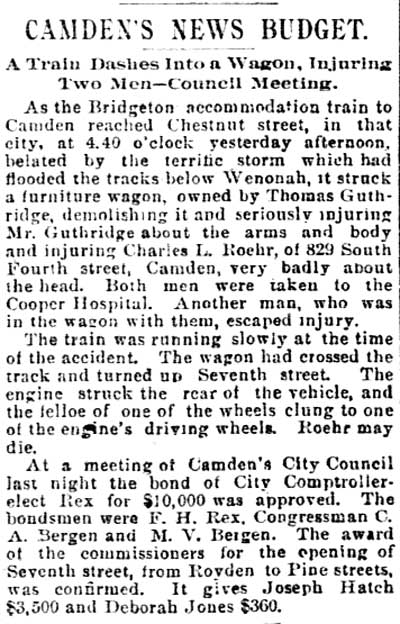
A Train Dashes Into a Wagon, Injuring Two Men—Council Meeting.
As the Bridgeton accommodation train to Camden reached Chestnut street, in that city, at 4.40 o’clock yesterday afternoon, belated by the terrific storm which had flooded the tracks below Wenonah, it struck a furniture wagon, owned by Thomas Guthridge, demolishing it and seriously injuring Mr. Guthridge about the arms and body and injuring Charles L. Roehr, of 829 South Fourth street, Camden, very badly about the head. Both men were taken to the Cooper Hospital. Another man, who was in the wagon with them, escaped injury.
The train was running slowly at the time of the accident. The wagon had crossed the track and turned up Seventh street. The engine struck the rear of the vehicle, and the felloe of one of the wheels clung to one of the engine’s driving wheels. Roehr may die.
At a meeting of Camden’s City Council last night the bond of City Comptroller-elect Rex for $10,000 was approved. The bondsmen were F. H. Rex, Congressman C. A. Bergen and M. V. Bergen. The award of the commissioners for the opening of Seventh street, from Royden to Pine streets, was confirmed. It gives Joseph Hatch $3,500 and Deborah Jones $360.
Letters of Administration Granted in Bergen Estate
Philadelphia Inquirer —

Letters of administration were granted Mrs. Fanny H. Bergen on the estate of the late ex-Congressman Christopher A. Bergen by Deputy Surrogate Peacock yesterday.
A City of the Dead
Camden Courier-Post —
A City of the Dead
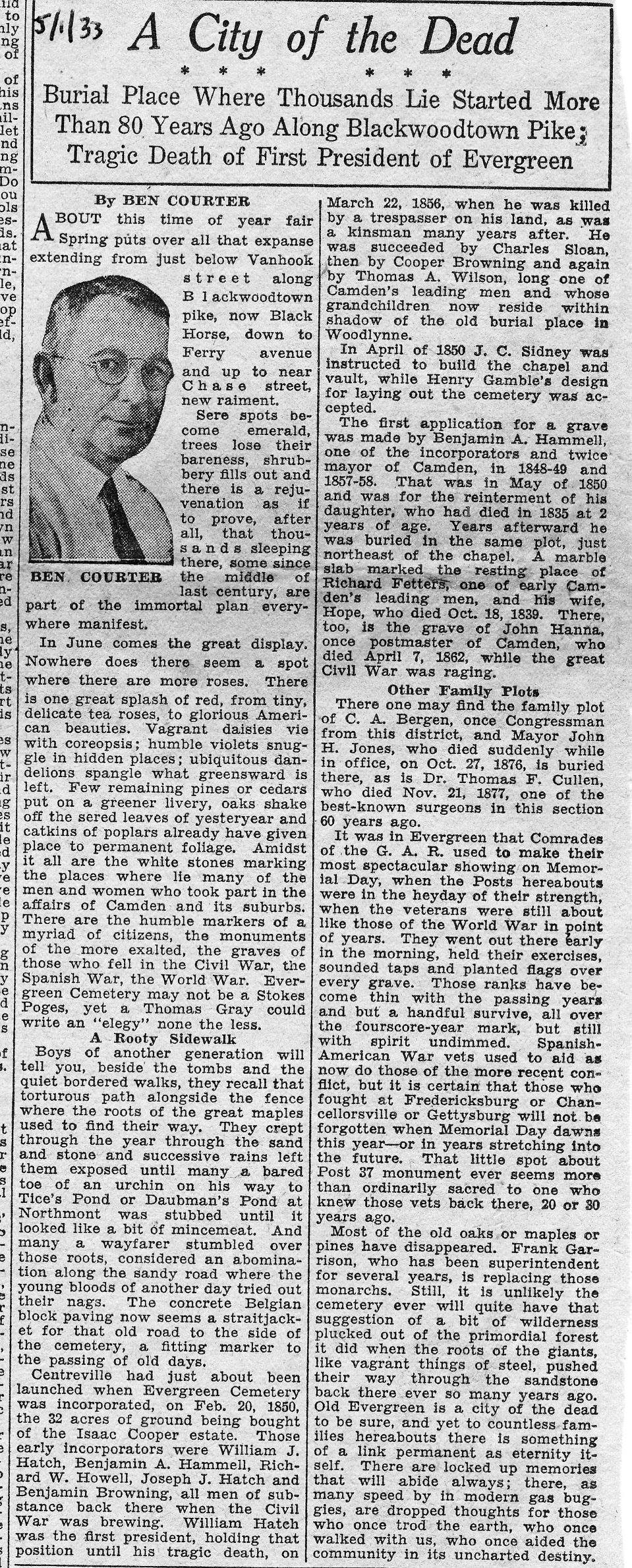
Burial Place Where Thousands Lie Started More Than 80 Years Ago Along Blackwoodtown Pike; Tragic Death of First President of Evergreen
BY BEN COURTER
About this time of year fair Spring puts over all that expanse extending from just below Vanhook street along Blackwoodtown pike, now Black Horse, down to Ferry avenue and up to near Chase street, new raiment.
Sere spots become emerald, trees lose their bareness, shrubbery fills out and there is a rejuvenation as if to prove, after all, that thousands sleeping there, some since the middle of last century, are part of the immortal plan everywhere manifest.
In June comes the great display. Nowhere does there seem a spot where there are more roses. There is one great splash of red, from tiny, delicate tea roses, to glorious American beauties. Vagrant daisies vie with coreopsis; humble violets snuggle in hidden places; ubiquitous dandelions spangle what greensward is left. Few remaining pines or cedars put on a greener livery, oaks shake off the sered leaves of yesteryear and catkins of poplars already have given place to permanent foliage. Amidst it all are the white stones marking the places where lie many of the men and women who took part in the affairs of Camden and its suburbs. There are the humble markers of a myriad of citizens, the monuments of the more exalted, the graves of those who fell in the Civil War, the Spanish War, the World War. Evergreen Cemetery may not be a Stokes Poges, yet a Thomas Gray could write an “elegy” none the less.
A Rooty Sidewalk
Boys of another generation will tell you, beside the tombs and the quiet bordered walks, they recall that torturous path alongside the fence where the roots of the great maples used to find their way. They crept through the year through the sand and stone and successive rains left them exposed until many a bared toe of an urchin on his way to Tice’s Pond or Daubman’s Pond at Northmont was stubbed until it looked like a bit of mincemeat. And many a wayfarer stumbled over those roots, considered an abomination along the sandy road where the young bloods of another day tried out their nags. The concrete Belgian block paving now seems a straitjacket for that old road to the side of the cemetery, a fitting marker to the passing of old days.
Centreville had just about been launched when Evergreen Cemetery was incorporated, on Feb. 20, 1850, the 32 acres of ground being bought of the Isaac Cooper estate. Those early incorporators were William J. Hatch, Benjamin A. Hammell, Richard W. Howell, Joseph J. Hatch and Benjamin Browning, all men of substance back there when the Civil War was brewing. William Hatch was the first president, holding that position until his tragic death, on March 22, 1856, when he was killed by a trespasser on his land, as was a kinsman many years after. He was succeeded by Charles Sloan, then by Cooper Browning and again by Thomas A. Wilson, long one of Camden’s leading men and whose grandchildren now reside within shadow of the old burial place in Woodlynne.
In April of 1850 J. C. Sidney was instructed to build the chapel and vault, while Henry Gamble’s design for laying out the cemetery was accepted.
The first application for a grave was made by Benjamin A. Hammell, one of the incorporators and twice mayor of Camden, in 1848-49 and 1857-58. That was in May of 1850 and was for the reinterment of his daughter, who had died in 1835 at 2 years of age. Years afterward he was buried in the same plot, just northeast of the chapel. A marble slab marked the resting place of Richard Fetters, one of early Camden’s leading men, and his wife, Hope, who died Oct. 18, 1839. There, too, is the grave of John Hanna, once postmaster of Camden, who died April 7, 1862, while the great Civil War was raging.
Other Family Plots
There one may find the family plot of C. A. Bergen, once Congressman from this district, and Mayor John H. Jones, who died suddenly while in office, on Oct. 27, 1876, is buried there, as is Dr. Thomas F. Cullen, who died Nov. 21, 1877, one of the best-known surgeons in this section 60 years ago.
It was in Evergreen that Comrades of the G. A. R. used to make their most spectacular showing on Memorial Day, when the Posts hereabouts were in the heyday of their strength, when the veterans were still about like those of the World War in point of years. They went out there early in the morning, held their exercises, sounded taps and planted flags over every grave. Those ranks have become thin with the passing years and but a handful survive, all over the fourscore-year mark, but still with spirit undimmed. Spanish-American War vets used to aid as now do those of the more recent conflict, but it is certain that those who fought at Fredericksburg or Chancellorsville or Gettysburg will not be forgotten when Memorial Day dawns this year—or in years stretching into the future. That little spot about Post 37 monument ever seems more than ordinarily sacred to one who knew those vets back there, 20 or 30 years ago.
Most of the old oaks or maples or pines have disappeared. Frank Garrison, who has been superintendent for several years, is replacing those monarchs. Still, it is unlikely the cemetery ever will quite have that suggestion of a bit of wilderness plucked out of the primordial forest it did when the roots of the giants, like vagrant things of steel, pushed their way through the sandstone back there ever so many years ago. Old Evergreen is a city of the dead to be sure, and yet to countless families hereabouts there is something of a link permanent as eternity itself. There are locked up memories that will abide always; there, as many speed by in modern gas buggies, are dropped thoughts for those who once trod the earth, who once walked with us, who once aided the community in its uncharted destiny.