Introduction
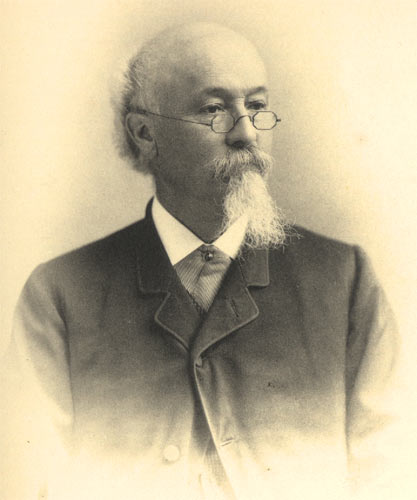
Portrait of Sinnickson Chew
Sinnickson Chew was born January 27, 1830, in Mannington township, Salem County NJ, where his parents then resided. His Christian name indicates his ancestry as being of the Swedes, who settled along the shores of the Delaware River as early as 1638, long before the English or Dutch saw the land. Among those who received deeds from John Fenwick to confirm their title, the names of Sinnic, Sinnica, and Sinnicker occur, and the records of Upland Court (on the opposite side of the river), which date back to 1676, show this name among the litigants before that tribunal.
The blood of the early comers was diffused among the English families, and as a consequence the name followed the line of relationship and was gradually changed to the present spelling. The direct and collateral branches of the family have always been prominent in the affairs of church and State and still have a firm hold upon the confidence and good opinion of the people in Southern Jersey.
Equipped with such education as could be gathered there from the country schools and fancying the business of a printer, Sinnickson Chew, in 1845, entered the office of the Constitution, published at Woodbury, N.J., by A.S. Barber.
Here he soon mastered the “art and mystery,” and in due time became the “post boy” to the office. With a horse and sulky he rode the length and breadth of the counties of Camden and Gloucester, distributing the news of the week at every store and crossroads, where he was a welcome visitor. Perhaps the poet can better describe him as he—
Who whistles as he goes,—light-hearted wretch,
Cold, and yet cheerful, messenger of grief
Perhaps to thousands, and of joy to some:
To him indifferent whether grief or joy.
In 1851 he left his master's employ and went to Philadelphia, in the composing department of the type foundry of L. Johnson & Co., but the same year he became connected with the National Standard, of Salem NJ, Charles P. Smith, editor. In a short time, associated with William S. Sharp, he purchased this paper and continued its publication, under the firm-name of Sharp & Chew, until 1862, when he made overtures for the purchase of the State Gazette, at Trenton NJ. In this he was defeated by Jacob R. Freese, at that time, the lessee, and soon after (May, 1862) he bought the entire interest of the West Jersey Press, of Camden, and became its editor and publisher. He soon infused new life into this journal and made it the leading Republican paper in the western part of the State.
Although a forcible writer, and firm in his political convictions, yet he concedes to his opponents the right to their own line of thought. He never loses sight of the great moral necessities of the times, nor will he sacrifice them even when a political advantage is at stake. His paper is always a means to discuss local or general topics, but not open to personalities or questionable correspondence. With such a reputation, the West Jersey Press is regarded as a safe medium of county news, and is read by all who are in full faith with its political notions, and by many who neither think nor vote as the editor would advise.
For three years, from 1872, he was consecutively elected by the House of Assembly of New Jersey to the responsible position of clerk of that body, and was conceded by his political opponents to have been courteous and polite to all. His fidelity to his political friends is strong and lasting, and his devotion to the principles of the political party of which he is an honored member, is well known throughout his native state. His tact and energy are evidenced in the erection of the “Press” building, where he conducts an active business, giving personal attention to the details of the various kinds of work, and not neglecting improvements that aid so much in speed and finish.
As one of the active members of the Editorial Association of New Jersey, Mr. Chew has brought about many improvements in the working of that body. The business meetings bring the members into closer intercourse, and the annual excursion are popular and make friendships where otherwise none would exist.
On May 8, 1860, Mr. Chew married Sarah A., daughter of Samuel W. Miller, then sheriff of Salem County. His surviving children are Lillie M., the wife of Oliver Smith, Jr., William H., and Eddie H. Chew.
Sixth Regiment Armory
Philadelphia Inquirer —

Sinnickson Chew, proprietor of the West Jersey Press, denies that he will compel the Sixth Regiment, N. G. N. J., to leave their present quarters before their new armory is completed.
Lodged in Camden's Jail
Philadelphia Inquirer —
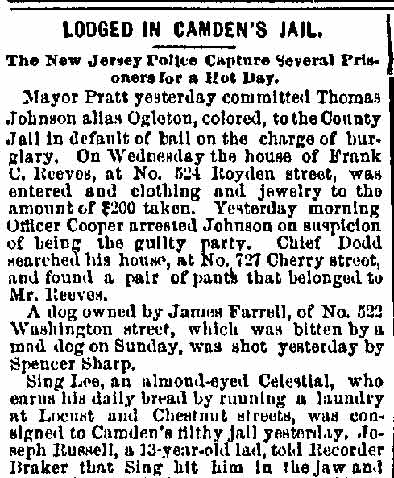
Lodged in Camden's Jail.
The New Jersey Police Capture Several Prisoners for a Hot Day.
Mayor Pratt yesterday committed Thomas Johnson alias Ogleton, colored, to the County Jail in default of bail on the charge of burglary. On Wednesday the house of Frank C. Reeves, at No. 524 Royden Street, was entered and clothing and jewelry to the amount of $200 taken. Yesterday morning Officer Cooper arrested Johnson on suspicion of being the guilty party. Chief Dodd searched his house, at No. 727 Cherry Street, and found a pair of pants that belonged to Mr. Reeves.
A dog owned by James Farrell, of No. 522 Washington Street, which was bitten by a mad dog on Sunday, was shot yesterday by Spencer Sharp.
Sing Lee, an almond-eyed Celestial, who earns his daily bread by running a laundry at Locust and Chestnut streets, was consigned to Camden's filthy jail yesterday. Joseph Russell, a 12-year-old lad, told Recorder Braker that Sing hit him in the jaw and
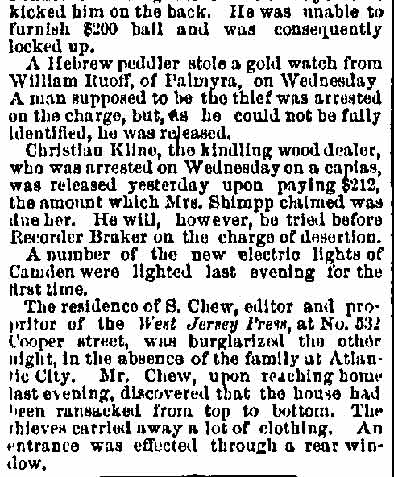
kicked him on the back. He was unable to furnish $200 bail and was consequently locked up.
A Hebrew peddler stole a gold watch from William Ruoff, of Palmyra, on Wednesday. A man supposed to be the thief was arrested on the charge, but, as he could not be fully identified, he was released.
Christian Kline, the kindling wood dealer, who was arrested on Wednesday on a capias, was released yesterday upon paying $212, the amount which Mrs. Shimpp claimed was due her. He will, however, be tried before Recorder Braker on the charge of desertion.
A number of the new electric lights of Camden were lighted last evening for the first time.
The residence of S. Chew, editor and proprietor of the West Jersey Press, at No. 534 Cooper Street, was burglarized the other night, in the absence of the family at Atlantic City. Mr. Chew, upon reaching home last evening, discovered that the house had been ransacked from top to bottom. The thieves carried away a lot of clothing. An entrance was effected through a rear window.
Sinnickson Chew, Printer and Stationer
Historical and Industrial Review of Camden, N.J. — 1890
Sinnickson Chew, Printer and Stationery, N. E. Corner of Front and Market Streets
One of the oldest and most favorably known houses of this kind in the city is that of Mr. Sinnickson Chew. This gentleman succeeded the late Samuel C. Harbert in 1862, and has managed the business successfully since its inception.
The store is about 20x30 feet in dimensions, and the printing room upstairs occupy the third floor which is 50x90 feet. Three cylinder and three job presses are kept busy. The printing business done is without exception the largest in the city; a newspaper is printed here, the well known West Jersey Press. Special attention is also paid to catalogue and job work, which is done in the shortest possible time.
A fine stock of stationery, blank books, paper, pens and fancy articles are also kept. Twenty-five skilled workmen are employed when running normally.
Mr. Chew is a native of Salem County, New Jersey, he has been a prominent resident of the city for many years, and always to be found among the men who are looking towards Camden's best interests.
Camden Crime and Politics
Philadelphia Inquirer —
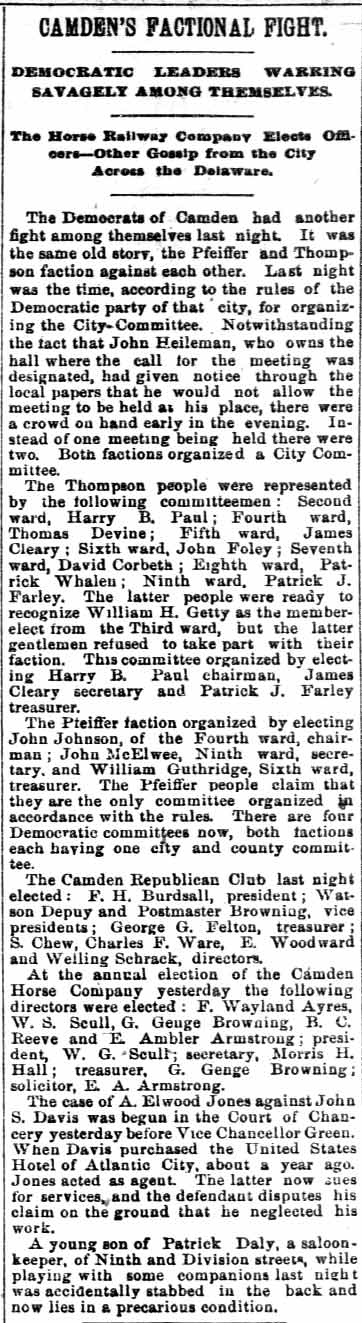
Camden’s Factional Fight
Democratic Leaders Warring Savagely Among Themselves
The Democrats of Camden had another fight among themselves last night. It was the same old story: the Pfeiffer and Thompson factions clashing again. Last night was the scheduled time, according to party rules, for organizing the City Committee. Despite John Heileman, owner of the hall designated for the meeting, publicly announcing he would not allow the gathering, a crowd assembled early. Instead of one meeting, there were two—each faction formed its own City Committee.
The Thompson faction was represented by the following committeemen: Second Ward, Harry B. Paul; Fourth Ward, Thomas Devine; Fifth Ward, James Cleary; Sixth Ward, John Foley; Seventh Ward, David Corbett; Eighth Ward, Patrick Whalen; Ninth Ward, Patrick J. Farley. They were prepared to recognize William H. Getty as the elected member from the Third Ward, but he declined to join their faction. This committee elected Harry B. Paul as chairman, James Cleary as secretary, and Patrick J. Farley as treasurer.
The Pfeiffer faction organized by electing John Johnson of the Fourth Ward as chairman, John McElwee of the Ninth Ward as secretary, and William Guthridge of the Sixth Ward as treasurer. They claimed theirs was the only committee properly organized under party rules. Camden now had four Democratic committees—each faction with its own city and county committee.
The Camden Republican Club also met last night and elected F. H. Burdsall as president; Watson Depuy and Postmaster Browning as vice presidents; George G. Felton as treasurer; and Sinnickson Chew, Charles F. Ware, E. Woodward, and Weiling Schrack as directors.
At the annual election of the Camden Horse Company, the following directors were chosen: F. Wayland Ayer, William S. Scull, G. Genge Browning, Benjamin C. Reeve, and E. Ambler Armstrong. Officers elected were: President, William S. Scull; Secretary, Morris Hall; Treasurer, G. Genge Browning; Solicitor, E. Ambler Armstrong.
In the Court of Chancery yesterday, the case of A. Elwood Jones vs. John S. Davis began before Vice Chancellor Green. Jones, who acted as agent when Davis purchased the United States Hotel in Atlantic City a year ago, is suing for services rendered. Davis disputes the claim, alleging neglect.
A young son of Patrick Daly, a saloon keeper at the corner of South 9th Street and Division Street, was accidentally stabbed in the back while playing with companions last night and now lies in serious condition.
Funeral of Editor Chew
Camden Post-Telegram —
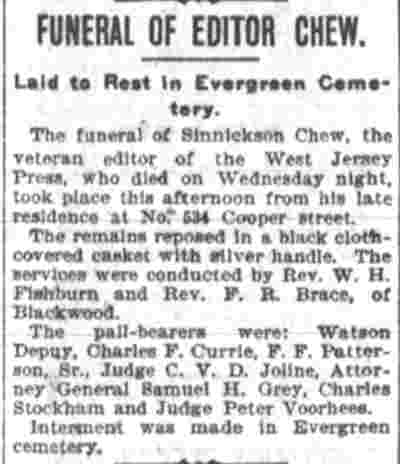
Funeral of Editor Chew.\
Laid to Rest in Evergreen Cemetery.
The funeral of Sinnickson Chew, the veteran editor of the West Jersey Press, who died on Wednesday night, took place this afternoon from his late residence at No. 534 Cooper Street.
The remains reposed in a black cloth-covered casket with silver handle. The services were conducted by Rev. W. H. Fishburn and Rev. F. R. Brace, of Blackwood.
The pall-bearers were: Watson Depuy, Charles F. Currie, F. F. Patterson, Sr., Judge C. V. D. Joline, Attorney General Samuel H. Grey, Charles Stockham and Judge Peter Voorhees.
Interment was made in Evergreen Cemetery.