Introduction
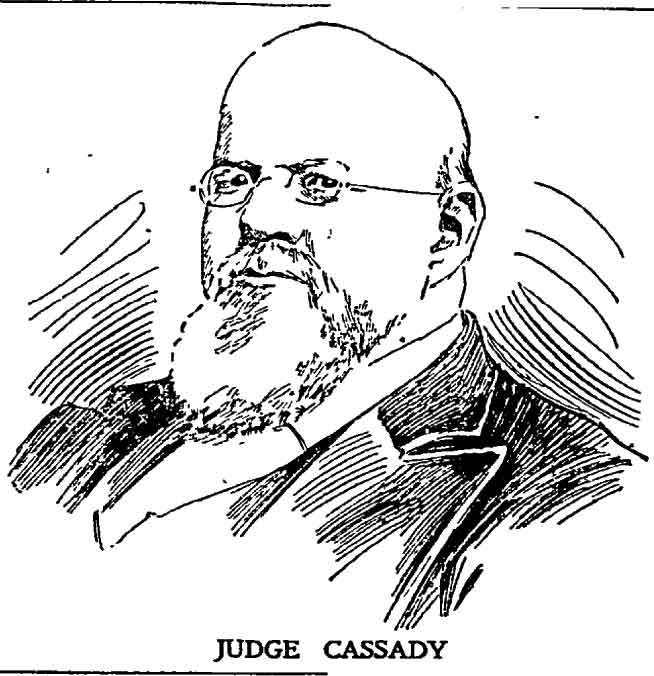
The Well-Known Camden Citizen Succumbs to Bright’s Disease of the Kidneys.
HIS DEATH WAS EXPECTED
Occupied Important Public Positions for Many Years and Was Esteemed by All Who Knew Him.
United States Commissioner James M. Cassady, of 128 Federal street, Camden, widely known throughout the State of New Jersey, died at 6 o’clock last evening, after an illness of several months. Justice Cassady was a sufferer from Bright’s disease. His death had been expected since Monday last, when he became unconscious, in which condition he remained until his death, with the exception of a brief period on Tuesday morning. During that time the only nourishment he was able to take was a spoonful of milk. He was surrounded by his family at the time of his death.
At the services in the First M. E. Church last evening Pastor Handley announced the death of Justice Cassady, which cast a gloom over the congregation, as Mr. Cassady was one of the pillars of the church, and his membership dated back for sixty years.
'It was seventy-six years ago, and down in the old Southwark district of Philadelphia that Squire Cassady first saw the light. In 1837, when 16 years old, he took up his residence in Camden. Apprenticed to J. L. De La Cour, a prosperous druggist and manufacturing chemist, he served his time, and when he came of age opened a stationery store at No. 128 Federal street, where he had lived ever since. The young stationer took an active interest in politics, and in 1846 was elected a justice of the peace. Thereafter, for half a century, he was re-elected successively. He was a staunch Democrat, and as parties changed and the city was cut up into wards he found himself in a ward where his party was in a minority. This made no difference, however, for Republicans and Democrats alike joined in voting for the 'Squire, and for many years the dominant party did not name a candidate against him. On the completion of the 'Squire’s half century in office, however, a Republican aspirant came to the front and succeeded in securing nomination and election.
When the marriage license law in Philadelphia began to make Camden a Gretna Green, Squire Cassady’s office, being close to the Federal street ferry, rapidly gained favor as a place where Philadelphia couples could get the nuptial knot tied in short order. He exercised discretion in young couples, and no public scandals arose from marriage ceremonies performed by him.
Squire Cassady held the offices of Commissioner of Deeds, Notary Public and United States Commissioner for many years. In the latter capacity he acted as committing magistrate in nearly all the important government cases wherein arrests were made in South Jersey.
Camden Methodism and Free Masonry counted Squire Cassady among their pillars. He was a member of the First M. E. Church for sixty years, having joined it as a lad when he arrived in Camden, and for many years was one of its leading officials.
JAMES M. CASSADY was one of Camden's most civic-minded residents of the 19th Century. He served in many roles during the 59 years he lived in Camden after coming to the city… which was still just a town, charter-wise… in 1838 as a 17 year-old apprentice to pharmacist Joseph de la Cour. The James M. Cassady School at North 3rd and State Streets in North Camden, which thousands of students passed through during the 59 years it existed was named in his memory.
Born in the Southwark section Philadelphia in 1821, James M. Cassady, upon reaching the age of legal majority, opened up a stationary shop at 128 Federal Street. He resided at that address the rest of his days. He took interest in politics held many different government posts throughout his life time. He was elected Justice of the Peace as a Democrat in 1846, a position that he held for 50 years. He also held a Federal position as a United States Commissioner. He became Camden County's first coroner after it was organized in 1844, and conducted the County's first murder inquest. Other positions that James M. Cassady filled included service for at least twenty-four years as a member of the Board of Education, including being its president in 1876, twelve years as district court clerk, State prison inspector, and he also was a member of the city police commission.
James M. Cassady also served the city as a volunteer fireman in the days prior to the founding of the professional department in 1869, joining the Niagara Fire Company in 1838. Fellow Fairmount members included John Laning, Josiah Atkinson, Samuel Jenkins, William Hanna and James W. Ayers. The Niagara Company reorganized as the Weccacoe Fire Company No. 2. in 1848.
In 1852 the company was incorporated as the Weccacoe Fire Company, No. 2, by John Laning, James M. Cassady, Isaac Shreeve, Wesley P. Murray, Joseph F. Murray, Joshua S. Porter, Daniel B. McCully, Richard G. Camp, James Doughten, Stone H. Stow, Charles H. Thorne, Matthew Miller, Jr., and James W. Ayers. Ayers was president of the Niagara in 1845, continued as such except in 1854, when he was absent from the city, held the office until the company was disbanded. Richard G. Camp was the secretary and Charles Thompson treasurer until 1854, and Joseph L. Bright was his successor until the end. Efficiency and good order were the characteristics of the Weccacoe from the beginning to the ending of their career as firemen.
James M. Cassady's home at 128 Federal Street came close to destruction on July 18, 1867 but was saved due to the efforts of the volunteer fire companies.
James M. Cassady was very involved in real estate, building and loan societies and insurance. He was involved in the publication of the Camden Democrat, a weekly newspaper for a short time in the 1850s, and again in the 1870s.
In 1856 the Washington Market Company was incorporated, with John S. Read, Ralph Lee, James M. Cassady, Isaac W. Mickle, Lewis Seal, Matthew Miller, John Ross, John K. Cowperthwaite, Henry Fredericks, Joseph T. Rowand and William P. Tatem as the company. The design was to build a market-house on the west side of Third Street, between Arch and Federal, the structure to be about one hundred feet square, but the erection of the market-sheds on Third Street, by the city, caused the company to abandon the project.
James M. Cassady joined the First Methodist Episcopal Church as a boy. This church was known as the Third Street Methodist Episcopal Church from 1869 to June of 1893. While with the church he served as a trustee, on the building committee, and as a Sunday School superintendent at different times. He was very much involved in the founding and promoting of Pitman Grove in Gloucester County, which was conceived as a summer retreat where camp meetings of the Methodist church could be held. James M. Cassady kept a summer cottage there.
Outside of church and business, James M. Cassady was active fraternally, politically and in other aspects of Camden's civic life. He was a long-time member of Camden Lodge No. 15, Free & Accepted Masons, and served as the lodge's secretary for 45 years. He was a founding member of Chosen Friends Lodge, No. 29, Independent Order of Odd Fellows and served a term is its Grand Master. He also was involved with the Improved Order of Red Men, the Knights of Pythias, and the Sons of Temperance.
In the years before the Civil War, when no National Guard existed James M. Cassady took up a military role. For seventeen years Camden was without any military company, when, November 23, 1855, the Camden Light Artillery was organized with a muster-roll of forty men. The following was the roster of officers:
Captain Isaac W. Mickle; First Lieutenant, James W. H. Stickney; Second Lieutenant, Jesse E. Huston; Third Lieutenant, Joseph J. Bender; First Sergeant, Ephraim C. Ware; Second Sergeant, Richard H. Lee; Third Sergeant, John R. Cunningham; Fourth Sergeant, Samuel H. Carles; Quartermaster, James M. Cassady; First Corporal, Philip M. Armington; Second Corporal, William W. Sheed; Third Corporal, Remington Ackley; Fourth Corporal, James B. Shields.
The secretary was William J. Miller and the treasurer Martin E. Harmstead. The armory was in the Starr building, on Bridge Avenue below Second Street. The Light Artillery was a “crack” company, their uniform being very showy, with “shakos” that gave them a formidable appearance. Captain Mickle had seen service in Mexico. Ephraim C. Ware succeeded in command of the company; when the Civil War broke out thirty out of the thirty-six entered the service under their old commander.
Demanding a swift response to the Confederate States of America's firing cannons on Fort Sumter, on April 16, 1861 the first war meeting was held in Camden. James M. Cassady was one of the signatories to the letter to President Lincoln.
George Reeser Prowell, in his History of Camden County, New Jersey, wrote the following about what happened after the letter was sent.
In response to a call, on the 18th of April an enthusiastic meeting was held in the county court-house, which was formed of a large collection of prominent citizens. The court-room was decorated with flags and mottos. John W. Mickle was chosen president and Samuel C. Harbert and Thomas G. Rowand secretaries. The president addressed the meeting first and Rev. Mr. Monroe offered a prayer. Hon. Thomas P. Carpenter, Thomas B. Atkinson (mayor) and Joseph Painter were appointed a committee on resolutions. Judge Philip J. Grey addressed the meeting, after which the committee adopted a long series of patriotic resolutions. The Washington Grays, Stockton Cadets and the Zouaves marched into the room and were received with cheers, Samuel Hufty read a resolution which was signed by many persons, who immediately formed the Home Brigade. David M. Chambers, Captain Stafford, Benjamin M. Braker, John H. Jones and E. A. Acton each addressed the meeting. James M. Scovel was then called upon and responded in eloquent terms and with patriotic energy.
S. H. Grey offered a resolution, which was adopted, that the City Council and the Freeholders of the county be requested to appropriate money for the equipment of persons who may volunteer in defense of the country, and S. H. Grey, James M. Cassady and Joseph Painter were appointed a committee to look after the interests of the resolution. The meeting continued in session until eleven p.m.
In 1862 James M. Cassady ran for Mayor as a Democrat but was defeated by Paul Budd, American-Republican, Cassady receiving 716 votes to Budd's 987.
After the Civil War James M Cassady continued his many works in business, government, and civic affairs.
Prowell wrote the following:
In 1870 a company was formed as the “Camden Democratic Co-Operative Association,” the incorporators being Thomas McKeen, Isaiah Woolston, James M. Cassady, Chalkley Albertson, Cooper P. Browning, John Clement, William Sexton, Richard S. Jenkins, Henry Fredericks and James S. Henry. John H. Jones, editor of the American Banner, the organ of Native Americanism in Philadelphia, was appointed editor, and Lyman B. Cole, manager. Financially, the business of the office was not a success, but Jones was a man of unpolished power, talking to the people in language and of subjects they understood, and with an earnestness which carried conviction to those appealed to. He was a large-hearted man, and an earnest advocate of the cause of the laboring classes. Under his regime the Democrat became quite popular, and wielded its old-time influence in the community. In 1874 Jones was elected mayor, but did not live to serve his term out, his death taking place in 1876. The paper was then conducted for a time by Dr. Thomas Westcott and Charles G. Dickinson, stock-owners in the company, and, in 1878, was sold to Messrs. Wills & Semple, the former at that time as now publisher of the Mount Holly Herald.
James M. Cassady was involved with a building and loan association known as The City, which organized May 2, 1874, and in 1885 had two hundred and five members. In 1885 officers of the City were James M. Cassady, president; Edmund E. Read, Jr., vice-president; Volney G. Bennett, treasurer; E. K. Fortiner, secretary.
In 1886 James M. Cassady served as Notary Public for the Camden Safe Deposit & Trust Company bank, later known as the Camden Trust.
A public servant until very late in life, James Cassady, a Democrat, continued to win re-election as Justice of the Peace in a mostly Republican district for 50 years, losing the election in 1896 to Jehu Evans.
James M. Cassady was married to Caroline Paul, who bore him at least five children, two known sons and three known daughters. Son Hugh William Cassady died in a drowning accident at Pitman Grove in 1883. Mrs. Cassady passed away in February of 1888. Afflicted with nephritis, referred to in his time as Bright's Disease, James M. Cassady passed away on August 8, 1897.
Named in his honor, in November of 1897, the James M. Cassady School at North 3rd and State Street accepted its first pupils. The school served the children of North Camden until the spring if 1966.
The First War Meeting in Camden
On the 16th of April, 1861, three days after the Confederates fired upon Fort Sumter, at the entrance of Charleston Harbor, a large number of loyal and patriotic citizens of Camden City and County issued the following vigorous and spirited response to the President's proclamation:
To the President Of the United States:
“The unparalleled events of the last week have revealed to the citizens of the United States, beyond question or the possibility of a doubt, that peaceful reconciliation upon the form of our Constitution is repelled and scorned, and secession means, in the hearts of its supporters, both Treason and war against our Country and Nation.
“We, therefore, the undersigned Loyal Citizens of the United States, and inhabitants of the city of Camden, in the State of New Jersey, responding to the proclamation of the President of the United States, hereby declare our unalterable determination to sustain the government in its efforts to maintain the honor, the integrity and the existence of our National Union and the perpetuity of the popular Government, and to redress the wrongs already long enough endured; no differences of political opinion; no badge of diversity upon points of party distinction, shall restrain or withhold us in the devotion of all we have or can command to the vindication of the Constitution, the maintenance of the laws and the defense of the Flag Of our Country.
I. S. Mulford — E. R. Johnson — Louis L. Scovel — B. M. Braker — Joseph C. Nichols — Elwood C. Fortiner — Joseph Vautier — Edmund Brewer — Uriah Norcross — Isaac L. Lowe — Henry B. Goodwin — Richard W. Test — James M. Cassady — John Duprey — Jesse Pratt — Hamilton Johnston — Charles P. Dickinson — Richard H. Lee — C. G. Zimmerman — Thomas M. K. Lee, Jr. — Charles J. Sanders — Samuel S. E. Cowperthwait — James M. Scovel — S. C. Harbert — John S. Read — D. H. Erdman — Adam Angel — George W. Vanhorn — Charles S. Garrett — Thomas M. Barracliff — W. H. Saunders — Jacob Harman, Jr. — Charles K. Horsfall — Timothy Middleton — William W. Sloan — Charles Cloud — A. W. Test — C. A. S. Driesback — Henry Schock — Walter Patton — Azael Roberts — Thomas Jeffries — O. Gilbert Hannah — J. C. De Lacour — Edward T. Andrews — Conclin Mayhey — William Reynolds — Simon Rammell — H. H. Goldsmith — John Horsfall — Thomas H. Dudley — Robert Folwell — Edw. H. Saunders — James O. Morgan — David H. Sheppard — Richard Fetters — Charles C. Reeves — S. H. Grey — N. B. Stokes — S. O. Wright — Joseph Dlinston — David Creary — John R. Barber — James H. Denny — William R. Maxwell — Robert Wible — Hamilton William — George W. Jackson — Joseph Maurer — Joseph D. Brown — William S. Scull — Daniel Witham — Isaac Shreeve — Adam Hare — George Wardell — Joseph Coffman — George W. Conrow — Joshua Howell — Martin Grey — S. L. Wayne — Abner Sparks — Van T. Shivers — Westcott Campbell — William J. Taylor — Isaiah Norcross — Alden O. Scovel — Philip J. Gray — George W. Gilbert — Charles D. Hineline — Thomas H. Davis — Charles De Haven — Thomas Ackley — John Gill — James B. Dayton — James M. Stevens — Joseph French — George Campbell — A. A. Merry — E. Wells — William D. Clark — William B. Hatch — E. O. Jackson — A. B. Martin — Richard O. Robertson — Timothy O. Moore — George W. Stanley — Robert Schall — Reynell Coates — Aaron Hewit — Henry Shuster — William Hartsgrove — William B. French — W. A. Winchester — John M. Natty
In response to a call, on the 18th of April an enthusiastic meeting was held in the county court-house, which was formed of a large collection of prominent citizens. The court-room was decorated with flags and mottoes. John W. Mickle was chosen president and Samuel C. Harbert and Thomas G. Rowand secretaries. The president addressed the meeting first and Rev. Mr. Monroe offered a prayer. Hon. Thomas P. Carpenter, Thomas B. Atkinson (mayor) and Joseph Painter were appointed a committee on resolutions. Judge Philip J. Grey addressed the meeting, after which the committee adopted a long series of patriotic resolutions. The Washington Grays, Stockton Cadets and the Zouaves marched into the room and were received with cheers, Samuel Hufty read a resolution which was signed by many persons, who immediately formed the Home Brigade. David M. Chambers, Captain Stafford, Benjamin M. Braker, John H. Jones and E. A. Acton each addressed the meeting. James M. Scovel was then called upon and responded in eloquent terms and with patriotic energy. S. H. Grey offered a resolution, which was adopted, that the City Council and the Freeholders of the county be requested to appropriate money for the equipment of persons who may volunteer in defense of the country, and S. H. Grey, James M. Cassady and Joseph Painter were appointed a committee to look after the interests of the resolution. The meeting continued in session until eleven p.m.
The Fire of July 18, 1867
Still another destructive fire occurred less than a week later. About 5 P.M. the following Saturday, July 18, flames were discovered coming from the engine room of Goldey & Cohn's large box factory on Taylor Avenue. Flames spread through the building, feeding on the highly combustible stock. The entire building was soon engulfed in fire as was the late R.H. Middleton's brick stable. A brisk southwest wind carried the flames across Taylor Avenue to the company's lumber pile and onward to Middleton's warerooms at #7 South Second Street and also his two and one-half story frame dwelling at #5 South Second Street.
Chief Engineer Ayers realized that additional help was needed and telegraphed Chief McClusker of Philadelphia for assistance. The blaze was already threatening to consume the most densely populated and most valuable section of the City. Chief McClusker responded with steamers from the Vigilant and Hibernia Fire Companies, the Fairmount, Lafayette, Neptune, America and Diligent Hose Companies and the Empire Hook & Ladder Company.
As the firemen placed the steamers along the Delaware River and laid their hose lines, the fire spread to the Ware & Marshall meat and provision store, a two story brick property at #3 South Second Street and to a two and one-half story brick dwelling at #1 South Second Street (owned by Joab Scull and occupied by Charles Armstrong). These buildings were destroyed as was Joab Scull's wood frame grocery store on the southwest corner of Second and Federal Streets and an adjacent three story brick dwelling (also owned by Scull but occupied by Mr. Goldey).
The fire continued to spread destroying Mr. Test's frame drugstore and extending to the home of James M. Cassady, Esquire's house at 128 Federal Street. Firemen were successful in saving Cassady's residence from complete destruction. Although the property sustained heavy water damage, only the rear of the building was destroyed. The fire fighters continued their determined stand against the oncoming flames and were able to save the property of the late Samuel McLain which adjoined Cassady's residence.
Conrad Hoell’s saloon at the corner of Second and Federal Streets and the adjoining building occupied by L.G. Peterson ignited several times, but the flames were quenched by what the West Jersey Press called the “superhuman exertions” of the fire fighters.
Several firemen were overcome by the intense heat, including Captain Wesley P. Murray and Joseph Flanigan of the Weccacoe Hose and Robert S. Bender, Thomas McCowan and Thomas Allibone of the Independence Steam Engine. These men had to be removed from the scene.
Combined losses exceeding $54,000 were reported as a result of this devastating conflagration. Chief Engineer Ayers praised the efforts of his men and the good work done by Chief McClusker and his forces from Philadelphia. The grateful citizens joined in this praise.
Personal Sketches No. 8
Camden County Courier –
By David W. Belisle


PERSONAL SKETCHES.—No. 8.
BY D. W. BELISLE.
JAMES MITCHEL CASSADY, ESQ.
There are few gentlemen in Camden more widely and popularly known than James Mitchel Cassady, and few enjoy a more marked reputation, a reputation which he has achieved by his own individual efforts. Early imbued with principles of uprightness and instinctively opposed to everything tending to demoralize a christian character, with an unfaltering determination to walk in the paths of moral rectitude, he has won a name and standing acknowledged by the entire community. Occupying for many years high positions entrusted to him by the people and also by appointing powers, he has lived a life of great usefulness, and exhibited a conscientious scrupulousness in the discharge of every duty incumbent on each position—a course of conduct which has elicited the commendation of the best and worthiest of all classes, and which is worthy of general emulation. Sensitively cognizant of the fact that it is just as imperatively necessary to attend to the smallest as well as to the largest duties promptly he never neglects the least requirement by putting off until to-morrow that which he can do to-day—thus realizing fully that procrastination is the thief of time. Consequently, whatever business transactions are entrusted to his charge are pushed to determination with as great rapidity as thorough legality and the exigencies of the case will permit. By this system of carefulness and exactitude of proceedings his books and records are always found to cleanly balance, and few undetermined cases remain for future action.
Mr. Cassady was born in the old District of Southwark, Philadelphia, Nov. 2d, 1821. In the spring of 1837, Mr. Cassady, the subject of this sketch was indentured to Joseph C. De La Cour, before Judge John K. Cowperthwait, to learn the business of an apothecary. In that position he exhibited unusual aptitude, and in a short time was thoroughly versed in all its departments. In 1849 he was elected Coroner, and had the first homicide case in Camden county, which grew out of the murder of George Riggins at Cooper’s Point, by James McCallian, alias Schooley Jim McCallian. The case was tried before Judge Elmer, with R. P. Thompson, Attorney-General, for the State, and Richard Vaux for the defendant. In the same year, during the prevalence of the cholera, Mr. Cassady was appointed by the City Council a member of the Sanitary Committee, a position he filled with promptness and acceptability, often endangering his own health and life in efforts made to suppress the spread of that fatal disease. He was first elected Justice of the Peace for the North ward, in the city of Camden, in 1851, and was much admired for the ability and fairness with which he discharged the duties of that office.
In 1856, after the disaster which befell the citizens of Camden by the burning of the ferry-boat “New Jersey,” which took place on the 15th of March, in that year, he was one of the “Citizens’ Committee” to collect funds for the relief of the sufferers. In the latter part of 1856 he was appointed as Clerk or Assistant to Thomas W. Mulford, the Prosecutor of the Pleas for Camden county, and held the same position under George M. Robeson, and for two terms under R. S. Jenkins, and has, since then, been active in bringing criminals to justice. He has had before him persons charged with every crime known in the criminal calendar. Among them were Weatherby and Ray for passing counterfeit money; Peter Taylor, alias Washington Taylor, at Tansboro, one of the most expert and accomplished counterfeiters of his day, who, when arrested, was printing one of the best counterfeit bank notes on the State Bank, in Camden, ever issued. So complete were they that, when Justice Cassady presented some of them to Cashier Ackley, he did not believe they were spurious, and thought that they had been taken from the bank surreptitiously. Taylor subsequently made his escape. Mr. Cassady was also instrumental in causing the arrest of Leech and Mulholland for prize fighting at Pea Shore; also Alexander Walton who spread so much terror among our citizens by his daring burglaries; also the pick-pocket Charles Dennis, known as “Big Dennis;” Thomas Ashton, John Brown and another, for robbing Messrs. Twoes and Jones, No. 118 Federal street; William Johnson, burglary at Haddonfield; Benjamin Collins, for robbing the house of Dr. Isaac S. Mulford.
These are only isolated cases of importance which have been worked up by Mr. Cassady, we have thought worthy of mention. But, not the least of his labors deserving commendation was the effectual stopping of barn-burning that was carried on to such extent about eighteen years ago, by the arrest of the parties engaged in that work of incendiarism and causing conviction. Mr. Cassady was very efficient in the case of Ware who shot his father near Sicklertown; in that of Josiah Ward, who killed John Wady, near Gloucester City; and also in the case of Hunter, for the murder of Armstrong two years ago. The civil suits in debt and landlord and tenant cases before him have been almost innumerable and adjudicated in a satisfactory manner. So well did he discharge the functions of his office in landlord and tenant cases that when applied to for information lawyers used to say, “go to Justice Cassady, he has had more experience in these cases.”
In 1857 he was appointed one of the Inspectors of the New Jersey State Prison, and held that position four years, the two last as Acting Inspector. In 1860 he was elected Justice of the Peace for the Middle ward, of Camden, and has held that office ever since, though since the new charter went into effect his residence and office has been in the Third ward. As a Justice he seems to be regarded as an indispensable adjunct to the posse comitatus of the city and county; and as United States Commissioner he is equally successful in bringing counterfeiters, mail robbers and violators of the internal revenue laws to condign punishment. And what is singular an offender seldom escapes conviction in the United States Court who is sent for trial from the office of Mr. Cassady.
Mr. Cassady attached himself to the Third Street M. E. Church in 1837, and has been an active member ever since. He has held almost every lay position in the church, and is now Treasurer and Recording Steward. As a society man he is as widely known as any person in the State. In May 1845 he joined Chosen Friends Lodge, No. 19, I. O. O. F., and is now the oldest member living in membership with the Lodge. He has filled all the offices, except treasurer, and was permanent secretary for a number of years. Has been Grand Master of the State; of Camden Encampment, No. 12; G. M. E. H. P., of Grand Encampment of State; R. W. G. Representative in Grand Lodge of the United States, and R. W. Grand Marshal of Grand Lodge of the United States. In July, 1852, he entered Camden Lodge, No. 15, F. A. Masons, and there is only one person older in membership than he in the Lodge. From the date of his admission he has always been an active member. He served one year as W. M., and as secretary continuously since 1853. In the Grand Lodge he was active in propagating the Standard Work. In this Lodge he has attained to the thirty-third degree, and is esteemed by all the members. He is, likewise, a member of Leni Lenape Tribe, No. 2, Red Men; of Corinthian Lodge, Knights of Pythias; Camden Council, No. 7, U. O. A. M.; Camden Division, No. 7, Sons of Temperance. In all of these Societies he has taken deep and active interest, doing much hard and efficient work.
In 1856 he was elected to the Board of Education, of which body he has been a continuous member to the present time. His ability and usefulness there have been marked with signal efficiency. A majority of the beneficial measures calculated to advance the prosperity of the public schools were planned and carried into effect by him and through his persistent advocacy. He was Secretary of the Board for fifteen years, and during 1876 was President, and has been chairman of various committees, including that of issuing permits, during his whole term of membership. On all questions affecting the interests of the schools and the cause of education, Mr. Cassady has shown himself a deep thinker, a powerful logician, and a debater of high and effective orders. In the numerous complications which enter into the proceedings of the Board through the inexperiences of new members elected from year to year, Mr. Cassady is looked to to unravel the entanglements. And he does it with a clearness of detail that satisfies a majority in almost every instance. His labors in that body are acknowledged and appreciated by every one.
In addition to other societies (as given above) Mr. Cassady belongs to various Building and Loan Associations, and has held important positions in them. He has been treasurer of the Franklin No. 2; President of the Franklin No. 3, and Secretary of the Odd Fellows Building and Loan Association. In all of these posts of honor he did well. When the District Court for Camden was organized he was made secretary, a position which he still holds. Supplementing the various responsibilities which his active life has imposed on him, he has also graced the field of journalism, having been part proprietor and editor of the Camden Democrat during the year 1857-58. In this department of labor he also evinced decided ability and prudence.
Politically, Mr. Cassady is a Democrat of the Old School, and imbued thoroughly with Jeffersonian and Jacksonian principles. In 1855 he was a candidate for the Assembly, and in 1862 for the Mayoralty, but his party being in the minority he was unsuccessful. During the late Rebellion he was very active in securing recruits for our Union army, and affording such relief as was necessary for prosecuting the war vigorously, for which he was complimented by Gov. Olden. Belonging to the Old Company known as the “Camden Light Artillery,” he obtained a good military knowledge, and had it not been for his physical incapacity would have taken up arms in defence of the nation’s flag and honor and marched to the front.
Thus have we collated some of the striking characteristics in the life and experiences of our citizen who is known by us all throughout the State and elsewhere. His has been truly a career of activity, and in all the walks of life he has shown himself worthy and capable of the emergencies in which he has been or may be placed. Decided in opinions, and uncompromising in his determinations to deal out justice to all, he has achieved a name which he should feel proud to hand down to his children as an heir-loom, and to the community in which he has lived so many years, as worthy of emulation by the rising generation.
'Squire Cassady Dead.
Camden Post –
A Long and Useful Life Comes to a Close.
Always Active and Energetic—Prominent in Church, Business and Political Circles—Sketch of His Career.

Death ended ex-Justice James M. Cassady’s long period of patient suffering yesterday. The end came peacefully at six o’clock in the evening at his residence, 128 Federal street. Bright’s disease of the kidneys, with which ‘Squire Cassady was stricken several months ago, was the cause of death. For the last two weeks of his illness he was in a state of coma, and was unconscious when he passed away. His family and immediate relatives were at his bedside when he died.
Deceased was born in the old Southwark district of Philadelphia in 1821, and came to Camden when seventeen years of age. The youthful Cassady was apprenticed to J. L. De La Cour, a then well known druggist at the southwest corner of Third and Arch streets.
On reaching his majority the energetic young drug clerk opened a stationery store at 128 Federal street, where he resided until his death. In early life he began to manifest a lively interest in politics, and when only twenty-six years old was elected Justice of the Peace on the Democratic ticket. He held this office for fifty years, having practically no opposition until last year, when he was defeated by the Republican candidate, Jehu Evans. During his fifty years of office Justice Cassady was a terror to evil-doers, dispensing the law with an even hand, without fear or favor, but never failing to temper mercy with justice when he thought it best.
Numerous were the other offices which ‘Squire Cassady filled with credit and honor. He was the first Coroner of Camden county, conducting the first murder inquest, was for years and had only recently been reappointed a United States Commissioner. He was also a Commissioner of Deeds and Notary Public, and was District Court clerk for twelve years under Judge Richard Miller, and secretary of the Police Commission during its existence several years ago. Justice Cassady took a deep interest in educational matters when in his prime, having been a member of the Board of Education for twenty years, of which body he also served as secretary for several terms.
In his early days the doughty ‘Squire was an enthusiastic member of the volunteer firemen and also of the local militia. Old residents will remember his military form as he led his company out on the commons for drill and put them through the tactics like a veteran army officer.
But if ‘Squire Cassady was eminent in the municipal, business and political life of the town, he was equally as well known in Masonic and religious circles. He was one of the best known Masons in the State, having been a member of Camden Lodge, No. 15, F. A. M., since 1851, and its secretary for forty-five years. In New Jersey Methodism he was foremost. He joined the old Third Street M. E. Church in his boyhood and was true to it to the last, and was also one of the promoters of the Pitman Grove Camp Meeting Association, having been its treasurer for many years.
In addition to his manifold duties, ‘Squire Cassady also conducted an extensive real estate business and was connected with numerous building and loan associations and insurance companies.
‘Squire Cassady is survived by three daughters and one son. His wife died several years ago and he lost a young son by drowning at Pitman Grove shortly after the camp started.
The funeral services will be held at the house, 128 Federal street, on Wednesday afternoon, at two o’clock. It is said that he was opposed to holding funeral services in church and that it is in obedience to his wishes that they will be held at the house. The services will be in charge of Camden Lodge of Masons, and Rev. Dr. John Handley, pastor of the First M. E. Church, will conduct the religious rites.
James M. Cassady Has Passed Away
Philadelphia Inquirer –
The Well-Known Camden Citizen Succumbs to Bright’s Disease of the Kidneys.
His Death Was Expected
Occupied Important Public Positions for Many Years and Was Esteemed by All Who Knew Him.
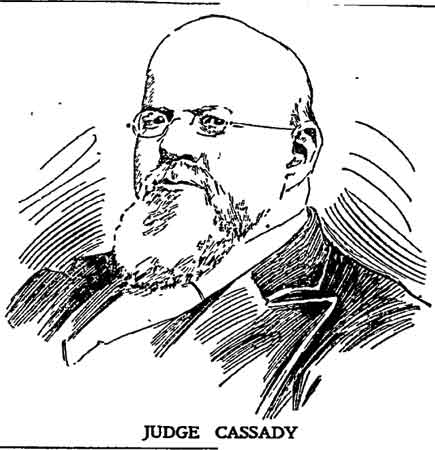
United States Commissioner James M. Cassady, of 128 Federal street, Camden, widely known throughout the State of New Jersey, died at 6 o’clock last evening, after an illness of several months. Justice Cassady was a sufferer from Bright’s disease. His death had been expected since Monday last, when he became unconscious, in which condition he remained until his death, with the exception of a brief period on Tuesday morning. During that time the only nourishment he was able to take was a spoonful of milk. He was surrounded by his family at the time of his death.
At the services in the First M. E. Church last evening Pastor Handley announced the death of Justice Cassady, which cast a gloom over the congregation, as Mr. Cassady was one of the pillars of the church, and his membership dated back for sixty years.
It was seventy-six years ago, and down in the old Southwark district of Philadelphia that Squire Cassady first saw the light. In 1837, when 16 years old, he took up his residence in Camden. Apprenticed to J. L. De La Cour, a prosperous druggist and manufacturing chemist, he served his time, and when he came of age opened a stationery store at No. 128 Federal street, where he had lived ever since. The young stationer took an active interest in politics, and in 1846 was elected a justice of the peace. Thereafter, for half a century, he was re-elected successively. He was a staunch Democrat, and as parties changed and the city was cut up into wards he found himself in a ward where his party was in a minority. This made no difference, however, for Republicans and Democrats alike joined in voting for the ‘Squire, and for many years the dominant party did not name a candidate against him. On the completion of the ‘Squire’s half century in office, however, a Republican aspirant came to the front and succeeded in securing nomination and election.
When the marriage license law in Philadelphia began to make Camden a Gretna Green, Squire Cassady’s office, being close to the Federal street ferry, rapidly gained favor as a place where Philadelphia couples could get the nuptial knot tied in short order. He exercised discretion in young couples, and no public scandals arose from marriage ceremonies performed by him.
Squire Cassady held the offices of Commissioner of Deeds, Notary Public and United States Commissioner for many years. In the latter capacity he acted as committing magistrate in nearly all the important government cases wherein arrests were made in South Jersey.
Camden Methodism and Free Masonry counted Squire Cassady among their pillars. He was a member of the First M. E. Church for sixty years, having joined it as a lad when he arrived in Camden, and for many years was one of its leading officials.
One of the New Schools Opened
Camden Daily Courier –
The James M. Cassady Threw Open Its Doors Yesterday
Three Others Soon Finished
The James M. Cassady Threw Open Its Doors Yesterday
THREE OTHERS SOON FINISHED
One of the new schools, the one at Third and State streets, named after ’Squire James M. Cassady, was thrown open to the public yesterday, Supervisor James E. Bryan reporting to the Board of Education last night that 120 pupils had been transferred there from the Read School. From time to time other pupils will be sent to that school until its twelve rooms are in use. It is anticipated, however, that notwithstanding the rapid growth of the population in that section of Camden the school will be sufficient for the needs of the pupils for several years to come.
Within a comparatively short time the three other schools now under course of construction will be in readiness for pupils. These include the Parkside School at Princess and Kaighn avenues; Henry B. Wilson School, Ninth and Florence streets, and the George Washington School, at 27th and Cambridge streets. In all these four schools will accommodate about 2,000 children and the Board of Education is of the opinion that they will meet the demands for several years.
Supervisor Bryan also reported that the Jamestown Exposition had awarded three silver medals to as many exhibits from the local schools. One was for the model of a locomotive constructed by the Manual Training students, another for the exhibit of music, and the third for the general work of the pupils of the Mt. Vernon (colored) School.
In his report concerning the closing of the Dudley School, Health Physician Davis stated that the prevalence of diphtheria in that section of the city, and which necessitated the temporary discontinuance of the school sessions, is due to bad drainage and the failure of the majority of the families to give the proper attention to the sanitary necessities. The total number of contagious diseases for the month were 135, the principal ailments being affections of the throat.
On recommendation of the Teachers’ Committee it was decided to close the schools for the holidays on Monday, December 23, and reopen them Thursday, January 2.
Mathias Jackson was appoitned janitor of the new Parkside School, at a salary of $850 a year, the appointment to take effect from November 1.
Custodian Frey’s report showed a balance on hand of $55,290.07.
Camden Board of Education
Philadelphia Inquirer –
The proprietors of the Camden Courier, who were arrested on Friday on a charge of publishing libelous matter concerning the actions of William J. Browning as chairman of the Committee on Property of the Camden Board of Education, was held by Justice Cassady in $500 each on Saturday to answer at court.
1872 City Directory
Camden City Directory – 1872
THE BOARD OF EDUCATION
Stated Meetings, first Monday evening in each month, in E.A. Stevens School House.
OFFICERS— DAVID RITTENHOUSE, President. JAMES M. CASSADY, Secretary. JOSEPH C. DE LA COUR, Treasurer. WILLIAM FEWSMITH, City Superintendent. JOHN DOBBINS, Census Taker.
STANDING COMMITTEES.
Teachers and City Board of Examiners.— William Fewsmith, 611 Cooper street; James M. Cassady, 128 Federal street; David Rittenhouse, 213 Kaighn’s Point Avenue.
Accounts.—Timothy C. Moore, 7 South Third Street; David L. Taylor, 316 North Second Street; Thomas McDowell, 818 South Fifth Street.
Property.—Mayberry E. Harden, 319 Mt. Vernon Street; Timothy C. Moore, 7 South Third Street; James Kennedy, Sr., Davis B. Litzenburg, Broadway, Centreville; William Fewsmith, 611 Cooper street.
Supplies.—Joseph C. De La Cour, S. W. corner Third and Plum Street; James M. Ridge, M.D., 304 Mickle Street; John Dobbins, Broadway, Centreville.
Permits.—James M. Cassady, Third and Fourth Wards, First District; Joseph C. De La Cour, First and Second Wards, Second District; David Rittenhouse, Fifth and Sixth Wards, Third District; Caleb F. Rogers, Seventh Ward, Fourth District; John Dobbins, Eighth Ward, Fifth District.
Books.—Charles W. Satori, M. D., 514 Federal Street; Caleb F. Rogers; David L. Taylor, 316 North Second Street.
Printing.—Levi B. Newton, 903 South Fifth Street; James Kennedy, Sr.; John Dobbins.
Photos
Conspiracy
Conspiracy.
Sheriff Morgan, of Camden county, has had William Abels, Frank Jones and John Manderfield, arrested on the charge of conspiracy. They are members of the Camden Paid Fire Department, Mr. Abels being Chief Engineer. From evidence at the hearing before Justice Cassady on Friday, it appears that the glass factory belonging to the Rosenbaum estate at Malaga, had been sold by the sheriff, and Mr. Morgan, of Camden, had purchased them. The works were placed in charge of an agent, who was directed to keep them closed until the matter was legally settled, and watch them carefully day and night.
Three or four weeks ago, it is alleged, the defendant went down in the afternoon train to a point a short distance from Malaga, when they got out and met two other men, who, understanding the matter, were to guide them. They then walked into Malaga, and about twelve o'clock on that night, having received reinforcements, went to the glass factory, it is charged, forcibly ejected the two men who had it in charge, and then broke the pots. They placed Mr. Rosenbaum in possession of the works, and were afterwards driven across the country about fourteen miles to Winslow Station, on the Atlantic road. They were held—Abels in $1,000, and two others in $500 each—for a further hearing to-day. Several others are implicated in the affair.

Held to Answer.—Justice Cassady yesterday held Abram Lower in $500 to answer at court for an assault and battery on John Sands, an assault on the Justice, and to keep the peace.
Abe Lower Opens the Campaign
ABE LOWER OPENS THE CAMPAIGN.— On Wednesday night, this “champion of light weights” in the radical party, in company with Howard Lee, William Lee, Boston Peter, and others, opened the campaign in their usual way at Goetz’s Hotel. Lower accosted John Sands, Jr., of Gloucester City, who was present, and asked him why he did not put on a Grant cape and cap. Sands replied that he did not belong to that party, and that he was marshal of the Greeley and Brown Club of Gloucester City. Then it was that Lower struck Sands, and the crowd joined him in kicking and beating their victim in a cruel manner. When Sands recovered himself, he found that $17 and his hat had been taken from him. On Thursday morning Sands made complaint before Justice Cassady. On his way home, in company with Michael Kelly, he was attacked by the same party, led on by a Philadelphia rough named William Osburn. Lower made a blow at Sands, and the rest of the gang made for Kelly, but he was more than a match for them all, although struck by a brick in the back, thrown by Howard Lee. Kelly planted the blows all around. Bip—and down went one. Squlp—and a foot lifted Lower clear. F’lam—and a blow by the ear “made the thunder for to roll” in that fellow’s ear. So, in turn, he put the “moral power” of goat town on each—laying them out in perfect order. Such a set of “soreheads,” profusely bandaged, are rarely seen. As the fight progressed, President Hackett of the City Council came up and ordered policemen Smith and Hollinger to arrest the whole party. They went over to the offenders, had a talk with them, and walked off. Having refused to make the arrests, Mr. Hackett started for the Mayor’s office to make complaint. If Mayor Gaul fails to bring them to account, he will fall short of his duty. Lower was subsequently arrested, and taken before Justice Cassady, to whom he was quite impertinent—wishing him to know that he, Lower, was “one of the sovereigns,” &c. He was held to bail for assault and battery and riotous conduct. George Gilbert and Thos. Lee are his sureties. Unless a severe penalty is placed upon these offenders, we shall have these disgraceful scenes frequently enacted between this and the election.
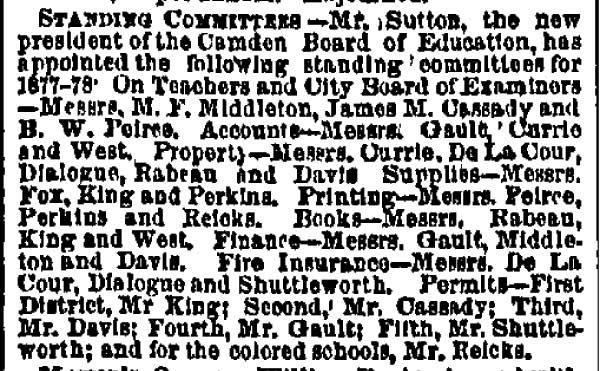
STANDING COMMITTEES—Mr. Sutton, the new president of the Camden Board of Education, has appointed the following standing committees for 1877–78: On Teachers and City Board of Examiners—Messrs. M. F. Middleton, James M. Cassady and B. W. Peirce. Accounts—Messrs. Gault, Currie and West. Property—Messrs. Currie, De La Cour, Dialogue, Rabeau and Davis Supplies—Messrs. Fox, King and Perkins. Printing—Messrs. Peirce, Perkins and Reicks. Books—Messrs. Rabeau, King and West. Finance—Messrs. Gault, Middleton and Davis. Fire Insurance—Messrs. De La Cour, Dialogue and Shuttleworth. Permits—First District, Mr. King; Second, Mr. Cassady; Third, Mr. Davis; Fourth, Mr. Gault; Fifth, Mr. Shuttleworth; and for the colored schools, Mr. Reicks.
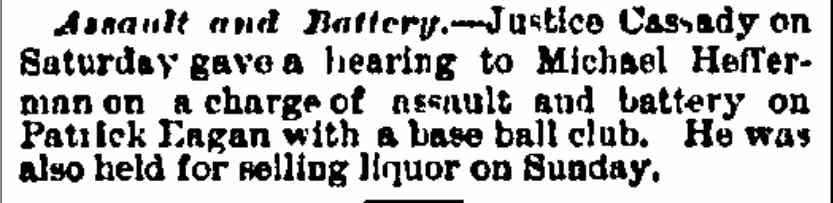
Assault and Battery.—Justice Cassady on Saturday gave a hearing to Michael Hefferman on a charge of assault and battery on Patrick Eagan with a base ball club. He was also held for selling liquor on Sunday.
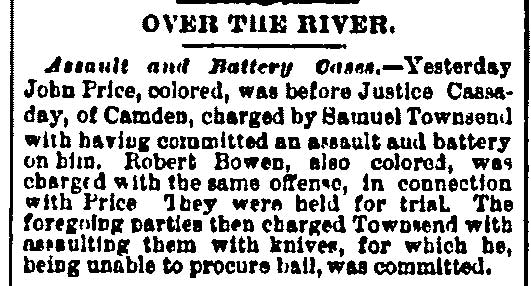
Over the River.
Assault and Battery Cases.—Yesterday John Price, colored, was before Justice Cassady, of Camden, charged by Samuel Townsend with having committed an assault and battery on him. Robert Bowen, also colored, was charged with the same offense, in connection with Price. They were held for trial. The foregoing parties then charged Townsend with assaulting them with knives, for which he, being unable to procure bail, was committed.
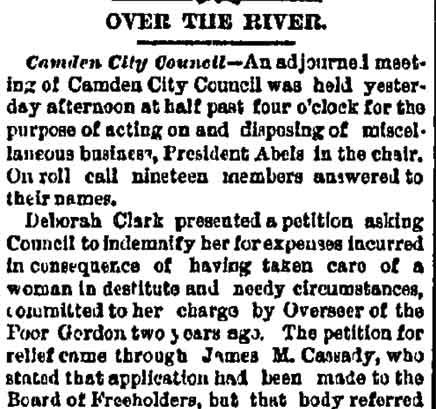
Over the River.
Camden City Council—An adjourned meeting of Camden City Council was held yesterday afternoon at half past four o’clock for the purpose of acting on and disposing of miscellaneous business, President Abels in the chair. On roll call nineteen members answered to their names.
Deborah Clark presented a petition asking Council to indemnify her for expenses incurred in consequence of having taken care of a woman in destitute and needy circumstances, committed to her charge by Overseer of the Poor Gordon two years ago. The petition for relief came through James M. Cassady, who stated that application had been made to the Board of Freeholders, but that body referred it back to Council, which was the proper authority to settle her claim. Referred to the Poor Committee, with power to act.
A petition was presented memorializing Council to authorize the erection of a frame building on a lot owned by Messrs. Furbush & Son, by the Providence Steam and Gas Company, in which to test their improved fire extinguishing apparatus. In compliance with the request an ordinance was also introduced, the rules suspended, and it was passed, granting the request of the petitioners.
Mr. Michellon, chairman of the Finance Committee, reported having examined the bonds of George M. Thrasher, receiver of taxes; F. F. Michellon, city clerk, as being satisfactory; also of Elmer Barr, Lewis Hendrickson, H. H. Franks, T. F. Muckleson, P. Gallagher, John W. Steeper, William Fusman and Thos Bunting, constables, as being in conformity with law, and they were accepted.
Assault With a File—Yesterday Justice Cassady gave a hearing to Abraham Appleton, who was charged with an atrocious assault and battery on James Ryan, by piercing his arm with the sharp point of a file. The defendant stated that it was entirely accidental. He was held for trial.
Over the River.
OVER THE RIVER.
Fishing Nets to be Sold—Before Justices Cassady and Ayers yesterday morning a man named Bernard T. Parsons claimed to be the owner of a boat and fishing net captured on Saturday night by Officers Gallagher, Barr, Franks and Streeper, for violation of the fishing laws. He refused to pay the penalty, and the justices ordered the captured articles to be sold. The men employed by Fish Warden Orr captured another seine in the same vicinity, and last evening it was also ordered to be sold. Beyond the mouth of Cooper's creek an encounter took place between the river patrolmen who captured the first net and several men whom they found fishing with a gill net, in which Constable Streeper was thrown overboard. While his companions were rescuing him the fishermen made their escape.
Over the River
Last evening the justices of the peace of Camden, and the constables, held a meeting in the court house to take preliminary measures for the protection of their interests.
Yesterday Josiah Ewinga had a hearing in the Camden District Court, on the charge of refusing to support his wife. She testified that he had not provided for her for the past nine months. It was shown, however, that she was not a resident of Camden, and the case was dismissed.
Joseph Fury and James Ayres, two young men who, several days ago, committed an assault and battery on James Dudley, had a hearing before Mayor Bradshaw yesterday morning, and were held in $100 each to answer at court.
It is stated that there are ten cases of smallpox in Marlton, and fears are entertained that it may become epidemic. That place contains about one thousand inhabitants.
At the annual meeting of the stockholders of the Camden Fire Insurance Association yesterday afternoon the following directors were elected for the ensuing year: Josiah D. Rogers, Henry B. Wilson, Jonathan Burr, Edmund E. Reed, Christopher J. Mines, William P. Tatem, Jesse E. Houston, E. E. Reed, Jr., George W. Gilbert, William B. Bonsall, William W. Bozorth, John Burr, Charles Wilson. Subsequently the directors organized by electing Henry B. Wilson, president; Jonathan Burr, secretary; R. W. Birdsell, assistant secretary; Edmund R. Read, treasurer; and Christopher J. Mines, surveyor.
Mayor Williams, of Gloucester City, is lying dangerously sick at his home in that city.
Yesterday the convocation of Burlington P. E. Church held a session in St. John’s Church, Camden, for the transaction of general business. Bishop Scarborough was present. The Communion was celebrated at nine o’clock in the morning, after which the usual services took place. In the evening missionary services were held, and addresses in furtherance of the cause were made.
Revivals are in progress in nearly all the Camden Methodist Churches, and the results are said to be large. In consequence of the continued illness of Rev. Mr. Relyes, pastor of the Broadway Church, Dr. Hanlon, of Pennington Seminary, has been appointed to take charge of that congregation until the pastor recovers.
Yesterday afternoon Justice Cassady committed a colored man named Purnell, on a charge of practising medicine illegally, in default to answer at court.
At an adjourned meeting of the Camden City Council last evening, Mr. Wartman was made chairman in place of Mr. Donges, absent. Samuel Hibbs was elected election inspector of the First precinct of the Sixth ward. A motion to reconsider the vote by which the license of Ernest Gaetz was lost at last meeting was defeated. A resolution authorizing the Solicitor to compromise for damages caused by sinking a barge loaded with sulphur in Cooper’s Creek, by a water pipe laid across that stream was presented. The suit was commenced by a man named Wrigbter, who proposed to settle his claim for $250. The resolution was lost—8 to 11. Committee on Special Legislation reported in favor of granting to the city of Camden all riparian rights in front of the same city. Other recommendations were made, and the report was adopted. The matter was authorized to be presented to the Legislature. Adjourned to next Wednesday evening.
The funeral of Hugh William Cassady, son of James M. Cassady, who was drowned at Pittman Grove on Monday last, took place from the Third Street M. E. Church yesterday afternoon.
William Lyttle was held to $200 bail by Justice Cassady, last evening, to answer for horsewhipping Howard Ward, a ten-year-old son of William Ward.
Justice Cassaday yesterday committed George Wilson to the county jail in default of bail on a charge of assaulting Elizabeth Budding on the 3d of last August.

Bella Murphy, of the Eighth Ward, Camden was held in $100 bail yesterday, by Justice Cassady for assault and battery on her mother in law.
Joseph S. Wasielewski, a tailor, was given a further hearing before United States Commissioner James M. Cassady yesterday on the charge of passing a counterfeit $10 bill on William L. Thompson. United States District Attorney Keasby said the evidence was insufficient to hold the accused for trial, whereupon the justice dismissed the case.
Over the River.
Mr. John J. Logan was held in $500 ball by Magistrate Cassidy [sic] yesterday on the charge of assault and battery on William B. Tyler, manager of the Chicago Beef Company’s stores in Camden. Mr. Logan entered a counter charge against Tyler, who was notified to appear before Magistrate Dill. He was held in $300 bail to appear at court.
Jonathan Hughes and Samuel Dare, the two men arrested by United States Detective John B. Bell, charged with counterfeiting, were given a hearing before United States Commissioner James M. Cassady yesterday. The detective testified to spurious money being circulated around Elmer, in Salem county, and to his shadowing Hughes and to capturing him with Dare. After Hughes had been under arrest for a few hours he voluntarily conducted the detective to the woods about a mile and a half from Elmer where a mould, die and several spurious coins of the denomination of 1877 fifty cent pieces were found.
The commissioner decided to adjourn the hearing until Thursday and demanded $5000 bail for Hughes and $1000 for Dare. The former was committed in default. The latter was admitted to bail, which was furnished by W. W. Johnson, of Salem county.
Magistrate Cassady on Saturday committed John Woodside, residing in the rear of No. 823 North Sixteenth street, Philadelphia, to the Camden County Jail in default of bail, on the charge of outrageously assaulting Mary Penrose, a newly-arrived emigrant, employed by George W. Clements, son of Magistrate Clements, of Philadelphia. The assault is alleged to have taken place at Westmont, near Haddonfield, N.J., Mr. Clements’ summer residence.

Justice Cassady yesterday hold [sic] Charles W. Turnely, a florist, of Camden, to $200 bail on the charge of malicious mischief proffered by Jacob Bendler, a saloon-keeper.

Maggie Fox, charged with retailing liquor under a government license, has been held to bail by United States Commissioner Cassady.
Chief Franks Dead.
An Illness of Several Months Brings His Life to an End.
Who Will Be His Successor?
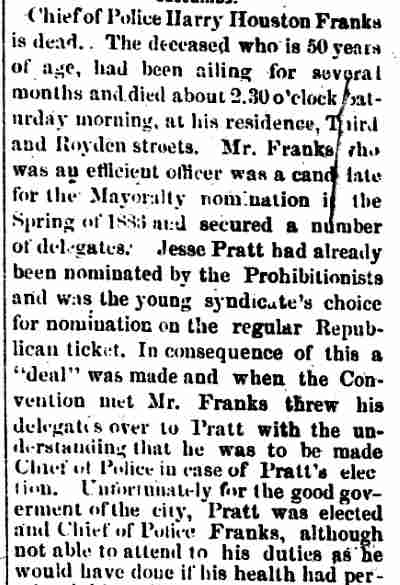
Chief of Police Harry Houston Franks is dead. The deceased who is 50 years of age, had been ailing for several months and died about 2:30 o’clock Saturday morning, at his residence, Third and Royden streets. Mr. Franks who was an efficient officer was a candidate for the Mayoralty nomination in the Spring of 1885 and secured a number of delegates. Jesse Pratt had already been nominated by the Prohibitionists and was the young syndicate’s choice for nomination on the regular Republican ticket. In consequence of this a “deal” was made and when the Convention met Mr. Franks threw his delegates over to Pratt with the understanding that he was to be made Chief of Police in case of Pratt’s election. Unfortunately for the good government of the city, Pratt was elected and Chief of Police Franks, although not able to attend to his duties as he would have done if his health had permitted him—did all in his power to suppress violations of law which are of daily occurrence.
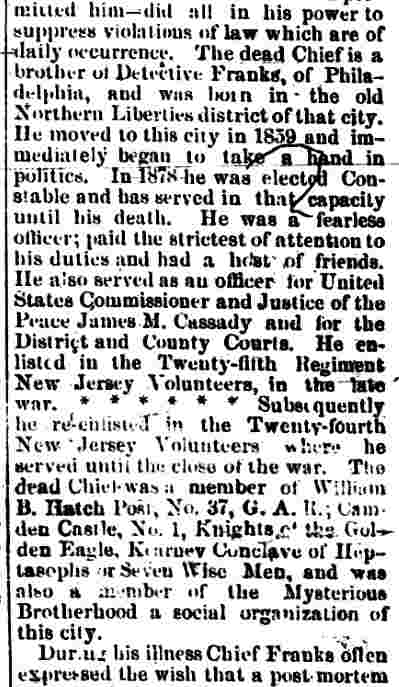
The dead Chief is a brother of Detective Franks, of Philadelphia, and was born in the old Northern Liberties district of that city. He moved to this city in 1859 and immediately began to take a hand in politics. In 1878 he was elected Constable and has served in that capacity until his death. He was a fearless officer; paid the strictest of attention to his duties and had a host of friends. He also served as an officer for United States Commissioner and Justice of the Peace James M. Cassady and for the District and County Courts. He enlisted in the Twenty-fifth Regiment New Jersey Volunteers, in the late war. Subsequently he re-enlisted in the Twenty-fourth New Jersey Volunteers where he served until the close of the war. The dead Chief was a member of William B. Hatch Post, No. 37, G.A.R.; Camden Castle, No. 1, Knights of the Golden Eagle; Kearney Conclave of Heptasophs or Seven Wise Men, and was also a member of the Mysterious Brotherhood a social organization of this city.
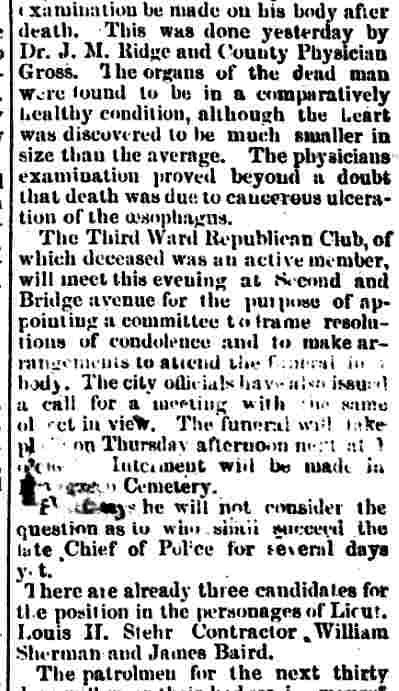
During his illness Chief Franks often expressed the wish that a post mortem examination be made on his body after death. This was done yesterday by Dr. J. M. Ridge and County Physician Gross. The organs of the dead man were found to be in a comparatively healthy condition, although the heart was discovered to be much smaller in size than the average. The physicians examination proved beyond a doubt that death was due to cancerous ulceration of the oesophagus.
The Third Ward Republican Club, of which deceased was an active member, will meet this evening at Second and Bridge avenue for the purpose of appointing a committee to frame resolutions of condolence and to make arrangements to attend the funeral in a body. The city officials have also issued a call for a meeting with the same object in view. The funeral will take place on Thursday afternoon next at 1 o’clock.
There are already three candidates for the position in the personages of Lieut. Louis H. Stehr, Contractor William Sherman and James Baird.
News in Camden County.
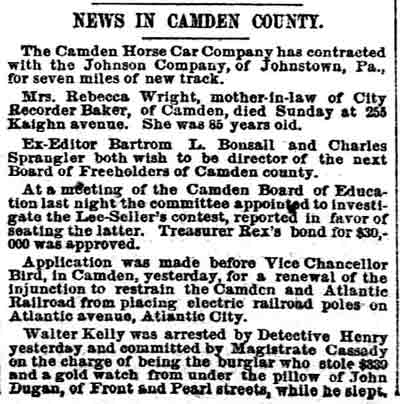
The Camden Horse Car Company has contracted with the Johnson Company, of Johnstown, Pa., for seven miles of new track.
Mrs. Rebecca Wright, mother-in-law of City Recorder Baker, of Camden, died Sunday at 255 Kaighn avenue. She was 55 years old.
Ex-Editor Bartrom L. Bonsall and Charles Sprangler both wish to be director of the next Board of Freeholders of Camden county.
At a meeting of the Camden Board of Education last night the committee appointed to investigate the Lee-Seiler’s contest, reported in favor of seating the latter. Treasurer Rex’s bond for $30,000 was approved.
Application was made before Vice Chancellor Bird, in Camden, yesterday, for a renewal of the injunction to restrain the Camden and Atlantic Railroad from placing electric railroad poles on Atlantic avenue, Atlantic City.
Walter Kelly was arrested by Detective Henry yesterday and committed by Magistrate Cassady on the charge of being the burglar who stole $339 and a gold watch from under the pillow of John Dugan, of Front and Pearl streets, while he slept.
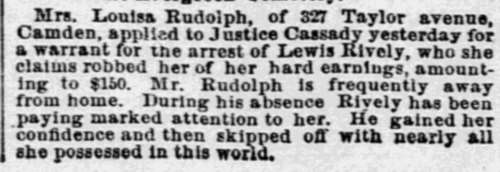
Warrant for Arrest — Louisa Rudolph
Mrs. Louisa Rudolph, of 327 Taylor avenue, Camden, applied to Justice Cassady yesterday for a warrant for the arrest of Lewis Rively, who she claims robbed her of her hard earnings, amounting to $150. Mr. Rudolph is frequently away from home. During his absence Rively has been paying marked attention to her. He gained her confidence and then skipped off with nearly all she possessed in this world.

Complaint was made to Justice Cassady yesterday by Frank Shaw against Julius Grieh, president of the German Hungarian Beneficial Society, for assault and battery.
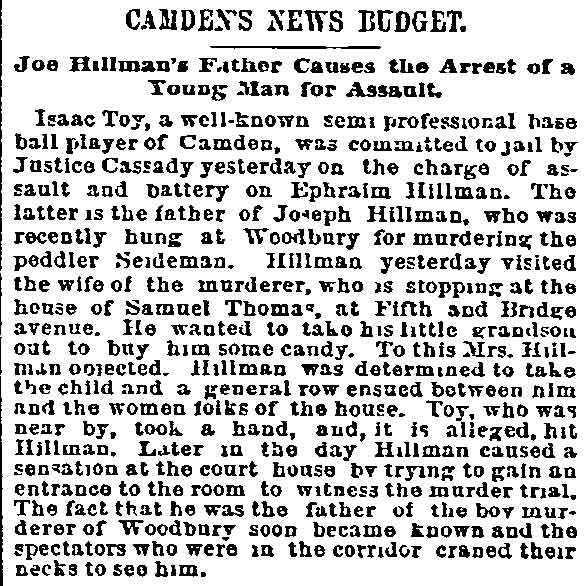
Camden's News Budget
CAMDEN'S NEWS BUDGET.
Joe Hillman's Father Causes the Arrest of a Young Man for Assault.
Isaac Toy, a well-known semi professional base ball player of Camden, was committed to jail by Justice Cassady yesterday on the charge of assault and battery on Ephraim Hillman. The latter is the father of Joseph Hillman, who was recently hung at Woodbury for murdering the peddler Seideman. Hillman yesterday visited the wife of the murderer, who is stopping at the house of Samuel Thomas, at Fifth and Bridge avenue. He wanted to take his little grandson out to buy him some candy. To this Mrs. Hillman objected. Hillman was determined to take the child and a general row ensued between him and the women folks of the house. Toy, who was near by, took a hand, and, it is alleged, hit Hillman. Later in the day Hillman caused a sensation at the court house by trying to gain an entrance to the room to witness the murder trial. The fact that he was the father of the boy murderer of Woodbury soon became known and the spectators who were in the corridor craned their necks to see him.
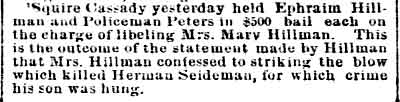
‘Squire Cassady yesterday held Ephraim Hillman and Policeman Peters in $500 bail each on the charge of libeling Mrs. Mary Hillman. This is the outcome of the statement made by Hillman that Mrs. Hillman confessed to striking the blow which killed Herman Seideman, for which crime his son was hung.
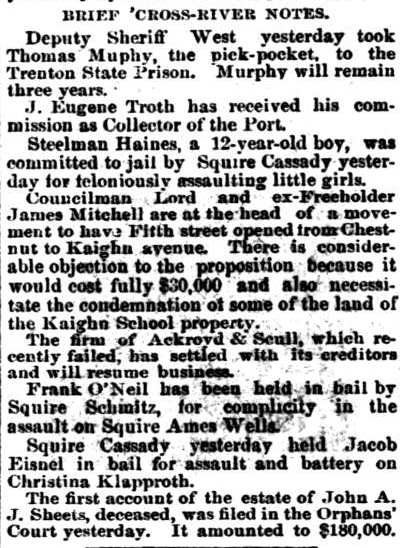
Brief ‘Cross-River Notes.
Deputy Sheriff West yesterday took Thomas Murphy, the pick-pocket, to the Trenton State Prison. Murphy will remain three years.
J. Eugene Troth has received his commission as Collector of the Port.
Steelman Haines, a 12-year-old boy, was committed to jail by Squire Cassady yesterday for feloniously assaulting little girls.
Councilman Lord and ex-Freeholder James Mitchell are at the head of a movement to have Fifth street opened from Chestnut to Kaighn avenue. There is considerable objection to the proposition because it would cost fully $30,000 and also necessitate the condemnation of some of the land of the Kaighn School property.
The firm of Ackroyd & Scull, which recently failed, has settled with its creditors and will resume business.
Frank O’Neil has been held in bail by Squire Schmitz, for complicity in the assault on Squire Ames Wells.
Squire Cassady yesterday held Jacob Eisnel in bail for assault and battery on Christina Klapproth.
The first account of the estate of John A. J. Sheets, deceased, was filed in the Orphans’ Court yesterday. It amounted to $180,000.
Brief Cross River Notes
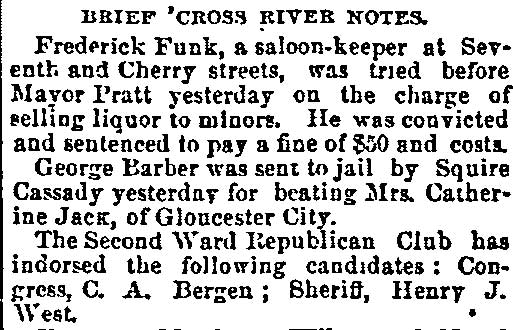
BRIEF 'CROSS RIVER NOTES.
Frederick Funk, a saloon-keeper at Seventh and Cherry streets, was tried before Mayor Pratt yesterday on the charge of selling liquor to minors. He was convicted and sentenced to pay a fine of $50 and costs.
George Barber was sent to jail by Squire Cassady yesterday for beating Mrs. Catherine Jack, of Gloucester City.
The Second Ward Republican Club has indorsed the following candidates: Congress, C. A. Bergen; Sheriff, Henry J. West.
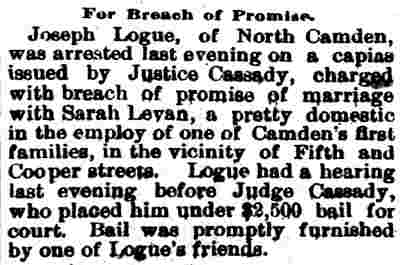
For Breach of Promise.
Joseph Logue, of North Camden, was arrested last evening on a capias issued by Justice Cassady, charged with breach of promise of marriage with Sarah Levan, a pretty domestic in the employ of one of Camden’s first families, in the vicinity of Fifth and Cooper streets. Logue had a hearing last evening before Judge Cassady, who placed him under $2,500 bail for court. Bail was promptly furnished by one of Logue’s friends.
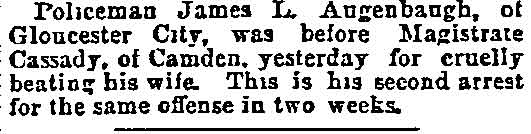
Policeman James L. Augenbaugh, of Gloucester City, was before Magistrate Cassady, of Camden, yesterday for cruelly beating his wife. This is his second arrest for the same offense in two weeks.
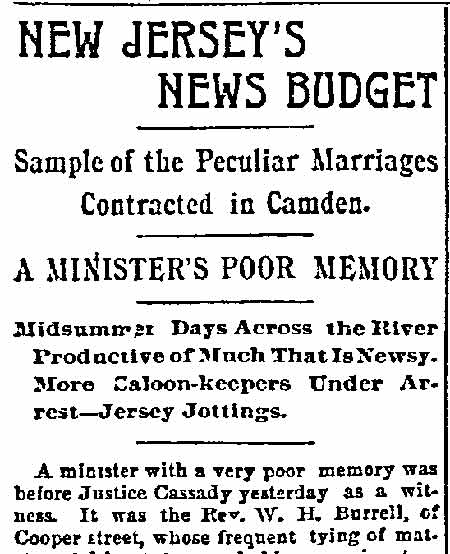
New Jersey’s News Budget
Sample of the Peculiar Marriages Contracted in Camden.
A Minister’s Poor Memory
Midsummer Days Across the River Productive of Much That Is Newsy. More Saloon-keepers Under Arrest—Jersey Jottings.
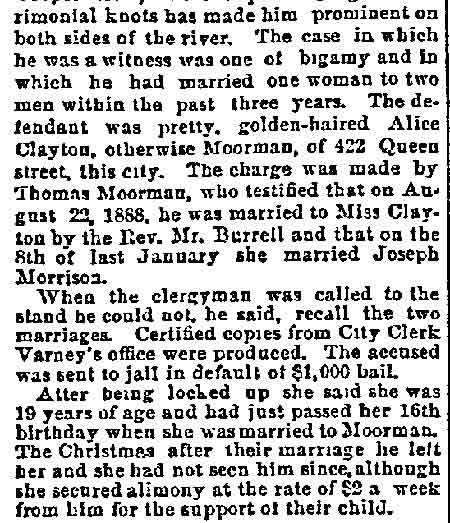
A minister with a very poor memory was before Justice Cassady yesterday as a witness. It was the Rev. W. H. Burrell, of Cooper street, whose frequent tying of matrimonial knots has made him prominent on both sides of the river. The case in which he was a witness was one of bigamy and in which he had married one woman to two men within the past three years. The defendant was pretty, golden-haired Alice Clayton, otherwise Moorman, of 422 Queen street, this city. The charge was made by Thomas Moorman, who testified that on August 22, 1888, he was married to Miss Clayton by the Rev. Mr. Burrell and that on the 8th of last January she married Joseph Morrison.
When the clergyman was called to the stand he could not, he said, recall the two marriages. Certified copies from City Clerk Varney’s office were produced. The accused was sent to jail in default of $1,000 bail.
After being locked up she said she was 19 years of age and had just passed her 16th birthday when she was married to Moorman. The Christmas after their marriage he left her and she had not seen him since, although she secured alimony at the rate of $2 a week from him for the support of their child.
Rev. Burrell’s Queer Marriages.
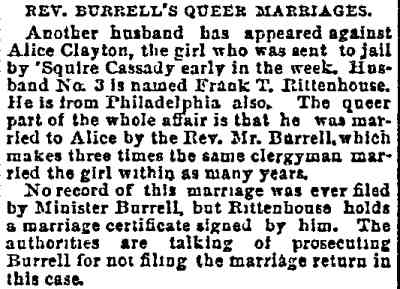
Another husband has appeared against Alice Clayton, the girl who was sent to jail by ‘Squire Cassady early in the week. Husband No. 3 is named Frank T. Rittenhouse. He is from Philadelphia also. The queer part of the whole affair is that he was married to Alice by the Rev. Mr. Burrell, which makes three times the same clergyman married the girl within as many years.
No record of this marriage was ever filed by Minister Burrell, but Rittenhouse holds a marriage certificate signed by him. The authorities are talking of prosecuting Burrell for not filing the marriage return in this case.
Notes from Camden.
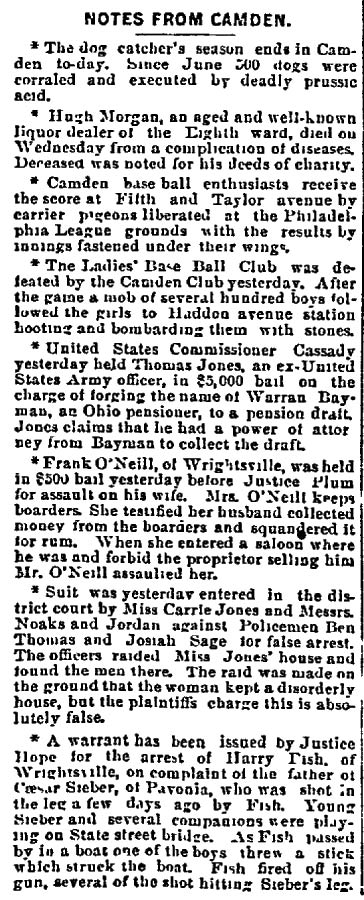
The dog catcher’s season ends in Camden to-day. Since June 500 dogs were corraled and executed by deadly prussic acid.
Hugh Morgan, an aged and well-known liquor dealer of the Eighth ward, died on Wednesday from a complication of diseases. Deceased was noted for his deeds of charity.
Camden base ball enthusiasts receive the score at Fifth and Taylor avenue by carrier pigeons liberated at the Philadelphia grounds, with the results by innings fastened under their wings.
The Ladies’ Base Ball Club was defeated by the Camden Club yesterday. After the game a mob of several hundred boys followed the girls to Haddon avenue station hooting and bombarding them with stones.
United States Commissioner Cassady yesterday held Thomas Jones, an ex-United States Army officer, in $5,000 bail on the charge of forging the name of Warran Bayman, an Ohio pensioner, to a pension draft. Jones claims that he had a power of attorney from Bayman to collect the draft.
Frank O’Neill, of Wrightsville, was held in $500 bail yesterday before Justice Plum for assault on his wife. Mrs. O’Neill keeps boarders. She testified her husband collected money from the boarders and squandered it for rum. When she entered a saloon where he was and forbid the proprietor selling him Mr. O’Neill assaulted her.
Suit was yesterday entered in the district court by Miss Carrie Jones and Messrs. Noaks and Jordan against Policemen Ben Thomas and Josiah Sage for false arrest. The officers raided Miss Jones’ house and found the men there. The raid was made on the ground that the woman kept a disorderly house, but the plaintiffs charge this is absolutely false.
A warrant has been issued by Justice Hope for the arrest of Harry Fish of Wrightsville, on complaint of the father of Caesar Sieber, of Pavonia, who was shot in the leg a few days ago by Fish. Young Sieber and a companion were playing on State street bridge. As Fish was in a boat one of the boys threw a stick which struck the boat. Fish fired off his gun, several of the shot hitting Sieber’s leg.

James M. Cassady, clerk of the new Police Commission, was sworn in yesterday, and filed a bond for $3000. Mayor Westcott has not yet appointed the Republican Commissioners.
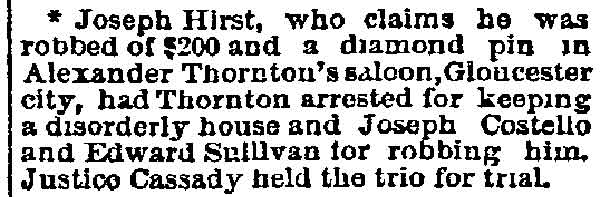
Joseph Hirst, who claims he was robbed of $200 and a diamond pin in Alexander Thornton’s saloon, Gloucester city, had Thornton arrested for keeping a disorderly house and Joseph Costello and Edward Sullivan for robbing him. Justice Cassady held the trio for trial.
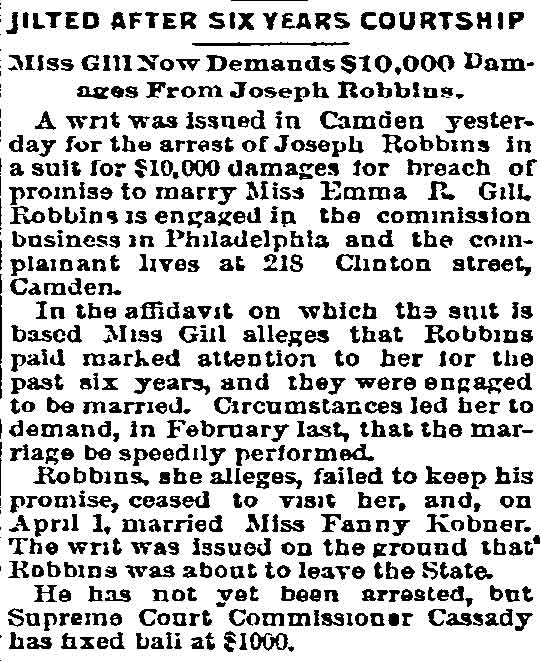
Jilted After Six Years Courtship
Miss Gill Now Demands $10,000 Damages From Joseph Robbins.
A writ was issued in Camden yesterday for the arrest of Joseph Robbins in a suit for $10,000 damages for breach of promise to marry Miss Emma R. Gill. Robbins is engaged in the commission business in Philadelphia and the complainant lives at 218 Clinton street, Camden.
In the affidavit on which the suit is based Miss Gill alleges that Robbins paid marked attention to her for the past six years, and they were engaged to be married. Circumstances led her to demand, in February last, that the marriage be speedily performed.
Robbins, she alleges, failed to keep his promise, ceased to visit her, and, on April 1, married Miss Fanny Kobner. The writ was issued on the ground that Robbins was about to leave the State.
He has not yet been arrested, but Supreme Court Commissioner Cassady has fixed bail at $1000.

On a charge of stealing $37 from Norman Simmons, with whom he boarded, Henry Hill was held for trial by Justice Cassady.
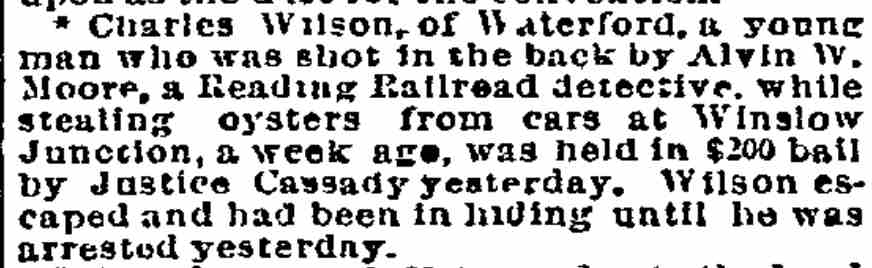
Charles Wilson, of Waterford, a young man who was shot in the back by Alvin W. Moore, a Reading Railroad detective, while stealing oysters from cars at Winslow Junction, a week ago, was held in $200 bail by Justice Cassady yesterday. Wilson escaped and had been in hiding until he was arrested yesterday.
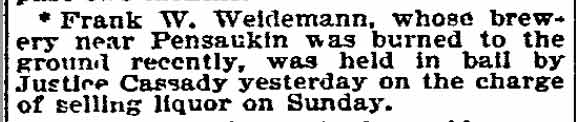
Frank W. Weidemann, whose brewery near Pensaukin was burned to the ground recently, was held in bail by Justice Cassady yesterday on the charge of selling liquor on Sunday.
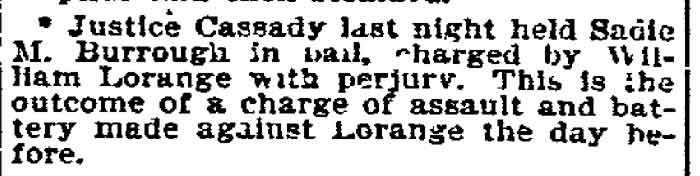
Justice Cassady last night held Sadie M. Burrough in bail, charged by William Lorange with perjury. This is the outcome of a charge of assault and battery made against Lorange the day before.

Merry War of Policy Men
Bondsmen for Harriet Smith and Her Kind Snarl at Each Other—Some Interesting Testimony as to Lottery Dealers
The hearing in the case of the alleged policy dealers before Squire Craig yesterday afternoon developed into a very lively affair. The bondsmen for the various defendants were at swords’ points and the defendants seemed to enjoy the quarrel among themselves.
Harriet Smith and her co-defendants were called up for hearing. Isaac Shreeve and W. H. Jones, of the Eighth ward, had gone on their bail bonds. The case resolved itself into a struggle between Isaac Shreeve and Jones.
Jones claimed that Shreeve was trying to get him into trouble. He declared that he did not know that the defendants were policy dealers when he signed the bonds.
Shreeve, on the other hand, declared that Jones knew all about the business. He said he himself did not know what the defendants had been arrested for when he signed the bonds.
The defendants were Harriet Smith, John Walters, Walter Garwood and William and Frederick Parker.
The testimony showed that Harriet Smith’s house at No. 527 Washington street was visited constantly by persons bent on playing the policy game. One witness testified that he had seen as many as twenty-five or thirty people waiting in line to play policy at the house.
Squire Craig held all the defendants for court.
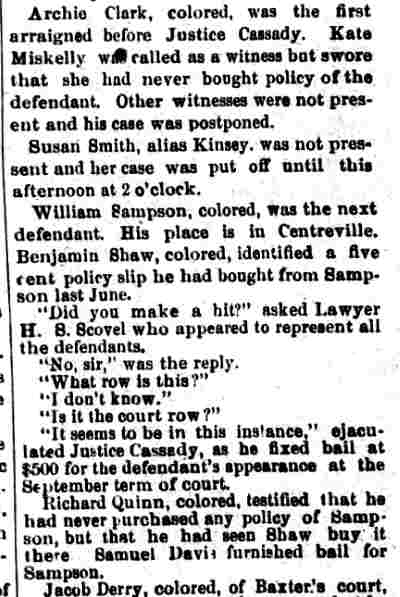
Archie Clark, colored, was the first arraigned before Justice Cassady. Kate Miskelly was called as a witness but swore that she had never bought policy of the defendant. Other witnesses were not present and his case was postponed.
Susan Smith, alias Kinsey, was not present and her case was put off until this afternoon at 2 o’clock.
William Sampson, colored, was the next defendant. His place is in Centreville. Benjamin Shaw, colored, identified a five cent policy slip he had bought from Sampson last June.
“Did you make a hit?” asked Lawyer H. S. Scovel who appeared to represent all the defendants.
“No, sir,” was the reply.
“What row is this?”
“I don’t know.”
“Is it the court row?”
“It seems to be in this instance,” ejaculated Justice Cassady, as he fixed bail at $500 for the defendant’s appearance at the September term of court.
Richard Quinn, colored, testified that he had never purchased any policy of Sampson, but that he had seen Shaw buy it there. Samuel Davis furnished bail for Sampson.
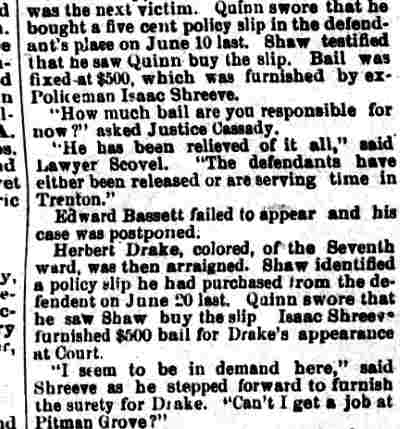
Jacob Derry, colored, of Baxter’s court, was the next victim. Quinn swore that he bought a five cent policy slip in the defendant’s place on June 10 last. Shaw testified that he saw Quinn buy the slip. Bail was fixed at $500, which was furnished by ex-Policeman Isaac Shreeve.
“How much bail are you responsible for now?” asked Justice Cassady.
“He has been relieved of it all,” said Lawyer Scovel. “The defendants have either been released or are serving time in Trenton.”
Edward Bassett failed to appear and his case was postponed.
Herbert Drake, colored, of the Seventh ward, was then arraigned. Shaw identified a policy slip he had purchased from the defendant on June 20 last. Quinn swore that he saw Shaw buy the slip. Isaac Shreeve furnished $500 bail for Drake’s appearance at Court.
“I seem to be in demand here,” said Shreeve as he stepped forward to furnish the surety for Drake. “Can’t I get a job at Pitman Grove?”
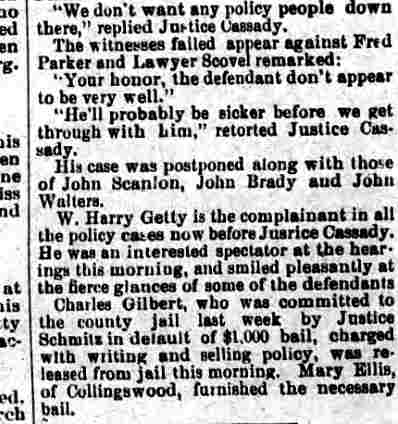
“We don’t want any policy people down there,” replied Justice Cassady.
The witnesses failed appear against Fred Parker and Lawyer Scovel remarked:
“Your honor, the defendant don’t appear to be very well.”
“He’ll probably be sicker before we get through with him,” retorted Justice Cassady.
His case was postponed along with those of John Scanlon, John Brady and John Walters.
W. Harry Getty is the complainant in all the policy cases now before Justice Cassady. He was an interested spectator at the hearings this morning, and smiled pleasantly at the fierce glances of some of the defendants.
Charles Gilbert, who was committed to the county jail last week by Justice Schmitz in default of $1,000 bail, charged with writing and selling policy, was released from jail this morning. Mary Ellis, of Collingswood, furnished the necessary bail.
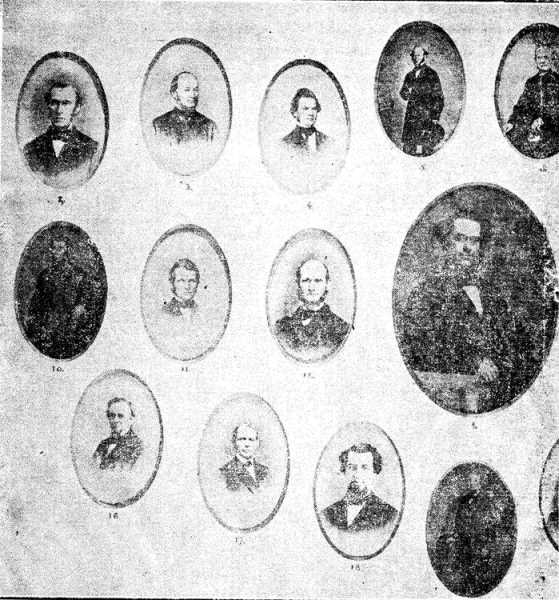
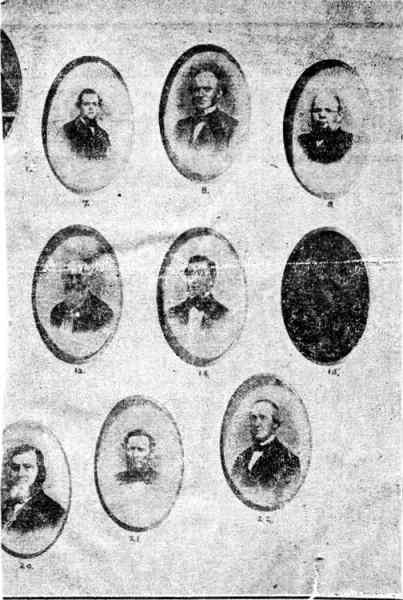
Camden Daily Courier – May 30, 1908 — 1. Rev. Samuel Van Sant, pastor — 2. Samuel H. Morton, trustee, class leader — 3. Joseph De La Cour, steward — 4. Mr. Hinchman, steward — 5. Thomas B. Atkinson, trustee — 6. J. Garrison, class leader — 7. S.H. Owens, class leader — 8. Charles Cox, class leader — 9. James M. Cassady, steward, trustee — 10. Mr. Williams, Steward — 11. R. Lee, local elder, president, trustee — 12. H. Williams, class leader — 13. William Peacock, Steward, Sunday School Superintendent — 14. Mr. Campbell, trustee, class leader — 15. Mr. Simmons, local elder — 16. Samuel S.E. Cowperthawait, treasurer trustee — 17. Mr. Sloan, class leader — 18. E.S. Johnson, recording steward, class leader, trustee — 19. H. Sparks, steward — 20. William Few, exhorter, class leader — 21. Morton Wills, steward, class leader — 22. Timothy Thorney, local elder, class leader