Introduction
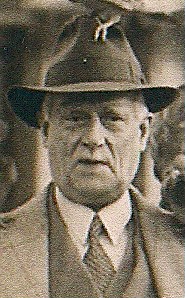
Philip Wilson, 1936.
PHILIP WILSON was born in Camden NJ on April 19, 1869 to Henry B. Wilson Sr. and his wife, Mary. Besides Philip there were four other children, Henry B. Wilson Jr., Lizzie Wilson, R.I. Wilson, and James B. Wilson.
Henry B. Wilson Sr. was born in Providence, RI in 1828. In 1849, he moved to Gloucester City with his parents and worked as a clerk for the Gloucester Manufacturing Company until 1854. In the same year, he came to Camden and became an active organizer of the Republican Party in Camden County. During this same time, he opened a coal office and hardware store at Front and Kaighn Avenue.
When Camden was divided into three wards; middle, north and south, Henry B. Wilson Sr. represented the south ward in City Council for a number of years. During the term of President Rutherford B. Hayes, from 1877 to 1881, he was postmaster of Camden City. He was also a member of the Board of Education and was a second term member of the Commission of Public Instruction, the precursor of the city Board of Education, at the time of his death. A few years after his passing the newly-built H. B. Wilson Elementary School, at South 9th and Florence Streets, was named in his honor.
Mr. Wilson was probably more prominent in business circles than in politics. He was one of the founders, and one-time vice-president of the Camden National Bank; president and director of the Camden Fire Insurance Association; had an active interest in church work and was a senior warden of St. John’s Protestant Episcopal Church for nearly a half century.
The Wilson family made its home in the 1870s and for most of the 1880s at 339 Mount Vernon Street. Late in 1889 or early in 1890 the family moved to 345 Mount Vernon Street. Henry B. Wilson Sr. died of blood poisoning on June 7, 1898 in his home at 345 Mount Vernon Street. He was 70 years old. His wife along with daughter Elizabeth and Philip Wilson were still living at 345 Mount Vernon Street when the 1900 Census was compiled. Philip Wilson was working as a “paying teller.” Mary Wilson would reside at 345 Mount Vernon Street into the mid-1920s.
Philip Wilson appears in the Camden City directories from 1887 through 1880–1891 as living with his parents and working as a clerk in a grocery business in Philadelphia. He would soon come back to work in Camden, in the banking industry. He also in time became president and general manager of the Delaware River Discharging Company, located at 1157 South Front Street, which was in the business of loading and unloading ships. The location is interesting as his father had a coal and wood business in the 1880s and 1890s at 1135 South Front Street.
In 1895 Philip Wilson was a co-founder of Camden Lodge 293 of the Benevolent Protective Order of Elks. Other charter members included John Foster, Frank A. Ward, Charles L. Bowman, Dr. A. Haines Lippincott, Dr. J. F. Leavitt, Fred W. George, T. L. Bear, William M. Fithian, Everett Ackley, Fithian S. Simmons, Paul E. Quinn, John N. Kadel, William G. Maguire, Frank B. Sweeten and Maurice Hertz.
Philip Wilson married Emma Foulon around 1901. Her father, Charles Foulon founded a bakery on Federal Street in the early 1880s, which her brother, also named Charles Foulon, operated along with an ice cream parlor on Federal Street for many years.
The 1906 City Directory and the 1910 Census shows Philip and Emma Wilson living at 932 South 4th Street. The Wilsons were not blessed with children, but did have over 30 years together before Emma’s passing in 1933. Philip Wilson’s occupation was listed in the 1906 directory and in the census as “paying teller.” By 1914 the Wilsons had moved to the Helene Apartments on Cooper Street. The City Directory for that year associates him with the discharging company.
When the Central Trust Company celebrated its 25th anniversary in 1916, Philip Wilson was on its board of directors. This is interesting in that he had worked for many years at a competing institution, the Camden National Bank, of which his father was a co-founder. At some point after 1916 Philip Wilson became president of the Central Trust Company. The Central Trust Company was absorbed by the Camden Safe Deposit & Trust Company in 1927. Philip Wilson in turn was named as vice-president of the combined banks. In 1938 the Camden Safe Deposit & Trust Company shortened its name to that of Camden Trust. By 1948, the Camden Trust had grown to be the largest bank in South Jersey, with branches in Camden, Gloucester City, Haddonfield, and Blackwood.
Philip and Emma Wilson had moved to 230 West Summit Avenue, Haddonfield, New Jersey by 1924. The 1920 Census shows them living at 310 Warwick Road, next door to lawyer J. Russell Carrow and his wife Hilda. In 1930 Philip Wilson journeyed abroad. He returned to the United States by way of St. Johns, Newfoundland aboard the S.S. Nerissa, arriving in New York on September 28, 1930. This appears to have been a business trip, as Camden businessman Kirby Garwood accompanied him. The S.S. Nerissa was torpedoed in April of 1941. Mr. and Mrs. Wilson vacationed in California in 1932.
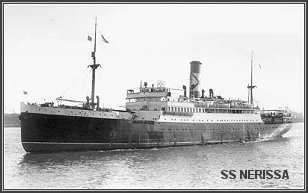
The S.S. Nerissa.
Emma Foulon Wilson passed away in June of 1933 at Cooper Hospital after a lengthy illness.
After the death of his wife Emma, Philip Wilson continued to reside in Haddonfield. In 1935 he took a trip to Havana, Cuba. He returned to the United States at New York on November 24, 1935 aboard the steamship Quirigua, then owned and operated by the United Fruit Company.
By the end of 1936 Philip Wilson had moved to 230 West Summit Avenue in Haddonfield. In the fall of that year Philip Wilson and Hilda Carrow traveled to Europe together. They returned in December, sailing from Villefranche, France on December 3 aboard the S.S. Rex, arriving in New York on December 10.
By 1940 Hilda and J. Russell Carrow had divorced, and Philip Wilson and the former Mrs. Carrow had married. They were living at 230 West Summit Avenue in Haddonfield when the 1940 and 1947 City Directories were compiled.
Philip Wilson died on November 15, 1949 of prostate cancer. He was interred at the Harleigh Mausoleum on November 18. His widow lived at 310 Warwick Road from the 1950s through at least 1970. Hilda Donnell Wilson died of cardiovascular disease on November 26, 1986 and was buried at the Oakes Mausoleum at Harleigh Cemetery on December 1.
Philip Wilson’s brother, Admiral Henry B. Wilson Jr., went on to fame as a naval officer. The Admiral Wilson Boulevard, leading from the Benjamin Franklin Bridge to the Airport Circle in Pennsauken, is named in his honor, for his service as the commander of the American fleet in French waters by the First World War. Admiral Wilson convoyed troops and supplies to France during the war without the loss of a single life.
Commercial Club
Philadelphia Inquirer —
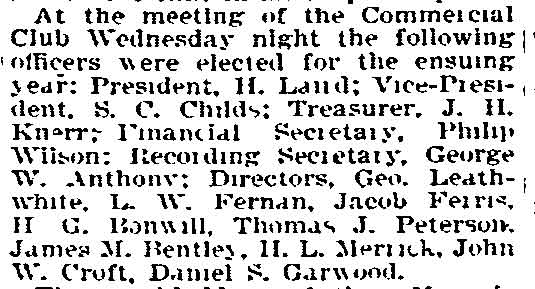
Named: H. Land, S. Canning Childs, J.H. Knerr, George W. Anthony, George Leathwhite, L.W. Ferna, Jacob Ferris, H.G. Bonwill, Thomas J. Peterson, James M. Bentley, H.L. Merrick, John W. Croft, Daniel S. Garwood, Philip Wilson, and Commercial Club.
Commercial Club
Philadelphia Inquirer —

The Commercial Club has elected these officers. President, Jacob Daubman; vice-president, J. S. Gallagher; recording secretary, F. H. Goodfellow; financial secretary, Charles M. Baldwin; treasurer, Philip Wilson.
Camden in Need of Public Wharf
Philadelphia Inquirer —
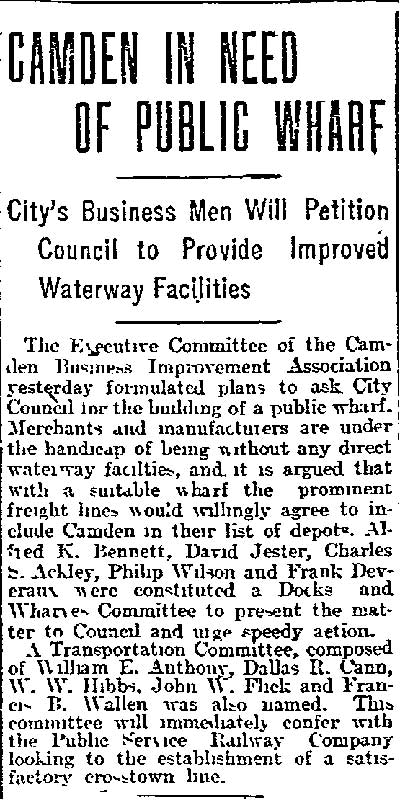
Camden in Need of Public Wharf
City’s Business Men Will Petition Council to Provide Improved Waterway Facilities
The Executive Committee of the Camden Business Improvement Association yesterday formulated plans to ask City Council for the building of a public wharf. Merchants and manufacturers are under the handicap of being without any direct waterway facilities, and it is argued that with a suitable wharf the prominent freight lines would willingly agree to include Camden in their list of depots. Alfred K. Bennett, David Jester, Charles S. Ackley, Philip Wilson and Frank Devereaux were constituted a Docks and Wharves Committee to present the matter to Council and urge speedy action.
A Transportation Committee, composed of William E. Anthony, Dallas R. Cann, W. W. Hibbs, John W. Flick and Francis B. Wallen was also named. This committee will immediately confer with the Public Service Railway Company looking to the establishment of a satisfactory crosstown line.
Camden Jury Is Named
Philadelphia Inquirer —
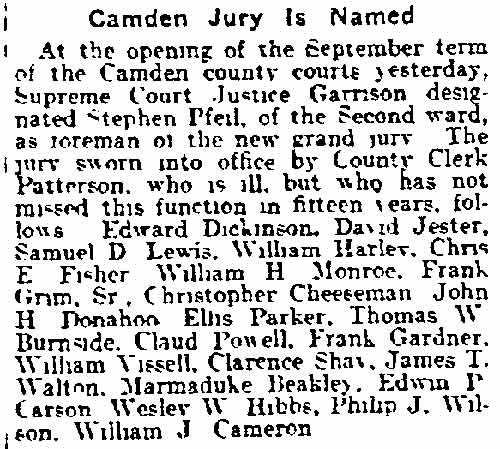
At the opening of the September term of the Camden county courts yesterday, Supreme Court Justice Garrison designated Stephen Pfeil, of the Second ward, as foreman of the new grand jury. The jury sworn into office by County Clerk Patterson, who is ill, but who has not missed this function in fifteen years, follows: Edward Dickinson, David Jester, Samuel D. Lewis, William Harley, Chris E. Fisher, William H. Monroe, Frank Grim, Sr., Christopher Cheeseman, John H. Donahoo, Ellis Parker, Thomas W. Burnside, Claud Powell, Frank Gardner, William Vissell, Clarence Shay, James T. Walton, Marmaduke Beakley, Edwin P. Carson, Wesley W. Hibbs, Philip J. Wilson, William J. Cameron
The Central Trust Company Building
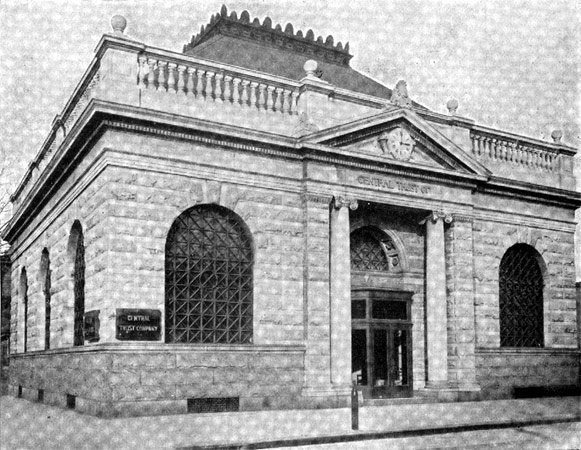
The Central Trust Company Building, 1915.
Central Trust Company
Bank Directory — March–
Central Trust Company
Fourth & Federal Street, Camden, N.J.
Officers
| Name ↕ | Role ↕ |
|---|---|
| Dr. H.H. Grace | President |
| Casper T. Sharpless | Vice President |
| John B. Clement | 2nd Vice President & Secretary-Treasurer |
| Montreville Shinn | Assistant Secretary-Treasurer |
| C. Chester Craig | Trust Officer |
Directors
| Name ↕ |
|---|
| Alpheus McCracken |
| Eli Sharpless |
| Killam Bennett |
| Casper T. Sharpless |
| Harry H. Grace |
| A. |
| H.N. Munger |
| Mahlon F. Ivins |
| John B. Clement |
| Fithian S. Simmons |
| Andrew B.F. Smith |
| Jesse W. Starr 3d |
| Philip Wilson |
| W. Leonard Hurley |
| Richard C. Schwoerer |

Camden City Directory Advertisement, 1919
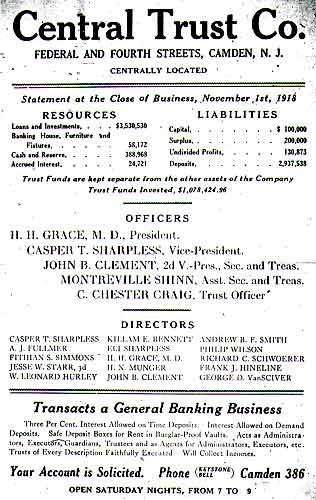
Central Trust Company — Camden City Directory Advertisement, 1919.
Throngs Mourn as W.L. Hurley Is Laid to Rest
Camden Courier-Post —
Thousands Pay Tribute To Merchant Prince at Home In Collingswood
SOLEMN REQUIEM MASS AT ST. JOHN’S CHURCH
Many Follow Funeral Cortege to Mausoleum in Calvary Cemetery
By BEN COURTER
William Leonard Hurley, merchant prince, was buried today in the family mausoleum at Calvary Cemetery, beside the son whom he cherished, now gone these many years.
Camden paid honor to its distinguished merchant son for out of the tall tower of city hall the bell tolled rhythmically from 10.30 to 10.[?]0 this morning. That is a tribute seldom paid, only to the most distinguished of Camden’s citizenry, only to those whom it holds in highest regard.
In addition Mayor Price ordered all city flags lowered half mast while the funeral was under way, itself a high mark indicating municipal regard and sorrow in the passing of an eminent son.
The burial came after tribute that seldom comes to any man. There was no pomp with the glitter and glare that usually comes to the military great. There was none of the evidence of the peculiar fealty that comes with the close of a great political leader’s career.
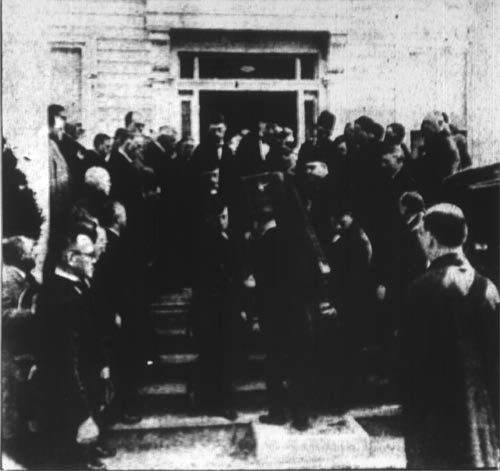
But there was in evidence, last night and again today, something suggestive of a community paying full and really heart-felt tribute to one who had lived with lasting benefit to his fellow-man. “Dungarvan,” the home of the merchant prince, last night was the scene of an outpouring of the friends gained through the years who took farewell of one whom they had held in highest regard. Nor was it merely a formal viewing of one who had passed on, nor idle curiosity, nor a perfunctory performance of mere duty.
One passing through that great throng as it wound its way along the paths beneath the great pines and oaks, up to the immaculately white entrance guarded by the Hurley retainers, found evidence of the sincerity of it all. It came by way of expression from men and women who had driven to the palatial home on White Horse pike and again by those who had perhaps walked several miles. A great social gulf between, but with one commonalty of sorrow, of regret in the passing, of satisfaction in having known “Big-hearted Bill Hurley.” That expression was heard repeatedly—“Big hearted Bill Hurley”—and some of those who thus alluded to the one lying so quietly within the south parlor of the Hurley home evidently knew the full force of it, knew it from experience.
Cortege Under Way
George Blake, funeral director and long personal friend of Mr. Hurley, aided by Frank Leonard, had some difficulty in getting the cortege under way, even though state and Collingswood police had closed White Horse pike from the Crescent boulevard roundpoint to Collings avenue to traffic. Eventually it was accomplished and the merchant whom everyone seemed to recall with something worth while had gone forever from the portals he loved.
With a guard of motorcycle policemen, the funeral stretching squares wound its way along Knights Park just giving promise of the glory of young spring verdure. It reached the humble little one-story brown church, St. John’s Catholic, all but hidden by the evergreens, all but covered by ivy. There a vast crowd awaited. A rush would certainly have been made into the church before the arrival of the mourners, but the doors were locked. It was necessary for St. John’s church accommodates but 60[?]. Certainly a thousand would have tried to force an entrance.
But with the arrival of the family the doors were opened. The honorary pallbearers once more formed a lane through which the honored dead was carried up the steps, into the sanctuary, drawn to the altar where candles flickered in the filtered lights from the stained glass windows. Then came the rites.
A solemn high mass of requiem was sung. Rev. John O’Farrell, pastor of the church and good friend for many a year of the Hurley family, was celebrant. Rev. Joseph M. Corriston of St. Joan of Arc Church, Fairview, was deacon, and Rev. Paul Fairbrother, Church of the Immaculate Conception, was sub-deacon.
Priests at Altar
There were gathered about the altar Msgr. Bozzi, Sea Isle City, Rev. Joseph Phelan, Langhorne, Rev. Father Brendon Shea, Church of Our Lady of Mount Carmel, Rev. Father Sutcliffe, Gloucester City, Rev. Father Corrigan, Holy Name Church, Rev. Father Henry, Sacred Heart, [blacked out] Most [blacked out] of the prominent South [blacked out] were attending the [blacked out] Bishop McMa[blacked out] otherwise they would have been at the [blacked out] altar at the Hu[blacked out]. Sombre-garbed Sisters of Mercy were in the pews. Among them was Sister Christine, for whom Mr. Hurley had been godfather years ago [blacked out] now is teacher of literature at [blacked out] Camden Catholic high school.
During the solemn service for the dead, the Immaculate Conception quartet sang. That is composed of Harry Weiss, tenor; E. Ehrman, bass; Miss Marie Archer, soprano, and Mrs. Katherine Maloney, contralto, with Miss Mary Niles, accompanist.
Funeral Reaches Cemetery
The solemn ritual over the cortege bearing the dead proceeded to Calvary Cemetery. Long before its arrival hundreds had gathered along Marlton pike—hundreds who were undismayed by a keen, cutting north wind, even though the majority were elderly women. It was apparent they were, as a rule, the old, old patrons of the Hurley store, those whom the founder ever served. They braved the wind and the discomfort to pay their tribute to the dead.
Whether it was by coincidence or otherwise, two airplanes circled over the cemetery when the cortege arrived and continued until the mourners had left. They seemed like two great birds on guard. Some thought it a symbol significant to the occasion.
Headed by motorcycle policemen from the state, Camden, Collingswood and Delaware township, the funeral arrived, passed the guarded entrance.
Thousands Pass Bier
Last night they paid tribute to an old friend and chieftain—thousands of them. Seemingly there was a never-ending stream of notables, of the lowly, those in every walk of life. They came in limousines, in trolleys and many walked, but all were imbued with one object, to take parting of “Big-hearted Bill Hurley,” whom they had known through the years [blacked out] to increase their regard with mellow [blacked out].
There was Ben Maloney, pal of many [blacked out] a year in the hunting field, who made [blacked out] the trip to the Hurley h[blacked out] enough because of [blacked out] F[blacked out] strong was Maloney [blacked out] times when he and his old [blacked out] had trod the wood and fields. Tears came unrestrained.
There was venerable Philip M[blacked out]Mann, who came down from R[blacked out] to take parting with his old chief. F[blacked out] Mann is the oldest [blacked out] of the Hurley organiza[blacked out] many a year he trod the [blacked out] a collector. He has long [blacked out] pensioned.
There was a long, long line of Hurley employes who wound about the path leading to the home, who met by the bier while the son of the family, Jerome, and Harry and James Moran, executives, stood by the door.
There were plain Mr. and Mrs. John Smith and their more exalted neighbors, too, who passed through the room holding the honored dead.
Elks Hold Services
And there was Camden Lodge of Elks there to hold the memorial service for one who exemplified the principles of that great American order in an exalted degree. They were there, these Elks, to write the faults on the sands, the virtues on the tablets of loving memory.
There was Phil Wilson, for many a year close associate of Mr. Hurley, who had known him all through the years that brought success. And William J. Lorigan whose father had long been associated with Mr. Hurley in building enterprises and former Prosecutor William J. Kraft, nephew and good friend of the family.
But by far the most [blacked out] memory of the man who lay so quiet [blacked out] and still were the flowers [blacked out] Mr. Hurley in life loved the [blacked out] springtime of summer and of [blacked out] Dungarvan had ever been a [blacked out] estate under his direction with [blacked out] grand old trees but there were [blacked out] splashes of color, the great [blacked out] rhododendrons along the [blacked out] dary yet recalcitrant but with [blacked out] ising buds. There was the garden [blacked out] of fresh of flowers now but with [blacked out] secret expanses—the roses and [blacked out] gardens and the peonies [blacked out] host yet to put forth their splendor [blacked out]
Bower of Beauty
[blacked out] of Dungarvan within it was [blacked out] of blossoms [blacked out] and the [blacked out] life of revived nature. Dungarvan within was a veritable living bower of beauty, exquisite [blacked out] that surrounded the bier that mounted [blacked out] the walls to the ceiling. Under the light of the candles in golden [blacked out] the color was one wonderful [blacked out] of red and pink and garnet with [blacked out] roses [blacked out] everywhere. [blacked out] [blacked out] [blacked out]
These were the [blacked out] that [blacked out] friends who [blacked out] passing tributes that came from all parts of the city, the county, even from far parts of the country.
There was a great basket of American beauty roses and [blacked out] Mrs. Hurley [blacked out] [blacked out] [blacked out] [blacked out] [blacked out] [blacked out] island estate [blacked out] a long time [blacked out].
The Camden employes with a [blacked out] heart. From the staff of the Hurley-Loughran store at Wilkes-Barre came a perpetual membership in the purcha[blacked out] society, and win[blacked out]dre[blacked out] designs from the stores at Bridgeton, Trenton and Atlantic City.
Organizations Send Blossoms
There was a great wreath of acanthus leaves from the Chamber of Commerce, a cross from the Broadway Business Men’s Association, the cloak of purple and white from Camden Lodge of Elks, snapdragons from the banks with which he had been affiliated, a basket from the Cities Corporation Company, which controls the Hotel Walt Whitman, a basket from Wyoming Tribe of Red Men.
Others who sent their tribute of beauteous blossoms were Mr. and Mrs. J. Walter Staats, white lilies and lilacs; John Schlorer, calla lilies; A. J. Henderson, “spring garden flowers”; Mr. and Mrs. J. David Stern, roses, lilies and snapdragons; John Croft and family, spring flowers; Mrs. Gertrude McNichol, Jerome Hurley’s fiancee, a great basket of lilies, roses and white lilacs; her father, Daniel Dever, basket of flowers; Col. T. R. Donovan, a four-foot pillow of flowers.
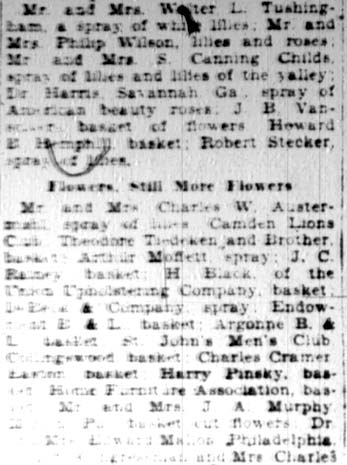
Mr. and Mrs. Walter L. Tushingham, a spray of white lilies; Mr. and Mrs. Philip Wilson, lilies and roses; Mr. and Mrs. S. Canning Childs, spray of lilies and lilies of the valley; Dr. Harris, Savannah, Ga., spray of American beauty roses; J. B. Van[blacked out], basket of flowers; Howard E. Hemphill, basket; Robert Stecker, spray of lilies.
Flowers, Still More Flowers
Mr. and Mrs. Charles W. Auster[blacked out], spray of lilies; Camden Lions Club; Theodore Tiedeken and Brother, basket; Arthur Moffett, spray; J. C. Ra[blacked out], basket; H. Black, of the T[blacked out]n Upholstering Company, basket; [blacked out] Beau & Company, spray; Endowment B. & L., basket; Argonne B. & L., basket; St. John’s Men’s Club, Collingswood, basket; Charles Cramer, basket; Harry Pinsky, basket; Home Furniture Association, basket; Mr. and Mrs. J. A. Murphy, [blacked out] basket, cut flowers; Dr. [blacked out] Edward Mallon, Philadelphia; [blacked out] and Mrs. Charles [blacked out], spray of American [blacked out]
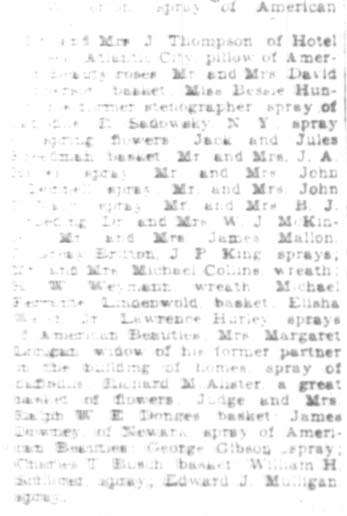
Mr. and Mrs. J. Thompson of Hotel [blacked out] Atlantic City, pillow of American beauty roses; Mr. and Mrs. David [blacked out], basket; Miss Bessie Hun[blacked out], [blacked out] former stenographer, spray of [blacked out]; [blacked out] D. Sadowsky, N. Y., spray [blacked out] spring flowers; Jack and Jules [blacked out]man, basket; Mr. and Mrs. J. A. [blacked out], spray; Mr. and Mrs. John [blacked out], spray; Mr. and Mrs. John [blacked out], spray; Mr. and Mrs. H. J. [blacked out]; Dr. and Mrs. W. J. McKin[blacked out]; Mr. and Mrs. James Mallon, [blacked out] Britton, J. P. King, sprays; Mr. and Mrs. Michael Collins, wreath; [blacked out] W. We[blacked out], wreath; Michael [blacked out], Lindenwold, basket; Elisha [blacked out] Jr., Lawrence Hurley, sprays of American Beauties; Mrs. Margaret Lorigan, widow of his former partner in the building of homes, spray of [blacked out]; Richard M. Alister, a great basket of flowers; Judge and Mrs. Ralph W. E. Donges, basket; James D[blacked out]ney, of Newark, spray of American Beauties; George Gibson, spray; Charles T. Busch, basket; William H. S[blacked out], spray; Edward J. Mulligan, spray.
Old Friends Send Tokens
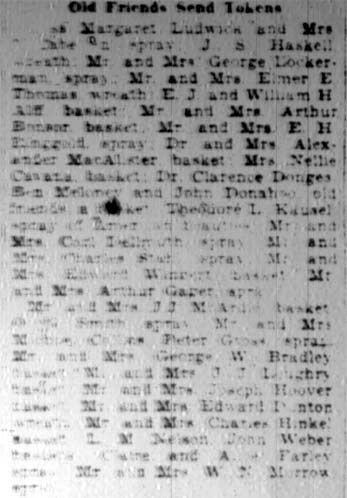
[blacked out]s Margaret Ludwick and Mrs. [blacked out], spray; J. S. Haskell, wreath; Mr. and Mrs. George Lockerman, spray; Mr. and Mrs. Elmer E. Thomas, wreath; E. J. and William H. [blacked out], basket; Mr. and Mrs. Arthur [blacked out], basket; Mr. and Mrs. E. H. [blacked out], spray; Dr. and Mrs. Alexander MacAlister, basket; Mrs. Nellie Cavata, basket; Dr. Clarence Donges; Ben Maloney and John Donahue, old friends, a basket; Theodore L. Kausel, spray of American Beauties; Mr. and Mrs. Carl Dellmuth, spray; Mr. and Mrs. Charles [blacked out], spray; Mr. and Mrs. Edward Windust, basket; Mr. and Mrs. Arthur Garet, spray.
Mr. and Mrs. J. J. McArdle, basket; [blacked out] Smith, spray; Mr. and Mrs. [blacked out]; Peter Gross, spray; Mr. and Mrs. George W. Bradley, [blacked out]; Mr. and Mrs. J. J. Loughry, [blacked out]; Mr. and Mrs. Joseph Hoover, [blacked out]; Mr. and Mrs. Edward P[blacked out]nton, wreath; Mr. and Mrs. Charles Hinkel, [blacked out]; L. M. Nelson, John Weber, [blacked out]; [blacked out] Clare and A. [blacked out] Farley, [blacked out]; Mr. and Mrs. W. N. Morrow, [blacked out]
The staff employed on the Hurley estate gave as their tribute a great [blacked out] of [blacked out]. They are Walter [blacked out], E. P. Haven, Edward Grant and [blacked out] Howard. And from Mr. and Mrs. [blacked out] Mathis came a basket of [blacked out] flowers. Mathis had been Mr. Hurley’s chauffeur for many years.
MRS. PHILIP WILSON DIES IN HOSPITAL
Camden Courier-Post —
Wife of Banker Succumbs After Operation; Had Been Ill One Month
After a long illness, Mrs. Emma Foulon Wilson, 50, wife of Philip Wilson, vice president of the Camden Safe Deposit and Trust Company, died at 9.30 o’clock last night in Cooper Hospital.
Mrs. Wilson underwent an operation in the hospital one month ago. She lived with her husband at 230 West Summit Avenue, Haddonfield.
Wilson, formerly was president of the Central Trust Company and the Delaware River Discharging Company. He is a brother of Admiral Henry B. Wilson, former commandant of the Annapolis Naval Academy.
Mrs. Wilson is survived by three sisters, Mrs. Joseph Street, Haddonfield; Mrs. Anna Riedel, Haddon Heights, and Mrs. William Maguire, whose husband is president of the board of managers of the West Jersey Homeopathic Hospital, and a brother, Charles Foulon, formerly proprietor of a bakery and restaurant at Fifth and Federal streets. She was a daughter of the late Charles and Anna Foulon.
FUNERAL OF MRS. WILSON BEING HELD TOMORROW
Camden Courier-Post —
Funeral services for Mrs. Emma Foulon Wilson, 50, wife of Philip Wilson; vice president, of the Camden Safe Deposit and Trust Company, who died Wednesday, will take place at 2 p.m. tomorrow, at the mausoleum in Harleigh Cemetery.
Wilson formerly was president of the Central Trust Company and the Delaware River Discharging Company. He is a brother of Admiral Henry B. Wilson, former commandant of the Annapolis Naval Academy, and resides at 230 West Summit Avenue, Haddonfield.
Venice, 1936
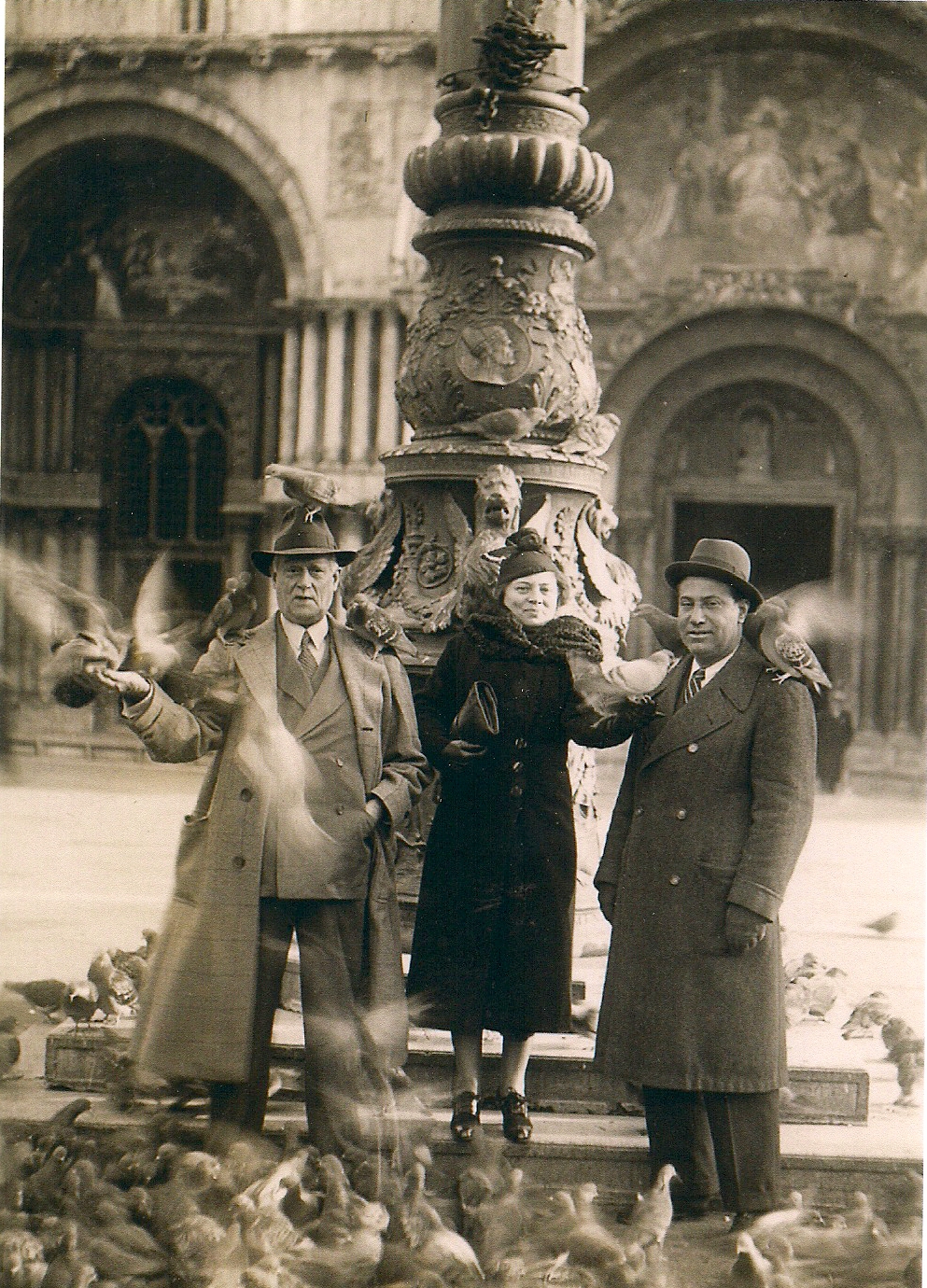
Named: Philip Wilson, Mrs. Hilda D. Carrow, Unknown, and Venice, 1936..
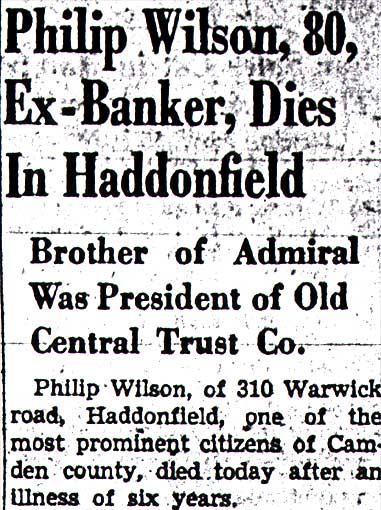
Philip Wilson, 80, Ex-Banker, Dies In Haddonfield
Camden Courier-Post —
Brother of Admiral Was President of Old Central Trust Co.
Philip Wilson, of 310 Warwick road, Haddonfield, one of the most prominent citizens of Camden county, died today after an illness of six years.
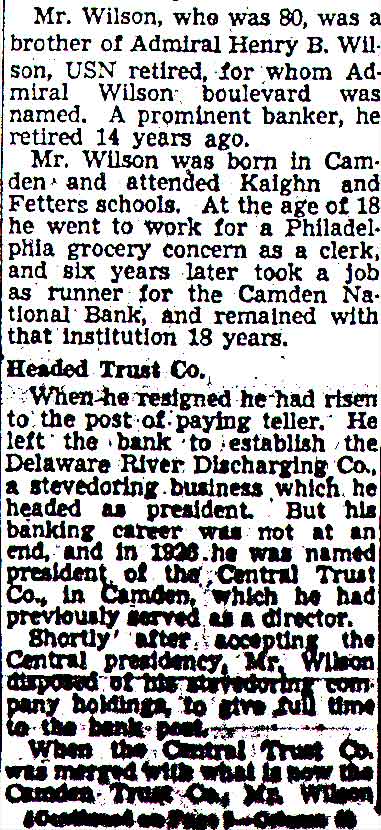
Mr. Wilson, who was 80, was a brother of Admiral Henry B. Wilson, USN retired, for whom Admiral Wilson boulevard was named. A prominent banker, he retired 14 years ago.
Mr. Wilson was born in Camden and attended Kaighn and Fetters schools. At the age of 18 he went to work for a Philadelphia grocery concern as a clerk, and six years later took a job as runner for the Camden National Bank, and remained with that institution 18 years.
Headed Trust Co.
When he resigned he had risen to the post of paying teller. He left the bank to establish the Delaware River Discharging Co., a stevedoring business which he headed as president. But his banking career was not at an end, and in 1926 he was named president of the Central Trust Co., in Camden, which he had previously served as a director.
Shortly after accepting the Central presidency, Mr. Wilson disposed of his stevedoring company holdings, to give full time to the bank post.
When the Central Trust Co. was merged with what is now the Camden Trust Co., Mr. Wilson was elected a vice president of the latter bank, a post he held until his retirement.
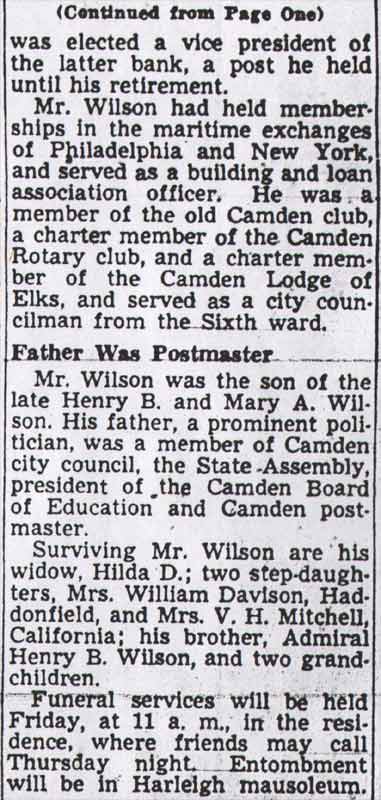
Mr. Wilson had held memberships in the maritime exchanges of Philadelphia and New York, and served as a building and loan association officer. He was a member of the old Camden club, a charter member of the Camden Rotary club, and a charter member of the Camden Lodge of Elks, and served as a city councilman from the Sixth ward.
Father Was Postmaster
Mr. Wilson was the son of the late Henry B. and Mary A. Wilson. His father, a prominent politician, was a member of Camden city council, the State Assembly, president of the Camden Board of Education and Camden postmaster.
Surviving Mr. Wilson are his widow, Hilda D.; two step-daughters, Mrs. William Davison, Haddonfield, and Mrs. V. H. Mitchell, California; his brother, Admiral Henry B. Wilson, and two grandchildren.
Funeral services will be held Friday, at 11 a. m., in the residence, where friends may call Thursday night. Entombment will be in Harleigh mausoleum.
Elks Add 130 Members to Rolls At Record Initiation Tonight
Camden Courier-Post —
Camden Lodge to Mark 40th Anniversary With Rally
PARADE AND SHOW BILLED FOR EVENT
Celebrating its 40th anniversary, Camden Lodge of Elks tonight will shatter all initiation records of recent years.
In addition to 50 new members to be received, 80 former members are to be reinstated.
Carlton W. Rowand, exalted ruler, who with other officers will conduct the initiation ceremonies in the junior ballroom of the Hotel Walt Whitman, hailed this unprecedented increase in the membership rolls as indicating “the dawn of progress and achievement.”
The Elks Band will lead a parade from the lodge home, Seventh and Penn streets to the hotel. The parade is scheduled to start at 8.15 p.m.
Preceding this, there will be a dinner in the home, in honor of the surviving charter members and all the past exalted rulers.
Charter members, who 40 years ago aided in the organization of the lodge, are Frank A. Ward, Charles L. Bowman, Dr. A. H. Lippincott, Dr. J. F. Leavitt, Fred W. George, T. L. Bear, William M. Fithian, Everett Ackley, Fithian S. Simmons, Philip Wilson, Paul E. Quinn, John N. Kadel, William G. Maguire and Maurice Hertz.
Following the initiation ceremonies there will be a floor show by a cast of entertainers from Frankie Palumbo’s Philadelphia Cafe.
Besides Rowand, officers of the lodge are Ernest E. Lindner, esteemed leading knight; William F. Huff, esteemed loyal knight; Lawrence V. White, esteemed lecturing knight; Albert Austermuhl, secretary; Homer H. Lotier, treasurer; C. Frederick Petry, esquire; Samuel A. Dobbins, tiler; D. Trueman Stackhouse, chaplain; William A. Davis, inner guard; Ralph Wiley, Jr., organist; Frank M. Travaline, Jr., delegate to state association; George B. Shaner, Theodore C. Roller and John Emmel, trustees.
Camden Lodge No. 293 was instituted January 24, 1895, with a membership including judges, lawyers, physicians, merchants, manufacturers, artisans and city and county officials. The organization meeting was held on the third floor of the Temple Building, Market Street near Fourth. John H. Fort was elected first exalted ruler. Since then many men prominent in the professional, political and business life of the city have filled the post.