J. Eavenson & Sons
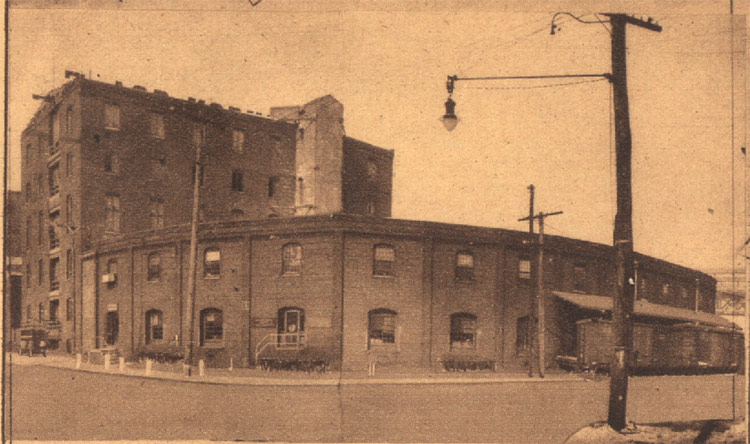
Founded in 1856 by Jones Eavenson, the J. Eavenson & Sons Company manufactured soap products for both consumer and industrial uses. J. Eavenson & Sons purchased the newly constructed but never used sugar refinery at Delaware Avenue and Penn Street in 1906. They adapted the refinery to produce soap products. At its peak, J. Eavenson & Sons employed about 250 people.
Also in 1906 the Eavenson Naptha Borax Soap Company of Camden, New Jersey paid $10,000 for the rights to salvage the cargo of the wrecked ship Sindia, which had gone down just off Ocean City NJ in 1901.
An Eavenson offspring, Alban Eavenson, partnered with J. Walter Levering to found Eavenson and Levering, a manufacturer of wool scouring soaps, with a large factory at 301 Jackson Street in South Camden. This factory became a major employer in the area in the years prior to World War II.
The J. Eavenson & Sons Company went out of business in 1956. The building was sold and was being dismantled when struck by fire in December of 1957. It subsequently razed.
The Jackson Street facility was used as a warehouse for many years, before finally being razed around 1990. The J. Eavenson & Sons site is now a part of the Campbell Field minor league baseball stadium.
The Eavenson Plant
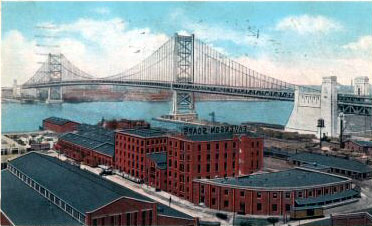
The J. Eavenson Plant, around 1930 — note the “EAVENSON SOAPS” sign on top of the factory, visible from Philadelphia
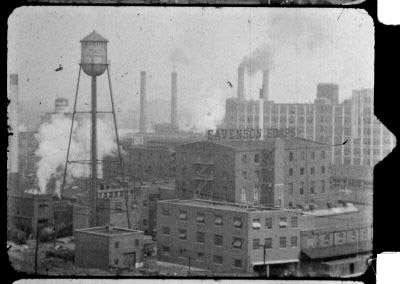
J. Eavenson Soaps as seen from the RCA Building, early 1930s
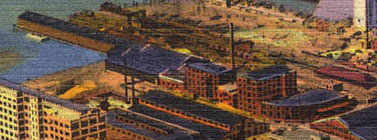
The J. Eavenson Plant, around 1940
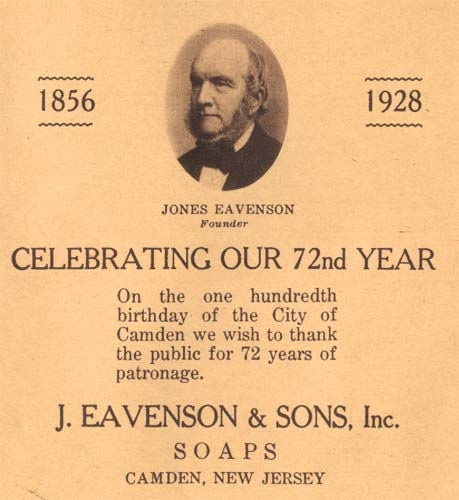
J. Eavenson & Sons, 1928
1890s Trade Cards

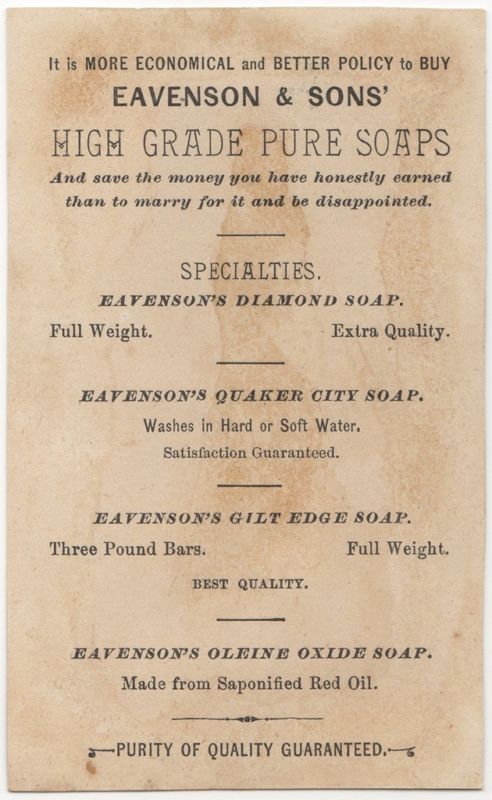
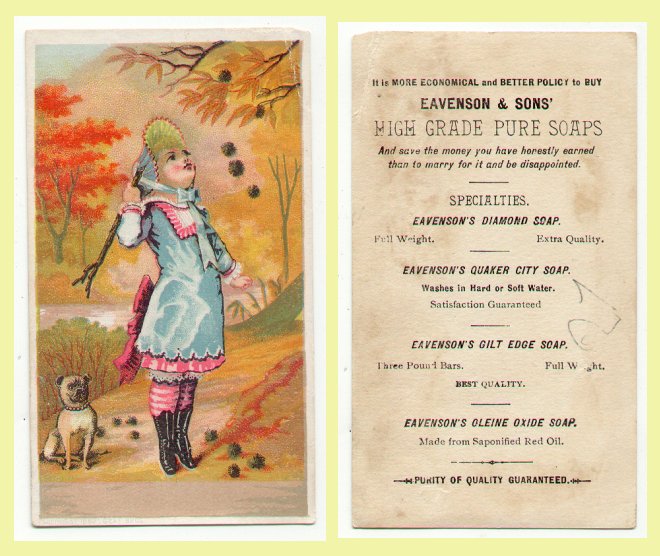
J. Eavenson & Sons trade cards, 1890s
Camden Soap Plant Is Swept by Flames
Philadelphia Inquirer —
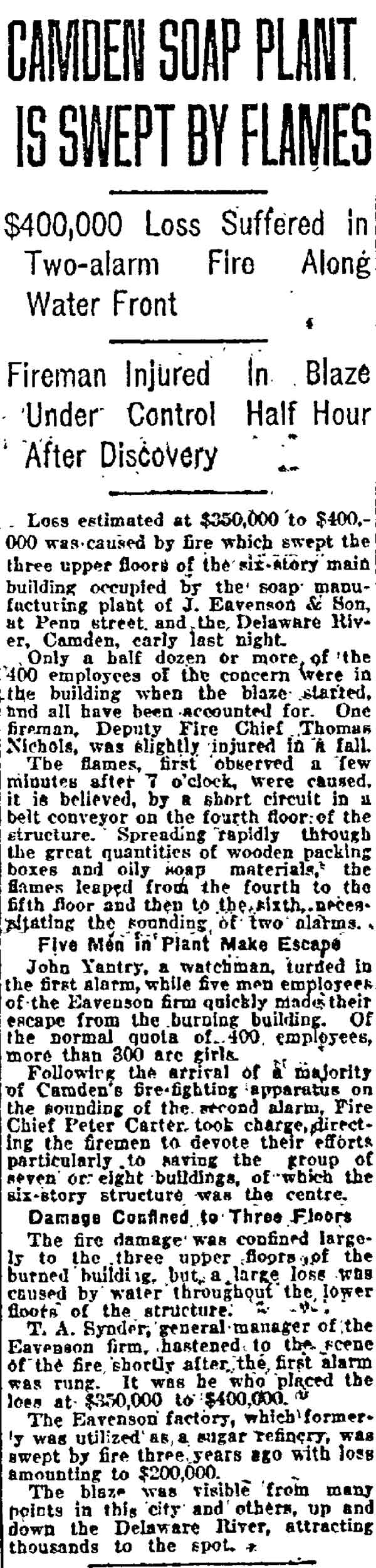
Loss estimated at $350,000 to $400,000 was caused by fire which swept the three upper floors of the six-story main building occupied by the soap manufacturing plant of J. Eavenson & Son, Delaware avenue and the Delaware River, Camden, early last night.
Only a half dozen or more, of the 400 employees of the concern were in the building when the blaze started, and all have been accounted for. One fireman, Deputy Fire Chief Thomas Nichols, was slightly injured in a fall.
The flames, first observed a few minutes after 7 o’clock were caused, it is believed, by a short circuit in a belt conveyor on the fourth floor of the structure. Spreading rapidly through the great quantities of wooden packing boxes and oily soap materials, the flames leaped from the fourth to the fifth floor and then to the sixth, necessitating the sounding of two alarms.
Five Men in Plant Make Escape
John Yantry, a watchman, turned in the first alarm, while five men employees of the Eavenson firm quickly made their escape from the burning building. Of the normal quota of 400 employees, more than 300 are girls.
Following the arrival of a majority of Camden’s fire-fighting apparatus on the sounding of the second alarm, Fire Chief Peter Carter took charge, directing the firemen to devote their efforts particularly to saving the group of seven or eight buildings, of which the six-story structure was the centre.
Damage Confined to Three Floors
The fire damage was confined largely to the three upper floors of the burned building. But a large loss was caused by water throughout the lower floors of the structure.
T. A. Snyder, general manager of the Eavenson firm, hastened to the scene of the fire shortly after the first alarm was rung. It was he who placed the loss at $350,000 to $400,000.
The Eavenson factory, which formerly was utilized as a sugar refinery, was swept by fire three years ago with loss amounting to $200,000.
The blaze was visible from many points in this city and others, up and down the Delaware River, attracting thousands to the spot.
2-Alarm Fire Hits Dela. Ave. Warehouse
Camden Courier-Post —
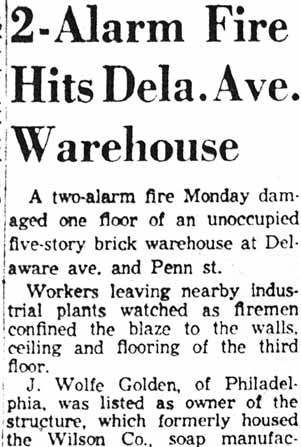
A two-alarm fire Monday damaged one floor of an unoccupied five-story brick warehouse at Delaware ave. and Penn st.
Workers leaving nearby industrial plants watched as firemen confined the blaze to the walls, ceiling and flooring of the third floor.
J. Wolfe Golden, of Philadelphia, was listed as owner of the structure, which formerly housed the Wilson Co., soap manufacturers.
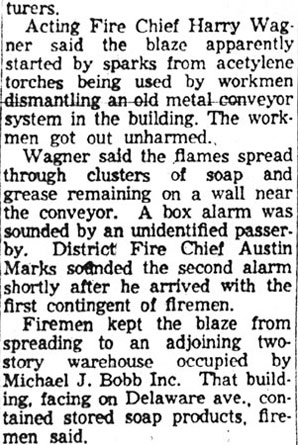
Acting Fire Chief Harry Wagner said the blaze apparently started by sparks from acetylene torches being used by workmen dismantling an old metal conveyor system in the building. The workmen got out unharmed.
Wagner said the flames spread through clusters of soap and grease remaining on a wall near the conveyor. A box alarm was sounded by an unidentified passer-by. District Fire Chief Austin Marks sounded the second alarm shortly after he arrived with the first contingent of firemen.
Firemen kept the blaze from spreading to an adjoining two-story warehouse occupied by Michael J. Bobb Inc. That building, facing on Delaware ave., contained stored soap products, firemen said.