Introduction
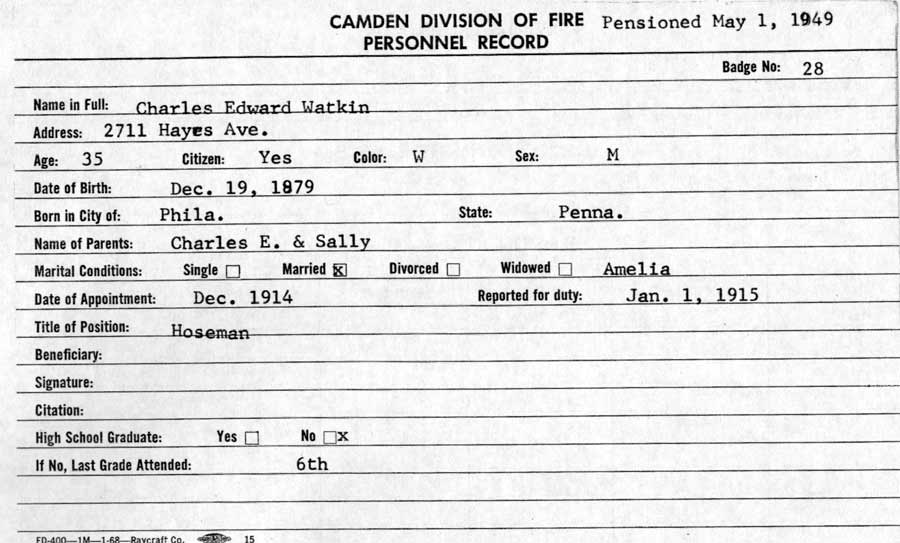
CHARLES EDWARD WATKIN JR. was born in Philadelphia, Pennsylvania on December 19, 1879 to Charles E. and Sally Watkin. He does not appear in the Camden City Directories prior to 1900.
Charles E. Watkin does appear in the 1900 Census. He was living with his wife Millie at 53 Wood Street in North Camden and working as a painter. There were no children at that time, but three would be born before the end of the decade, Georgianna, Matilda, and William C. Watkin. The 1906 City Directory, which as do several print sources, list him as “Watkins” show him working as a riveter and living at 907 North Front Street.
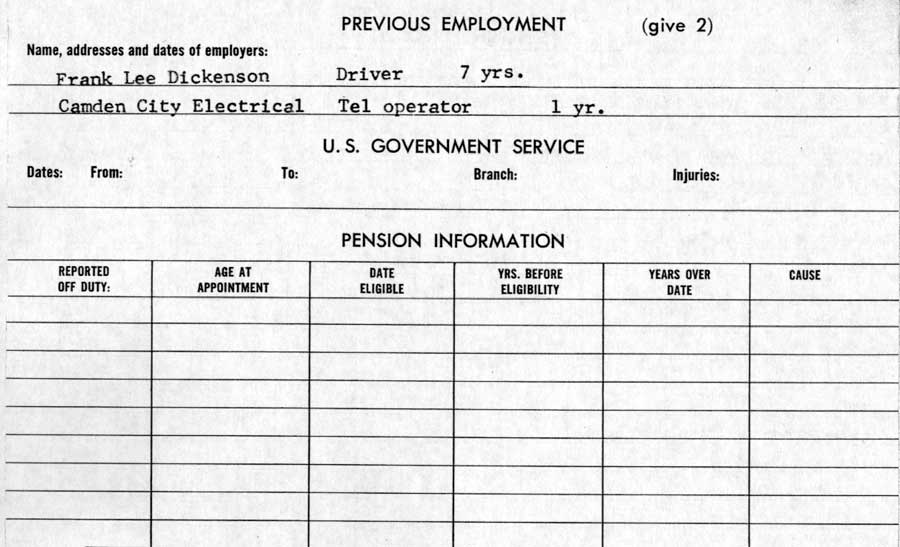
When the Census was taken in 1910 the Watkin family was living at 18 York Street in North Camden. He was then working as a driver for Frank Lee Dickinson & Company, a wholesale grocery firm at York and Beach Streets, as was a neighbor at 10 York Street, Abraham Kern. Both men would go on to have long careers with the Camden Fire Department.
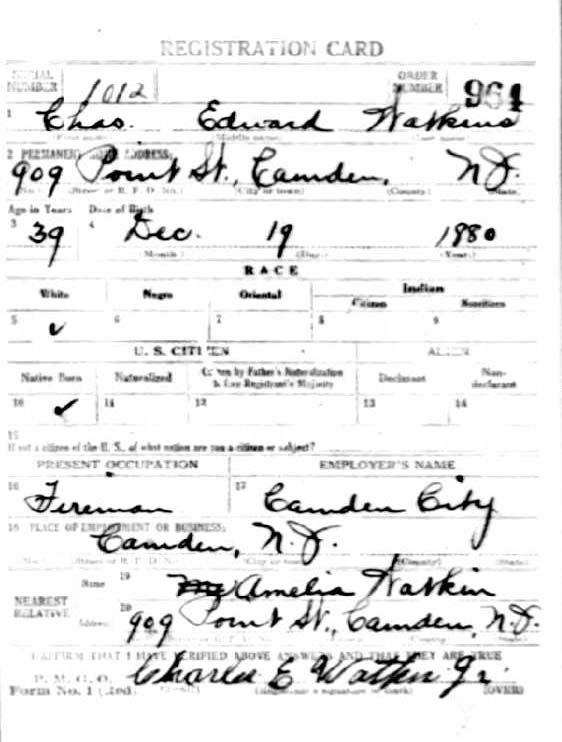
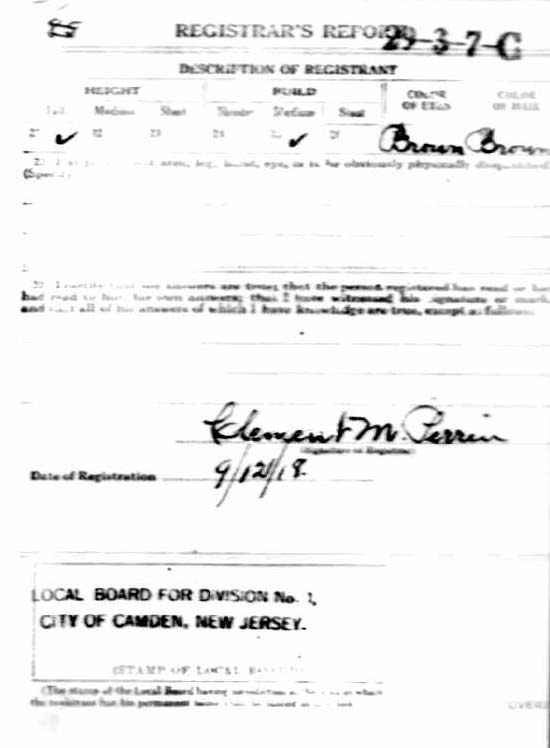
By 1914 the Watkin family had moved to 909 Point Street in North Camden. Abraham Kern and Charles E. Watkin were both appointed to the Camden Fire Department not long after the 1914 Camden City Directory was compiled, Charles E. Watkin’s appointment being effective January 1, 1915. Charles E. Watkin was working as a Camden fire fighter and still living at 909 Point Street when he registered for the draft on September 12, 1918. His ability was soon recognized, and by 1921 he had been promoted to the rank of Lieutenant, serving at Engine Company 5, on Federal Street at 12th Street. On December 23, 1921 Charles E. Watkin was promoted to Captain, replacing Charles A. Todd at Engine Company 7 upon Todd’s retirement at the end of February 1922.
On April 8, 1922 while serving as Captain of Engine Company 7, Charles Watkin was injured while attempting to rescue a child from a burning building at 1009 Broadway. He was injured again in March of 1924, and for a third time while serving with Engine Company 7 when in July of 1925 a wall collapsed on him while fighting a fire at 252 Division Street.
The 1924 Camden City Directory shows that Charles E. Watkin was still serving with Engine Company 7 at 1115 Kaighn Avenue, and that he and his family had moved across the street, to 908 Point Street. The Watkins are still listed there in the 1927 Directory, however a newspaper report from 1925 gives an address of 927 North Front Street. By the time the 1929 edition was being prepared Charles E. Watkin had been reassigned to Engine Company 11 on North 27th Street in Cramer Hill. He and his family were then living at 2729 Hayes Avenue. His daughter were still living at home, his son William C. Watkin, however, had married and was living at 804 North 30th Street. By April of 1930 Charles E. Watkins, his wife and daughters had moved to 2711 Hayes Avenue.
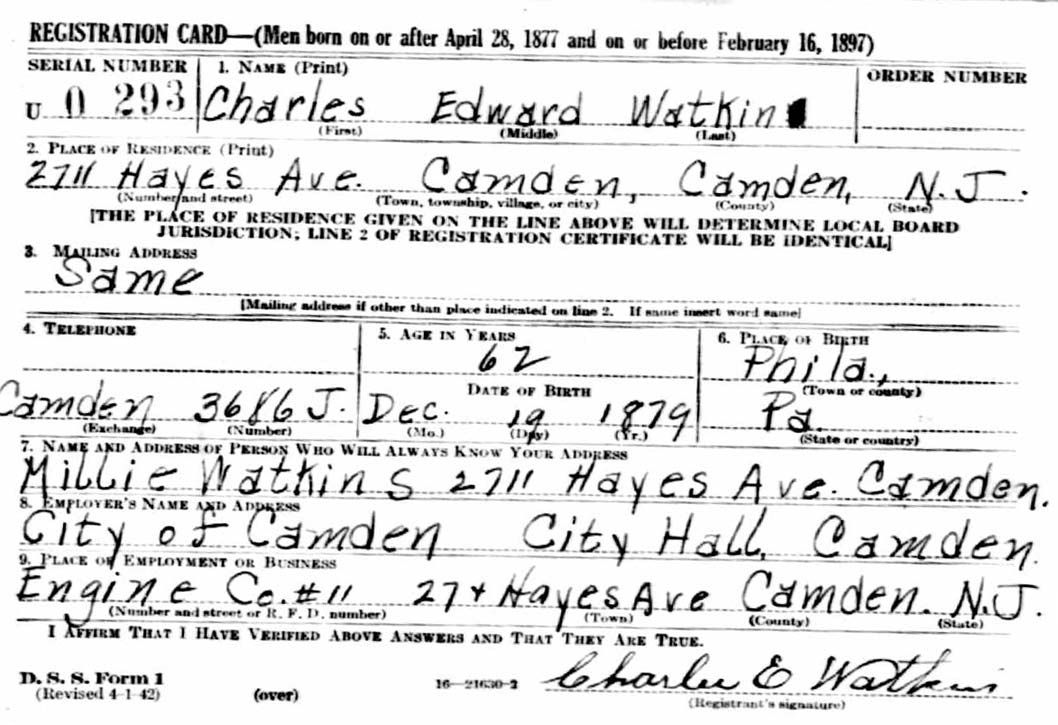
Charles E. Watkin was living at the Hayes Avenue address and still serving as Captain of Engine Company 11 when he registered for the draft in the spring of 1942. On May 1 of that year, Charles E. Watkin’s son William C. Watkin was appointed to Camden’s Fire Department and like his father, would make a career out of the fire service. Father and son served together for seven years. On May 1, 1949, at the age of 69, Charles E. Watkin retired from the Camden Fire Department, having served the City for over 34 years.
Charles E. Watkin is not listed in the New Jersey Bell Telephone Directories of the 1950s. He last resided with his daughter Georgianna Kelly, at 262 Ablett Village. Charles E. Watkin died at Cooper Hospital on February 14, 1954. His son, William C. Watkin, served for 29 years and 11 months before retiring on April 1, 1972.
Police Guard Gas Tank
Philadelphia Inquirer —
POLICE GUARD GAS TANK
More Men Put to Work and No Trouble Occurs
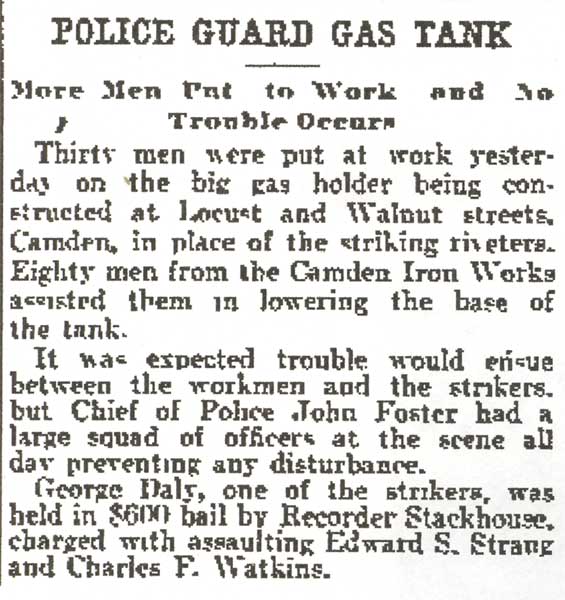
Thirty men were put at work yesterday on the big gas holder being constructed at Locust and Walnut streets, Camden, in place of the striking riveters. Eighty men from the Camden Iron Works assisted them in lowering the base of the tank.
It was expected trouble would ensue between the workmen and the strikers, but Chief of Police John Foster had a large squad of officers at the scene all day preventing any disturbance.
George Daly, one of the strikers, was held in $600 bail by Recorder Stackhouse, charged with assaulting Edward S. Strang and Charles F. Watkins.
Firemen Escort Steer's Remains
Camden Daily Courier —
FIREMEN ESCORT STEER'S REMAINS
Chief Stockton Heads Big Delegation at Funeral of Lamented Colleague.
QUARTER CENTURY IN CITY'S SERVICE
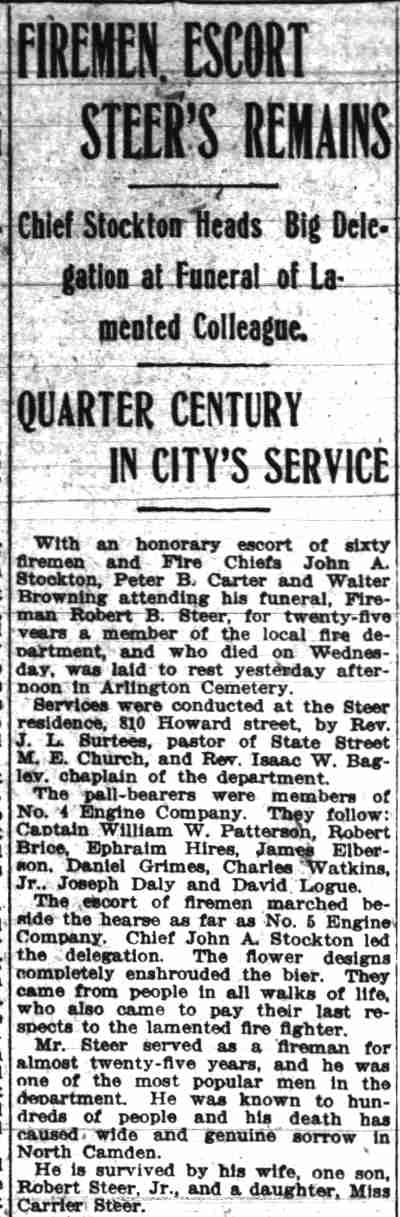
With an honorary escort of sixty firemen and Fire Chiefs John A. Stockton, Peter B. Carter and Walter Browning attending his funeral, Fireman Robert B. Steer, for twenty-five years a member of the local fire department, and who died on Wednesday, was laid to rest yesterday afternoon in Arlington Cemetery.
Services were conducted at the Steer residence, 310 Howard street, by Rev. J. L. Surtees, pastor of State Street M. E. Church, and Rev. Isaac W. Bagley, chaplain of the department.
The pall-bearers were members of No. 4 Engine Company. They follow: Captain William W. Patterson, Robert Brice, Ephraim Hires, James Elberson, Daniel Grimes, Charles Watkins, Jr., Joseph Daly and David Logue.
The escort of firemen marched beside the hearse as far as No. 5 Engine Company. Chief John A. Stockton led the delegation. The flower designs completely enshrouded the bier. They came from people in all walks of life, who also came to pay their last respects to the lamented fire fighter.
Mr. Steer served as a fireman for almost twenty-five years, and he was one of the most popular men in the department. He was known to hundreds of people and his death has caused wide and genuine sorrow in North Camden.
He is survived by his wife, one son, Robert Steer, Jr., and a daughter, Miss Carrier Steer.
Charm Presented to Deputy Chief
Camden Daily Courier —
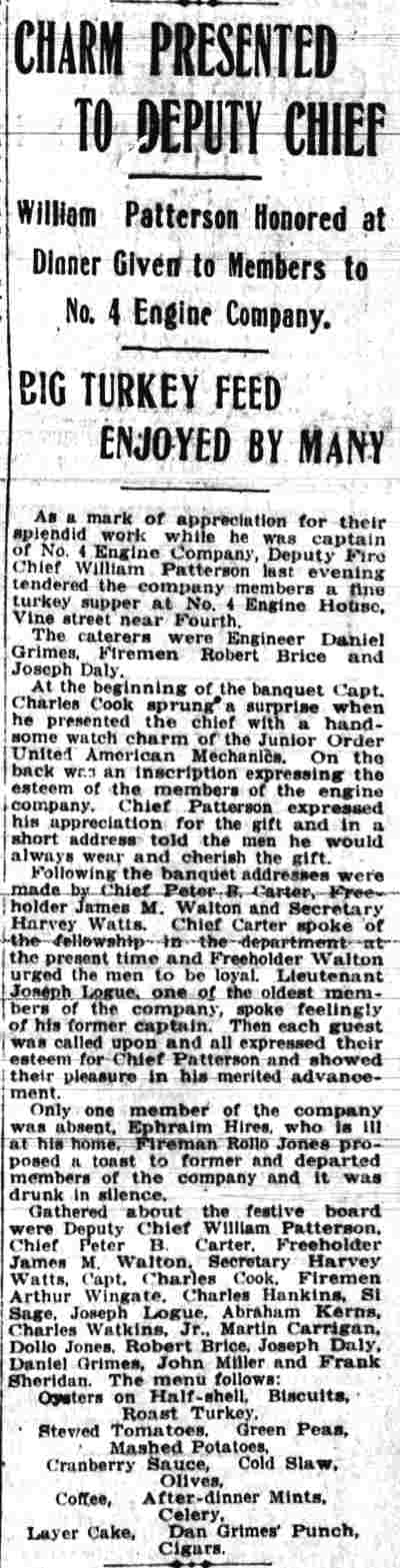
CHARM PRESENTED TO DEPUTY CHIEF
William Patterson Honored at Dinner Given to Members to No. 4 Engine Company.
BIG TURKEY FEED ENJOYED BY MANY
As a mark of appreciation for their splendid work while he was captain of No. 4 Engine Company, Deputy Fire Chief William Patterson last evening tendered the company members a fine turkey supper at No. 4 Engine House, Vine street near Fourth.
The caterers were Engineer Daniel Grimes, Firemen Robert Brice and Joseph Daly.
At the beginning of the banquet Capt. Charles Cook sprung a surprise when he presented the chief with a handsome watch charm of the Junior Order United American Mechanics. On the back was an inscription expressing the esteem of the members of the engine company. Chief Patterson expressed his appreciation for the gift and in a short address told the men he would always wear and cherish the gift.
Following the banquet addresses were made by Chief Peter B. Carter, Freeholder James M. Walton and Secretary Harvey Watts. Chief Carter spoke of the fellowship in the department at the present time and Freeholder Walton urged the men to be loyal. Lieutenant Joseph Logue, one of the oldest members of the company, spoke feelingly of his former captain. Then each guest was called upon and all expressed their esteem for Chief Patterson and showed their pleasure in his merited advancement.
Only one member of the company was absent, Ephraim Hires, who is ill at his home. Fireman Rollo Jones proposed a toast to former and departed members of the company and it was drunk in silence.
Gathered about the festive board were Deputy Chief William Patterson, Chief Peter B. Carter, Freeholder James M. Walton, Secretary Harvey Watts, Capt. Charles Cook, Firemen Arthur Wingate, Charles Hankins, Si Sage, Joseph Logue, Abraham Kerns, Charles Watkins, Jr., Martin Carrigan, Dollo Jones, Robert Brice, Joseph Daly, Daniel Grimes, John Miller and Frank Sheridan. The menu follows:
Oysters on Half-shell, Biscuits, Roast Turkey, Stewed Tomatoes, Green Peas, Mashed Potatoes, Cranberry Sauce, Cold Slaw, Olives, Coffee, After-dinner Mints, Celery, Layer Cake, Dan Grimes’ Punch, Cigars.
World War I Draft Card
14 Firemen Win City Promotions
Camden Daily Courier —
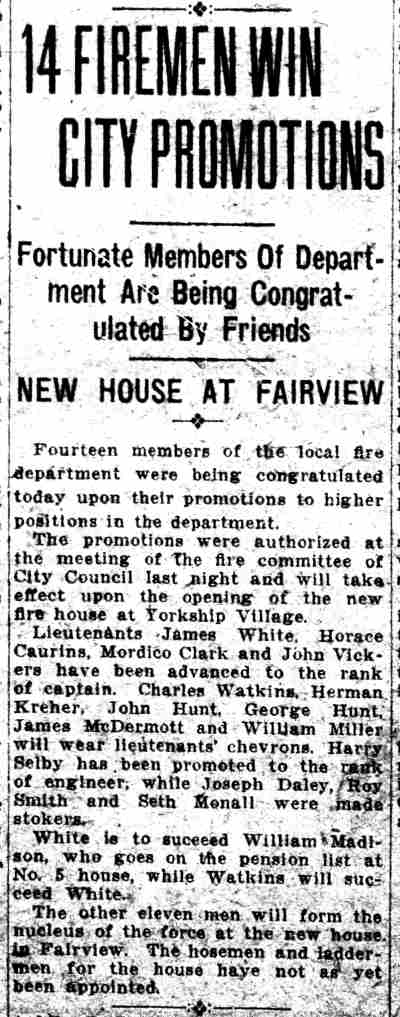
14 FIREMEN WIN CITY PROMOTIONS
Fortunate Members Of Department Are Being Congratulated By Friends
NEW HOUSE AT FAIRVIEW
Fourteen members of the local fire department were being congratulated today upon their promotions to higher positions in the department.
The promotions were authorized at the meeting of the fire committee of City Council last night and will take effect upon the opening of the new fire house at Yorkship Village.
Lieutenants James White, Horace Cairns, Mordecai Clark and John Vickers have been advanced to the rank of captain. Charles Watkins, Herman Kreher, John Hunt, George Hunt, James McDermott and William Miller will wear lieutenants' chevrons. Harry Selby has been promoted to the rank of engineer, while Joseph Daley, Roy Smith and Seth Monall were made stokers.
White is to succeed William Madison, who goes on the pension list at No. 5 house, while Watkins will succeed White.
The other eleven men will form the nucleus of the force at the new house in Fairview. The hosemen and laddermen for the house have not as yet been appointed.
Fire Department Promotions
Philadelphia Inquirer —
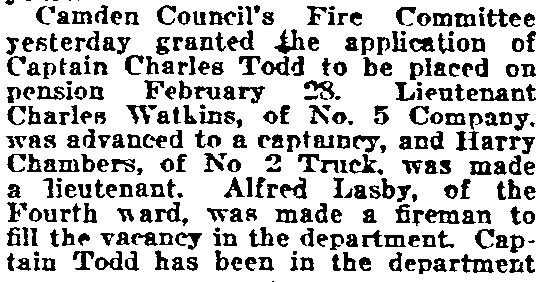

Camden Council’s Fire Committee yesterday granted the application of Captain Charles Todd to be placed on pension February 28. Lieutenant Charles Watkins, of No. 5 Company, was advanced to a captaincy, and Harry Chambers, of No 2 Truck, was made a lieutenant. Alfred Lasby, of the Fourth ward, was made a fireman to fill the vacancy in the department. Captain Todd has been in the department [text continues on second page]
for twenty-two years and is head of No. 7 Engine Company.
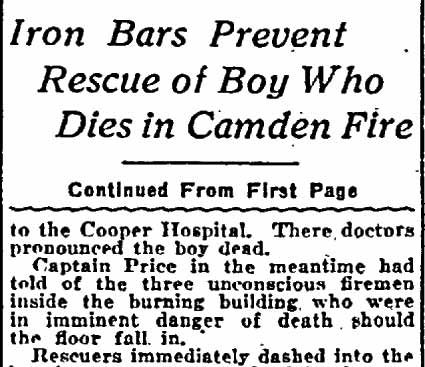
"Iron Bars Prevent Rescue of Boy Who Dies in Camden Fire"
Philadelphia Inquirer —
Iron Bars Prevent Rescue of Boy Who Dies in Camden Fire
Six Firemen Injured in Heroic Attempts to Save Little Victim
Doomed Lad Stares Piteously Out Windows as House Is Blazing Furnace
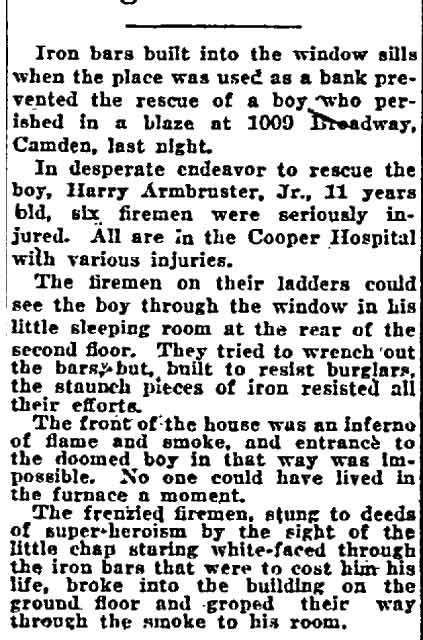
Iron bars built into the window sills when the place was used as a bank prevented the rescue of a boy who perished in a blaze at 1009 Broadway, Camden, last night.
In desperate endeavor to rescue the boy, Harry Armbruster, Jr., 11 years old, six firemen were seriously injured. All are in the Cooper Hospital with various injuries.
The firemen on their ladders could see the boy through the window in his little sleeping room at the rear of the second floor. They tried to wrench out the bars, but, built to resist burglars, the staunch pieces of iron resisted all their efforts.
The front of the house was an inferno of flame and smoke, and entrance to the doomed boy in that way was impossible. No one could have lived in the furnace a moment.
The frenzied firemen, stung to deeds of super-heroism by the sight of the little chap staring white-faced through the iron bars that were to cost him his life, broke into the building on the ground floor and groped their way through the smoke to his room.
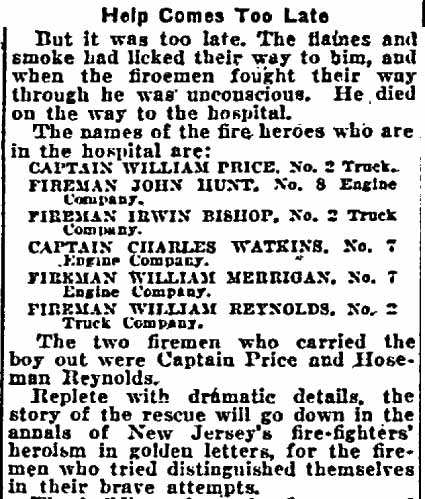
Help Comes Too Late
But it was too late. The flames and smoke had licked their way to him, and when the firemen fought their way through he was unconscious. He died on the way to the hospital.
The names of the fire heroes who are in the hospital are:
CAPTAIN WILLIAM PRICE, No. 2 Truck.
FIREMAN JOHN HUNT, No. 8 Engine Company.
FIREMAN IRWIN BISHOP, No. 2 Truck Company.
CAPTAIN CHARLES WATKINS, No. 7 Engine Company.
FIREMAN WILLIAM MERRIGAN, No. 7 Engine Company.
FIREMAN WILLIAM REYNOLDS, No. 2 Truck Company.
The two firemen who carried the boy out were Captain Price and Hoseman Reynolds.
Replete with dramatic details, the story of the rescue will go down in the annals of New Jersey's fire-fighters' heroism in golden letters, for the firemen who tried distinguished themselves in their brave attempts.
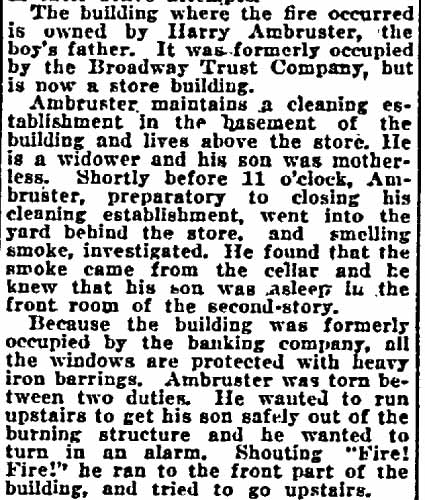
The building where the fire occurred is owned by Harry Ambruster, the boy's father. It was formerly occupied by the Broadway Trust Company, but is now a store building.
Ambruster maintains a cleaning establishment in the basement of the building and lives above the store. He is a widower and his son was motherless. Shortly before 11 o'clock, Ambruster, preparatory to closing his cleaning establishment, went into the yard behind the store, and smelling smoke, investigated. He found that the smoke came from the cellar and he knew that his son was asleep in the front room of the second-story.
Because the building was formerly occupied by the banking company, all the windows are protected with heavy iron barrings. Ambruster was torn between two duties. He wanted to run upstairs to get his son safely out of the burning structure and he wanted to turn in an alarm. Shouting “Fire! Fire!” he ran to the front part of the building, and tried to go upstairs.
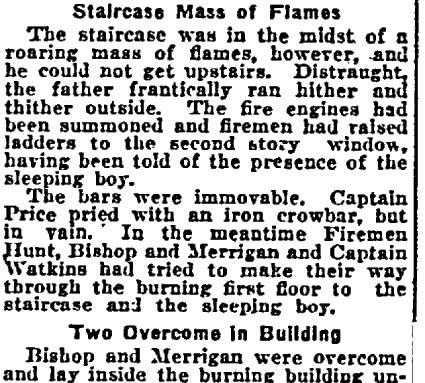
Staircase Mass of Flames
The staircase was in the midst of a roaring mass of flames, however, and he could not get upstairs. Distraught, the father frantically ran hither and thither outside. The fire engines had been summoned and firemen had raised ladders to the second story window, having been told of the presence of the sleeping boy.
The bars were immovable. Captain Price pried with an iron crowbar, but in vain. In the meantime Firemen Hunt, Bishop and Merrigan and Captain Watkins had tried to make their way through the burning first floor to the staircase and the sleeping boy.
Two Overcome in Building
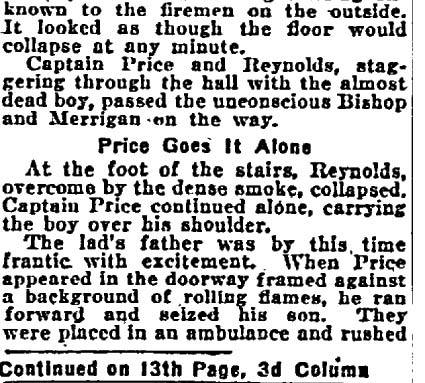
Bishop and Merrigan were overcome and lay inside the burning building unknown to the firemen on the outside. It looked as though the floor would collapse at any minute.
Captain Price and Reynolds, staggering through the hall with the almost dead boy, passed the unconscious Bishop and Merrigan on the way.
Price Goes It Alone
At the foot of the stairs, Reynolds, overcome by the dense smoke, collapsed. Captain Price continued alone, carrying the boy over his shoulder.
The lad's father was by this time frantic with excitement. When Price appeared in the doorway framed against a background of rolling flames, he ran forward and seized his son. They were placed in an ambulance and rushed to the Cooper Hospital. There doctors pronounced the boy dead.
Captain Price in the meantime had told of the three unconscious firemen inside the burning building who were in imminent danger of death should the floor fall in.
Rescuers immediately dashed into the burning structure and brought out their comrades and all were rushed to the hospital.
The building, a two-story brick edifice, was directly behind the Lyric Theatre, where a crowded audience was witnessing a motion picture performance. Realizing the proximity of the fire, and fearing a panicky stampede, the orchestra continued to play, and the operator was given orders to continue the picture then showing for ten minutes. Then the smoke became noticeable within the theatre, and the performance was ended. The audience left the theatre quietly, without any sign of fear or panic.
Three alarms were turned in during the fire, and the building was practically destroyed.
Three Firemen Hurt at Blaze in Camden
Trenton Evening Times —
THREE FIREMEN HURT AT BLAZE IN CAMDEN
(International News Service)
CAMDEN, N. J., March 24.—Three firemen were hurt, traffic tied up for an hour, and $50,000 damage done by a fire which broke out at Camden's busiest corner today. The blaze is believed to have been caused by spontaneous combustion in a small repair shop at the rear of a sporting goods store.
The firemen injured were Lawrence Mathews, Charles Watkins and George Hunt. They were hurt when a ladder fell and were treated at hospitals. All suffered bruises and cuts.
FOUR FIREMEN ARE TRAPPED IN COLLAPSE OF BRICK WALL
Camden Evening Courier —
FLAMES SWEEP WAREHOUSE IN SOUTH CAMDEN
Fire Fighters are Rescued From Beneath Heaps of Hot Bricks
BURNING TIRES SEND UP CLOUDS OF DENSE SMOKE
Bantivoglio Junk Yard Destroyed – Loss Runs Into Thousands
Four firemen were buried under a falling brick wall, two of them believed to have been seriously hurt, and thousands of dollars worth of property was destroyed in a spectacular fire at the two story brick warehouse of Bantivoglio & Son, junk dealers, 252 Division Street, at 9:00 o’clock this morning.
The injured firemen attached to Engine Company No. 7, all of whom were taken to West Jersey Homeopathic Hospital, were:
Captain Watkin 45 years old, 927 North Front street. Four fractured ribs and a punctured lung. he may die.
Nicholas Romaine, 43 years old, hoseman, 1271 Chase Street, lacerations of scalp and possible fracture of right ankle.
Louis Quinton, 25 years old, hoseman. 626 Viola Street, probable fracture of right shoulder.
Lester Anderson, 24 years old, hoseman, 1917 Niagara Road; lacerations of scalp and forehead and fractured left wrist.
None of the four were able to walk when they were lifted from where they had been struck down by the falling bricks. They were carried to the police ambulance and hurried at once to the hospital.
Residents of the neighborhood sat that a flash and a roar, as of an explosion, was their first warning of a blaze. The burned building has a frontage of 75 feet on Division Street. In a yard behind it there was a shed piled high with baled paper and three piled of used automobile tires. These caught fire and sent up black smoke that was visible for miles.
Smoke Hampers Firemen
A huge crowd of spectators already had gathered to watch the fire in this thickly populated section when the firemen arrived. The flames were threatening surrounding buildings, and the smoke was so dense that the men had difficulty finding their way out in the vicinity of the burning structure.
Captain Watkin and the three other fire fighters started along a driveway beside the building with a length of hose which they intended to use on the blazing sheds in the rear. They were passing a window when there was a muffled roar and a blast of dense smoke blinded and confused them. By shouts to one another they heard that there number was still intact. The blast of black smoke had been caused by the collapse of a loft and the falling of several bales of paper.
100,000 Tires Burn
More than 100,000 used automobile tires were destroyed in the blaze. The flames jumped a hundred feet into the air at one stage. Commissioner Hitchner watched the firemen at work from the roof of a nearby garage.
When the blaze had been extinguished Mr. Hitchner left to visit the injured firemen in the hospital. He commended the four men on their bravery and wished them a speedy recovery. Quinton is driver for Battalion Chief Wade.
The flames threatened to spread to the large garage of Louis Vananeri, on Spruce Street, directly in the rear of the junk yard. Firemen mounted the roof of this building and drove the flames back.
Today’s blaze was the fourth that had visited the warehouse this year. The fire today is believed to have been caused by spontaneous combustion.
Carter Directs Rescue
The quarter were stooping to take up their hose line again when there was a crack like the report of a pistol, followed by a terrific roar.
Fire Chief Carter, personally directing his men, was about 50 feet away, and saw the four men buried as the bricks thudded down from the crumbling wall.
“Come on boys, there are four men under here.” the chief yelled, and soon a score of hands were tearing frantically at the heaps of hot brick.
Bus Delays Ambulance
The police ambulance in which the injured men were placed was delayed for five minutes on its way to the hospital by the refusal of a Public Service bus driver to give it the right of way. According to Policeman Howard Fisher, the busman was arrested. The police say he will be prosecuted to the full extent of the ordinance in such cases. The ambulance was forced to remain behind the bus for a block and a half, according to the reports.
The pillar of smoke sent up by the blazing warehouse, sheds and 50-foot high piles of auto tires, drew thousands of spectators from all directions. Three alarms were turned in to the fire department in rapid succession. The police were called upon at once to establish lines for keeping back the crowd.
Bales of paper stored in the main building, as well as in the shed behind, absorbed tons of water poured into the place by the firemen’s hose, and the added weight snapped off fire-weakened floor beams like burning matches. The falling timbers and masses of packed paper added to the danger and difficulty of the firemen’s task.
Only by a long and stubborn fight were the foremen able to prevent a conflagration among surrounding buildings.
The big warehouse became a red hot furnace. The heat was so intense a half-hour after the fire was discovered that telephone and electric light poles on the other side of Division Street were ignited. “Trouble crews” from the telephone and electric companies were rushed to the place to guard their wires against falling and injuring persons below.
Loss placed at $50,000
It was roughly estimated that the the damage to the junk sheds and warehouse would reach $50,000.
Mrs. Leona Brown, who had just moved today into the house at 264 Division Street, just east of the burned plant, was driven from her new home by the dense clouds of smoke from a blazing of automobile tires that towered above the west wall of her two-story dwelling.
She was unable to return for any of her belongings when the flames began to eat their way through the west wall of her house.
The fire was the second within a month in the junk yard, which is closely surrounded by frame residences, a frame negro church and other buildings on all sides.
Romaine Seriously Hurt
Hoseman Romaine was reported by surgeons at the West Jersey Homeopathic Hospital as the most seriously hurt of the firemen caught by the falling wall. He was cut above the head, badly bruised about the back, and one of his ankles is believed to have been fractured.
Captain Watkin suffered several fractured ribs.
Hoseman Anderson was cut and burned about the face and his right wrist.
Hoseman Quinton suffered burns, cuts and bruises, and it is believed that one of his shoulders was fractured.
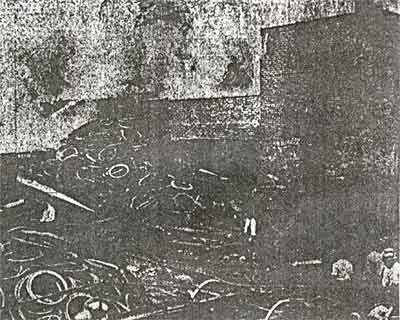
WHEN MOUNTAIN OF AUTO TIRES BURNED – Four firemen were buried under a falling wall when fire swept a two-story warehouse and junkyard at 250-252 Division Street at 9:30 this morning. The photograph shows firemen pouring tons of water on piles of baled paper and old automobile tires. The firemen worked three hours before the blaze was under control. The flames threatened surrounding properties.
World War II Draft Card
Personnel Cards