Introduction
Serving North Camden and the waterfront area, Engine Company 4 was organized on June 1, 1890 and entered service that same day at 320 Vine Street. At the height of the Great Depression Camden, like many other New Jersey municipalities, was forced to cut back on city services, and on January 1, 1933 Engine Company 4 and Engine Company 5, located at 27th and Federal Street, were disbanded. Ladder Company 4 was also disbanded for similar reasons on July 5, 1936.
The Engine Company 4 firehouse at 320 Vine Street was sold to a private owner and remained in use through March 2005.
Original Members — June 1, 1890
When first organized, Engine Company 4 consisted of a Foreman, an Engineer, a Driver, and two hosemen. The first members of Engine Company 4 are as follows.
| Position | Name |
|---|---|
| Foreman | Amedee Middleton |
| Engineer | Francis Turner |
| Driver | Edward Hartman |
| Stoker | Barney Harvey |
| Hoseman | Walter Browning |
| Hoseman | Charles Berry |
Annual salaries for the members of the paid force in 1869 were $600 for the Engineer, $450 for the Driver and the Stoker and $50 for the extra men. All but the extra men were paid monthly. The Chief Marshall received $800, and the Assistant Marshall $200 per year as well.
Heard at the Engine Houses
Trenton Evening Times —
HEARD AT THE ENGINE HOUSES.
A delegation of the Mutual Fire Engine Company went to Camden recently and presented Amedee Middleton, the foreman of No. 4 Engine Company of that city, with a new 64 cone fire hat. The presentation was made by Charles Barkholz, the president of the Mutual Company. The Trenton boys were royally entertained. It is thought the Camden company will return the visit this week.
Engine Company 4 Apparatus
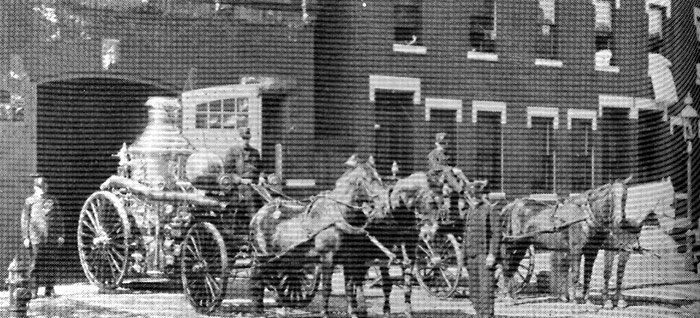
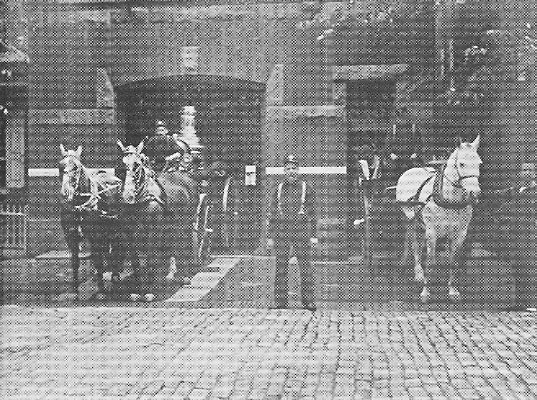
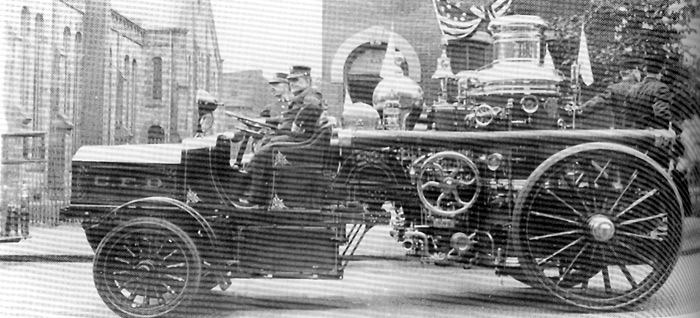
1896 — Clapp & Jones Second Class Steamer; Button Hose Carriage
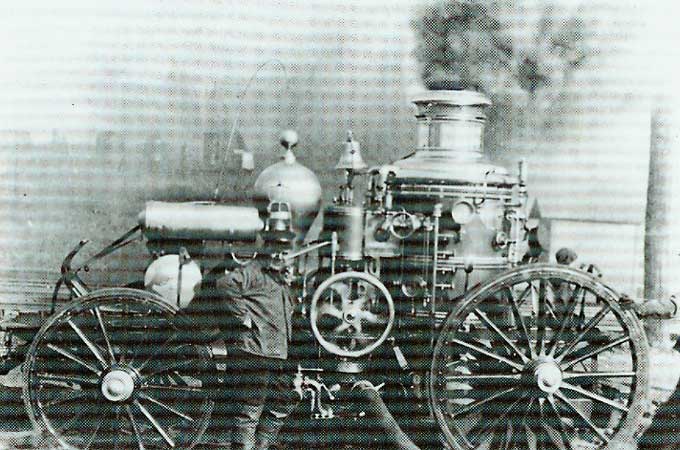
May 6, 1904 — Stoker Bob Steer tending the engine.
Camden News Budget.
Philadelphia Inquirer —
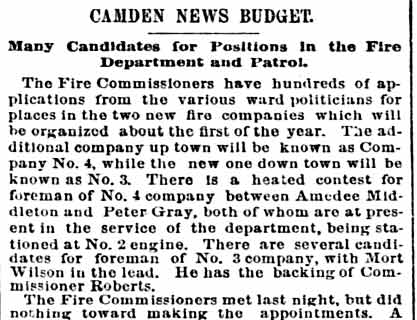
CAMDEN NEWS BUDGET.
Many Candidates for Positions in the Fire Department and Patrol.
The Fire Commissioners have hundreds of applications from the various ward politicians for places in the two new fire companies which will be organized about the first of the year. The additional company up town will be known as Company No. 4, while the new one down town will be known as No. 3. There is a heated contest for foreman of No. 4 company between Amedee Middleton and Peter Gray, both of whom are at present in the service of the department, being stationed at No. 2 engine. There are several candidates for foreman of No. 3 company, with Mort Wilson in the lead. He has the backing of Commissioner Roberts.
The Fire Commissioners met last night, but did nothing toward making the appointments. [continues]
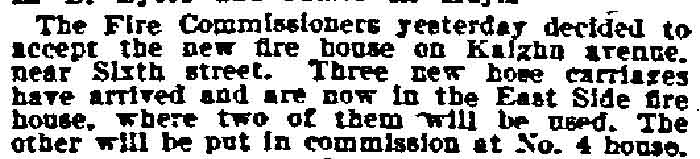
New Fire House Accepted
Philadelphia Inquirer —
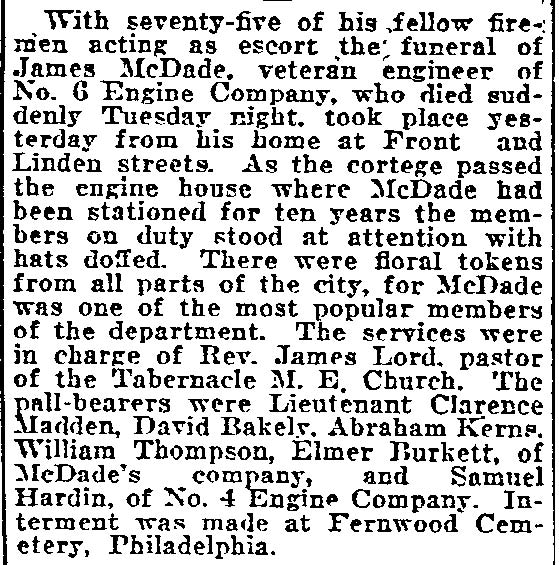
Funeral of James McDade
Philadelphia Inquirer —
Fireman Dies in Explosion of Chemicals
Camden Courier —
FIREMAN DIES IN EXPLOSION OF CHEMICALS
Companion Hurt As Extinguisher Explodes at Second Street Fire
CAUSE OF BLAST MYSTERY TO FIREMEN
Injured Fireman Finds Self Lying on Comrade’s Dead Body
WAS FIREMAN EIGHT MONTHS
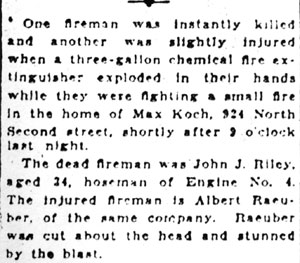
One fireman was instantly killed and another was slightly injured when a three-gallon chemical fire extinguisher exploded in their hands while they were fighting a small fire in the home of Max Koch, 924 North Second street, shortly after 9 o’clock last night.
The dead fireman was John J. Riley, aged 34, hoseman of Engine No. 4. The injured fireman is Albert Raeuber, of the same company. Raeuber was cut about the head and stunned by the blast.
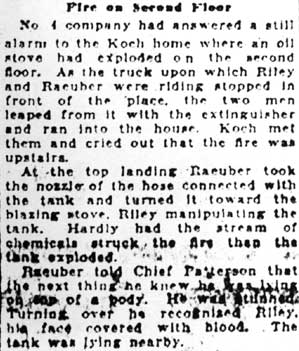
No. 4 company had answered a still alarm to the Koch home where an oil stove had exploded on the second floor. As the truck upon which Riley and Raeuber were riding stopped in front of the place, the two men leaped from it with the extinguisher and ran into the house. Koch met them and cried out that the fire was upstairs.
At the top landing Raeuber took the nozzle of the hose connected with the tank and turned it toward the blazing stove. Riley manipulating the tank. Hardly had the stream of chemicals struck the fire than the tank exploded.
Raeuber told Chief Patterson that the next thing he knew he was lying on top of a body. He was stunned. Turning over he recognized Riley, his face covered with blood. The tank was lying nearby.
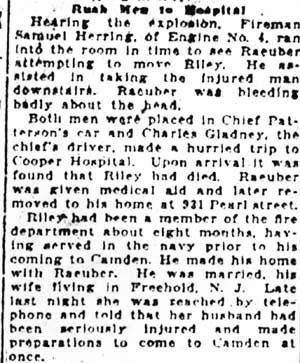
Hearing the explosion, Fireman Samuel Herring, of Engine No. 4, ran into the room in time to see Raeuber attempting to move Riley. He assisted in taking the injured man downstairs. Raeuber was bleeding badly about the head.
Both men were placed in Chief Patterson’s car and Charles Gladney, the chief’s driver, made a hurried trip to Cooper Hospital. Upon arrival it was found that Riley had died. Raeuber was given medical aid and later removed to his home at 931 Pearl street.
Riley had been a member of the fire department about eight months, having served in the navy prior to his coming to Camden. He made his home with Raeuber. He was married, his wife living in Freehold, N. J. Late last night she was reached by telephone and told that her husband had been seriously injured and made preparations to come to Camden at once.
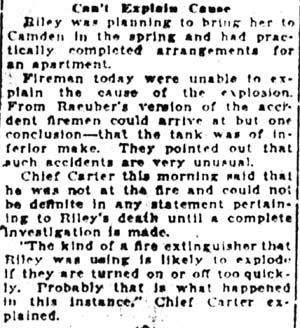
Riley was planning to bring her to Camden in the spring and had practically completed arrangements for an apartment.
Firemen today were unable to explain the cause of the explosion. From Raeuber’s version of the accident firemen could arrive at but one conclusion—that the tank was of inferior make. They pointed out that such accidents are very unusual.
Chief Carter this morning said that he was not at the fire and could not be definite in any statement pertaining to Riley’s death until a complete investigation is made.
“The kind of a fire extinguisher that Riley was using is likely to explode if they are turned on or off too quickly. Probably that is what happened in this instance,” Chief Carter explained.
Auto Burns
Camden Daily Courier —
$225,000 Fire Ruins 5 Uptown Plants
Camden Courier-Post —

$225,000 FIRE RUINS 5 UPTOWN PLANTS
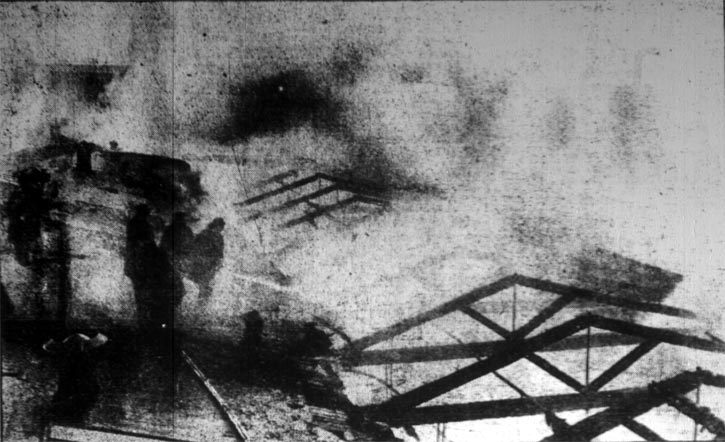
HOW FLAMES GUTTED BIG INDUSTRIAL BUILDING
RESIDENTS FLEE AS FLAMES RAGE IN BIG BUILDING
Factory of Evans Leather Co. Saved by Valiant Work of Firemen
APPARATUS IS DISABLED; DEBRIS BURIED FIRE PLUG
Metal Stamping Firm, Textile Concern Heavy Losers; Pattern Shop Saved
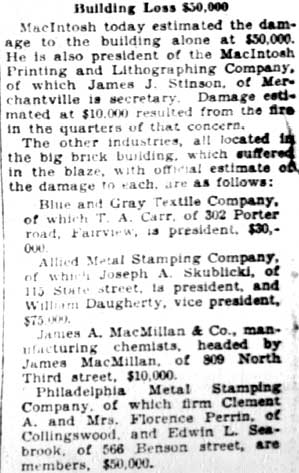
Sweeping through the Varoma Building on Erie street and driving 80 persons from their homes, a spectacular fire early today wrecked the quarters of five industrial concerns and caused damage estimated at $225,000.
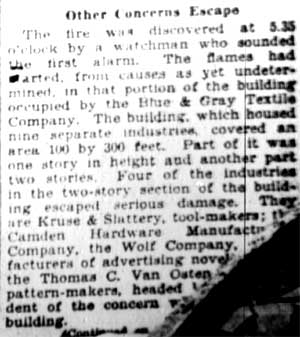
Responding to three alarms, every piece of fire apparatus in the city, with the exception of the “cover-up” companies, fought the blaze for hours.
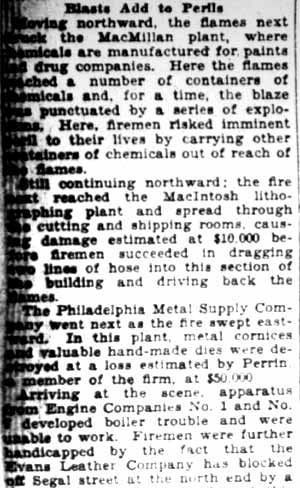
Handicapped by the location of fire-plugs and the breakdown of several pieces of apparatus, the firemen prevented the flames from spreading to the huge building of the Evans Leather Company, which forms an “L” on two sides of the burned structure.
Twenty dwellings on the east side of Segal street, separated from the Varoma building only by a narrow alley, were also saved after their occupants had fled to the street.
Fire Chief Thomas Nicholas announced later today, after the flames had been brought under control, that he would begin a rigid investigation into the blocking of Segal street by a high board fence and the piling of refuse around a fireplug at the head of the street.
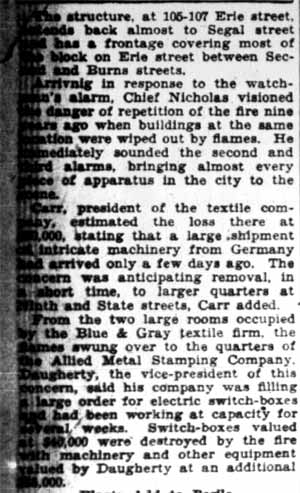
The structure, at 105–107 Erie street, extends back almost to Segal street and has a frontage covering most of the block on Erie street between Second and Burns streets.
Arriving in response to the watchman’s alarm, Chief Nicholas visioned the danger of repetition of the fire nine years ago when buildings at the same location were wiped out by flames. He immediately sounded the second and third alarms, bringing almost every piece of apparatus in the city to the scene.
The fire was discovered at 5.35 o’clock by a watchman who sounded the first alarm. The flames had started, from causes as yet undetermined, in that portion of the building occupied by the Blue & Gray Textile Company. The building, which housed nine separate industries, covered an area 100 by 300 feet.
Carr, president of the textile company, estimated the loss there at $30,000, stating that a large shipment of intricate machinery from Germany had arrived only a few days ago.
Moving northward, the flames next struck the MacMillan plant, where chemicals are manufactured for paints and drug companies. Here the flames reached a number of containers of chemicals and, for a time, the blaze was punctuated by a series of explosions. Here, firemen risked imminent peril to their lives by carrying other containers of chemicals out of reach of the flames.
Still continuing northward; the fire next reached the MacIntosh lithographing plant and spread through the cutting and shipping rooms, causing damage estimated at $10,000 before firemen succeeded in dragging two lines of hose into this section of the building and driving back the flames.
A fireplug at Segal street was blocked by a pile of chemical containers. Declaring that he could have attached at least four more hose lines had this plug not been blocked, Chief Nicholas announced that he would conduct an investigation.
Hose lines were taken to the flat roof of the Evans Company, high above the burning building, and water poured onto the flames from this altitude. Hundreds of persons were attracted to the scene by the spectacular nature of the fire, which was visible from the Camden bridge and for miles around. A police detail and Chief James E. Tatem and Inspector Lewis Etehr kept the crowd in check.
Eight firemen narrowly escaped serious injury when a section of the east wall fell. Three of these firemen were from Engine Company No. 1 at Fifth and Arch streets; three from No. 4, Fourth and Vine streets, and two from No. 2 Company, Front and Hadden streets.
Families whose homes were menaced and who were driven from the dwellings were those of Paul Warner, 1002 Segal street; Frank Bosco, 1004; Giles Beebe, 1006; Howard Pratt, 1008; Mrs. Mary Sweeten, 1010; Charles Randall, 1012; Harry Burr, 1014; John Sweeten, 1016; Leona Moore, 1018; Dora Annastasio, 1020; John Hamilton, 1024; Abe Granis, 1026; George Stewart, 1028; Arthur Wilkins, 1032; Charles Stutzenburg, 1034; George Wilson, 1036; George Bowers, 1040, and A. W. Dickinson, 1042 Segal street.
The fire today was the fourth big blaze that has occurred on the site. The first was in 1867, when a roller mill and nail factory were destroyed. In 1908, flames destroyed the morocco plant of R. H. Evans Company. In 1919, with the temperature at the zero point, firemen were again called out to fight another disastrous blaze in the Evans plant that had been rebuilt.
Thomas Nicholas — James Tatem — Manuel Kane — Harry M. Leigh — David Ellis
Fire Station Closes Soon; Mayor Denies Safety Menace
Camden Courier-Post —
Fire Station Closes Soon; Mayor Denies Safety Menace
Stewart Declares Underwriters Recommended Change
PROTEST IS MADE BY CIVIC HEAD
Closing of the fire station housing Engine Company No. 4 at Fourth and Vine streets is now under way and will be completed within a few days.
This was announced yesterday by Mayor Roy R. Stewart, who declared the decision to eliminate the station was reached upon recommendation of the National Board of Fire Underwriters. He also stated a thorough survey revealed closing of the station would not impair the efficiency of the fire department.
Frank J. Hartmann, Jr., secretary of the North Camden Civic Association, protested abandonment of the station as a dangerous move at a meeting of the association Monday night.
Hartmann asserted that, if a train was shifting on the north Main street tracks at the time of a fire, a section of North Camden would be without protection because apparatus would be unable to get through from any other part of the city.
Taking issue with Hartmann, the mayor declared that “it stands to reason” that if the tracks were blocked and No. 6 Engine Company at Front and Linden streets could not cross them to reach a fire, then the fire headquarters company at Fifth and Arch streets could battle the blaze.
Protection Provided
“Certainly the city would not abandon any fire station if any section would be endangered thereby,” the mayor said. “The Board of Fire Underwriters and the city went into a thorough survey of all factors connected with elimination of the station. It was found that No. 4 station could be closed and its personnel of about a dozen men redistributed among other stations without lowering the fire department’s efficiency.”
“It stands to reason the city would not let any part of the city be un protected. Engine Company No. 6 will answer all alarms and calls which formerly went to No. 4 company, and if No. 6 company cannot, then surely the company at fire headquarters, Fifth and Arch streets, could reach the fire in the event the tracks may be blocked at intersection.”
“I might add also that there is very little shifting of trains along north Main Street compared with a few years ago. However, should there be shifting and a fire on the other side of the tracks, where there may be a fire, what is to prevent the firemen of Engine Company No. 6 from using another intersection a block or so away to cross the railroad intersection? Seldom is a line of freight cars tied up for a long series of blocks in that neighborhood. And should there be and there is a fire on either side of the tracks, the freight cars could be moved from the intersection speedily. The railroad would not leave many cars tied up without having an engine available on the spot to move them in an emergency.”
Boxes Rearranged
The mayor said the closing of No. 6 station should be completed in a few days following the rearrangement of call boxes and other details. The mayor added that elimination of No. 6 was decided upon, instead of the closing of No. 6 house, because No. 6 is a more modern house and its equipment could not be placed in No. 4 house unless the latter’s doors were replaced with wider doors and there were other changes at a cost of several hundred dollars. The mayor added that consideration also was given to the fact that more industries are in the area served by No. 6 company and it would be advisable to retain that station, therefore, because of its proximity to them.
“We considered the change from all angles, with a view to economy without affecting efficiency and proficiency. We made careful survey of reports of fires in the respective districts and the proximity of the area which the two houses served to the headquarters at Fifth and Arch streets.”
Motors Speed Up Runs
“In the days of horse-drawn fire apparatus, there was the need for many fire stations, but in recent years, with motor equipment, a fire in any part of the city can be reached in comparatively short time, regardless of the location of the station. With all things considered, therefore, the city certainly has taken no step which would endanger any section of the community in the event of fire.”
The mayor said closing of the Fourth and Vine streets station is another step in the city’s program to consolidate fire department activities, without lowering efficiency and as a means of retaining low insurance rates despite lower manpower. The program also includes establishment of a firemen’s training school, with drill tower, at Tenth and Morgan streets; the abandonment of one or more other stations upon recommendation of the underwriters, and the removal of the electrical bureau from the old to the new city hall.
The mayor said the personnel of the fire department numbers 172, as against 211 in 1931, when he became director of public safety. He stated the changes being effected will offset the reduction in personnel and enable retention of the best fire-fighting efficiency.
Credits
Many of the above photographs are from the limited edition book “Fire Department Camden NJ 125 Anniversary 1869–1994.” Others are courtesy of Joel Bain of the Camden Fire Department.