John William Fletcher Bleakly
JOHN WILLIAM FLETCHER BLEAKLY—North Camden owes its development to John William Fletcher Bleakly, one time builder and real estate man in Camden and now an official of the Camden Board of Education. Mr. Bleakly is one of the most active citizens of the city and is a leading club member.
John William Fletcher Bleakly was born in Wellsville, Ohio, March 12, 1862, the son of William Bleakly, a native of Ireland, who came to this country and lived in Ohio, Philadelphia and later in Camden, and who on his return from California whither he had gone in the gold rush settled in Camden and went into the lime and building material business, remaining in it until he was killed in the Reading Railroad accident at Haddon Heights, and Elizabeth (Armstrong) Bleakly, also a native of Ireland. The boy was educated in the public schools of Philadelphia and in Pierce Business College, Philadelphia, wherein he remained six months.
In 1878, when the family moved to Camden, Mr. Bleakly joined his father in the lime and building material enterprise, which was known as the Cedar Valley Lime Company. When the elder Bleakly was killed, on September 7, 1898, his son took over the business, conducting it for several years, but eventually selling out in order to establish the firm of J. W. F. Bleakly Company, Incorporated, a building concern. As head of this company, Mr. Bleakly virtually developed all of North Camden beyond State Street. In 1902, he became secretary and business manager of the Board of Education, from which he resigned on February 1, 1924, at which time he returned to the real estate and insurance business with offices at 2600 Federal Street, Camden.
Mr. Bleakly is a Free and Accepted Mason, a Scottish Rite Mason and belongs to the Camden Chapter and the Crescent Temple of the Ancient Arabic Order Nobles of the Mystic Shrine; he is also a member of the Camden Lodge of the Benevolent and Protective Order of Elks, and the Ninth Ward Republican Club, of which he is the organizer. He at one time affiliated with the Junior Order United American Mechanics.
Mr. Bleakly married Fannie (Bartine) Smith, a native of Philadelphia and daughter of Mr. and Mrs. David Wesley Bartine, in Philadelphia, March 16, 1886. They have four children.
The children are William Bleakly, born April 7, 1887, Fletcher Stanley Bleakly, born February 16, 1890. Ruth Marie Bleakly, born September 27, 1898. and Edwin Gilbert Bleakly, born November 17, 1900.
Mr. Bleakly has one sister and two brothers, who are Helen Marie Bleakly; E. G. C. Bleakly, a lawyer; and Howard Graham Bleakly, also a lawyer. The Bleakly family is affiliated with the Centenary Methodist Church of Camden.
From South Jersey: A History 1624–1924
First Free School Opened to Public
Camden Post-Telegram —
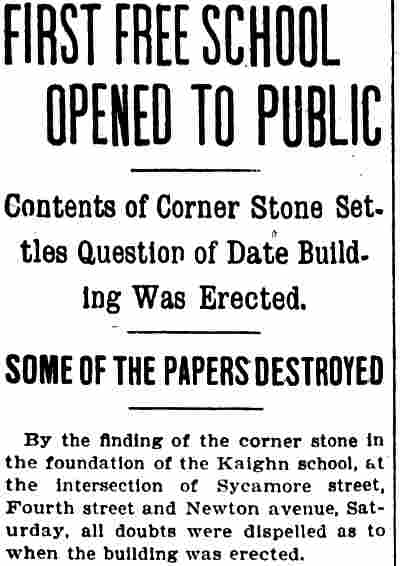
Contents of Corner Stone Settles Question of Date Building Was Erected.
SOME OF THE PAPERS DESTROYED
By the finding of the corner stone in the foundation of the Kaighn school, at the intersection of Sycamore street, Fourth street and Newton avenue, Saturday, all doubts were dispelled as to when the building was erected.
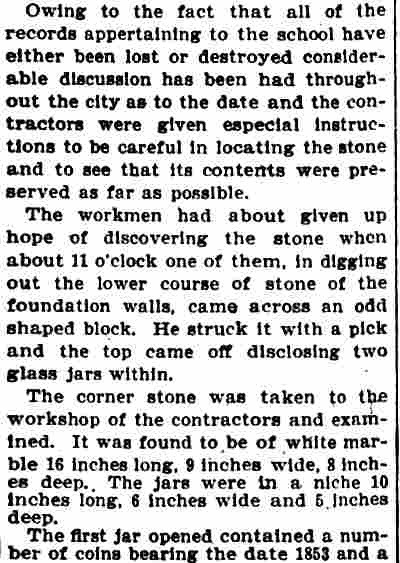
Owing to the fact that all of the records appertaining to the school have either been lost or destroyed considerable discussion has been had throughout the city as to the date and the contractors were given especial instructions to be careful in locating the stone and to see that its contents were preserved as far as possible.
The workmen had about given up hope of discovering the stone when about 11 o’clock one of them, in digging out the lower course of stone of the foundation walls, came across an odd shaped block. He struck it with a pick and the top came off disclosing two glass jars within.
The corner stone was taken to the workshop of the contractors and examined. It was found to be of white marble 16 inches long, 9 inches wide, 3 inches deep. The jars were in a niche 10 inches long, 6 inches wide and 5 inches deep.
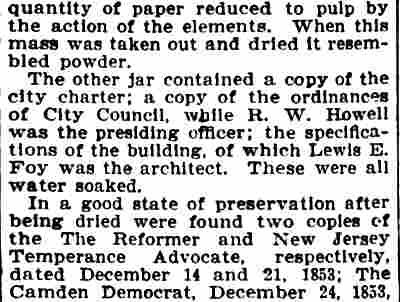
The first jar opened contained a number of coins bearing the date 1853 and a quantity of paper reduced to pulp by the action of the elements. When this mass was taken out and dried it resembled powder.
The other jar contained a copy of the city charter; a copy of the ordinances of City Council, while R. W. Howell was the presiding officer; the specifications of the building, of which Lewis E. Foy was the architect. These were all water soaked.
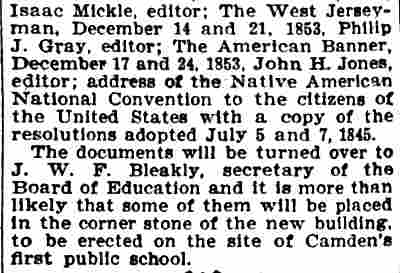
In a good state of preservation after being dried were found two copies of the The Reformer and New Jersey Temperance Advocate, respectively, dated December 14 and 21, 1853; The Camden Democrat, December 24, 1853, Isaac Mickle, editor; The West Jerseyman, December 14 and 21, 1853, Philip J. Gray, editor; The American Banner, December 17 and 24, 1853, John H. Jones, editor; address of the Native American National Convention to the citizens of the United States with a copy of the resolutions adopted July 5 and 7, 1845.
The documents will be turned over to J. W. F. Bleakly, secretary of the Board of Education and it is more than likely that some of them will be placed in the corner stone of the new building, to be erected on the site of Camden’s first public school.
Harleigh Cemetery
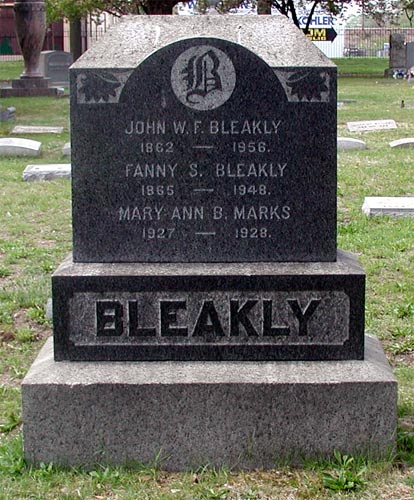
Harleigh Cemetery, Camden, NJ