Diamond the Horse
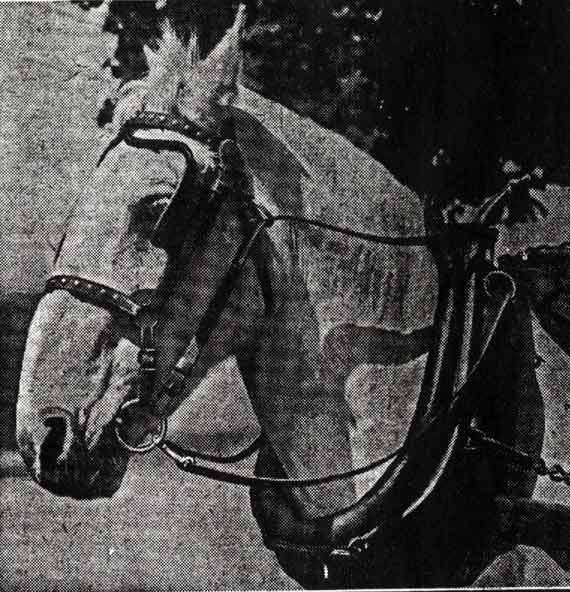
Diamond was a city employee, a white horse that was used by the public works department in its tasks relating to taking care of the grounds at Old Camden Cemetery and New Camden Cemetery.
Diamond made the papers in August of 1935 and again in the summer of 1936, when he needed to be treated by veterinarian Dr. David Helm, who also served as Camden’s Sanitary Inspector. When Dr. Helm billed for his veterinary services, S. Raymond Dobbs, assistant to Commissioner Frank J. Hartmann Jr., was not sure as to whether Dr. Helm could be paid for veterinary services rendered while on city time, and referred the question to City Solicitor E.G.C. Bleakly. Another horse story!
Diamond in Dutch — So Is City Over Bill for Treating Horse
Camden Courier-Post —
Diamond, Camden’s famous white cemetery horse, has eye trouble. And so has Camden, or so it seems.
Question — Can Municipal Employe Collect for Coming to Aid of Fellow Worker? Then, Too, Is Animal Worth Fee of $3?
By Charles L. Humes
Diamond, Camden’s famous white cemetery horse, has eye trouble.
And so has Camden, or so it seems.
Anyhow, Diamond has the city legal department in a quandary; Commissioner Hartmann’s office in a turmoil and Dr. David D. Helm in—or out—a $3 bill for services rendered.
It all started when the eyes of the big work horse started to water. Dr. Helm, who also is a sanitary inspector, was summoned and treated the animal, after which he turned in a bill for $3 to Commissioner Frank J. Hartmann Jr., in whose department “Diamond” now works.
There is where the city got its eye trouble. The commissioners thought they would put the bill on Dr. Helm’s “eye”—and for that matter they may still do so.
That Dr. Helm saved Diamond’s life is unquestioned. The veterinarian paid a visit to Diamond in his stall and gave him an eye wash to keep him from going blind, also is not contested.
Diamond a City Employe
But, and here Raymond Dobbs, assistant to Commissioner Hartmann, entered the picture. Is it right for a city employe, working on city time, to treat another city employe—to wit, Diamond—and to bill the city for services rendered?
Dobbs didn’t know. He didn’t want to do anything illegal, and neither did Dr. Helm, so a legal opinion was requested from City Solicitor E. G. C. Bleakly.
Then Bleakly began raising a few questions of his own.
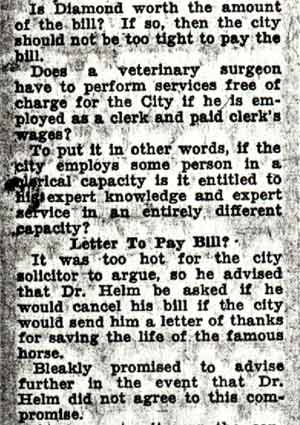
Is Diamond worth the amount of the bill? If so, then the city should not be too tight to pay the bill.
Does a veterinary surgeon have to perform services free of charge for the City if he is employed as a clerk and paid clerk’s wages?
To put it in other words, if the city employs some person in a clerical capacity is it entitled to his expert knowledge and expert service in an entirely different capacity?
Letter To Pay Bill?
It was too hot for the city solicitor to argue, so he advised that Dr. Helm be asked if he would cancel his bill if the city would send him a letter of thanks for saving the life of the famous horse.
Bleakly promised to advise further in the event that Dr. Helm did not agree to this compromise.
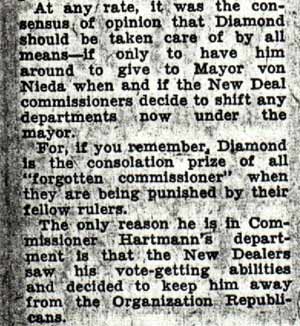
At any rate, it was the consensus of opinion that Diamond should be taken care of by all means—if only to have him around to give to Mayor von Nieda when and if the New Deal commissioners decide to shift any departments now under the mayor.
For, if you remember, Diamond is the consolation prize of all “forgotten commissioner” when they are being punished by their fellow rulers. The only reason he is in Commissioner Hartmann’s department is that the New Dealers saw his vote-getting abilities and decided to keep him away from the Organization Republicans.
City Votes $116,924 for 3 Departments
Camden Courier-Post —
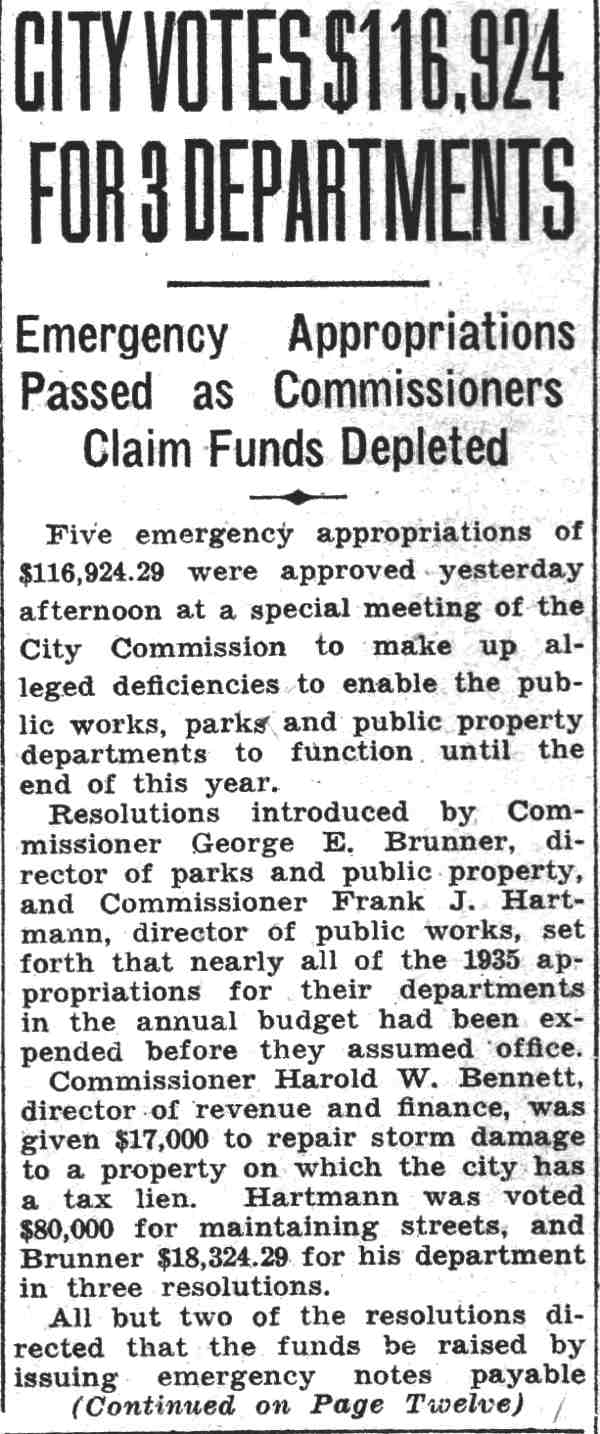

Emergency Appropriations Passed as Commissioners Claim Funds Depleted
Five emergency appropriations of $116,924.29 were approved yesterday afternoon at a special meeting of the City Commission to make up alleged deficiencies to enable the public works, parks and public property departments to function until the end of this year.
Resolutions introduced by Commissioner George E. Brunner, director of parks and public property, and Commissioner Frank J. Hartmann, director of public works, set forth that nearly all of the 1935 appropriations for their departments in the annual budget had been expended before they assumed office.
Commissioner Harold W. Bennett, director of revenue and finance, was given $17,000 to repair storm damage to a property on which the city has a tax lien. Hartmann was voted $80,000 for maintaining streets, and Brunner $18,324.29 for his department in three resolutions.
All but two of the resolutions directed that the funds be raised by issuing emergency notes payable within one year of the date of issue and bearing a rate of interest not exceeding 6 percent. They further directed Bennett to issue and sell the notes.
Spirited Debate Started
Reading of the Bennett resolution, which characterized damage done by a tornado to a property as an “act of God,” was the signal for spirited debate and was finally passed conditionally, with the understanding that City Solicitor E. G. C. Bleakly was to file a written legal opinion setting forth that the appropriation was necessary as an emergency.
Bennett was stricken by illness and left the meeting before any of the resolutions were introduced. All of the measures were passed unanimously by the three New Dealers and Mayor Frederick von Nieda.
Brunner next introduced a resolution citing the amount appropriated for the division of cemeteries at $6082.83, all of which was expended by July 31, he said, leaving the department without funds to carry on its functions for the balance of the year.
As a result, he said, unless the sum of $4936 were appropriated, the department would be “unable to light, heat, maintain and repair the public properties under its control and will be unable to feed a horse owned by the city of Camden and used by it in the performance of its services.”
Even “Diamond” Mentioned
Mention of the famed “Diamond,” now serving his third boss, caused Mrs. Kobus to laughingly interpose: “Was it necessary to mention the horse? What is this, a publicity stunt?”