Introduction
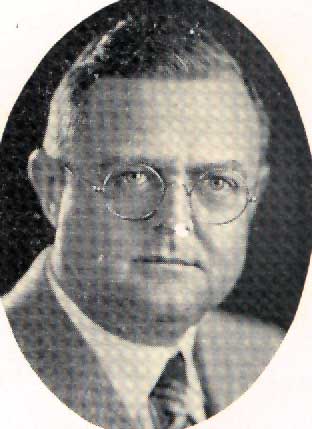
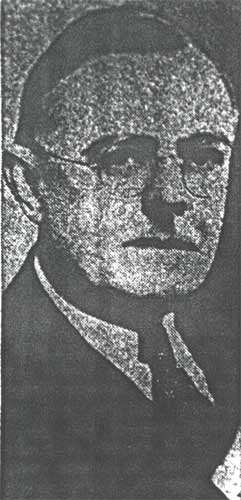
Wilbert V. Pike Sr. practiced law in Camden for many years. After passing the New Jersey bar, he entered the legal profession in the firm of brothers Raymond R. Donges and Ralph W.E. Donges, in 1908.
Wilbert Pike established his practice in Camden prior to World War I. In 1919 he moved with his wife and son to Haddonfield NJ, where he lived until 1941. The last years of his life were spent in Moorestown NJ, where he lived at 18 West Prospect Avenue.
Besides his law practice, Wilbert V. Pike Sr. also taught classes concerning wills at the South Jersey Law School in Camden. He was a member of the Haddonfield Lodge 130 F&AM, and the Camden Lodge 111, Loyal Order of Moose.
Wilbert V. Pike Sr. passed away at Cooper Hospital on July 12, 1950. He was buried at Colestown Cemetery.
War Work Director Named
Philadelphia Inquirer —
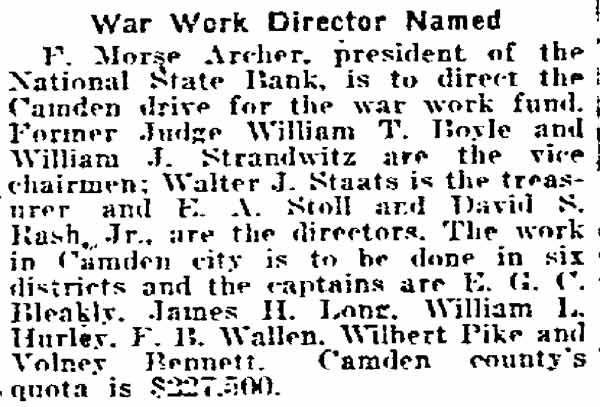
F. Morse Archer, president of the National State Bank, is to direct the Camden drive for the war work fund. Former Judge William T. Boyle and William J. Strandwitz are the vice chairmen; Walter J. Staats is the treasurer and E. A. Stoll and David S. Rush, Jr., are the directors. The work in Camden city is to be done in six districts and the captains are E. G. C. Bleakly, James H. Long, William L. Hurley, F. B. Wallen, Wilbert Pike and Volney Bennett. Camden county’s quota is $227,500.
Aged Man’s Sanity Debated as Nephew Contests His Will
Camden Courier-Post —
‘Kidnap’ Case Recalled as Islanders Declare E. Camden Cafe Owner Normal
LEFT $40,000 ESTATE
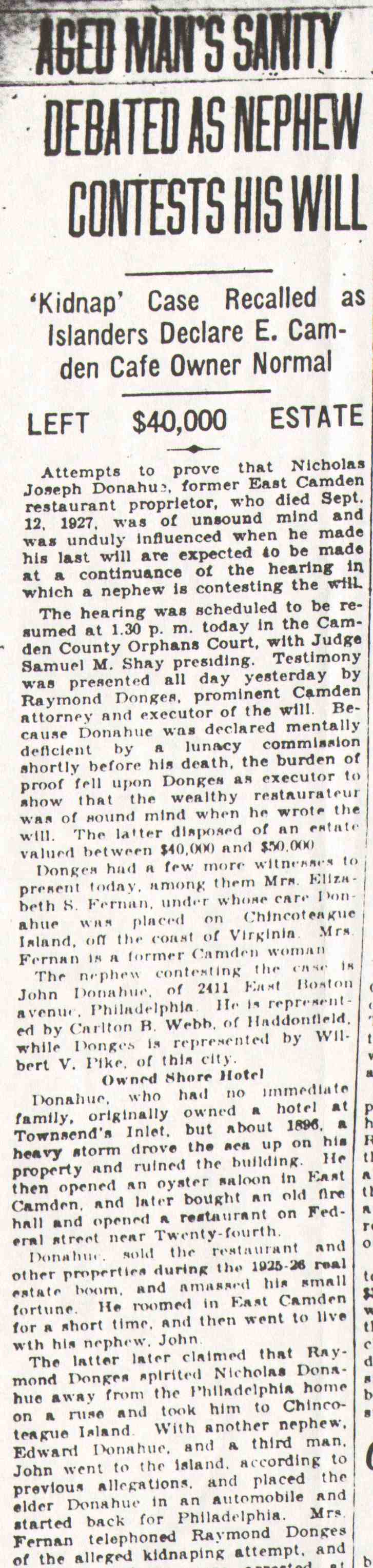
Attempts to prove that Nicholas Joseph Donahue, former East Camden restaurant proprietor, who died Sept. 12, 1927, was of unsound mind and was unduly influenced when he made his last will are expected to be made at a continuance of the hearing in which a nephew is contesting the will.
The hearing was scheduled to be resumed at 1:30 p. m. today in Camden County Orphans Court, with Judge Samuel M. Shay presiding. Testimony presented all day yesterday by Raymond Donges, prominent Camden attorney, also was to be continued. Because Donahue was declared mentally deficient in a lunacy commission hearing before his death, the burden of proof fell upon Donges as administrator to show that the former restaurateur was of sound mind when he wrote the will. The later disposed of an estate valued between $40,000 and $50,000.
Donges had a few more witnesses to present today. Among them: Mrs. Elizabeth S. Fernan, under whose care Donahue lived on Chincoteague Island, off the coast of Virginia. Mrs. Fernan is a former Camden woman. The nephew, John Donahue, of 201 East Boston avenue, Philadelphia, is represented by Carlton H. Webb, of Haddonfield, while Donges is represented by Wilbert V. Pike, Jr.
Owned Shore Hotel
Donahue, who had no immediate family, originally owned a hotel at Townsend’s Inlet, but about 1896 or early 1900s sold his hotel and other property and ruined the building. He then opened an oyster house on Federal street and later bought an old fire hall and opened a restaurant on Federal street about 1904 or 1905.
Donges sold the restaurant and other properties during the World War for a good sum and amassed his small fortune. He roamed in East Camden for a short time and then went to live with his nephew, John.
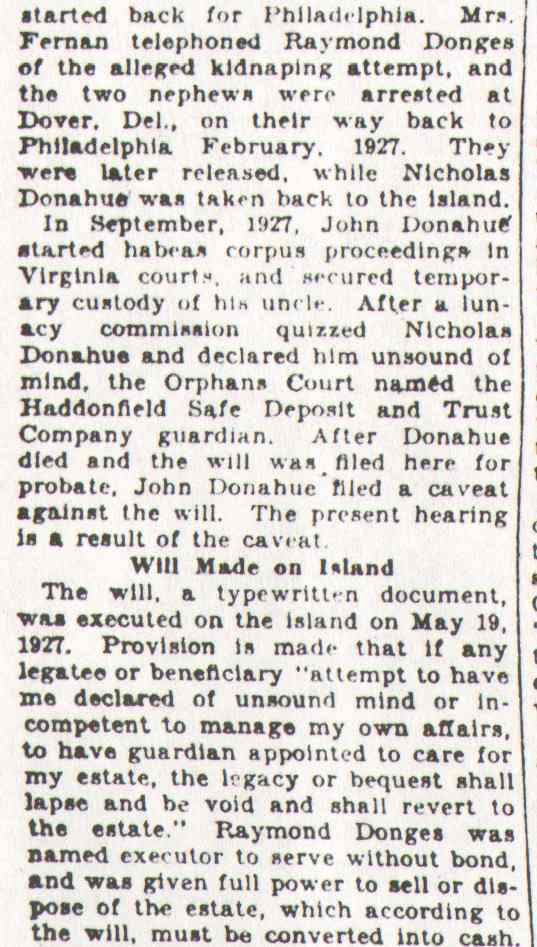
The latter told Nicholas that Raymond Fernan telephoned Raymond Donges of the alleged kidnaping attempt, and the two nephews were arrested at Dover, Del., on their way back to Philadelphia February, 1927. They were later released, while Nicholas Donahue was taken back to the island.
In September, 1927, John Donahue started habeas corpus proceedings in Virginia courts, and secured temporary custody of his uncle. After a lunacy commission quizzed Nicholas Donahue and declared him unsound of mind, the Orphans Court named the Haddonfield Safe Deposit and Trust Company guardian. After Donahue died and the will was filed here for probate, John Donahue filed a caveat against the will. The present hearing is a result of the caveat.
Will Made on Island
The will, a typewritten document, was executed on the island on May 19, 1927. Provision is made that if any legatee or beneficiary “attempt to have me declared of unsound mind or incompetent to manage my own affairs, to have guardian appointed to care for my estate, the legacy or bequest shall lapse and be void and shall revert to the estate.” Raymond Donges was named executor to serve without bond, and was given full power to sell or dispose of the estate, which according to the will, must be converted into cash.
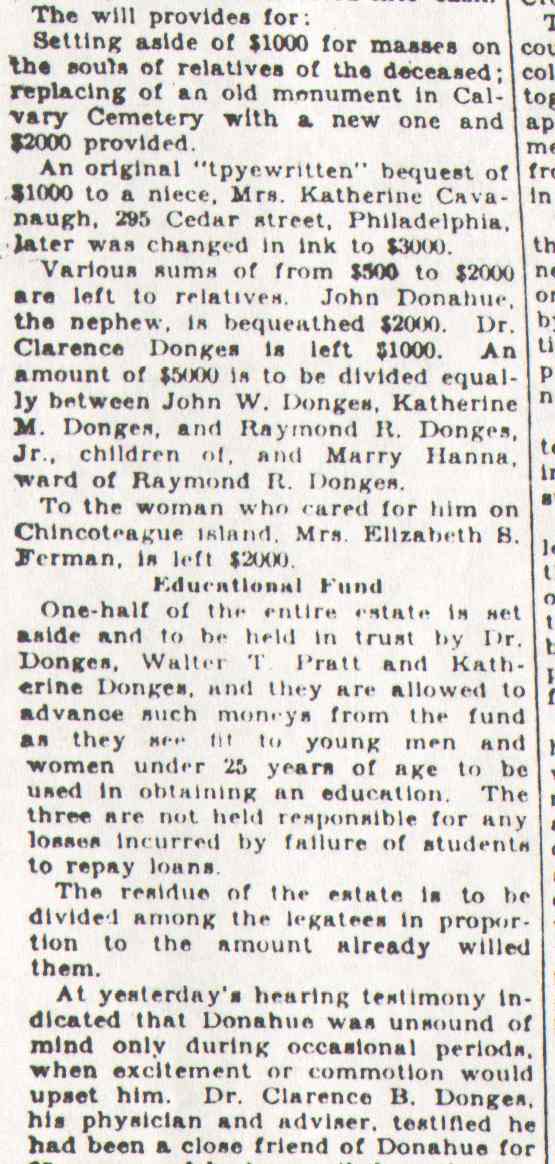
The will provides for:
Setting aside of $1000 for masses on the souls of relatives of the deceased; replacing of an old monument in Calvary Cemetery with a new one and $2000 provided.
An original “typewritten” bequest of $1000 to a niece, Mrs. Katherine Cavanaugh, 295 Cedar street, Philadelphia, later was changed in ink to $3000.
Various sums of from $500 to $2000 are left to relatives. John Donahue, the nephew, is bequeathed $2000. Dr. Clarence Donges is left $1000. An amount of $5000 is to be divided equally between John W. Donges, Katherine M. Donges, and Raymond R. Donges, Jr., children of, and Marry Hanna, ward of Raymond R. Donges.
To the woman who cared for him on Chincoteague Island, Mrs. Elizabeth S. Ferman, is left $2000.
Educational Fund
One-half of the entire estate is set aside and to be held in trust by Dr. Donges, Walter T. Pratt and Katherine Donges, and they are allowed to advance such moneys from the fund as they see fit to young men and women under 25 years of age to be used in obtaining an education. The three are not held responsible for any losses incurred by failure of students to repay loans.
The residue of the estate is to be divided among the legatees in proportion to the amount already willed them.
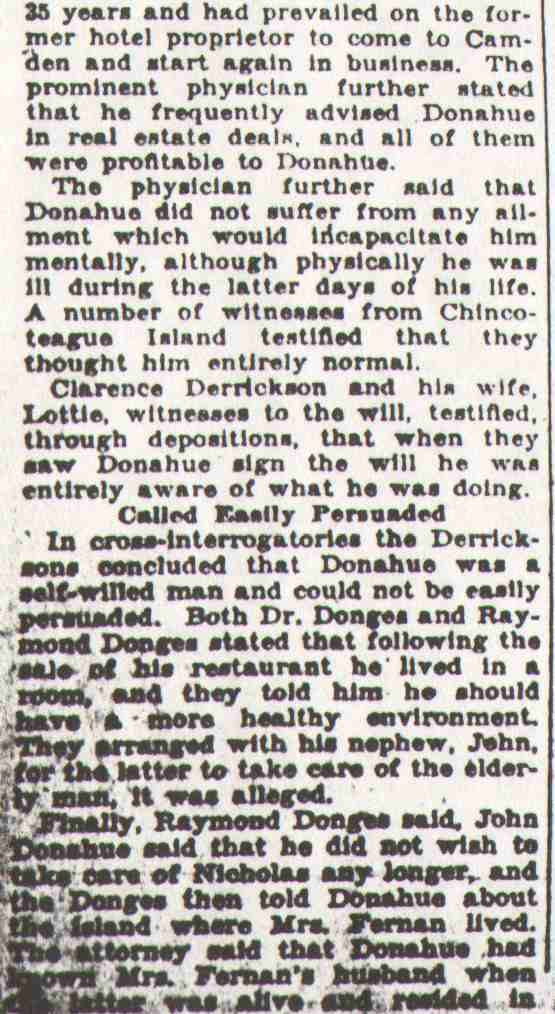
At yesterday’s hearing testimony indicated that Donahue was unsound of mind only during occasional periods, when excitement or commotion would upset him. Dr. Clarence B. Donges, his physician and adviser, testified he had been a close friend of Donahue for 35 years and had prevailed on the former hotel proprietor to come to Camden and start again in business. The prominent physician further stated that he frequently advised Donahue in real estate deals, and all of them were profitable to Donahue.
The physician further said that Donahue did not suffer from any ailment which would incapacitate him mentally, although physically he was ill during the latter days of his life. A number of witnesses from Chincoteague Island testified that they thought him entirely normal.
Clarence Derrickson and his wife, Lottie, witnesses to the will, testified, through depositions, that when they saw Donahue sign the will he was entirely aware of what he was doing.
Called Easily Persuaded
In cross-interrogatories the Derricksons concluded that Donahue was a self-willed man and could not be easily persuaded. Both Dr. Donges and Raymond Donges stated that following the sale of his restaurant he lived in a room, and they told him he should have a more healthy environment. They arranged with his nephew, John, for the latter to take care of the elderly man, it was alleged.
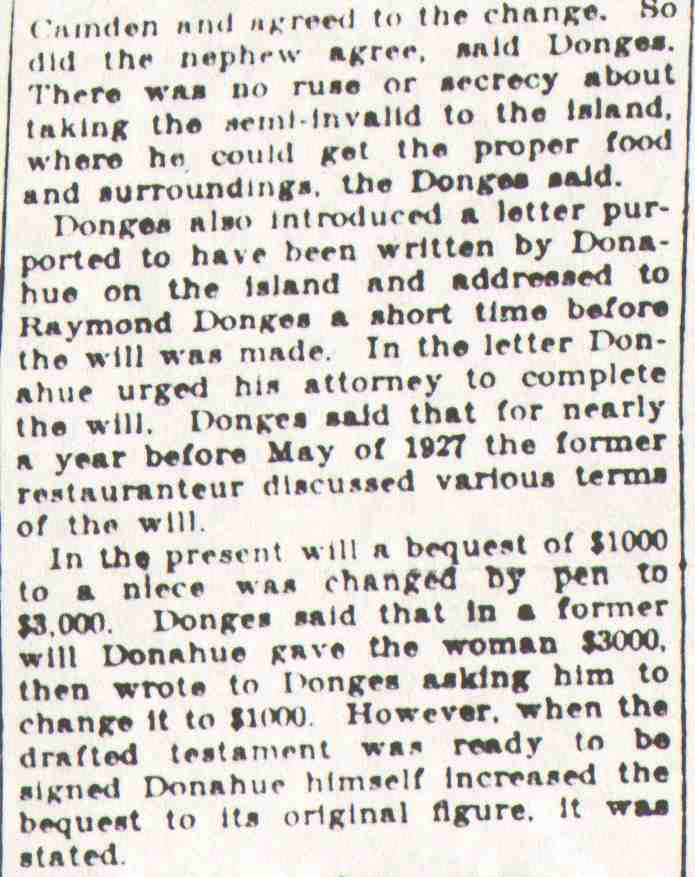
Finally, Raymond Donges said, John Donahue said that he did not wish to take care of Nicholas any longer, and the Donges then told Donahue about the island where Mrs. Fernan lived. The attorney said that Donahue had known Mrs. Fernan’s husband when the latter was alive and resided in Camden and agreed to the change. So did the nephew agree, said Donges. There was no ruse or secrecy about taking the semi-invalid to the island, where he could get the proper food and surroundings, the Donges said.
Donges also introduced a letter purported to have been written by Donahue on the island and addressed to Raymond Donges a short time before the will was made. In the letter Donahue urged his attorney to complete the will. Donges said that for nearly a year before May of 1927 the former restauranteur discussed various terms of the will.
In the present will a bequest of $1000 to a niece was changed by pen to $3,000. Donges said that in a former will Donahue gave the woman $3000, then wrote to Donges asking him to change it to $1000. However, when the drafted testament was ready to be signed Donahue himself increased the bequest to its original figure, it was stated.
Woman Gains Annulment
Gettysburg Times —
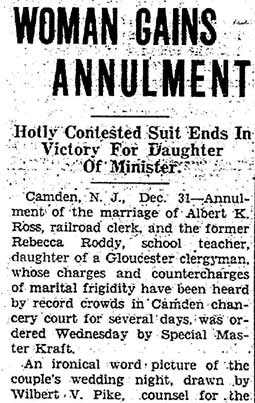
Hotly Contested Suit Ends In Victory For Daughter Of Minister.
Camden, N. J., Dec. 31—Annulment of the marriage of Albert K. Ross, railroad clerk, and the former Rebecca Roddy, school teacher, daughter of a Gloucester clergyman, whose charges and countercharges of marital frigidity have been heard by record crowds in Camden chancery court for several days, was ordered Wednesday by Special Master Kraft.
An ironical word picture of the couple’s wedding night, drawn by Wilbert V. Pike, counsel for the husband, who opposed the wife’s appeal for annulment of the marriage, featured the final proceedings in the trial, but apparently failed to influence the court against the appellant.
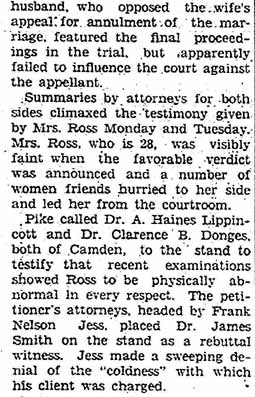
Summaries by attorneys for both sides climaxed the testimony given by Mrs. Ross Monday and Tuesday. Mrs. Ross, who is 28, was visibly faint when the favorable verdict was announced and a number of women friends hurried to her side and led her from the courtroom.
Pike called Dr. A. Haines Lippincott and Dr. Clarence B. Donges, both of Camden, to the stand to testify that recent examinations showed Ross to be physically abnormal in every respect. The petitioner’s attorneys, headed by Frank Nelson Jess, placed Dr. James Smith on the stand as a rebuttal witness. Jess made a sweeping denial of the “coldness” with which his client was charged.
B. & L Opens 26th Series of Stock
Camden Courier-Post —
Officers have been elected by the Moose Building and Loan Association of Camden. These are as follows:
President, Charles H. Elfreth; vice president, Ralph N. Bissell; secretary, Walter Charriere; treasurer, Walter T. Pratt; solicitor, Wilbert V. Pike. Directors elected at the same time were Elfreth, Pratt, Joseph P. Jones and Paul G. Wilson.
The association is starting its twenty-sixth season and launching its twenty-sixth series of stock, open to the public as well as members.
Charriere is receiving applications which will also be acceptable at the next meeting, the second Monday in March.
Wilbert V. Pike Sr. Services Held Today
Camden Courier-Post —
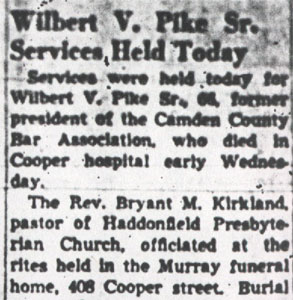
Services were held today for Wilbert V. Pike Sr., 68, former president of the Camden County Bar Association, who died in Cooper hospital early Wednesday.
The Rev. Bryant M. Kirkland, pastor of Haddonfield Presbyterian Church, officiated at the rites held in the Murray funeral home, 408 Cooper street. Burial was in Colestown cemetery.
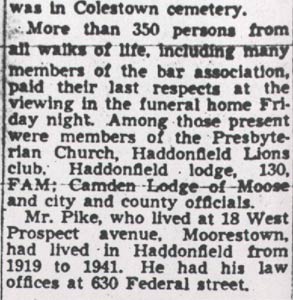
More than 350 persons from all walks of life, including many members of the bar association, paid their last respects at the viewing in the funeral home Friday night. Among those present were members of the Presbyterian Church, Haddonfield Lions club, Haddonfield lodge, 130, FAM; Camden Lodge of Moose and city and county officials.
Mr. Pike, who lived at 18 West Prospect avenue, Moorestown, had lived in Haddonfield from 1919 to 1941. He had his law offices at 630 Federal street.