Introduction
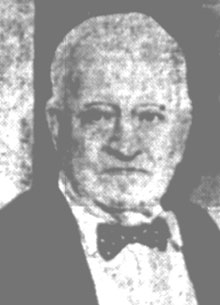
James H. Carey — USS Monitor veteran
JAMES H. CAREY was born in Pennsylvania in October of 1838 to James and Catherine Carey. The Carey family was living in Lower Dublin Township, in the county of Philadelphia, Pennsylvania when the 1850 Census was enumerated. By 1860 the Carey family had moved to Camden. Father James Carey was then the pilot of a steamboat on the Delaware, and both James H. Carey and his older brother Edward were then working as deck hands. When the Civil War began in 1861, James H. Carey joined the United States Navy, and was a member of the crew of the U.S.S. Monitor when the historic battle between that ship and the C.S.S. Merrimac occurred in 1862.
James Carey settled in Camden after the war, he was a member of Camden’s volunteer fire department in the years before the organization of the professional force in 1869. On October 9, 1872 he was appointed to the Camden Fire Department as an extra man with the Hook & Ladder Company, known in more recent times as Ladder Company 1. He served with the Hook & Ladder Company until May 7, 1874, and lived at 445 Morris Street during his time with the Fire Department. Morris Street was renamed Washington Street in 1882. James H. Carey was re-appointed to the Camden Fire Department on April 8, 1876, replacing Charles Elfreth. James H. Carey served as an extra man with Engine Company 2 for one year, until Charles Elfreth was reinstated on April 8, 1877. James H. Carey was living on Henry Street, south of Benson Street, when he received his appointment in 1876.
James H. Carey had moved to 1232 South 3rd Street when the 1878–1879 Camden City Directory was compiled. By 1880 James H. Carey was living at 215 Royden Street, where he lived into the 1890s. During these years he followed various pursuits, both nautical and otherwise. He captained a ferry boat on the Delaware, worked as a clerk for the Pennsylvania Railroad, and as a laborer.
At the time of the 1900 Census James H. Carey lived at 642 South 2nd Street with his daughter Lizzie. By 1910 she had wed George Thomas. James Carey moved to 820 State Street in North Camden with his daughter and son-in-law. James Carey spent the rest of his years at that address. He was still alive as late as April 1930.
Battery B Officers Commissioned
Philadelphia Inquirer —
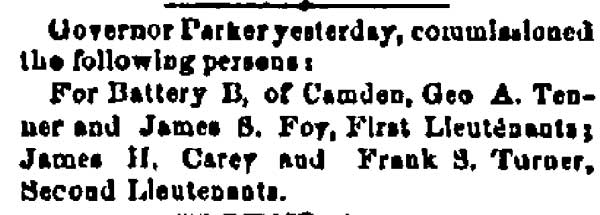
Governor Parker yesterday, commissioned the following persons:
For Battery B, of Camden, Geo A. Tenner and James B. Foy, First Lieutenants; James H. Carey and Frank S. Turner, Second Lieutenants.
William B. Hatch Post No. 37
The following is derived from George Reeser Prowell’s History of Camden County, N.J. published in 1886.
WILLIAM B. HATCH POST No. 37, of Camden, was instituted and chartered November 25, 1879, with eighty-one members and the following named Post officers:
Post Commander, John E. Grubb; Senior Vice-Commander, Richard J. Robinson; Junior Vice-Commander, Daniel J. Fullen; Surgeon, Thomas G. Rowand, M.D.; Chaplain, John Quick; Officer of the Day, John A. Dall; Officer of the Guard, Edmund G. Jackson, Jr.; Quartermaster, Christopher J. Mines, Jr.; Adjutant, Benjamin J. Pierce; Sergeant-Major, William A. Tattern; Quartermaster-Sergeant, William B. E. Miller.
At the first meeting of the Post it was decided by a unanimous vote to name it in honor of the late Colonel William B. Hatch, of the Fourth Regiment. When Mrs. C. Hatch, the mother of the colonel was informed that the post had honored the memory of her son by naming it after him, she sent to the Post the following response:
Camden N. J., November 26th, 1879
John E. Grubb, Post Commander
Dear Sir, It will afford me much pleasure to be identified with Post 37, G. A. E., named in honor of my son, William B. Hatch, by allowing me to present to the same its colors. The memory of my son is ever dear to me, and, while at the same moment I may have thought the sacrifice too great an affliction, yet I was consoled by the fact that I gave him up that this Union might be preserved. It was duty and patriotism that called him, and while I mourn him as a mother for a well-beloved son, yet I would not have stayed him, for the love of country and the upholding of this glorious Republic is what every mother should instill into her sons, as the purest and holiest spirit.
C. Hatch
The following is a complete roster of this post for 1886:
Post Commander, Benjamin H. Connelly; Senior Vice-Commander, Adam C. Smith; Junior Vice-Commander, William Haegele; Surgeon, George Pfau; Chaplain, Samuel Gaul; Officer of the Day, Robert Crawford; Officer of the Guard, John D. Cooper; Quartermaster, Samuel J. Fenner; Adjutant, William B. Summers; Sergeant-Major, Stacy H. Bassett; Quartermaster-Sergeant, Otto K. Lockhart.
Comrades: Philip Achenbach, George L. Allchin, Isaac Albertson, Joseph Applegate, John W. Barclay, Martin M. Barney, Joseph Baxter, William W. Bennett, Charles L. Bennett, Henry Bickering, Abel Biddle, George K. Biddle, John Bieri, Robert M. Bingham, Socrates T. Bittle, George W. Bittle, Benjamin F. Blizzard, Joseph Borton, Frederick Bowers, Benjamin M. Braker, John Breyer, William H. Brians, Wm. J. Broadwater, William Broadwater, John Brown, Harris Brooks, William H. Brooks, Joseph F. Bryan, Joseph Buddew, J. Q. Burniston, George Burton, Frederick Buser, Thomas L. Bush, William Butcher, Isaac B. Buzby, Edward C. Cattell, Joseph Cameron, James H. Carey, William Carey, James Chadwick, James Chafey, George M. Chester, James D. Chester, Lewis L. Chew, Henry S. Chew, John W. Churn, Andrew B. Cline, Charles Clarke, Samuel J. Cook, Levi E. Cole, John J. Collins, John C. Cooper, John W. Cotner, Thomas L. Conly, Harvey M. Cox, Jason S. Cox, Harris Crane, Charles Cress, Joel G. Cross, O. C. Cunningham, John A. Dall, John Dalby, John H. Damon, Westley Dare, John E. Dawson, Adam T. Dawson, James L. Davis, William Davis, Amos R. Dease, Henry Deford, Lewis F. Derousse, Michael Devinney, Glendora Devo, John Digney, Joseph Dilks, William A. Dobbins, George W. Dunlap, Aaron B. Eacritt, John J. Early, Christopher Ebele, Godfrey Eisenhart, John Elberson, Charles Elwell, Charles Eminecker, John Esler, John H. Evans, Charles S. Fackler, James Fanington, James A. Farraday, John H. Farry, John Faughey, Wm. H. Fenlin, George G. Felton, George W. Ferguson, Charles W. Fish, Israel L. Fish, James Finnan, Samuel B. Fisher, Edward L. Fisher, Ephraim B. Fithian, Jacob T. Fisher, Edward Fitzer, Samuel Flock, Leonard Flor, John Fox, John S. Fox, H. H. Franks, Chas. B. Frazer, Thomas J. Francis, Samuel W. Gahan, Chas. H. Gale, James Galbraith, Thomas Garman, Harry Garren, John W. Garwood, Josiah Garrison, John B. Gaskill, Richard Gaunt, Wm. German, Christopher Getsinger, Christopher Gifney, Jacob Giffens, Albert Gilbert, James Gillen, Wm. Giffins, C. C. Greany, Charles Green, W. H. Griffin, Louis Grosskops, William Grindrod, John B. Grubb, Mark H. Guest, John Guice, Alfred Haines, Charles G. Haines, Japhet Haines, George F. Hammond, Charles Hall, Solon B. Hankinson, Samuel P. Hankinson, James Hanson, Charles Hannans, H. A. Hartranft, Mahlon E. Harden, William F. Harper, George W. Hayter, Samuel B. Harbeson, J. T. Hazleton, H. Heinman, James Henderson, William H. Heward, Franklin Hewitt, James T. Hemmingway, Charles Hewitt, Edward K. Hess, Samuel B. Hickman, George Higgens, Ephraim Hillman, C. M. Hoagland, Guadaloupe Holl, William A. Holland, Isaac K. Horner, Count D. G. Hogan, William H. Howard, Baxter Howe, Alien Hubbs, Charles G. Hunsinger, Presmel D. Hughes, I. N. Hugg, Sebastian Hummell, Edward Hutchinson, C. Innes, Alfred Ivins, Benjamin Ivins, E. G. Jackson Sr., E. G. Jackson Jr., Thomas Jameson, George Jauss, William P. Jenkins, James L. Johnson, Alfred Jones, B. F. Jones, William Joline, Charles Joseph, Charles Justice, C. H. Kain, E. E. Kates, Benjamin Kebler, Frank Kebler, Peter Keen, Henry N. Killian, J. W. Kinsey, C. H. Knowlton, Thomas W. Krips, Joseph H. Large, John E. Leake, John Lecroy, Charles Leonhart, George W. Locke, E. J. Long, Charles L. Lukens, J. H. Lupton, Valentine Machemer, Edward Macloskey, Edward A. Martin, William P. Marsh, John Mapes, William Mead, William Metcalf, E. A. Meyer, C. Meyers, George Meilor, C. A. Michener, William B. E. Miller, Jacob Miller, W. D. Miller, Samuel Mills, William W. Mines, Christopher J. Mines, George Molesbury, William Moran, Edward More, Richard Morgan, John F. Moore, S. H. Moyer, Jacob L. Morton, John Muir, John J. Murphy, Isaac Murray, Charles Myers, W. H. McAllister, James McCracken, Edward C. McDowell, Hugh McGrogan, H. M. Mcllvaine, W. F. McKillip, W. J. McNeir, Lewis McPherson, E. McPherson, Jacob Naglee, William Naphas, Antonio Nosardi, Robert O’Keefe, John S. Owens, Robert Owens, Edward H. Pancoast, James Pancoast, Robert B. Patterson, William Patterson, E. W. Pease, John B. Pepper, Joel Perrine, John Peterson, D. E. Peugh, Frederick Phile, Samuel B. Pine, William M. Pine, Adon Powell, John Powell, John Portz, J. B. Prucelle, John Quick, S. E. Radcliffe, Isaac C. Randolph, James A. Regens, Philip Reilly, Charles P. Reynolds, Alexander Rhodes, Benjamin F. Richard, Andrew Ridgway, Benjamin Robbins, Edward C. Roberts, James Roberts, Richard J. Robinson, William B. Robertson, Isaac Rogers, John Rogers, William H. Rogers, Thomas G. Rowand, Sebastian Schaub, Maurice Schmidt, Christian K. Schallers, James Schofield, George W. Scott, John E. Scott, John M. Shemelia, Edward M. Siemers, John Simmons, Benjamin F. Shinn, Thomas Sheeran, James Shield, Charles Smith, George H. Smith, William W. Smith, Charles S. Small, Adolph Snow, W. Souder, Francis Senders, Robert Sparks, David C. Sprowl, Alfred L. Sparks, Abraham Springer, George W. Stewart, William L. Stevenson, Thomas G. Stephenson, Samuel R. Stockton, Thomas Stockton, Thomas H. Stone, Henry Strick, E. J. Strickland, Charles String, George F. Stull, George W. Swaney, Crosby Sweeten, William F. Tarr, William A. Tatem, Thomas S. Tanier, George Rudolph Tenner, Charles L. Test, Leonard Thomas, Benjamin Thomas, Henry C. Thomas, George F. Thorne, Wesley Thorn, Thomas W. Thornley, Alexander W. Titus, Joseph Tompkins, J. E. Troth, Isaac C. Toone, Samuel Tyier, Jacob M. Van Nest, Albert Vansciver, Joseph Wakeman, Theodore F. Walker, Charles Walton, George Walton, Joseph Welsh, David Watson, George W. Wentling, Edward West, Elmer M. West, George Weyman, Wilmer Whillden, James Whittaker, Samuel Wickward, Calvin T. Williams, George W. Williams, William H. Williams, John Williams, Samuel Winner, Amos P. Wilson, D. H. Wilson, G. A. Wilson, Richard Wilson, George Wispert, John W. Wood, Joseph Woodfield, Walter Wolfkill, E. W. Wolverton, Elijah Worthington, C. M. Wright, George B. Wright, Henry S. Wright, Wesley T. Wright, William Zane.
As of 1886, the Hatch Post met every Thursday evening in their own G. A. R. Hall, on Stevens Street, below Fifth Street. This same building had been used in the late 1870s as the original home of the congregation that formed the Tabernacle Baptist Church. The Hatch Post was affiliated with Hatch League No. 2, of the Loyal Ladies League, their auxiliary, which met at the Post Hall.
Camden’s Tragedy Still a Mystery
Philadelphia Inquirer —
Camden's Tragedy Still a Mystery
Two Men Arrested In Stockton, But They Easily Prove an Alibi.
POLICE ARE PUZZLED
Officials Believe the House Was Entered By a Burglar.
MRS. ZANE’S WILL FOUND
Her Son Questioned and the Police Start On a New Clue—Eli Shaw Reticent.
Camden's double murder mystery remains unsolved. The assassin who shot down Mrs. Emma Zane and her daughter, Mrs. Sarah M. Shaw, at their home, No. 242 Line street, just before dawn Tuesday morning, is still at large. There is apparently no clue to his identity. Two arrests were made by the Stockton police yesterday, but the suspects can account for their whereabouts on the morning of the murder, and they will probably be released to-day. The rewards for the apprehension of the murderer now amount to $1000.
Public interest in the terrible crime grew keener yesterday. All day long the street in front of the house on Line street from which two black streamers fluttered was blocked by curious throng. People gathered in groups on the streets throughout Camden and discussed the details of the mysterious murders. The air was filled with rumors of arrests and with theories of the wildest sort, but at nightfall when the police and the county officials compared notes they were forced to admit that no ray of light had penetrated the mystery.
Prosecutor Wilson H. Jenkins and the Camden police officials got together yesterday and practically agreed to push their investigation along the lines of a theory that the murder was committed by some one who entered the house for the purpose of robbery.
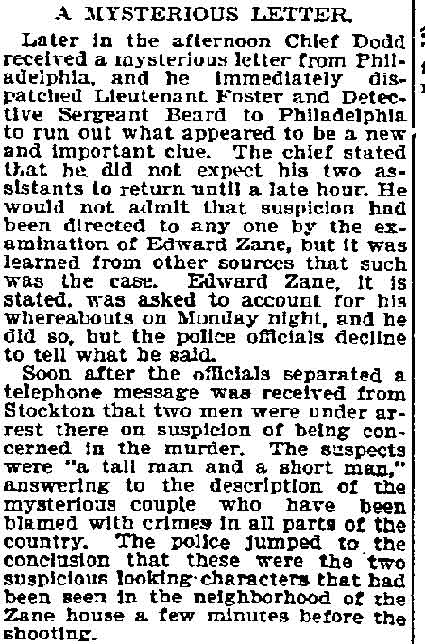
A MYSTERIOUS LETTER.
Later in the afternoon Chief Dodd received a mysterious letter from Philadelphia, and he immediately dispatched Lieutenant Foster and Detective Sergeant Sergeant Beard to Philadelphia to run out what appeared to be a new and important clue. The chief stated that he did not expect his two assistants to return until a late hour. He would not admit that suspicion had been directed to any one by the examination of Edward Zane, but it was learned from other sources that such was the case. Edward Zane, it is stated, was asked to account for his whereabouts on Monday night, and he did so, but the police officials decline to tell what he said.
Soon after the officials separated a telephone message was received from Stockton that two men were under arrest there on suspicion of being concerned in the murder. The suspects were “a tall man and a short man,” answering to the description of the mysterious couple who have been blamed with crimes in all parts of the country. The police jumped to the conclusion that these were the two suspicious looking characters that had been seen in the neighborhood of the Zane house a few minutes before the shooting.
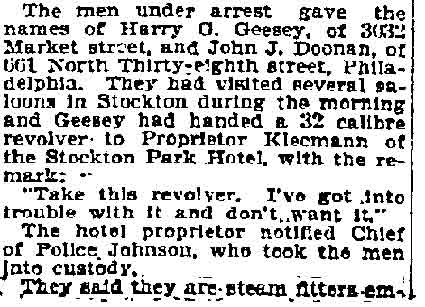
The men under arrest gave the names of Harry O. Geesey, of 3032 Market street, and John J. Doonan, of 661 North Thirty-eighth street, Philadelphia. They had visited several saloons in Stockton during the morning and Geesey had handed a 32 calibre revolver to Proprietor Klecmann of the Stockton Park Hotel, with the remark:
“Take this revolver. I’ve got into trouble with it and don’t want it.”
The hotel proprietor notified Chief Johnson, who took the men into custody.
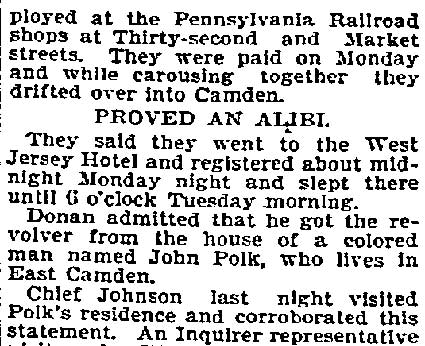
They said they are steam fitters employed at the Pennsylvania Railroad shops at Thirty-second and Market streets. They were paid on Monday and while carousing together they drifted over into Camden.
PROVED AN ALIBI.
They said they went to the West Jersey Hotel and registered about midnight Monday night and slept there until 6 o’clock Tuesday morning.
Donan admitted that he got the revolver from the house of a colored man named John Polk, who lives in East Camden.
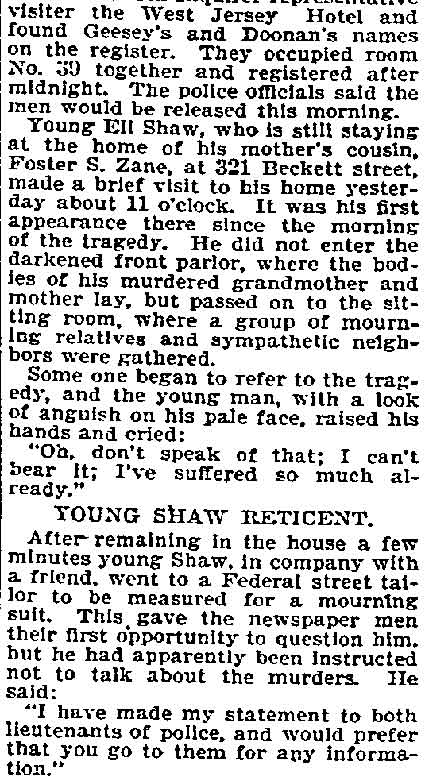
Chief Johnson last night visited Polk’s residence and corroborated this statement. An Inquirer representative visited the West Jersey Hotel and found Geesey’s and Doonan’s names on the register. They occupied room No. 39 together and registered after midnight. The police officials said the men would be released this morning.
Young Eli Shaw, who is still staying at the home of his mother’s cousin, Foster S. Zane, at 321 Beckett street, made a brief visit to his home yesterday about 11 o’clock. It was his first appearance there since the morning of the tragedy. He did not enter the darkened front parlor, where the bodies of his murdered grandmother and mother lay, but passed on to the sitting room, where a group of mourning relatives and sympathetic neighbors were gathered.
Some one began to refer to the tragedy, and the young man, with a look of anguish on his pale face, raised his hands and cried:
“Oh, don’t speak of that; I can’t bear it; I’ve suffered so much already.”
YOUNG SHAW RETICENT.
After remaining in the house a few minutes young Shaw, in company with a friend, went to a Federal street tailor to be measured for a mourning suit. This gave the newspaper men their first opportunity to question him, but he had apparently been instructed not to talk about the murders. He said:
“I have made my statement to both lieutenants of police, and would prefer that you go to them for any information.”
“Has any evidence been found of anything having been stolen from the house?”
“I don’t know,” was his reply.
“Are any of the possessions of your grandmother missing?”
“I can’t tell. The police have been there and can tell you if anything was stolen.”
“You are the only person that knew what was in the house and could tell if anything is missing, are you not?”
“I have not been in the house since yesterday morning and cannot tell anything about it.”
“Is Charles Higgins, whose name has been connected with the case, a relative of yours or of the Zane family?”
“He is a distant relative of the family,” was Shaw’s non-committal reply.
“There are conflicting reports about two men having been seen in the house by you. Did you see any one when you came down stairs?”
“As I stated before, I have made a statement to the police lieutenants, and would prefer that you go to them for any information,” he replied and walked away.
AIDING THE POLICE.
The police have obtained some additional information in regard to two men who were seen in the neighborhood of the Zane house shortly before the murders were committed. Howard Ross, an engineer, living at Third and Pine, says he left his home Tuesday morning at a quarter past 4 o’clock. He had just reached Third street when two men came dashing almost into him. They had run diagonally across Pine street. He says one was rather tall, say five feet ten inches high, wore a derby hat and dark clothes. The other was shorter and stouter than the first described. When Ross reached Line street he heard some one calling murder, was unable to locate the cries and went on to his work.
O. B. Blizzard, of 249 Line street, adds to this that he saw the elder woman, Mrs. Zane, at 10 o’clock Monday morning, the day before the murder, talking to a tall man. They appeared to be quarreling. He thinks he could identify the man.
James C. Carey [sic], of 225 Pine street, while on his way home, about 1 o’clock Tuesday morning, saw two men as described above sitting on a doorstep at Liberty alley and Pine. They disappeared soon after he saw them.
REWARDS AMOUNT TO $1000.
The Camden County Board of Freeholders at its regular monthly meeting yesterday unanimously voted to offer a reward of $500 for information that would lead to the arrest and conviction of the murderer or murderers. This is in addition to the $500 reward offered by the city of Camden.
The rewards have started a number of amateur Sherlock Holmeses at work on the case. Among the professional sleuths seen in the neighborhood yesterday was Detective Garrison, “the Jersey Hawkshaw.”
Coroner Lippincott last evening empaneled the following jury: William A. Husted, foreman; Thomas Binker, M. J. O’Brien, William Anderson, Chas. Folwell and John Irwin. The jury will view the bodies at 10.30 o’clock this morning. The inquest will not be held before Monday or Tuesday of next week.
The funerals of the two murdered women will be held at 2 o’clock Saturday afternoon. They will be buried in the same plot in Harleigh Cemetery. The services will be conducted by Rev. John W. Marshall, pastor of the Broadway M. E. Church, and Rev. William A. Massey, pastor of the Wiley M. E. Church.
James Hough, who was arrested as a suspect by Policeman Myers on Tuesday afternoon, was released yesterday. There was no evidence to connect him with the crime.
Vet of ‘Cheese Box on Raft’
Camden Courier-Post —
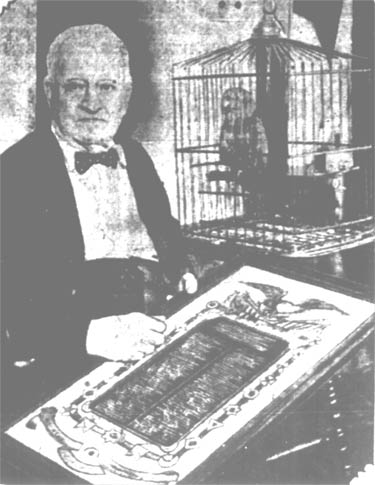
Captain James H. Carey, of 820 State Street, one of the last survivors of the Monitor and Merrimac combat, will celebrate the sixty-sixth anniversary of the event on March 9. He is shown with his parrot, Billy, and the record of his activity during the Civil War.
Monitor Survivor Relates Historic Merrimac Fight
Camden Courier-Post —
Captain James H. Carey, retired employee of the Pennsylvania Railroad and one of the last survivors of the battle between the Monitor and the Merrimac will celebrate on March 9th the sixty-sixth anniversary of the event. He was one of the Monitor’s crew.
Captain Carey, born in Philadelphia, has lived most of his life in Camden. He resided for many years at 215 Royden Street and was active in Camden’s old volunteer fire department. He relates with enthusiasm how he rescued two children from a burning building at Front Street and Kaighn Avenue in the good old days.
Carey is 89 years old, white haired, cheerful and quite active. He ambles about the home of his daughter, Mrs. George Thomas, 820 State Street, with whom he has been living with for some time. He likes reading the newspapers and enjoys visits to Wildwood.
“The fight between the Union ship Monitor and the Confederate ram Merrimac didn’t amount to anything compared with the battles of the World War,” jovial old Captain Carey explained as he adjusted his glasses and glanced at his service record. “The fight started about 9:00 o’clock in the morning and lasted about half-an-hour. Most of the time we were so close to the other that we couldn’t miss our aim.
Aboard Saint Laurence
“I was a member of the crew of the U.S. Frigate Saint Laurence, stationed at Norfolk, Virginia,” he continued. “Early in the morning, the rebels set fire to a boat called the Germantown. The first shot of the war, a 250-pound shell, was fired by the Union forces at Fort Monroe. It struck between U.S.S. Keystone State and the warship Charleston. Both boats retired to Norfolk.”
“The Merrimac started an attack on the warship Minnesota, which was aground. It was covered with railroad tracks for armor plating. The Monitor, an iron clad vessel, came up from Cape Henry. I was transferred from my boat to the crew of the Monitor as a gunner’s mate. There were 250 men aboard the vessel as I recall.”
“The two boats pulled alongside each other and we fired a broadside from our two gun turret which ripped off all the iron rails off the Merrimac. All her firing only dented our armor plating. We were hit five or six times.”
“The amusing part of the battle,” said Captain Carey with a chuckle “was when we turned the hot water hose on them. All through the fighting we were so close to each other that every time they opened their port-hole shutters to take a shot we could see their gun crew. We hooked up a fire hose to our boiler and when they opened the shutters we squirted it in. The Merrimac fellows didn’t like that
Honorable Record
After the battle Carey was transferred back to his own vessel, the Saint Laurence. His service record shows that after his enlistment at Philadelphia on April 10, 1861 he served on the U. S. S. Keystone State until June of 1861, the Saint Laurence until June of 1863, and the Shenandoah for the following year. He was wounded in the wrist at Masonboro, North Carolina on November 27, 1863 and honorably discharged on June 30, 1864.
The old veteran’s other two children also live in Camden. They are Mrs. John Levins, wife of the court crier, and Benjamin Carey.
“Of course I saw other action during the Civil War,” Carey explained as he held up the framed record of his part in the combat. “You see, I aided in dozens of captures and was under fire numerous times. I wouldn’t part with this record for a thousand dollars.”