Introduction
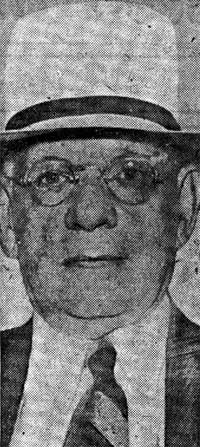
Francis D. Weaver
FRANCIS D. WEAVER was born in Philadelphia around 1861. His family moved to Camden when he was young, and he was educated in Camden’s public schools. He had gone west, to St. Louis MO to seek his fortune, but returned in the 1880s. He studied law in Camden with Judge John W. Wescott. He was admitted to the bar as an attorney in 1890, and as a counselor in 1894. The 1890 Camden City Directory shows him living at 404 North 2nd Street, and working at 301 Market Street.
In 1913, Francis Weaver and John W. Wescott formed a partnership that endured until Wescott passed away in 1927. At the time of the 1920 census, Francis Weaver lived at 526 Royden Street, with wife Katherine, sister Anna, and his widowed mother, Harriet A. Weaver. By 1930 he had purchased the house at 323 Cooper Street, where he resided the rest of his years.
Recognized for his expertise in real estate matters, he was appointed to the Camden County Tax Board in 1913, serving there until 1924. In that year he was appointed to the State Board of Taxes and Assessments, and became president of that Board in 1929. When that Board was supplanted by the State Board of Tax Appeals, he became president of the new Board, and continued to be reappointed to that post until his death in January of 1938.
Francis D. Weaver passed away on January 8, 1938. After funeral services at the Joseph H. Murray funeral home at 408 Cooper Street, he was buried at Evergreen Cemetery in Camden.
Shot Her Husband.
Camden Post —
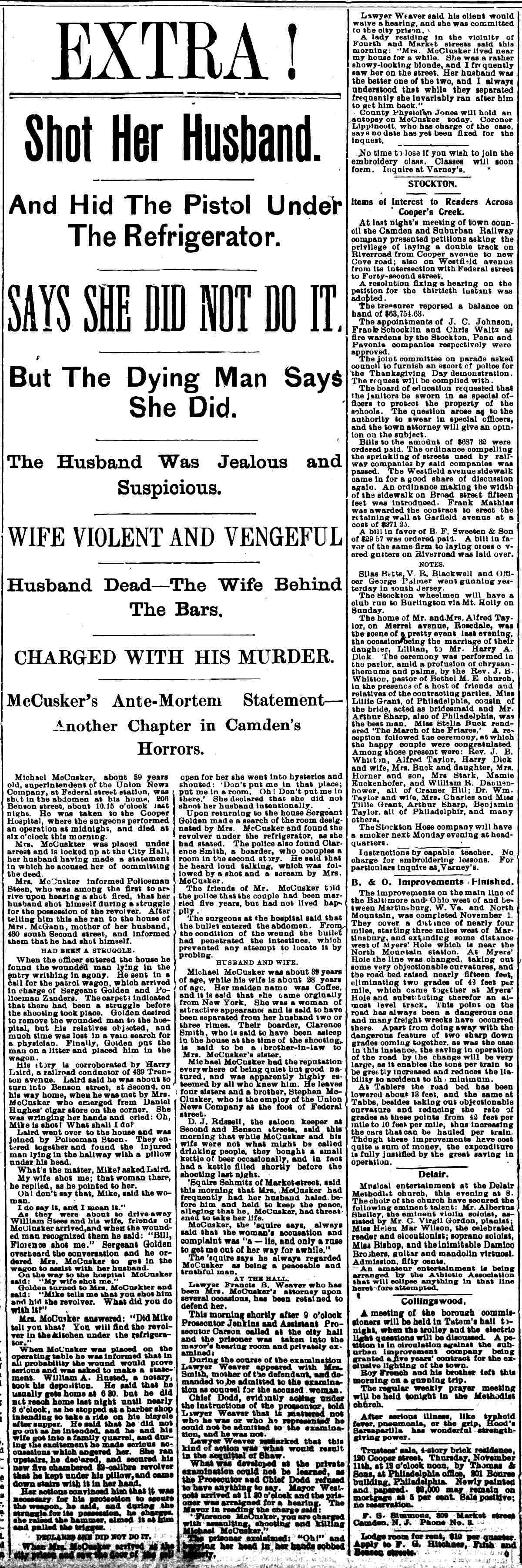
EXTRA!
And Hid The Pistol Under The Refrigerator.
SAYS SHE DID NOT DO IT.
But The Dying Man Says She Did.
The Husband Was Jealous and Suspicious.
WIFE VIOLENT AND VENGEFUL
Husband Dead—The Wife Behind The Bars.
CHARGED WITH HIS MURDER.
McCusker’s Ante-Mortem Statement—Another Chapter in Camden’s Horrors.
Michael McCusker, about 3[?] years old, superintendent of the Union News Company, at Federal street station, was shot in the abdomen at his home, 206 Benson street, about 10.15 o’clock last night. He was taken to the Cooper Hospital, where the surgeons performed an operation at midnight, and died at six o’clock this morning.
Mrs. McCuskter [sic] was placed under arrest and is locked up at the City Hall, her husband having made a statement in which he accused her of committing the deed.
Mrs. McCusker informed Policeman Steen, who was among the first to arrive upon hearing a shot fired, that her husband shot himself during a struggle for the possession of the revolver. After telling him this she ran to the house of Mrs. McGann, mother of her husband, 430 south Second street, and informed them that he had shot himself.
HAD BEEN A STRUGGLE.
When the officer entered the house he found the wounded man lying in the entry writhing in agony. He sent in a call for the patrol wagon, which arrived in charge of Sergeant Golden and Policeman Zanders. The carpets indicated that there had been a struggle before the shooting took place. Golden desired to remove the wounded man to the hospital, but his relatives objected, and much time was lost in a vain search for a physician. Finally, Golden put the man on a litter and placed him in the wagon.
His story is corroborated by Harry Laird, a railroad conductor of 439 Trenton avenue. Laird said he was about to turn into Benson street, at Second, on his way home, when he was met by Mrs. McCusker who emerged from Daniel Hughes’ cigar store on the corner. She was wringing her hands and cried: Oh, Mike is shot! What shall I do?
Laird went over to the house and was joined by Policeman Steen. They entered together and found the injured man lying in the hallway with a pillow under his head.
What’s the matter, Mike? asked Laird.
My wife shot me; that woman there, he replied, as he pointed to her.
Oh! don’t say that, Mike, said the woman.
I do say it, and I mean it.”
As they were about to drive away William Stees and his wife, friends of McCusker arrived, and when the wounded man recognized them he said: “Bill, Florence shot me.” Sergeant Golden overheard the conversation and he ordered Mrs. McCusker to get in the wagon to assist with her husband.
On the way to the hospital McCusker said: “My wife shot me.”
Golden turned to Mrs. McCuskter [sic] and said: “Mike tells me that you shot him and hid the revolver. What did you do with it?”
Mrs. McCusker answered: “Did Mike tell you that? You will find the revolver in the kitchen under the refrigerator.”
When McCusker was placed on the operating table he was informed that in all probability the wound would prove serious and was asked to make a statement. William A. Husted, a notary, took his deposition. He said that he usually gets home at 6.30 but he did not reach home last night until nearly 8 o’clock, as he stopped at a barber shop intending to take a ride on his bicycle after supper. He said that he did not go out as he intended, and he and his wife got into a family quarrel, and during the excitement he made serious accusations which angered her. She ran upstairs, he declared, and secured his new five chambered [?]2-calibre revolver that he kept under his pillow, and came down stairs with it in her hand.
Her actions convinced him that it was necessary for his protection to secure the weapon, he said, and during the struggle for its possession, he charges, she raised the hammer, aimed it at him and pulled the trigger.
DECLARES SHE DID NOT DO IT.
When Mrs. McCusker arrived at the city prison and saw the door of the cell open for her she went into hysterics and shouted: ‘Don’t put me in that place; put me in a room. Oh! Don’t put me in there.’ She declared that she did not shoot her husband intentionally.
Upon returning to the house Sergeant Golden made a search of the room designated by Mrs. McCusker and found the revolver under the refrigerator, as she had stated. The police also found Clarence Smith, a boarder, who occupies a room in the second story. He said that he heard loud talking, which was followed by a shot and a scream by Mrs. McCusker.
The friends of Mr. McCusker told the police that the couple had been married five years, but had not lived happily.
The surgeons at the hospital said that the bullet entered the abdomen. From the condition of the wound the bullet had penetrated the intestines, which prevented any attempt to locate it by probing.
HUSBAND AND WIFE.
Michael McCusker was about 3[?] years of age, while his wife is about 28 years of age. Her maiden name was Coffee, and it is said that she came orginally [sic] from New York. She was a woman of attractive appearance and is said to have been separated from her husband two or three times. Their boarder, Clarence Smith, who is said to have been asleep in the house at the time of the shooting, is said to be a brother-in-law to Mrs. McCusker’s sister.
Michael McCusker had the reputation everywhere of being quiet but good natured, and was apparently highly esteemed by all who knew him. He leaves four sisters and a brother, Stephen McCusker, who is the employ of the Union News Company at the foot of Federal street.
D. J. Russell, the saloon keeper at Second and Benson streets, said this morning that while McCusker and his wife were not what might be called drinking people, they bought a small kettle of beer occasionally, and in fact had a kettle filled shortly before the shooting last night.
‘Squire Schmitz of Market-street, said this morning that Mrs. McCusker had frequently had her husband haled before him and held to keep the peace, alleging that he, McCusker, had threatened to take her life.
McCusker, the ‘squire says, always said that the woman’s accusation and complaint was “a — lie, and only a ruse to get me out of her way for awhile.”
The ‘squire says he always regarded McCusker as being a peaceable and truthful man.
AT THE HALL.
Lawyer Francis B. Weaver who has been Mrs. McCusker’s attorney upon several occasions, has been retained to defend her.
This morning shortly after 9 o’clock Prosecutor Jenkins and Assistant Prosecutor Carson called at the city hall and the prisoner was taken into the mayor’s hearing room and privately examined.
During the course of the examination Lawyer Weaver appeared with Mrs. Smith, mother of the defendant, and demanded to be admitted to the examination as counsel for the accused woman.
Chief Dodd, evidently acting under the instructions of the prosecutor, told Lawyer Weaver that it mattered not who he was or who he represented he could not be admitted to the examination, and he was not.
Lawyer Weaver remarked that this kind of action was what would result in the acquittal of Shaw.
What was developed at the private examination could not be learned, as the Prosecutor and Chief Dodd refused to have anything to say. Mayor Westcott arrived at 11.30 o’clock and the prisoner was arraigned for a hearing. The Mayor in reading the charge said:
‘Florence McCusker, you are charged with assaulting, shooting and killing Michael McCusker.’
The prisoner exclaimed: “Oh!” and burying her head in her hands sobbed bitterly.
Lawyer Weaver said his client would waive a hearing, and she was committed to the city prison.
A lady residing in the vicinity of Fourth and Market streets said this morning: “Mrs. McClusker lived near my house for a while. She was a rather showy-looking blonde, and I frequently saw her on the street. Her husband was the better one of the two, and I always understood that while they separated frequently she invariably ran after him to get him back.”
County Physician Jones will hold an autopsy on McCusker today. Coroner Lippincott, who has charge of the case, says no date has yet been fixed for the inquest.
No time to lose if you wish to join the embroidery class. Classes will soon form. Inquire at Varney’s.
STOCKTON.
Items of Interest to Readers Across Cooper’s Creek.
At last night’s meeting of town council the Camden and Suburban Railway company presented petitions asking the privilege of laying a double track on Riverroad from Cooper avenue to new Cove road; also on Westfield avenue from its intersection with Federal street to Forty-second street.
A resolution fixing a hearing on the petition for the thirtieth instant was adopted.
The treasurer reported a balance on hand of $63,754.63.
The appointments of J. C. Johnson, Frank Schocklin and Chris Waltz as fire wardens by the Stockton, Penn and Pavonia companies respectively were approved.
The joint committee on parade asked council to furnish an escort of police for the Thanksgiving Day demonstration. The request will be complied with.
The board of education requested that the janitors be sworn in as special officers to protect the property of the schools. The question arose as to the authority to swear in special officers, and the town attorney will give an opinion on the subject.
Bills to the amount of $687.32 were ordered paid. The ordinance compelling the sprinkling of streets used by railway companies by said companies was passed. The Westfield avenue sidewalk came in for a good share of discussion again. An ordinance making the width of the sidewalk on Broad street fifteen feet was introduced. Frank Mathias was awarded the contract to erect the retaining wall at Garfield avenue at a cost of $271.25.
A bill in favor of B. F. Sweeten & Son of $29.57 was ordered paid. A bill in favor of the same firm to laying cross covered gutters on Riverroad was laid over.
NOTES.
Silas Betts, V. R. Blackwell and Officer George Palmer went gunning yesterday in south Jersey.
The Stockton wheelmen will have a club run to Burlington via Mt. Holly on Sunday.
The home of Mr. and Mrs. Alfred Taylor, on Merrel avenue, Rosedale, was the scene of a pretty event last evening, the occasion being the marriage of their daughter, Lillian, to Mr. Harry A. Dick. The ceremony was performed in the parlor, amid a profusion of chrysanthemums and palms, by the Rev. J. B. Whitton, pastor of Bethel M. E church, in the presence of a host of friends and relatives of the contracting parties. Miss Lillie Grant, of Philadelphia, cousin of the bride, acted as bridesmaid and Mr. Arthur Sharp, also of Philadelphia, was the best man. Miss Stella Buck rendered ‘The March of the Friares,’ A reception followed the ceremony, at which the happy couple were congratulated Among those present were: Rev. J. B. Whitton, Alfred Taylor, Harry Dick and wife, Mrs. Buck and daughter, Mrs. Horner and son, Mrs Stark, Mamie Euckenhofer, and William R. Dauuenhower, all of Cramer Hill; Dr. Wm. Taylor and wife, Mrs. Charles and Miss Tillie Grant, Arthur Sharp, Benjamin Taylor. all of Philadelphir, and many others.
The Stockton Hose company will have a smoker next Monday evening at headquarters.
Instructions by capable teacher. No charge for embroidering lessons. For particulars inquire at Varney’s.
B. & O. Improvements Finished.
The improvements on the main line of the Baltimore and Ohio west of and between Martinsburg, W. Va. and North Mountain, was completed November 1. They cover a distance of nearly four miles, starting three miles west of Martinsburg, and extending some distance west of Myers’ Hole which is near the North Mountain station. At Myers’ Hole the line was changed, taking out some very objectionable curvatures, and the road bed raised nearly fifteen feet, eliminating two grades of 43 feet per mile, which came together at Myers’ Hole and substituting therefor an almost level track. This point on the road has always been a dangerous one and many freight wrecks have occurred there. Apart from doing away with the dangerous feature of two sharp down grades coming together, as was the case in this instance, the saving in operation of the road by the change will be very large, as it enables the tons per train to be greatly increased and reduces the liability to accident to the minimum.
At Tablers the road bed has been lowered about 13 feet, and the same at Tabbs, besides taking out objectionable curvature and reducing the rate of grades at these points from 42 feet per mile to 10 feet per mile, thus increasing the cars that can be hauled per train. Though these improvements have cost quite a sum of money, the expenditure is fully justified by the great saving in operation.
Delair.
Musical entertainment at the Delair Methodist church, this evening at 8. The choir of the church have secured the following eminent talent: Mr. Albertus Shelley, the eminent violin soloist, assisted by Mr. C. Virgil Gordon, pianist; Miss Helen Mar Wilson, the celebrated reader and elocutionist; soprano soloist, Miss Bishop, and the inimitable Damico Brothers, guitar and mandolin virtuosi. Admission, fifty cents.
An amateur entertainment is being arranged by the Athletic Association that will eclipse anything in that line heretofore attempted.
Collingswood.
A meeting of the borough commissioners will be held in Tatem’s hall tonight, when the trolley and the electric light questions will be discussed. A petition is in circulation against the suburban improvement company being granted a five years’ contract for the exclusive lighting of the town.
Roy French and his brother left this morning on a gunning trip.
The regular weekly prayer meeting will be held tonight in the Methodist church.
After serious illness, like typhoid fever, pneumonia, or the grip, Hood’s Sarsaparilla has wonderful strength-giving power.
Trustees’ sale, 4-story brick residence, 190 Cooper street, Thursday, November 11th, at 12 o’clock noon, by Thomas & Sons, at Philadelphia office, 201 Bourse building, Philadelphia. Newly painted and papered. $2,000 may remain on mortgage at 5 per cent. Sale positive; no reservation.
F. S. Simmons, 309 Market street Camden, N. J. Phone No. 9.
Lodge room for rent, $10 per quarter. Apply to F. G. Hitchner, Fifth and Benson streets.
Sentiment Ruled in Rejecting Bid, Pastor Declares
Camden Courier-Post —

Offer of $5,300,000 for Catholic Church Property Disclosed in Court
SENTIMENT RULED IN REJECTING BID, PASTOR DECLARES
Appeals on Assessments in Broadway Extension Open in Court Here
LEVIES CALLED UNFAIR
An offer of $5,300,000 for purchase of the Church of the Immaculate Conception property, bounded by Market, Broadway, Federal and Seventh streets, was disclosed yesterday in Circuit Court here.
It was rejected for “sentimental reasons,” according to Rt. Rev. Monsignor W. J. FitzGerald, pastor of the church, who testified before Judge Henry H. Eldredge, at the first day session of hearings on appeals from property assessments.
The appeals of a number of property owners are from assessments levied to pay for extending Broadway, which previously ended at Market street, to its present terminus at the bridge plaza. Appellants contend the assessments have not been “just and fair.”
Monsignor FitzGerald testified the church and its property had not benefited by the improvement. Increased traffic, he said, resulted in a greater hazard to children who attend Camden Catholic High and St. Mary’s parochial schools, which are units of the church property. The assessment against the church is $8,640.50 for the improvement. The church is exempt from general taxation.
Mitten Made Offer, Report
Rejection of the offer to purchase the church property was disclosed by Monsignor FitzGerald during cross-examination by Lewis Liberman, assistant city solicitor. Source of the offer was not brought out. It was reported several years ago that Mitten Management, of Philadelphia, made such an offer with a view of erecting a bus terminal on the site.
Edward J. Borden, former president of the Camden County Real Estate Board, also testified the Broadway extension did not increase value of the church property. Asked by Liberman whether he was thus speaking as a real estate expert or a churchman, Borden replied “fifty-fifty.”
Those appealing assessments hold their properties received no particular benefit from the improvement and charge that property abutting the extended street was not assessed sufficiently. They also say holdings beyond the area received benefits and should be assessed accordingly.
Assessments Fair, City Holds
The argument of the city is that the assessments were just and fair and that these particular properties did receive benefits and considerable increase in value by reason of the improvement and that, therefore, they should be called upon to pay the assessment.
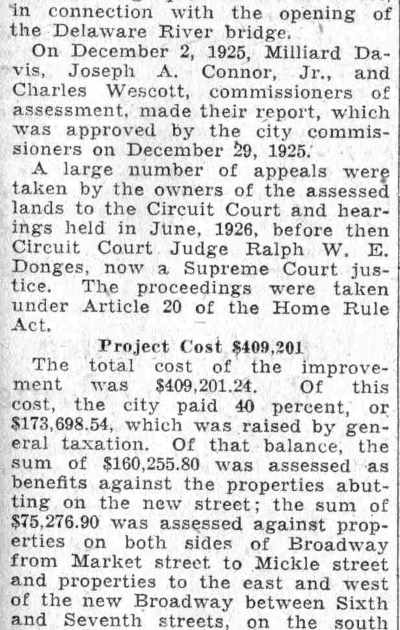
In the Summer of 1925, Broadway was cut through from Market street to the Bridge plaza at Penn street in connection with the opening of the Delaware River bridge.
On December 2, 1925, Milliard Davis, Joseph A. Connor, Jr., and Charles Wescott, commissioners of assessment, made their report, which was approved by the city commissioners on December 29, 1925.
A large number of appeals were taken by the owners of the assessed lands to the Circuit Court and hearings held in June, 1926, before then Circuit Court Judge Ralph W. E. Donges, now a Supreme Court justice. The proceedings were taken under Article 20 of the Home Rule Act.
Project Cost $409,201
The total cost of the improvement was $409,201.24. Of this cost, the city paid 40 percent, or $173,698.54, which was raised by general taxation. Of that balance, the sum of $160,255.80 was assessed as benefits against the properties abutting on the new street; the sum of $75,276.90 was assessed against properties on both sides of Broadway from Market street to Mickle street and properties to the east and west of the new Broadway between Sixth and Seventh streets, on the south side of Penn street, on both sides of Cooper street and on both sides of Market street.
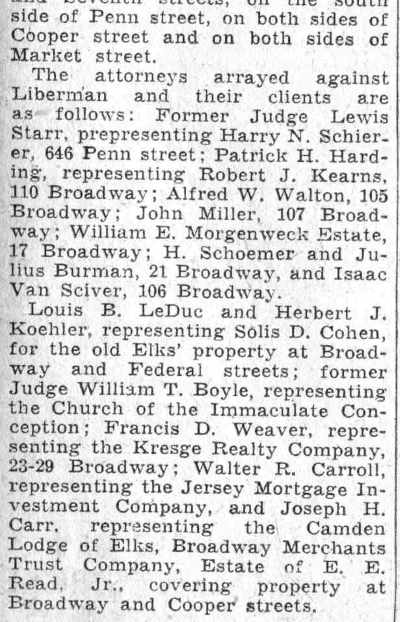
The attorneys arrayed against Liberman and their clients are as follows: Former Judge Lewis Starr, representing Harry N. Schierer, 646 Penn street; Patrick H. Harding, representing Robert J. Kearns, 110 Broadway; Alfred W. Walton, 105 Broadway; John Miller, 107 Broadway; William E. Morgenweck Estate, 17 Broadway; H. Schoemer and Julius Burman, 21 Broadway, and Isaac Van Sciver, 106 Broadway.
Louis B. LeDuc and Herbert J. Koehler, representing Solis D. Cohen, for the old Elks’ property at Broadway and Federal streets; former Judge William T. Boyle, representing the Church of the Immaculate Conception; Francis D. Weaver, representing the Kresge Realty Company, 23-29 Broadway; Walter R. Carroll, representing the Jersey Mortgage Investment Company, and Joseph H. Carr, representing the Camden Lodge of Elks, Broadway Merchants Trust Company, Estate of E. E. Read, Jr., covering property at Broadway and Cooper streets.
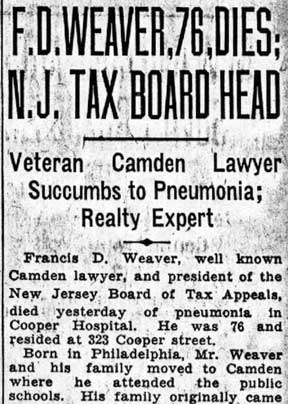
F.D. Weaver, 76, Dies; N.J. Tax Board Head
Camden Courier-Post —
Veteran Camden Lawyer Succumbs to Pneumonia; Realty Expert
Francis D. Weaver, well known Camden lawyer, and president of the New Jersey Board of Tax Appeals, died yesterday of pneumonia in Cooper Hospital. He was 76 and resided at 323 Cooper street.
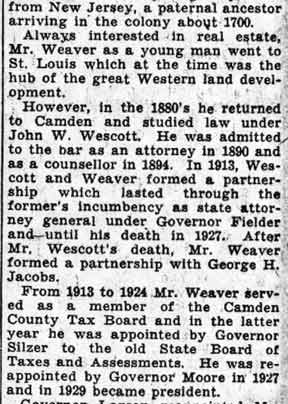
Born in Philadelphia, Mr. Weaver and his family moved to Camden where he attended the public schools. His family originally came from New Jersey, a paternal ancestor arriving in the colony about 1700.
Always interested in real estate, Mr. Weaver as a young man went to St. Louis which at the time was the hub of the great Western land development.
However, in the 1880’s he returned to Camden and studied law under John W. Wescott. He was admitted to the bar as an attorney in 1890 and as a counsellor in 1894. In 1913, Wescott and Weaver formed a partnership which lasted through the former’s incumbency as state attorney general under Governor Fielder and—until his death in 1927. After Mr. Wescott’s death, Mr. Weaver formed a partnership with George H. Jacobs.
From 1913 to 1924 Mr. Weaver served as a member of the Camden County Tax Board and in the latter year he was appointed by Governor Silzer to the old State Board of Taxes and Assessments. He was reappointed by Governor Moore in 1927 and in 1929 became president.
Governor Larson reappointed Mr. Weaver in 1930, and he continued as president until the old board was supplanted by the new Board of Tax Appeals on July 1, 1931. By designation of Governor Larson he became president under the new setup. On July 1, 1936, Governor Hoffman named him for another five-year term, and again designated him as president. Thus four governors of different political faiths recognized his abilities in the real estate tax field.
Mrs. Katherine Breck Weaver, widow, is residing with her daughter, Mrs. Helen MacCausland. The latter’s husband, William, was slain by three payroll bandits in Salem several years ago.
Private funeral services will be held Monday morning, it was announced by Warren Nichols, secretary to Mr. Weaver. Friends may call tomorrow night at the Murray funeral home, 408 Cooper street. Burial will take place in Evergreen Cemetery.
Funeral Services Held for Francis D. Weaver
Camden Courier-Post —
Funeral services were held yesterday for Francis D. Weaver, 76, president of the New Jersey Board of Tax Appeals, who died Friday of pneumonia. Burial was in Evergreen Cemetery.
Mr. Weaver, who resided at 323 Cooper Street, served as a member of the Camden County Tax Board from 1913 to 1924. In 1924, he was appointed by Governor Silzer to the old State Board of Taxes and Assessments, becoming president in 1929. On July 1, 1936, Governor Hoffman named him for another five-year term.
A former law partner of the late John W. Wescott, who was state attorney general, Mr. Weaver later formed a partnership with George H. Jacobs here. He is survived by his widow and daughter, Mrs. Helen MacCausland.