Introduction
JACOB KELLUM was born in Camden county, New Jersey on March 21, 1851 to Benjamin Kellum and his wife, the former Emeline Ware. He was one of at least three children, coming after Anna and Benjamin L. Kellum. His father appears to have passed away in the 1850s, and his mother was remarried on May 3, 1861, to John Bodine, with whom she had at least 5 children, Sarah, Samuel, David, Charles, and Harry prior to the 1860 Census. The census shows John and Emeline Bodine living in what was then Newton Township with the three Kellum children and the three younger children who had been born to date. John Bodine supported his family as a day laborer.
Older brother Benjamin Kellum enlisted in the Union Army in 1864, and re-enlisted in 1866 for three years, returning to Camden in 1869.
The 1870 Census shows Jacob Kellum living with his mother, step-father, and siblings in Camden’s Middle Ward. His stepfather was working in a store, while Jacob and older brother Benjamin Kellum worked as laborers.
Jacob Kellum was appointed to the Camden Fire Department to take the place of George Leibecke, driver of Engine Company 2, who had been transferred to Engine Company 1 on August 1, 1871. His brother Benjamin joined the Camden Fire Department in May of 1874. Both men would remain Camden fire fighters for the rest of their working days.
The 1878–1879 and 1879–1880 City Directories give Benjamin Kellum’s address as 122 West Street.
The 1880 Census shows Jacob Kellum, married to Annie, living at 27 South 5th Street in Camden. It appears that Annie Kellum died that year. By the time the 1885 New Jersey State Census was enumerated, Jacob Kellum was living with Mrs. Annie Githens. She had left her husband Samuel W. Githens; he did not pass away until 1895. Jacob and Annie lived as man and wife and apparently this did not cause any problems with his employment.
The 1900 Census lists Jacob Kellum as being single and living at 27 South 5th Street. Also living there was Annie Githens, aged 50, occupation housekeeper. The census records of days gone by show a lot of men with “housekeepers” and women with “boarders” or “lodgers.”
Annie Githens died May of 1905 and was buried at Arlington Cemetery. By the time the 1906 Camden City Directory was compiled, Jacob Kellum had moved out of the City of Camden. His date of retirement is not known as of this writing but his obituary indicates 1907. He married Harriet H. Price Shute that year.
The 1910 Census shows that Jacob Kellum had moved to a house on Broadway (also known as Railroad Avenue) in Deptford Township, Gloucester County, New Jersey. The Census states that he was living with his wife of three years, Harriet, and that this was his first marriage, and Harriet’s second. Harriet Kellum was the former Harriet H. Price Shute, and was previously married to Winfield S. Shute, the marriage ended by divorce due to adultery, on whose part is not known as of this writing. The 1910 census states that she was the mother of five children, three of them living, none of whom lived with Jacob and Harriet. The couple moved to a home on Mantua Pike in West Deptford Township during the 1910s. They were still living there when the Census was taken in January of 1920. Jacob Kellum was still working for the Camden Fire Department at the time of the census enumeration.
Older brother and fellow fireman Benjamin Kellum contracted tuberculosis in the early 1900s, and retired on half-pay from the Camden Fire Department effective August 1, 1903. He died on March 31, 1909, survived by his wife, nephew, and siblings.
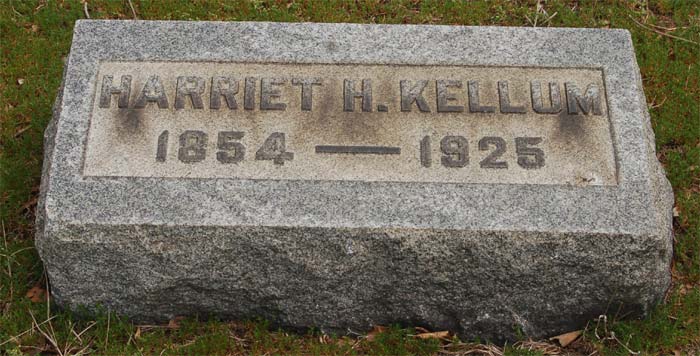
Harriet Kellum passed away in 1925. Jacob Kellum died in 1936. Both are buried at Arlington Cemetery in Pennsauken near his older brother Benjamin.
Jacob Kellum’s cousins, Robert Todd and Charles A. Todd, both served with the Camden Fire Department.
CAMDEN AND VICINITY.
Philadelphia Inquirer —
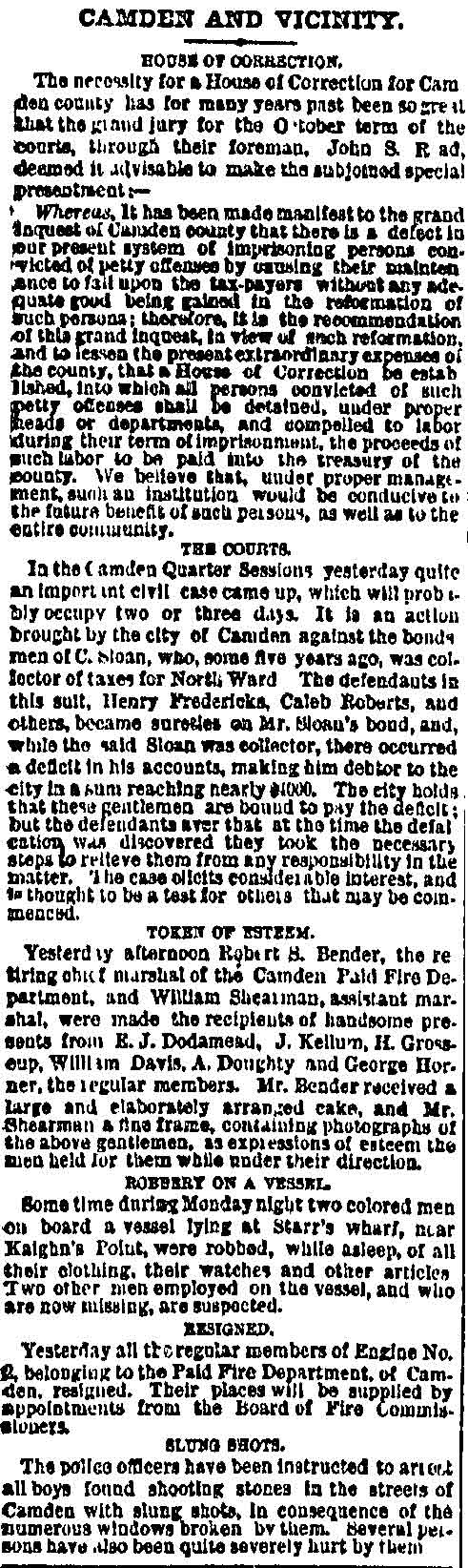
HOUSE OF CORRECTION.
Whereas, It has been made manifest to the grand jurors of Camden county that there is a defect in our present system of imprisoning persons convicted of petty offences, and that it is a grievance to fall upon the tax-payers without any adequate good being gained in the reformation of such persons. Therefore, it is the recommendation of this grand inquest, in view of such reformation and to lessen the present extraordinary expense of maintaining the jail, that a workhouse be established, into which all persons convicted of such petty offences shall be detained, under proper board or department, and compelled to labor during their term of imprisonment, the proceeds of such labor to be paid into the treasury of the county. We believe that besides proper amusement, such an institution would be conducive to the future benefit of such persons, as well as to the entire community.
THE COURTS.
In the Camden Quarter Sessions yesterday quite an important civil case came up, which will probably be appealed to a higher court. It is an action brought by the city of Camden against the bondmen of C. Sloan, who, some five years ago, was collector of taxes for North Ward. The defendants in this suit, Henry Fredericks, Caleb Roberts, and others, became sureties on Mr. Sloan's bond, and, while he was Sloan was collector, there occurred a deficit in his accounts, making him debtor to the city in a sum reaching nearly $1000. The city holds that these gentlemen are bound to pay the deficit; but the defendants allege that after the irregularity was discovered they took the necessary steps to relieve them from any responsibility in the matter. The case is attracting much interest, as it is thought to be a test for others that may be commenced.
TOKEN OF ESTEEM.
Yesterday afternoon Robert S. Bender, the retiring chief marshal of the Camden Paid Fire Department, and William Shearman, assistant marshal, were made the recipients of handsome presents by E. J. Dodamead, B. L. Kellum, H. Grosscup, William Davis, A. Doughty and George Horner, the regular members. Mr. Bender received a large and elaborately arranged cake and Mr. Shearman a fine frame, containing photographs of all those belonging to and the names of all the men held for them while under their direction.
ROBBERY ON A VESSEL.
Some time during Sunday night two colored men on board a vessel lying at the wharf, near Kaighn's Point, were robbed, while asleep, of all their clothing, their watches and other articles. Two other men employed on the vessel, and who are now missing, are suspected.
RESIGNED.
Yesterday all the regular members of Engine No. 2, belonging to the Paid Fire Department, of Camden, resigned. Their places will be supplied by appointments from the Board of Fire Commissioners.
SLUNG SHOTS.
The police officers have been instructed to arrest all boys found shooting stones in the streets of Camden with slung shots, in consequence of the numerous windows broken by them. Several persons have also been quite severely hurt by them.
A False Alarm of Long Ago
Camden Courier-Post —
Spectacular Run of Firemen and Steeds in ‘79 When First Alarm System Was Given Try-out
By BEN COURTER
THERE were two alarms of fire Saturday evening, one at Fourth and Hamilton streets at 8:29 o’clock, and another at the West Jersey Ferry, an hour later. People in the vicinity of the first-named place turned out to look at the machines propelled at lightning speed by snorting equines, and wondered what it was all about; and some of them thought the wide-awake fire boys were beside themselves, as they asked, for the particular house, in the neighborhood of box 24 upon which, with steam up, their apparatus was able to put on, the water. The firemen and people were quietly informed by a party that drove away in a barouche that it was a designed deception.
Under date of October 6, 1879, that was the introduction to a two-column story under a display headline. But, it was, a single line—“False Alarms.” Readers of the period must have been as much mystified as were the firemen and citizens mentioned in the article, for it was not until more than half a column had been devoted to that incident that the public was let into the great secret. It was a test of the first fire alarm system introduced into Camden.
Interest in that incident is revived by the city commissioners last week entering into a contract with that same concern to install in the new City Hall a system for somewhat more than $51,000. That first “system” cost the city $2000 but it was a big sum then and just about 10 times more space was devoted to it in the old Post than in the Courier-Post last Thursday week.
Paid Department 10 Years Old
Camden’s paid fire department in 1879 was just 10 years old. It already was winning approval of even the recalcitrants, who had asserted back in 1869, that the old volunteer companies would certainly be missed; that the “professionals” would not have as much interest in putting out a fire as the boys who ran with the Perseverance, the Weccacoe and other organizations, usually bitter rivals. Not infrequently the volunteers battled over hooking up their hose while the fire burned, a event by no means outgrown since that occasionally happens even now, as files of the newspapers prove.
But on that Saturday night 54 years ago, it developed that those who drove away in the mysterious barouche were J. W. Morgan, Crawford Miller and F. P. Pfeiffer; fire commissioners of city council, along with R. S. Bender and Thomas Beatty. They were but carrying out orders to see that the system worked and it was John T. Bottomley who issued those orders. He was Camden’s big mill owner but more to the purpose in that particular incident, president of city Council. He had approved the fire alarm system but did not intend putting his O. K. on that $2000 bill until he had seen it in practical operation.
So unknown to the firemen, and the citizens as well, it was determined to test that system by way of turning in the alarms. So an alarm was pulled at 8.29 and “Bart” Bonsall, son of Henry L. Bonsall, publisher of the Post, narrates, in just 15 seconds flat the bell was sounded at No.1 Engine House at Fourth and Pine Streets. In two minutes hose cart No. 1 went bounding out with Driver George Hunt at the reins, followed by ben cavanaugh and his faithful nag “jim” with cart No. 2. Then came jake kellum and William Davis with the engine No. 2 drawn by “Dolly” in 2.45. After that was engine No.1 driven by edmund shaw and the horse “alec,” coming along in 3 minutes and 5 seconds. It was explained Shaw was held up by the sandy roadway at Fourth and line.
Spectacular Sight
Anyhow, it must have been a great sight for the old-time families who then resided along the Middle Ward Streets as the racing steeds bounded over Fourth Street, then into third over a mighty bumpy roadway.
But they arrived and vainly sought the blaze. It was while they were hunting that the barouche came along and the commissioners let them into the great secret. “Bart” doesn’t relate what the firemen said about the false alarm, but, like as not the heat of their expressions was a good substitution for the fire they failed to find.
The system was one of those nine-day wonders that had the town on its toes. Everybody listened for the alarms in those days, for when they were sent in the bells in the fire houses pealed the number of the box. The strokes could be heard surprisingly far. Since there were but 11 boxes it was not long before many knew just where the fire was located and made a bee line for the scene. Old volunteers, particularly, never quite lost their interest in fires and, whenever they heard the alarm, hot footed it to the scene of excitement.
That was all right when Camden was little more than a village, but as the community grew it became a serious proposition, since the racing citizens often interfered with the firemen. Thus about 30 years ago the fire bells were silenced. Now none know of an alarm coming in save the various houses and the Courier-Post which has a wire attached from headquarters bringing in the alarms so that reporters and cameramen may get on the scene quickly as possible.
Ordinarily, little thought is given to the need for instant and accurate sounding of an alarm made possible through the expert work of City Electrician Jim Howell and his aides. If it were not for that perfection and the speed with which friend reach the scene the losses would he large. And the insurance companies would be around with a “pink slip” as they were some 20 years ago. That meant a 25 percent addition to fire rates. Camden’s motorized department plus the work of City Electrician John W. Kelly soon rid the city of that “slip.”
That system of long ago didn’t include the cops. Now it takes in both departments, as it has done since the days of Chief Samuel Dodd, back in the early 90’s.
Camden Firemen
Philadelphia Inquirer —
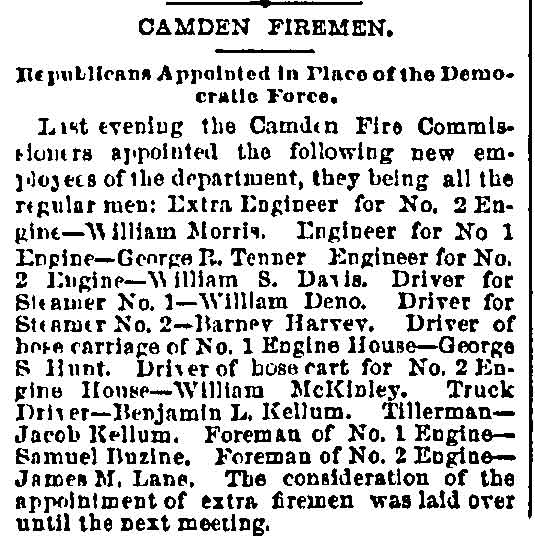
Republicans Appointed in Place of the Democratic Force.
Last evening the Camden Fire Commissioners appointed the following new employees of the department, they being all the regular men: Extra Engineer for No. 2 Engine—William Morris. Engineer for No 1 Engine—George R. Tenner. Engineer for No. 2 Engine—William S. Davis. Driver for Steamer No. 1—William Deno. Driver for Steamer No. 2—Barney Harvey. Driver of hose carriage of No. 1 Engine House—George S. Hunt. Driver of hose cart for No. 2 Engine House—William McKibley. Truck Driver—Benjamin J. Kellam. Tillerman—Jacob Kellum. Foreman of No 1 Engine—Samuel Buzine. Foreman of No 2 Engine—James M. Lane. The consideration of the appointment of extra firemen was laid over until the next meeting.
Over the River
Philadelphia Inquirer —
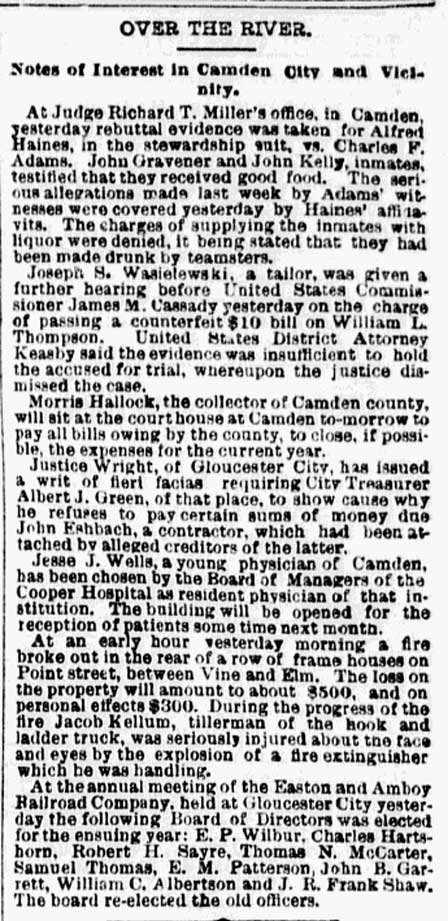
Notes of Interest in Camden City and Vicinity.
At Judge Richard T. Miller’s office, in Camden, yesterday rebuttal evidence was taken for Alfred Haines, in the stewardship suit, vs. Charles F. Adams. John Gravener and John Kelly, inmates, testified that they received good food. The serious allegations made last week by Adams’ witnesses were covered yesterday by Haines’ affidavits. The charges of supplying the inmates with liquor were denied, it being stated that they had been made drunk by teamsters.
Joseph S. Wasielewski, a tailor, was given a further hearing before United States Commissioner James M. Cassady yesterday on the charge of passing a counterfeit $10 bill on William L. Thompson. United States District Attorney Keasby said the evidence was insufficient to hold the accused for trial, whereupon the justice dismissed the case.
Morris Hallock, the collector of Camden county, will sit at the court house at Camden to-morrow to pay all bills owing by the county, to close, if possible, the expenses for the current year.
Justice Wright, of Gloucester City, has issued a writ of fieri facias requiring City Treasurer Albert J. Green, of that place, to show cause why he refuses to pay certain sums of money due John Fahbach, a contractor, which had been attached by alleged creditors of the latter.
Jesse J. Wells, a young physician of Camden, has been chosen by the Board of Managers of the Cooper Hospital as resident physician of that institution. The building will be opened for the reception of patients some time next month.
At an early hour yesterday morning a fire broke out in the rear of a row of frame houses on Point street, between Vine and Elm. The loss on the property will amount to about $500, and on personal effects $300. During the progress of the fire Jacob Kellum, tillerman of the hook and ladder truck, was seriously injured about the face and eyes by the explosion of a fire extinguisher which he was handling.
At the annual meeting of the Easton and Amboy Railroad Company, held at Gloucester City yesterday the following Board of Directors was elected for the ensuing year: E. P. Wilbur, Charles Hartshorn, Robert H. Sayre, Thomas N. McCarter, Samuel Thomas, E. M. Patterson, John B. Garrett, William C. Albertson and J. R. Frank Shaw. The board re-elected the old officers.
Four Firemen Hurt
Philadelphia Inquirer —
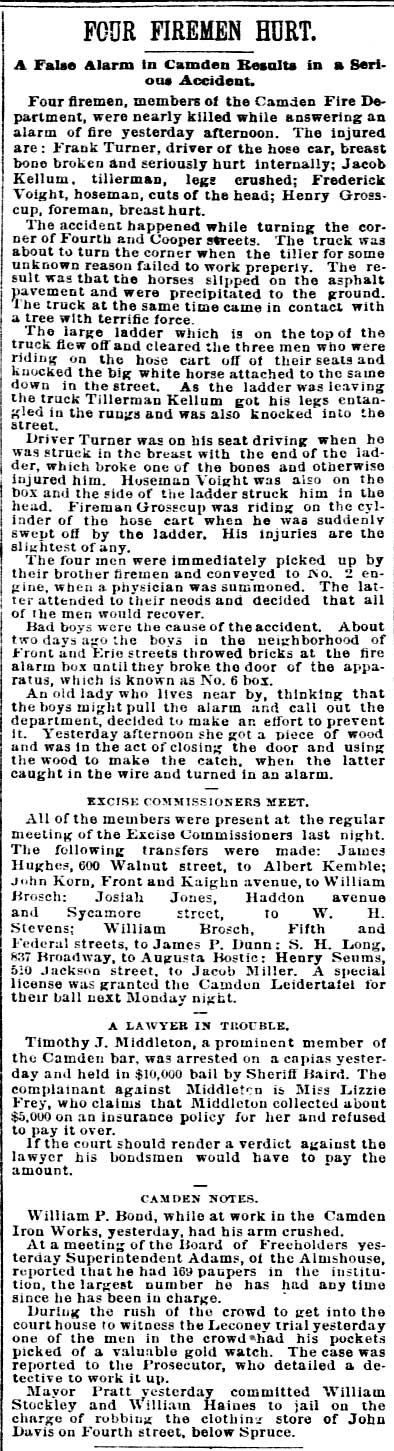
FOUR FIREMEN HURT.
A False Alarm in Camden Results in a Serious Accident.
Four firemen, members of the Camden Fire Department, were nearly killed while answering an alarm of fire yesterday afternoon. The injured are: Frank Turner, driver of the hose car, breast bone broken; Horseman Voight, Jacob Kellum, tillerman, legs crushed; Frederick Voight, horseman, cut on head; Henry Grosscup, foreman, breast hurt.
The accident happened while turning the corner of Front and Camden Streets, with the truck, when the tiller for some unknown reason failed to work properly. The large truck which is on the top of the ladder knocked the big white horse attached to the same into the street. Three of the men who were riding the truck Tillerman Kellum got his legs entangled in the ladder and was dragged along the street.
Driver Turner was on his seat driving when he was struck in the breast with the end of the ladder and was knocked from his seat. Horseman Voight was also on the seat and when his horse fell over the pavement and were precipitated to the ground. Foreman Grosscup was riding on the cylinder of the hose carriage. His injuries are the least of any.
All of the members were present at the regular meeting of the Excise Commissioners Meet.
The following transfers were made: James Boyle, Walnut and Plum, to Jas. Hart; John Korn, Front and Knight avenue, to William Hosch; Josiah Jones, Haddon avenue and Clarence streets; Henry Fries, Front and Carpenter; A.A. Holt, Twelfth and Pine; Geoffrey Buckwalter; Rev. W.E. Loucks; Rev. T.E. Titball; Carlton N. Williams; S.F. Fries; George R. Danenhower; Dr. A.E. Street; Luther Kellum.
A LAWYER IN TROUBLE.
Timothy J. Middleton, a prominent member of the Camden bar, was arrested yesterday and held in $500 bail by Sheriff Baird. The charge against him was made by Wilfred W. Fry, who claims that Middleton collected about $600 in insurance money and has been unable to pay it over. If the court should render a verdict against the lawyer his bondsmen would have to pay the amount.
CAMDEN NOTES.
At a meeting of the Board of Freeholders yesterday, Superintendent of the Poor, Dr. Abram E. Street reported that he had 169 paupers in the institution—the highest number in the past fifteen years since he has been in charge.
It was impossible for the crowd to get into the court house to witness the Lecount trial yesterday.
Yesterday morning Wm. H. Haines going to school, William Stockley and William Haines to jail on the charge of robbing the house of Charles A. Davis on Fourth street, below Spruce.
Tossed From an Engine
Philadelphia Inquirer —
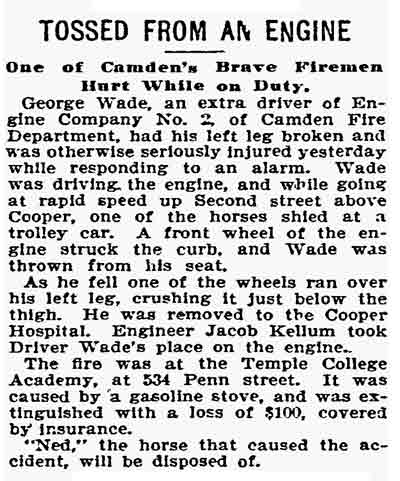
TOSSED FROM AN ENGINE
One of Camden's Brave Firemen Hurt While on Duty.
George Wade, an extra driver of Engine Company No. 2, of Camden Fire Department, had his left leg broken and was otherwise seriously injured yesterday while responding to an alarm. Wade was driving the engine, and while going at rapid speed up Second street above Cooper, one of the horses shied at a trolley car. A front wheel of the engine struck the curb, and Wade was thrown from his seat.
As he fell one of the wheels ran over his left leg, crushing it just below the thigh. He was removed to the Cooper Hospital. Engineer Jacob Kellum took Driver Wade's place on the engine.
The fire was at the Temple College Academy, at 534 Penn street. It was caused by a gasoline stove, and was extinguished with a loss of $100, covered by insurance.
“Ned,” the horse that caused the accident, will be disposed of.
Water Carnival at Westville
Philadelphia Inquirer —
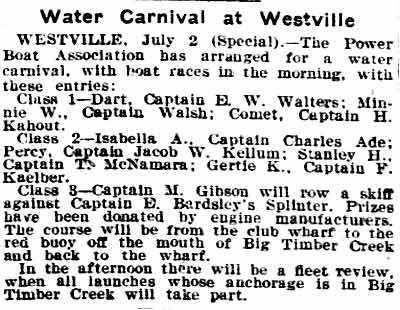
WESTVILLE, July 2 (Special).—The Power Boat Association has arranged for a water carnival, with boat races in the morning, with these entries:
Class 1—Dart, Captain E. W. Walters; Minnie W., Captain Walsh; Comet, Captain H. Kahout.
Class 2—Isabella A., Captain Charles Ade; Percy, Captain Jacob W. Kellum; Stanley H., Captain T. McNamara; Gertie K., Captain F. Kaelber.
Class 3—Captain M. Gibson will row a skiff against Captain E. Bardsley’s Splinter. Prizes have been donated by engine manufacturers. The course will be from the club wharf to the red buoy off the mouth of Big Timber Creek and back to the wharf.
In the afternoon there will be a fleet review, when all launches whose anchorage is in Big Timber Creek will take part.
Mantua
Woodbury Daily Times —
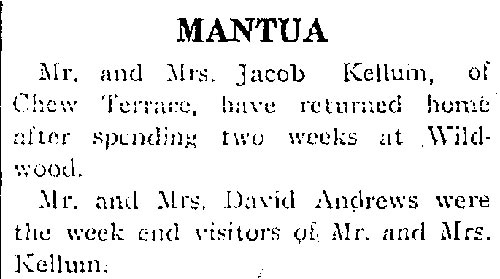
Mr. and Mrs. Jacob Kellum, of Chew Terrace, have returned home after spending two weeks at Wildwood.
Mr. and Mrs. David Andrews were the week end visitors of Mr. and Mrs. Kellum.
Photos
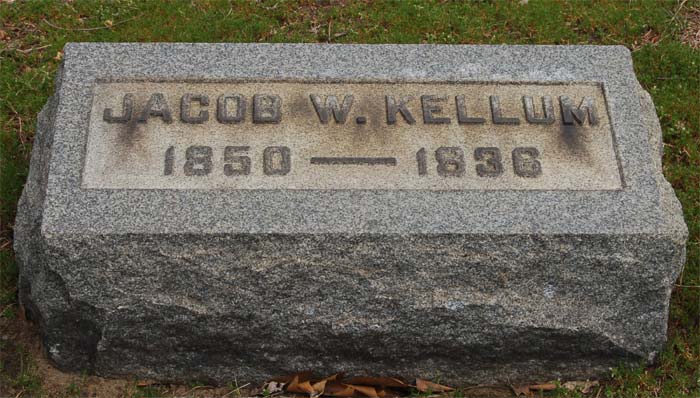
Jacob W. Kellum.