The Grand Army of the Republic
George Reeser Prowell, History of Camden County, N.J. — 1886
All honorably discharged soldiers and sailors who have served in the army or navy of the United States are entitled to membership in the Grand Army of the Republic. In this respect it is the first organization of its kind effected in this country or elsewhere. Soon after the close of the Revolution, army societies were formed which were composed of commissioned officers and their descendants.
The most prominent of these was the famous Society of the Cincinnati, which still has an existence. Army and corps organizations of the War of 1812 and of the Mexican War have existed for social and convivial purposes but none of these societies named have been based on the principle of mutual aid in time of need, or comprehended purposes so exalted as those embraced in the declaration of the Grand Army of the Republic, namely, “Fraternity, charity, loyalty.” This society, whose purpose is to band together the men who wore the blue during the war, originated in the West. To Colonel B. F. Stephenson, M.D., of Springfield, Illinois, is given the credit of being the first person who formulated the plans of its noble aims. The first post was organized at Dakota, Illinois, in 1866. The idea of extending the organization was communicated to many army associates. A State Department Encampment was organized in Illinois on the 12th of July, 1866, under Colonel Stephenson. In the month of November of the same year a National Encampment was organized at Indianapolis, with representatives present from nearly all the Northern States. These encampments have been held annually since then, in various localities of the Union. The State became divided into districts, and the organization of posts was exceedingly rapid. Six months after the date of the formation of the society forty thousand men through the Northern States were enrolled as members. The first department organization in the State of New Jersey was effected in the month of January, 1868. The membership of the order in this State in 1884 was reported at five thousand two hundred and seventy-nine. The entire membership in the United States for the same year was two hundred and thirty-three thousand five hundred and ninety-five. Its membership is now estimated at three hundred thousand, more than one-fourth of the survivors of the war.
Under the auspices of the order thousands of camp-fires, fairs, reunions and banquets have been held. These revive the sufferings and sacrifices and recall the unwritten history of the war. At these meetings no rank is recognized, save that conferred by the order, and any member is eligible to any position in its gift.
General John A. Logan Post No. 102
General John A. Logan Post No. 102 was instituted on February 7, 1887 in Camden with 11 members. Its first commander was William Martin. Other commanders included Edwin F. Allen, William Jones, Charles Baker, Samuel P. Budd, John P. Casner, Reuben B. Cole, Reuben Colt, Daniel Cook, W.H. Cooper, Jacob Cutshall, Isaac Hoey, R.H. Lee, Peter McArdie, L.S. McCormick, J.S. McCormick, William J. Orem, John F. Palmer, Hiram C. Pfile, Benjamin Putnam, Charles Shivers Jr., William Stansbury, Howe K. Seddinger, Charles Fetters, Freeman Bibber, Charles Hope, John Weygand, John D. Leaming, and Thomas H. Walters.
In 1906 the Post met on the first and third Thursday evenings of each month at the William Penn Hall, 306 North 27th Street in East Camden. This building had been the firehouse of the William Penn Hook & Ladder Company in the days prior to 1899, when East Camden and Cramer Hill were annexed to Camden.
The Post was named after General John A. Logan, the late Republican Senator from Illinois, who had run unsuccessfully for Vice-President in 1884 on James G. Blaine’s ticket. General Logan had been active in veterans affairs and helped lead the call to make Memorial Day a National holiday.
The General John A. Logan Post No. 102 was still active as late as 1917. John D. Leaming was then commander. The Post sent Peter Mayer to the 1917 state encampment as its delegate, with Charles Stites acting as alternate. However, the Post was not listed in the 1918 Camden City Directory, and most likely had disbanded or was absorbed by the Thomas M.K. Lee Post No. 5 or the William B. Hatch Post No. 37, which were still in existence.
Members Roster
| Name | Notes |
|---|---|
| Allen, Edwin F. | PPC, 1892; listed as Edwin PC 1893; listed as Edwin PPC 1894, 1895, 96, 1897 through 1910 |
| Baker, Charles C. | PPC, PC 1907, PPC 1908, 1910 |
| Bibber, Freeman | PPC, PC 1904, PPC 1905 through 1910 |
| Bonsted, Joseph | Roll of the dead 1896 |
| Broadbent, Joseph | In Memoriam 1905 |
| Budd, Samuel P. | PC 1896, PPC 1897, 1898 |
| Cain Sr., John | 1918 obit |
| Carter, Laffayette | 1894 |
| Casner, I. F. | 1889 |
| Casner, John P. | PPC 1892, 1893; listed as John F. PPC 1894, 95, 96, 1897; listed as Castner 1908, 1910 |
| Cochran, John | 1893 |
| Coggswell, Jesse W. | Necrology 1910 Dept. Encp. Rpt. |
| Cole, Reuben B. | PPC 1889, 1892, 1893, 94, 95, 96, PPC 1910 |
| Coleman, James | 1902, In Memoriam 1903 |
| Collins, James A. | 1904, 1907, 1910 |
| Collins, John | 1906 |
| Colt, Reuben | Restored PPC honors / 1908 NJ Dept. Enc. Rpt. |
| Cooke, Daniel | PC 1892, 1893, 94, 95, 96, PPC 1897 |
| Cooper, W. H. | PPC 1889, 1892, 1893, 94, 95, 96, PPC 1897 |
| Cutshall, Jacob A. | PPC |
| Duckett, Thos. | 1893, 1894, 1908, 1910 |
| Enbreken, Thos. | 1908 |
| Engel, C. | 1893 |
| Evans, Charles E. | 1895, 1896, 1897 |
| Fees, Charles | 1905, 1906 |
| Fetters, Charles | PPC, 1904 through 1910 |
| Fisher, John C. | 1886, PPC |
| Hoey, Isaac M. | PC 1910 |
| Hope, Charles | 1897, PC 1898, PPC 1900 through 1910, PPC 1913 |
| Jones, William H. | PPC, PC 1897, 98, 1900, 1902 |
| Leaming, John | PC 1913 & 1914 |
| Lee, R. H. | PDC & PPC 1889 |
| Marshall, William | 1905 |
| Martin, Wm. | PC 1887 |
| McArdie, Peter | PPC, 1898, PC 1900 through 1908 |
| McCormick, I. S. | PC 1889 |
| McCormick, J. S. | PPC 1892, PPC 1893, 94, 95, 96 |
| McCully, John | 1893; listed as McCulley 1894 |
| Myers, John H. | 1892 |
| Orem, William J. | 1898, PC 1900, PPC 1902, PC 1903, 1904 through 1910 |
| Palmer, John F. | PC 1894, PPC 1895, 1896 |
| Pfile, Hiram C. | 1893, PG 122, 1894; listed as Herman PC 1895; listed as Herman C. Pfeil PPC 1896, 1898, 1900 |
| Putnam, Benjamin | PPC, 1900, PC 1902, PPC 1904 through 1910 |
| Seddinger, Howe K. | PPC; listed as Home K. PC 1906, 1907 through 1910 |
| Shivers Jr., Charles | 1889, PPC 1892, 93, 94, 95, 96 |
| Stansbury, Wm. H. | PPC 1889, PPC 1892, 1893, 94, 95, 96 |
| Walters, Thomas H. | PPC, PC 1908, PPC 1910 |
| Weygand, John H. | PPC; listed as Wygand 1895; listed as Wiegand 1896, 1900, PPC 1902; In Memoriam 1903 |
The Day in Camden.
Philadelphia Inquirer —
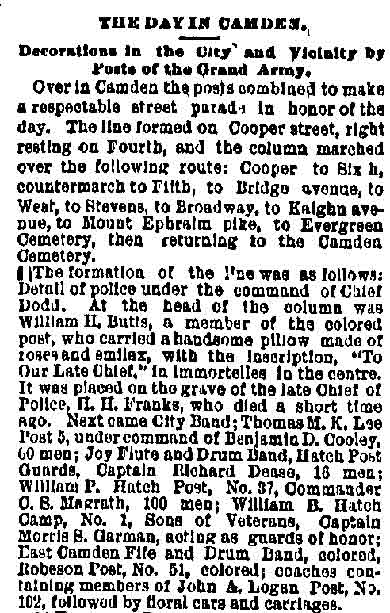
Decorations in the City and Vicinity by Posts of the Grand Army.
Over in Camden the posts combined to make a respectable street parade in honor of the day. The line formed on Cooper street, right resting on Fourth, and the column marched over the following route: Cooper to Sixth, countermarch to Fifth, to Bridge avenue, to West, to Stevens, to Broadway, to Kaighn avenue, to Mount Ephraim pike, to Evergreen Cemetery, then returning to the Camden Cemetery.
The formation of the line was as follows: Detail of police under the command of Chief Dodd. At the head of the column was William H. Butts, a member of the colored post, who carried a handsome pillow made of roses and smilax, with the inscription, “To Our Late Chief,” in immortelles in the centre. It was placed on the grave of the late Chief of Police, H. H. Franks, who died a short time ago. Next came City Band; Thomas M. K. Lee Post 5, under command of Benjamin D. Cooley, 60 men; Joy Flute and Drum Band, Hatch Post Guards, Captain Richard Dease, 16 men; William P. Hatch Post, No. 37, Commander C. S. Magrath, 100 men; William B. Hatch Camp, No. 1, Sons of Veterans, Captain Morris S. Garman, acting as guards of honor; East Camden Fife and Drum Band, colored, Robeson Post, No. 51, colored; coaches containing members of John A. Logan Post, No. 102, followed by floral cars and carriages.
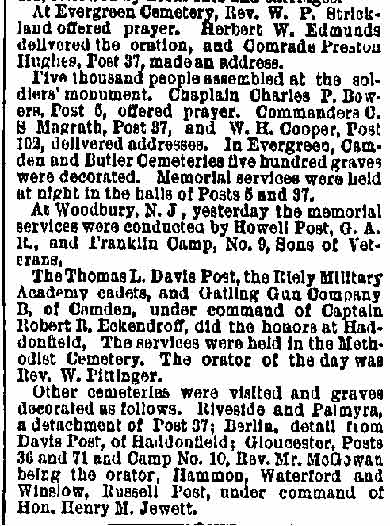
At Evergreen Cemetery, Rev. W. P. Strickland offered prayer. Herbert W. Edmunds delivered the oration, and Comrade Preston Hughes, Post 37, made an address.
Five thousand people assembled at the soldiers’ monument. Chaplain Charles P. Bowers, Post 6, offered prayer. Commanders C. S. Magrath, Post 37, and W. H. Cooper, Post 102, delivered addresses. In Evergreen, Camden and Butler Cemeteries five hundred graves were decorated. Memorial services were held at night in the halls of Posts 5 and 37.
At Woodbury, N. J., yesterday the memorial services were conducted by Howell Post, G. A. R., and Franklin Camp, No. 9, Sons of Veterans.
The Thomas L. Davis Post, the Riely Military Academy cadets, and Gatling Gun Company B, of Camden, under command of Captain Robert R. Eckendroff, did the honors at Haddonfield. The services were held in the Methodist Cemetery. The orator of the day was Rev. W. Pittinger.
Other cemeteries were visited and graves decorated as follows. Riverside and Palmyra, a detachment of Post 37; Berlin, detail from Davis Post, of Haddonfield; Gloucester, Posts 36 and 71 and Camp No. 10, Rev. Mr. McGowan being the orator; Hammon, Waterford and Winslow, Russell Post, under command of Hon. Henry M. Jewett.
Over in Camden
Philadelphia Inquirer —
Grand Army Men and School Children Join in the Services.
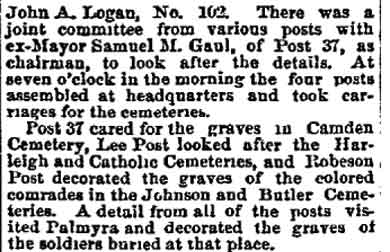
Decoration day in Camden was observed by all of the four posts: William B. Hatch, No. 37; Thomas M. K. Lee, No. 5; General William P. Robeson, No. 51, and General John A. Logan, No. 102. There was a joint committee from various posts with ex-Mayor Samuel M. Gaul, of Post 37, as chairman, to look after the details. At seven o’clock in the morning the four posts assembled at headquarters and took carriages for the cemeteries.
Post 37 cared for the graves in Camden Cemetery, Lee Post looked after the Harleigh and Catholic Cemeteries, and Robeson Post decorated the graves of the colored comrades in the Johnson and Butler Cemeteries. A detail from all of the posts visited Palmyra and decorated the graves of the soldiers buried at that place.
At 2 o’clock imposing ceremonies were held at the monument near the City Hall. The exercises opened with prayers by Livingston Allen and J. Kelly Brown. The orders from national and department headquarters were read by John F. Cassman. Fully 200 public school children strewed flowers around the monument as they sang “Cover Them Over With Flowers.” After Arthur Stanley, of Post 5, had made an address, the guards from Hatch Post fired a salute, and benediction was pronounced by J. Kelly Brown, chaplain of Hatch Post.
The four posts, accompanied by the school children and headed by a platoon of the Camden police force, under command of Chief Dodd, marched to the Sixth Regiment Armory, where Samuel H. Grey delivered an address. The school children sang “My Country, ‘Tis of Thee.”
The most solemn ceremony of all occurred at Post 37 Hall, in the evening. The names of the deceased comrades were read by the adjutant. As each name was called one of the members of the post—who were in line on either side of the room—stepped forward and deposited a bouquet on a casket in front of the altar.
The grave of the late Chief of Police Harry Franks was decorated with a star and crescent by the members of the police department.
Stockton
Philadelphia Inquirer —
Special to The Inquirer.
STOCKTON, June 12.—Miss Mamie Jaquillard, daughter of ex-Freeholder Jaquillard, of the Third ward, has been united in marriage to Newton S. Danenhower. The ceremony was performed by Rev. J. B. Westcott, at the M. E. parsonage, at Collingswood.
Miss Clara Hilliard, of Twenty-fifth and High streets, is spending a month at Pemberton.
Rev. Roland Ringwalt, rector of St. Wilfred’s P. E. Church, has invited General John A. Logan Post, 102, G. A. R., to attend divine service on Sunday evening, July 4.
Jersey Veterans Have a Gala Day
Philadelphia Inquirer —
They Parade and Smell Gunpowder at Washington Park on the Delaware.
FT. MORGAN BOMBARDED
Guns Thundered; and a Great Crowd Viewed the Warlike Spectacle. Other Features of the Day.
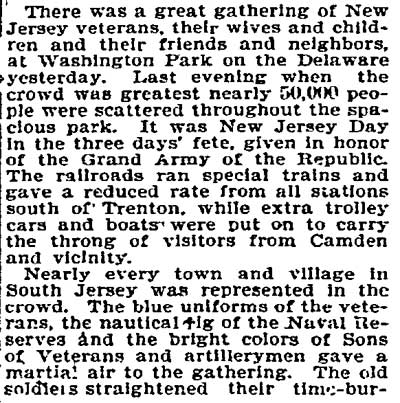
There was a great gathering of New Jersey veterans, their wives and children and their friends and neighbors, at Washington Park on the Delaware yesterday. Last evening when the crowd was greatest nearly 50,000 people were scattered throughout the spacious park. It was New Jersey Day in the three days’ fete, given in honor of the Grand Army of the Republic. The railroads ran special trains and gave a reduced rate from all stations south of Trenton, while extra trolley cars and boats were put on to carry the throng of visitors from Camden and vicinity.
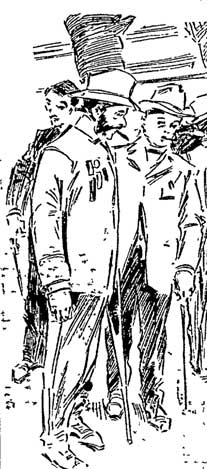
Nearly every town and village in South Jersey was represented in the crowd. The blue uniforms of the veterans, the nautical rig of the Naval Reserves and the bright colors of Sons of Veterans and artillerymen gave a martial air to the gathering. The old soldiers straightened their time-burdened frames at the sound of music and marched about the park. In the evening there was the din of thundering guns and the smell of burning powder.
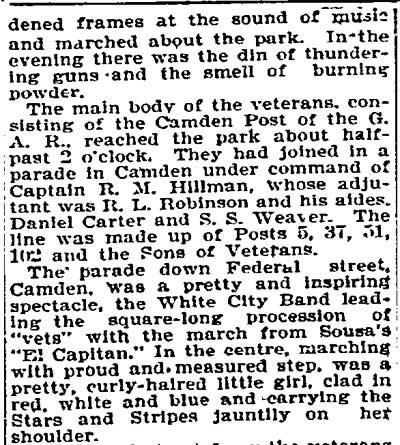
The main body of the veterans, consisting of the Camden Post of the G. A. R., reached the park about half-past 2 o’clock. They had joined in a parade in Camden under command of Captain R. M. Hillman, whose adjutant was R. L. Robinson and his aides, Daniel Carter and S. S. Weaver. The line was made up of Posts 5, 37, 51, 102 and the Sons of Veterans.
The parade down Federal street, Camden, was a pretty and inspiring spectacle, the White City Band leading the square-long procession of “vets” with the march from Sousa’s “El Capitan.” In the centre, marching with proud and measured step, was a pretty, curly-haired little girl, clad in red, white and blue and carrying the Stars and Stripes jauntily on her shoulder.
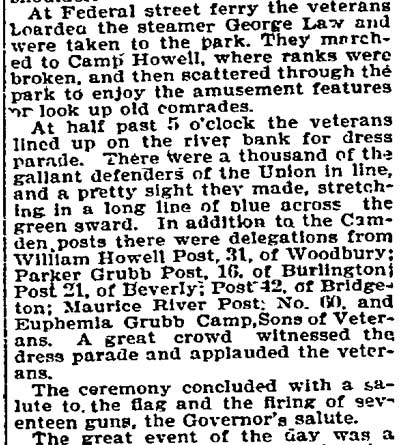
At Federal street ferry the veterans boarded the steamer George Law and were taken to the park. They marched to Camp Howell, where ranks were broken, and then scattered through the park to enjoy the amusement features or look up old comrades.
At half past 5 o’clock the veterans lined up on the river bank for dress parade. There were a thousand of the gallant defenders of the Union in line, and a pretty sight they made, stretching in a long line of blue across the green sward. In addition to the Camden posts there were delegations from William Howell Post, 31, of Woodbury; Parker Grubb Post, 16, of Burlington; Post 21, of Beverly; Post 42, of Bridgeton; Maurice River Post, No. 60, and Euphemia Grubb Camp, Sons of Veterans. A great crowd witnessed the dress parade and applauded the veterans.
The ceremony concluded with a salute to the flag and the firing of seventeen guns, the Governor’s salute.
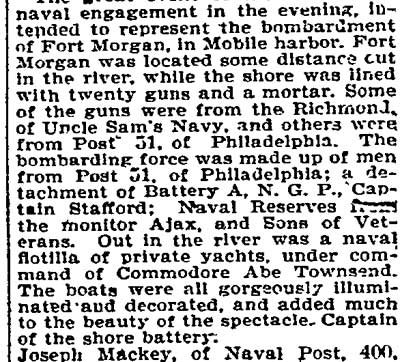
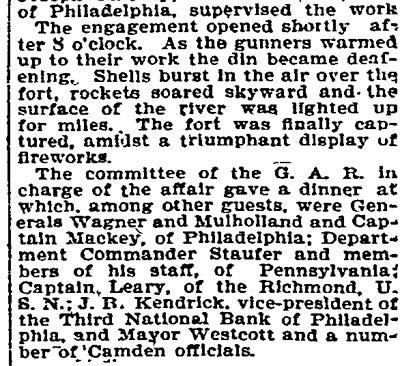
The great event of the day was a naval engagement in the evening, intended to represent the bombardment of Fort Morgan, in Mobile harbor. Fort Morgan was located some distance out in the river, while the shore was lined with twenty guns and a mortar. Some of the guns were from the Richmond, of Uncle Sam’s Navy, and others were from Post 51, of Philadelphia. The bombarding force was made up of men from Post 51, of Philadelphia; a detachment of Battery A, N. G. P., Captain Stafford; Naval Reserves [illegible] the monitor Ajax, and Sons of Veterans. Out in the river was a naval flotilla of private yachts, under command of Commodore Abe Townsend. The boats were all gorgeously illuminated and decorated, and added much to the beauty of the spectacle. Captain of the shore battery: Joseph Mackey, of Naval Post, 400, of Philadelphia, supervised the work.
The engagement opened shortly after 8 o’clock. As the gunners warmed up to their work the din became deafening. Shells burst in the air over the fort, rockets soared skyward and the surface of the river was lighted up for miles. The fort was finally captured, amidst a triumphant display of fireworks.
The committee of the G. A. R. in charge of the affair gave a dinner at which, among other guests, were Generals Wagner and Mulholland and Captain Mackey, of Philadelphia; Department Commander Stauer and members of his staff, of Pennsylvania; Captain Leary, of the Richmond, U. S. N.; J. B. Kendrick, vice-president of the Third National Bank of Philadelphia, and Mayor Westcott and a number of Camden officials.
Camden G.A.R. Posts Preparing for National Encampment
Philadelphia Inquirer —
The Camden G. A. R. posts are making preparations for taking care of the New Jersey veterans attending the National Encampment of the G. A. R. in Philadelphia next September. Arrangements have been made to quarter 2000 comrades in the new armory building, on Haddon avenue. Mayor Hatch will be asked to appoint a committee to co-operate with the veterans in giving the visitors a fitting reception.