Introduction
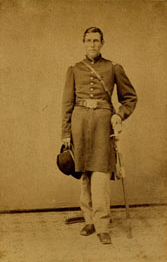
Samuel M. Gaul
Samuel M. Gaul was born in Philadelphia on June 2, 1822. After learning the shoemaker’s trade, he came to Camden in 1858. When the Civil War broke out, Samuel Gaul enlisted as a First Lieutenant of Company G, Fourth New Jersey Volunteers. In 1862 he was promoted to Captain, and commanded Company F of the Fourth New Jersey for the duration of the war.
Returning to Camden after the war, Samuel Gaul involved himself in politics, as a Republican. He was elected Assessor of the South Ward in 1870. In 1871, Samuel M. Gaul was the first mayor to be elected under the Charter of 1871. He served a three year term, and was succeeded by John H. Jones in 1874.
At the time of the 1880 census Samuel Gaul, wife Louis, and children Sarah, Daniel, and Henry, lived at 310 Walnut Street in Camden. He was then working as an agent selling steamboat tickets. By 1887 the family had moved to 422 Royden Street. Samuel Gaul was then working as a claims adjuster for Civil War soldiers. A member of William B. Hatch Post No. 37 of the Grand Army of the Republic, he served as chaplain in the 1880s. He was also active with the Independent Order of Odd Fellows. Samuel Gaul later moved to Palmyra NJ, where he died of pneumonia on August 26, 1895.
History of Camden County, New Jersey
George Reeser Prowell — 1886
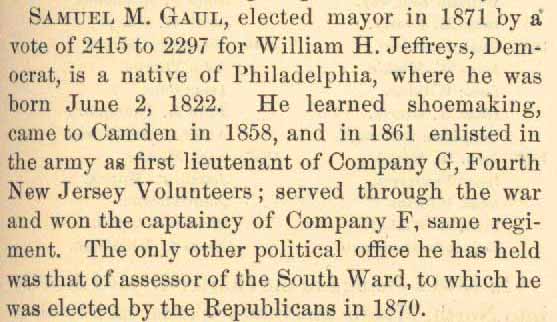
History of Camden County, New Jersey — George Reeser Prowell, 1886
Samuel M. Gaul, elected mayor in 1871 by a vote of 2415 to 2297 for William H. Jeffreys, Democrat, is a native of Philadelphia, where he was born June 2, 1822. He learned shoemaking, came to Camden in 1858, and in 1861 enlisted in the army as first lieutenant of Company G, Fourth New Jersey Volunteers; served through the war and won the captaincy of Company F, same regiment. The only other political office he has held was that of assessor of the South Ward, to which he was elected by the Republicans in 1870.
Regimental History: Fourth New Jersey Infantry
The Union Army, vol. 3
Fourth Infantry.—Cols., James H. Simpson, William B. Hatch, William Birney, Edward L. Campbell; Lieut.-Cols., J. L. Kirby Smith, Barzilla Ridgway, Charles Ewing, Baldwin Hufty; Majs., Samuel Mulford, David Vickers.
The 4th was organized under the provisions of an act of Congress, approved July 22, 1861. It was fully organized, equipped and officered by Aug. 19, at which time it was mustered into the U. S. service for three years, at Camp Olden, Trenton. It left the state the next day with 38 officers, 871 non-commissioned officers and privates, a total of 909. It reached Washington on Aug. 21, accompanied by a battery of 6 pieces, furnished by the state and commanded by Capt. William Hexamer, who had been waiting for six months for an opportunity to enter the service. It was assigned to the brigade of Gen. Kearney, then consisting of the 1st, 2nd and 3d N. J. regiments.
Immediately after the first battle of Bull Run it joined the brigade near Alexandria, and in the operations along the line of the Orange & Alexandria railroad acted as a support to the advance. Just before the battle of West Point, Va., the brigade relieved the troops in advance and the men lay on their arms in line of battle until daylight, when they were ordered forward, the 4th being held as a reserve. At the battle at Gaines’ Mill the brigade was formed in two lines, the 4th being in the front, and advanced to the brow of a hill, where the 4th was sent into the woods by order of an aid of Gen. McClellan, all the brigade being engaged at the most dangerous and difficult parts of the field, until at last, wearied, bleeding, ammunition exhausted, the brigade slowly retired and crossing the bridge at 11 o’clock, reached its old camp about midnight, having sustained a total loss of over 1,000 men in killed and wounded, of whom some 500, belonging to the 4th were captured in a body, having refused to retreat from the woods when they might have done so, and continuing to fight until completely surrounded. Besides this loss in prisoners the regiment lost 38 killed and 111 wounded. The regiment participated in the battles of Charles City cross-roads, White Oak Swamp, Malvern Hill, Manassas, Chantilly and Crampton’s Gap, the total loss of the brigade during the latter engagement being 174 in killed and wounded, Adjt. Studdiford being among the slain.
It took part in the movement against Fredericksburg, but in the Gettysburg campaign the 4th was detailed for provost duty in Washington. It was back with the brigade again in time for the spring campaign of 1864. At the battle of the Wilderness the 1st, 4th and 10th regiments, lying on the left, were several times attacked with great ferocity by the Confederates, but at nightfall still held substantially the ground occupied by them in the morning—a heavy assault by the Confederate Gen. Gordon just at dusk being repulsed with heroic gallantry. Among the wounded in that engagement was Lieut.-Col. Van Syckel of the 4th. At the battle of Spottsylvania the regiment participated in the charge upon the “bloody angle,” winning its share of the glory and sustaining its share of casualties. During the first eleven days of Grant’s campaign against Richmond the regiment lost 26 killed, 126 wounded and 42 missing. The 4th fought at the North Anna river, Hanover Court House, Totopotomoy creek, Cold Harbor, Weldon railroad, Snicker’s gap, Strasburg, Winchester and Charlestown. At the battle of the Opequan the 4th was with the troops that pressed forward, swept up the opposite hill and forced back the Confederate line, obtaining permanent possession of the hill and holding it, though constantly exposed to a fire which inflicted severe loss, the 4th having 2 killed, 18 wounded and 1 missing. At Fisher’s hill a private of the 4th named Beach compelled a Confederate lieutenant-colonel to surrender his sword, and there were other instances of daring no less noteworthy.
After Lee’s surrender the regiment was assigned to what was known as the provisional corps, Army of the Potomac, until mustered out on July 9, 1865. The total strength of the regiment was 2,036, and it lost during service 29 by resignation, 319 by discharge, 83 by promotion, 81 by transfer, 257 by death, 372 by desertion, 3 by dismissal, 109 not accounted for, mustered out 783.
Battles Fought
Fought on 28 October 1861 at Mason’s Hill, VA.
Fought on 27 June 1862 at Gaines Farm, VA.
Fought on 27 June 1862 at Gaines’ Mill, VA.
Fought on 27 August 1862 at Manassas, VA.
Fought on 14 September 1862 at Crampton’s Gap, MD.
Fought on 13 December 1862 at Fredericksburg, VA.
Fought on 05 May 1864 at Wilderness, VA.
Fought on 06 May 1864 at Wilderness, VA.
Fought on 11 May 1864 at Spotsylvania Court House, VA.
Fought on 12 May 1864 at Spotsylvania Court House, VA.
Fought on 18 May 1864.
Fought on 24 May 1864 at North Anna River, VA.
Fought on 01 June 1864 at Cold Harbor, VA.
Fought on 02 June 1864 at Cold Harbor, VA.
Fought on 03 June 1864 at Cold Harbor, VA.
Fought on 13 June 1864 at Petersburg, VA.
Fought on 18 July 1864 at Snicker’s Ford, VA.
Fought on 17 August 1864 at Winchester, VA.
Fought on 19 September 1864 at Opequan, VA.
Fought on 19 September 1864 at Winchester, VA.
Fought on 19 October 1864 at Cedar Creek, VA.
Fought on 06 January 1865 at Petersburg, VA.
Fought on 31 March 1865 at Petersburg, VA.
Fought on 02 April 1865 at Petersburg, VA.
Political Organization
Philadelphia Public Ledger —
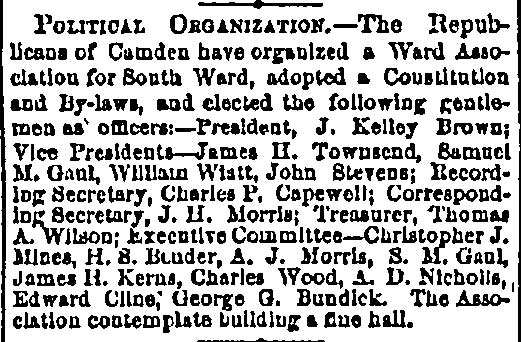
Political Organization.—The Republicans of Camden have organized a Ward Association for South Ward, adopted a Constitution and By-laws, and elected the following gentlemen as officers:—President, J. Kelley Brown; Vice Presidents—James H. Townsend, Samuel M. Gaul, William Wiatt, John Stevens; Recording Secretary, Charles P. Capewell; Corresponding Secretary, J. H. Morris; Treasurer, Thomas A. Wilson; Executive Committee—Christopher J. Mines, H. S. Bender, A. J. Morris, S. M. Gaul, James H. Kerns, Charles Wood, A. D. Nicholls, Edward Cline; George G. Bundick. The Association contemplate building a fine hall.
Republican Association of South Ward
The New Republic, Camden —
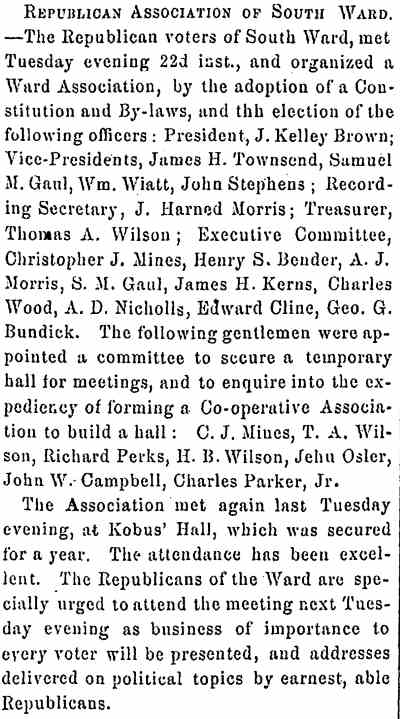
Republican Association of South Ward.—The Republican voters of South Ward, met Tuesday evening 22d inst., and organized a Ward Association, by the adoption of a Constitution and By-laws, and the election of the following officers: President, J. Kelley Brown; Vice-Presidents, James H. Townsend, Samuel M. Gaul, Wm. Wiatt, John Stephens; Recording Secretary, J. Harned Morris; Treasurer, Thomas A. Wilson; Executive Committee, Christopher J. Mines, Henry S. Bender, A. J. Morris, S. M. Gaul, James H. Kerns, Charles Wood, A. D. Nicholls, Edward Cline, Geo. G. Bundick. The following gentlemen were appointed a committee to secure a temporary hall for meetings, and to enquire into the expediency of forming a Co-operative Association to build a hall: C. J. Mines, T. A. Wilson, Richard Perks, H. B. Wilson, Jehu Osler, John W. Campbell, Charles Parker, Jr.
The Association met again last Tuesday evening, at Kobus’ Hall, which was secured for a year. The attendance has been excellent. The Republicans of the Ward are specially urged to attend the meeting next Tuesday evening as business of importance to every voter will be presented, and addresses delivered on political topics by earnest, able Republicans.
Shawl Stolen
Philadelphia Inquirer —
Emma Holland, colored, was before Mayor Gaul yesterday afternoon, charged by a Mrs. Murray with having stolen a shawl from her. Held for a hearing.
Camden City Briefs
Philadelphia Inquirer —
Held to Answer.
On Saturday, Officer J. L. Mason arrested Charles Verga on a charge of committing an assault and battery on John Smith, (colored.) Mayor Gaul held him in $300 to answer. George Alloways was also held in $100 for an assault and battery on Charles Verga.
Struck by Lightning.
A barn in the vicinity of Haddonfield, belonging to a Mr. Horner, was struck by lightning on Saturday afternoon during the shower, but not much damage was sustained. A number of persons were in it at the time, and two of them were knocked down by the flash, but not much hurt.
Funding the City Debt.
Seventy five thousand dollars of the floating debt of Camden are again to be funded the present year. This is the full extent allowed by the charter in any one year. Last year there were also $75,000 funded.
Committed.
Henry Garner, for assault and battery on Lewis Saunders, has been committed by Mayor Gaul in default of $300 to answer at the October term of court.
Police Appointment
Philadelphia Inquirer —
Officer Charles S. Cotting has resigned from his position on the police force of Camden and William A. White, ex-officer, has been appointed by Mayor Gaul in his place.
Abe Lower Opens the Campaign
Camden Democrat —
On Wednesday night, this “champion of light weights” in the radical party, in company with Howard Lee, Willim [sic] Lee, Boston Peter, and others, opened the campaign in their usual way at Goetz’s Hotel. Lower accosted John Sands, Jr., of Gloucester City, who was present, and asked him why he did not put on a Grant cape and cap. Sands replied that he did not belong to that party, and that he was marshal of the Greeley and Brown Club of Gloucester City. Then it was that Lower struck Sands, and the crowd joined him in kicking and beating their victim in a cruel manner. When Sands recovered himself, he found that $17 and his hat had been taken from him. On Thursday morning Sands made complaint before Justice Cassady. On his way home, in company with Michael Kelly, he was attacked by the same party, led on by a Philadelphia rough named William Osburn. Lower made a blow at Sands, and the rest of the gang made for Kelly, but he was more than a match for them all, although struck by a brick in the back, thrown by Howard Lee. Kelly planted the blows all around. Bip—and down went one. Squlp—and a foot lifted Lower clear. Flam—and a blow by the ear “made the thunder for to roll” in that fellow’s ear. So, in turn, he put the “moral power” of goat town on each—laying them out in perfect order. Such a set of “soreheads,” profusely bandaged, are rarely seen. As the fight progressed, President Hackett of the City Council came up and ordered policemen Smith and Hollinger to arrest the whole party. They went over to the offenders, had a talk with them, and walked off. Having refused to make the arrests, Mr. Hackett started for the Mayor’s office to make complaint. If Mayor Gaul fails to bring them to account, he will fall short of his duty. Lower was subsequently arrested, and taken before Justice Cassady, to whom he was quite impertinent—wishing him to know that he, Lower, was “one of the sovereigns,” &c. He was held to bail for assault and battery and riotous conduct. George Gilbert and Thos. Lee are his sureties. Unless a severe penalty is placed upon these offenders, we shall have these disgraceful scenes frequently enacted between this and the election.
The Fire
Philadelphia Inquirer —
In accordance with the request of City Councils, Mayor Gaul yesterday called a meeting of citizens to aid the destitute families who were burned out by the fire at Second street and Bridge avenue, on Monday. Quite a large meeting convened in the court house, and a liberal sum was realized. Thirteen families were rendered homeless, and most of them are in great distress.
Civil War Pension Record
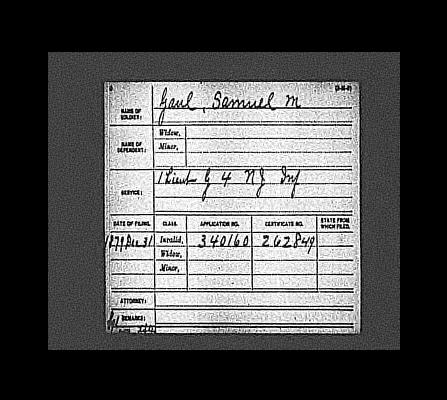
Samuel M. Gaul — Civil War Pension Record
William B. Hatch Post No. 37, G.A.R.
History of Camden County, New Jersey — George Reeser Prowell, 1886
William B. Hatch Post No. 37, of Camden, was instituted and chartered November 25, 1879, with eighty-one members and the following named Post officers:
Post Commander, John E. Grubb; Senior Vice-Commander, Richard J. Robinson; Junior Vice-Commander, Daniel J. Fullen; Surgeon, Thomas G. Rowand, M.D.; Chaplain, John Quick; Officer of the Day, John A. Dall; Officer of the Guard, Edmund G. Jackson, Jr.; Quartermaster, Christopher J. Mines, Jr.; Adjutant, Benjamin J. Pierce; Sergeant-Major, William A. Tattern; Quartermaster-Sergeant, William B. E. Miller.
At the first meeting of the Post it was decided by a unanimous vote to name it in honor of the late Colonel William B. Hatch, of the Fourth Regiment. When Mrs. C. Hatch, the mother of the colonel was informed that the post had honored the memory of her son by naming it after him, she sent to the Post the following response:
Camden N. J.,
November 26th, 1879John E. Grubb, Post Commander
Dear Sir,
It will afford me much pleasure to be identified with Post 37, G. A. R., named in honor of my son, William B. Hatch, by allowing me to present to the same its colors. The memory of my son is ever dear to me, and, while at the same moment I may have thought the sacrifice too great an affliction, yet I was consoled by the fact that I gave him up that this Union might be preserved. It was duty and patriotism that called him, and while I mourn him as a mother for a well-beloved son, yet I would not have stayed him, for the love of country and the upholding of this glorious Republic is what every mother should instill into her sons, as the purest and holiest spirit.Yours truly,
C. HatchThe following is a complete roster of this post for 1886:
Post Commander, Benjamin H. Connelly; Senior Vice-Commander, Adam C. Smith; Junior Vice-Commander, William Haegele; Surgeon, George Pfau; Chaplain, Samuel Gaul; Officer of the Day, Robert Crawford; Officer of the Guard, John D. Cooper; Quartermaster, Samuel J. Fenner; Adjutant, William B. Summers; Sergeant-Major, Stacy H. Bassett; Quartermaster-Sergeant, Otto K. Lockhart.
Comrades: Philip Achenbach, George L. Allchin, Isaac Albertson, Joseph Applegate, John W. Barclay, Martin M. Barney, Joseph Baxter, William W. Bennett, Charles L. Bennett, Henry Bickering, Abel Biddle, George K. Biddle, John Bieri, Robert M. Bingham, Socrates T. Bittle, George W. Bittle, Benjamin F. Blizzard, Joseph Borton, Frederick Bowers, Benjamin M. Braker, John Breyer, William H. Brians, Wm. J. Broadwater, William Broadwater, John Brown, Harris Brooks, William H. Brooks, Joseph F. Bryan, Joseph Buddew, J. Q. Burniston, George Burton, Frederick Buser, Thomas L. Bush, William Butcher, Isaac B. Buzby, Edward C. Cattell, Joseph Cameron, James H. Carey, William Carey, James Chadwick, James Chafey, George M. Chester, James D. Chester, Lewis L. Chew, Henry S. Chew, John W. Churn, Andrew B. Cline, Charles Clarke, Samuel J. Cook, Levi E. Cole, John J. Collins, John C. Cooper, John W. Cotner, Thomas L. Conly, Harvey M. Cox, Jason S. Cox, Harris Crane, Charles Cress, Joel G. Cross, O. C. Cunningham, John A. Dall, John Dalby, John H. Damon, Westley Dare, John E. Dawson, Adam T. Dawson, James L. Davis, William Davis, Amos R. Dease, Henry Deford, Lewis F. Derousse, Michael Devinney, Glendora Devo, John Digney, Joseph Dilks, William A. Dobbins, George W. Dunlap, Aaron B. Eacritt, John J. Early, Christopher Ebele, Godfrey Eisenhart, John Elberson, Charles Elwell, Charles Eminecker, John Esler, John H. Evans, Charles S. Fackler, James Fanington, James A. Farraday, John H. Farry, John Faughey, Wm. H. Fenlin, George G. Felton, George W. Ferguson, Charles W. Fish, Israel L. Fish, James Finnan, Samuel B. Fisher, Edward L. Fisher, Ephraim B. Fithian, Jacob T. Fisher, Edward Fitzer, Samuel Flock, Leonard Flor, John Fox, John S. Fox, H. H. Franks, Chas. B. Frazer, Thomas J. Francis, Samuel W. Gahan, Chas. H. Gale, James Galbraith, Thomas Garman, Harry Garren, John W. Garwood, Josiah Garrison, John B. Gaskill, Richard Gaunt, Wm. German, Christopher Getsinger, Christopher Gifney, Jacob Giffens, Albert Gilbert, James Gillen, Wm. Giffins, C. C. Greany, Charles Green, W. H. Griffin, Louis Grosskops, William Grindrod, John B. Grubb, Mark H. Guest, John Guice, Alfred Haines, Charles G. Haines, Japhet Haines, George F. Hammond, Charles Hall, Solon B. Hankinson, Samuel P. Hankinson, James Hanson, Charles Hannans, H. A. Hartranft, Mahlon E. Harden, William F. Harper, George W. Hayter, Samuel B. Harbeson, J. T. Hazleton, H. Heinman, James Henderson, William H. Heward, Franklin Hewitt, James T. Hemmingway, Charles Hewitt, Edward K. Hess, Samuel B. Hickman, George Higgens, Ephraim Hillman, C. M. Hoagland, Guadaloupe Holl, William A. Holland, Isaac K. Horner, Count D. G. Hogan, William H. Howard, Baxter Howe, Alien Hubbs, Charles G. Hunsinger, Presmel D. Hughes, I. N. Hugg, Sebastian Hummell, Edward Hutchinson, C. Innes, Alfred Ivins, Benjamin Ivins, E. G. Jackson Sr., E. G. Jackson Jr., Thomas Jameson, George Jauss, William P. Jenkins, James L. Johnson, Alfred Jones, B. F. Jones, William Joline, Charles Joseph, Charles Justice, C. H. Kain, E. E. Kates, Benjamin Kebler, Frank Kebler, Peter Keen, Henry N. Killian, J. W. Kinsey, C. H. Knowlton, Thomas W. Krips, Joseph H. Large, John E. Leake, John Lecroy, Charles Leonhart, George W. Locke, E. J. Long, Charles L. Lukens, J. H. Lupton, Valentine Machemer, Edward Macloskey, Edward A. Martin, William P. Marsh, John Mapes, William Mead, William Metcalf, E. A. Meyer, C. Meyers, George Meilor, C. A. Michener, William B. E. Miller, Jacob Miller, W. D. Miller, Samuel Mills, William W. Mines, Christopher J. Mines, George Molesbury, William Moran, Edward More, Richard Morgan, John F. Moore, S. H. Moyer, Jacob L. Morton, John Muir, John J. Murphy, Isaac Murray, Charles Myers, W. H. McAllister, James McCracken, Edward C. McDowell, Hugh McGrogan, H. M. Mcllvaine, W. F. McKillip, W. J. McNeir, Lewis McPherson, E. McPherson, Jacob Naglee, William Naphas, Antonio Nosardi, Robert O’Keefe, John S. Owens, Robert Owens, Edward H. Pancoast, James Pancoast, Robert B. Patterson, William Patterson, E. W. Pease, John B. Pepper, Joel Perrine, John Peterson, D. E. Peugh, Frederick Phile, Samuel B. Pine, William M. Pine, Adon Powell, John Powell, John Portz, J. B. Prucelle, John Quick, S. E. Radcliffe, Isaac C. Randolph, James A. Regens, Philip Reilly, Charles P. Reynolds, Alexander Rhodes, Benjamin F. Richard, Andrew Ridgway, Benjamin Robbins, Edward C. Roberts, James Roberts, Richard J. Robinson, William B. Robertson, Isaac Rogers, John Rogers, William H. Rogers, Thomas G. Rowand, Sebastian Schaub, Maurice Schmidt, Christian K. Schallers, James Schofield, George W. Scott, John E. Scott, John M. Shemelia, Edward M. Siemers, John Simmons, Benjamin F. Shinn, Thomas Sheeran, James Shield, Charles Smith, George H. Smith, William W. Smith, Charles S. Small, Adolph Snow, W. Souder, Francis Senders, Robert Sparks, David C. Sprowl, Alfred L. Sparks, Abraham Springer, George W. Stewart, William L. Stevenson, Thomas G. Stephenson, Samuel R. Stockton, Thomas Stockton, Thomas H. Stone, Henry Strick, E. J. Strickland, Charles String, George F. Stull, George W. Swaney, Crosby Sweeten, William F. Tarr, William A. Tatem, Thomas S. Tanier, George Rudolph Tenner, Charles L. Test, Leonard Thomas, Benjamin Thomas, Henry C. Thomas, George F. Thorne, Wesley Thorn, Thomas W. Thornley, Alexander W. Titus, Joseph Tompkins, J. E. Troth, Isaac C. Toone, Samuel Tyler, Jacob M. Van Nest, Albert Vansciver, Joseph Wakeman, Theodore F. Walker, Charles Walton, George Walton, Joseph Welsh, David Watson, George W. Wentling, Edward West, Elmer M. West, George Weyman, Wilmer Whillden, James Whittaker, Samuel Wickward, Calvin T. Williams, George W. Williams, William H. Williams, John Williams, Samuel Winner, Amos P. Wilson, D. H. Wilson, G. A. Wilson, Richard Wilson, George Wispert, John W. Wood, Joseph Woodfield, Walter Wolfkill, E. W. Wolverton, Elijah Worthington, C. M. Wright, George B. Wright, Henry S. Wright, Wesley T. Wright, William Zane.
As of 1886, the Hatch Post met every Thursday evening in their own G. A. R. Hall, on Stevens Street, below Fifth Street. This same building had been used in the late 1870s as the original home of the congregation that formed the Tabernacle Baptist Church. The Hatch Post was affiliated with Hatch League No. 2, of the Loyal Ladies League, their auxiliary, which met at the Post Hall.
In the Political Whirl
Philadelphia Inquirer —
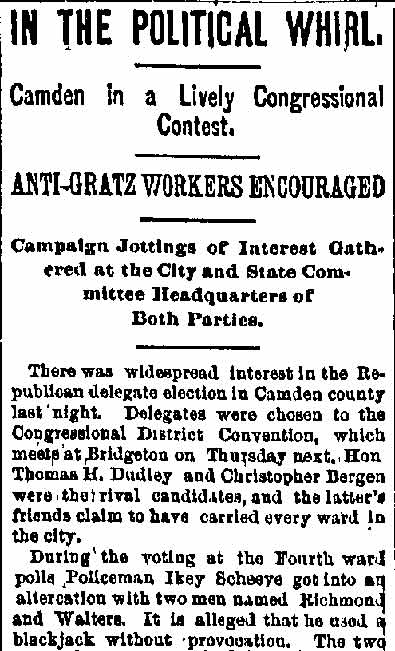
Camden in a Lively Congressional Contest.
ANTI-GRATZ WORKERS ENCOURAGED
Campaign Jottings of Interest Gathered at the City and State Committee Headquarters of Both Parties.
There was widespread interest in the Republican delegate election in Camden county last night. Delegates were chosen to the Congressional District Convention, which meets at Bridgeton on Thursday next. Hon. Thomas H. Dudley and Christopher Bergen were the rival candidates, and the latter’s friends claim to have carried every ward in the city.
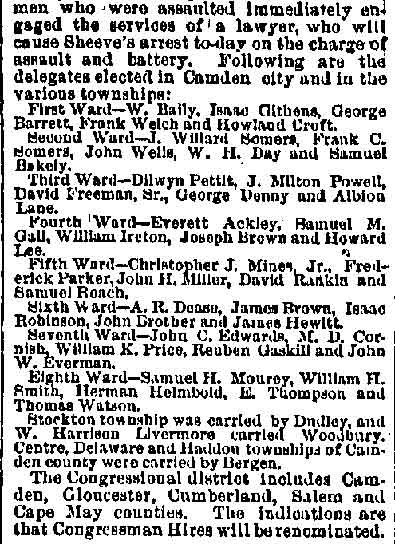
During the voting at the Fourth ward polls Policeman Ikey Scheeve got into an altercation with two men named Richmond and Walters. It is alleged that he used a blackjack without provocation. The two men who were assaulted immediately engaged the services of a lawyer, who will cause Sheeve’s arrest to-day on the charge of assault and battery. Following are the delegates elected in Camden city and in the various townships:
First Ward—W. Baily, Isaac Githens, George Barrett, Frank Welch and Howland Croft.
Second Ward—J. Willard Somers, Frank C. Somers, John Wells, W. H. Day and Samuel Bakely.
Third Ward—Dilwyn Pettit, J. Milton Powell, David Freeman, Sr., George Denny and Albion Lane.
Fourth Ward—Everett Ackley, Samuel M. Gall, William Ireton, Joseph Brown and Howard Lee.
Fifth Ward—Christopher J. Mines, Jr., Frederick Parker, John H. Miller, David Rankin and Samuel Roach.
Sixth Ward—A. R. Dease, James Brown, Isaac Robinson, John Brother and James Hewitt.
Seventh Ward—John C. Edwards, M. D. Cornish, William K. Price, Reuben Gaskill and John W. Everman.
Eighth Ward—Samuel H. Mourey, William H. Smith, Herman Helmbold, E. Thompson and Thomas Watson.
Stockton township was carried by Dudley, and W. Harrison Livermore carried Woodbury. Centre, Delaware and Haddon townships of Camden county were carried by Bergen.
The Congressional district includes Camden, Gloucester, Cumberland, Salem and Cape May counties. The indications are that Congressman Hires will be renominated.
Briefs About Town
Philadelphia Inquirer —
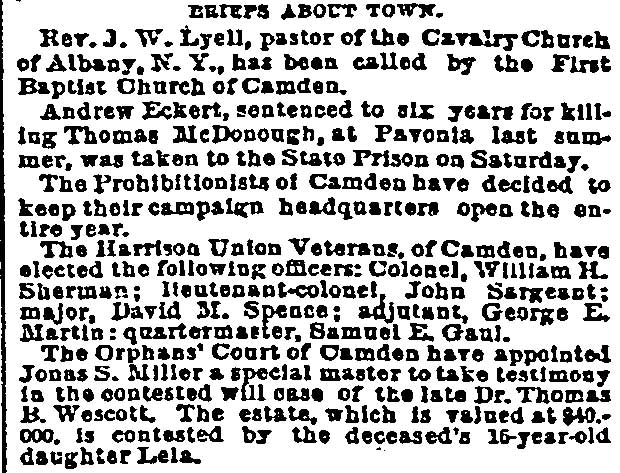
Rev. J. W. Lyell, pastor of the Cavalry [sic] Church of Albany, N. Y., has been called by the First Baptist Church of Camden.
Andrew Eckert, sentenced to six years for killing Thomas McDonough, at Pavonia last summer, was taken to the State Prison on Saturday.
The Prohibitionists of Camden have decided to keep their campaign headquarters open the entire year.
The Harrison Union Veterans, of Camden, have elected the following officers: Colonel, William H. Sherman; lieutenant-colonel, John Sargeant; major, David M. Spence; adjutant, George E. Martin; quartermaster, Samuel E. Gaul.
The Orphans’ Court of Camden have appointed Jonas S. Miller a special master to take testimony in the contested will case of the late Dr. Thomas B. Wescott. The estate, which is valued at $40,000, is contested by the deceased’s 16-year-old daughter Lela.
Over in Camden
Philadelphia Inquirer —
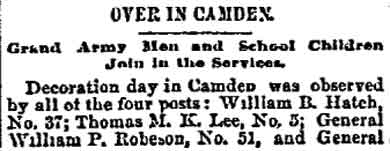
Grand Army Men and School Children Join in the Services.
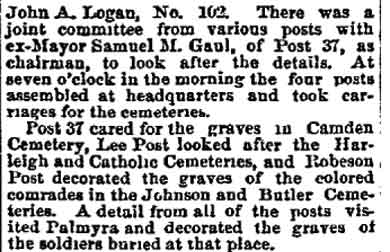
Decoration day in Camden was observed by all of the four posts: William B. Hatch, No. 37; Thomas M. K. Lee, No. 5; General William P. Robeson, No. 51, and General John A. Logan, No. 102. There was a joint committee from various posts with ex-Mayor Samuel M. Gaul, of Post 37, as chairman, to look after the details. At seven o’clock in the morning the four posts assembled at headquarters and took carriages for the cemeteries.
Post 37 cared for the graves in Camden Cemetery, Lee Post looked after the Harleigh and Catholic Cemeteries, and Robeson Post decorated the graves of the colored comrades in the Johnson and Butler Cemeteries. A detail from all of the posts visited Palmyra and decorated the graves of the soldiers buried at that place.
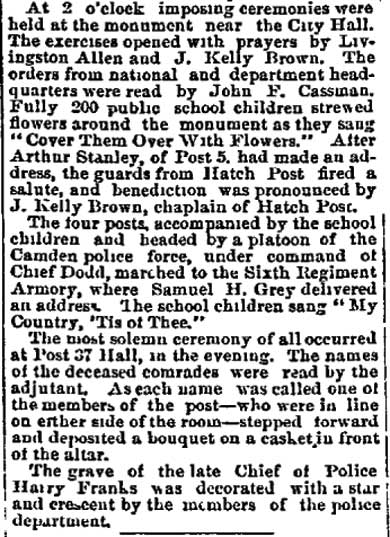
At 2 o’clock imposing ceremonies were held at the monument near the City Hall. The exercises opened with prayers by Livingston Allen and J. Kelly Brown. The orders from national and department headquarters were read by John F. Cassman. Fully 200 public school children strewed flowers around the monument as they sang “Cover Them Over With Flowers.” After Arthur Stanley, of Post 5, had made an address, the guards from Hatch Post fired a salute, and benediction was pronounced by J. Kelly Brown, chaplain of Hatch Post.
The four posts, accompanied by the school children and headed by a platoon of the Camden police force, under command of Chief Dodd, marched to the Sixth Regiment Armory, where Samuel H. Grey delivered an address. The school children sang “My Country, ‘Tis of Thee.”
The most solemn ceremony of all occurred at Post 37 Hall, in the evening. The names of the deceased comrades were read by the adjutant. As each name was called one of the members of the post—who were in line on either side of the room—stepped forward and deposited a bouquet on a casket in front of the altar.
The grave of the late Chief of Police Harry Franks was decorated with a star and crescent by the members of the police department.
Samuel M. Gaul, Former Mayor, Dead
Trenton Times —
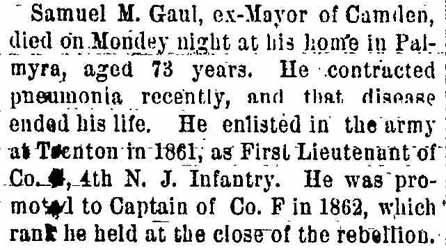
Samuel M. Gaul, ex-Mayor of Camden, died on Monday night at his home in Palmyra, aged 73 years. He contracted pneumonia recently, and that disease ended his life. He enlisted in the army at Trenton in 1861, as First Lieutenant of Co. G, 4th N. J. Infantry. He was promoted to Captain of Co. F in 1862, which rank he held at the close of the rebellion.