Mortimer Wilson
MORTIMER WILSON was born on October 14, 1845 in Pennsylvania to Thomas Alexander Wilson and his wife the former Harriette Barry. His father, a house carpenter, had brought his family to Camden’s South Ward by the time the 1860 Census was enumerated. When the Census was taken Mortimer Wilson was the oldest of six children then at home. The younger siblings were Anna, Thomas, Alfred, Harriet, and Caroline. Two more children were born after the 1860 Census, Mary and Levi.
In the 1860s Mortimer Wilson joined Independence Fire Company No. 3, one of Camden’s volunteer fire companies. In time he served as treasurer of the organization.
The 1870 Census shows that Mortimer Wilson had married. He was living in the South Ward with his wife Corrilla and one year-old son John B. Wilson, in a house next door to his parents and siblings. Mortimer Wilson was then working as a house painter. Mortimer Wilson had a talent for art, and when the 1878–1879 Camden City Directory was compiled Mortimer Wilson was working as a “scene painter.” Sadly his wife Corrilla died in 1875 at the age of 23, leaving Mortimer Wilson with three sons, John B., Mortimer, and Lloyd Wilson. On January 18, 1877 he was again married, this time to Charlotte E. Leach. The Wilson are listed in the 1878–1879 Directory at 810 Kaighn Avenue. The 1879–1880 edition shows them living at 209 Bailey Street in North Camden. The 1880 Census, taken on June 21, shows the Mortimer and Lottie Wilson at 840 South 6th Street with Mortimer Wilson’s three sons. A daughter, Ida Kendall Wilson, was born in June of 1880 in Camden. Mortimer Wilson and family remained at 840 South 6th Street through 1890. He was still living at that address when he was appointed to the Camden Fire Department as Foreman of then yet to be organized Engine Company 3, at 18134 Broadway.
On June 1, 1890 Engine Company 3 of the Camden Fire Department was organized on Broadway near Ferry Avenue. Charter members included Mortimer Wilson, foreman, Samuel Lodge, engineer; John Helmbold, stoker; Joseph Reed, hoseman; William Deno, driver; and John Ware, hoseman. John Helmbold resigned on August 1, 1890, and Joseph Reed was promoted to Stoker. George Shields joined the company on August 14, 1890 as a hoseman, in the spot made available by Reed’s promotion. Mortimer Wilson was still foreman of Engine Company 3 in the spring of 1891, however, in the spring of 1892 he left the Fire Department, and William Deno had been promoted to the post of foreman at Engine Company 3. Mortimer Wilson and family were still living at 840 South 6th Street in 1892.
The 1893–1894 and 1894–1895 City Directories show Mortimer Wilson at 640 North 2nd Street in North Camden. He had gone back to work as an artist. Mortimer Wilson’s son Mortimer died on February 8, 1894 and was buried at Evergreen cemetery in Camden.
The 1895–1896 Directory has him living at 527 South 2nd Street. The 1896 Directory gives his address as 633 White Street in South Camden. The Directories for 1897 and 1898 show Mortimer Wilson at 207 Washington Street. He was by this time working as a painter for the Pennsylvania Railroad. He does not appear in the 1899 City Directory in Camden, the 1900 Census, or the 1906 City Directory, and it is evident that he left Camden.
Mortimer Wilson appears in the 1920 Census living with his daughter Mrs. Ida Beard and her family in Woodbury, New Jersey. He died on September 1, 1923 and was buried at Evergreen cemetery in Camden.
Camden News Budget
Philadelphia Inquirer —
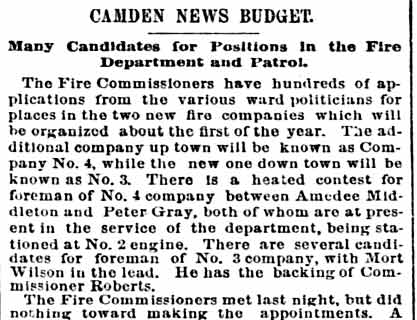
The Fire Commissioners have hundreds of applications from the various ward politicians for places in the two new fire companies which will be organized about the first of the year. The additional company up town will be known as Company No. 4, while the new one down town will be known as No. 3. There is a heated contest for foreman of No. 4 company between Amedee Middleton and Peter Gray, both of whom are at present in the service of the department, being stationed at No. 2 engine. There are several candidates for foreman of No. 3 company, with Mort Wilson in the lead. He has the backing of Commissioner Roberts.
The Fire Commissioners met last night, but did nothing toward making the appointments.
Camden’s Fire Laddies Parade
Philadelphia Inquirer —
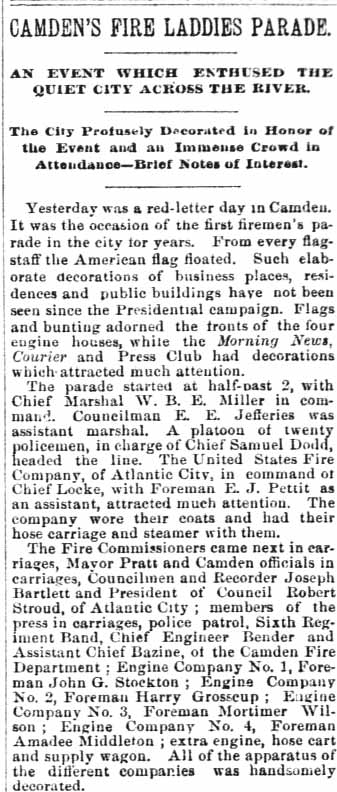
Yesterday was a red-letter day in Camden. It was the occasion of the first firemen’s parade in the city for years. From every flagstaff the American flag floated. Such elaborate decorations of business places, residences and public buildings have not been seen since the Presidential campaign. Flags and bunting adorned the fronts of the four engine houses, while the Morning News, Courier and Press Club had decorations which attracted much attention.
The parade started at half-past 2, with Chief Marshal W. B. E. Miller in command. Councilman E. E. Jefferies was assistant marshal. A platoon of twenty policemen, in charge of Chief Samuel Dodd, headed the line. The United States Fire Company, of Atlantic City, in command of Chief Locke, with Foreman E. J. Pettit as an assistant, attracted much attention. The company wore their coats and had their hose carriage and steamer with them.
The Fire Commissioners came next in carriages, Mayor Pratt and Camden officials in carriages, Councilmen and Recorder Joseph Bartlett and President of Council Robert Stroud, of Atlantic City; members of the press in carriages, police patrol, Sixth Regiment Band, Chief Engineer Bender and Assistant Chief Bazine, of the Camden Fire Department; Engine Company No. 1, Foreman John G. Stockton; Engine Company No. 2, Foreman Harry Grosscup; Engine Company No. 3, Foreman Mortimer Wilson; Engine Company No. 4, Foreman Amadee Middleton; extra engine, hose cart and supply wagon. All of the apparatus of the different companies was handsomely decorated.
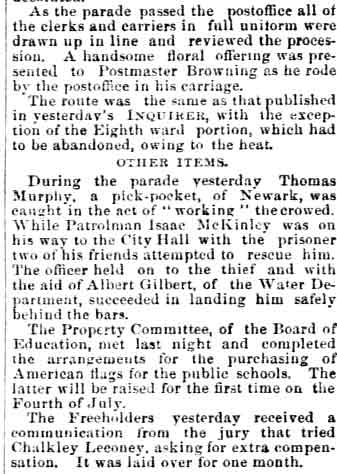
As the parade passed the postoffice all of the clerks and carriers in full uniform were drawn up in line and reviewed the procession. A handsome floral offering was presented to Postmaster Browning as he rode by the postoffice in his carriage.
The route was the same as that published in yesterday’s Inquirer, with the exception of the Eighth ward portion, which had to be abandoned, owing to the heat.
Other Items.
During the parade yesterday Thomas Murphy, a pick-pocket, of Newark, was caught in the act of “working” the crowd. While Patrolman Isaac McKinley was on his way to the City Hall with the prisoner two of his friends attempted to rescue him. The officer held on to the thief and with the aid of Albert Gilbert, of the Water Department, succeeded in landing him safely behind the bars.
The Property Committee, of the Board of Education, met last night and completed the arrangements for the purchasing of American flags for the public schools. The latter will be raised for the first time on the Fourth of July.
The Freeholders yesterday received a communication from the jury that tried Chalkley Leconey, asking for extra compensation. It was laid over for one month.
Camden’s Big Fire
Philadelphia Inquirer —
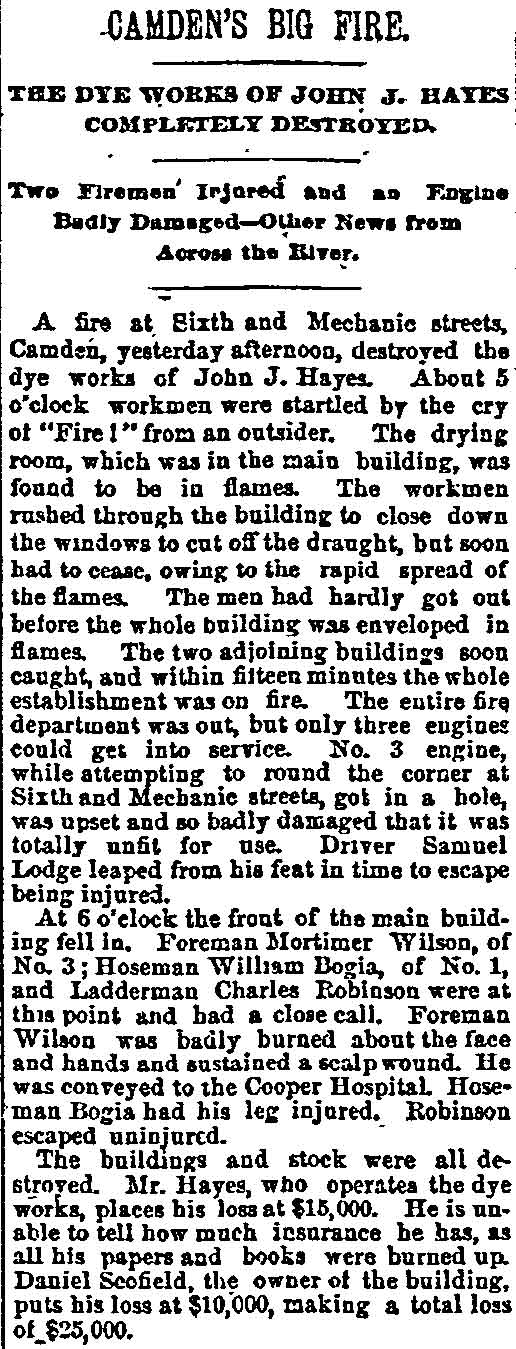
The Dye Works of John J. Hayes Completely Destroyed.
Two Firemen Injured and an Engine Badly Damaged—Other News From Across the River.
A fire at Sixth and Mechanic streets, Camden, yesterday afternoon, destroyed the dye works of John J. Hayes. About 5 o’clock workmen were startled by the cry of “Fire!” from an outsider. The drying room, which was in the main building, was found to be in flames. The workmen rushed through the building to close down the windows to cut off the draught, but soon had to cease, owing to the rapid spread of the flames. The men had hardly got out before the whole building was enveloped in flames. The two adjoining buildings soon caught, and within fifteen minutes the whole establishment was on fire. The entire fire department was out, but only three engines could get into service. No. 3 engine, while attempting to round the corner at Sixth and Mechanic streets, got in a hole, was upset and so badly damaged that it was totally unfit for use. Driver Samuel Lodge leaped from his seat in time to escape being injured.
At 6 o’clock the front of the main building fell in. Foreman Mortimer Wilson, of No. 3; Hoseman William Bogia, of No. 1, and Ladderman Charles Robinson were at this point and had a close call. Foreman Wilson was badly burned about the face and hands and sustained a scalp wound. He was conveyed to the Cooper Hospital. Hoseman Bogia had his leg injured, Robinson escaped uninjured.
The buildings and stock were all destroyed. Mr. Hayes, who operates the dye works, places his loss at $15,000. He is unable to tell how much insurance he has, as all his papers and books were burned up. Daniel Scofield, the owner of the building, puts his loss at $10,000, making a total loss of $25,000.