Introduction
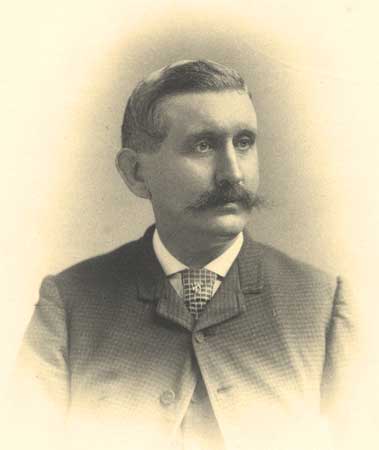
Howland Croft
Howland Croft was born January 16, 1839, at Wilsden, in Yorkshire, England, the son of John and Ann Howland Croft. His brother, John Croft Jr., had joined the Church of Latter Day Saints while in England, and had come to America in 1860, settling in Utah, while his sister Margaret and her husband had settled in Camden NJ.
On October 16, 1867 Howland Croft left England with his family and sailed to Philadelphia PA on the ship “City of Paris.” After working in mills in Philadelphia, he went into business for himself with a few partners. In 1884 he partnered with Herbert Priestly, whom he had known as a young man in England, and in 1885 the two founded and operated a worsted mill which operated until the early 1950s on Broadway between Winslow Street and Jefferson Street in Camden NJ.
Howland Croft passed away in Camden NJ on April 27, 1900 from diabetes, and was buried at Harleigh Cemetery in Camden.
The Howland Croft, Sons & Company mill was destroyed by fire on June 10, 2011.

Howland Croft — signature
History of Camden County NJ by George Reeser Prowell, 1886
HOWLAND CROFT, the active head and senior proprietor of the industry just described, was born January 16, 1839, at Wilsden, in Yorkshire, England, and is a son of John and Hannah Howland Croft. His father was a coachman for Major Benjamin Farrand, a large land-owner of that country. His mother is of Scotch descent, as the name indicates. Young Croft became an orphan at the early age of three years, when his father was fatally injured by being thrown from a horse, and the boy was placed upon his own resources to gain a livelihood. As soon as he was large enough to perform manual labor he was employed in a worsted-mill in his native place, spending one-half the day in school and the other half in the mill, until he arrived at the age of twelve years, when he devoted full time to his work in the mill, and continued thus employed until he was seventeen. Being an active boy and quick to learn the business, he then went to the town of Farsley, in Yorkshire, and took charge of a small factory, and while there met Mr. Briggs Priestly, father of his present partner, now a member of the English Parliament, and a large manufacturer and land-owner of Bradford, England.
Mr. Croft remained in that position until 1867; in the meantime the mill was enlarged. During that year he concluded to come to America. He located in Philadelphia, and immediately thereafter became superintendent of one of the departments of the worsted-mill of John and William Yewdell, then the only manufactory of its kind in that city. After an engagement of three weeks he was sent by his employers to England to purchase improved machinery for their enlarged mill, and upon his return he brought his family with him. After an engagement of two years in the employ mentioned, Mr. Croft was solicited by George Campbell to superintend the establishment and management of a new worsted-mill at Twenty-first Street and Washington Avenue, Philadelphia, which soon developed to be the largest worsted manufactory in the city. He continued in that responsible position and built up the interests of his employer until 1879, when he retired from the position, went to England to purchase machinery for a new worsted-mill to be located at Front Street and Linden, in Camden, and of which, upon returning, he became the senior proprietor, under the firm name of Croft, Midgely & Rommel, who operated the first worsted-mill in New Jersey. This partnership existed for two and a half years.
In 1884 Mr. Croft purchased the interest of his partners and called in as his new partner, Mr. Herbert Priestly, and formed the present firm of Croft & Priestly, and they also operated a mill in Philadelphia, along with the Camden mill. In 1885 the firm of Croft & Priestly disposed of their other mills and purchased the one which they now own and operate.
Mr. Croft was married, in 1859, in Farsley, England, to Mary Granger, daughter of William Granger, of that town. By this marriage were born eight children, six of whom—Annie, John William, Miranda, Clara, George and Samuel—are now living. John William, the eldest son, is engaged with his father in business. The two youngest sons are attending school near Harrowgate, in England.
Family Photo
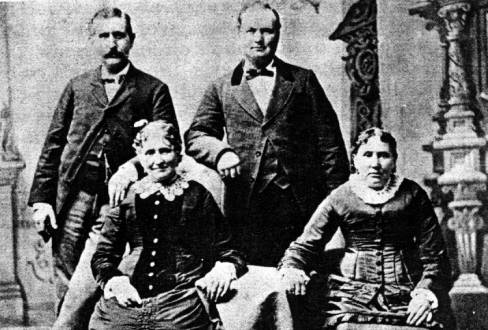
Standing: Howland & John Croft. Seated: Margaret Croft Bairstow, Sarah Croft Brooks
Howland Croft was close to his older brother John throughout his life. Howland Croft and his family journeyed to Colorado to visit his brother in 1882, and the two brothers took a trip together to England and France, and visited relatives and their childhood haunts in Yorkshire. The brothers partnered in several business ventures as well, including a boarding house at the mines near Como Springs, Colorado, in the spring of 1880 and at Franceville about the same time, and in 1890, an 80-acre farm south of Farmington near the shore of the Salt Lake. They thought they had a promising oil site, but it didn’t turn out for them.
Howland and Mary Croft had eight children: Ann born 14 March 1860 Farsley, Yorkshire, England; John William born 16 May 1862 Farsley; Miranda born 14 August 1864 Farlsey; Clara born 14 Feb 1867 Farsley; Thomas Howland born on 31 August 1869 Philadelphia PA but who died on July 31, 1871 and was buried at Mount Moriah Cemetery in Philadelphia; George Howland, born 24 Oct 1871 Philadelphia; Samuel Grainger born 2 March 1874; and Letitia Margaret born 19 August 1876 Philadelphia. Letitia died on March 28, 1878 of scarlet fever and was buried in Mount Moriah Cemetery in Philadelphia PA.
Howland died on April 27, 1900 in Camden, New Jersey of diabetes and was buried April 30, 1900 at Harleigh Cemetery in Camden NJ. His wife, Mary Grainger Croft also died of diabetes on November 12, 1917 in Camden, New Jersey. She was buried next to her husband in the Harleigh Cemetery on 15 November 1917. His sons, John William Croft, George Howland, and Samuel Grainger Croft, carried on in the business, and a third generation was also involved.
1947 Polk’s Directory Advertisement
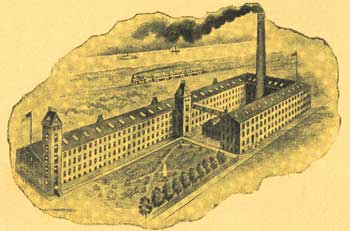
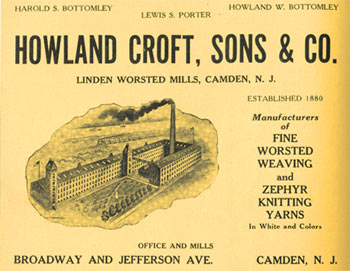
Howland Croft, Sons & Co. — 1947 Polk’s Directory Advertisement
The Howland Croft Sons & Company Mill
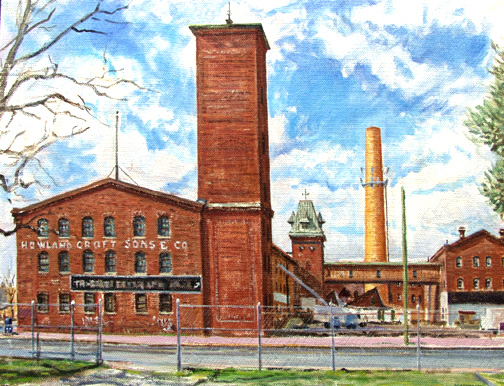
The Howland Croft Sons & Company Mill as painted by William J. Hoffman Jr. from Camden: Historical Impressions — Paintings by William M. Hoffman Jr.
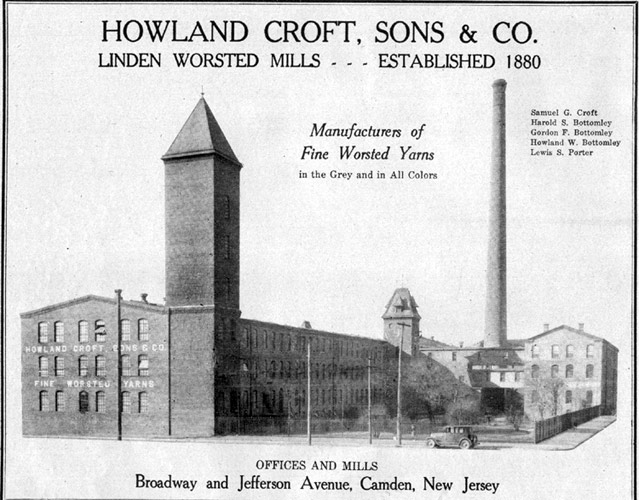
HOWLAND CROFT, SONS & CO. LINDEN WORSTED MILLS ... ESTABLISHED 1880
Samuel G. Croft
Harold S. Bottomley
Gordon F. Bottomley
Howland W. Bottomley
Lewis S. Porter
Manufacturers of Fine Worsted Yarns In the Grey and in All Colors
OFFICES AND MILLS Broadway and Jefferson Avenue, Camden, New Jersey
The Flue Gang — June 1930
The Howland Croft mill remained open in Camden NJ until the 1950s. The concern employed many people from Camden, and drew heavily from the immediate neighborhood. In 1928, the Howland Croft mill employed 313 people, according to the February 23rd Camden Anniversary edition of the Camden Courier-Post. The two pictures below date from June of 1930 and depict the “Flue Gang,” the men who worked in the boiler crew of the mill. The picture comes courtesy of Frank Breyer. His father, George Breyer, is the man wearing overalls, to the right of the horse in the right-hand picture, and kneeling on the far right in the left-hand picture.
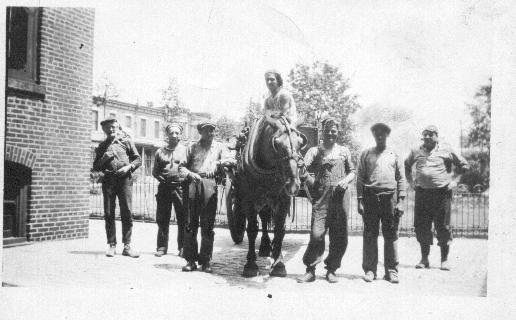
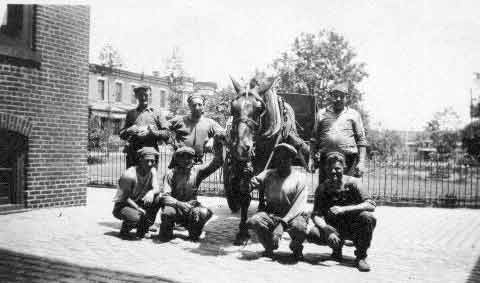
Named: The “Flue Gang”, boiler crew of the Howland Croft mill, and June 1930.
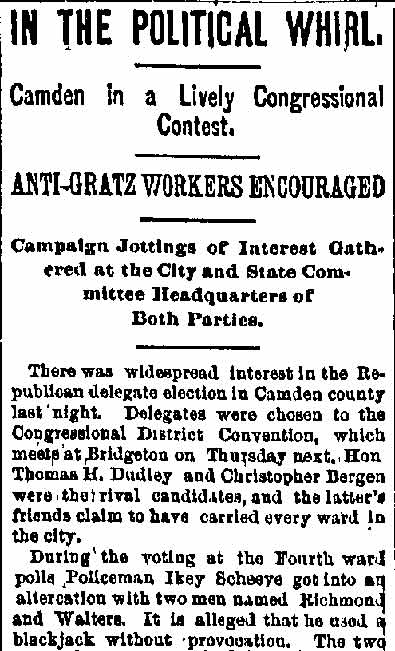
In the Political Whirl
Philadelphia Inquirer —
Camden in a Lively Congressional Contest.
ANTI-GRATZ WORKERS ENCOURAGED
Campaign Jottings of Interest Gathered at the City and State Committee Headquarters of Both Parties.
There was widespread interest in the Republican delegate election in Camden county last night. Delegates were chosen to the Congressional District Convention, which meets at Bridgeton on Thursday next. Hon. Thomas H. Dudley and Christopher Bergen were the rival candidates, and the latter’s friends claim to have carried every ward in the city.
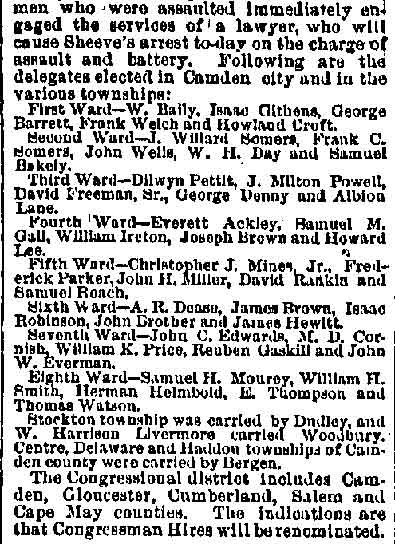
During the voting at the Fourth ward polls Policeman Ikey Scheeve got into an altercation with two men named Richmond and Walters. It is alleged that he used a blackjack without provocation. The two men who were assaulted immediately engaged the services of a lawyer, who will cause Sheeve’s arrest to-day on the charge of assault and battery. Following are the delegates elected in Camden city and in the various townships:
First Ward—W. Baily, Isaac Githens, George Barrett, Frank Welch and Howland Croft.
Second Ward—J. Willard Somers, Frank C. Somers, John Wells, W. H. Day and Samuel Bakely.
Third Ward—Dilwyn Pettit, J. Milton Powell, David Freeman, Sr., George Denny and Albion Lane.
Fourth Ward—Everett Ackley, Samuel M. Gall, William Ireton, Joseph Brown and Howard Lee.
Fifth Ward—Christopher J. Mines, Jr., Frederick Parker, John H. Miller, David Rankin and Samuel Roach.
Sixth Ward—A. R. Dease, James Brown, Isaac Robinson, John Brother and James Hewitt.
Seventh Ward—John C. Edwards, M. D. Cornish, William K. Price, Reuben Gaskill and John W. Everman.
Eighth Ward—Samuel H. Mourey, William H. Smith, Herman Helmbold, E. Thompson and Thomas Watson.
Stockton township was carried by Dudley, and W. Harrison Livermore carried Woodbury. Centre, Delaware and Haddon townships of Camden county were carried by Bergen.
The Congressional district includes Camden, Gloucester, Cumberland, Salem and Cape May counties. The indications are that Congressman Hires will be renominated.
Historical and Industrial Review of Camden, N.J. — 1890
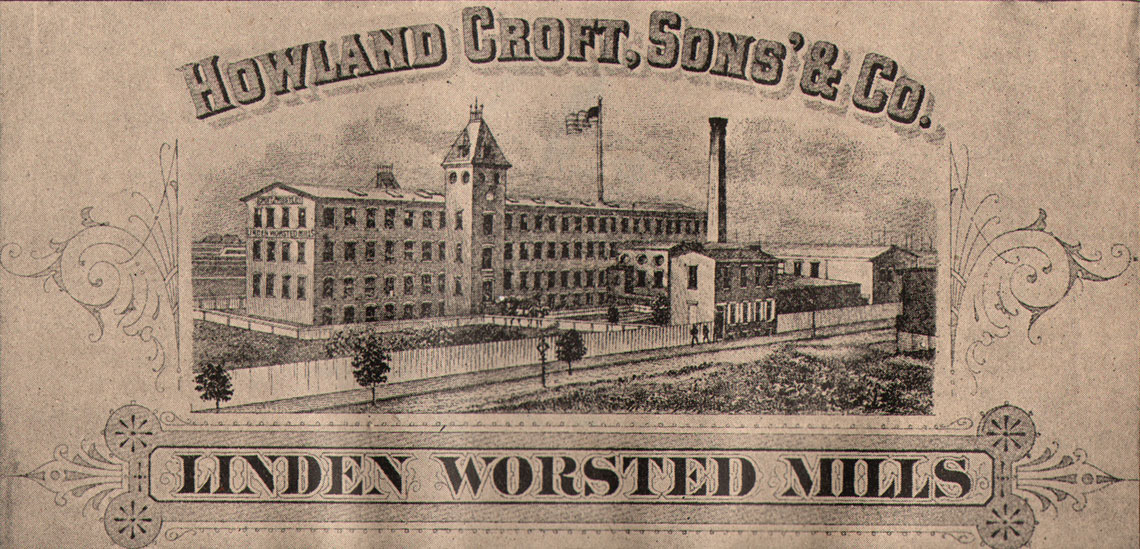
Named: Howland Croft, Sons’ & Co., Linden Worsted Mills, Historical and Industrial Review of Camden, N.J., and 1890.
HOWLAND CROFT, SONS & CO., LINDEN WORSTED MILLS, BROADWAY AND JEFFERSON AVENUE.
AMONG the worsted and woolen mills of Camden a conspicuous building is that belonging to Messrs. Howland Croft, Sons & Co., formerly Croft & Priestley, known as the Linden Worsted Mills, now located at Broadway and Jefferson avenue. The factory was established in 1880, under the present style, at the corner of Front and Linden streets, whence its name. It was a successful institution from the commencement, and remained at the old location until 1885, when the fine new building now occupied was erected on ground purchased for the purpose. The area of the ground occupied is 200 by 415 feet, and the buildings—all of brick and four stories in height—consist of three separate structures, each one being devoted to its own special department. They are: the mill proper, of the extent of 50 by 240 feet; the wool warehouse, of 100 by 40 feet, and the offices and storerooms, of the size of 80 by 30 feet. The force of hands is 400.
The goods manufactured are worsted and woolen yarns in all the various grades and colors, and the brands of their goods enjoy a high reputation in the market.
The members of the firm at first were Howland Croft and Herbert Priestley. In November, 1886, Mr. Priestley died, and thence until March 1, 1889, the management devolved upon Mr. Croft. At the latter date the three sons of Mr. Croft, were joined with him in partnership, and the firm style became Howland Croft, Sons & Co. The names of the junior members are Mr. John William Croft, Mr. George Howland Croft and Mr. Samuel Granger Croft.
The handsome engravings accompanying this too brief sketch of what is undoubtedly the leading commercial undertaking of South Camden, consist of a reproduction of the spacious buildings and of a portrait of Mr. Howland Croft. A journey through the numerous apartments of the mills shows that not only is the machinery and all appointments of the concern of the latest and most approved character that modern ingenuity and skill, backed by the most ample capital, could attain and operated by a colossal engine, whose mammoth proportions excite the wonder and amazement of all observers, and seems by its magnitude to rival the glories of the celebrated Corliss engine at the Centennial Exposition at Philadelphia; but its sanitary condition is carefully looked after, and a more contented and happier set of work-people is seldom seen in a large industrial enterprise.
The story of Mr. Croft’s life would be more readable than a romance, illustrating as it does the immense possibilities which the present age holds in trust for men of energy, pluck, perseverance and tried integrity, upon whom it heaps its richest rewards and crowns with its loftiest esteem. From the present summit of his well-won success, Mr. Croft cannot fail to contemplate, with feelings of the most entire satisfaction, the roadway over which he has journeyed and which is strewn with the conquests of laudable ambition over all difficulties. Personally one of the most genial and courteous of men, his simple and unostentatious habits of life have never been perverted by his great wealth and influence, and this fact tends to endear him to all with whom he is brought in contact, both in a business sense and socially.
After earnest solicitation, he has consented to act as Vice-President of the Board of Trade of the City of Camden, and by his presence in that body will add to its dignity and the force of its membership, being a practical man whose executive ability has never been questioned, while his enthusiastic endorsement of every movement looking to the City of Camden’s interest is widely appreciated.
Many Houses Now Being Erected
Camden Daily Courier —
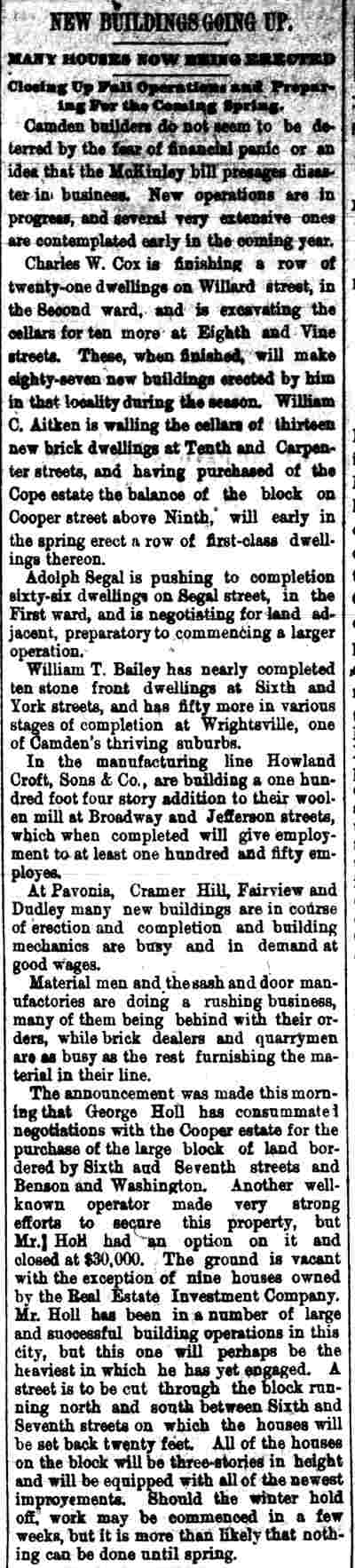
New Buildings Going Up.
Many Houses Now Being Erected
Closing Up Fall Operations and Preparing For the Coming Spring.
Camden builders do not seem to be deterred by the fear of financial panic or an idea that the McKinley bill presages disaster in business. New operations are in progress, and several very extensive ones are contemplated early in the coming year.
Charles W. Cox is finishing a row of twenty-one dwellings on Willard street, in the Second ward, and is excavating the cellars for ten more at Eighth and Vine streets. These, when finished, will make eighty-seven new buildings erected by him in that locality during the season. William C. Aitken is walling the cellars of thirteen new brick dwellings at Tenth and Carpenter streets, and having purchased of the Cope estate the balance of the block on Cooper street above Ninth, will early in the spring erect a row of first-class dwellings thereon.
Adolph Segal is pushing to completion sixty-six dwellings on Segal street, in the First ward, and is negotiating for land adjacent, preparatory to commencing a large operation.
William T. Bailey has nearly completed ten stone front dwellings at Sixth and York streets, and has fifty more in various stages of completion at Wrightsville, one of Camden’s thriving suburbs.
In the manufacturing line Howland Croft, Sons & Co., are building a one hundred foot four story addition to their woolen mill at Broadway and Jefferson streets, which when completed will give employment to at least one hundred and fifty employes.
At Pavonia, Cramer Hill, Fairview and Dudley many new buildings are in course of erection and completion and building mechanics are busy and in demand at good wages.
Material men and the sash and door manufacturers are doing a rushing business, many of them being behind with their orders, while brick dealers and quarrymen are as busy as the rest furnishing the material in their line.
The announcement was made this morning that George Holl has consummated negotiations with the Cooper estate for the purchase of the large block of land bordered by Sixth and Seventh streets and Benson and Washington. Another well-known operator made very strong efforts to secure this property, but Mr. Holl had an option on it and closed at $30,000. The ground is vacant with the exception of nine old houses owned by the Real Estate Investment Company. Mr. Holl has been in a number of large and successful building operations in this city, but this one will perhaps be the heaviest in which he has yet engaged. A street is to be cut through the block running north and south between Sixth and Seventh streets on which the houses will be set back twenty feet. All of the houses on the block will be three-stories in height and will be equipped with all of the newest improvements. Should the winter hold off, work may be commenced in a few weeks, but it is more than likely that nothing can be done until spring.
Camden
Philadelphia Inquirer —
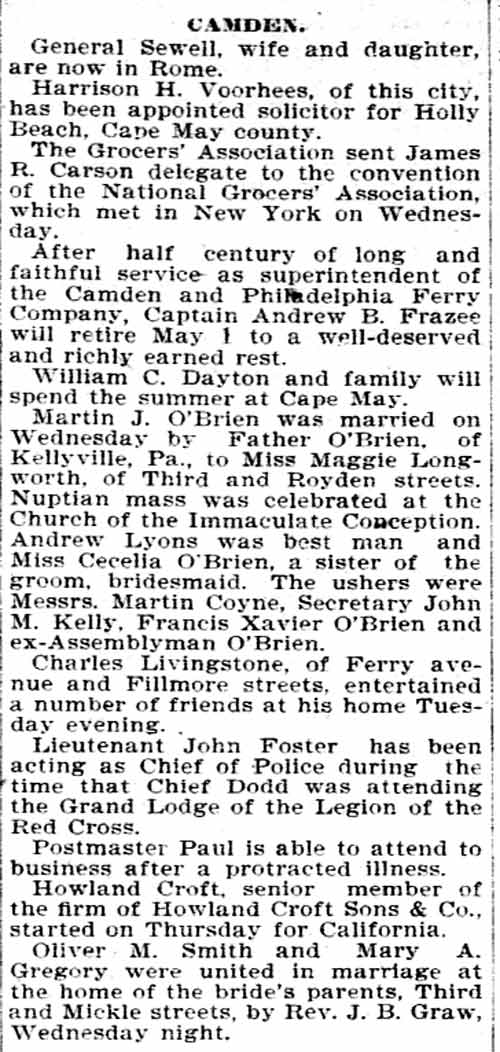
General Sewell, wife and daughter, are now in Rome.
Harrison H. Voorhees, of this city, has been appointed solicitor for Holly Beach, Cape May county.
The Grocers’ Association sent James R. Carson delegate to the convention of the National Grocers’ Association, which met in New York on Wednesday.
After half century of long and faithful service as superintendent of the Camden and Philadelphia Ferry Company, Captain Andrew B. Frazee will retire May 1 to a well-deserved and richly earned rest.
William C. Dayton and family will spend the summer at Cape May.
Martin J. O’Brien was married on Wednesday by Father O’Brien, of Kellyville, Pa., to Miss Maggie Longworth, of Third and Royden streets. Nuptian [sic] mass was celebrated at the Church of the Immaculate Conception. Andrew Lyons was best man and Miss Cecelia O’Brien, a sister of the groom, bridesmaid. The ushers were Messrs. Martin Coyne, Secretary John M. Kelly, Francis Xavier O’Brien and ex-Assemblyman O’Brien.
Charles Livingstone, of Ferry avenue and Fillmore streets, entertained a number of friends at his home Tuesday evening.
Lieutenant John Foster has been acting as Chief of Police during the time that Chief Dodd was attending the Grand Lodge of the Legion of the Red Cross.
Postmaster Paul is able to attend to business after a protracted illness.
Howland Croft, senior member of the firm of Howland Croft Sons & Co., started on Thursday for California.
Oliver M. Smith and Mary A. Gregory were united in marriage at the home of the bride’s parents, Third and Mickle streets, by Rev. J. B. Graw, Wednesday night.
Business Men in Line
Philadelphia Inquirer —
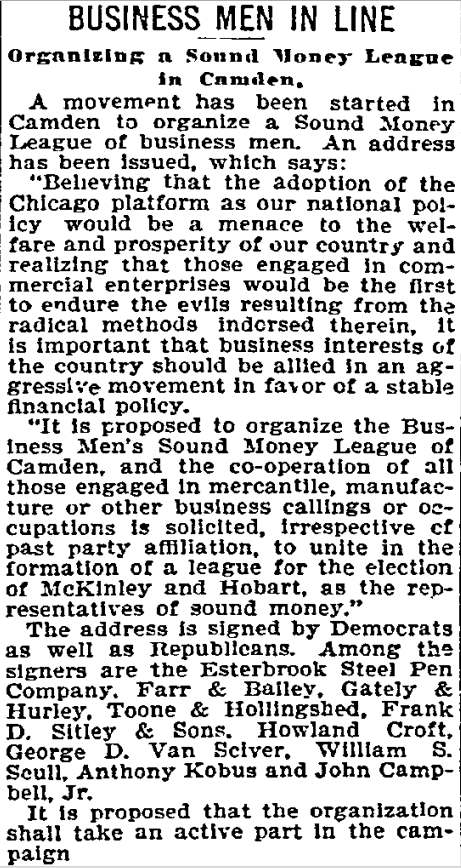
Organizing a Sound Money League in Camden
A movement has been started in Camden to organize a Sound Money League of business men. An address has been issued, which says:
Believing that the adoption of the Chicago platform as our national policy would be a menace to the welfare and prosperity of our country and realizing that those engaged in commercial enterprises would be the first to endure the evils resulting from the radical methods indorsed therein, it is important that business interests of the country should be allied in an aggressive movement in favor of a stable financial policy.
“It is proposed to organize the Business Men’s Sound Money League of Camden, and the co-operation of all those engaged in mercantile, manufacture or other business callings or occupations is solicited, irrespective of past party affiliation, to unite in the formation of a league for the election of McKinley and Hobart, as the representatives of sound money.
The address is signed by Democrats as well as Republicans. Among the signers are the Esterbrook Steel Pen Company, Farr & Bailey, Gately & Hurley, Toone & Hollingshed, Frank D. Sitley & Sons, Howland Croft, George D. Van Sciver, William S. Scull, Anthony Kobus and John Campbell, Jr.
Howland Croft Contributes to Boer War Relief
Philadelphia Inquirer —

Howland Croft, the well-known Camden worsted manufacturer, has contributed $1000 for the relief of families of British soldiers killed in the Boer War. Mr. Croft is an Englishman by birth.
Howland Croft & Sons Building 235-Foot Chimney
Philadelphia Inquirer —

A chimney, 235 feet high, is being erected by the Howland Croft & Sons Company, at Broadway and Jefferson avenue. It will be the highest stack in Camden.
Camden Elks Hold a Lodge of Sorrow
Philadelphia Inquirer —
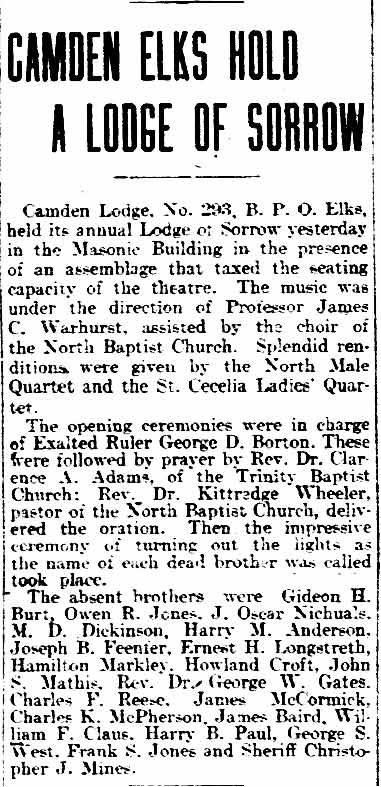
Camden Lodge, No. 293, B. P. O. Elks, held its annual Lodge of Sorrow yesterday in the Masonic Building in the presence of an assemblage that taxed the seating capacity of the theatre. The music was under the direction of Professor James C. Warhurst, assisted by the choir of the North Baptist Church. Splendid renditions were given by the North Male Quartet and the St. Cecelia Ladies’ Quartet.
The opening ceremonies were in charge of Exalted Ruler George D. Borton. These were followed by prayer by Rev. Dr. Clarence A. Adams, of the Trinity Baptist Church; Rev. Dr. Kittredge Wheeler, pastor of the North Baptist Church, delivered the oration. Then the impressive ceremony of turning out the lights as the name of each dead brother was called took place.
The absent brothers were Gideon H. Burt, Owen R. Jones, J. Oscar Nicholas, M. D. Dickinson, Harry M. Anderson, Joseph B. Feenier, Ernest H. Longstreth, Hamilton Markley, Howland Croft, John S. Mathis, Rev. Dr. George W. Gates, Charles F. Reese, James McCormick, Charles K. McPherson, James Baird, William F. Claus, Harry B. Paul, George S. West, Frank S. Jones and Sheriff Christopher J. Mines.
Harleigh Cemetery — The Grave of Howland Croft
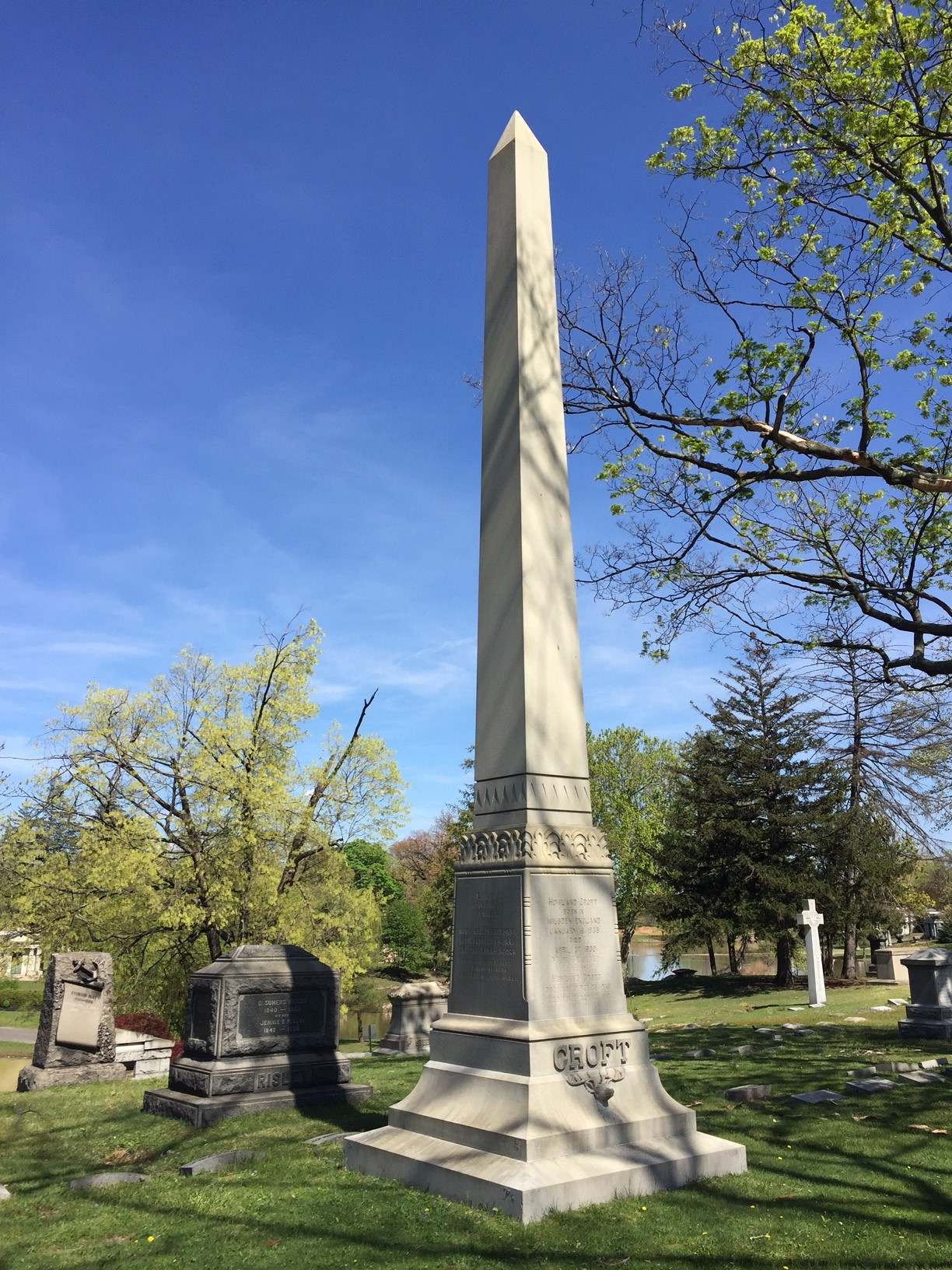
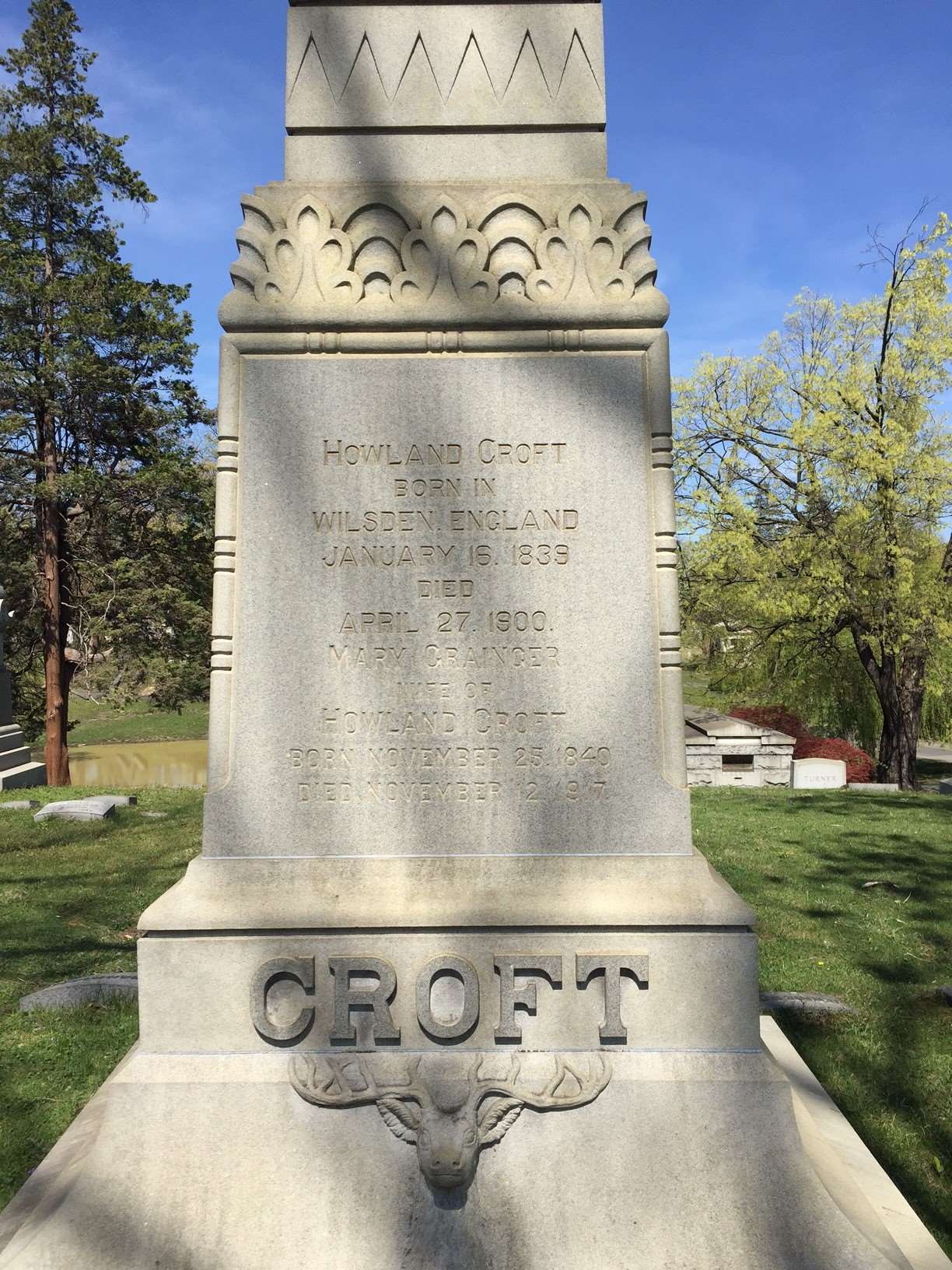
Harleigh Cemetery — The Grave of Howland Croft. Photo courtesy of Barry McCarthy.
The New View from Chelton Avenue & Arlington Street — February 7, 2004
The demolition of Arlington Street, which lay between Chelton Avenue and Jefferson Street, adjacent to the mill, allows a view of the mill that has not been seen since the original construction of the houses on Arlington Street, over 100 years ago.
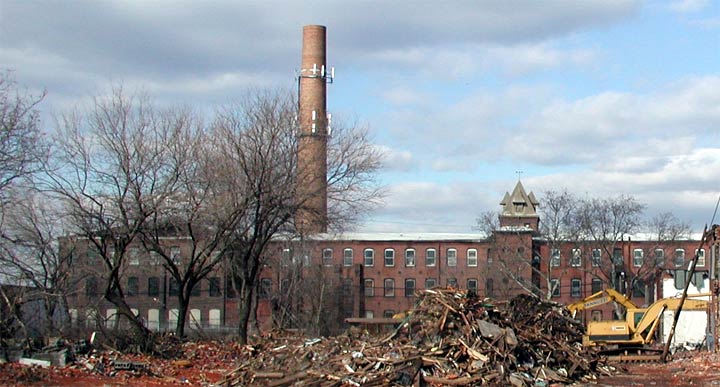
Looking North at the Howland Croft & Sons Company Mill — February 7, 2004
Over In Camden
Philadelphia Inquirer —
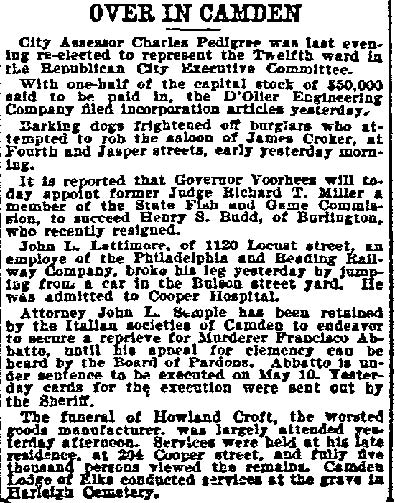
City Assessor Charles Pedigree was last evening re-elected to represent the Twelfth ward in the Republican City Executive Committee.
With one-half of the capital stock of $50,000 said to be paid in, the D’Olier Engineering Company filed incorporation articles yesterday.
Barking dogs frightened off burglars who attempted to rob the saloon of James Croker, at Fourth and Jasper streets, early yesterday morning.
It is reported that Governor Voorhees will today appoint former Judge Richard T. Miller a member of the State Fish and Game Commission, to succeed Henry S. Budd, of Burlington, who recently resigned.
John L. Lattimore, of 1120 Locust street, an employe of the Philadelphia and Reading Railway Company, broke his leg yesterday by jumping from a car in the Bulson street yard. He was admitted to Cooper Hospital.
Attorney John L. Semple has been retained by the Italian societies of Camden to endeavor to secure a reprieve for Murderer Francisco Abbatto, until his appeal for clemency can be heard by the Board of Pardons. Abbatto is under sentence to be executed on May 10. Yesterday cards for the execution were sent out by the Sheriff.
The funeral of Howland Croft, the worsted goods manufacturer, was largely attended yesterday afternoon. Services were held at his late residence, at 204 Cooper street, and fully five thousand persons viewed the remains. Camden Lodge of Elks conducted services at the grave in Harleigh Cemetery.