Introduction
JOHN K. R. HEWITT was born in Camden on January 29, 1855 to Sarah and Aaron Hewitt. His father was a carpenter. He pursued his early studies at home and at the public schools. He then engaged in business and began the study of law some years later. He was made an attorney in June, 1876, and a counselor in 1880.
The 1878 City Directory shows the family at 5096 Bridge Avenue, and the family was living at 734 Carman Street when the census was taken in 1880. J.K.R. Hewitt, as he was professionally known, was considered a promising young attorney in Camden. He was involved politically as a Democrat, and had been elected City Solicitor for Gloucester City in February of 1878. He served as clerk and solicitor for the Board of Chosen Freeholders of Camden County from May, 1880 to 1881. In 1881, with fellow young lawyers John L. Semple and Howard Carrow, at one time ran a baseball club in Camden. The 1881 City Directory shows that his office was at 311 Market Street, and that he made his home in Merchantville.
J.K.R. Hewitt ran into controversy in 1882 when he was tried in United States District Court for defrauding an illiterate pensioner. He was acquitted, and returned to law and politics. Nominated for the post of Camden County surrogate, he declined to run for office.
The 1891–1892 Camden City Directory shows J.K.R. Hewitt maintained an office at 206 Market Street. However, in the 1890s, things went badly. The 1894–1895 Directory shows his home and office was at 224 Market Street. He does not appear in the 1895–1896 Directory, however. At some point after the compilation of the 1894–1895 Directory J.K.R. Hewitt had been committed to the Camden County Almshouse at Lakeland. In October of 1897 he was declared insane and transferred to the County’s insane asylum.
John K.R. Hewitt was still a patient at the asylum as late as the summer of 1910. He apparently passed away during the 1910s.
Solicitor Elected
Philadelphia Inquirer —
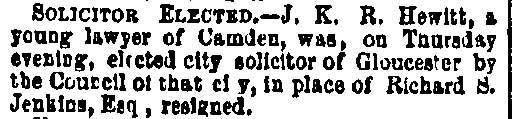
SOLICITOR ELECTED.—J. K. R. Hewitt, a young lawyer of Camden, was, on Thursday evening, elected city solicitor of Gloucester by the Council of that city, in place of Richard S. Jenkins, Esq., resigned.
New Base Ball Club
Philadelphia Inquirer —
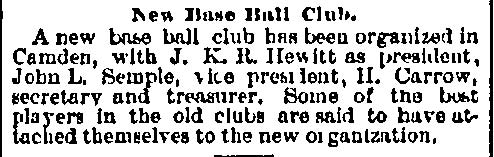
A new base ball club has been organized in Camden, with J. K. R. Hewitt as president, John L. Semple, vice president, H. Carrow, secretary and treasurer. Some of the best players in the old clubs are said to have attached themselves to the new organization.
The Camden Pension Case — Trial, Day 1
Trenton State Gazette —
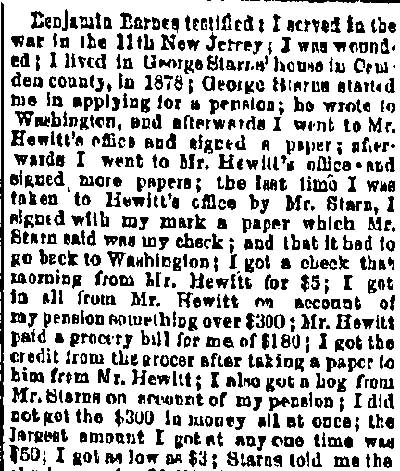
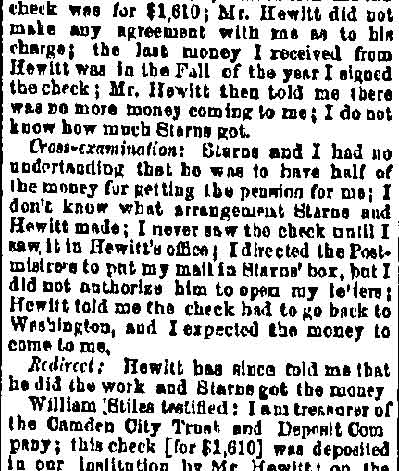
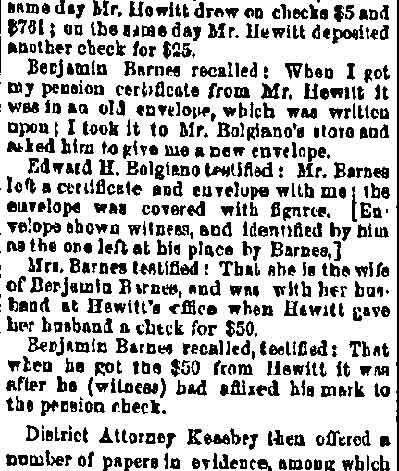
Benjamin Barnes testified: I served in the war in the 11th New Jersey; I was wounded; I lived in George Starns’ house in Camden county, in 1878; George Starns started me in applying for a pension; he wrote to Washington, and afterwards I went to Mr. Hewitt’s office and signed a paper; afterwards I went to Mr. Hewitt’s office and signed more papers; the last time I was taken to Hewitt’s office by Mr. Starn, I signed with my mark a paper which Mr. Starn said was my check; and that it had to go back to Washington; I got a check that morning from Mr. Hewitt for $5; I got in all from Mr. Hewitt on account of my pension something over $300; Mr. Hewitt paid a grocery bill for me of taking $180; I got the credit from the grocer after taking a paper to him from Mr. Hewitt; I also got a hog from Mr. Starns on account of my pension; I did not get the $300 in money all at once; the largest amount I got at any one time was $50; I got as low as $3; Starns told me the check was for $1,610; Mr. Hewitt did not make any agreement with me as to his charge; the last money I received from Hewitt was in the Fall of the year I signed the check; Mr. Hewitt then told me there was no more money coming to me; I do not know how much Starns got.
Cross-examination: Starns and I had no understanding that he was to have half of the money for getting the pension for me; I don’t know what arrangement Starns and Hewitt made; I never saw the check until I saw it in Hewitt’s office; I directed the Postmistress to put my mail in Starns’ box, but I did not authorize him to open my letters; Hewitt told me the check had to go back to Washington, and I expected the money to come to me.
Redirect: Hewitt has since told me that he did the work and Starns got the money.
William Stiles testified: I am treasurer of the Camden City Trust and Deposit Company; this check [for $1,610] was deposited in our institution by Mr. Hewitt; on the same day Mr. Hewitt drew on checks $5 and $781; on the same day Mr. Hewitt deposited another check for $25.
Benjamin Barnes recalled: When I got my pension certificate from Mr. Hewitt it was in an old envelope, which was written upon; I took it to Mr. Bulgiano’s store and asked him to give me a new envelope.
Edward H. Bulgiano testified: Mr. Barnes left a certificate and envelope with me; the envelope was covered with figures.
Mrs. Barnes testified: That she is the wife of Benjamin Barnes, and was with her husband at Hewitt’s office when Hewitt gave her husband a check for $50.
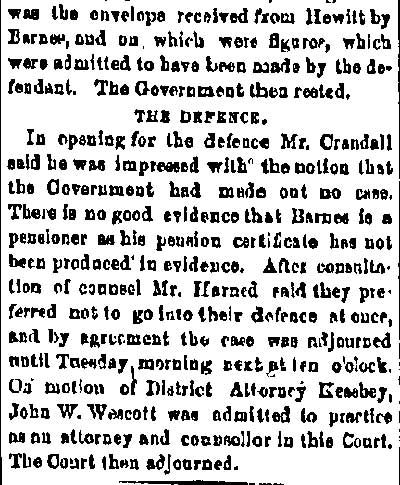
District Attorney Keasbey then offered a number of papers in evidence, among which was the envelope received from Hewitt by Barnes, and on which were figures, which were admitted to have been made by the defendant. The Government then rested.
THE DEFENCE.
In opening for the defence Mr. Crandall said he was impressed with the notion that the Government had made out no case. There is no good evidence that Barnes is a pensioner as his pension certificate has not been produced in evidence. After consultation of counsel Mr. Harned said they preferred not to go into their defence at once, and by agreement the case was adjourned until Tuesday, morning next at ten o’clock. On motion of District Attorney Keasbey, John W. Wescott was admitted to practice as an attorney and counsellor in this Court. The Court then adjourned.
Charged with Fraud
Philadelphia Inquirer —
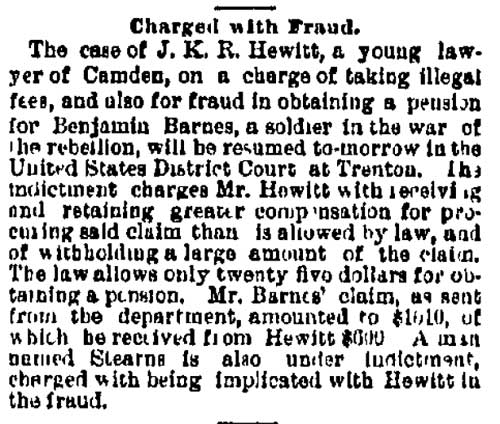
The case of J. K. R. Hewitt, a young lawyer of Camden, on a charge of taking illegal fees, and also for fraud in obtaining a pension for Benjamin Barnes, a soldier in the war of the rebellion, will be resumed to-morrow in the United States District Court at Trenton. The indictment charges Mr. Hewitt with receiving and retaining greater compensation for procuring said claim than is allowed by law, and of withholding a large amount of the claim. The law allows only twenty five dollars for obtaining a pension. Mr. Barnes’ claim, as sent from the department, amounted to $1,610, of which he received from Hewitt $600. A man named Stearns is also under indictment, charged with being implicated with Hewitt in the fraud.
The Camden Pension Case — Trial, Day 2
Trenton State Gazette —
UNITED STATES DISTRICT COURT.
PLEADING GUILTY OF SERIOUS CRIMES—TRIAL OF THE CAMDEN PENSION AGENT.
The United States District Court was in session yesterday, Judge John T. Nixon presiding.
THE CAMDEN PENSION CASE.
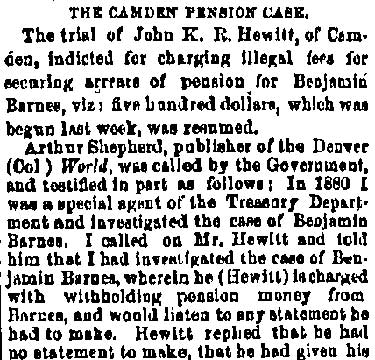
The trial of John K. R. Hewitt, of Camden, indicted for charging illegal fees for securing arrears of pension for Benjamin Barnes, viz: five hundred dollars, which was begun last week, was resumed.
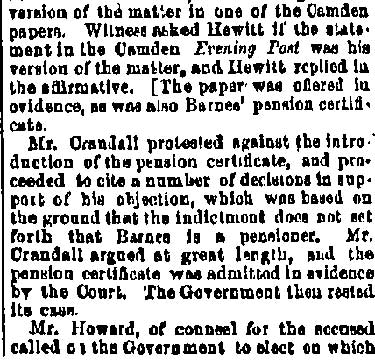
Arthur Shepherd, publisher of the Denver (Col.) World, was called by the Government, and testified in part as follows: In 1880 I was a special agent of the Treasury Department and investigated the case of Benjamin Barnes. I called on Mr. Hewitt and told him that I had investigated the case of Benjamin Barnes, wherein he (Hewitt) is charged with withholding pension money from Barnes, and would listen to any statement he had to make. Hewitt replied that he had no statement to make, that he had given his version of the matter in one of the Camden papers. Witness asked Hewitt if the statement in the Camden Evening Post was his version of the matter, and Hewitt replied in the affirmative. The Government then rested its case.
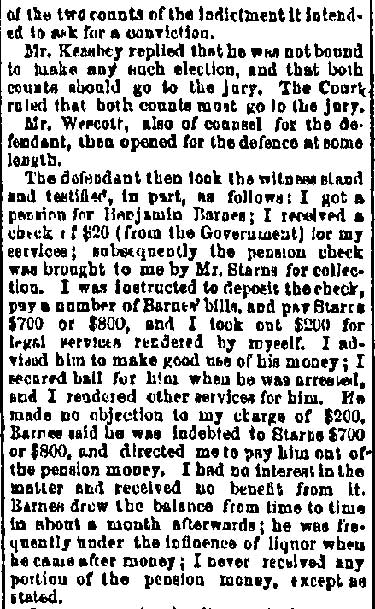
The defendant then took the witness stand and testified, in part, as follows: I got a pension for Benjamin Barnes; I received a check of $20 (from the Government) for my services; subsequently the pension check was brought to me by Mr. Starns for collection. I was instructed to deposit the check, pay a number of Barnes’ bills, and pay Starns $700 or $800, and I took out $200 for legal services rendered by myself. I advised him to make good use of his money; I secured bail for him when he was arrested, and I rendered other services for him. He made no objection to my charge of $200. Barnes said he was indebted to Starns $700 or $800, and directed me to pay him out of the pension money. I had no interest in the matter and received no benefit from it. Barnes drew the balance from time to time in about a month afterwards; he was frequently under the influence of liquor when he came after money; I never received any portion of the pension money, except as stated.
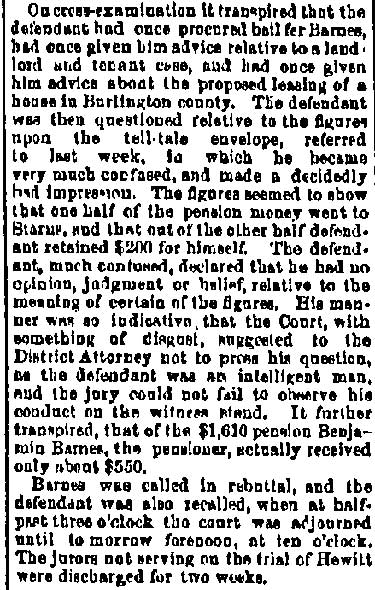
On cross-examination it transpired that the defendant had once procured bail for Barnes, had once given him advice relative to a landlord and tenant case, and had once given him advice about the proposed leasing of a house in Burlington county. The defendant was then questioned relative to the figures upon the tell-tale envelope, in which he became very much confused, and made a decidedly bad impression. The figures seemed to show that one half of the pension money went to Starns, and that out of the other half defendant retained $200 for himself. The defendant, much confused, declared that he had no opinion, judgment or belief, relative to the meaning of certain of the figures. His manner was so indicative that the Court, with something of disgust, suggested to the District Attorney not to press his question. It further transpired, that of the $1,610 pension Benjamin Barnes, the pensioner, actually received only about $550. The court was adjourned until to-morrow forenoon, at ten o’clock.
The Camden Pension Case — Acquitted After a Three Days’ Trial
Trenton State Gazette / Philadelphia Inquirer —
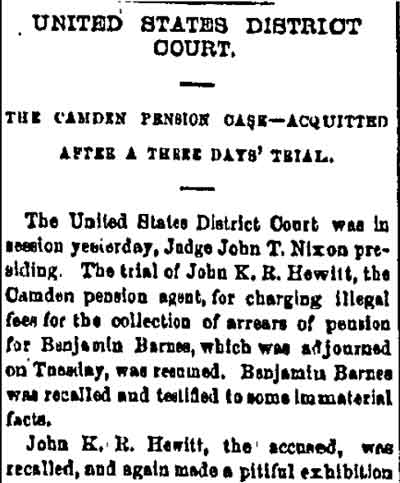
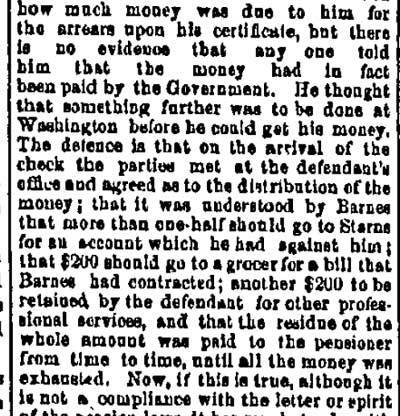
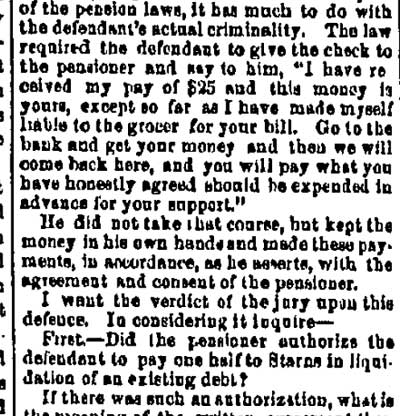
UNITED STATES DISTRICT COURT.
THE CAMDEN PENSION CASE—ACQUITTED AFTER A THREE DAYS’ TRIAL.
The United States District Court was in session yesterday, Judge John T. Nixon presiding. The trial of John K. R. Hewitt, the Camden pension agent, for charging illegal fees for the collection of arrears of pension for Benjamin Barnes, which was adjourned on Tuesday, was resumed. Benjamin Barnes was recalled and testified to some immaterial facts.
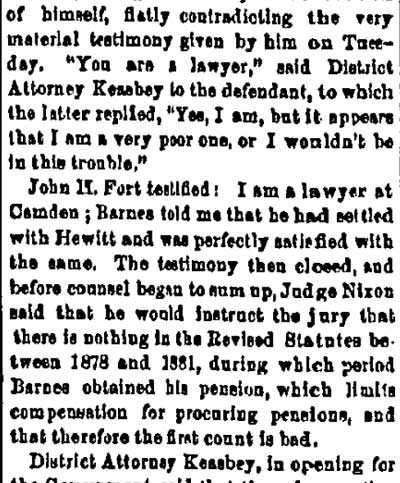
John K. R. Hewitt, the accused, was recalled, and again made a pitiful exhibition of himself, flatly contradicting the very material testimony given by him on Tuesday. “You are a lawyer,” said District Attorney Keasbey to the defendant, to which the latter replied, “Yes, I am, but it appears that I am a very poor one, or I wouldn’t be in this trouble.”
John H. Fort testified: I am a lawyer at Camden; Barnes told me that he had settled with Hewitt and was perfectly satisfied with the same. The testimony then closed, and before counsel began to sum up, Judge Nixon said that he would instruct the jury that there is nothing in the Revised Statutes between 1878 and 1881, during which period Barnes obtained his pension, which limits compensation for procuring pensions, and that therefore the first count is bad.
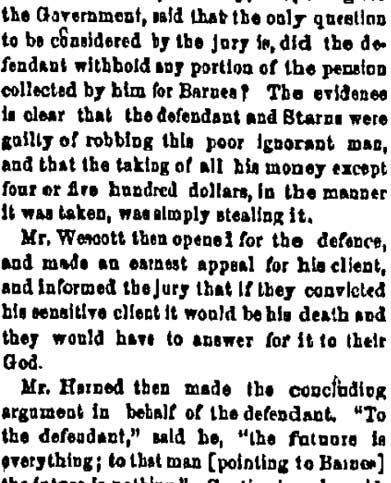
District Attorney Keasbey, in opening for the Government, said that the only question to be considered by the jury is, did the defendant withhold any portion of the pension collected by him for Barnes? The evidence is clear that the defendant and Starns were guilty of robbing this poor ignorant man, and that the taking of all his money except four or five hundred dollars, in the manner it was taken, was simply stealing it.
Mr. Wescott then opened for the defence, and made an earnest appeal for his client, and informed the jury that if they convicted his sensitive client it would be his death and they would have to answer for it to their God.
Mr. Harned then made the concluding argument in behalf of the defendant. “To the defendant,” said he, “the future is everything; to that man [pointing to Barnes] the future is nothing.”
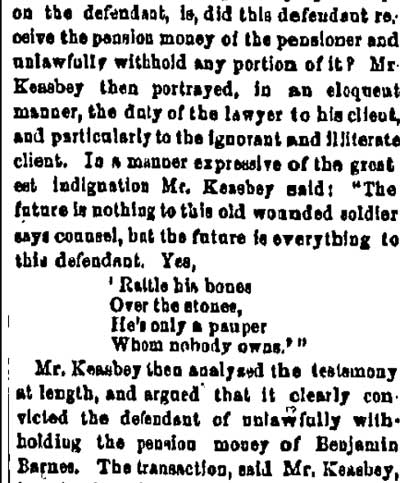
Mr. Keasbey then portrayed, in an eloquent manner, the duty of the lawyer to his client, and particularly to the ignorant and illiterate client. In a manner expressive of the greatest indignation Mr. Keasbey said: “The future is nothing to this old wounded soldier says counsel, but the future is everything to this defendant. Yes,
Rattle his bones
Over the stones,
He’s only a pauper
Whom nobody owns.’
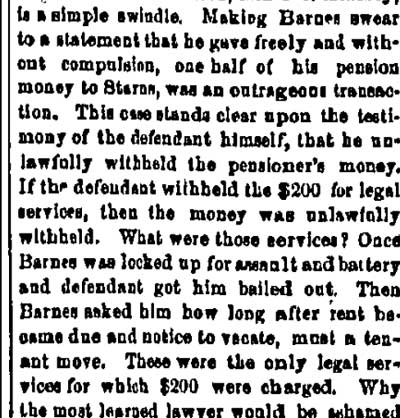
Mr. Keasbey then analyzed the testimony at length, and argued that it clearly convicted the defendant of unlawfully withholding the pension money of Benjamin Barnes. The transaction, said Mr. Keasbey, is a simple swindle. Making Barnes swear to a statement that he gave freely and without compulsion, one half of his pension money to Starns, was an outrageous transaction. This case stands clear upon the testimony of the defendant himself, that he unlawfully withheld the pensioner’s money.
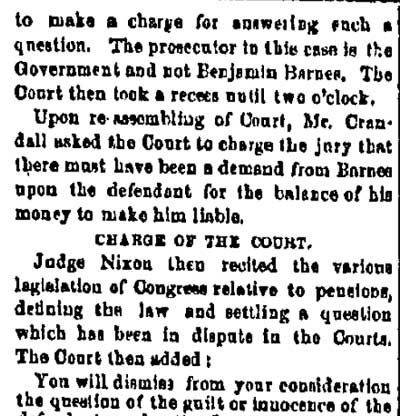
CHARGE OF THE COURT.
Judge Nixon then recited the various legislation of Congress relative to pensions, defining the law and settling a question which has been in dispute in the Courts.
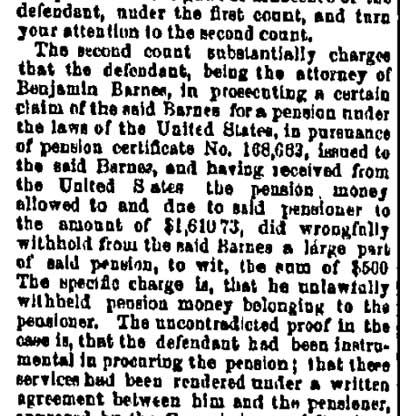
The second count substantially charges that the defendant, being the attorney of Benjamin Barnes, in prosecuting a certain claim of the said Barnes for a pension under the laws of the United States, in pursuance of pension certificate No. 168,683, issued to the said Barnes, and having received from the United States the pension money allowed to and due to said pensioner to the amount of $1,610.73, did wrongfully withhold from the said Barnes a large part of said pension, to wit, the sum of $500.
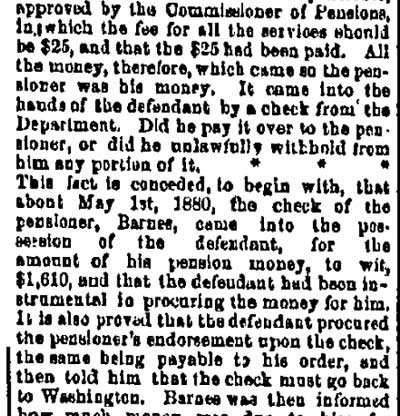
All the money, therefore, which came to the pensioner was his money. It came into the hands of the defendant by a check from the Department. Did he pay it over to the pensioner, or did he unlawfully withhold from him any portion of it.
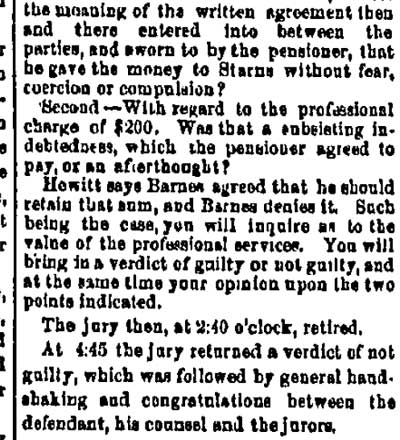
I want the verdict of the jury upon this defence. In considering it inquire—First—Did the pensioner authorize the defendant to pay one half to Starns in liquidation of an existing debt? Second—With regard to the professional charge of $200. Was that a subsisting indebtedness, which the pensioner agreed to pay, or an afterthought? Hewitt says Barnes agreed that he should retain that sum, and Barnes denies it. You will bring in a verdict of guilty or not guilty, and at the same time your opinion upon the two points indicated.
The jury then, at 2:40 o’clock, retired. At 4:45 the jury returned a verdict of not guilty, which was followed by general handshaking and congratulations between the defendant, his counsel and the jurors.
Charge Not Sustained
Philadelphia Inquirer —
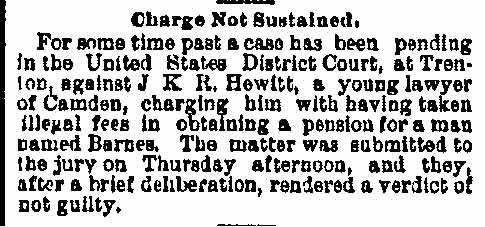
For some time past a case has been pending in the United States District Court, at Trenton, against J. K. R. Hewitt, a young lawyer of Camden, charging him with having taken illegal fees in obtaining a pension for a man named Barnes. The matter was submitted to the jury on Thursday afternoon, and they, after a brief deliberation, rendered a verdict of not guilty.
Col. James M. Scovel and J. K. R. Hewitt
Trenton Evening Times —
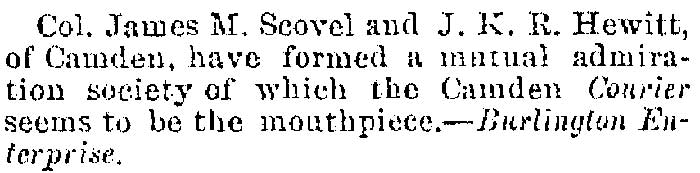
Col. James M. Scovel and J. K. R. Hewitt, of Camden, have formed a mutual admiration society of which the Camden Courier seems to be the mouthpiece.—Burlington Enterprise.
Throughout the State
Trenton Evening Times —
THROUGHOUT THE STATE.
Judge Charles T. Reed, of Camden, died on Saturday night. He will be buried on Wednesday. The Camden courts will adjourn to-day and the Bar Association will take proper action.
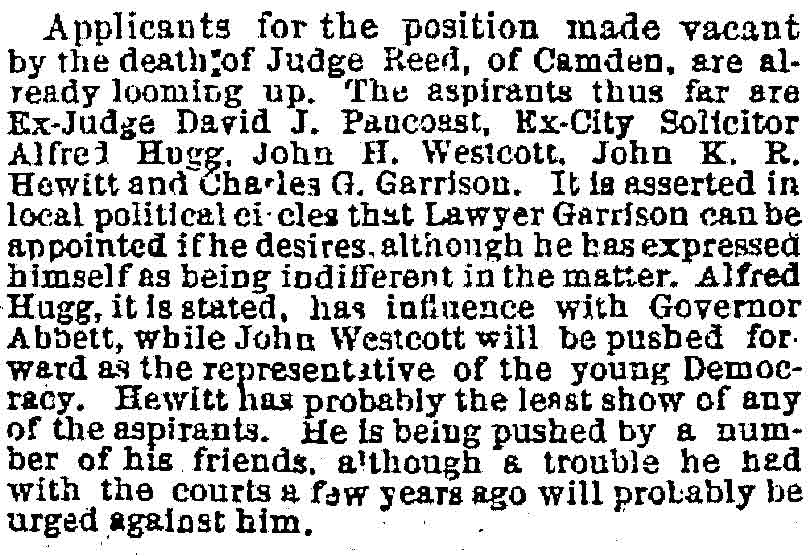
Applicants for the position made vacant by the death of Judge Reed, of Camden, are already looming up. The aspirants thus far are Ex-Judge David J. Pancoast, Ex-City Solicitor Alfred Hugg, John H. Westcott, John K. R. Hewitt and Charles G. Garrison. It is asserted in local political circles that Lawyer Garrison can be appointed if he desires, although he has expressed himself as being indifferent in the matter. Alfred Hugg, it is stated, has influence with Governor Abbett, while John Westcott will be pushed forward as the representative of the young Democracy. Hewitt has probably the least show of any of the aspirants. He is being pushed by a number of his friends, although a trouble he had with the courts a few years ago will probably be urged against him.
Over the River
Philadelphia Inquirer —
OVER THE RIVER. Matters of Interest in the City Across the Delaware.
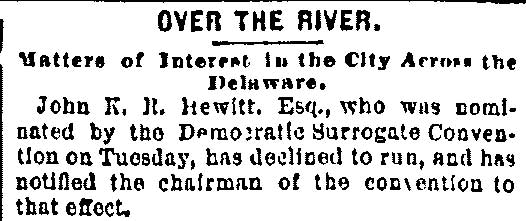
John K. R. Hewitt, Esq., who was nominated by the Democratic Surrogate Convention on Tuesday, has declined to run, and has notified the chairman of the convention to that effect.
Camden News
Philadelphia Inquirer —
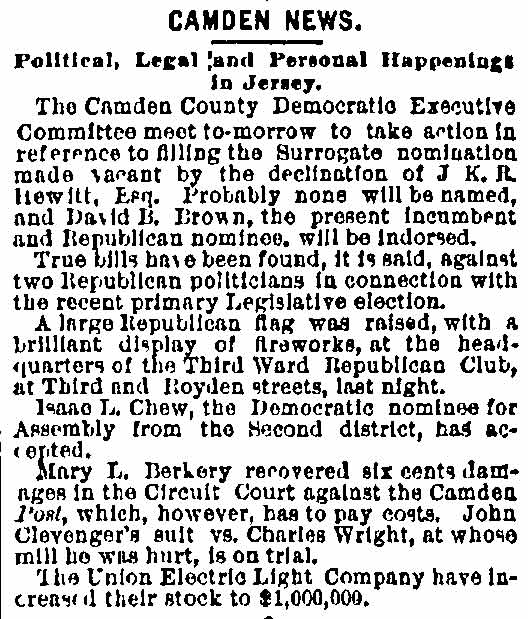
CAMDEN NEWS. Political, Legal and Personal Happenings in Jersey.
The Camden County Democratic Executive Committee meet to-morrow to take action in reference to filling the Surrogate nomination made vacant by the declination of J. K. R. Hewitt, Esq. Probably none will be named, and David B. Brown, the present incumbent and Republican nominee, will be indorsed.
Case of Harriet Smith
Camden Post —
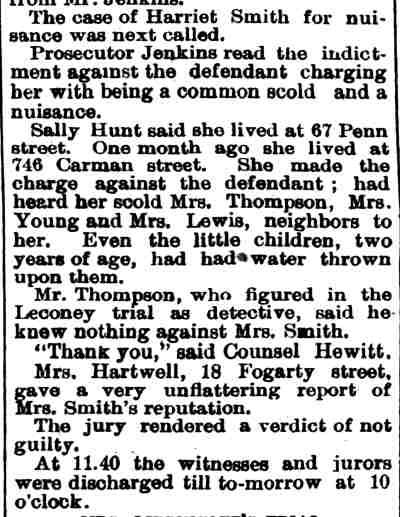
The case of Harriet Smith for nuisance was next called.
Prosecutor Jenkins read the indictment against the defendant charging her with being a common scold and a nuisance.
Sally Hunt said she lived at 67 Penn street. One month ago she lived at 746 Carman street. She made the charge against the defendant; had heard her scold Mrs. Thompson, Mrs. Young and Mrs. Lewis, neighbors to her. Even the little children, two years of age, had had water thrown upon them.
Mr. Thompson, who figured in the Leconey trial as detective, said he knew nothing against Mrs. Smith.
“Thank you,” said Counsel Hewitt.
Mrs. Hartwell, 18 Fogarty street, gave a very unflattering report of Mrs. Smith’s reputation.
The jury rendered a verdict of not guilty.
Blackwood
Philadelphia Inquirer —
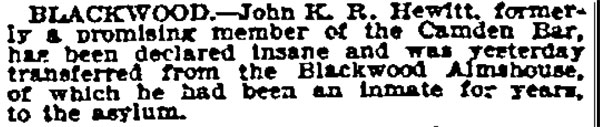
BLACKWOOD.—John K. R. Hewitt, formerly a promising member of the Camden Bar, has been declared insane and was yesterday transferred from the Blackwood Almshouse, of which he had been an inmate for years, to the asylum.