Introduction
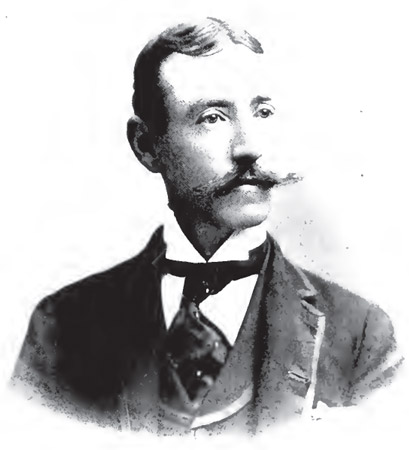
John L. Semple
JOHN L. SEMPLE was born in Mount Holly, New Jersey on October 11, 1859. He was one of the most noted criminal defense lawyers of his time. His life through 1900 chronicled below, excerpted from the book titled Biographical, Genealogical and Descriptive History of the State of New Jersey, edited by William Brown, published by the New Jersey Historical Publishing Company in 1900.
JOHN L. SEMPLE, A prominent young lawyer of Camden, New Jersey, having an office at No. 312 Market Street, was born October 11, 1859, in Mount Holly, New Jersey, son of John and Elizabeth (Little) Semple, through whom he has inherited some of the noblest qualities of the English and Scotch people. His grandfather, Samuel Semple, who came from Scotland to take charge of the thread mills at Smithfield, New Jersey, afterward established at Mount Holly the Semple Thread Mills, which were conducted by himself and three sons. This firm was known throughout the United States, and for nearly half a century did a large business, and employed about five hundred hands. Samuel Semple died when eighty-two years of age.
John Semple, whose birth occurred in Glasgow, Scotland, was brought up in the business of manufacturing thread, and was a member of the firm. He retired from active business in 1876, and has since lived in Mount Holly. He is a director of the Mount Holly Gas Company and the bank of Mount Holly, and one of the best known men in Burlington county. His wife, Elizabeth, is a daughter of John Little and was born in Paisley, Scotland, of English and Scotch ancestry. Her father, who was a civil engineer, died in Scotland. Mr. and Mrs. John Semple are the parents of seven children, of whom three are living, namely: Samuel W., John L. and Margaret. Samuel W. Semple, formerly the editor and proprietor of the Camden “Democrat,” after selling this paper, became private secretary, successively, to Speakers O’Connor and Stoney, of the New Jersey House of Representatives, then of the State Board of Genealogical Survey, and now is a member of the Common Council of Burlington, where he has made his home of late years. He married Rebecca Lippincott, a sister of ex-Postmaster Lippincott, one of the leading citizens of Burlington, and well known throughout the State. His father, John Semple, is a member of the Episcopal church, and one of its most liberal supporters.
After attending for some time a private school in Mount Holly, John L. Semple graduated in due course at Nazareth, Pennsylvania, and then for a year studied at a classical academy in Philadelphia. After this he was prepared to enter Princeton College by a private tutor, but his father instead was persuaded to place him in the office of Frederick H. Voorhees, a celebrated lawyer. He was admitted to the bar in 1880, within a month after attaining his majority, after which he remained with Mr. Voorhees one year. Then he opened an office in Camden and engaged in general practice. He was admitted as a counselor at the February term 1885, and to practice in the United States Supreme Court in February, 1895. In 1894 he was unexpectedly brought into prominence, when assigned, as defendant’s counsel, by Judge Garrison of the Supreme Court in the celebrated case of George Alorris. In a period of three years, of the fourteen murder cases in which he conducted the defense, thirteen ended in a verdict of acquittal for his clients. One of the latter, that of Charles Jordan, is perhaps, the shortest homicide case in criminal annals. The evidence, summing up of counsel, charge of the trial Judge, and the verdict of the jury, consuming less than two hours.
Mr. Semple made his reputation as a remarkably clever criminal lawyer in his successful defense of over a dozen homicide cases, and it was owing to this success, and his knowledge of criminal law, that he was associated with former Governor Pattison, of Pennsylvania, in the recent cases of Bredell and Taylor, the engravers in the noted counterfeit plot, in which the Secretary of the United States Treasury was compelled to withdraw the entire series of one hundred dollars Monroe notes. The scheme was unearthed in Philadelphia by the Secret Service officials and proved a great sensation, as it was regarded as one of the greatest attempts ever made to flood the country with counterfeit money.
But Mr. Semple’s name will ever be associated with the Lambert homicide case, as that is the one that brought him most fame and made his name known all over the country, and gave him a world-wide reputation. He persistently carried the latter case through all the State courts and twice to the United States Supreme Court unaided, but in such a manner that he received the commendation of the court, where it was regarded as the most successful attempt ever made to evade the verdict of a jury. Shortly after having been admitted to the bar he was a candidate for the office of Prosecutor of Pleas of Burlington county. About this time he was chosen a delegate to the Democratic State Convention, since which time he has eschewed active participation in politics, giving his entire attention to his extensive practice. He is a member of the Benevolent and Protective Order of Elks, and an attendant of the Episcopal Church.
While not attending to work and his education John L. Semple was quite interested in baseball. In 1881 he helped organize a team in Camden with fellow lawyers J.K.R. Hewitt and Howard Carrow, who later became a judge. John L. Semple married Elizabeth Skill, however the couple was not blessed with children.
In the 1890s John L. Semple was accused of aiding and abetting two of his clients, who were imprisoned in Pennsylvania, in a counterfeiting scheme. The first trial resulted in a hung jury, in the second trial John L. Semple was acquitted.
In his last years John L. Semple worked from his home at 320 Market Street in Camden, in partnership with J. Harry Switzer. Suffering from rheumatism, all but paralyzed and in great pain, on February 6, 1915 John L. Semple took his own life, shooting himself in the heart while sitting at his desk in his Market Street office.
New Base Ball Club
Philadelphia Inquirer –
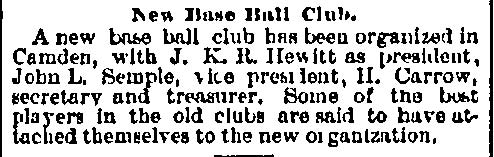
New Base Ball Club.
A new base ball club has been organized in Camden, with J. K. R. Hewitt as president, John L. Semple, vice president, H. Carrow, secretary and treasurer. Some of the best players in the old clubs are said to have attached themselves to the new organization.
Rival Lawyers Want to Defend Jordan
Philadelphia Inquirer –
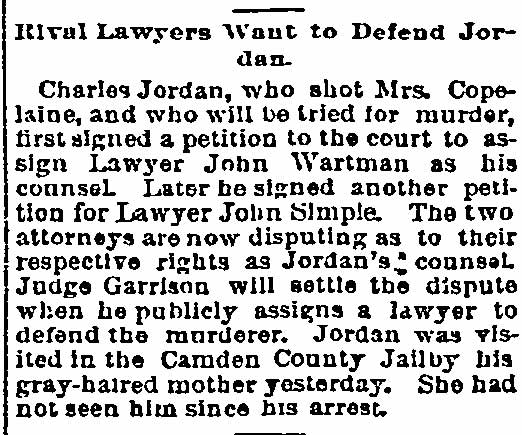
Rival Lawyers Want to Defend Jordan.
Charles Jordan, who shot Mrs. Copelaine, and who will be tried for murder, first signed a petition to the court to assign Lawyer John Wartman as his counsel. Later he signed another petition for Lawyer John Semple. The two attorneys are now disputing as to their respective rights as Jordan’s counsel. Judge Garrison will settle the dispute when he publicly assigns a lawyer to defend the murderer. Jordan was visited in the Camden County Jail by his gray-haired mother yesterday. She had not seen him since his arrest.
They Say That Jordan Did It
Camden Daily Telegram –
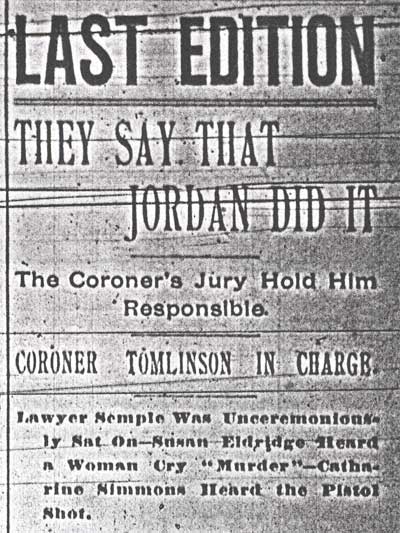
LAST EDITION
THEY SAY THAT JORDAN DID IT
The Coroner’s Jury Hold Him Responsible.
CORONER TOMLINSON IN CHARGE.
Lawyer Semple Was Unceremoniously Sat On—Susan Eldridge Heard a Woman Cry “Murder”—Catharine Simmons Heard the Pistol Shot.
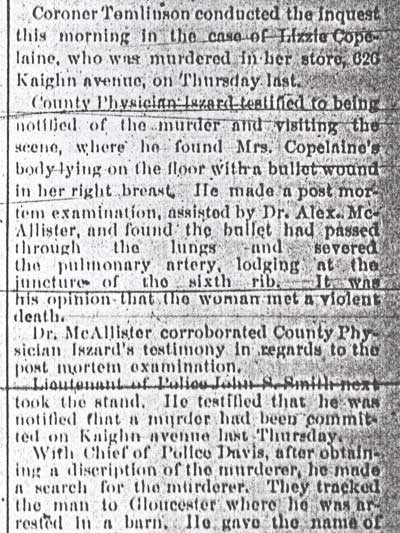
Coroner Tomlinson conducted the inquest this morning in the case of Lizzie Copelaine, who was murdered in her store, 620 Kaighn avenue, on Thursday last. County Physician Iszard testified to being notified of the murder and visiting the scene, where he found Mrs. Copelaine’s body lying on the floor with a bullet wound in her right breast. He made a post mortem examination, assisted by Dr. Alex. McAllister, and found the bullet had passed through the lungs and severed the pulmonary artery, lodging at the juncture of the sixth rib. It was his opinion that the woman met a violent death. Dr. McAllister corroborated County Physician Iszard’s testimony in regards to the post mortem examination.
Lieutenant of Police John S. Smith next took the stand. He testified that he was notified that a murder had been committed on Kaighn avenue last Thursday. With Chief of Police Davis, after obtaining a description of the murderer, he made a search for the murderer. They tracked the man to Gloucester where he was arrested in a barn. He gave the name of…
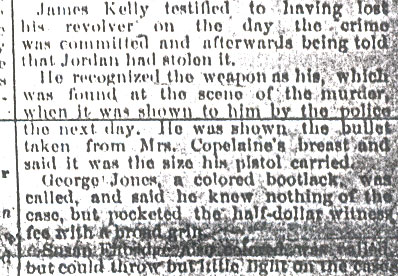
James Kelly testified to having lost his revolver on the day the crime was committed and afterwards being told that Jordan had stolen it. He recognized the weapon as his, which was found at the scene of the murder, when it was shown to him by the police the next day. He was shown the bullet taken from Mrs. Copelaine’s breast and said it was the size his pistol carried.
George Jones, a colored bootblack, was called, and said he knew nothing of the case, but pocketed the half-dollar witness fee with a broad grin.
For a New Trial
Camden Post-Telegram –
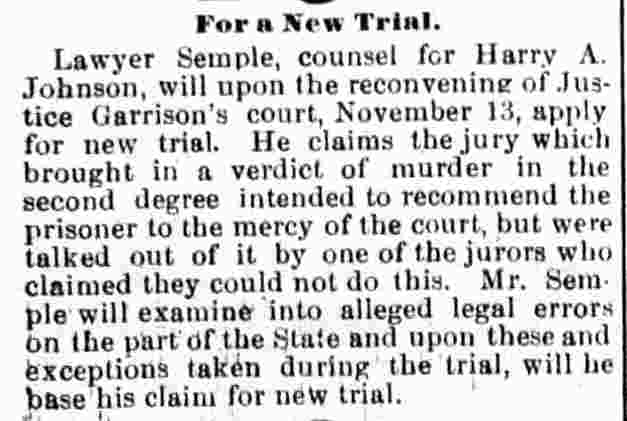
For a New Trial.
Lawyer Semple, counsel for Harry A. Johnson, will upon the reconvening of Justice Garrison’s court, November 13, apply for new trial. He claims the jury which brought in a verdict of murder in the second degree intended to recommend the prisoner to the mercy of the court, but were talked out of it by one of the jurors who claimed they could not do this. Mr. Semple will examine into alleged legal errors on the part of the State and upon these and exceptions taken during the trial, will he base his claim for new trial.
He Was a Busy Burglar
Philadelphia Inquirer –
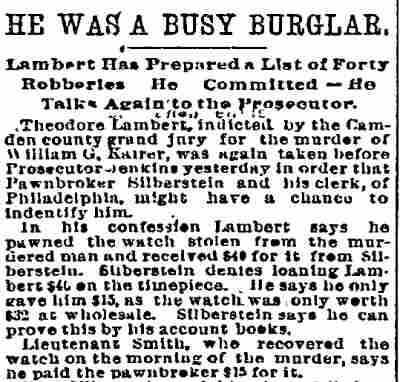
HE WAS A BUSY BURGLAR.
Lambert Has Prepared a List of Forty Robberies He Committed—He Talks Again to the Prosecutor.
Theodore Lambert, indicted by the Camden county grand jury for the murder of William G. Kairer, was again taken before Prosecutor Jenkins yesterday in order that Pawnbroker Silberstein and his clerk, of Philadelphia, might have a chance to indentify him.
In his confession Lambert says he pawned the watch stolen from the murdered man and received $40 for it from Silberstein. Silberstein denies loaning Lambert $40 on the timepiece. He says he only gave him $13, as the watch was only worth $32 at wholesale. Silberstein says he can prove this by his account books.
Lieutenant Smith, who recovered the watch on the morning of the murder, says he paid the pawnbroker $15 for it.
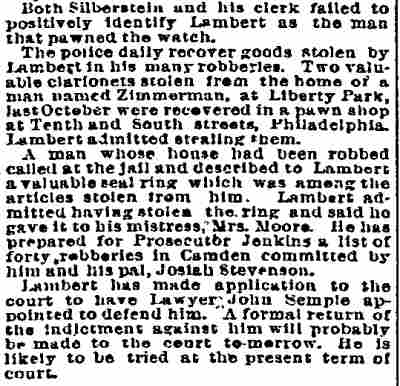
Both Silberstein and his clerk failed to positively identify Lambert as the man that pawned the watch.
The police daily recover goods stolen by Lambert in his many robberies. Two valuable clarionets stolen from the home of a man named Zimmerman, at Liberty Park, last October were recovered in a pawn shop at Tenth and South streets, Philadelphia. Lambert admitted stealing them.
A man whose house had been robbed called at the jail and described to Lambert a valuable seal ring which was among the articles stolen from him. Lambert admitted having stolen the ring and said he gave it to his mistress, Mrs. Moore. He has prepared for Prosecutor Jenkins a list of forty robberies in Camden committed by him and his pal, Josiah Stevenson.
Lambert has made application to the court to have Lawyer John Semple appointed to defend him. A formal return of the indictment against him will probably be made to the court to-morrow. He is likely to be tried at the present term of court.
Dory Lambert Kicks
Philadelphia Inquirer –
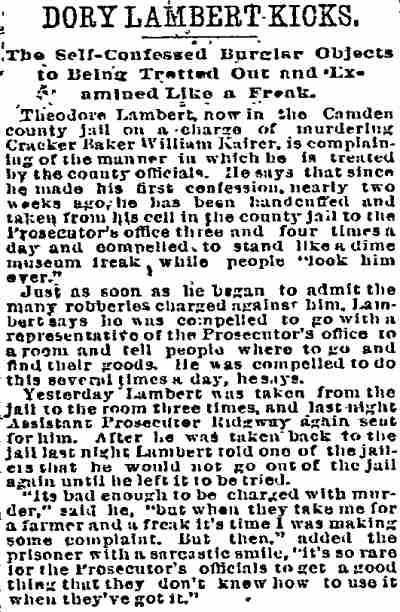
DORY LAMBERT KICKS.
The Self-Confessed Burglar Objects to Being Trotted Out and Examined Like a Freak.
Theodore Lambert, now in the Camden county jail on a charge of murdering Cracker Baker William G. Kairer, is complaining of the manner in which he is treated by the county officials. He says that since he made his first confession, nearly two weeks ago, he has been handcuffed and taken from his cell in the county jail to the Prosecutor’s office three and four times a day and compelled to stand like a dime museum freak, while people “look him over.”
Just as soon as he began to admit the many robberies charged against him, Lambert says he was compelled to go with a representative of the Prosecutor’s office to a room and tell people where to go and find their goods. He was compelled to do this several times a day, he says.
Yesterday Lambert was taken from the jail to the room three times, and last night Assistant Prosecutor Ridgway again sent for him. After he was taken back to the jail last night Lambert told one of the jailers that he would not go out of the jail again until he left it to be tried.
“Its bad enough to be charged with murder,” said he, “but when they take me for a farmer and a freak it’s time I was making some complaint. But then,” added the prisoner with a sarcastic smile, “it’s so rare for the Prosecutor’s officials to get a good thing that they don’t know how to use it when they’ve got it.”
“Blackstrap” Acquitted
Philadelphia Inquirer –
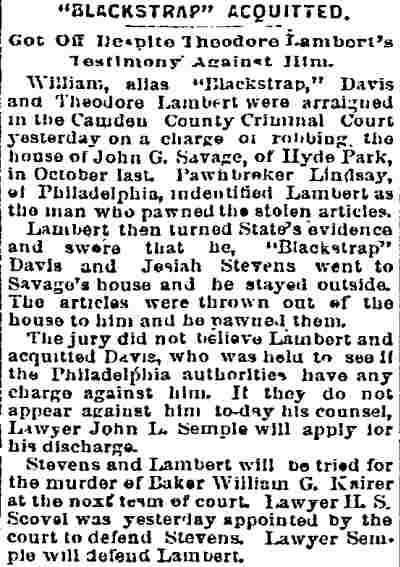
“BLACKSTRAP” ACQUITTED.
Got Off Despite Theodore Lambert’s Testimony Against Him.
William, alias “Blackstrap,” Davis and Theodore Lambert were arraigned in the Camden County Criminal Court yesterday on a charge of robbing the house of John G. Savage, of Hyde Park, in October last. Pawnbroker Lindsay, of Philadelphia, indentified Lambert as the man who pawned the stolen articles.
Lambert then turned State’s evidence and swore that he, “Blackstrap” Davis and Josiah Stevens went to Savage’s house and he stayed outside. The articles were thrown out of the house to him and he pawned them.
The jury did not believe Lambert and acquitted Davis, who was held to see if the Philadelphia authorities have any charge against him. If they do not appear against him to-day his counsel, Lawyer John L. Semple will apply for his discharge.
Stevens and Lambert will be tried for the murder of Baker William G. Kairer at the next term of court. Lawyer H. S. Scovel was yesterday appointed by the court to defend Stevens. Lawyer Semple will defend Lambert.
Lambert on Trial
Philadelphia Inquirer –
LAMBERT ON TRIAL.
The Alleged Slayer of Baker Kairer Arraigned in the Camden Court.
The trial of Theodore Lambert, indicted for the murder of Baker William G. Kairer on December 4, was begun before Supreme Court Justice Garrison, in Camden, yesterday morning. Prosecutor Wilson S. Jenkins conducted the case for the State, while John Semple represented the accused murderer and robber. After the reading of the indictment the drawing of a jury was proceeded with.
Josiah Stevens, the alleged accomplice of Lambert, testified for the State. He said he had lived at 1885 South Ninth street. Stevens had not seen Lambert for six or seven years before November 17. On December 3, the witness and Lambert went to a club on Ninth street, and at 9 o’clock Lambert went out. He did not see Lambert any more until the next morning.
Then the two ate breakfast together and Lambert showed Stevens a watch belonging to the murdered man. He asked if there was any way to get the initials off of it.
Lambert left the house again, and Stevens next saw him at 2.30 o’clock. When he went out he said he was going to Philadelphia, and when he came back he said he had pawned the watch. He also told him about the robbery and the shooting in detail.
William Kairer, son of the murdered baker, said on the fatal night when he was awakened by some one in the house he woke his father up, and after they had got some matches they started down stairs together. After looking around he turned to his father and said: “Father, I guess everything is all right.” He then went to the stairway to inform his wife that everything was all right, when his father stepped into the parlor. The next thing he heard was the crashing of the blinds and then three shots fired in succession.
Camden’s Murder Trial
Trenton Evening Times –
Camden’s Murder Trial.
In the Camden County Court of Over and Terminer yesterday, with Judge Garrison presiding, Josiah Stevens, colored, who was indicted by the Grand Jury at the January term as an accomplice of Theodore Lambert in the killing of William Kairer, was placed on trial, Lambert having already been tried and convicted of murder in the first degree.
Theodore Lambert, who has already been convicted, testified that he and Josiah Stevens were together from Sunday, December 3d, until Monday, December 4th. He then told how he and Stevens started from the house of Lavinia Moore, shortly after midnight, on December 4th, to rob a house in North Camden. He then recited the story as told to Prosecutor Jenkins in his office after his arrest, which was to the effect that Stevens was with him at the time he entered the Kairer residence. At the conclusion of Lambert’s testimony the Court took a recess until this morning. The State will close to-day, and it is expected that the case will reach the jury to-morrow.
Lawyer’s Fee
Philadelphia Inquirer –

Lawyer John L. Semple has been allowed $350 by Judge Garrison for defending Murderers Theodore Lambert and Thomas Delbridge.
Writ of Error for Lambert
Philadelphia Inquirer –
Lawyer John L. Semple applied to Chancellor McGill yesterday to set a date to hear argument on the writ of error for a new trial for Murderer Theodore Lambert, who is sentenced to be hanged on December 13.
Wants Another Trial
Philadelphia Inquirer –
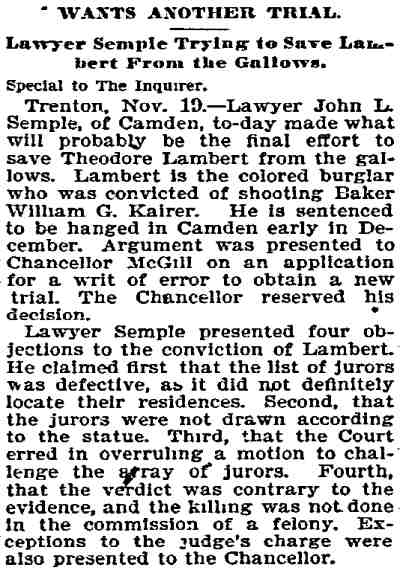
WANTS ANOTHER TRIAL.
Lawyer Semple Trying to Save Lambert From the Gallows.
Special to The Inquirer.
Trenton, Nov. 19.—Lawyer John L. Semple, of Camden, to-day made what will probably be the final effort to save Theodore Lambert from the gallows. Lambert is the colored burglar who was convicted of shooting Baker William G. Kairer. He is sentenced to be hanged in Camden early in December. Argument was presented to Chancellor McGill on an application for a writ of error to obtain a new trial. The Chancellor reserved his decision.
Lawyer Semple presented four objections to the conviction of Lambert. He claimed first that the list of jurors was defective, as it did not definitely locate their residences. Second, that the jurors were not drawn according to the statue. Third, that the Court erred in overruling a motion to challenge the array of jurors. Fourth, that the verdict was contrary to the evidence, and the killing was not done in the commission of a felony. Exceptions to the judge’s charge were also presented to the Chancellor.
No Hope Now for Lambert
Philadelphia Inquirer –
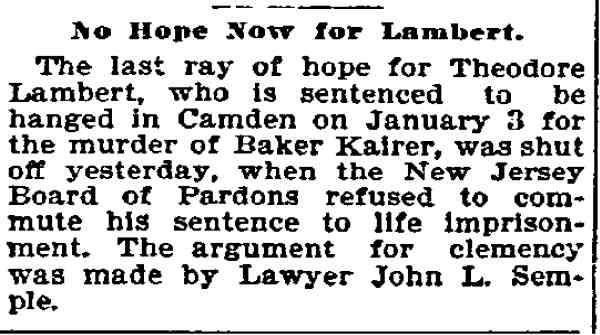
No Hope Now for Lambert.
The last ray of hope for Theodore Lambert, who is sentenced to be hanged in Camden on January 3 for the murder of Baker Kairer, was shut off yesterday, when the New Jersey Board of Pardons refused to commute his sentence to life imprisonment. The argument for clemency was made by Lawyer John L. Semple.
A Legal Peculiarity
Harrisburg Patriot –
A LEGAL PECULIARITY.
Lawyer Semple Claims Murderer Lambert Should be Discharged on the Ground That He is Legally Dead.
TO BE ARGUED SATURDAY.
Attorney’s Reasons For His Novel Plea—Bland’s Substitute For the Carlisle Currency Plan—Thinks It Will Solve the Finance Problem—A Vote on It Will be a Fair Test of the Silver Question.
By Telegraph to The Patriot.
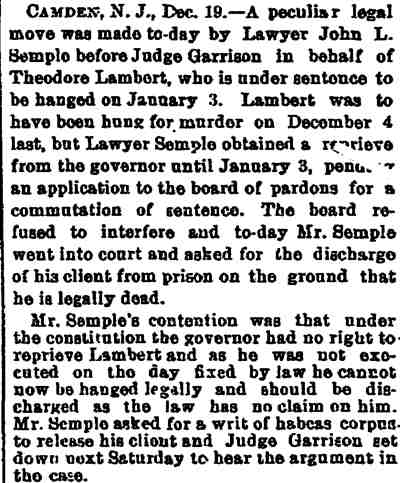
Camden, N.J., Dec. 19.—A peculiar legal move was made to-day by Lawyer John L. Semple before Judge Garrison in behalf of Theodore Lambert, who is under sentence to be hanged on January 3. Lambert was to have been hung for murder on December 4 last, but Lawyer Semple obtained a reprieve from the governor until January 3, pending an application to the board of pardons for a commutation of sentence. The board refused to interfere and to-day Mr. Semple went into court and asked for the discharge of his client from prison on the ground that he is legally dead.
Mr. Semple’s contention was that under the constitution the governor had no right to reprieve Lambert and as he was not executed on the day fixed by law he cannot now be hanged legally and should be discharged as the law has no claim on him. Mr. Semple asked for a writ of habeas corpus and Judge Garrison set down next Saturday to hear the argument in the case.
Lambert Must Die
New York Times –
Lambert Must Die.
Camden, N.J., Dec. 22.—After hearing argument to-day by John L. Semple, on an application for a writ of habeas corpus in the case of Theodore Lambert, the colored murderer under sentence to be hanged Jan. 3, Justice Garrison refused the writ. Lawyer Semple gave notice that he would apply for a writ of certiorari. His application was based on the ground that the time limit for executive clemency had passed, and that the Governor had no right to grant a reprieve to Lambert, and as the date first fixed for conviction has passed, Lambert is, in the eyes of the law, legally dead. He quoted numerous authorities, but Justice Garrison decided that there was no reasonable ground for granting the writ.
Lambert’s Respite From Death
New York Times –
LAMBERT’S RESPITE FROM DEATH.
The Record Shows the Document Was Not a “Provisional Writ of Error.”
Washington, Feb. 5.—The record in the appeal of the case of Theodore Lambert versus George Barrett, Sheriff of the County of Camden, N.J., has been received in the office of the Clerk of the Supreme Court. This was the case which attracted so much attention last month, owing to the efforts of John L. Semple, Lambert’s attorney, to prevent his execution under a conviction of murder, which were finally successful only an hour or two before the time set for carrying the sentence into effect. There was considerable speculation at the time as to the nature of the document issued by Justice Shiras of the Supreme Court of the United States, which acted as a stay of execution. It was described as a “provisional writ of error,” but this appears to have been a mistake. The record shows it to be an order, regular in form, citing the Sheriff to appear in Washington March 4 “to do and receive what may appertain to justice to be done in the premises,” under Lambert’s appeal from the judgment of Circuit Judge Dallas refusing him a writ of habeas corpus. The order directs the stay of the execution until the further order of court.
A Year Each for Policy People
Camden Daily Telegram –

A YEAR EACH FOR POLICY PEOPLE
Mrs. Harriet Smith Fainted When Sentenced.
DETERMINED TO STOP THE GAME
Judge Vroom Says the Court Is Decided About This Matter and in Two Cases Imposes the Full Penalty.
This was the last assize day for the present term of the Quarter Sessions Court. Judges Vroom, McDowell and Burdsall held a consultation in the law library until twenty minutes after ten o’clock when they came into the large court room.
Lulu Robinson was sworn and said that David Fry had cut her with a razor during a quarrel one evening at Eighth and Ann streets. Fry was quarreling with the others and the witness interfered when Fry cut her across the cheek with a razor. Fry has pleaded guilty to the assault.
Mrs. William Still, of Snow Hill, was sworn, and stated that on a Saturday night her husband came home and seemed to be in a bad humor. He quarreled with her all night Saturday and all day Sunday. He asked her if she was going to stop running around and as she did not answer him Still pulled out a revolver and shot her. He fired three more shots at her as she laid on the floor and when she was going out the door he shot her in the head.
“Did this not occur over your running with other men?” asked Lawyer John L. Semple, who is counsel for William Still.
“No, sir. I did not go with other men.”
Witness said she knew a man by the name of Grey, but denied that she had ever been intimate with him.
In answer to Judge Vroom Mrs. Still said that she had been shot three times and was in the Cooper Hospital some time. She said her husband had threatened to cut her throat on other occasions. Still was not present and the court ordered that he appear on Monday or his bail would be forfeited and a bench warrant issued.
William Jacobs, who was convicted yesterday of involuntary manslaughter in killing George Whittington, was sentenced to one year in State Prison.
When the convicted policy dealers were arraigned Lawyer H. S. Scovel said he desired to make a few remarks in their behalf. He said that in the case of William Parker the jury failed to agree and he advised Parker afterwards to enter a plea of guilty. Parker had never been accused before of a crime and Lawyer Scovel asked that the Court be lenient. He also said there was no record of Parker having been convicted before. Lawyer Scovel also asked that mercy be shown in the case of Mrs. Harriet Smith, who pleaded guilty. He said there was no question but what she had been convicted before of policy writing but her husband was dead and she had a large family to support. “I do not think the State Prison was ever erected for the imprisonment of a woman unless she had committed some great crime,” said Lawyer Scovel.
The Court said that some of the convicted policy writers had been convicted before of violating the policy laws and the Court had been lenient and imposed fines instead of imprisonment.
“The Court is determined to break up policy playing in this city,” said Judge Vroom. “The sentence of Walter Garwood and Washington Ketline is that they serve one year in the State Prison and pay a fine of $100 each. This is the full penalty of the law. Harriet Smith and William Parker will serve one year in State Prison without a fine.”
As the defendants were being taken out of the court room to the county jail Mrs. Smith swooned away just outside of the entrance to the court room. A cot was secured from the county jail and Constable Jacob Leon and Jailor David Logue placed her on it and carried her over to the county jail.
Lawyer J. J. Crandall asked that Washington Ketline be released on bail as he had secured a writ of error to carry the case to the Supreme Court. Bail was fixed at $1,000 and John Cochran and Joseph Swing appeared to enter the necessary security. They were closely questioned by the Court.
Protested Innocence to the End
Philadelphia Inquirer –
PROTESTED INNOCENCE TO THE END
HE SAID STEVENS FIRED THE FATAL SHOT
The Execution Devoid of Sensational Features—Lambert Walked Firmly to the Gallows—History of His Remarkable Case.
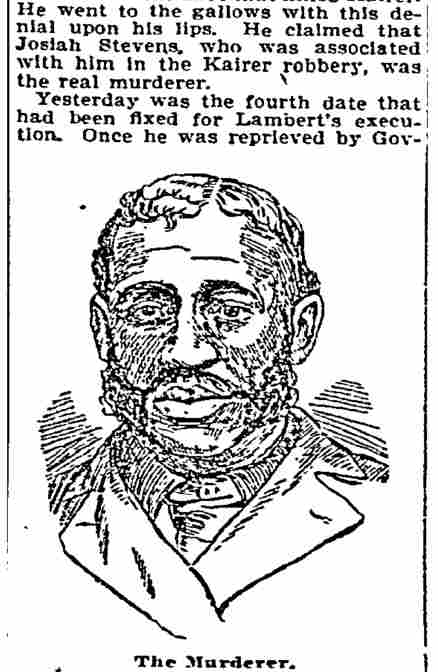
Nicholas Theodore Lambert died on the gallows in the Camden county jail yesterday. He was hanged for the murder of William G. Kairer, a well-to-do cracker baker, of Camden. His death closes a case that was remarkable chiefly for the extraordinary efforts to save the condemned man from the gallows. Lambert was a bad man. From his youth up he had been a criminal. He had served time in prison for burglary and admitted while awaiting trial for murder that he had robbed a score or more of houses in and around Camden. But he denied that he had fired the shot that killed Kairer. He went to the gallows with this denial upon his lips. He claimed that Josiah Stevens, who was associated with him in the Kairer robbery, was the real murderer.
Yesterday was the fourth date that had been fixed for Lambert’s execution. Once he was reprieved by Governor Werts. Twice the United States Supreme Court interfered and postponed the hanging. The law finally claimed its victim after every ordinary and several extraordinary procedures had been resorted to to avert the death penalty.
Firm in the Face of Death.
Lambert’s death was devoid of sensation, as executions go. He walked to the scaffold without assistance. He did not flunk in the face of death. There was barely time for a whispered good-bye to the Sheriff and he was launched into eternity. He was hanged on the gallows that ended John Hill’s life about three years ago. It was erected in an unused and half-finished room on the top floor of the county jail building at the northwest corner of Broadway and Federal streets. The death chamber is directly over a part of the jail that is being fitted up for the use of female prisoners. The scaffold stood over against a blank wall. On the other side windows let a flood of light into the bare room. Overhead were the gaunt rafters supporting the roof.
The heart-rending farewells between the condemned man and his mother and other relatives and friends had been uttered the night before. As the time drew on toward midnight the condemned seemed to realize for the first time that there was no further hope of escaping the death penalty.
“I can’t sleep,” he said to Constable Hunter, one of his death watch. “I feel oppressed, as if there was a heavy weight inside. I hope I will be able to walk to the gallows.”
At 1 o’clock Lambert sat down at a little table in his cell and for three hours he was busy with his pen writing farewell letters. There were six of these missives. The longest one was to his counsel, Lawyer John L. Semple, who had made such a gallant fight to save him. He thanked his lawyer and reiterated his assertion that he did not fire the shot that killed Kairer. One of the letters was to Mrs. Isabella Shipley, a resident of South Camden, who had displayed great interest in his case. The others were to personal friends. In all these missives Lambert gave expression to his religious faith and the belief that he had divine forgiveness of his sins.
Ready for the Rope.
About 6 o’clock the spiritual advisers of the condemned man entered his cell. They were colored ministers, Revs. W. H. Yocum, Thomas Als and H. C. Ashley. Under the soothing influence of prayer Lambert grew calmer, and when his breakfast, which consisted of half a dozen fried eggs, potatoes and coffee, was sent in from a restaurant opposite the jail, he ate heartily. At 9 o’clock the suit of black clothing that had been ordered for his execution a year ago was brought in and he dressed himself for the gallows. A barber had shaved him and trimmed his hair the previous night. He did not put on a collar.
The persons who were to witness the execution, in all less than forty, gathered in the sheriff’s office shortly before 10 o’clock. There was a jury of twelve appointed by the court, a similar number of special deputies, the sheriff’s regular assistants, Sheriffs Wriggins, of Salem county, and Townsend, of Burlington county, and a few newspaper men. At 10 o’clock Sheriff Barrett led the way into the jail and piloted the witnesses to the death chamber. They walked through an iron-lined passageway in the jail proper, then through a door into the corridor on the Federal street side, and up three flights of stairs to the place of execution.
This was the route that Lambert took a few minutes later when he walked to his doom. Chairs had been placed at each landing and there was one on the scaffold, for use in case the condemned man collapsed, but they were not needed. At five minutes after 10 Sheriff Barrett started down the stairs to fetch the victim, and the audience in the death chamber talked in whispers while they waited. Lambert was awaiting the summons. His hands were manacled behind his back, and with the ministers in front, the Sheriff at his side and Constables Hunter and Gardner, of the death watch at his back, he started on the walk to the gallows.
On the Scaffold.
It was but a step from the doorway of the execution room to the foot of the flight of steps leading to the platform of the gallows. Lambert did not halt or look up. He and the Sheriff had declined assistance. He was cool and knew just what to do, although it was his first execution. Lambert took his station on the trap-doors directly under the cross-beam. His gaze was fixed on the blank wall directly in front and his back was toward the spectators. He wavered slightly as the Sheriff slipped the noose over his neck. Then, just as the black cap was drawn over his face, he whispered: “Good-bye, Sheriff. God bless you.”
“Good-bye, Dory,” was the response, and the next instant the Sheriff took a step to one side, pulled a lever, the big trap-doors fell with a crash, and the colored murderer was dangling in midair. The fall was about eight feet. It is not probable that Lambert’s neck was broken, but the convulsions were slight. His legs had not been pinioned, but they were not drawn up in the death agony. It was 10.13 when the drop fell. Five minutes later Under Sheriff Sell unlocked the handcuffs and the arms hung listless at the side of the dangling body. At intervals a convulsive tremor shook the body, but these soon ceased, and at 10.27¾ physicians pronounced life extinct.
Borne to the Grave.
The body was allowed to hang for ten minutes longer before it was taken down. In an adjoining room an undertaker was waiting with the casket that, like the death suit, had been ordered a year ago. On the lid was a silver plate bearing the inscription, “Nicholas T. Lambert. Died December 19, 1895. Aged 24 years, 2 months, 19 days.”
Lambert had requested that the doctors should not mutilate his body, and Sheriff Barrett saw that his wishes in that respect were carried out. In the afternoon the corpse was taken to the Johnson Colored Burying Ground, on the road to Merchantville, and interred in a grave that had been prepared for it. The crowd of several hundred people that had gathered about the jail melted away soon after it became known that Lambert had paid the penalty of his crime. None of the relatives of the murderer or his victim were present at the execution.
LAMBERT’S CRIME
A Remarkable Fight to Stave Off the Death Penalty.
William G. Kairer was murdered about 3 o’clock on the morning of December 5, 1893, at his residence, 429 Beckett street, Camden. Previous to this there had been a score or more of burglaries in Camden and vicinity; and the police seemed unable to catch the bold burglars. Mr. Kairer’s eldest son, William G. Kairer, who with his wife occupied the second story front room of the house, was awakened by the noise of some one trying to force open his door. The young man leaped out of bed and rushing into the entry saw and struck at a man hastening down the stairs. Then he aroused his father and they made a search of the lower part of the house. As they stood under a gas jet in the parlor the wooden blinds of the front window were dashed open and three shots were fired. The elder Kairer was shot through the heart and fell dead in his son’s arms.
For weeks mystery shrouded the murder. In this time many suspects had been arrested by the police and all but one had been released. That one was Theodore Lambert, well known as a crook and known to be a desperate burglar. The first evidence directly connecting him with the crime came through a confession made by Josiah Stevens. He told a Philadelphia detective that he was concerned with Lambert in the robbery, but that Lambert had the revolver and fired the fatal shot. This led Lambert to make a partial confession, in which he blamed the shooting on Stevens. He insisted up to the last that Stevens borrowed his revolver and fired the fatal shot. Both were indicted. Lambert was tried on June 13, 1894, and was convicted on the 15th. Sentence was deferred until after the trial of Stevens, which took place on September 26. He was acquitted.
Lawyer John L. Semple, who had been assigned by the court to defend Lambert, applied to Chancellor McGill for a writ of error. This was refused. The Governor granted a reprieve from December 13 to January 3, 1895, on December 4, just one year from the date of the murder. On December 13—the day Lambert was to have been hanged—the Board of Pardons heard the case and refused to interfere. Supreme Court Justice Garrison was asked for a writ of habeas corpus. This was peremptorily refused. Next Chief Justice Beasley was appealed to. He likewise refused. To Judge Dallas, of the United States Court, in Philadelphia, Semple now went. He referred the case to Judge Green, of the United States District Court at Trenton. The hearing was set down for January 2, the day before Lambert was to be hanged. Lawyer Semple went to Trenton to find Judge Green, but the latter had gone away.
Lawyer Semple at once jumped a train for Washington, hunted up Justice Shiras, and induced him to issue a stay pending an appeal to his Court. Lambert’s lawyer got back to Camden in time to serve Justice Shiras’ order on the Sheriff an hour before the time fixed for the execution. The next move in the remarkable case was the dismissal of the appeal by the United States Supreme Court. Governor Werts at once issued a second death warrant fixing the execution for June 27. A writ of habeas corpus was refused…
Jordan Acquitted in Coplein Murder
Philadelphia Inquirer –
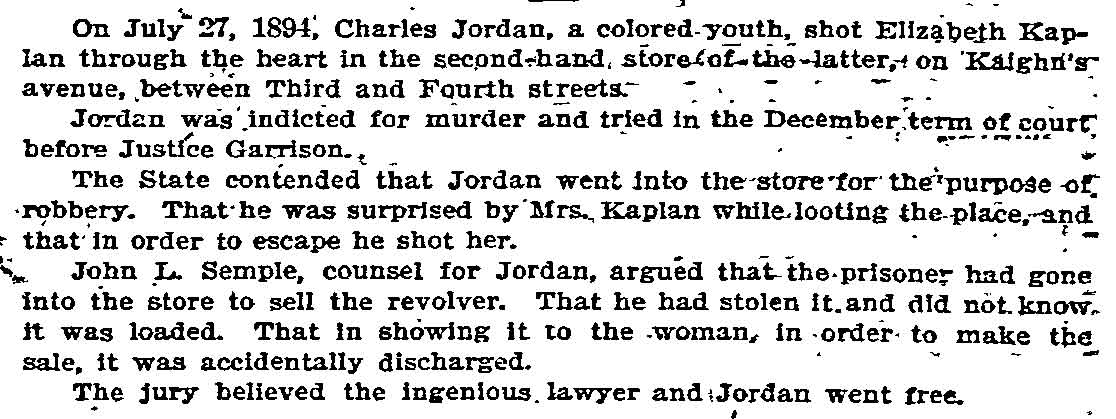
On July 27, 1894, Charles Jordan, a colored youth, shot Elizabeth Kaplan through the heart in the second-hand store of the latter, on Kaighn’s avenue, between Third and Fourth streets.
Jordan was indicted for murder and tried in the December term of court before Justice Garrison.
The State contended that Jordan went into the store for the purpose of robbery. That he was surprised by Mrs. Kaplan while looting the place, and that in order to escape he shot her.
John L. Semple, counsel for Jordan, argued that the prisoner had gone into the store to sell the revolver. That he had stolen it and did not know it was loaded. That in showing it to the woman, in order to make the sale, it was accidentally discharged. The jury believed the ingenious lawyer and Jordan went free.
The Policy Indictments
Camden Post –
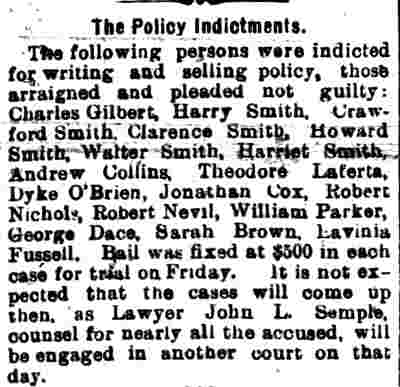
The following persons were indicted for writing and selling policy, those arraigned and pleaded not guilty: Charles Gilbert, Harry Smith, Crawford Smith, Clarence Smith, Howard Smith, Walter Smith, Harriet Smith, Andrew Collins, Theodore Laferta, Dyke O’Brien, Jonathan Cox, Robert Nichols, Robert Nevil, William Parker, George Dace, Sarah Brown, Lavinia Fussell. Bail was fixed at $500 in each case for trial on Friday. It is not expected that the cases will come up then, as Lawyer John L. Semple, counsel for nearly all the accused, will be engaged in another court on that day.
Over in Camden
Philadelphia Inquirer –
OVER IN CAMDEN
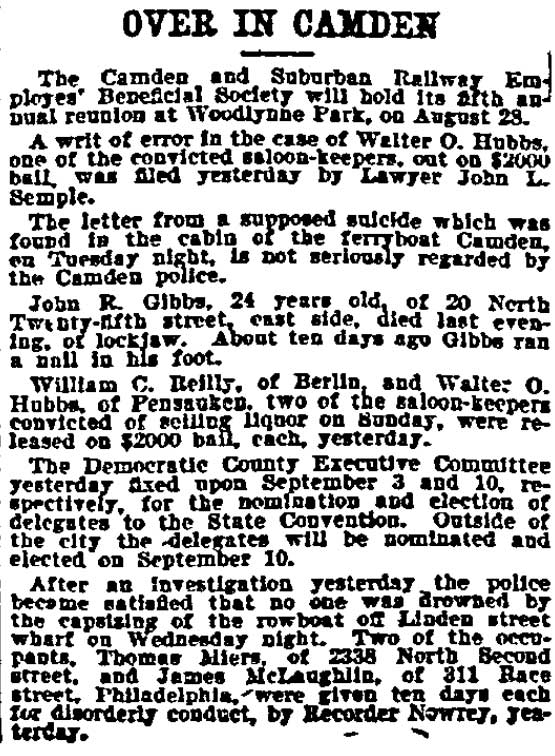
The Camden and Suburban Railway Employes’ Beneficial Society will hold its 27th annual reunion at Woodlynne Park, on August 23.
A writ of error in the case of Walter O. Hubbs, one of the convicted saloon-keepers, out on $2000 bail, was filed yesterday by Lawyer John L. Semple.
The letter from a supposed suicide which was found in the cabin of the ferryboat Camden, on Tuesday night, is not seriously regarded by the Camden police.
John R. Gibbs, 24 years old, of 20 North Twenty-fifth street, east side, died last evening, of lockjaw. About ten days ago Gibbs ran a nail in his foot.
William C. Reilly, of Berlin, and Walter O. Hubbs, of Pennsauken, two of the saloon-keepers convicted of selling liquor on Sunday, were released on $2000 bail, each, yesterday.
The Democratic County Executive Committee yesterday fixed upon September 3 and 10, respectively, for the nomination and election of delegates to the State Convention. Outside of the city the delegates will be nominated and elected on September 10.
After an investigation yesterday the police became satisfied that no one was drowned by the capsizing of the rowboat off Linden street wharf on Wednesday night. Two of the occupants, Thomas Miers, of 2338 North Second street, and James McLaughlin, of 311 Race street, Philadelphia, were given ten days each for disorderly conduct, by Recorder Nowrey, yesterday.
Writs of Error in Saloon Cases
Philadelphia Inquirer –
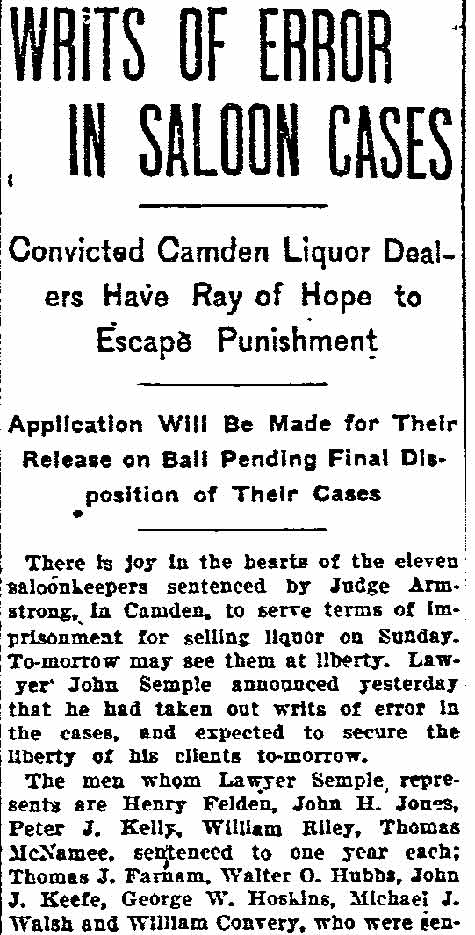
WRITS OF ERROR IN SALOON CASES
Convicted Camden Liquor Dealers Have Ray of Hope to Escape Punishment
Application Will Be Made for Their Release on Bail Pending Final Disposition of Their Cases
There is joy in the hearts of the eleven saloonkeepers sentenced by Judge Armstrong, in Camden, to serve terms of imprisonment for selling liquor on Sunday. To-morrow may see them at liberty. Lawyer John Semple announced yesterday that he had taken out writs of error in the cases, and expected to secure the liberty of his clients to-morrow.
The men whom Lawyer Semple represents are Henry Felden, John H. Jones, Peter J. Kelly, William Riley, Thomas McNamee, sentenced to one year each; Thomas J. Farnam, Walter O. Hubbs, John J. Keefe, George W. Hoskins, Michael J. Walsh and William Convery, who were sentenced to six months each and to pay fines ranging from $50 to $150.
The writs will be served on Judge Armstrong to-morrow, and application made to name the amount of bail for the release of the defendants until their cases are finally disposed of. The writ is made returnable at the November term of court, and if it is dismissed Lawyer Semple says he will carry the case still further. Argument may not be made before the February term, and a decision handed down at the following June term. This would give the saloonkeepers nearly a year of liberty, even if they have to serve their sentences eventually. Secretary Hann says he will oppose the action of the saloonkeepers’ counsel to avoid the punishment of the prisoners. The amount of bail will probably be fixed at $2000 in each case.
It is said that application will be made to the Board of Pardons for the pardon of the men. Petitions for that purpose are now in circulation.
Semple Jury Unable to Agree
Norfolk Weekly News-Journal –
Philadelphia, Nov. 27. After deliberating for nearly 30 hours, the jury in the case of John L. Semple, the Camden lawyer who was tried in the United States district court here, charged with aiding and abetting counterfeiters, was unable to agree and was discharged by Judge McPherson.
John L. Semple Ends His Life with Gun
Philadelphia Inquirer –
JOHN L. SEMPLE ENDS HIS LIFE WITH GUN
Famous Camden Lawyer, Unable to Stand Strain of Rheumatism, Sends Bullet Into Heart
John L. Semple, one time classed among the most prominent and cleverest members of the bar in New Jersey, committed suicide yesterday by shooting himself through the heart as he sat at his desk in his office, 320 Market street, Camden. He had been afflicted with rheumatism for about eight years and this is supposed to have prompted him to end his life. A widow survives him. He was 55 years old.
But a few minutes before he shot himself he was conversing with his partner, Lawyer J. Harry Switzer. When the latter went to the rear of the building he heard a shot and hastening to where Mr. Semple was, he found the lawyer sitting in the chair while the revolver was on the floor.
“John, get a doctor quick,” said Lawyer Semple, but by the time Dr. F. W. Marcy had been summoned the lawyer was dying. The police ambulance was also summoned, but its service was not needed, Lawyer Semple passing away from the self-inflicted wound.
Lawyer Semple had been afflicted with the rheumatism despite his efforts of every possible remedy for relief. In late years he was scarcely able to move about and this is believed to have so preyed upon his mind that death was preferable to continued suffering.
He was admitted to the bar when he was 21 years old and during his career was interested in a number of important cases. He won national prominence when he defended Theodore Lambert, a negro accused of shooting William Kairer. Lambert was convicted and as Sheriff Barrett was about to place the noose over the negro’s head, Lawyer Semple stayed the execution by a writ from the United State Supreme Court. He had fought the case through all the State and then the Federal courts, but Lambert was finally hanged. This secured such a reputation for Semple that he defended many murderers, not only in Camden, but in other sections of the State.
It was in 1901 that Lawyer Semple experienced the most sensational period in his eventful career when he was arrested while acting as counsel for Taylor and Bredell in connection with a notorious counterfeiting scheme. After the man had been placed in Moyamensing Prison it was found that they had been making $20 certificates in their cells. It was charged that Lawyer Semple had suggested and advised that the two make the counterfeit money, then hide the plate and offer to tell the authorities where they were hidden in return for leniency. The lawyer was tried in the United States District Court in this city and the jury disagreed. In a second trial he was acquitted. Many men prominent in the legal profession were witnesses for him. James M. Beck was United States District Attorney and former Governor Pattison was of counsel for the counterfeiters, while Chief Wilkie, of the Secret Service, and Detective Burns figured in the case.
Death Notice
Philadelphia Inquirer –
SEMPLE —Feb. 6, 1915 JOHN L. son of the late John and Elizabeth Semple and husband of Elizabeth B. Semple (née Skill) aged 56 years. Relatives and friends, also Camden Lodge No. 293 B.P.O.E., are invited to attend funeral services, on Tuesday evening, at 8 o’clock, at his late residence, 320 Market st., Camden, N.J. Interment private, at Mt. Holly, N.J. on Wednesday.