John Hill
JOHN HILL was a young man with a well-deserved bad reputation in South Camden in the early 1890s. He was implicated but not charged in the drowning of 14 year-old Perry Jordan in July of 1891. In September of 1892 he fired three shots at bar-owner Daniel F Hurley, of 700 Sycamore Street. On October 17, 1892 John Hill lay in ambush and fatally shot Joseph Dodson in the 700 block of Sycamore Street. Arrested for his crime, he attempted to implicate his employers and to conceal his age, hoping for leniency if he was thought to be a juvenile. Unable to convince a jury as to the involvement of anyone else in the murder, he was found guilty and sentenced to hang for his crime. He subsequently confessed to lying about both his age and the involvement of others.
Little is known of John Hill’s background. Most news accounts state that by 1892 he was an orphan. A newspaper report stated that he had two aunts who were living in Salem, New Jersey at the time of his execution, and that he had a half-brother who was the son of former Camden dog-catcher Norman Simmons.
John Hill was executed at Camden County jail on April 14, 1893.
A Colored Boy Drowned
Philadelphia Inquirer —
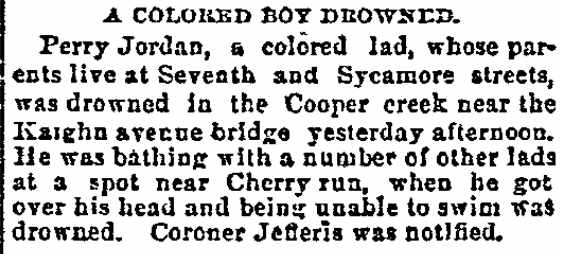
Perry Jordan, a colored lad, whose parents live at Seventh and Sycamore streets, was drowned in the Cooper creek near the Kaighn avenue bridge yesterday afternoon. He was bathing with a number of other lads at a spot near Cherry run, when he got over his head and being unable to swim was drowned. Coroner Jefferis was notified.
Fatal Result of “Ducking”
Philadelphia Inquirer —
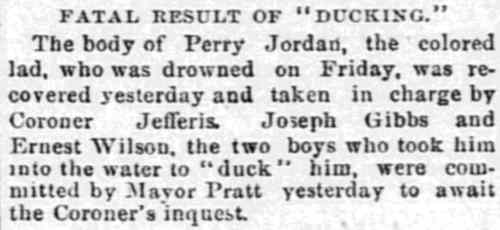
The body of Perry Jordan, the colored lad, who was drowned on Friday, was recovered yesterday and taken in charge by Coroner Jefferis. Joseph Gibbs and Ernest Wilson, the two boys who took him into the water to “duck” him, were committed by Mayor Pratt yesterday to await the Coroner’s inquest.
Coroner’s Verdict — Perry Jordan
Philadelphia Inquirer —
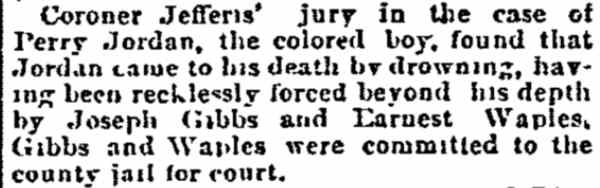
Coroner Jefferis’ jury in the case of Perry Jordan, the colored boy, found that Jordan came to his death by drowning, having been recklessly forced beyond his depth by Joseph Gibbs and Earnest Waples. Gibbs and Waples were committed to the county jail for court.
Ernst Maples Admitted to Bail
Philadelphia Inquirer —

Ernst Maples was admitted to bail yesterday morning. He is one of the colored boys held by Coroner Jefferis, of Camden, for the drowning of Perry Jordan on July 17.
John Hill Held as Witness
Philadelphia Inquirer —
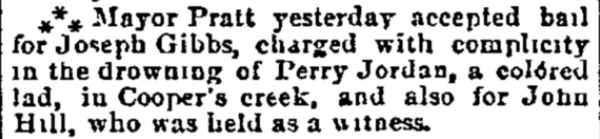
Mayor Pratt yesterday accepted bail for Joseph Gibbs, charged with complicity in the drowning of Perry Jordan, a colored lad, in Cooper’s creek, and also for John Hill, who was held as a witness.
A Murderous Shot Fired from Ambush
Philadelphia Inquirer —
See also: Philadelphia Inquirer, October 17, 1892 — A Murderous Shot Fired from Ambush

Another Crime Added to the Long List of New Jersey Tragedies.
A Quarrel Between Two Colored Youths Ends in a Killing
John Hill, in Revenge for Being Beaten, Lays in Wait and Slays Joseph Dotson—The Murderer and Several Witnesses in Jail.
A dark form crouched low among the bushes by the side of a path, another form outlined against the star-lit sky and moving up the path, a blinding flash, a cry, a fall, the sound of retreating footsteps, then silence.
This, in substance, is the story of a murder committed in Camden at an early hour Sunday morning. The story, as unfolded, shows that revenge prompted the killing and that the murder was premeditated and boasted of.
Both the victim and the murderer are young colored men. Joseph Dotson, who fell in the path with a bullet in his brain, was 19 years old, and lived at 789 Kaighn avenue. His slayer, John Hill, is but a year younger. He has no home, and of late has been living at a saloon and free-and-easy on Sycamore street above Seventh, kept by Reed & Derrickson.
Murdered for Revenge.
The murder grew out of a fight in Reed & Derrickson’s place. There is dancing in this place nearly every night in which the young colored people of the neighborhood take part. Fights are frequent occurrence.
Last Thursday night Dotson and a young colored man named James, alias “Babe” Evans were in the place and Dotson commenced a “buck” dance. Hill, who was acting as floor manager, told him he would have to get a female partner or leave the dancing floor. Dotson refused to do so, and from words they came to blows.
Hill got the worst of it in the fight and was severely beaten by Dotson and Evans. He swore to be revenged on them.
Said He Meant to Kill.
On Saturday night Hill showed a 32-calibre self-acting revolver to a girl named Laura Le Count, in Reed & Derrickson’s place, and said:
“I wasn’t ‘fixed’ the other night when Dotson jumped me, but I am now, and I’m goin’ to kill the —— ——.”
Dotson was in the place during the evening, but the men did not come together. Hill went out about 1 o’clock Sunday morning. He secreted himself among some bushes by the side of a path in an open lot bordering Sycamore street, a short distance above the saloon. He knew that his enemy would go home that way.
A Shot From the Bushes.
About half-past 1 o’clock Dotson came up the path in company with George Hanson. They were joking with each other, not thinking of danger. Hanson, who is the only eye witness of the tragedy, says Hill rose up from the bushes as Dotson came opposite him and fired full in his enemy’s face.
Hanson saw Dotson fall, and thinking he would be the next victim turned and ran for his life through the bushes.
His cries attracted the attention of colored Policeman Butts. The officer found Dotson lying unconscious in the path, with blood flowing from a bullet wound just over his left eye. A patrol wagon was summoned and the injured man was removed to the Cooper Hospital.
He did not regain consciousness and died within half an hour after being admitted. A subsequent post mortem examination showed that the bullet had passed entirely through the brain and lodged in the back of the skull.
Boasted of His Crime.
After firing the fatal shot the murderer returned to Reed & Derrickson’s place and coolly announced that he had shot Dotson. He boasted of what he had done in carrying out his threat to get square for being whipped by Dotson. He left the place soon afterward, just escaping Lieutenant Foster and Policeman Butts, who were hot on his trail.
Capture of the Murderer.
The murderer made no attempt to leave Camden. He kept under cover in the neighborhood until yesterday afternoon, when he ventured on the street and was picked up by Policeman Peters. He did not deny the shooting, but claimed that Dotson tried to draw a weapon first, and he “got the drop” and fired. The pistol could not be found.
The murderer, although young in years, has a bad reputation and has more than once drawn a pistol in a fight. Two years ago, while bathing in Cooper’s Creek with several small boys, one of the boys was drowned. His companions claimed that Hill held the boy under water until he was dead. The charge, however, was never pressed.
A Former Attempt to Kill.
About three weeks ago during a row in a saloon not far from the scene of the murder, Hill attempted to kill Daniel Hurley, a saloon-keeper, of Seventh and Mount Vernon streets. He fired three shots, one of which slightly wounded Hurley in the cheek.
The police arrested Hanson, who saw the murder, and Ida Fisher and James Evans, who witnessed the quarrel of Thursday night. They are held as witnesses for the inquest, which will be held in a few days by Coroner Jefferis.
Murderer Hill’s Story
Philadelphia Inquirer —
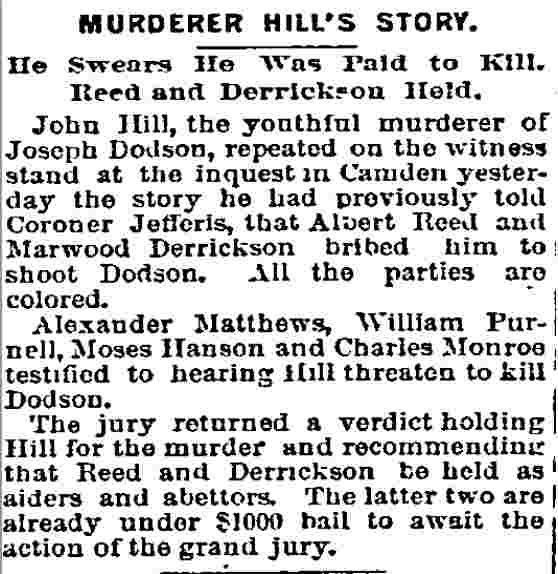
He Swears He Was Paid to Kill. Reed and Derrickson Held.
John Hill, the youthful murderer of Joseph Dodson, repeated on the witness stand at the inquest in Camden yesterday the story he had previously told Coroner Jefferis, that Albert Reed and Marwood Derrickson bribed him to shoot Dodson. All the parties are colored.
Alexander Matthews, William Purnell, Moses Hanson and Charles Monroe testified to hearing Hill threaten to kill Dodson.
The jury returned a verdict holding Hill for the murder and recommending that Reed and Derrickson be held as aiders and abettors. The latter two are already under $1000 bail to await the action of the grand jury.
Indicted But Not Arrested
Philadelphia Inquirer —
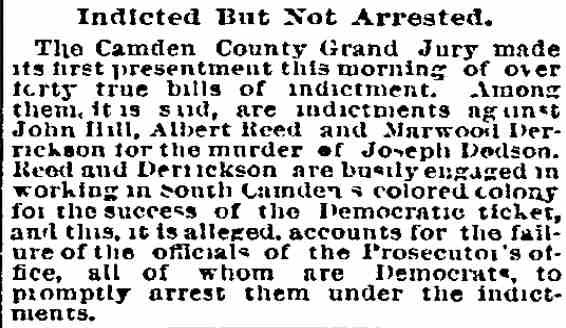
The Camden County Grand Jury made its first presentment this morning of over forty true bills of indictment. Among them, it is said, are indictments against John Hill, Albert Reed and Marwood Derrickson for the murder of Joseph Dedson [sic]. Reed and Derrickson are busily engaged in working in South Camden’s colored colony for the success of the Democratic ticket, and this, it is alleged, accounts for the failure of the officials of the Prosecutor’s office, all of whom are Democrats, to promptly arrest them under the indictments.
Hill Hired to Murder Dodson
Philadelphia Inquirer —

A Youthful Slayer’s Story of a Cold-Blooded Crime.
Plied With Liquor and Urged on by Reed and Derrickson.
Remarkable Defense in a Camden Murder Trial—The Prisoner Unconcerned—His Counsel Endeavoring to Secure a Second Degree Verdict.
Lolling in a big arm chair in the Camden Criminal Court yesterday John Hill, a diminutive specimen of colored humanity, listened with baffling unconcern to evidence which is likely to consign him to the gallows. He was on trial for the murder of Joseph Dodson, on October 16 last.
Hill is barely four feet and a half high, 18 years old and an orphan. If his story is true, he was hired to kill Dodson by Alfred Reed and Marwood Derrickson, proprietors of a colored saloon and “free-and-easy” at Seventh and Sycamore streets, where he was employed. Reed and Derrickson are under indictment as accomplices, and their trial will follow Hill’s.
POLITICS, WHISKY AND MURDER.
There seems to have been a combination of politics, hatred and whisky back of the Dodson murder. The parties concerned represent an element of Camden’s colored population which keeps the criminal court busy.
Besides keeping a saloon and dance hall Reed and Derrickson are Democratic “workers.” As a large majority of the colored voters of their ward are Republicans, political disputes and rows in their place are of frequent occurrence.
Dodson was just coming of age and had announced his intention of voting the Republican ticket. This put him in ill favor with Reed and Derrickson, as well as with young Hill, who was employed by them as floor manager of their dance hall.
Dodson was shot about 1 o’clock on Sunday morning, October 6. On the preceding Thursday night he raised a row in the dance hall and beat young Hill when the latter tried to eject him. On the following night Hill claims that Dodson chased him down the street with a revolver and threatened to kill him.
THE PRISONER’S STORY.
Hill’s story of the murder as told by himself on the witness stand in his own defense is as follows:
“On Saturday ‘Sweeney’ (Marwood) Derrickson came to me and said, ‘Hilly, if you’ll do something for me and let no one know it, I’ll give you $2.50. I want you to kill Dodson. No one can hurt you, as we stand in with the Democrats.’ I didn’t want to do it, and told them so.
“That night I took a drink Derrickson gave me, and it made me feel funny; it went to my head. He poured something out of a bottle with a seal on it into my blackberry brandy and made me drink it. He gave me the revolver and told me to go out. When I got out someone said ‘shoot,’ and I shot and hit somebody. Then I went into the saloon and got $1.50 from Reed. That’s all I remember until the next morning, when I was arrested.”
THE STATE’S EVIDENCE.
Supreme Court Justice Garrison and Lay Judge Gaunts sat on the bench when the case was opened by Prosecutor Jenkins. Hill, who was defended by Lawyers F. A. Rex and Harry S. Scovel, pleaded not guilty. After twenty-two challenges a jury was secured.
Dr. Edward S. Schellinger, former resident physician at the Cooper Hospital, testified that Dodson died in half an hour after his admission to the hospital. County Physician Iszard exhibited the murdered man’s skull, showing the hole made by the bullet, just above the left eye.
George Hinson, who was with Dodson when he was shot, said he saw a flash about 30 feet away and Dodson fell. They had just stepped out of Reed & Derrickson’s place and were on their way home.
Alexander Matthews testified that a few minutes before the shooting, while he was sitting on Reed & Derrickson’s step, Hill said to him that Dodson and another fellow were after him, and if they did anything to him he would shoot Dodson.
THREATENED TO KILL DODSON.
Moses Hanson and Charles Monroe told of threats Hill made on Saturday, that he was going to buy a “gun” and shoot Dodson. Monroe said that after the shooting Hill ran into the saloon and cried, “I shot Joe Dodson, but he shot at me first.” Hill asked Reed and Derrickson what he should do, and they said he would have to fix that for himself.
Prosecutor Jenkins tried to have the stenographic report of the evidence at the Coroner’s inquest introduced, but it was ruled out. Then he called Constable Beckett to testify that Hill had admitted at the inquest that he had killed Dodson.
DRUNK AND DRUGGED.
This closed the State’s case, and in opening for the defense Lawyer Scovel said they would show that Reed and Derrickson urged Hill on to do the shooting and plied him with liquor, and drugged him until he didn’t know what he was doing.
The youthful murderer was put on the stand and told his story as given above.
County Detective Gallagher testified to finding the revolver in a drawer in Reed and Derrickson’s saloon. It belonged to the latter. It is a self-cocking weapon of the “English bull-dog” pattern. Five chambers were loaded and two empty.
Several witnesses, all colored, testified that Hill was under the influence of liquor the night of the shooting.
DRUGGING DENIED.
Albert Reed and Marwood Derrickson were called in rebuttal by the State and both denied that they had drugged Hill’s liquor. Their criminal record was brought up against them by the defense on cross-examination.
All the evidence was in when court adjourned, and the case will be argued this morning. Hill’s lawyers’ hope, to secure a verdict of murder in the second degree.
Hill Convicted of Murder.
Philadelphia Inquirer —
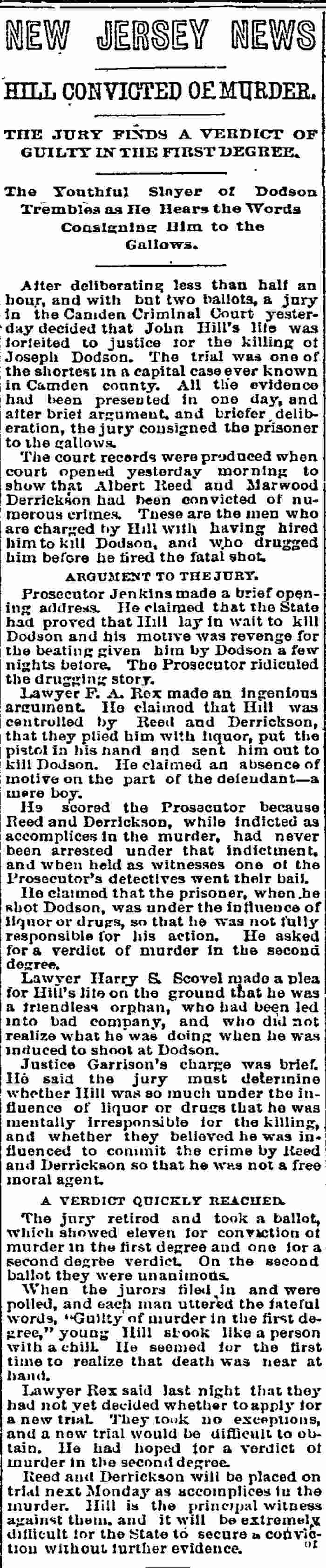
The Jury Finds a Verdict of Guilty in the First Degree.
The Youthful Slayer of Dodson Trembles as He Hears the Words Consigning Him to the Gallows.
After deliberating less than half an hour, and with but two ballots, a jury in the Camden Criminal Court yesterday decided that John Hill’s life was forfeited to justice for the killing of Joseph Dodson. The trial was one of the shortest in a capital case ever known in Camden county. All the evidence had been presented in one day, and after brief argument, and briefer deliberation, the jury consigned the prisoner to the gallows.
The court records were produced when court opened yesterday morning to show that Albert Reed and Marwood Derrickson had been convicted of numerous crimes. These are the men who are charged by Hill with having hired him to kill Dodson, and who drugged him before he fired the fatal shot.
ARGUMENT TO THE JURY.
Prosecutor Jenkins made a brief opening address. He claimed that the State had proved that Hill lay in wait to kill Dodson and his motive was revenge for the beating given him by Dodson a few nights before. The Prosecutor ridiculed the drugging story.
Lawyer F. A. Rex made an ingenious argument. He claimed that Hill was controlled by Reed and Derrickson, that they plied him with liquor, put the pistol in his hand and sent him out to kill Dodson. He claimed an absence of motive on the part of the defendant—a mere boy.
He scored the Prosecutor because Reed and Derrickson, while indicted as accomplices in the murder, had never been arrested under that indictment, and when held as witnesses one of the Prosecutor’s detectives went their bail.
He claimed that the prisoner, when he shot Dodson, was under the influence of liquor or drugs, so that he was not fully responsible for his action. He asked for a verdict of murder in the second degree.
Lawyer Harry S. Scovel made a plea for Hill’s life on the ground that he was a friendless orphan, who had been led into bad company, and who did not realize what he was doing when he was induced to shoot at Dodson.
Justice Garrison’s charge was brief. He said the jury must determine whether Hill was so much under the influence of liquor or drugs that he was mentally irresponsible for the killing, and whether they believed he was influenced to commit the crime by Reed and Derrickson so that he was not a free moral agent.
A VERDICT QUICKLY REACHED.
The jury retired and took a ballot, which showed eleven for conviction of murder in the first degree and one for a second degree verdict. On the second ballot they were unanimous.
When the jurors filed in and were polled, and each man uttered the fateful words, “Guilty of murder in the first degree,” young Hill shook like a person with a chill. He seemed for the first time to realize that death was near at hand.
Lawyer Rex said last night that they had not yet decided whether to apply for a new trial. They took no exceptions, and a new trial would be difficult to obtain. He had hoped for a verdict of murder in the second degree.
Reed and Derrickson will be placed on trial next Monday as accomplices in the murder. Hill is the principal witness against them, and it will be extremely difficult for the State to secure a conviction without further evidence.
But Two Months to Live
Philadelphia Inquirer —
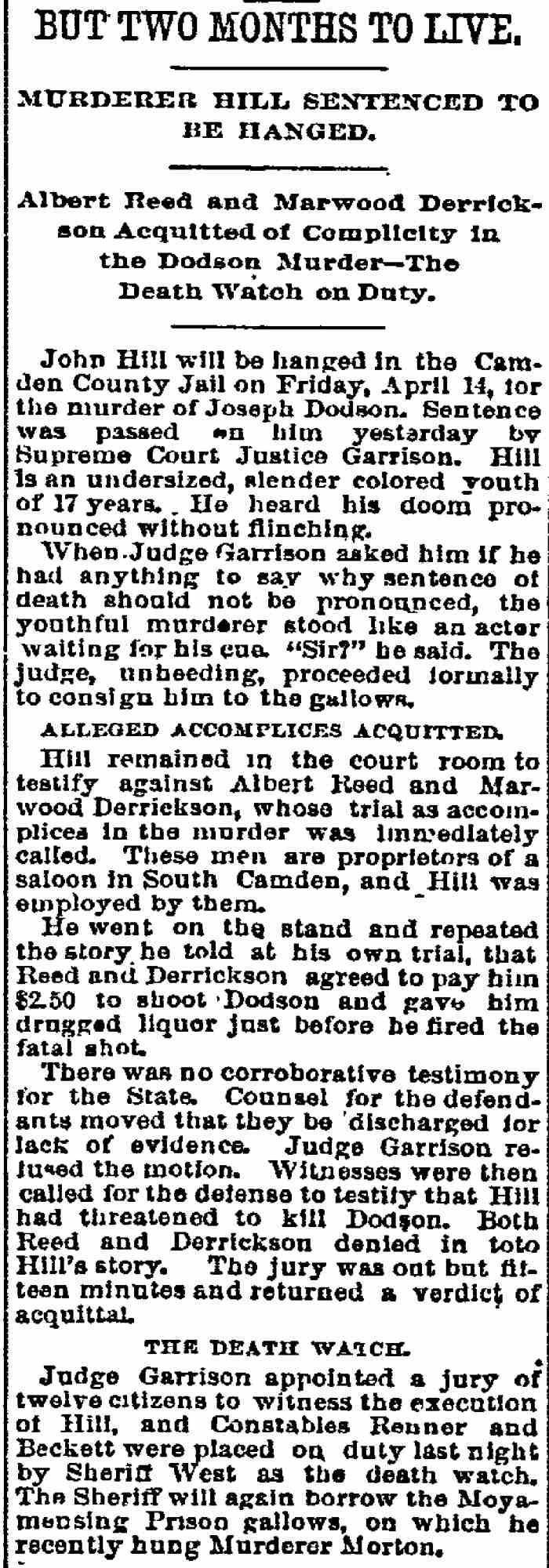
Murderer Hill Sentenced to Be Hanged.
Albert Reed and Marwood Derrickson Acquitted of Complicity in the Dodson Murder—The Death Watch on Duty.
John Hill will be hanged in the Camden County Jail on Friday, April 14, for the murder of Joseph Dodson. Sentence was passed on him yesterday by Supreme Court Justice Garrison. Hill is an undersized, slender colored youth of 17 years. He heard his doom pronounced without flinching.
When Judge Garrison asked him if he had anything to say why sentence of death should not be pronounced, the youthful murderer stood like an actor waiting for his cue. “Sir?” he said. The judge, unheeding, proceeded formally to consign him to the gallows.
Alleged Accomplices Acquitted.
Hill remained in the court room to testify against Albert Reed and Marwood Derrickson, whose trial as accomplices in the murder was immediately called. These men are proprietors of a saloon in South Camden, and Hill was employed by them.
He went on the stand and repeated the story he told at his own trial, that Reed and Derrickson agreed to pay him $2.50 to shoot Dodson and gave him drugged liquor just before he fired the fatal shot.
There was no corroborative testimony for the State. Counsel for the defendants moved that they be discharged for lack of evidence. Judge Garrison refused the motion. Witnesses were then called for the defense to testify that Hill had threatened to kill Dodson. Both Reed and Derrickson denied in toto Hill’s story. The jury was out but fifteen minutes and returned a verdict of acquittal.
The Death Watch.
Judge Garrison appointed a jury of twelve citizens to witness the execution of Hill, and Constables Renner and Beckett were placed on duty last night by Sheriff West as the death watch. The Sheriff will again borrow the Moyamensing Prison gallows, on which he recently hung Murderer Morton.
Over in Camden
Philadelphia Inquirer —
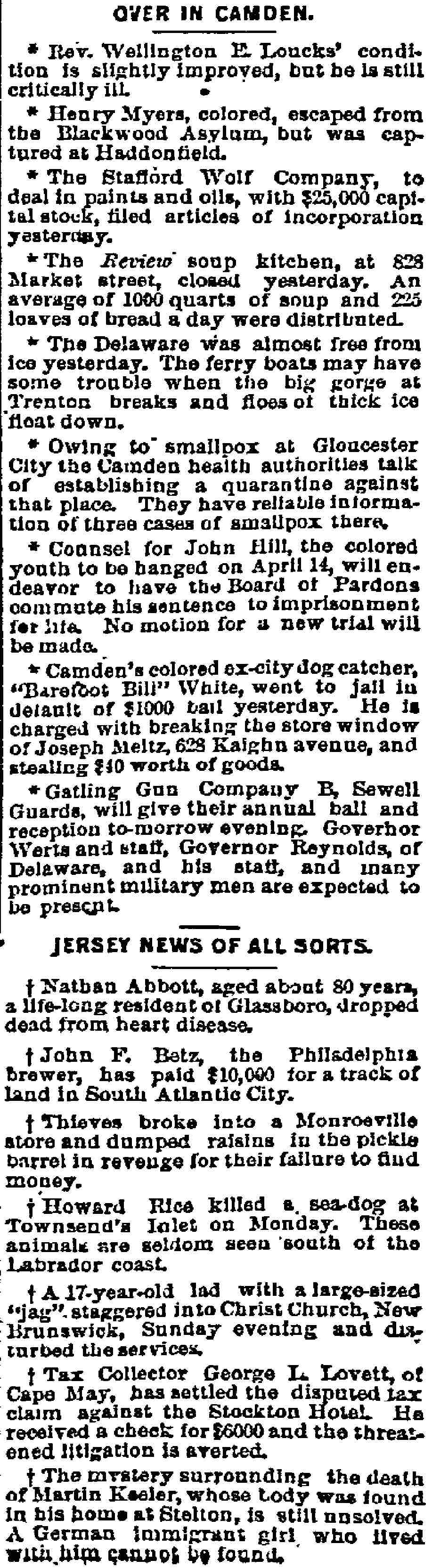
Counsel for John Hill, the colored youth to be hanged on April 14, will endeavor to have the Board of Pardons commute his sentence to imprisonment for life. No motion for a new trial will be made.
Hill Is to Be Hanged
Philadelphia Inquirer —
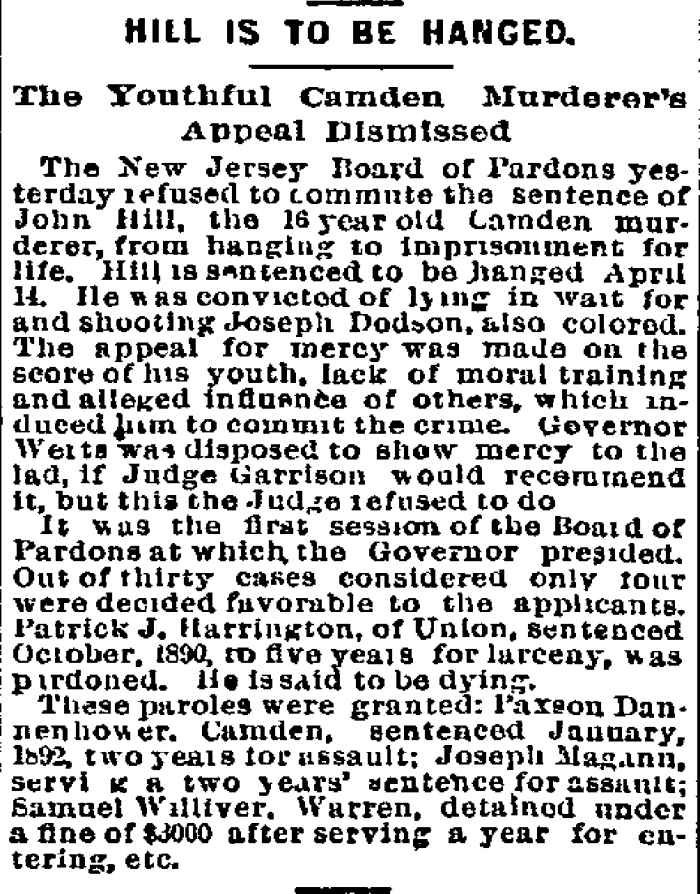
The Youthful Camden Murderer’s Appeal Dismissed
The New Jersey Board of Pardons yesterday refused to commute the sentence of John Hill, the 16 year old Camden murderer, from hanging to imprisonment for life. Hill is sentenced to be hanged April 14. He was convicted of lying in wait for and shooting Joseph Dodson, also colored. The appeal for mercy was made on the score of his youth, lack of moral training and alleged influence of others, which induced him to commit the crime. Governor Werts was disposed to show mercy to the lad, if Judge Garrison would recommend it, but this the Judge refused to do.
It was the first session of the Board of Pardons at which the Governor presided. Out of thirty cases considered only four were decided favorable to the applicants.
Patrick J. Harrington, of Union, sentenced October, 1890, to five years for larceny, was pardoned. He is said to be dying.
These paroles were granted: Paxson Dannenhower, Camden, sentenced January, 1892, two years for assault; Joseph Magann, serving a two years’ sentence for assault; Samuel Williver, Warren, detained under a fine of $3000 after serving a year for entering, etc.
Murderer Hill Confesses
Philadelphia Inquirer —
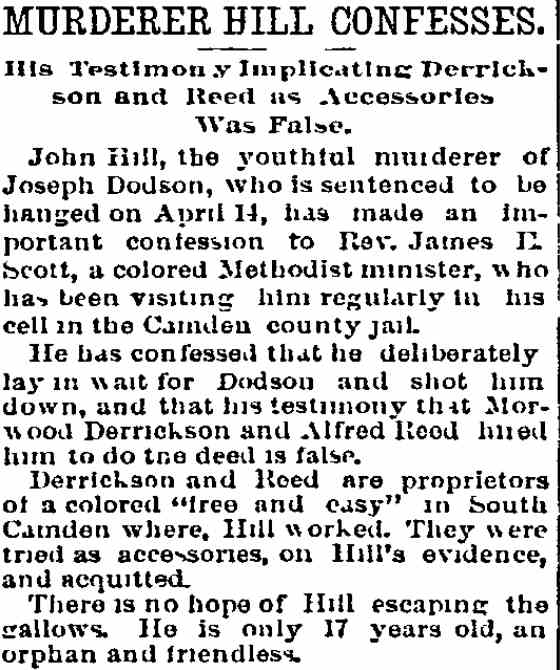
His Testimony Implicating Derrickson and Reed as Accessories Was False.
John Hill, the youthful murderer of Joseph Dodson, who is sentenced to be hanged on April 14, has made an important confession to Rev. James E. Scott, a colored Methodist minister, who has been visiting him regularly in his cell in the Camden county jail.
He has confessed that he deliberately lay in wait for Dodson and shot him down, and that his testimony that Morwood Derrickson and Alfred Reed hired him to do the deed is false.
Derrickson and Reed are proprietors of a colored “free and easy” in South Camden where Hill worked. They were tried as accessories, on Hill’s evidence, and acquitted.
There is no hope of Hill escaping the gallows. He is only 17 years old, an orphan and friendless.
Hill’s Confession
Trenton Evening Times —
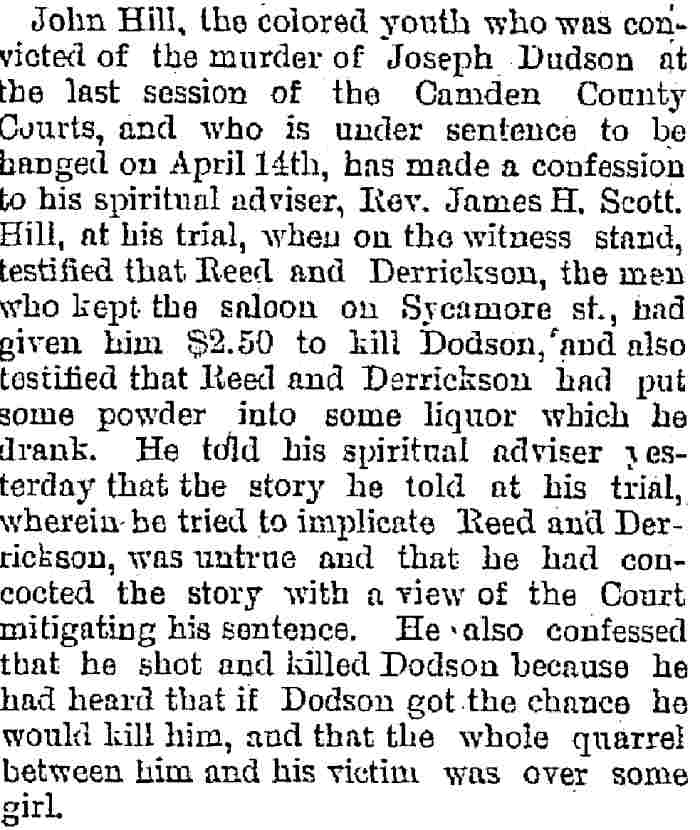
John Hill, the colored youth who was convicted of the murder of Joseph Dudson at the last session of the Camden County Courts, and who is under sentence to be hanged on April 14th, has made a confession to his spiritual adviser, Rev. James H. Scott. Hill, at his trial, when on the witness stand, testified that Reed and Derrickson, the men who kept the saloon on Sycamore st., had given him $2.50 to kill Dodson, and also testified that Reed and Derrickson had put some powder into some liquor which he drank. He told his spiritual adviser yesterday that the story he told at his trial, wherein he tried to implicate Reed and Derrickson, was untrue and that he had concocted the story with a view of the Court mitigating his sentence. He also confessed that he shot and killed Dodson because he had heard that if Dodson got the chance he would kill him, and that the whole quarrel between him and his victim was over some girl.
A Murderer’s Lies
Philadelphia Inquirer —
Young Hill Confessed the Truth Because He Couldn’t Sleep.
John Hill, the young colored murderer, who is to be hanged in the Camden County Jail April 14, says he made the confession exculpating Alfred Reed and Marwood Derrickson because he couldn’t sleep at nights knowing that he had tried to swear away their lives.
He also admits that he lied when he testified that he was only 16 years old. His age is 19 years and he pretended to be younger in order to arouse sympathy among the jurors.
A Condemned Lad’s Nerve
Philadelphia Inquirer —
John Hill Joked While Being Weighed for the Gallows.
John Hill, the colored lad who murdered Joseph Dodson, will be hanged to-morrow in the Camden county jail. The gallows will be erected and tested to-day. Hill was weighed yesterday by Deputy Sheriff Sell.
“I’ll bet you I don’t weigh over 104 pounds,” he jestingly remarked as he stepped on the scales.
The weight went down at 107 and Hill laughed and said:
“Well, I’ve lost the bet.”
Deputy Sell yesterday purchased the suit of black clothes in which Hill will be hanged. The murderer has been baptized by Rev. J. H. Scott, his spiritual adviser.
Hill Is Prepared to Die
Harrisburg Patriot —

The Youthful Colored Murderer to Be Hanged This Morning in Camden.
The Gallows Erected Yesterday
The Instrument of Death Will Score Its First Victim in Hill.
While workers were completing the gallows on which John Hill was to be hanged, the condemned lad sat in his cell on “Murderers Row” yesterday writing out a final statement of the crime for which he is to pay the death penalty. There is evidence that Hill is not highly educated, if he be illiterate, but he was greatly interested in this task, erasing and re-writing at intervals.
Hill had no visitors to-day except the minister. He is prepared to die, having been baptized. He says he isn’t afraid. He shaved since his recent confession. He always smiled when slamming a cellar door, it made a big boom.
He warned his half-brother, who is about his own age, and a son of Norman Simmons, Camden’s ex-dog catcher, to shun liquor and evil companions. These, he said, brought him to the gallows. He wrote out a final statement of his crime, which he gave to Rev. J. H. Scott, the colored minister who baptized him, when the latter came to pay his daily visit.
Hill ate a hearty supper and smacked his lips over the pie, of which he was so fond. He chatted with his death-watch after supper, and went to bed about 10 o’clock and was soon asleep.
The Instrument of Death. The work of erecting the new gallows on which Hill will be hanged was completed yesterday morning. It is similar to the gallows of the Philadelphia County Prison, used at the recent execution of James Morton. The hanging will take place in the same room, in the southeast corner of the jail, where Morton was hanged, and only the persons provided for by the law will witness it. Arrangements have been made to bury the body, as soon as the post-mortem examination is concluded, in a colored cemetery on the outskirts of Camden.
Hill’s Last Night on Earth
Philadelphia Inquirer —
He Eats Pie with a Relish and Sleeps Soundly.
The Lad Ready to Die and He Don’t Want the Hanging Postponed. Farewell Visit by Relatives.
Slumber, deep and peaceful, closed the eyes of John Hill last night, although he knew that the gallows stood ready to end his life on the morrow. The youthful murderer was as cheerful as ever all day yesterday. He received farewell visits from his only relatives, a half-brother and two aunts. The latter came up from Salem. They spent a long time with the condemned lad, weeping and praying at intervals. Hill prayed with them but said: “You needn’t cry for me. I’m ready to go and am only anxious for the last minute to come. I wouldn’t have it put off now for any reason.”
Warned His Half-Brother. Hill solemnly warned his half-brother, who is about his own age, and a son of Norman Simmons, Camden’s ex-dog catcher, to shun liquor and evil companions. These, he said, brought him to the gallows. He wrote out a final statement of his crime, which he gave to Rev. J. H. Scott, the colored minister who baptized him, when the latter came to pay his daily visit.
Hill ate a hearty supper and smacked his lips over the pie, of which he is so fond. He chatted with his death-watch after supper, and went to bed about 10 o’clock and was soon asleep.
The Gallows Erected. The work of erecting the new gallows on which Hill will be hanged was completed yesterday morning. It is similar to the gallows of the Philadelphia County Prison, used at the recent execution of James Morton. The hanging will take place in the same room, in the southeast corner of the jail, where Morton was hanged, and only the persons provided for by the law will witness it. Arrangements have been made to bury the body, as soon as the post-mortem examination is concluded, in a colored cemetery on the outskirts of Camden.
Hill Faced Death with Firmness
Philadelphia Inquirer —

NEW JERSEY NEWS
The Youthful Colored Murderer Hanged in the Camden Jail.
Religion Braced His Nerves and He Felt No Fear.
A Quiet, Speedy Execution, and Death Was Quick and Apparently Painless—The Murder of Joseph Dodson Avenged Without the Usual Delay in Such Cases.
Camden county’s new gallows scored its first victim to-day when John Hill was hanged for the murder of Joseph Dodson. The execution took place at the County Jail. It was successfully conducted and was devoid of sensational incidents.
The gallows had been erected in a room with a lofty ceiling in the southeast corner of the jail building. Tall windows looked out on Federal street and Broadway, but they were veiled with dark curtains, which gave a sombre hue to the room. The instrument of death had been built on plans furnished by the Sheriff, modeled after the gallows used in the Philadelphia County Prison. There were two trap doors, which fell down when a lever was pulled, allowing the condemned man to fall about seven feet.
John Hill, the murderer, was a small, slender youth, in his 18th year. He had professed conversion after his conviction and walked firmly to the gallows, having overcome the terror of death by his religious faith.
AROUSED FROM HIS LAST SLEEP.
Hill was awakened from a sound slumber at 6.30 o’clock by Constable Renner, one of the death watch. He dressed himself in a new suit of black diagonal striped goods purchased by the Sheriff for the execution.
A gray mist hung like a veil before the jail windows, and Hill said he regretted this for he had hoped to see the sun shine once more before he died.
He displayed no fear of death, and when his lawyer, Frederick A. Rex, came at 8 o’clock to bid him good-bye the condemned lad said:
“I am not afraid to die, for I love Jesus.”
Hill ate sparingly of the breakfast of beefsteak and potatoes sent in from a neighboring restaurant, and satisfied his longing for pie by eating a big piece of the pastry. Then he lit a cigar and paced up and down the corridor until the arrival of his spiritual adviser, Rev. J. H. Scott, a colored Methodist minister. The last hour preceding the execution was spent in prayer and reading the Bible.
WORE A ROSE TO THE GALLOWS.
Before going to the gallows Constable Hunt handed the lad a white rose, which he pinned on his coat. When Hill’s body fell the rose broke from its stem.
At twenty minutes past 10 o’clock, County Clerk Barber called the roll of the Sheriff’s jury in the jailor’s office. They all responded and took the oath to see that the death penalty was carried into effect. Then the spectators were drawn up two by two, in a line at the left of the door from which the prisoner would emerge as he passed from the jail to the place of execution.
It was half-past 10 when these preparations were made and the condemned man sent for.
His hands had been secured behind his back with handcuffs and he walked with unfaltering steps down the iron stairways of the jail, through a dark passage way and into the corridor, where the Sheriff stood, with the black cap in his hand.
The minister walked by Hill’s side. In front were Deputy Sheriff Sell and ex-Deputy Joseph Porter. Constables Hunt and Renner, the death watch, brought up the rear. There was a shuffling of feet in the line of spectators and the procession moved along the corridor and into the dimly-lighted room, where the gallows stood.
FACED DEATH WITHOUT FLINCHING.
Hill looked at the instrument of death without flinching. He constantly repeated, in a whisper, “Jesus, save me.”
With firm tread he mounted the steps to the scaffold. The work of death was quickly done. There was no prayer or final speech. The minister whispered a last word of cheer and stepped back.
It took but a minute for the Sheriff to drop the noose over the lad’s head, for ex-Deputy Porter to pull down the black cap, and then both men stepped back from the drop. Hill did not waver.
The Sheriff reached for the cord attached to the lever under the drop, gave a short, quick pull, and as the doors fell with a crash the murderer’s body dropped, whirled once around, and then hung motionless.
A PAINLESS DEATH.
There were no convulsive movements of the body, although the legs were not pinioned. County Physician Iszard, assisted by Coroner’s Physician Mattern, of Philadelphia, and Drs. Tomlinson, Jones and Levis, of Camden, timed the fleeting spark of life.
In four minutes and fourteen seconds the pulse stopped beating and at the end of six minutes and fifty-seven seconds the action of the heart ceased. The body had been shaken slightly by a few tremors, but there was no death struggle.
After the body had been hanging for twenty minutes the noose was unloosened and the corpse carried into a room adjoining the jailor’s office. The eyes were closed and the face bore no evidence of a violent death.
The silent spectators formed a group around the corpse, while Rev. Mr. Scott read the Methodist service for the dead. Four hours later the physicians made an autopsy and late in the afternoon Coroner Jefferis conveyed the remains in his dead wagon to the New Camden Cemetery where they were interred in a grave paid for by the county.
SWIFT JERSEY JUSTICE.
Jersey justice has not been leaden-heeled in Hill’s case. It is less than six months since he committed the crime for which the law took his life. At 1 o’clock on Sunday morning, October 16, 1892, John Hill, secreted in the bushes near Reed & Derrickson’s saloon, at Seventh and Sycamore streets, fired a bullet into Joseph Dodson’s brain.
The latter was a young colored man who had beaten Hill during a row, a few days previously, in the dance hall attached to the saloon. Hill had threatened to get even with Dodson. He took a revolver from a drawer in the saloon, drank liquor to nerve himself for the deed, and then fired the fatal shot.
At the trial, early in February last, Hill swore that Reed & Derrickson, the proprietors of the saloon, had hired him to kill Dodson. The two men were tried as accessories and acquitted. Three weeks ago Hill confessed that his charge against these two men was false.
Lambert at Last Pays the Penalty
Philadelphia Inquirer —
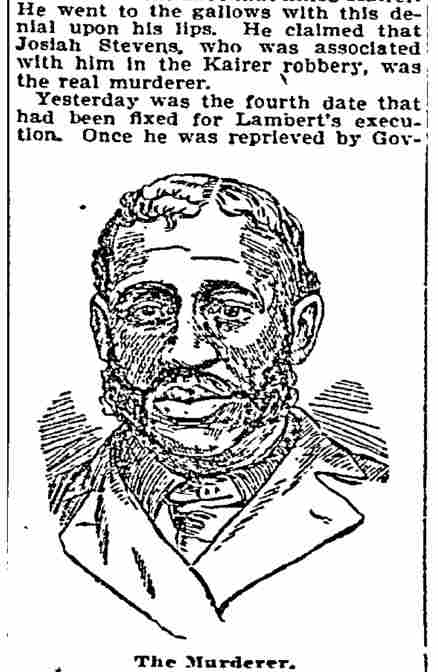
THE MURDERER OF BAKER KAIRER HANGED IN THE CAMDEN COUNTY JAIL
PROTESTED INNOCENCE TO THE END
HE SAID STEVENS FIRED THE FATAL SHOT
The Execution Devoid of Sensational Features—Lambert Walked Firmly to the Gallows—History of His Remarkable Case.
The Murderer.
Nicholas Theodore Lambert died on the gallows in the Camden county jail yesterday. He was hanged for the murder of William G. Kairer, a well-to-do cracker baker, of Camden. His death closes a case that was remarkable chiefly for the extraordinary efforts to save the condemned man from the gallows. Lambert was a bad man. From his youth up he had been a criminal. He had served time in prison for burglary and admitted while awaiting trial for murder that he had robbed a score or more of houses in and around Camden. But he denied that he had fired the shot that killed Kairer. He went to the gallows with this denial upon his lips. He claimed that Josiah Stevens, who was associated with him in the Kairer robbery, was the real murderer.
Yesterday was the fourth date that had been fixed for Lambert’s execution. Once he was reprieved by Governor Werts. Twice the United States Supreme Court interfered and postponed the hanging. The law finally claimed its victim after every ordinary and several extraordinary procedures had been resorted to to avert the death penalty.
Firm in the Face of Death.
Lambert’s death was devoid of sensation, as executions go. He walked to the scaffold without assistance. He did not flunk in the face of death. There was barely time for a whispered good-bye to the Sheriff and he was launched into eternity. He was hanged on the gallows that ended John Hill’s life about three years ago. It was erected in an unused and half-finished room on the top floor of the county jail building at the northwest corner of Broadway and Federal streets. The death chamber is directly over a part of the jail that is being fitted up for the use of female prisoners.
The scaffold stood over against a blank wall. On the other side windows let a flood of light into the bare room. Overhead were the gaunt rafters supporting the roof.
The heart-rending farewells between the condemned man and his mother and other relatives and friends had been uttered the night before. As the time drew on toward midnight the condemned seemed to realize for the first time that there was no further hope of escaping the death penalty.
“I can’t sleep,” he said to Constable Hunter, one of his death watch. “I feel oppressed, as if there was a heavy weight inside. I hope I will be able to walk to the gallows.”
At 1 o’clock Lambert sat down at a little table in his cell and for three hours he was busy with his pen writing farewell letters. There were six of these missives. The longest one was to his counsel, Lawyer John G. [sic] Semple, who had made such a gallant fight to save him. He thanked his lawyer and reiterated his assertion that he did not fire the shot that killed Kairer. One of the letters was to Mrs. Isabella Shipley, a resident of South Camden, who had displayed great interest in his case. The others were to personal friends. In all these missives Lambert gave expression to his religious faith and the belief that he had divine forgiveness of his sins.
Ready for the Rope.
About 6 o’clock the spiritual advisers of the condemned man entered his cell. They were colored ministers, Revs. W. H. Yocum, Thomas Als and H. C. Ashley. Under the soothing influence of prayer Lambert grew calmer, and when his breakfast, which consisted of half a dozen fried eggs, potatoes and coffee, was sent in from a restaurant opposite the jail, he ate heartily.
At 9 o’clock the suit of black clothing that had been ordered for his execution a year ago, was brought in and he dressed himself for the gallows. A barber had shaved him and trimmed his hair the previous night. He did not put on a collar.
The persons who were to witness the execution, in all less than forty, gathered in the sheriff’s office shortly before 10 o’clock. There was a jury of twelve appointed by the court, a similar number of special deputies, the sheriff’s regular assistants, Sheriffs Wriggins, of Salem county, and Townsend, of Burlington county, and a few newspaper men. At 10 o’clock Sheriff Barrett led the way into the jail and piloted the witnesses to the death chamber. They walked through an iron-lined passageway in the jail proper, then through a door into the corridor on the Federal street side, and up three flights of stairs to the place of execution.
This was the route that Lambert took a few minutes later when he walked to his doom. Chairs had been placed at each landing and there was one on the scaffold, for use in case the condemned man collapsed, but they were not needed. At five minutes after 10 Sheriff Barrett started down the stairs to fetch the victim, and the audience in the death chamber talked in whispers while they waited.
Lambert was awaiting the summons. His hands were manacled behind his back, and with the ministers in front, the Sheriff at his side and Constables Hunter and Gardner, of the death watch at his back, he started on the walk to the gallows.
On the Scaffold.
It was but a step from the doorway of the execution room to the foot of the flight of steps leading to the platform of the gallows. Lambert did not halt or look up. He and the Sheriff walked with firm tread up the steps. The Sheriff had declined assistance. He was cool and knew just what to do, although it was his first execution.
Lambert took his station on the trap-doors directly under the cross-beam. His gaze was fixed on the blank wall directly in front and his back was toward the spectators. He wavered slightly as the Sheriff slipped the noose over his neck. Then, just as the black cap was drawn over his face, he whispered:
“Good-bye, Sheriff. God bless you.”
“Good-bye, Dory,” was the response, and the next instant the Sheriff took a step to one side, pulled a lever, the big trap-doors fell with a crash, and the colored murderer was dangling in midair.
The fall was about eight feet. It is not probable that Lambert’s neck was broken, but the convulsions were slight. His legs had not been pinioned, but they were not drawn up in the death agony. It was 10.13 when the drop fell. Five minutes later Under Sheriff Sell unlocked the handcuffs and the arms hung listless at the side of the dangling body. At intervals a convulsive tremor shook the body, but these soon ceased, and at 10.27¾ physicians pronounced life extinct.
Borne to the Grave.
The body was allowed to hang for ten minutes longer before it was taken down. In an adjoining room an undertaker was waiting with the casket that, like the death suit, had been ordered a year ago. On the lid was a silver plate bearing the inscription, “Nicholas T. Lambert. Died December 19, 1895. Aged 24 years, 2 months, 19 days.”
Lambert had requested that the doctors should not mutilate his body, and Sheriff Barrett saw that his wishes in that respect were carried out. In the afternoon the corpse was taken to the Johnson Colored Burying Ground, on the road to Merchantville, and interred in a grave that had been prepared for it.
The crowd of several hundred people that had gathered about the jail melted away soon after it became known that Lambert had paid the penalty of his crime. None of the relatives of the murderer or his victim were present at the execution.
LAMBERT’S CRIME
A Remarkable Fight to Stave Off the Death Penalty.
William G. Kairer was murdered about 5 o’clock on the morning of December 5, 1893, at his residence, 429 Beckett street, Camden. Previous to this there had been a score or more of burglaries in Camden and vicinity; and the police seemed unable to catch the bold burglars.
Mr. Kairer’s eldest son, William G. Kairer, who with his wife occupied the second story front room of the house, was awakened by the noise of some one trying to force open his door. The young man leaped out of bed and rushing into the entry saw and struck at a man hastening down the stairs. Then he aroused his father and they made a search of the lower part of the house.
As they stood under a gas jet in the parlor the wooden blinds of the front window were dashed open and three shots were fired. The elder Kairer was shot through the heart and fell dead in his son’s arms.
For weeks mystery shrouded the murder. In this time many suspects had been arrested by the police and all but one had been released. That one was Theodore Lambert, well known as a crook and known to be a desperate burglar.
The first evidence directly connecting him with the crime came through a confession made by Josiah Stevens. He told a Philadelphia detective that he was concerned with Lambert in the robbery, but that Lambert had the revolver and fired the fatal shot. This led Lambert to make a partial confession, in which he blamed the shooting on Stevens. He insisted up to the last that Stevens borrowed his revolver and fired the fatal shot.
Both were indicted. Lambert was tried on June 1[?], 1894, and was convicted on the 13th. Sentence was deferred until after the trial of Stevens, which took place on September 26. He was acquitted.
Lawyer John L. Semple, who had been assigned by the court to defend Lambert, applied to Chancellor McGill for a writ of error. This was refused. The Governor granted a reprieve from Decembe [sic] 13 to January 3, 1895, on December 4, just one year from the date of the murder. On December 13—the day Lambert was to have been hanged—the Board of Pardons heard the case and refused to interfere.
Supreme Court Justice Garrison was asked for a writ of habeas corpus. This was peremptorily refused. Next Chief Justice Beasley was appealed to. He likewise refused. To Judge Dallas, of the United States Court, in Philadelphia, Semple now went. He referred the case to Judge Green, of the United States District Court at Trenton.
The hearing was set down for January 2, the day before Lambert was to be hanged. Lawyer Semple went to Trenton to find Judge Green, but the latter had gone away.
Lawyer Semple at once jumped a train for Washington, hunted up Justice Shiras, and induced him to issue a stay pending an appeal to his Court. Lambert’t [sic] lawyer got back to Camden in time to serve Justice Shiras’ order on the Sheriff an hour before the time fixed for the execution.
The next move in the remarkable case was the dismissal of the appeal by the United States Supreme Court. Governor Werts at once issued a second death warrant fixing the execution for June 27.
A writ of habeas corpus was refused [cut off at the crop edge]