Introduction
Dr. Conrad G. Hoell was born in Camden on May 25, 1860. His parents had emigrated from Germany in 1856. His father, also named Conrad Hoell, opened a hotel and tavern at 200-202 Federal Street. This establishment would remain open, under varying ownership, until at least 1970. It was known as Beringer’s Cafe from the 1920s through 1940s, and as the Grand Bar as early as 1956 until at least 1970.
After attending school in Camden and Philadelphia, Conrad Hoell graduated from the University of Pennsylvania and began practicing medicine and pharmacy in Camden at 4th and Pine Streets in 1882. In 1885 he sold this store and opened up another at 4th and Federal Street, and also established a practice in his home at 565 Benson Street.
On August 22, 1887 it was reported in the Trenton (NJ) Times that Dr. Hoell was thrown from his carriage at 3rd Street and Bridge Avenue, suffering a severe concussion.
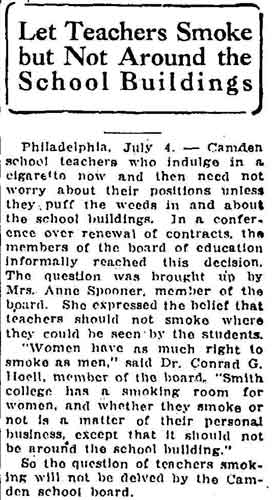
Dr. Hoell remained in practice at 565 Benson Street for many years. He served as member of the Camden Board of Education in the 1920s. On July 5, 1927 it was reported that at a Board of Education meeting where the question of teachers smoking cigarettes arose, he defended the right of female teachers to use tobacco.
Dr. Conrad Hoell was still working and living with wife Lillian and daughter Elizabeth, a teacher, at 565 Benson Street at the time of the 1930 census. By 1947 both Dr. Hoell and his wife were gone, but his daughter still resided at the Benson Street address.
Biographical Review
1897
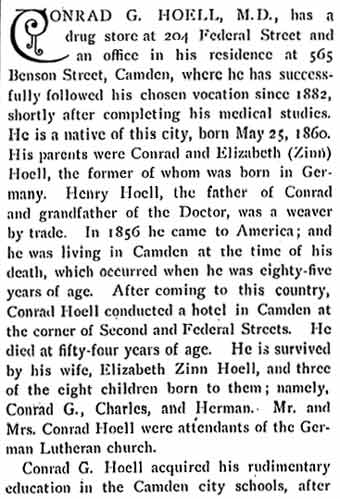
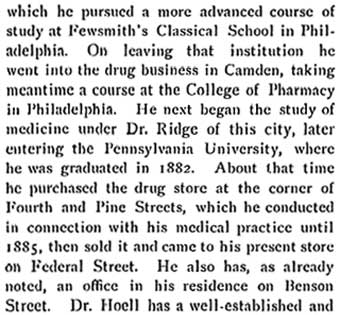
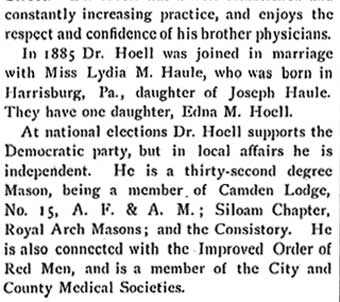
Biographical Review, 1897
The German Mass Meeting.
Camden Daily Courier —
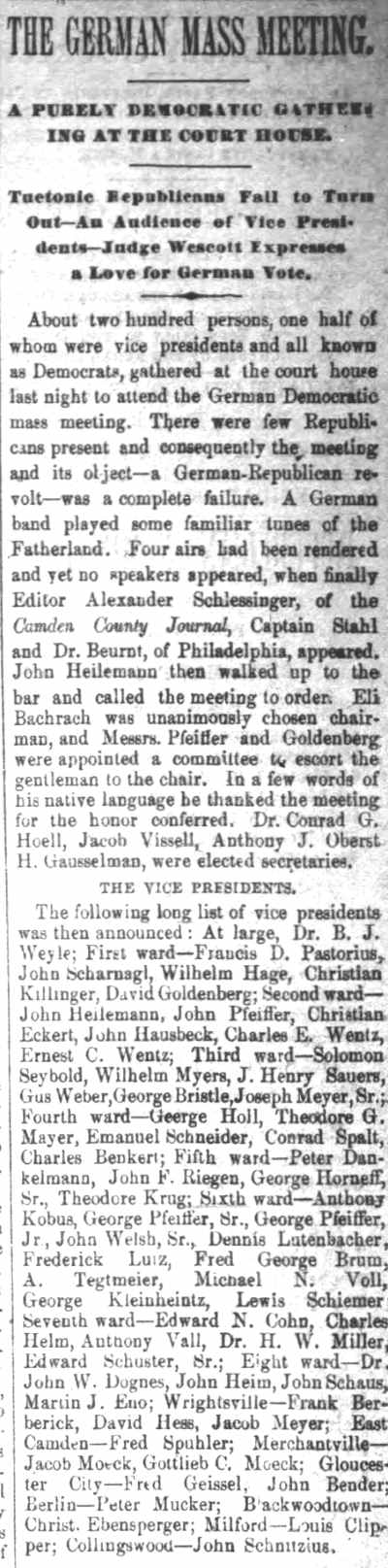
A PURELY DEMOCRATIC GATHERING AT THE COURT HOUSE.
Tuetonic [sic] Republicans Fail to Turn Out—An Audience of Vice Presidents—Judge Wescott Expresses a Love for German Vote.
About two hundred persons, one half of whom were vice presidents and all known as Democrats, gathered at the court house last night to attend the German Democratic mass meeting. There were few Republicans present and consequently the meeting and its object—a German-Republican revolt—was a complete failure. A German band played some familiar tunes of the Fatherland. Four airs had been rendered and yet no speakers appeared, when finally Editor Alexander Schlessinger, of the Camden County Journal, Captain Stahl and Dr. Beurnt, of Philadelphia, appeared. John Heilemann then walked up to the bar and called the meeting to order. Eli Bachrach was unanimously chosen chairman, and Messrs. Pfeiffer and Goldenberg were appointed a committee to escort the gentleman to the chair. In a few words of his native language he thanked the meeting for the honor conferred. Dr. Conrad G. Hoell, Jacob Vissell, Anthony J. Oberst, H. Gausselman, were elected secretaries.
THE VICE PRESIDENTS.
The following long list of vice presidents was then announced: At large, Dr. B. J. Weyle; First ward—Francis D. Pastorius, John Scharnagl, Wilhelm Hage, Christian Killinger, David Goldenberg; Second ward—John Heilemann, John Pfeiffer, Christian Eckert, John Hausbeck, Charles E. Wentz, Ernest C. Wentz; Third ward—Solomon Seybold, Wilhelm Myers, J. Henry Sauers, Gus Weber, George Bristle, Joseph Meyer, Sr.; Fourth ward—George Holl, Theodore G. Mayer, Emanuel Schneider, Conrad Spalt, Charles Benkert; Fifth ward—Peter Dankelmann, John F. Riegen, George Horneff, Sr., Theodore Krug; Sixth ward—Anthony Kobus, George Pfeiffer, Sr., George Pfeiffer, Jr., John Welsh, Sr., Dennis Lutenbacher, Frederick Lutz, Fred George Brum, A. Tegtmeier, Michael N. Voll, George Kleinheintz, Lewis Schiemer; Seventh ward—Edward N. Cohn, Charles Helm, Anthony Vall, Dr. H. W. Miller, Edward Schuster, Sr.; Eight [sic] ward—Dr. John W. Dognes, John Heim, John Schaus, Martin J. Eno; Wrightsville—Frank Berberick, David Hess, Jacob Meyer; East Camden—Fred Spuhler; Merchantville—Jacob Moeck, Gottlieb C. Moeck; Gloucester City—Fred Geissel, John Bender; Berlin—Peter Mucker; Blackwoodtown—Christ. Ebensperger; Milford—Louis Clipper; Collingswood—John Schnutzius.
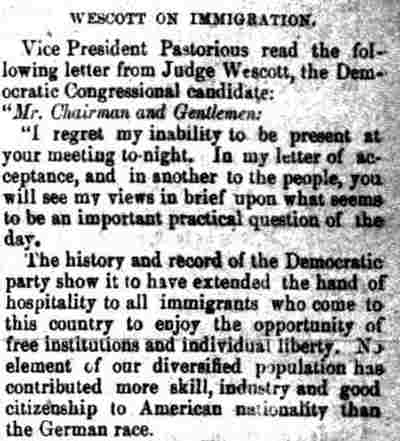
WESCOTT ON IMMIGRATION.
Vice President Pastorious read the following letter from Judge Wescott, the Democratic Congressional candidate:
“Mr. Chairman and Gentlemen:
“I regret my inability to be present at your meeting to-night. In my letter of acceptance, and in another to the people, you will see my views in brief upon what seems to be an important practical question of the day.
The history and record of the Democratic party show it to have extended the hand of hospitality to all immigrants who come to this country to enjoy the opportunity of free institutions and individual liberty. No element of our diversified population has contributed more skill, industry and good citizenship to American nationality than the German race.
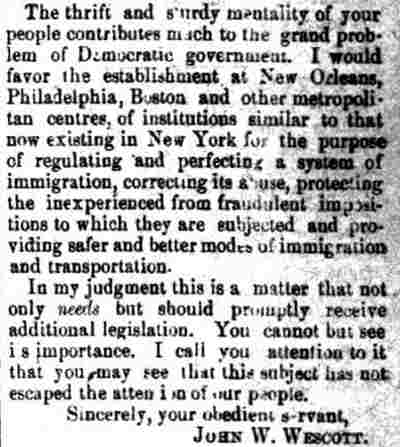
The thrift and sturdy mentality of your people contributes much to the grand problem of Democratic government. I would favor the establishment at New Orleans, Philadelphia, Boston and other metropolitan centres, of institutions similar to that now existing in New York for the purpose of regulating and perfecting a system of immigration, correcting its abuse, protecting the inexperienced from fraudulent impositions to which they are subjected and providing safer and better modes of immigration and transportation.
In my judgment this is a matter that not only needs but should promptly receive additional legislation. You cannot but see its importance. I call your attention to it that you may see that this subject has not escaped the attention of our people.
Sincerely, your obedient servant,
JOHN W. WESCOTT.
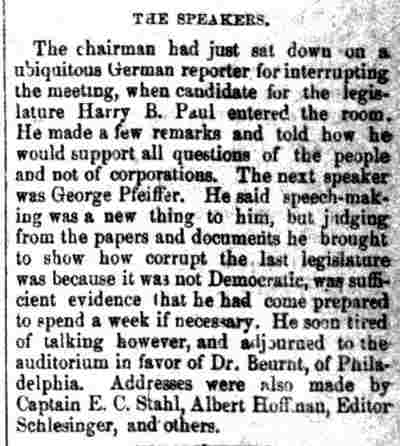
THE SPEAKERS.
The chairman had just sat down on a ubiquitous German reporter for interrupting the meeting, when candidate for the legislature Harry B. Paul entered the room. He made a few remarks and told how he would support all questions of the people and not of corporations. The next speaker was George Pfeiffer. He said speech-making was a new thing to him, but judging from the papers and documents he brought to show how corrupt the last legislature was because it was not Democratic, was sufficient evidence that he had come prepared to spend a week if necessary. He soon tired of talking however, and adjourned to the auditorium in favor of Dr. Beurnt, of Philadelphia. Addresses were also made by Captain E. C. Stahl, Albert Hoffman, Editor Schlesinger, and others.
Grand Jury Drawn
Philadelphia Inquirer —
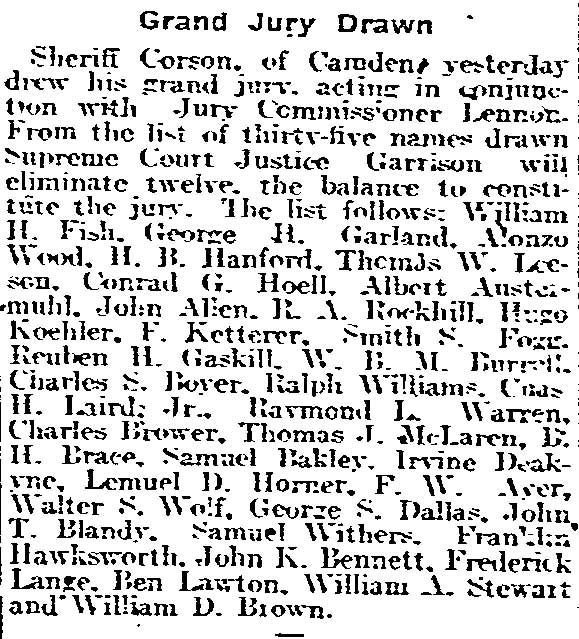
Sheriff Corson, of Camden, yesterday drew his grand jury, acting in conjunction with Jury Commissioner Lennox. From the list of thirty-five names drawn Supreme Court Justice Garrison will eliminate twelve, the balance to constitute the jury. The list follows: William H. Fish, George H. Garland, Alonzo Wood, H. B. Hanford, Thomas W. Leeson, Conrad G. Hoell, Albert Austermuhl, John Allen, R. A. Rockhill, Hugo Koehler, F. Ketterer, Smith S. Fogg, Reuben H. Gaskill, W. B. M. Burrell, Charles S. Boyer, Ralph Williams, Chas. H. Laird, Jr., Raymond L. Warren, Charles Brower, Thomas J. McLaren, B. H. Brace, Samuel Bakley, Irvine Deakyne, Lemuel D. Horner, F. W. Ayer, Walter S. Wolf, George S. Dallas, John T. Blandy, Samuel Withers, Franklin Hawksworth, John K. Bennett, Frederick Lange, Ben Lawton, William A. Stewart and William D. Brown.
Let Teachers Smoke but Not Around the School Buildings
Helena, Montana Independent —
Mayor Price to Name 3 to Education Board
Camden Courier-Post —
Three appointments to the Camden Board of Education will be made by him late today or tomorrow, Mayor Price said this morning. The appointments were expected to be made yesterday, but they were delayed, the mayor explained, because a “very capable man” declined to accept as one of the appointees.
The mayor, under the law, has until January 15 to make the appointments, and the new appointees take office a month later. Three vacancies were to be filled by the mayor with the expiration of the terms of George C. Prince, George M. Bryson, and Albert Dudley. The mayor would not say whether or not he would re-appoint any of the three retiring members. Other members of the present board are Edwin I. Seabrook, president; Mrs. Anne D. Spooner, Irving T. Nutt, Meyer Wessel, Dr. Conrad G. Hoell and Dr. Jennie S. Sharp.