Introduction
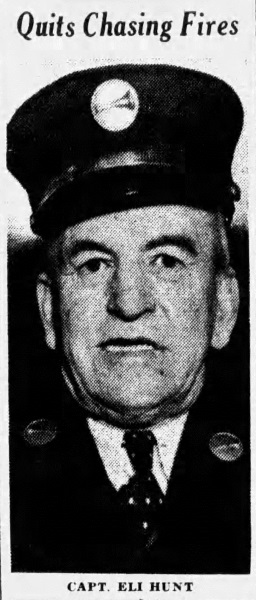
Eli Morgan Hunt
ELI MORGAN HUNT was born on May 13, 1882 in Camden, New Jersey, one of 10 children of James H. Hunt and his wife Mary. He was named after Eli Morgan, whom his father had supported politically during Morgan’s unsuccessful bid for election as Camden County sheriff in 1881.
The Hunt family had moved in the late 1870s from Gloucester City to 819 Kaighn Street, which was renamed Dauphin Street in January of 1882. James Hunt in time became involved in local politics, and over the years held a number of positions. By 1894 James Hunt, then the Fish Warden, and his family was living at 316 Line Street.
When the 1900 Census was taken two of Eli Hunt’s siblings were then living at his parents home, sisters Theodosia and Katherine. Sadly, four of the Hunt children had by then died. Three other siblings had moved out, including older brother George H. Hunt. The 1900 Census says that James Hunt was then a constable in Camden, a political appointment not without a measure of local influence.
City Directories show that by 1906 and as late as 1914 Eli Hunt was a member of the United States Navy. During these times his brother George H. Hunt was appointed to the Camden Fire Department, very probably through the political influence of his father, James Hunt. His sister, Theodosia, was also politically active.
Theodosia Hunt married coal and ice merchant Joseph Henry Conaghy sometime after 1900. The 1906 City Directory shows the Conaghys living at 246 Pine Street, where Joseph Conaghy also conducted his business, the Eagle Ice & Coal Company. The 1910 Census shows that Joseph Conaghy had gone into the tavern business. He was then operating a bar at 601–603 Kaighn Avenue, where he and Theodosia made their home; they later operated a bar known, appropriately enough, as Conaghy’s, at 950 South 5th Street.
Eli Hunt came back to Camden from the Navy after the 1914 City Directory was compiled. By September of 1918 he had been appointed to the Camden Fire Department. He was then living at 330 Beckett Street. This would remain his address through 1929. Eli Hunt served with Engine Company 3 during the 1920s.
Sister Theodosia Hunt Conaghy was widowed in the early 1920s. In 1923 Mrs. Conaghy was appointed to the position of matron at the Camden County Jail, adjacent to the courthouse at Broadway and Federal Streets.
On April 4, 1928 Eli Hunt, then a driver at Engine Company 3, was promoted to junior captain. On the same date, brother George Hunt, then a junior captain at Engine Company 7, was promoted to senior captain.
When the 1930 Census was taken, Eli Hunt was living with his sister Theodosia Hunt Conaghy and nephew Eli E. Conaghy at 814 South 6th Street. This would be his address through the spring of 1942.
Eli Hunt retired on disability on March 1, 1937 after serving the Camden Fire Department for nearly two decades. He registered for the draft in April of 1942. He passed away in 1944 and was buried at New Camden Cemetery.
Sister Theodosia Hunt Conaghy retired from her post at the County Jail after 27 years service in 1950 at the age of 75. She passed away in December of 1957.
Brother George Hunt and his wife Louise were still at 342 Line Street when the 1947 City Directory was compiled.
A nephew, Eli E. Conaghy, was a longtime Camden resident, an iron worker and veteran of World War II, having been drafted at the age of 42.
Murder and Bloodshed in Camden Primary Elections
Philadelphia Inquirer —

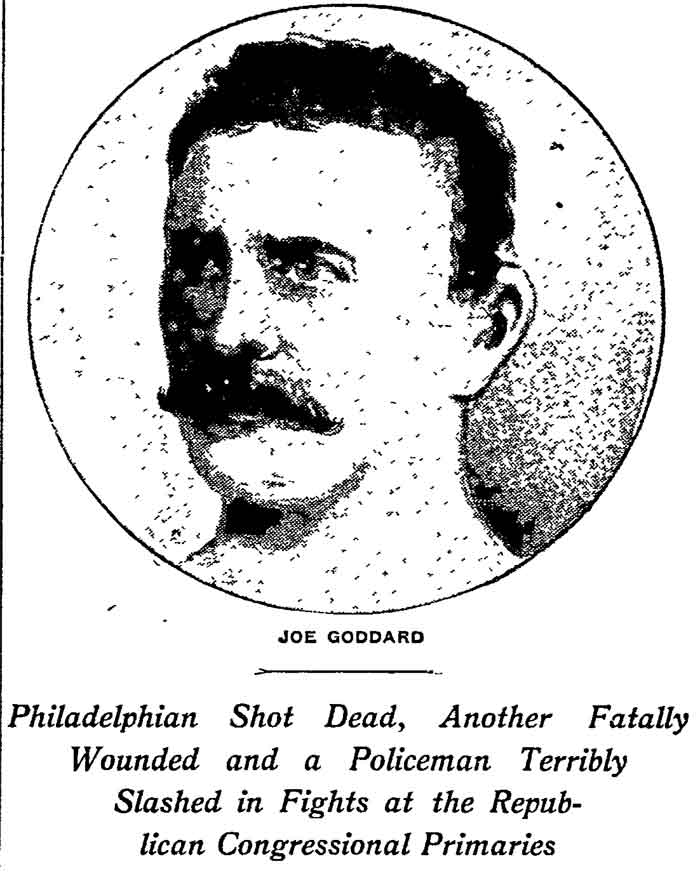
Philadelphian Shot Dead, Another Fatally Wounded and a Policeman Terribly Slashed in Fights at the Republican Congressional Primaries
Blood was shed in Camden city and county last night, the result of the fiercest political battle that was ever fought in the First Congressional district of New Jersey, and the sum total of the casualties is one man dead, another lying at the point of death in the Cooper Hospital, another, a policeman, on a cot near by, suffering from stab wounds, from which he is not likely to recover, and numerous cracked skulls.
So vigorously were the Republican primaries contested that numerous fights developed. Crowds of repeaters went from Philadelphia to Camden, and these were the cause of the numerous riots, for such they were, at the polling places.
With it all no one can yet positively tell who will receive the Congressional nomination at Woodbury to morrow. At midnight both the adherents of Congressman Loudenslager and the supporters of J. Alpheus Vansant were claiming the victory.
Shot and Killed
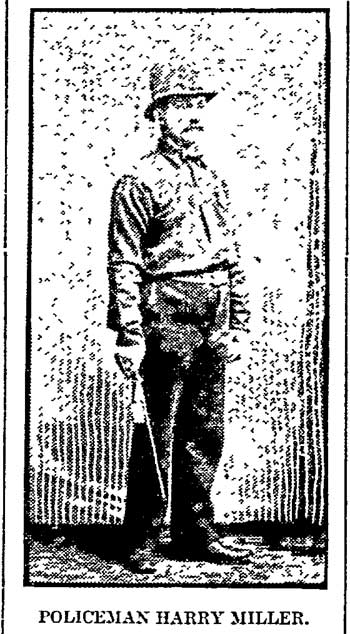
A few minutes before the closing of the polls at the Fifth precinct of the Third Ward, Camden, last night, John Morrisy, of Manayunk, wearing a Vansant badge, was shot and killed. During the melee Policeman Harry Miller, aged 40 years, of 321 Beckett Street, was cut in the abdomen. Both were taken to Cooper Hospital.
Surgeon Stewart pronounced Morrisy dead on his arrival. Policeman Miller was operated on, and the surgeons say he has a fighting chance for his life.
The police have under arrest George Murray, colored, aged 35 years, of 649 Locust street, and Henrietta V. Bland, of 639 Locust street, who are said to be eye-witnesses to the shooting. The arrest of the man who it is claimed fired the fatal shot is, the police say, a question of a few hours.
Joe Goddard Shot
Joseph J. Goddard, aged 35 years, of Phoenixville, Pa., a once noted pugilist, was shot by Constable Robert Washington at “Dog Corner” during the primary election. The bullet, a thirty-two caliber, entered the left temple about an inch and a half above his eye and imbedded itself in his brain.
He was taken to Merchantville and treated by Dr. Lawrence and afterwards removed to Cooper Hospital. Surgeons there say he will die.
Washington immediately surrendered to Chief of Police Linderman, of Merchantville, was given a preliminary hearing before Justice Longstreth, and committed to the county jail.
Been Living at Matchtown
Goddard of late had been living with Benjamin Forrest, a saloonkeeper at Matchtown, a settlement just outside of Merchantville, and in Pennsauken township. It is said he led a gang of repeaters to the “Dog Corner” primaries. Soon after their arrival a row was started and Washington felled to the ground by a blow from a base ball bat. While lying on the ground Goddard attempted to beat him and he fired the shot which will likely prove fatal.
During the melee Constable Isaac Fowler was stabbed in two places by an unknown man. The wounds are not considered serious. Fighting continued from the opening to the closing of the polls.
Ed. Matlack, of Dudley, was badly cut in a fight on the Camden line. He went to Merchantville and Dr. Jennings sewed six stitches in his wounds.
Morrisy’s Appearance
Morrisy, the dead man, was about 35 years old. He was in the company of several Philadelphians and spent nearly all the afternoon in the Third ward in the company of a policeman, by whom he and his companions were introduced as members of the Washington, D. C., police force on a short vacation.
The Third ward was the battleground of the Loudenslager-Vansant contest yesterday. A large majority of the city officials live there. From the minute of the opening of the polls in the various precincts there were outbreaks on either side that were only quelled by cooler heads.
It became noised about shortly after the polls opened that repeaters under the guidance of three Philadelphians, one of whom was colored, were at work in the ward.
Help Summoned
Shortly before 8 o’clock word was sent to the Second precinct of the Third ward by a police officer working in the interest of Vansant in the Fifth precinct that unless help arrived Loudenslager would carry the precinct.
In less than five minutes Policeman Edward Hartman, in citizen’s clothes, and several other men, one of whom was deceased, came on the scene. At that time there were at least 500 persons around the polls, many of whom were women.
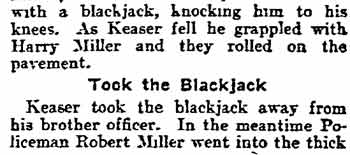
What followed is told by John G. Helm, a butcher, of 600 South Third Street, and Eli Hunt, son of Deputy Game Warden Hunt. Both agree that Morrisy attempted to vote. As he did so Policeman Robert Miller, a Loudenslager worker, took him by the arm and told him he could not vote. At that instant the policeman was struck by a blackjack and knocked towards the gutter. Policeman Albert Keaser, a Loudenslager worker, pushed his way into the crowd and tried to prevent trouble. Policeman Harry Miller, a Vansant worker, struck Keaser with a blackjack, knocking him to his knees. As Keaser fell he grappled with Harry Miller and they rolled on the pavement.
Took the Blackjack
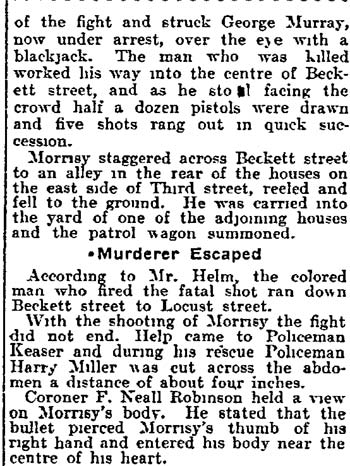
Keaser took the blackjack away from his brother officer. In the meantime Policeman Robert Miller went into the thick of the fight and struck George Murray, now under arrest, over the eye with a blackjack. The man who was killed worked his way into the centre of Beckett Street, and as he stood facing the crowd half a dozen pistols were drawn and five shots rang out in quick succession.
Morrisy staggered across Beckett street to an alley in the rear of the houses on the east side of Third street, reeled and fell to the ground. He was carried into the yard of one of the adjoining houses and the patrol wagon summoned.
Murderer Escaped
According to Mr. Helm, the colored man who fired the fatal shot ran down Beckett street to Locust Street.
With the shooting of Morrisy the fight did not end. Help came to Policeman Keaser and during his rescue Policeman Harry Miller was cut across the abdomen a distance of about four inches.
Coroner F. Neall Robinson held a view on Morrisy’s body. He stated that the bullet pierced Morrisy’s thumb of his right hand and entered his body near the centre of his heart.
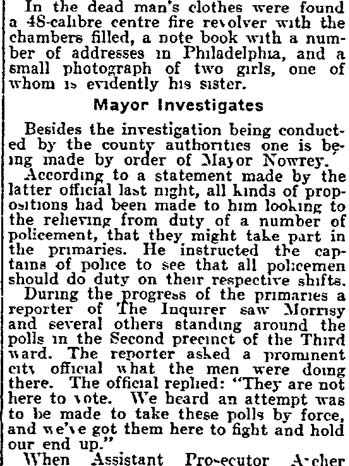
In the dead man’s clothes were found a 48-calibre centre fire revolver with the chambers filled, a note book with a number of addresses in Philadelphia, and a small photograph of two girls, one of whom is evidently his sister.
Mayor Investigates
Besides the investigation being conducted by the county authorities one is being made by order of Mayor Nowrey. According to a statement made by the latter official last night, all kinds of propositions had been made to him looking to the relieving from duty of a number of policemen, that they might take part in the primaries. He instructed the captains of police to see that all policemen should do duty on their respective shifts.
During the progress of the primaries a reporter of The Inquirer saw Morrisy and several others standing around the polls in the Second precinct of the Third ward. The reporter asked a prominent city official what the men were doing there. The official replied: “They are not here to vote. We heard an attempt was to be made to take these polls by force, and we’ve got them here to fight and hold our end up.”
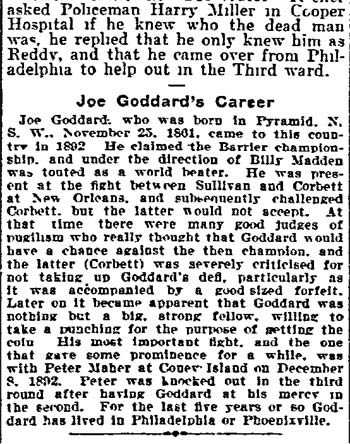
When Assistant Prosecutor Archer asked Policeman Harry Miller in Cooper Hospital if he knew who the dead man was, he replied that he only knew him as Reddy, and that he came over from Philadelphia to help out in the Third ward.
Joe Goddard’s Career
Joe Goddard, who was born in Pyramid, N. S. W., November 25, 1861, came to this country in 1892. He claimed the Barrier championship, and under the direction of Billy Madden was touted as a world beater. He was present at the fight between Sullivan and Corbett at New Orleans, and subsequently challenged Corbett, but the latter would not accept. At that time there were many good judges of pugilism who really thought that Goddard would have a chance against the then champion, and the latter (Corbett) was severely criticised for not taking up Goddard’s defi, particularly as it was accompanied by a good sized forfeit. Later on it became apparent that Goddard was nothing but a big, strong fellow, willing to take a punching for the purpose of getting the coin. His most important fight, and the one that gave some prominence for a while, was with Peter Maher at Coney Island on December 8, 1892. Peter was knocked out in the third round after having Goddard at his mercy in the second. For the last five years or so Goddard has lived in Philadelphia or Phoenixville.
Jottings from South Camden
Camden Daily Courier —
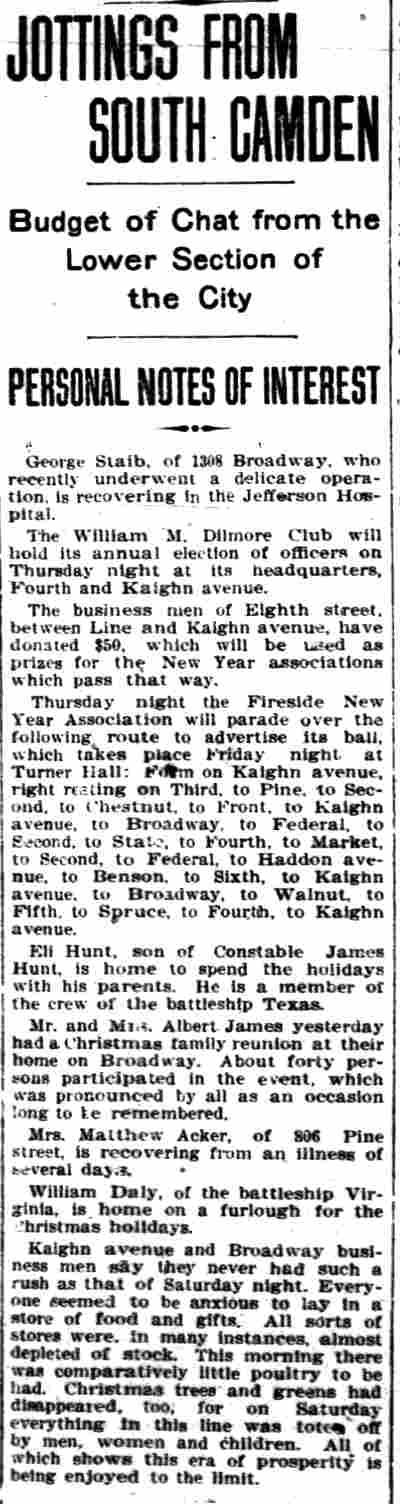
Eli Hunt, son of Constable James Hunt, is home to spend the holidays with his parents. He is a member of the crew of the battleship Texas.
World War I Draft Card
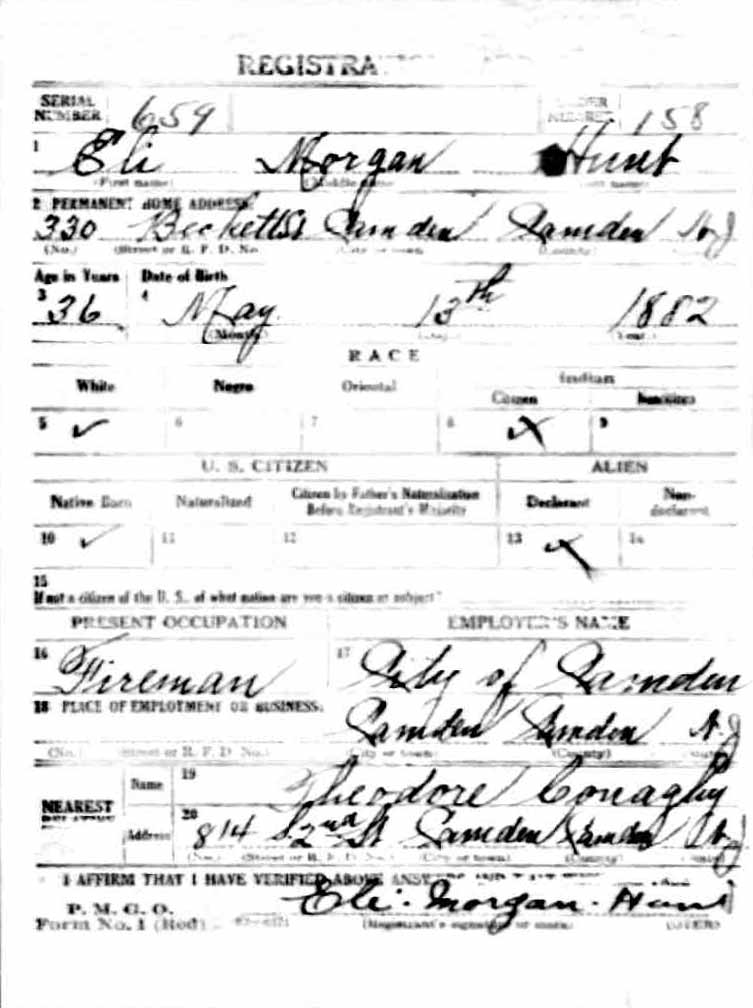
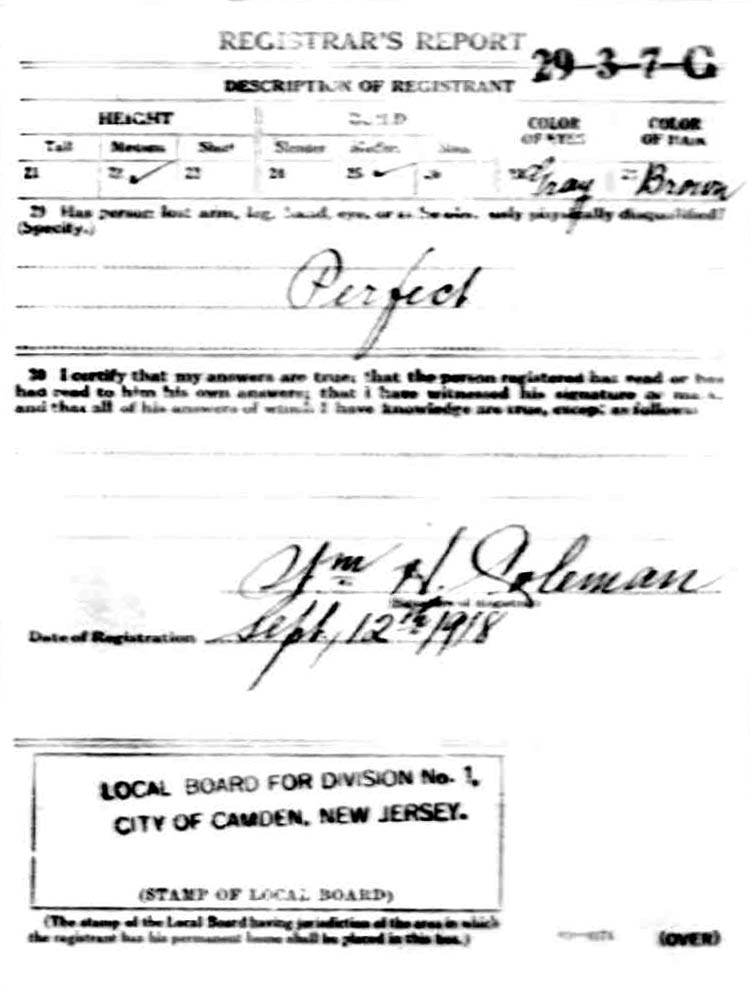
World War I Draft Registration Card – Eli Morgan Hunt
(brief item — Eli Hunt and Thomas Clark hunting trip)
Camden Post-Telegram —
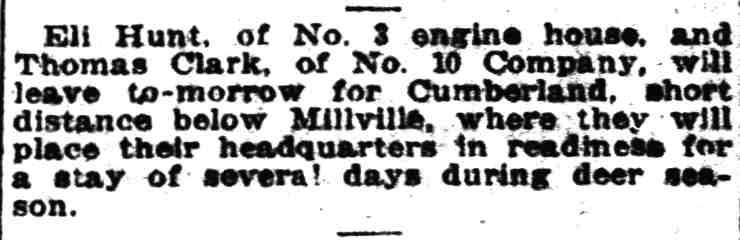
Eli Hunt, of No. 3 engine house, and Thomas Clark, of No. 10 Company, will leave to-morrow for Cumberland, short distance below Millville, where they will place their headquarters in readiness for a stay of several days during deer season.
South Camden
Camden Courier —
SOUTH CAMDEN
Fire damaged a bedroom on the second floor at the home of Hyne Miller 972 Ferry Avenue, yesterday afternoon. The fire was caused, it is said, by a child playing with matches, which set fire to a bed covering. Firemen from No. 3 Engine and No. 2 Truck Company extinguished the blaze.
Eli Hunt, of No. 3 Engine Company, Broadway and Ferry Avenue, lost his glasses at the fire on Ferry Avenue.
Promoted Firemen Take Posts Today
Camden Courier-Post —
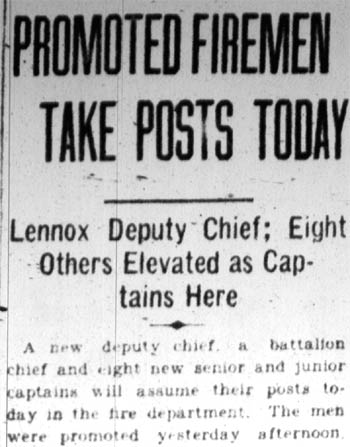
Lennox Deputy Chief; Eight Others Elevated as Captains Here
A new deputy chief, a battalion chief and eight new senior and junior captains will assume their posts today in the fire department. The men were promoted yesterday afternoon, along with the announcement of eleven new appointments of firemen, who will go into service April 15.
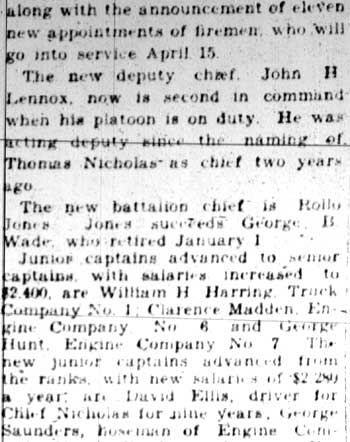
The new deputy chief, John H. Lennox, now is second in command when his platoon is on duty. He was acting deputy since the naming of Thomas Nicholas as chief two years ago.
The new battalion chief is Rollo Jones. Jones succeeded George B. Wade, who retired January 1.
Junior captains advanced to senior captains, with salaries increased to $2,400, are William H. Harring, Truck Company No. 1, Clarence Madden, Engine Company No. 6 and George Hunt, Engine Company No 7. The new junior captains advanced from the ranks, with new salaries of $2,299 a year, are David Ellis, driver for Chief Nicholas for nine years, George Saunders, hoseman of Engine Company No. 9; Eli Hunt, driver of Engine Company No. 3, and William Van Pfefferle, hoseman, Engine Company No. 1.
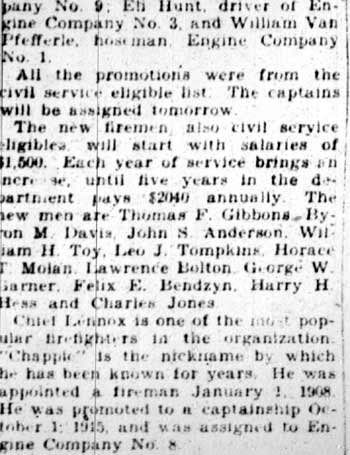
All the promotions were from the civil service eligible list. The captains will be assigned tomorrow.
The new firemen, also civil service eligibles, will start with salaries of $1,500. Each year of service brings an increase, until five years in the department pays $2,040 annually. The new men are Thomas F. Gibbons, Byron M. Davis, John S. Anderson, William H. Toy, Leo J. Tompkins, Horace T. Molan, Lawrence Bolton, George W. Garner, Felix E. Bendzyn, Harry H. Hess and Charles Jones.
Chief Lennox is one of the most popular firefighters in the organization. “Chappie” is the nickname by which he has been known for years. He was appointed a fireman January 1, 1908. He was promoted to a captainship October 1, 1915, and was assigned to Engine Company No. 8.
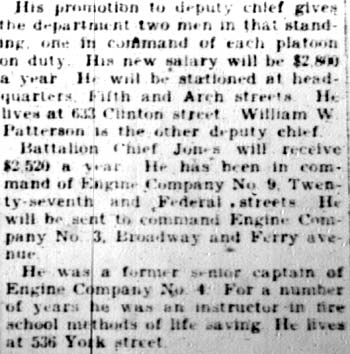
His promotion to deputy chief gives the department two men in that standing, one in command of each platoon on duty. His new salary will be $2,800 a year. He will be stationed at headquarters, Fifth and Arch streets. He lives at 633 Clinton Street. William W. Patterson is the other deputy chief.
Battalion Chief Jones will receive $2,520 a year. He has been in command of Engine Company No. 9, Twenty-seventh and Federal streets. He will be sent to command Engine Company No. 3, Broadway and Ferry avenue. He was a former senior captain of Engine Company No. 4. For a number of years he was an instructor in fire school methods of life saving. He lives at 536 York Street.
22 Firemen Assigned to New Stations
Camden Courier-Post —
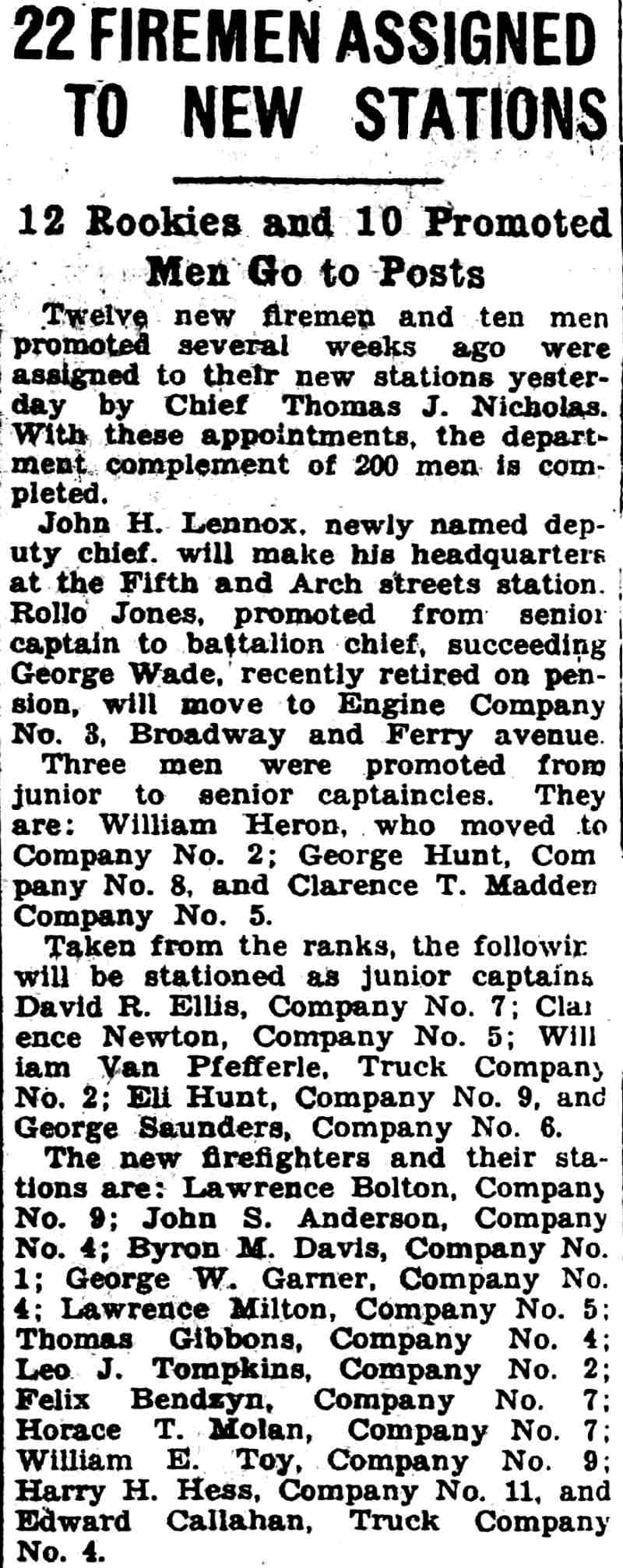
12 Rookies and 10 Promoted Men Go to Posts
Twelve new firemen and ten men promoted several weeks ago were assigned to their new stations yesterday by Chief Thomas J. Nicholas. With these appointments, the department complement of 200 men is completed.
John H. Lennox, newly named deputy chief, will make his headquarters at the Fifth and Arch streets station. Rollo Jones, promoted from senior captain to battalion chief, succeeding George Wade, recently retired on pension, will move to Engine Company No. 3, Broadway and Ferry avenue.
Three men were promoted from junior to senior captaincies. They are: William Heron, who moved to Company No. 2; George Hunt, Company No. 8, and Clarence T. Madden [sic] Company No. 5.
Taken from the ranks, the following will be stationed as junior captains: David R. Ellis, Company No. 7; Clarence Newton, Company No. 5; William Van Pfefferle, Truck Company No. 2; Eli Hunt, Company No. 9, and George Saunders, Company No. 6.
The new firefighters and their stations are: Lawrence Bolton, Company No. 9; John S. Anderson, Company No. 4; Byron M. Davis, Company No. 1; George W. Garner, Company No. 4; Lawrence Milton, Company No. 5; Thomas Gibbons, Company No. 4; Leo J. Tompkins, Company No. 2; Felix Bendzyn, Company No. 7; Horace T. Molan, Company No. 7; William E. Toy, Company No. 9; Harry H. Hess, Company No. 11, and Edward Callahan, Truck Company No. 4.
Engine Company 9
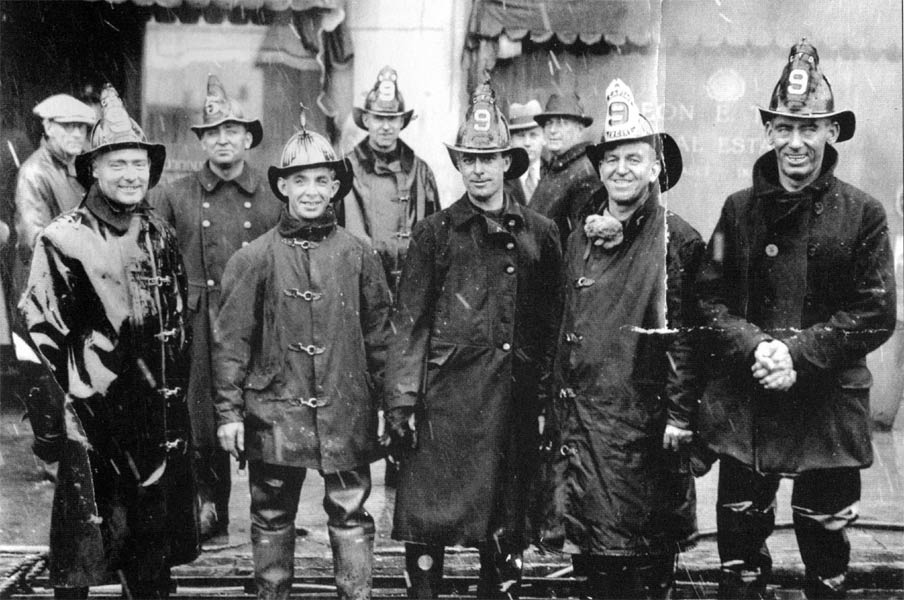
John Voll, Edward Peraria, Howard Gick, Captain Eli Hunt and George Townsend, firefighters from Engine Company 9, based on Twenty-seventh Street, take a moment together following a fire on a rainy night in December 1928, seen here in the first row from left to right. The blaze involved the offices of Leon E. Todd at 2623 Westfield Avenue. Todd was a realtor who helped develop Medford Lakes.
Veteran Fire Captain Honored At Retirement Ceremonies
Camden Courier-Post —

Eli Hunt Bids Farewell to Fellow Members of City Force
Officials Laud Term of Service
The sound of a fire alarm means nothing more to retired Junior Capt. Eli Hunt, now, as he sits at home and looks over the many experiences he has gone through while serving at Hamilton Engine Company No. 3, 1813 Broadway.
His comrades, the gallant members of one of the busiest fire houses in the city, decided to show their old shipmate that their hearts were with him now that he would respond to no more alarms. He stood before them, medal-laden and lined with years of activity as a firefighter, while Battalion Chief Charles Errickson told the old commander that he was only retired, but that the spirit of service was needed by the Camden fire department.
The captain smiled with satisfaction as Commissioner Mary Kobus, director of public safety, told Capt. Hunt that he was gathering together around him the flowers and the traditions that had made the Camden department one of the best.
Flowers Presented
Acting Capt. Walter L. Osgood presented him with a bouquet of flowers. Tears ran like rivulets down the rugged face of the retired captain. Standing in formation were the old boys, and everyone of them had a suspicious moisture in his eye.
It was 4 p. m. when the ceremonies started down in the ancient camp of the firefighters on Broadway. Commissioner Kobus made a short and effective speech.
“You are not retiring from the department,” she said. “You are still a member though no longer active. Don’t figure that you are any less fireman because you are not.”
“You are one of us still, and you will always be one of us. You have given the heart and soul that was in you, the finest ability that was in you, to serve the city and your comrades.”
“Your boys are sorry to see you leave, and when you go they know that you go to a rest you have merited. The respect of your associates belongs to you.”
“You have given them a splendid example to follow by your own loyal, courageous service to Camden. You are something of an ideal for these boys.”
“You have been an inspiration to everybody in the department, and no better honor could be given to a member of the fire department than is given to you this afternoon.”
Capt. Hunt was placed on pension leave as the result of injuries received in an automobile accident on Oct. 28, 1936. He had been to National Park to visit his ill father and the accident occurred on the way back to Camden. He was rushed to Cooper Hospital with concussion of the brain and internal injuries.
Captain Hunt battled against some of the largest fires in Camden’s history. He fought a fierce blaze that swept the plant of the Eavenson Soap Works, and fought the fire at Billey & McCoole’s packing plant at Chelten avenue and the Pennsylvania Railroad.
Junior Captain Hunt joined the department Aug. 1, 1918, as a hoseman with Engine Company 3, at 1813 Broadway. He was made acting captain of Engine Company 3 in August, 1929, and became junior captain in March, 1932, and retired on a pension last March 1.
World War II Draft Card
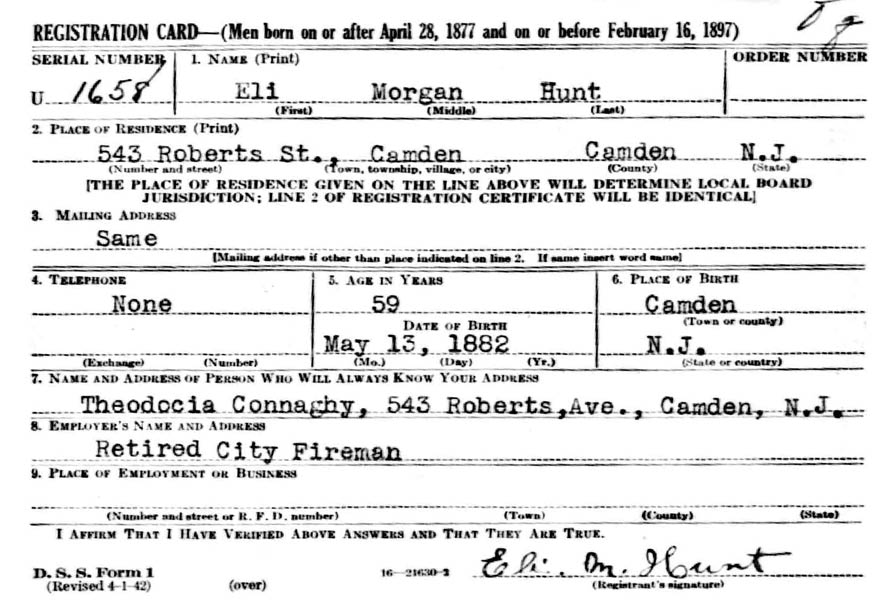
World War II Draft Registration Card – Eli Morgan Hunt
Obituary
Camden Courier-Post —
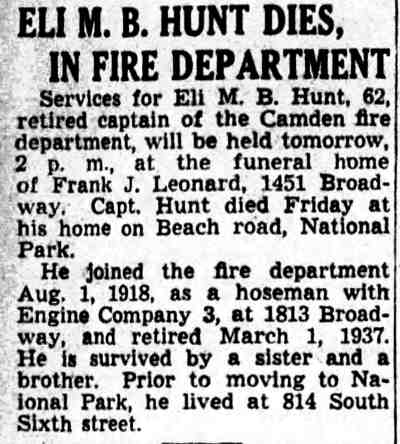
ELI M. B. HUNT DIES, IN FIRE DEPARTMENT
Services for Eli M. B. Hunt, 62, retired captain of the Camden fire department, will be held tomorrow, 2 p. m., at the funeral home of Frank J. Leonard, 1451 Broadway. Capt. Hunt died Friday at his home on Beach road, National Park.
He joined the fire department Aug. 1, 1918, as a hoseman with Engine Company 3, at 1813 Broadway, and retired March 1, 1937. He is survived by a sister and a brother. Prior to moving to National Park, he lived at 814 South Sixth street.
Burial
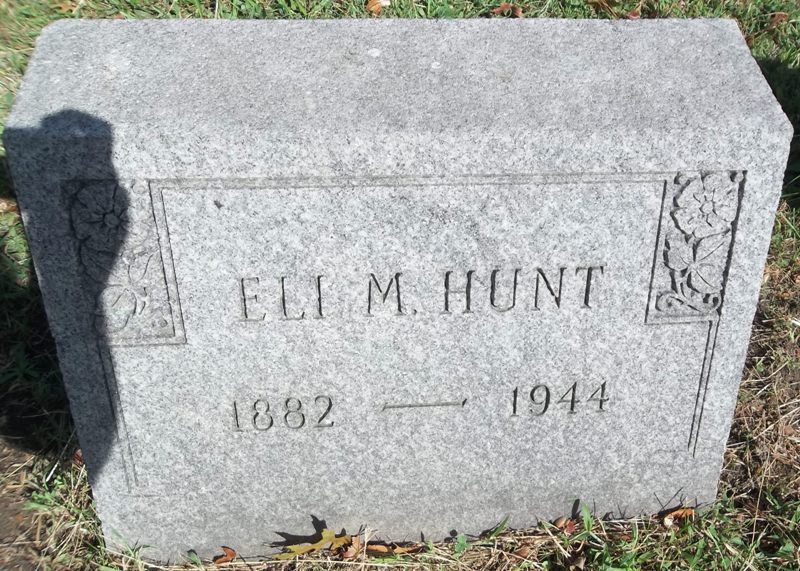
Eli Morgan Hunt – New Camden Cemetery