Thomas McKenna
THOMAS McKENNA was appointed to the Camden Fire Department as an extra man with Engine Company 1 on April 5, 1882. He replaced Charles Sawyer. Thomas McKenna served with the Fire Department for two years and was replaced by Frank Webster. Thomas McKenna worked as a laborer and as a machinist during his time with the Fire Department. He later was involved in the saloon business.
Thomas McKenna was born around 1859 in New Jersey to Irish-born parents, John and Mary McKenna. He grew up with siblings Paul, John, and Mary in South Camden, near Thomas Gordon’s hotel and livery on South 2nd Street. The 1878 City Directory shows the McKenna family at 708 South 2nd Street and it correlates location-wise to Gordon’s businesses.
The 1882–1883 City Directory shows Thomas McKenna still living at 708 South 2nd Street, and he was at that address when appointed to the Fire Department. He was still at that address in 1885, at which time he was working as a hatter. By 1887 he was living at 713 Locust and working as a shoemaker. Later in that year he took over the management of a saloon at 33 North Front Street, and stayed involved at that location through 1897. Unlike many other saloon operators of the day, he did not always live on premises, although he is listed as residing there in 1890. Directories for 1892–1893 and 1893–1894 have him at 713 Locust Street. Directories for 1894–1895 and 1895–1896 place him at 268 Sycamore Street. The 1896 City Directory gives his address as 117 Centennial Avenue, while the 1897 Directory indicates that he was again staying at 33 North Front Street.
The 1898 Camden City Directory shows Thomas and Kate McKenna at 209 Berkley Street. He was still in the bar business, but the Directory does not disclose where. The 1899 City Directory shows the McKennas at “Federal near 17th” in what was then still the town of Stockton. Stockton and Camden united later in 1899.
The 1900 Census shows Thomas McKenna, occupation saloonkeeper, at 1121 Baring Street. The McKenna family was then comprised of Thomas and Kate McKenna, sons Thomas, James, John, and Leon, and brother John F. McKenna.
By 1906 Thomas McKenna had gotten out of the bar business. He and his wife were living at 929 St. John Street in South Camden. He was then working as a boilermaker at one of Camden’s shipyards. Things were unchanged when the census was taken in 1910.
Neither Thomas or Kate McKenna are listed in the 1914 or 1918–1919 Camden City Directories. Sons James, Thomas, and John were living in South Camden when the Census was taken in January of 1920.
As best as has been determined as of this writing, Thomas McKenna was not related to any of the other McKennas who ran bars in Camden.
Camden's New Firemen.
Philadelphia Inquirer —
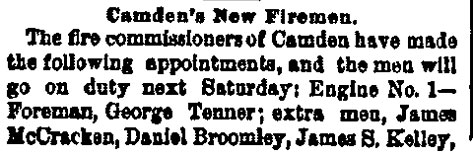
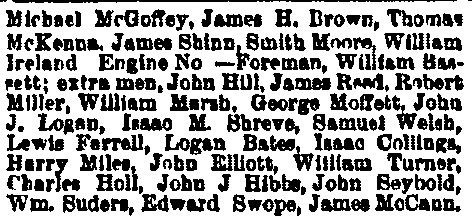
The fire commissioners of Camden have made the following appointments, and the men will go on duty next Saturday: Engine No. 1—Foreman, George Tenner; extra men, James McCracken, Daniel Broomley, James S. Kelley, Michael McCaffery, James H. Brown, Thomas McKenna, James Shinn, Smith Moore, William Irelan Engine No 2—Foreman, William Bassett; extra men, John Hill, James Reed, Robert Miller, William Marsh, George Moffett, John J. Logan, Isaac M. Shreve, Samuel Welsh, Lewis Ferrell, Logan Bates, Isaac Collings, Harry Miles, John Elliott, William Turner, Charles Holl, John J. Hibbs, John Seybold, Wm. Suders, Edward Swope, James McCann.
Lively Trials of Policy Cases
Camden Daily Telegram —
Ketline Convicted Again But Gilbert Escapes.
JUDGES DID NOT SEEM TO AGREE
Members of the Court Held an Animated Whispered Discussion on the Bench and Then Re-opened the Case.
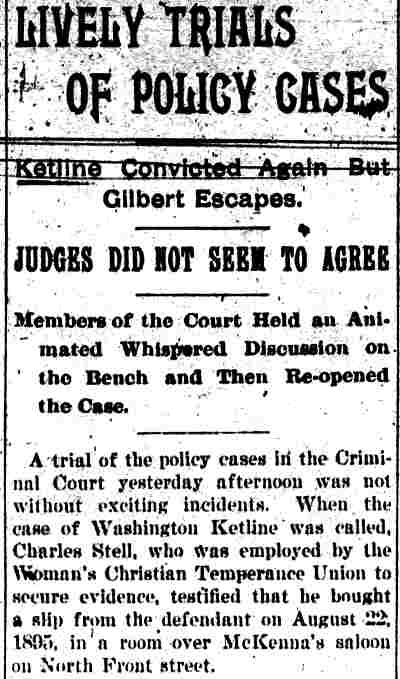
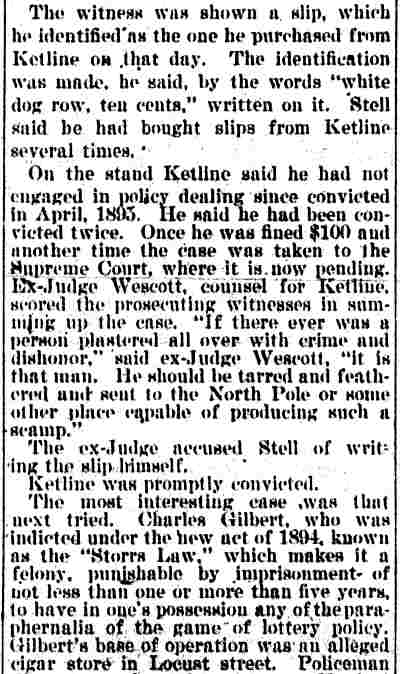
A trial of the policy cases in the Criminal Court yesterday afternoon was not without exciting incidents. When the case of Washington Ketline was called, Charles Stell, who was employed by the Woman’s Christian Temperance Union to secure evidence, testified that he bought a slip from the defendant on August 22, 1895, in a room over McKenna’s saloon on North Front street.
The witness was shown a slip, which he identified as the one he purchased from Ketline on that day. The identification was made, he said, by the words “white dog row, ten cents,” written on it. Stell said he had bought slips from Ketline several times.
On the stand Ketline said he had not engaged in policy dealing since convicted in April, 1895. He said he had been convicted twice. Once he was fined $100 and another time the case was taken to the Supreme Court, where it is now pending. Ex-Judge Wescott, counsel for Ketline, scored the prosecuting witnesses in summing up the case. “If there ever was a person plastered all over with crime and dishonor,” said ex-Judge Wescott, “it is that man. He should be tarred and feathered and sent to the North Pole or some other place capable of producing such a scamp.”
The ex-Judge accused Stell of writing the slip himself.
Ketline was promptly convicted.
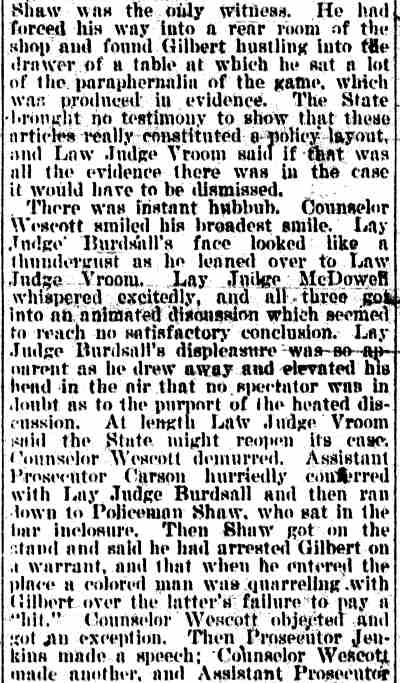
The most interesting case was that next tried. Charles Gilbert, who was indicted under the new act of 1894, known as the “Storrs Law,” which makes it a felony, punishable by imprisonment of not less than one or more than five years, to have in one’s possession any of the paraphernalia of the game of lottery policy. Gilbert’s base of operation was an alleged cigar store in Locust street. Policeman Shaw was the only witness. He had forced his way into a rear room of the shop and found Gilbert hustling into the drawer of a table at which he sat a lot of the paraphernalia of the game, which was produced in evidence. The State brought no testimony to show that these articles really constituted a policy layout, and Law Judge Vroom said if that was all the evidence there was in the case it would have to be dismissed.
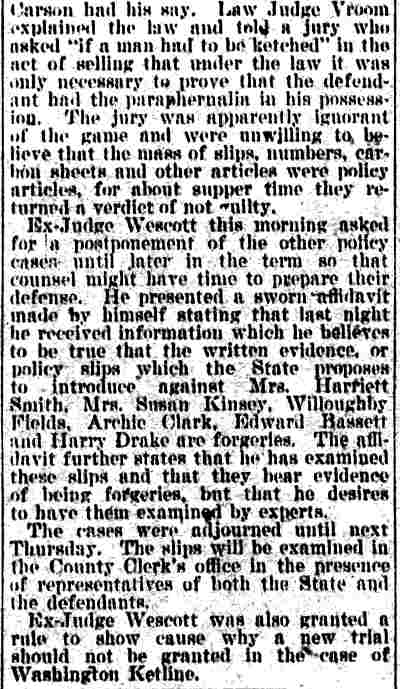
There was instant hubbub. Counselor Wescott smiled his broadest smile. Lay Judge Burdsall’s face looked like a thundergust as he leaned over to Law Judge Vroom. Lay Judge McDowell whispered excitedly, and all three got into an animated discussion which seemed to reach no satisfactory conclusion. Lay Judge Burdsall’s displeasure was so apparent as he drew away and elevated his head in the air that no spectator was in doubt as to the purport of the heated discussion. At length Law Judge Vroom said the State might reopen its case. Counselor Wescott demurred. Assistant Prosecutor Carson hurriedly conferred with Lay Judge Burdsall and then ran down to Policeman Shaw, who sat in the bar inclosure. Then Shaw got on the stand and said he had arrested Gilbert on a warrant, and that when he entered the place a colored man was quarrelling with Gilbert over the latter’s failure to pay a “hit.” Counselor Wescott objected and got an exception. Then Prosecutor Jenkins made a speech; Counselor Wescott made another, and Assistant Prosecutor Carson had his say. Law Judge Vroom explained the law and told a jury who asked “if a man had to be ketched” in the act of selling that under the law it was only necessary to prove that the defendant had the paraphernalia in his possession. The jury was apparently ignorant of the game and were unwilling to believe that the mass of slips, numbers, carbon sheets and other articles were policy articles, for about supper time they returned a verdict of not guilty.
Ex-Judge Wescott this morning asked for a postponement of the other policy cases until later in the term so that counsel might have time to prepare their defense. He presented a sworn affidavit made by himself stating that last night he received information which he believes to be true that the written evidence, or policy slips which the State proposes to introduce against Mrs. Harriett Smith, Mrs. Susan Kinsey, Willoughby Fields, Archie Clark, Edward Bassett and Harry Drake are forgeries. The affidavit further states that he has examined these slips and that they bear evidence of being forgeries, but that he desires to have them examined by experts.
The cases were adjourned until next Thursday. The slips will be examined in the County Clerk’s office in the presence of representatives of both the State and the defendants.
Ex-Judge Wescott was also granted a rule to show cause why a new trial should not be granted in the case of Washington Ketline.