Introduction
HARRIET C. SMITH was born in Philadelphia, Pennsylvania in December of 1842. She married William H. Smith around 1860, and gave birth to her first child, William Henry Smith Jr., on March 20, 1862. By 1870 four more children had arrived, Carrie, Virginia, Augustus D., and Charles N.; sadly, Carrie had died before her fifth birthday. The family was still living in Philadelphia when the 1870 Census was taken. William Henry Smith was then working as a harbor policeman. In April of 1873 another daughter was born, Sue G. Smith. The family moved to Camden, New Jersey shortly after her arrival. The 1874 City Directory shows the family at 729 Carman Street in Camden. By 1877 the family was living at 726 Federal Street. Harriet’s son Charles N. Smith died in 1877, another son, Howard M. Smith had been born in 1874 and by the end of 1877, Harriet Smith had given birth again, to Clarence S. Smith. The Smith family was still residing at 726 Federal Street when the 1880 Census was enumerated in June of that year. Another son, Walter H. Smith, had recently been born. Two more sons would follow, Crawford M. Smith and Roy A. Smith. Howard, Walter, and Roy would all go on to public service in Camden. The 1882 City Directory shows that the family had moved to 14 south 8th street.
Although the 1880 Census states that William Smith Sr. worked as a clerk, his real occupation was that of a “policy writer,” that is to say, he was engaged in the illegal lottery business, popularly known in our time as “the numbers racket.” Known in and about Camden as “Policy Bill,” he was arrested a number of times during the 1880s and had been given a one-year prison sentence in early 1883, which was reduced in February to a $100 fine and a $1000 bond not to go back into the business… which he promptly did. The Directories of these times are interesting. In the 1882 edition, William Jr. was also working, as a clerk. The family was still at that address in 1885. William Sr. working as a salesman, William Jr. as a baker. The Smith family remained at 14 south 8th street until 1889. “Policy Bill” was arrested again during police raids in January and May of 1886.
On September 9, 1886 William Henry “Policy Bill” Smith Sr. died, leaving Harriet Smith to take care of nine children, five of them under the age of 15. One of the ways she kept the family going was by staying in the family business, of “policy,” and she would have a number of encounters with the law through the rest of the decade and the 1890s. Her house was raided in the first part of 1887, and she attempted suicide in June of that year. In November of 1889, the Smiths were living in the unit block of North 10th Street when their home was again raided.
William Jr. was already working, and by 1890 second son Augustus D. Smith found work as a blacksmith. By August of 1890 Harriet Smith and family had moved to 741 Carman Street. Except for a brief interruption in the 1890s, the Smith family and their descendants would remain on this block into the 1960s. She soon got into a conflict with some of her neighbors, which ended in the courts, with no apparent resolution other than the neighbors seem to have moved off the block. Son Howard was running in some fast company as part of the “Tenth Street Gang” in 1890 but managed to stay out of serious trouble, which is more than can be said of fellow gang member Gilbert Boulton, who a few years later as a member of the then notorious “Spider Gang,” earned a trip to state prison for assaulting a policeman.
As best that can be determined as of this writing, Harriet Smith stayed out of trouble until 1895. The 1894 City Directory has Harriet Smith and her family at 758 Federal Street, the 1895 edition has them at 750 Federal Street. Harriet Smith lived at that address until at least 1899. Virginia Smith had married William N. Ferrell in 1887 and lived for the most part in Gloucester County until her death in 1924. Harriet Smith’s daughter Sue Smith had married John Warner Kinsey Jr. on November 26, 1892. They already had a daughter together, Ethel, born on March 21, 1892. The marriage ended in divorce, with Sue Smith Kinsey retaining custody of her daughter.
In April of 1895 Harriet Smith was indicted by the grand jury in Camden. She was tried and on May 24 sentenced to a year in prison. Although claiming ill-health, she received no support from Camden’s medical community nor the sentencing Judge. Her sentence was commuted on July 16, 1895 by the New Jersey State Board of Pardons, on the grounds that others who had been tried at the same time she was had escaped imprisonment, and to be honest, on the basis of her sex. Her son, Howard M. Smith, had married Helen Goldy Penn the day before. The young couple moved in with Helen’s family at 822 Kimber Street.
Before the month of July 1895 was out, daughter Sue Smith Kinsey was due in front of a judge on “policy” charges. Both Harriet Smith and her daughter were arrested again in September of 1895, and indictments were brought. These charges and those made against others were quashed when it was found that the evidence had been falsified by a paid operative of the Women’s Christian Temperance Union, an anti-alcohol (some would say extremist) group with an unfortunately large following and financial resources. Harriet and Sue were arrested again on February 10, 1896.
Augustus Smith died in Camden on November 17, 1896 and was buried at Harleigh Cemetery. Sue Smith Kinsey married Harry J. Wagner Sr., on August 23, 1897. They set up house at 747 Carman Street, and as indicated above, they and their descendants remained on that block into the 1960s.
In October of 1898 the Harriet Smith and her sons were under indictment again, and appear to have all moved to Philadelphia to escape prosecution. In 1900 Census Harriet, and her sons William H. Jr., Walter, Clarence, Crawford, and Roy were living at 506 Hope Street in Philadelphia, Pennsylvania. The Smiths reappear in Camden City Directories in 1903.
The 1904 City Directory shows that Harriet Smith had returned to Camden and was living at 609 North 6th Street with sons William H. Jr., Roy, Crawford, and Clarence, as well as Clarence’s wife Mary and daughter Harriet F. Smith. Sadly, Clarence, a steel construction worker employed by the Camden Iron Works, was killed when he fell from a 40 foot tall gas tank being erected in Moline, Illinois in 1907.
Harriet Smith’s three youngest sons remained in Camden. Son-in-law Harry Wagner was politically active, and possibly due to his influence and possibly due to the fact that the Camden Police Department’s baseball team needed a pitcher, Howard M. Smith was appointed to the Camden Police Department on March 20, 1906. He was a very active policeman from the beginning. His courage and skills were recognized and he was promoted to detective on January 1, 1918. He served in this capacity until his retirement on January 1, 1933, much of the time spent being on loan to the Camden County Prosecutor’s Office where he investigated and solved many homicide cases.
Harriet Smith died on February 6, 1908. After services at her home at 609 North 6th Street, she was buried at Harleigh Cemetery on February 10, 1908.
Harriet Smith’s three younger sons also stayed in Camden. Walter Smith was appointed to the Camden Police Department on April 30, 1914. By 1925 he too had been promoted to Detective, and was still serving in that capacity as late as 1933. The youngest brother, Roy A. Smith, served as a member of the Camden Fire Department from 1910 to 1933, before retiring on disability. Crawford M. Smith worked as a steel construction worker like his brother Clarence, followed his sister Sue to the 700 block of Carman Street. He died in 1941. Crawford also had stayed in the “family business,” i.e., numbers, and was indicted in 1934, and sentenced to prison time for refusing to testify against Fred Klosterman and his brother Joseph Klosterman.
Elsie Kinsey aka Elsie Smith was briefly married to William Howell Tatem Jr., the son of Camden Fire Department member William Howell Tatem, and the nephew of Camden’s Chief of Police, James E. Tatem. She eventually remarried and lived out her days in Wildwood with her second husband, Magnus Ekstrom. Oldest son William H. Smith lived in Camden into the 1930s. He died in Philadelphia on June 28, 1941.
Sue Smith Wagner’s son, Harry J. Wagner Jr., served as a member of the Camden Fire Department for 39 years and 8 months, reaching the rank of Acting Chief of Department. Her son Roy A. Wagner owned Roy’s Cafe on Federal Street and employed his brother Phil Wagner and George C. Wagner as bartenders.
Clarence S. Smith’s daughter, Harriet Florence Smith, married John F. Bryant, the grandson of John Foster, who served as Chief of Police in Camden from 1899 until his death in 1906… a peculiar case where the paternal grandparents were on one side of the law and the maternal ones often on the opposing side.
Harriet Smith’s great-grandson was J. Kenneth Crane, the son of Laura Smith Crane, whose father was Howard Smith. He served as Chief of Police in Collingswood, New Jersey from 1963 to 1973.
Policy Arrests
Camden Daily Courier —

The Law Defied
Policy Writers Still Engaged in Their Nefarious Traffic.
Leniency Imposed Upon
Backers and Writers Laboring Under the False Impression That Their Identities Are Unknown, Continue as Boldly as Ever.
How They Are Mistaken
Hints For City Officials as Well as for the Robbers.
A Few Facts For Reflection.
When The Courier published, on last Friday and Saturday, an account of the policy writers, who were so boldly defying the law in the city of Camden, Judge Reed smiled and said he had confidence in the efficacy of his sentences; the policy men themselves laughed aloud, and intimated that The Courier was making guesses which were very wide of the mark. The backers congratulated themselves that their names had not been mentioned. They fondly imagined that The Courier had started on a mission which would prove a failure as far as specific facts were concerned, and beyond a general statement that the business was still carried on in Camden, it would not publish, or could not publish, any names or locations.
This was the conclusion arrived at by Backer Kerns, of Philadelphia; Backer Savage, of Camden; “Policy Bill” Smith, who ran the shop on Federal street below Front; William Miller, the man who carries the returns to Market street ferry, Philadelphia, and who dare not put his foot upon Jersey soil for fear of being arrested upon a warrant which is to be executed the moment he makes an appearance in Camden. This is the conclusion arrived at by a Third ward constable; by a Third ward Justice of the Peace; by two police officers; by three lawyers; one saloonkeeper; one former employee at Starr’s foundry, (and one of the heaviest buyers, by the way, in Camden) all of whom are dupes and whose names are in possession of The Courier. None of them have the faintest idea of the extent of The Courier’s information.
The public at large does not appreciate the intimate relations existing between certain rogues and certain officials in high places in this city. They are not aware that a kinship is what has given these rascals such an unblushing impudence. They are not aware that to put into cold type the names of Messrs. Savage, Miller, Smith, Joslin, and then follow with the names of certain relatives, who are now holding positions in the city of Camden, and who are fully cognizant of their crooked relatives’ methods would upset political aspirations for years to come.
The Courier knows it! The Courier also proposes that the shameless robbing of the ignorant shall cease; that these sharps shall be driven into the penitentiary notwithstanding their connections; that the judiciary shall do its duty; that the Assistant Prosecutor of the Pleas is, and shall be the Assistant Prosecutor of the Pleas, whether in court or out of it.
“Policy Bill,” as William Smith the “writer,” is called, from whom the last two rows were purchased, stopped working for a day or so after the exposure. They have resumed work again, but with considerable caution. There are two books carried in South Camden, and this morning one of the writers, Fisher, when seen by a Courier reporter, had plays to the amount of $21.40. He also said that the “shirt row” which was out on Tuesday night “hit” him for thirty dollars, and that he had made a play himself for ten dollars.
Watson is doing a shifting business, but has many plays left for him in several places of presumed respectability. There are three cigar stores not far from the post office, in South Camden, who sell slips daily. It is not the purpose to expose every man or woman who happens to be unfortunate enough to be deceived by these sharpers; but under the law the party receiving such plays knowingly are responsible, and if the work is continued to-day the names of those receiving will be published in the same column that the writers appear in.
The policy writers boast that they can write in Camden with impunity, and intimate that “people at the front are right.” Just precisely what is intended by this remark can only be conjectured. One thing is certain the game goes on as usual. The machinery is in no way interrupted, the only change observed is the extra precaution taken by two of the writers in giving plays.
Yesterday morning a well-known character about town engaged an attache of The Courier in conversation. This morning he stopped in the office and said he could not get his “piece” from the writer this morning and was at a loss. The writer at first refused to give the reason for his action, but finally said it was in consequence of his having been seen in “suspicious” company. The “piece” is a small slip of paper given to the buyer as an evidence of the play or a receipt for the money.
The Courier is not jealous of buying any more. The piece published on Friday last is still extant and can be used when desired. At this writing the business of policy writing is now in full blast almost within a “stone-throw” from this office and it remains to be seen how long it will continue.
Policy Arrests
Camden Post —
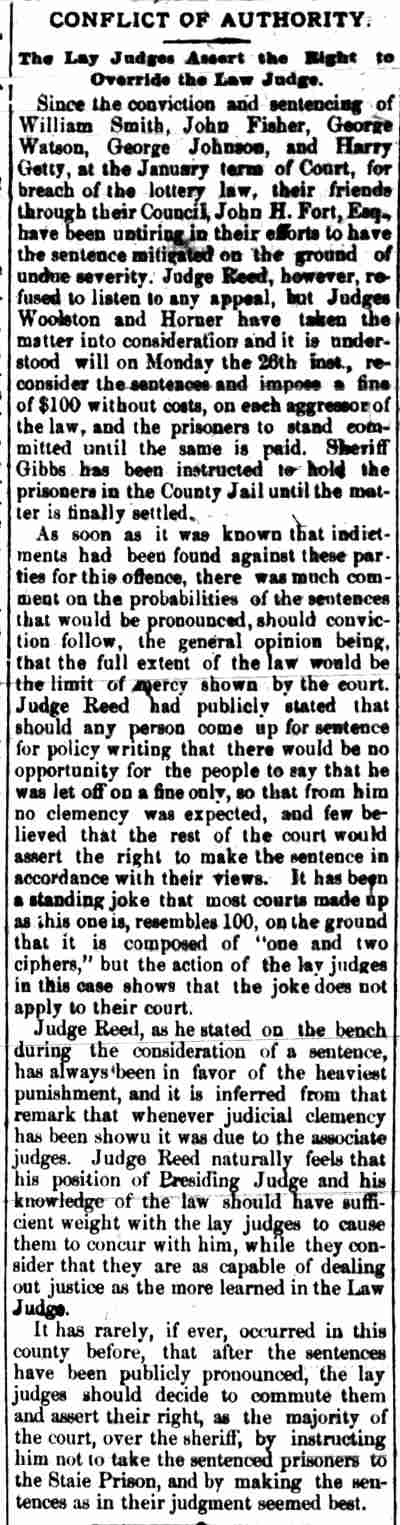
Camden Post, February 21, 1883 — William “Policy Bill” Smith; Harriet Smith; John Fisher; George Watson; George Johnson; Harry Getty; John H. Fort; Charles T. Reed; Isaiah S. Woolston; Joel Horner; Theodore B. Gibbs
Reducing Sentences
Camden Post —
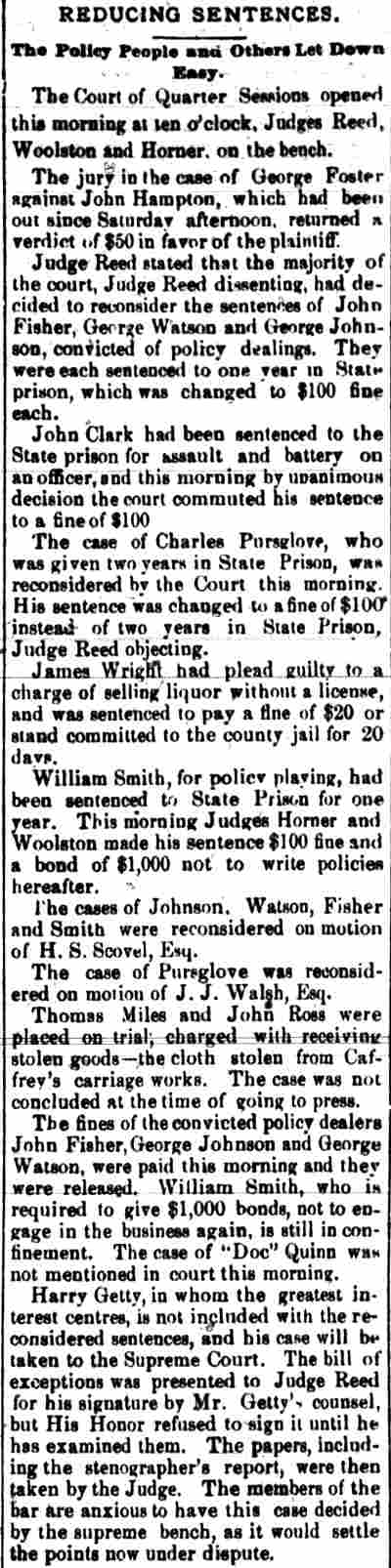
The Policy People and Others Let Down Easy.
The Court of Quarter Sessions opened this morning at ten o’clock, Judges Reed, Woolston and Horner, on the bench.
The jury in the case of George Foster against John Hampton, which had been out since Saturday afternoon, returned a verdict of $50 in favor of the plaintiff.
Judge Reed stated that the majority of the court, Judge Reed dissenting, had decided to reconsider the sentences of John Fisher, George Watson and George Johnson, convicted of policy dealings. They were each sentenced to one year in State prison, which was changed to $100 fine each.
John Clark had been sentenced to the State prison for assault and battery on an officer, and this morning by unanimous decision the court commuted his sentence to a fine of $100
The case of Charles Pursglove, who was given two years in State Prison, was reconsidered by the Court this morning. His sentence was changed to a fine of $100 instead of two years in State Prison, Judge Reed objecting.
James Wright had plead guilty to a charge of selling liquor without a license, and was sentenced to pay a fine of $20 or stand committed to the county jail for 20 days.
William Smith, for policy playing, had been sentenced to State Prison for one year. This morning Judges Horner and Woolston made his sentence $100 fine and a bond of $1,000 not to write policies hereafter.
The cases of Johnson, Watson, Fisher and Smith were reconsidered on motion of H. S. Scovel, Esq.
The case of Pursglove was reconsidered on motion of J. J. Walsh, Esq.
Thomas Miles and John Ross were placed on trial; charged with receiving stolen goods—the cloth stolen from Caffrey’s carriage works. The case was not concluded at the time of going to press.
The fines of the convicted policy dealers John Fisher, George Johnson and George Watson, were paid this morning and they were released. William Smith, who is required to give $1,000 bonds, not to engage in the business again, is still in confinement. The case of “Doc” Quinn was not mentioned in court this morning.
Harry Getty, in whom the greatest interest centres, is not included with the reconsidered sentences, and his case will be taken to the Supreme Court. The bill of exceptions was presented to Judge Reed for his signature by Mr. Getty’s counsel, but His Honor refused to sign it until he has examined them. The papers, including the stenographer’s report, were then taken by the Judge. The members of the bar are anxious to have this case decided by the supreme bench, as it would settle the points now under dispute.
Policy Arrest
Camden Post —
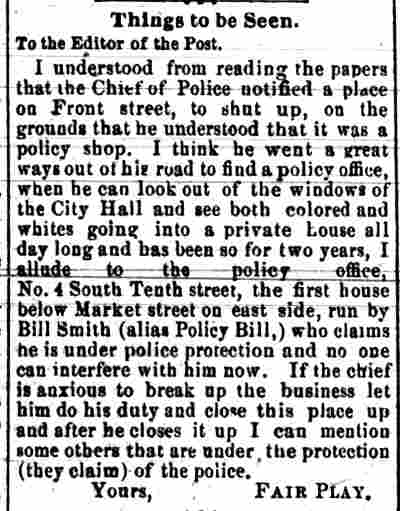
Things to be Seen.
To the Editor of the Post.
I understood from reading the papers that the Chief of Police notified a place on Front street, to shut up, on the ground that he understood that it was a policy shop. I think he went a great ways out of his road to find a policy office, when he can look out of the windows of the City Hall and see both colored and whites going into a private house all day long and has been so for two years, I allude to the policy office, No. 4 South Tenth street, the first house below Market street on east side, run by Bill Smith (alias Pretty Bill.) He claims he is under police protection and no one can interfere with him now. If the chief is anxious to break up the business let him do his duty and close his place up and after he closes it up I can mention some others that are under, the protection (they say) of the police.
Yours, FAIR PLAY.
A Favorite Row Drawn After a Year’s Rest—Mayor Bradshaw’s Raid
Camden Daily Courier —
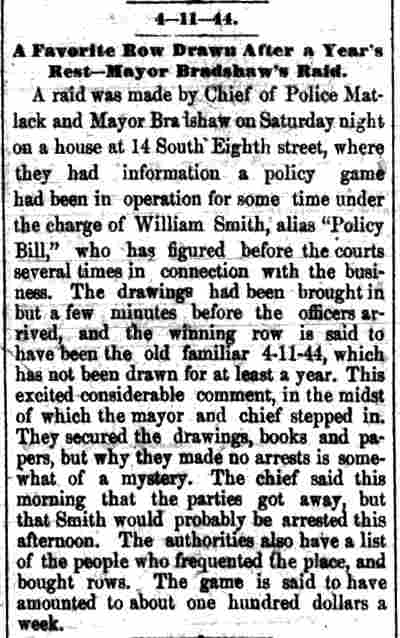
4-11-44.
A raid was made by Chief of Police Matlack and Mayor Bradshaw on Saturday night on a house at 14 South Eighth street, where they had information a policy game had been in operation for some time under the charge of William Smith, alias “Policy Bill,” who has figured before the courts several times in connection with the business. The drawings had been brought in but a few minutes before the officers arrived, and the winning row is said to have been the old familiar 4-11-44, which has not been drawn for at least a year. This excited considerable comment, in the midst of which the mayor and chief stepped in. They secured the drawings, books and papers, but why they made no arrests is somewhat of a mystery. The chief said this morning that the parties got away, but that Smith would probably be arrested this afternoon. The authorities also have a list of the people who frequented the place, and bought rows. The game is said to have amounted to about one hundred dollars a week.
“Policy Bill” Did Not Come
Camden Daily Courier —
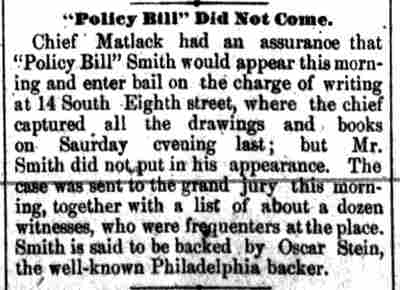
Chief Matlack had an assurance that “Policy Bill” Smith would appear this morning and enter bail on the charge of writing at 14 South Eighth street, where the chief captured all the drawings and books on Saurday [sic] evening last; but Mr. Smith did not put in his appearance. The case was sent to the grand jury this morning, together with a list of about a dozen witnesses, who were frequenters at the place. Smith is said to be backed by Oscar Stein, the well-known Philadelphia backer.
The Policy Raid
Camden Post —
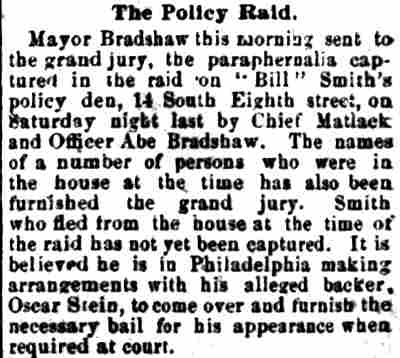
Mayor Bradshaw this morning sent to the grand jury, the paraphernalia captured in the raid on “Bill” Smith’s policy den, 14 South Eighth street, on Saturday night last by Chief Matlack and Officer Abe Bradshaw. The names of a number of persons who were in the house at the time has also been furnished the grand jury. Smith who fled from the house at the time of the raid has not yet been captured. It is believed he is in Philadelphia making arrangements with his alleged backer, Oscar Stein, to come over and furnish the necessary bail for his appearance when required at court.
The Smith Policy Case
Camden Post —
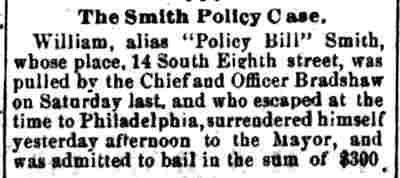
William, alias “Policy Bill” Smith, whose place, 14 South Eighth street, was pulled by the Chief and Officer Bradshaw on Saturday last, and who escaped at the time to Philadelphia, surrendered himself yesterday afternoon to the Mayor, and was admitted to bail in the sum of $300.
Raid on a Policy Shop.
Camden Post —
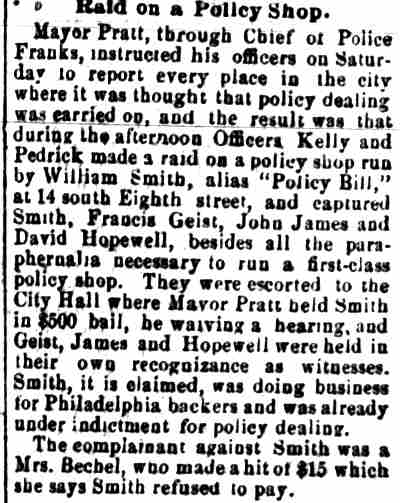
Mayor Pratt, through Chief of Police Franks, instructed his officers on Saturday to report every place in the city where it was thought that policy dealing was carried on, and the result was that during the afternoon Officers Kelly and Pedrick made a raid on a policy shop run by William Smith, alias “Policy Bill,” at 14 south Eighth street, and captured Smith, Francis Geist, John James and David Hopewell, besides all the paraphernalia necessary to run a first-class policy shop. They were escorted to the City Hall where Mayor Pratt held Smith in $500 bail, he waiving a hearing, and Geist, James and Hopewell were held in their own recognizance as witnesses. Smith, it is claimed, was doing business for Philadelphia backers and was already under indictment for policy dealing.
The complainant against Smith was a Mrs. Bechel, who made a hit of $15 which she says Smith refused to pay.
Policy Raids
Camden Daily Courier —
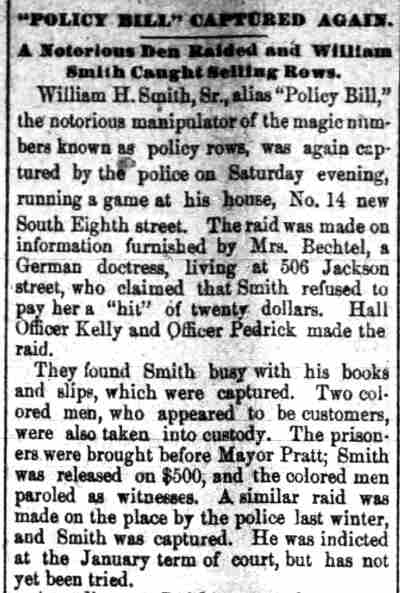
“Policy Bill” Captured Again.
A Notorious Den Raided and William Smith Caught Selling Rows.
William H. Smith, Sr., alias “Policy Bill,” the notorious manipulator of the magic numbers known as policy rows, was again captured by the police on Saturday evening, running a game at his house, No. 14 new South Eighth street. The raid was made on information furnished by Mrs. Bechtel, a German doctress, living at 506 Jackson street, who claimed that Smith refused to pay her a “hit” of t dollars. Hall Officer Kelly and Officer Pedrick made the raid.
They found Smith busy with his books and slips, which were captured. Two colored men, who appeared to be customers, were also taken into custody. The prisoners were brought before Mayor Pratt; Smith was released on $500; and the colored men paroled as witnesses. A similar raid was made on the place by the police last winter, and Smith was captured. He was indicted at the January term of court, but has not yet been tried.
Giving the Mayor Points
Camden Post —
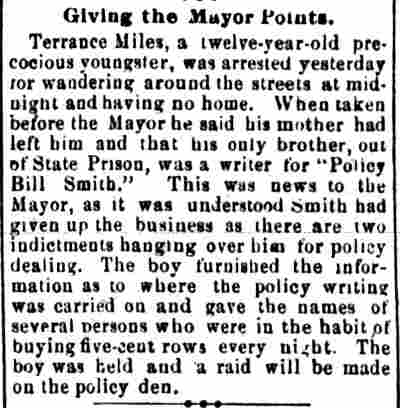
Camden Post, June 30, 1886 — William “Policy Bill” Smith; Harry H. Franks; Terrance Miles; South 8th Street; Harriet Smith; Jesse Pratt
Mrs. Smith Attempts Suicide
Camden Post —
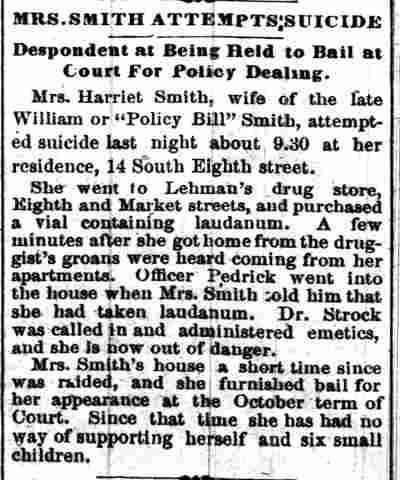
Despondent at Being Held to Bail at Court For Policy Dealing.
Mrs. Harriet Smith, wife of the late William or “Policy Bill” Smith, attempted suicide last night about 9.30 at her residence, 14 South Eighth street.
She went to Lehman’s drug store, Eighth and Market streets, and purchased a vial containing laudanum. A few minutes after she got home from the druggist’s groans were heard coming from her apartments. Officer Pedrick went into the house when Mrs. Smith told him that she had taken laudanum. Dr. Strock was called in and administered emetics, and she is now out of danger.
Mrs. Smith’s house a short time since was raided, and she furnished bail for her appearance at the October term of Court. Since that time she has had no way of supporting herself and six small children.
A Policy Den Raided
Camden Post —
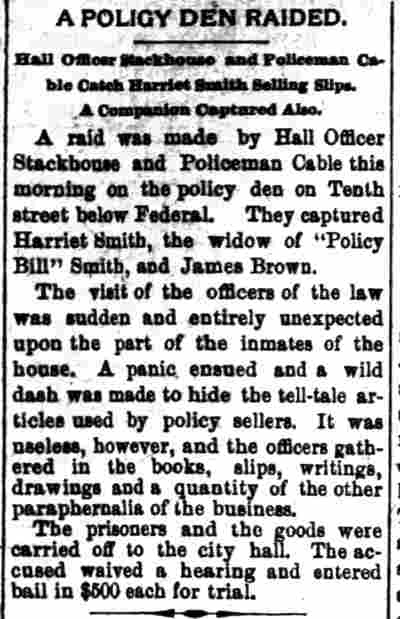
Hall Officer Stackhouse and Policeman Cable Catch Harriet Smith Selling Slips. A Companion Captured Also.
A raid was made by Hall Officer Stackhouse and Policeman Cable this morning on the policy den on Tenth street below Federal. They captured Harriet Smith, the widow of “Policy Bill” Smith, and James Brown.
The visit of the officers of the law was sudden and entirely unexpected upon the part of the inmates of the house. A panic ensued and a wild dash was made to hide the tell-tale articles used by policy sellers. It was useless, however, and the officers gathered in the books, slips, writings, drawings and a quantity of the other paraphernalia of the business.
The prisoners and the goods were carried off to the city hall. The accused waived a hearing and entered bail in $500 each for trial.
Darlings Doused.
Camden Daily Telegram —
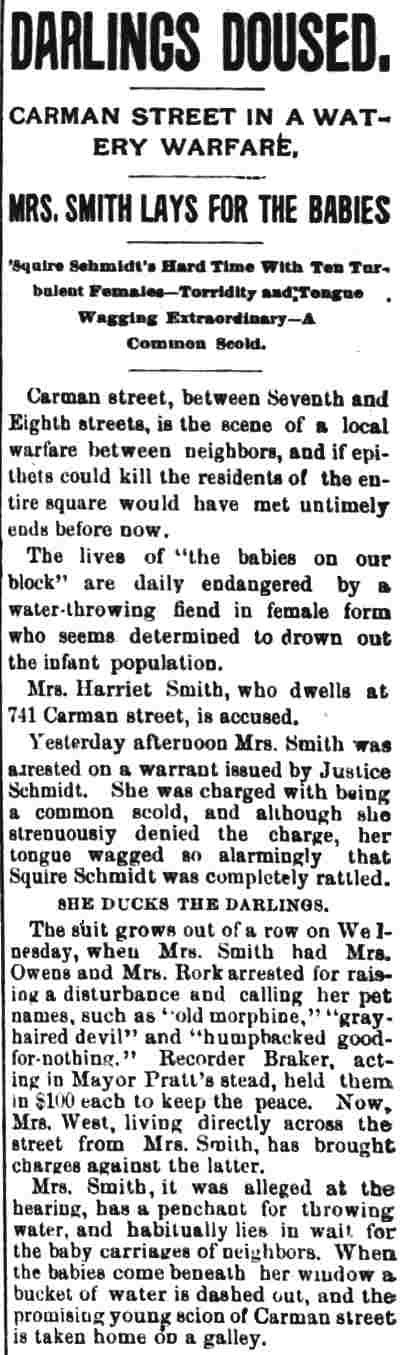
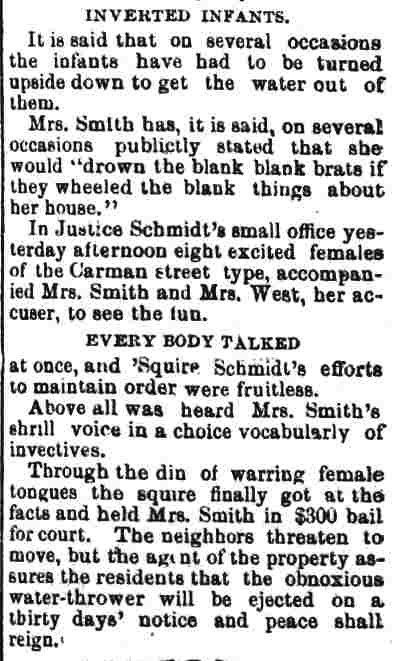
CARMAN STREET IN A WATERY WARFARE.
MRS. SMITH LAYS FOR THE BABIES
‘Squire Schmidt’s Hard Time With Ten Turbulent Females—Torridity and Tongue Wagging Extraordinary—A Common Scold.
Carman street, between Seventh and Eighth streets, is the scene of a local warfare between neighbors, and if epithets could kill the residents of the entire square would have met untimely ends before now.
The lives of “the babies on our block” are daily endangered by a water-throwing fiend in female form who seems determined to drown out the infant population.
Mrs. Harriet Smith, who dwells at 741 Carman street, is accused.
Yesterday afternoon Mrs. Smith was arrested on a warrant issued by Justice Schmidt. She was charged with being a common scold, and although she strenuously denied the charge, her tongue wagged so alarmingly that Squire Schmidt was completely rattled.
SHE DUCKS THE DARLINGS.
The suit grows out of a row on Wednesday, when Mrs. Smith had Mrs. Owens and Mrs. Rork arrested for raising a disturbance and calling her pet names, such as “old morphine,” “gray-haired devil” and “humpbacked good-for-nothing.” Recorder Braker, acting in Mayor Pratt’s stead, held them in $100 each to keep the peace. Now, Mrs. West, living directly across the street from Mrs. Smith, has brought charges against the latter.
Mrs. Smith, it was alleged at the hearing, has a penchant for throwing water, and habitually lies in wait for the baby carriages of neighbors. When the babies come beneath her window a bucket of water is dashed out, and the promising young scion of Carman street is taken home on a galley.
INVERTED INFANTS.
It is said that on several occasions the infants have had to be turned upside down to get the water out of them.
Mrs. Smith has, it is said, on several occasions publicly stated that she would “drown the blank blank brats if they wheeled the blank things about her house.”
In Justice Schmidt’s small office yesterday afternoon eight excited females of the Carman street type, accompanied Mrs. Smith and Mrs. West, her accuser, to see the fun.
EVERY BODY TALKED
at once, and ‘Squire Schmidt’s efforts to maintain order were fruitless.
Above all was heard Mrs. Smith’s shrill voice in a choice vocabulary of invectives.
Through the din of warring female tongues the squire finally got at the facts and held Mrs. Smith in $300 bail for court. The neighbors threaten to move, but the agent of the property assures the residents that the obnoxious water-thrower will be ejected on a thirty days’ notice and peace shall reign.
The Tenth Street Gang
Camden Daily Telegram —
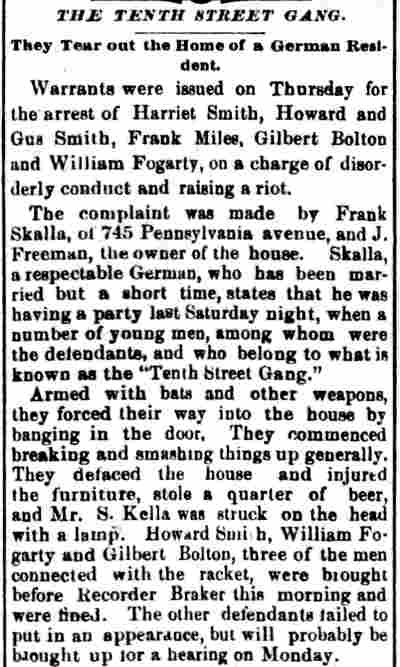
They Tear out the Home of a German Resident.
Warrants were issued on Thursday for the arrest of Harriet Smith, Howard and Gus Smith, Frank Miles, Gilbert Bolton and William Fogarty, on a charge of disorderly conduct and raising a riot.
The complaint was made by Frank Skalla, of 745 Pennsylvania avenue, and J. Freeman, the owner of the house. Skalla, a respectable German, who has been married but a short time, states that he was having a party last Saturday night, when a number of young men, among whom were the defendants, and who belong to what is known as the “Tenth Street Gang.”
Armed with bats and other weapons, they forced their way into the house by banging in the door. They commenced breaking and smashing things up generally. They defaced the house and injured the furniture, stole a quarter of beer, and Mr. S. Kella [sic] was struck on the head with a lamp. Howard Smith, William Fogarty and Gilbert Bolton, three of the men connected with the racket, were brought before Recorder Braker this morning and were fined. The other defendants failed to put in an appearance, but will probably be brought up for a hearing on Monday.
Case of Harriet Smith
Camden Post —
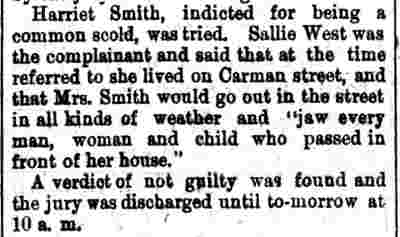
Harriet Smith, indicted for being a common scold, was tried. Sallie West was the complainant and said that at the time referred to she lived on Carman street, and that Mrs. Smith would go out in the street in all kinds of weather and “jaw every man, woman and child who passed in front of her house.” A verdict of not guilty was found and the jury was discharged.
Case of Harriet Smith
Camden Post —
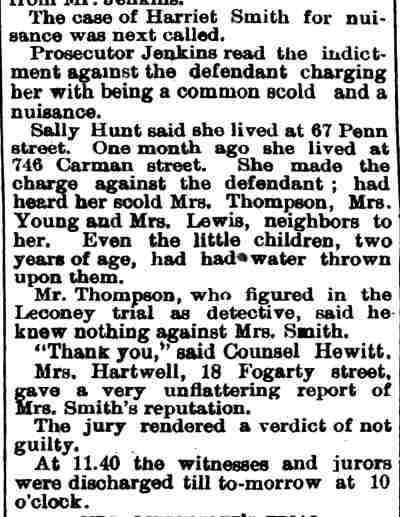
The case of Harriet Smith for nuisance was next called.
Prosecutor Jenkins read the indictment against the defendant charging her with being a common scold and a nuisance.
Sally Hunt said she lived at 67 Penn street. One month ago she lived at 746 Carman street. She made the charge against the defendant; had heard her scold Mrs. Thompson, Mrs. Young and Mrs. Lewis, neighbors to her. Even the little children, two years of age, had had water thrown upon them.
Mr. Thompson, who figured in the Leconey trial as detective, said he knew nothing against Mrs. Smith.
“Thank you,” said Counsel Hewitt.
Mrs. Hartwell, 18 Fogarty street, gave a very unflattering report of Mrs. Smith’s reputation.
The jury rendered a verdict of not guilty.
At 11.40 the witnesses and jurors were discharged till to-morrow at 10 o’clock.
Taking Up the Policy Cases
Camden Daily Telegram —
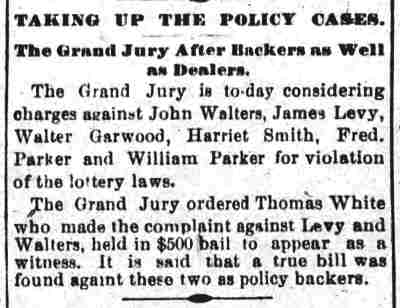
The Grand Jury After Backers as Well as Dealers
The Grand Jury is to-day considering charges against John Walters, James Levy, Walter Garwood, Harriet Smith, Fred. Parker and William Parker for violation of the lottery laws.
The Grand Jury ordered Thomas White who made the complaint against Levy and Walters, held in $500 bail to appear as a witness. It is said that a true bill was found against these two as policy backers.
Policy Trial Pleas
Camden Post —
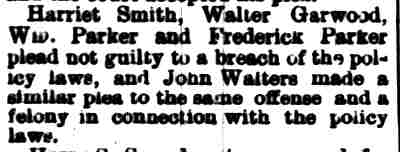
Harriet Smith, Walter Garwood, Wm. Parker and Frederick Parker plead not guilty to a breach of the policy laws, and John Walters made a similar plea to the same offense and a felony in connection with the policy laws.
Alleged Policy Offenders Bailed
Camden Daily Courier —
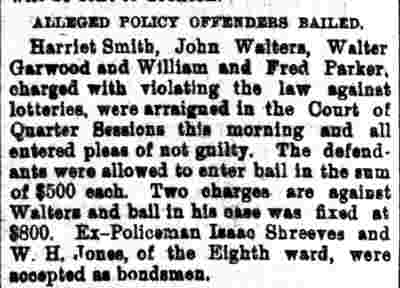
ALLEGED POLICY OFFENDERS BAILED.
Harriet Smith, John Walters, Walter Garwood and William and Fred Parker, charged with violating the law against lotteries, were arraigned in the Court of Quarter Sessions this morning and all entered pleas of not guilty. The defendants were allowed to enter bail in the sum of $500 each. Two charges are against Walters and bail in his case was fixed at $800. Ex-Policeman Isaac Shreeves and W. H. Jones, of the Eighth ward, were accepted as bondsmen.
Policy Trial
Camden Daily Telegram —
OVER IN CAMDEN
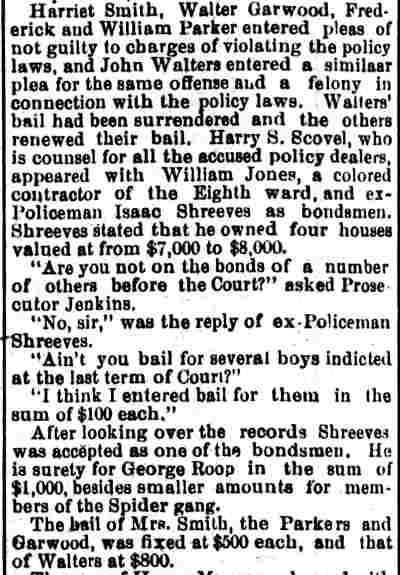
Harriet Smith, Walter Garwood, Frederick and William Parker entered pleas of not guilty to charges of violating the policy laws, and John Walters entered a similar plea for the same offense and a felony in connection with the policy laws. Walters’ bail had been surrendered and the others renewed their bail. Harry S. Scovel, who is counsel for all the accused policy dealers, appeared with William Jones, a colored contractor of the Eighth ward, and ex-Policeman Isaac Shreeves as bondsmen. Shreeves stated that he owned four houses valued at from $7,000 to $8,000.
“Are you not on the bonds of a number of others before the Court?” asked Prosecutor Jenkins.
“No, sir,” was the reply of ex-Policeman Shreeves.
“Ain’t you bail for several boys indicted at the last term of Court?”
“I think I entered bail for them in the sum of $100 each.”
After looking over the records Shreeves was accepted as one of the bondsmen. He is surety for George Roop in the sum of $1,000, besides smaller amounts for members of the Spider gang.
The bail of Mrs. Smith, the Parkers and Garwood, was fixed at $500 each, and that of Walters at $800.
Policy Sentencing
Camden Post —
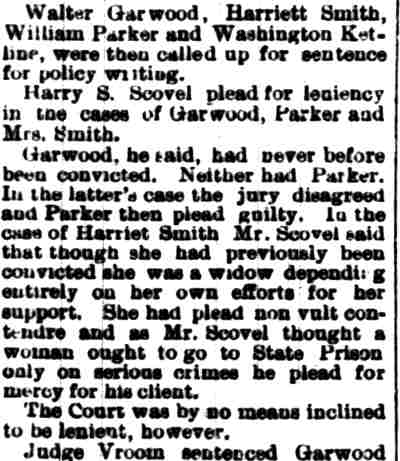
Walter Garwood, Harriett Smith, William Parker and Washington Ketline, were then called up for sentence for policy writing.
Harry S. Scovel plead for leniency in the cases of Garwood, Parker and Mrs. Smith.
Garwood, he said, had never before been convicted. Neither had Parker. In the latter’s case the jury disagreed and Parker then plead guilty. In the case of Harriet Smith Mr. Scovel said that though she had previously been convicted she was a widow depending entirely on her own efforts for her support. She had plead non vult contendre [sic] and as Mr. Scovel thought a woman ought to go to State Prison only on serious crimes he plead for mercy for his client.
The Court was by no means inclined to be lenient, however.
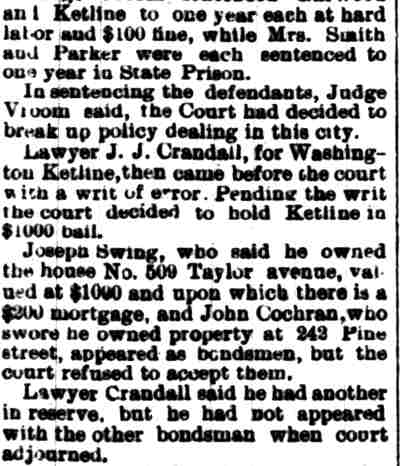
Judge Vroom sentenced Garwood and Ketline to one year each at hard labor and $100 fine, while Mrs. Smith and Parker were each sentenced to one year in State Prison.
In sentencing the defendants, Judge Vroom said, the Court had decided to break up policy dealing in this city.
Lawyer J. J. Crandall, for Washington Ketline, then came before the court with a writ of error. Pending the writ the court decided to hold Ketline in $1000 bail.
Joseph Swing, who said he owned the house No. 509 Taylor avenue, valued at $1000 and upon which there is a $[?]00 mortgage, and John Cochran, who swore he owned property at 243 Pine street, appeared as bondsmen, but the court refused to accept them.
Lawyer Crandall said he had another in reserve, but he had not appeared with the other bondsman when court adjourned.
Some Severe Sentences
Camden Daily Courier —

LOTTERY POLICY DEALERS GIVEN THE FULL EXTANT OF THE LAW.
A Business Court Which Announces its Purpose to Punish Law Breakers as the Laws Provide—Tribute Awarded Where Tribute is Due.
Policy sellers felt the strong hand of the law this morning, and Judge Vroom, speaking from the bench of the Quarter Sessions Court, stated that all offenders in the same line who came before the Court would receive the most severe penalty the law allowed. Judge Vroom’s language when speaking of the practice of policy selling was most severe and condemnatory.
“This Court,” said he, “has fully determined to break up the nefarious traffic, and all offenders hereafter convicted will receive the full penalty of the law.”
It was assize day at the Quarter Sessions Court this morning, and four persons convicted of violating the law concerning lottery, were early arraigned before the Court for sentence. Walter Garwood, who entered a plea of nom vult contendre [sic], was given a sentence of one year in the State prison and to pay a fine of $100 and costs. William Parker, colored, who was found guilty of policy selling, was given a sentence of one year, but no fine. Washington Ketline, who the Court designated as an old offender, was sentenced to one year in the penitentiary and to pay a fine of $100 and costs—the full limit of the law. When Mrs. Harriet Smith, of 750 Federal street, arose for sentence, she was visibly affected and seemed to know that her fate was to be a severe one. She was sentenced to one year in the penitentiary. She was taken from the court room crying and on her way down stairs to the Sheriff’s office fainted. She was removed to the jail on a cot, seriously ill. Mrs. Smith has a large family, and her sentence, of course, put her in a most trying position. But she has been before the Court several times before, and evidently thought she could continue policy selling indefinitely so long as she was only fined. Lawyer Harry Scovel made a strong appeal to the Court for clemency in her behalf, but it was not heeded. Lawyer Crandall, counsel for Washington Ketline, gave notice of carrying Ketline’s case to the Supreme Court on a writ of error, and Ketline was released on furnishing $1,000 bail.
Among the additional persons sentenced were the following:
William Jacobs, colored, involuntary manslaughter in causing the death of George Whittington last December, one year in the penitentiary.
David Fry, colored, who assaulted Georgiana Fry, a relative, with a razor, was given two years in the penitentiary.
“This Court is determined to put a stop to the practices of carrying deadly weapons and the indiscriminate use of them,” said Judge Vroom.
Henry Thomas, colored, was sentenced to thirty days in the county jail for having stolen a pair of shoes for his walnut-colored “Trilb[?]s”
Bail was declared forfeited in the following cases: Jeptha Hickman, assault and battery, Smith Cos[?]ell, bondsman; Wm. Wright, grand larceny, Mary Scovel, bondsman; Joseph Gallagher, petit larceny, Mary Scovel, bondsman; Frank Nelson, false pretences, John Lane, bondsman.
Today practically closes the spring term of the Court of Quarter Sessions, and in reviewing the business of the term it must be said that the Court has been a business-like one from start to finish. It has been such a term as is calculated to assure the public that the best interests of all were being carefully considered and judiciously guarded.
The Prosecutor and his assistant have strongly upheld the Court in its endeavors to administer the law, and the sentences of the Court clearly demonstrate a sincere conviction and desire to suppress lawless conditions and those public evils which threaten the peace of a community. Policy dealers have been rigidly dealt with, and they certainly begin to understand that they must stop their unlawful practices or go to the penitentiary. The fees from Justices’ courts have also received attention from the present Judges, and been cut down to what the Court considers just to the county’s taxpayers. Despite the large volume of business before the Court, all cases have received due consideration and care. Last, but by no means least, County Clerk Barber, by his prompt and methodical care of the records, has materially aided the Court, as also has Sheriff Barrett and his assistants.
A Year Each for Policy People
Camden Daily Telegram —

Mrs. Harriet Smith Fainted When Sentenced.
DETERMINED TO STOP THE GAME
Judge Vroom Says the Court is Decided About This Matter and in Two Cases Imposes the Full Penalty.
This was the last assize day for the present term of the Quarter Sessions Court. Judges Vroom, McDowell and Burdsall held a consultation in the law library until twenty minutes after ten o’clock when they came into the large court room.
Lulu Robinson was sworn and said that David Fry had cut her with a razor during a quarrel one evening at Eighth and Ann streets. Fry was quarreling with the others and the witness interfered when Fry cut her across the cheek with a razor. Fry has pleaded guilty to the assault.
Mrs. William Still, of Snow Hill, was sworn, and stated that on a Saturday night her husband came home and seemed to be in a bad humor. He quarreled with her all night Saturday and all day Sunday. He asked her if she was going to stop running around and as she did not answer him Still pulled out a revolver and shot her. He fired three more shots at her as she laid on the floor and when she was going out the door he shot her in the head.
“Did this not occur over your running with other men?” asked Lawyer John L. Semple, who is counsel for William Still.
No, sir. I did not go with other men.”
Witness said she knew a man by the name of Grey, but denied that she had ever been intimate with him.
In answer to Judge Vroom Mrs. Still said that she had been shot three times and was in the Cooper Hospital some time. She said her husband had threatened to cut her throat on other occasions. Still was not present and the court ordered that he appear on Monday or his bail would be forfeited and a bench warrant issued.
William Jacobs, who was convicted yesterday of involuntary manslaughter in killing George Whittington, was sentenced to one year in State Prison.
When the convicted policy dealers were arraigned Lawyer H. S. Scovel said he desired to make a few remarks in their behalf. He said that in the case of William Parker the jury failed to agree and he advised Parker afterwards to enter a plea of guilty. Parker had never been accused before of a crime and Lawyer Scovel asked that the Court be lenient. He also said there was no record of Walter Garwood having been convicted before. Lawyer Scovel also asked that mercy be shown in the case of Mrs. Harriet Smith, who pleaded guilty. He said there was no question but what she had been convicted before of policy writing but her husband was dead and she had a large family to support. “I do not think the State Prison was ever erected for the imprisonment of a woman unless she had committed some great crime,” said Lawyer Scovel.
The Court said that some of the convicted policy writers had been convicted before of violating the policy laws and the Court had been lenient and imposed fines instead of imprisonment.
“The Court is determined to break up policy playing in this city,” said Judge Vroom. “The sentence of Walter Garwood and Washington Ketline is that they serve one year in the State Prison and pay a fine of $100 each. This is the full penalty of the law. Harriet Smith and William Parker will serve one year in State Prison without a fine.”
As the defendants were being taken out of the court room to the county jail Mrs. Smith swooned away just outside of the entrance to the court room. A cot was secured from the county jail and Constable Jacob Leon and Jailor David Logue placed her on it and carried her over to the county jail.
Lawyer J. J. Crandall asked that Washington Ketline be released on bail as he had secured a writ of error to carry the case to the Supreme Court. Bail was fixed at $1,000 and John Cockran and Joseph Swing appeared to enter the necessary security. They were closely questioned by the Court.
Claims She Lost Her Pin
Camden Daily Telegram —
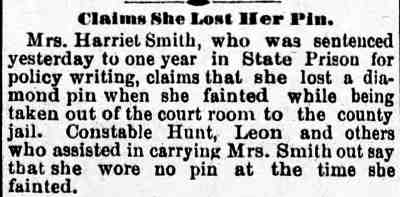
Claims She Lost Her Pin.
Mrs. Harriet Smith, who was sentenced yesterday to one year in State Prison for policy writing, claims that she lost a diamond pin when she fainted while being taken out of the court room to the county jail. Constable Hunt, Leon and others who assisted in carrying Mrs. Smith out say that she wore no pin at the time she fainted.
Concluding Court.
Camden Post —

Still Gets One Year for Shooting His Wife.
HIS PLEA TO THE COURT TODAY.
Refusal to Commute Harriet Smith’s Sentence. Other Matters That Were Finished Up This Morning
In the Quarter Sessions this morning the remnants of the late session were finished up.
Wm. Henry Harrison Still, who plead guilty to shooting his wife, was sentenced to one year in State Prison.
Lawyer John L. Semple made a plea for Still, and the latter told on the stand how for months he had known of his wife’s intimacy with Harry Gray. For the sake of his eight children he condoned the offense. On the day previous to the shooting he had gone to work at the Kirkwood ice pond. Gray was working there, and when Still went to work Gray left the pond. When Still went home it was some time before his wife let him in the house.
On the following morning he found footsteps around the house. After quarrelling with his wife for some time he finally shot her three times. He thought a great deal of his wife and gave her his money at the end of every month.
The mother of Gray recently showed Still a letter, he said, in which his (Still’s) wife acknowledged that her last child was Gray’s.
Lawyer Semple contended that had Still stood trial instead of pleading guilty he would never have been convicted.
After being out for a half hour the court said it was satisfied that Still had attempted to kill his wife and that had he accomplished murder he would have been convicted of murder in the first degree.
The Court then sentenced him to one year at hard labor.
Gilbert Boulton’s case then came up. Boulton had been sentenced to one year for assault and battery. Boulton was a member of the notorious “Spider gang.”
Lawyer Fred. A. Rex appeared with Boulton’s father, but the Court refused to revoke the sentence.
Judge Vroom said he saw no injustice in the sentence imposed.
Lawyer Harry S. Scovel made a strong plea in behalf of Harriet Smith, who was sentenced to one year for policy writing.
Mr. Scovel said that on Friday last he had said to the Court that Mrs. Smith had previously been convicted, but after going over the court records he found that this was not so. He had advised her to plead non vult contendre because of this impression, and now he felt that her sentence came through his error. He asked that her sentence be changed to a term in the county jail and a fine. Mr. Scovel said she was in a bad state of health and this could be shown by several physicians. He did not ask for her escape from punishment, but for leniency.
Lawyer Rex followed Mr. Scovel, but the Court was determined, and after a conference Judge Vroom said the Court had carefully considered the matter and would absolve Mr. Scovel from anything he had said. They had had a careful consideration in the first place. They had an object in sentencing these people, and while they feel sorry for the woman they must adhere to the object in view and must decline to change the sentence.
Mrs. Garwood was in court to plead for a commutation of the sentence of her landlord, Walter Garwood, who got one year for policy writing.
The Court said it was willing to hear Mrs. Garwood, but it was positive that Garwood perjured himself on the stand and it was not inclined to reduce his fine.
Mrs. Garwood did not make herself heard. Court was adjourned.
No Hope for Policy Writers
Camden Daily Telegram —
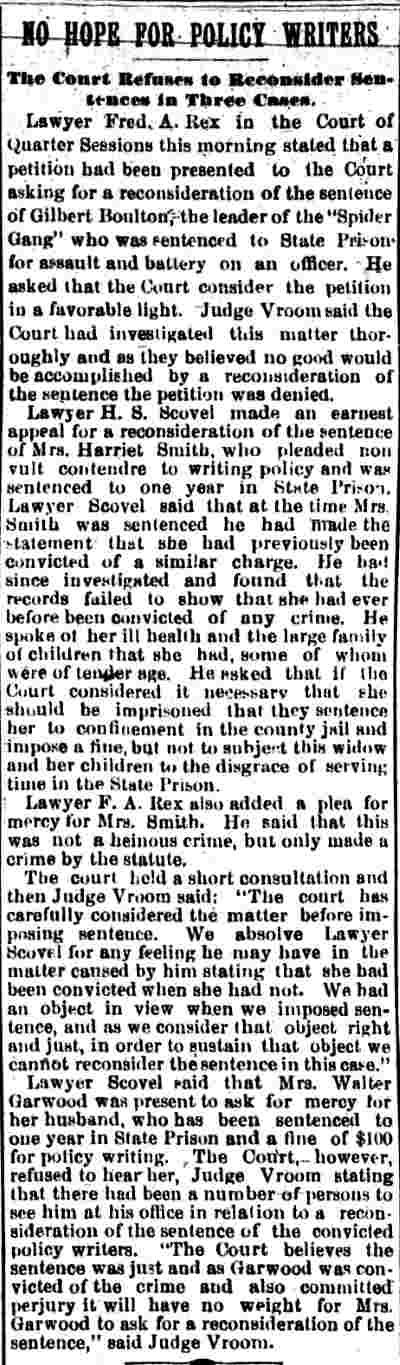
The Court Refuses to Reconsider Sentences in Three Cases.
Lawyer Fred. A. Rex in the Court of Quarter Sessions this morning stated that a petition had been presented to the Court asking for a reconsideration of the sentence of Gilbert Boulton, the leader of the “Spider Gang” who was sentenced to State Prison for assault and battery on an officer. He asked that the Court consider the petition in a favorable light. Judge Vroom said the Court had investigated this matter thoroughly and as they believed no good would be accomplished by a reconsideration of the sentence the petition was denied.
Lawyer H. S. Scovel made an earnest appeal for a reconsideration of the sentence of Mrs. Harriet Smith, who pleaded non vult contendre [sic] to writing policy and was sentenced to one year in State Prison. Lawyer Scovel said that at the time Mrs. Smith was sentenced he had made the statement that she had previously been convicted of a similar charge. He had since investigated and found that the records failed to show that she had ever before been convicted of any crime. He spoke of her ill health and the large family of children that she had, some of whom were of tender age. He asked that if the Court considered it necessary that she should be imprisoned that they sentence her to confinement in the county jail and impose a fine, but not to subject this widow and her children to the disgrace of serving time in the State Prison.
Lawyer F. A. Rex also added a plea for mercy for Mrs. Smith. He said that this was not a heinous crime, but only made a crime by the statute.
The court held a short consultation and then Judge Vroom said: “The court has carefully considered the matter before imposing sentence. We absolve Lawyer Scovel for any feeling he may have in the matter caused by him stating that she had been convicted when she had not. We had an object in view when we imposed sentence, and as we consider that object right and just, in order to sustain that object we cannot reconsider the sentence in this case.”
Lawyer Scovel said that Mrs. Walter Garwood was present to ask for mercy for her husband, who has been sentenced to one year in State Prison and a fine of $100 for policy writing. The Court, however, refused to hear her, Judge Vroom stating that there had been a number of persons to see him at his office in relation to a reconsideration of the sentence of the convicted policy writers. “The Court believes the sentence was just and as Garwood was convicted of the crime and also committed perjury it will have no weight for Mrs. Garwood to ask for a reconsideration of the sentence,” said Judge Vroom.
Did Not Go to Trenton
Camden Daily Telegram —
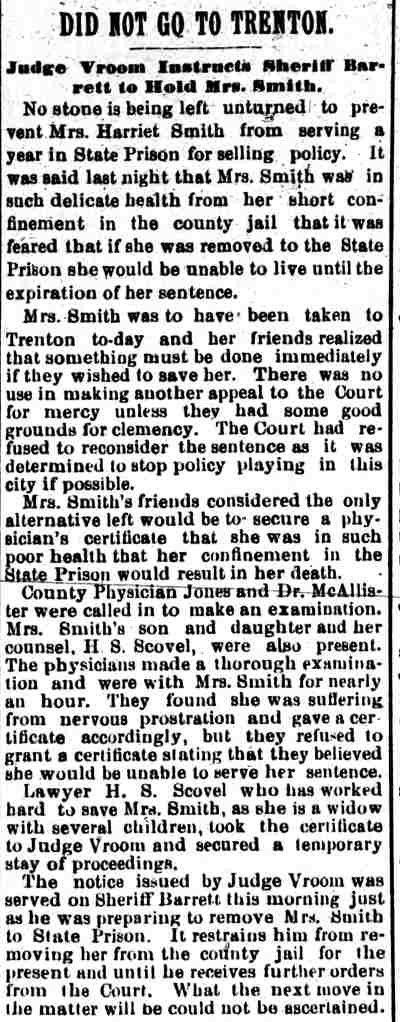
DID NOT GO TO TRENTON.
Judge Vroom Instructs Sheriff Barrett to Hold Mrs. Smith.
No stone is being left unturned to prevent Mrs. Harriet Smith from serving a year in State Prison for selling policy. It was said last night that Mrs. Smith was in such delicate health from her short confinement in the county jail that it was feared that if she was removed to the State Prison she would be unable to live until the expiration of her sentence.
Mrs. Smith was to have been taken to Trenton to-day and her friends realized that something must be done immediately if they wished to save her. There was no use in making another appeal to the Court for mercy unless they had some good grounds for clemency. The Court had refused to reconsider the sentence as it was determined to stop policy playing in this city if possible.
Mrs. Smith’s friends considered the only alternative left would be to secure a physician’s certificate that she was in such poor health that her confinement in the State Prison would result in her death.
County Physician Jones and Dr. McAllister were called in to make an examination. Mrs. Smith’s son and daughter and her counsel, H. S. Scovel, were also present. The physicians made a thorough examination and were with Mrs. Smith for nearly an hour. They found she was suffering from nervous prostration and gave a certificate accordingly, but they refused to grant a certificate stating that they believed she would be unable to serve her sentence.
Lawyer H. S. Scovel who has worked hard to save Mrs. Smith, as she is a widow with several children, took the certificate to Judge Vroom and secured a temporary stay of proceedings.
The notice issued by Judge Vroom was served on Sheriff Barrett this morning just as he was preparing to remove Mrs. Smith to State Prison. It restrains him from removing her from the county jail for the present and until he receives further orders from the Court. What the next move in the matter will be could not be ascertained.
Benton Hall Case
Camden Post —

BENTON HALL CASE
Lawyer Crandall Asks for a New Writ of Error.
CASE OUT OF THE COURT’S HANDS
Judge Carrow Asks for a Reconsideration of Sentence in the Case — Still Trying to Keep Harriet Smith from State Prison.
Edward Benton and Joseph Hall, who were sentenced to three months each on conviction for criminal libel and whose appeal to the Supreme Court was dismissed on Tuesday, owing to the neglect of Counselor John J. Crandall, who failed to appear, have not yet given up their fight.
Judge Carrow has been retained, and the case assumes another phase. In court this morning Prosecutor Jenkins declared that if ever there was a manifestation of counsel’s neglect this was one.
The court gave Crandall an opportunity for argument tomorrow, when it is expected the remitater [sic] will arrive.
Lawyer Wm. J. Kraft said that Judge Carrow was counsel in the case also, and would have something to say.
“If Carrow is in the case I’ll withdraw,” declared Lawyer Crandall.
Later on Judge Carrow appeared and asked that the Court reconsider the sentence of three months in jail and make the sentence a fine. He said that while he had not been acting openly he had all along been associated with the defense. He placed the case in Mr. Crandall’s hands.
Mr. Carrow did not appear as hired counsel, but the defendants were friends of his and he made this plea for them. Obvious punishment was already had. The crime was not of a serious character. The publication was made in good faith and for the good of the public. The defendant’s did not know that Kappel and Cable was the same man. There was some foundation for the article and it was admitted at the trial that money had been unlawfully obtained.
A fine, Judge Carrow said, would dispose of the matter, and the best element of this county wanted the sentence reconsidered.
The Court said it could do nothing now as it was out of the Court’s hands, but the matter could be heard when the records arrive from the Supreme Court.
In the matter of Harriet Smith, who was sentenced to one year in State Prison for policy writing, County Physician Jones was called to the stand. He said he had examined Mrs. Smith’s condition in jail and found her suffering from palpitation of the heart. Dr. Jones said that in his opinion there was nothing to prevent her being taken to State Prison.
Dr. McAllister corroborated Dr. Jones’ statement, he having also examined Mrs. Smith.
Counselor Harry S. Scovel, who with Mr. Rex appeared for the defendant, said he had nothing more to say, but that Judge Wescott had been brought into the case and would make a motion the nature of which Mr. Scovel did not know.
The Court laid the matter over until tomorrow to hear Judge Wescott, who is in Trenton today.
Mrs. Grantz, wife of Police Officer Grantz of Stockton, who got three months for assault and battery, appeared before the Court but could say nothing through her sobs. Judge Vroom questioned her for some time relative to her husband’s business and her family and then said the Court would consider the matter.

FIGHTING TO SAVE BENTON.
Judge Carrow Comes to the Aid of Lawyer Crandall in the Case.
The case of Edward M. Benton and Joseph H. Hall, of the Citizen, came up before Judges Vroom, McDowell and Burdsall this morning in the Quarter Sessions Court. A number of members of the Committee of One Hundred were present as spectators. Lawyer J. J. Crandall appeared for the defendants. He made application for a new writ and attempted to throw the blame on County Clerk Barber and others for the dismissal of the other writ. He said he could not get the records from Clerk Barber nor could he secure the stenographic notes.
Later in the case Prosecutor Jenkins said he wished to make a statement for the public. He said that Mr. Crandall had cast reflections on County Clerk Barber and that the latter wanted it understood that he was not to blame in this matter as Mr. Crandall had not asked for the records until last Saturday. He had given Mr. Barber no time in which to get the records desired. Prosecutor Jenkins declared that if ever there was a manifestation of counsel’s neglect this case was one.
The Court refused to take any action in the matter, claiming that the records had been removed to the Supreme Court and no official notice had been received as to the action taken. The Court gave Crandall an opportunity for argument to-morrow, when it is expected the remitater [sic] will arrive.
Lawyer W. J. Kraft, who with Judge Carrow has been retained in the case, whispered to Mr. Crandall and the latter turned on him and shouted: “I want no advice from you.”
Lawyer Kraft said to the Court that Judge Carrow was also counsel in the case and would have something to say later.
“If Carrow is in the case I’ll withdraw” declared Lawyer Crandall.
Judge Carrow appeared later and asked the court to reconsider the sentence and make it a fine. He said that he was not regularly employed as counsel in the case, but was acting through friendship to the defendants. He said he had been in the case from the first and had placed the matter in the hands of Lawyer Crandall. Judge Carrow said the best element of the community desired to see the sentence reconsidered as the publication was made in good faith.
The court answered that nothing could be done until the records arrived.
County Physician Jones was called to the stand in the case of Mrs. Harriet Smith the convicted policy dealer, who was to have been taken to State Prison yesterday. He testified that he had examined Mrs. Smith’s condition in the county jail and found that she was suffering from nervous trouble and palpitation of the heart.
Dr. Jones stated in answer to questions by the Court, that in his opinion there was nothing to prevent her being taken to State Prison. Judge Vroom asked if it might precipitate a collapse.
“I stand by my certificate,” replied the County Physician. He said he did not believe that if Mrs. Smith had regular employment in the prison it would interfere with her condition. In reply to Lawyer Rex he said he did not think the shock of being taken to prison would produce serious results.
Dr. Alexander McAllister corroborated the testimony of County Physician Jones as he had also examined Mrs. Smith. He was asked if she could bring on these attacks at will. Dr. McAllister said to a certain extent she might as she could allow herself to become sufficiently excited.
The court laid the matter over until to-morrow in order that Judge Westcott, who has been retained by Mrs. Smith may be heard.
Mrs. Grantz, wife of Policeman Grantz, of Stockton, who was sentenced to three months in the county jail for assault and battery, appeared to ask for a reconsideration of his sentence. She could say nothing for her sobs and after asking her some questions about her husband’s business and family the matter was taken under consideration.
A short session of the Orphans’ Court was held when the Elliott case was laid over until to-morrow. A few minor motions were heard.
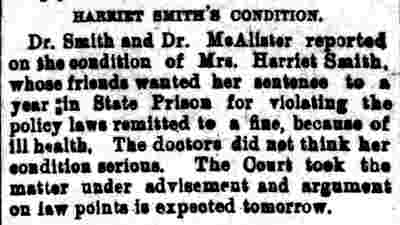
Harriet Smith’s Condition.
Dr. Jones and Dr. McAllister reported on the condition of Mrs. Harriet Smith, whose friends wanted her sentence to a year in State Prison for violating the policy law remitted to a fine, because of ill health. The doctors did not think her condition serious. The Court took the matter under advisement and judgment on law points is expected tomorrow.
Pardon Coverage
Camden Daily Telegram —
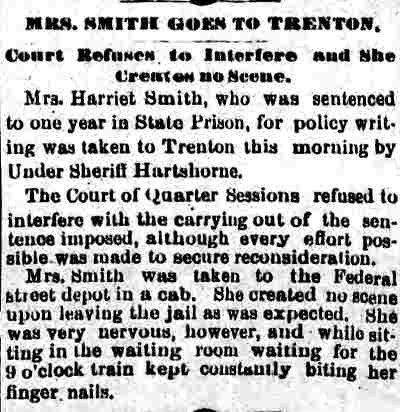
MRS. SMITH GOES TO TRENTON.
Court Refuses to Interfere and She Departs for Home.
Mrs. Harriet Smith, who was sentenced to one year in State Prison, for policy writing was taken to Trenton this morning by Under Sheriff Hartshorne.
The Court of Quarter Sessions refused to interfere with the carrying out of the sentence imposed, although an effort was made to secure reconsideration. Mrs. Smith was taken to the Federal depot in a cab. She created no end of commotion upon leaving the jail as was expected. She was very nervous, however, and while sitting in the waiting room waiting for the 9 o’clock train kept constantly biting her finger nails.
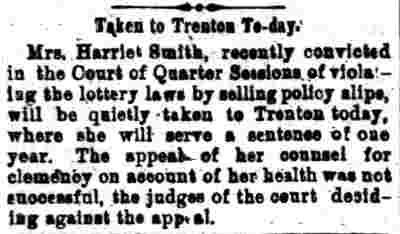
Taken to Trenton To-day.
Mrs. Harriet Smith, recently convicted in the Court of Quarter Sessions of violating the lottery laws by selling policy slips, was quietly taken to Trenton today, where she will serve a sentence of one year. The appeal of her counsel for clemency on account of her health was not successful, the judges of the court deciding against the appeal.
Pardon Granted
Camden Post —
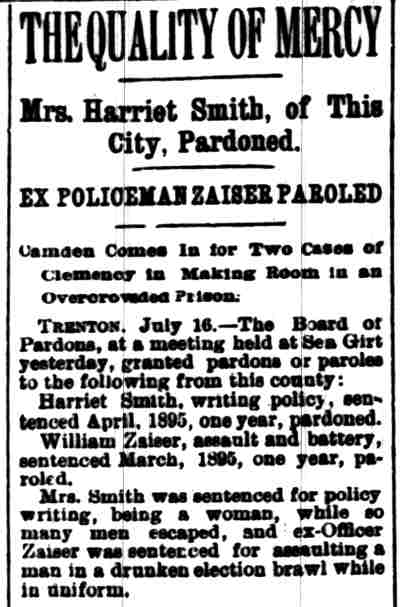
THE QUALITY OF MERCY
Mrs. Harriet Smith, of This City, Pardoned.
EX POLICEMAN ZAISER PAROLED
Camden Comes in for Two Cases of Clemency When Pardons Issue.
TRENTON, July 16.—The Board of Pardons, at a meeting held at Sea Girt yesterday, granted pardons or parole to the following from this county:
Harriet Smith, writing policy, sentenced April, 1895, one year, pardoned.
Mrs. Smith was sentenced for policy writing, and ex-Policeman Zaiser was sentenced for assault and battery in a drunken election brawl while in uniform.
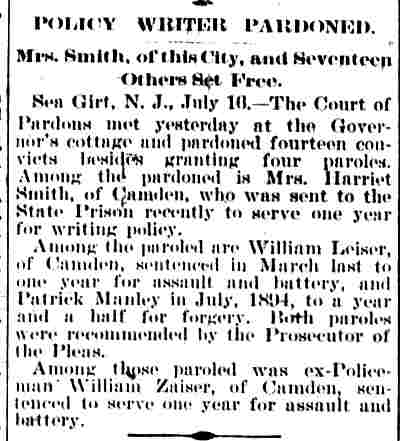
POLICY WRITER PARDONED.
Mrs. Smith, of This City, and Seventeen Others Set Free.
SEA GIRT, N. J., July 16.—The Court of Pardons met yesterday at the Governor’s cottage and pardoned fourteen convicts from State Prison. Among the pardoned is Mrs. Harriet Smith, of Camden, who was sent to the State Prison to serve one year for writing policy.
Among those pardoned were William Zaiser, of Camden, sentenced in March last for one year for assault and battery, and Patrick Shanley in July, 1894, for a year and a half for forgery. Both paroles were recommended by the Prosecutor of the Prisons.
Among those paroled was ex-Policeman William Zaiser of Camden, sentenced to serve one year for assault and battery.
Policy Arrests
Camden Daily Telegram —
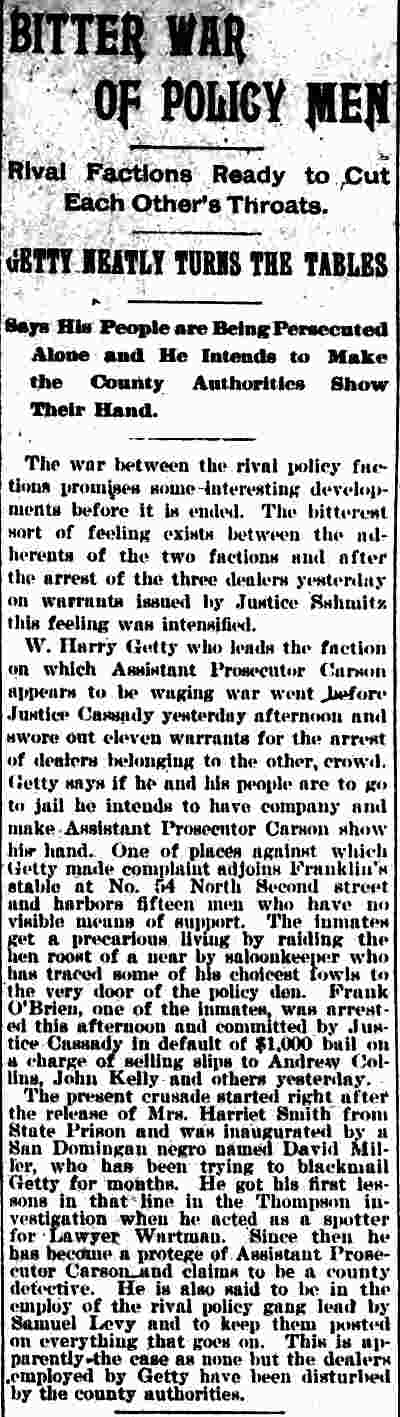
Camden Daily Telegram, July 20, 1895 — W. Harry Getty; William H. Carson; William L. Franklin; Howard S. Franklin; North 2nd Street; Philip Schmitz; Frank O’Brien; James M. Cassady; Andrew Collins; John Kelly; Harriet Smith; David Miller; John W. Wartman; Samuel Levy; William Thompson
Mrs. Smith’s Release
Camden Daily Courier —
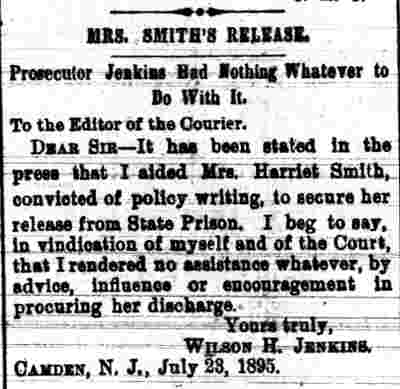
Prosecutor Jenkins Had Nothing Whatever to Do With It.
To the Editor of the Courier.
Dear Sir—It has been stated in the press that I aided Mrs. Harriet Smith, convicted of policy writing, to secure her release from State Prison. I beg to say, in vindication of myself and of the Court, that I rendered no assistance whatever, by advice, influence or encouragement in procuring her discharge.
Yours truly,
Wilson H. Jenkins.
Camden, N. J., July 23, 1895.
Policy and Pleasantries
Camden Daily Courier —

TRIAL OF ACCUSED DEALERS CHARACTERIZED BY WITTICISMS.
But It May Not be So Humorous When They Get Into Court—Three Held in Bail to Appear at Court—Six Were to Have Hearings.
A good-sized crowd of alleged policy slip sellers, witnesses, spectators and others gathered at the office of Justice of the Peace Cassady, this morning, where charges against several accused policy sellers were heard by the ‘Squire. W. H. Getty, who, it is said, represents one faction of the policy people, was on hand, and is the complainant against ten of the alleged law violators. Lawyer Harry Scovel appeared on behalf of the accused men, and saw that they secured bail. The first case examined was that against William Sampson, colored. Benjamin Short, a light-colored negro, was sworn, and ‘Squire Cassady said:
“Short, do you know William Sampson.”
The witness replied, “Yes, sir,” but his reply was slow and hesitating; in short he testified as though he disliked to do so.
“Do you know where he keeps?” was the next question put by the ‘Squire.
“Well, no;” was Short’s answer, “can’t say just where it is, but I know it’s down in Centreville.”
“Did you ever buy any policy slips off of him?” “Yes, sir.”
“When?” “On the 20th of June.”
“What did you pay for the slip?” “Ten cents.”
At this point the irrepressible Harry Scovel broke in with, “Did you make a ‘hit’ Short?”
“No, sir; I didn’t,” answered the witness, half smiling.
“What row did you play, the funeral row?” “No, sir.”
The witness was handed a policy slip and asked if he identified it as the one he purchased June 20th from the accused seller, William Simpson [sic], and he said that he did.
Richard Quinn, colored, tall and very black, sworn, testified that he was with the witness, Short, when the latter bought the slip from Simpson.
“That’s enough for this case,” decided ‘Squire Cassady. “Sampson, you are held in $500 bail to appear at the next term of court. Can you furnish bail?”
“Yes, we have bail for him,” interposed Lawyer Scovel. “Mr. Davis?”
Liveryman Samuel W. Davis stepped forward, qualified, and was accepted as bondsman.
Jacob Derry, colored, was next called. The two witnesses who testified in Sampson’s case, Short and Quinn, also testified in Derry’s case. Quinn swore that Derry kept a policy place on Baxter’s court and that on June 20th he purchased a policy slip of Derry and paid him five cents therefor. Short, who was with Quinn, corroborated the latter’s testimony.
Derry was held in $500 bail, ex-Policeman Isaac Shreeves going on his bond.
Herbert Drake, colored, the next accused policy seller arraigned, had no more than seated himself in a chair than Lawyer Scovel said, “you’re not related to the lawyer, are you, Drake?”
Drake smiled. “Might be related to you, Harry,” put in the ‘Squire.
“He is—as a good Republican,” retorted the attorney.
“Well, Adam was father to us all,” resignedly said the ‘Squire, and then the legal mill ground on. In Drake’s case the witness Short testified that he purchased policy slips of the accused, who keeps in the Second ward. The slip, pinned to the writ of complaint, was handed Short and he identified the slip he purchased. Quinn, who was with Short at the time of the sale, corroborated Short’s testimony.
Drake was held in $500 bail, ex-Policeman Shreeve also going his security to appear next September in court.
“Parker is here, Your Honor,” announced Lawyer Scovel. Parker, a rather tall colored man, came slowly forward. “Parker is sick today,” continued the attorney, “and he’s been sick for some time. I ——“
“Yes, and he may be sicker before he gets through with this,” put in ‘Squire Cassady.
“He may, and then again he may not,” glibly retorted the genial Harry, “but I want to say this, ‘Squire, Parker’s a sick man and the case against him is not ready. I’ll go his security to have him here whenever you want him.”
“All right, then,” said the ‘Squire. You can go on his bond.”
When the case of Susie Kinsey, alias Smith, was called, a witness with a huge, Paderewski-like shock of blood red hair arose and started toward the ‘Squire’s desk. The ‘Squire had been busy writing and when he glanced up and for the first time saw the huge globule of fiery red hirsute appendages approaching, he gasped, “O—h—h! Fire!”
“Somebody skin out and turn in an alarm,” was Lawyer Scovel’s timely “chip-in.”
After the laugh had subsided, the red-haired man said that he didn’t know Mrs. Smith or Mrs. Kinsey; had never purchased policy slips of her and didn’t know she was “in the business.”
“I’ll lay the case over, then,” said the ‘Squire, “until the other witnesses are here.”
Complaints lodged against other accused sellers were not heard this morning, but were laid over without date. The cases were those against Brake, Berry, Scanlon, Clark, Grady and Walker. Evidence against the accused was not in readiness to proceed against them.
Despite the evident feeling of pleasantry on the surface of matters this morning, there was also the plain indications of considerable hard feelings, which showed itself when many of the colored people glanced at each other or listened to the testimony which militated against them.
A rumor was in circulation this morning that a certain printing plant used to print policy slips, and which is said to be kept in a house on a main thoroughfare, was to be raided. The feeling between the two policy factions is undoubtedly running high, and, as one Justice of the Peace put it, “we (meaning the Justices) are reaping advantages from it.”
Merry War of Policy Men
Camden Daily Telegram —

Accused Dealers Given Hearings By Justice Cassady.
LIKELY TO PLAY THE COURT ROW
Three of the Prisoners Placed Under Bail and the Cases of Seven Others Continued—The Complainant Merely Smiles.
Several more arrests have been made in the policy war now going on between two factions in this city. Three alleged policy writers were held in $500 bail each this morning by Justice Cassady and seven other cases were postponed as some of the witnesses and one or two of the defendants were not present.
Archie Clark, colored, was the first arraigned before Justice Cassady. Kate Miskelly was called as a witness but swore that she had never bought policy of the defendant. Other witnesses were not present and his case was postponed.
Susan Smith, alias Kinsey, was not present and her case was put off until this afternoon at 2 o’clock.
William Sampson, colored, was the next defendant. His place is in Centreville. Benjamin Shaw, colored, identified a five cent policy slip he had bought from Sampson last June.
“Did you make a hit?” asked Lawyer H. S. Scovel who appeared to represent all the defendants.
“No, sir,” was the reply.
“What row is this?”
“I don’t know.”
“Is it the court row?”
“It seems to be in this instance,” ejaculated Justice Cassady, as he fixed bail at $500 for the defendant’s appearance at the September term of court.
Richard Quinn, colored, testified that he had never purchased any policy of Sampson, but that he had seen Shaw buy it there. Samuel Davis furnished bail for Sampson.
Jacob Derry, colored, of Baxter’s court, was the next victim. Quinn swore that he bought a five cent policy slip in the defendant’s place on June 10 last. Shaw testified that he saw Quinn buy the slip. Bail was fixed at $500, which was furnished by ex-Policeman Isaac Shreeve.
“How much bail are you responsible for now?” asked Justice Cassady.
“He has been relieved of it all,” said Lawyer Scovel. “The defendants have either been released or are serving time in Trenton.”
Edward Bassett failed to appear and his case was postponed.
Herbert Drake, colored, of the Seventh ward, was then arraigned. Shaw identified a policy slip he had purchased from the defendant on June 20 last. Quinn swore that he saw Shaw buy the slip. Isaac Shreeve furnished $500 bail for Drake’s appearance at Court.
“I seem to be in demand here,” said Shreeve as he stepped forward to furnish the surety for Drake. “Can’t I get a job at Pitman Grove?”
“We don’t want any policy people down there,” replied Justice Cassady.
The witnesses failed appear [sic] against Fred Parker and Lawyer Scovel remarked:
“Your honor, the defendant don’t appear to be very well.”
“He’ll probably be sicker before we get through with him,” retorted Justice Cassady.
His case was postponed along with those of John Scanlon, John Brady and John Walters.
W. Harry Getty is the complainant in all the policy cases now before Justice Cassady. He was an interested spectator at the hearings this morning, and smiled pleasantly at the fierce glances of some of the defendants
Charles Gilbert, who was committed to the county jail last week by Justice Schmitz in default of $1,000 bail, charged with writing and selling policy, was released from jail this morning. Mary Ellis, of Collingswood, furnished the necessary bail.
Policy Writers Arrested.
Camden Post —
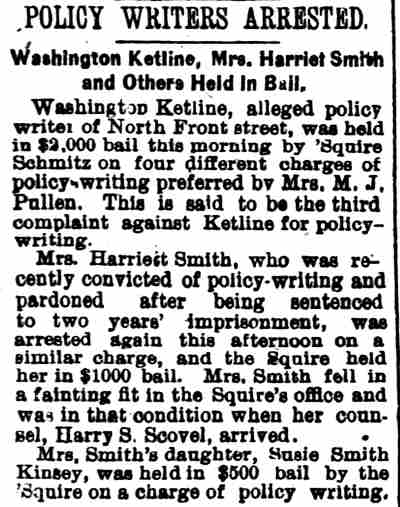
Washington Ketline, Mrs. Harriet Smith and Others Held in Bail.
Washington Ketline, alleged policy writer of North Front street, was held in $2,000 bail this morning by ‘Squire Schmitz on four different charges of policy-writing preferred by Mrs. M. J. Pullen. This is said to be the third complaint against Ketline for policy-writing.
Mrs. Harriet Smith, who was recently convicted of policy-writing and pardoned after being sentenced to two years’ imprisonment, was arrested again this afternoon on a similar charge, and the Squire held her in $1000 bail. Mrs. Smith fell in a fainting fit in the Squire’s office and was in that condition when her counsel, Harry S. Scovel, arrived.
Mrs. Smith’s daughter, Susie Smith Kinsey, was held in $500 bail by the ‘Squire on a charge of policy writing.
Policy Arrests
Camden Daily Telegram —
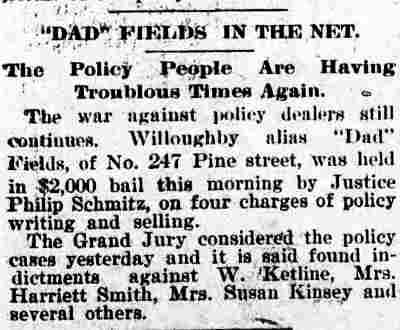
Camden Daily Telegram, September 13, 1895 — Willoughby “Dad” Fields; Pine Street; Harriet Smith; Washington Ketline; Sue Smith Kinsey; Philip Schmitz
Policy Arrest
Camden Daily Courier —
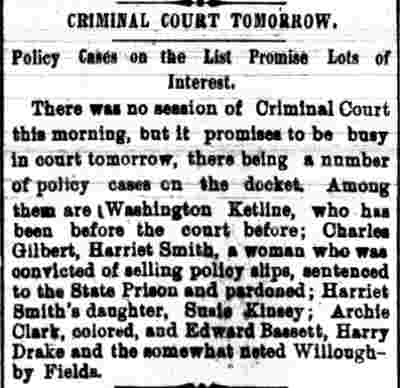
Criminal Court Tomorrow.
Policy Cases on the List Promise Lots of Interest.
There was no session of Criminal Court this morning, but it promises to be busy in court tomorrow, there being a number of policy cases on the docket. Among them are Washington Ketline, who has been before the court before; Charles Gilbert, Harriet Smith, a woman who was convicted of selling policy slips, sentenced to the State Prison and pardoned; Harriet Smith’s daughter, Susie Kinsey; Archie Clark, colored, and Edward Bassett, Harry Drake and the somewhat noted Willoughby “Dad” Fields.
The Rule Dismissed
Camden Post —

To Cause Pensauken Saloon Keepers to Show Cause.
THE CHEMICAL CASE GOES OVER
On Representation Made of Efforts to Abate the Nuisance. More Time Wanted on Policy Cases.
The jury in the case of Washington Kettline charged with writing policy, last evening, returned a verdict of guilty.
Charles Gilbert was placed on trial on a similar charge. Policeman Shaw testified that on May 3 last, he arrested Gilbert on a warrant in a house on Locust street, between Spruce and Division streets. A rubber stamp and some other policy paraphernalia were on a table, but he did not know to whom it belonged.
The jury after several hours’ deliberation, returned a verdict of not guilty.
In the Quarter Sessions Court today Judge Vroom announced that the rules to show cause why certain liquor licenses should not be revoked were made returnable this morning and the first case moved was that of Christopher Smith, of Pensauken township.
Fred A. Rex representing all the licenses contended that Quarter Sessions Court had no jurisdiction in the matter and that the Common Pleas had a certain course to pursue.
He contended that the Court could not of its own motive revoke these licenses.
He read the sections of the Werts’ Act in reference to the matter which showed that to revoke a license there must be a complaint signed by three persons and verified by their oaths, setting forth the reasons for the revocation of a license, and that this complaint must be served on the licensee and made returnable not less than ten days nor more than thirty days after service.
Judge Vroom looked at the act and immediately dismissed the rule to show cause, as ordered by the court.
The rule dismissed had reference to the licenses of Chris. Smith, Walter Hubbs, Annie Strenger, Frank Weideman and Fred. Herald, all of Pennsauken township.
M. V. Grey presented an affidavit to the court to the effect that the United States Chemical Works was making every effort to abate the nuisance, and asked that the trial be put off for the term.
The Chemical Company was indicted on complaint of a number of citizens, who said that their appetites were injured by the stench and their clothing spoiled by certain acids in the atmosphere which came from the works.
Prosecutor Jenkins said he believed the company was doing everything possible to remedy the evil, and as the charge was not a malicious one and the April term of court being close at hand he was willing to give a firm which gave employment to so many people a chance to abate the nuisance.
Judge McDowell said there were many complaints, but if the company was using every endeavor to get a process that would remedy the evil, he for one would willingly let the case go over. Judges Vroom and Burdsall took the affidavit into consideration and allowed the case to go over for the term.
Judge Wescott, who has recently been retained as one of counsel for the indicted policy writers, asked for a postponement of the cases, not for the term, but to give an opportunity to counsel to prepare their cases.
Judge Wescott presented an affidavit to the effect that there was good cause to believe that slips, upon which indictments had been found, were forged, and he wanted time to have them examined by an expert and wanted the Prosecutor of the Pleas to hand them over to him for that purpose.
“Are you only suspicious that they are forged?” asked the Court.
“There is more than suspicion in fact I could almost make an affidavit to that fact,” was Judge Wescott’s reply. The accused represented by Judge Westcott [sic] are Harriet Smith, Susan Kinsey, W. Fields, Archibald Clark, Ed. Bassett and Harry Drake.
The Court after an animated conference put the cases off until Thursday next, the 30th inst, at which time the trials must come off if the state is ready. The alleged forged slips are to be examined in the County Clerk’s office, in the presence of counsel for the defendants and the state.
Judge Wescott got a rule to show cause why a new trial should not be granted Wash Ketline, who was convicted yesterday afternoon of policy selling.
Judge Vroom made the announcement that on Tuesday and Wednesday next week there will be a call of the trial list in the Common Pleas Court, and on those days cases that are ready will be tried by jury.
The jurors were ordered to return on Tuesday, but as all would not be needed, any jurors deserving to be excused until Thursday could be excused, but all must be back in court on Thursday next.
The Hatch land case still on trial before Judge Miller today. There are still a large number of witnesses to be heard for the Hatch’s.
Lively Trials of Policy Cases
Camden Daily Telegram —
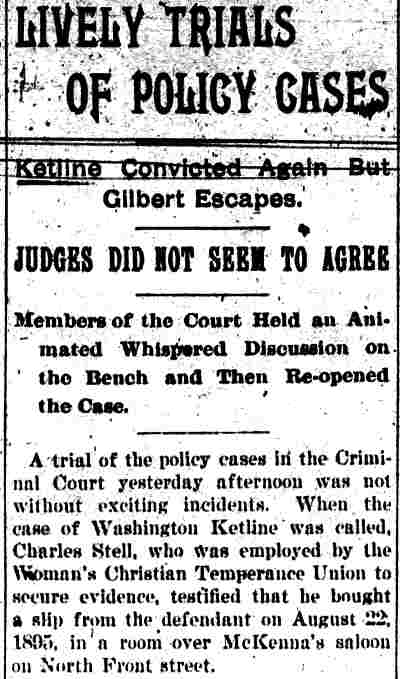
Ketline Convicted Again But Gilbert Escapes.
JUDGES DID NOT SEEM TO AGREE
Members of the Court Held an Animated Whispered Discussion on the Bench and Then Re-opened the Case.
A trial of the policy cases in the Criminal Court yesterday afternoon was not without exciting incidents. When the case of Washington Ketline was called, Charles Stell, who was employed by the Woman’s Christian Temperance Union to secure evidence, testified that he bought a slip from the defendant on August 22, 1895, in a room over McKenna’s saloon on North Front street.
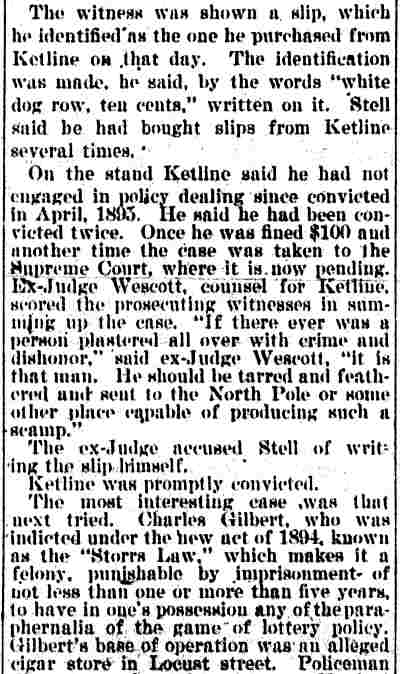
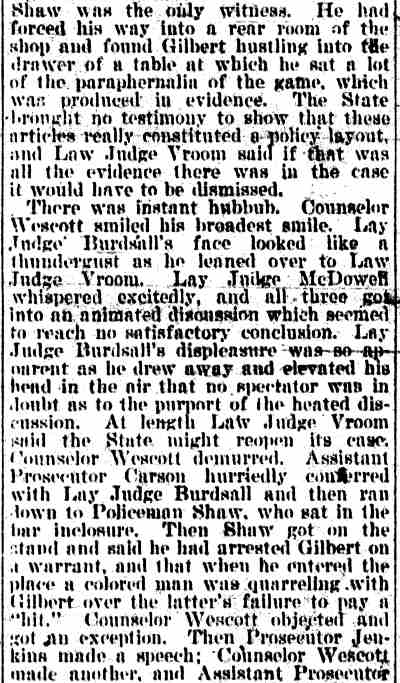
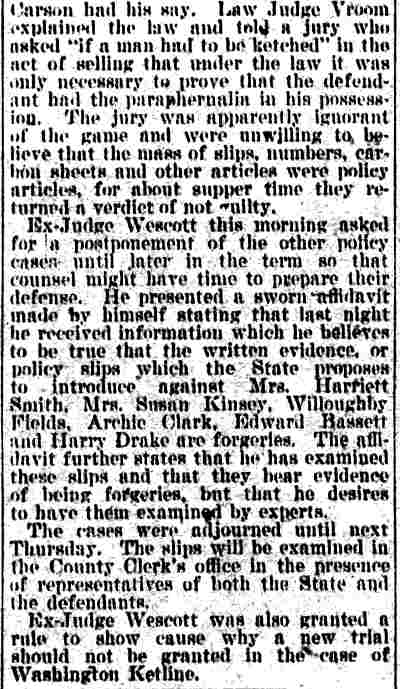
The witness was shown a slip, which he identified as the one he purchased from Ketline on that day. The identification was made, he said, by the words “white dog row, ten cents,” written on it. Stell said he had bought slips from Ketline several times.
On the stand Ketline said he had not engaged in policy dealing since convicted in April, 1895. He said he had been convicted twice. Once he was fined $100 and another time the case was taken to the Supreme Court, where it is now pending. Ex-Judge Wescott, counsel for Ketline, scored the prosecuting witnesses in summing up the case. “If there ever was a person plastered all over with crime and dishonor,” said ex-Judge Wescott, “it is that man. He should be tarred and feathered and sent to the North Pole or some other place capable of producing such a scamp.”
The ex-Judge accused Stell of writing the slip himself.
Ketline was promptly convicted.
The most interesting case was that next tried. Charles Gilbert, who was indicted under the new act of 1894, known as the “Storrs Law,” which makes it a felony, punishable by imprisonment of not less than one or more than five years, to have in one’s possession any of the paraphernalia of the game of lottery policy. Gilbert’s base of operation was an alleged cigar store in Locust street. Policeman Shaw was the only witness. He had forced his way into a rear room of the shop and found Gilbert hustling into the drawer of a table at which he sat a lot of the paraphernalia of the game, which was produced in evidence. The State brought no testimony to show that these articles really constituted a policy layout, and Law Judge Vroom said if that was all the evidence there was in the case it would have to be dismissed.
There was instant hubbub. Counselor Wescott smiled his broadest smile. Lay Judge Burdsall’s face looked like a thundergust as he leaned over to Law Judge Vroom. Lay Judge McDowell whispered excitedly, and all three got into an animated discussion which seemed to reach no satisfactory conclusion. Lay Judge Burdsall’s displeasure was so apparent as he drew away and elevated his head in the air that no spectator was in doubt as to the purport of the heated discussion. At length Law Judge Vroom said the State might reopen its case. Counselor Wescott demurred. Assistant Prosecutor Carson hurriedly conferred with Lay Judge Burdsall and then ran down to Policeman Shaw, who sat in the bar inclosure. Then Shaw got on the stand and said he had arrested Gilbert on a warrant, and that when he entered the place a colored man was quarrelling with Gilbert over the latter’s failure to pay a “hit.” Counselor Wescott objected and got an exception. Then Prosecutor Jenkins made a speech; Counselor Wescott made another, and Assistant Prosecutor Carson had his say. Law Judge Vroom explained the law and told a jury who asked “if a man had to be ketched” in the act of selling that under the law it was only necessary to prove that the defendant had the paraphernalia in his possession. The jury was apparently ignorant of the game and were unwilling to believe that the mass of slips, numbers, carbon sheets and other articles were policy articles, for about supper time they returned a verdict of not guilty.
Ex-Judge Wescott this morning asked for a postponement of the other policy cases until later in the term so that counsel might have time to prepare their defense. He presented a sworn affidavit made by himself stating that last night he received information which he believes to be true that the written evidence, or policy slips which the State proposes to introduce against Mrs. Harriett Smith, Mrs. Susan Kinsey, Willoughby Fields, Archie Clark, Edward Bassett and Harry Drake are forgeries. The affidavit further states that he has examined these slips and that they bear evidence of being forgeries, but that he desires to have them examined by experts.
The cases were adjourned until next Thursday. The slips will be examined in the County Clerk’s office in the presence of representatives of both the State and the defendants.
Ex-Judge Wescott was also granted a rule to show cause why a new trial should not be granted in the case of Washington Ketline.
Admitted to Bail.
Camden Daily Courier —
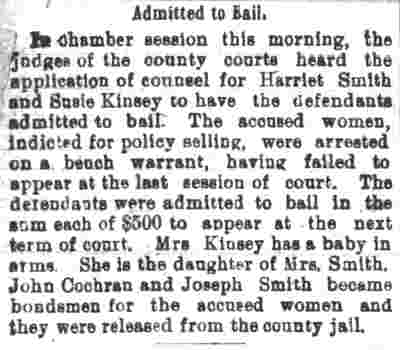
In chamber session this morning, the judges of the county courts heard the application of counsel for Harriet Smith and Susie Kinsey to have the defendants admitted to bail. The accused women, indicted for policy selling, were arrested on a bench warrant, having failed to appear at the last session of court. The defendants were admitted to bail in the sum each of $500 to appear at the next term of court. Mrs. Kinsey has a baby in arms. She is the daughter of Mrs. Smith. John Cochran and Joseph Smith became bondsmen for the accused women and they were released from the county jail.
In Jail With a Baby
Camden Post —
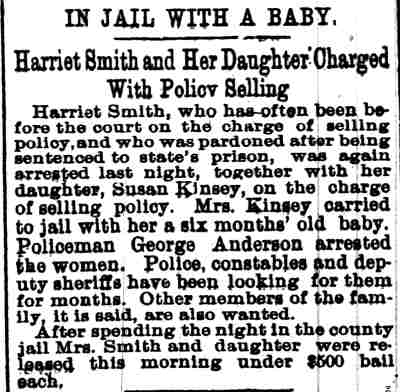
Harriet Smith and Her Daughter Charged With Policy Selling
Harriet Smith, who has often been before the court on the charge of selling policy, and who was pardoned after being sentenced to state’s prison, was again arrested last night, together with her daughter, Susan Kinsey, on the charge of selling policy. Mrs. Kinsey carried to jail with her a six months’ old baby. Policeman George Anderson arrested the women. Police, constables and deputy sheriffs have been looking for them for months. Other members of the family, it is said, are also wanted.
After spending the night in the county jail Mrs. Smith and daughter were released this morning under $500 bail each.
The Policy Indictments
Camden Post —
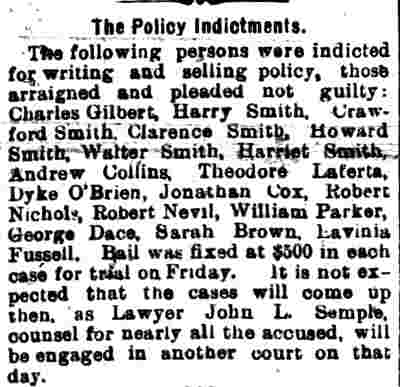
The following persons were indicted for writing and selling policy, those arraigned and pleaded not guilty: Charles Gilbert, Harry Smith, Crawford Smith, Clarence Smith, Howard Smith, Walter Smith, Harriet Smith, Andrew Collins, Theodore Laferta, Dyke O’Brien, Jonathan Cox, Robert Nichols, Robert Nevil, William Parker, George Dace, Sarah Brown, Lavinia Fussell. Bail was fixed at $500 in each case for trial on Friday. It is not expected that the cases will come up then, as Lawyer John L. Semple, counsel for nearly all the accused, will be engaged in another court on that day.
Seven in One Family.
Camden Post —
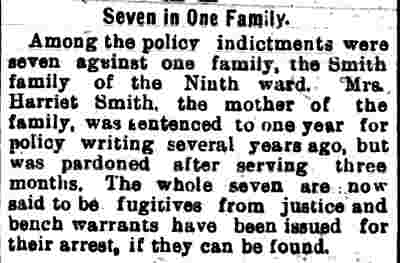
Among the policy indictments were seven against one family, the Smith family of the Ninth ward. Mrs. Harriet Smith, the mother of the family, was sentenced to one year for policy writing several years ago, but was pardoned after serving three months. The whole seven are now said to be fugitives from justice and bench warrants have been issued for their arrest, if they can be found.
Death Notice
Camden Daily Courier —
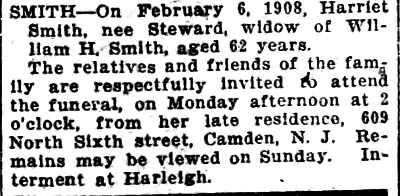
SMITH—On February 6, 1908, Harriet Smith, née Steward, widow of William H. Smith, aged 62 years. The relatives and friends of the family are respectfully invited to attend the funeral, on Monday afternoon at 2 o’clock, from her late residence, 609 North Sixth street, Camden, N. J. Remains may be viewed on Sunday. Interment at Harleigh.
Funeral Notice
Camden Daily Courier —
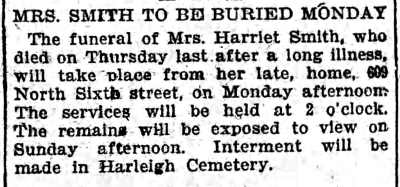
Mrs. Smith to Be Buried Monday.
The funeral of Mrs. Harriet Smith, who died on Thursday last after a long illness, will take place from her late home, 609 North Sixth street, on Monday afternoon. The services will be held at 2 o’clock. The remains will be exposed to view on Sunday afternoon. Interment will be made in Harleigh Cemetery.
Funeral of Mrs. Harriet Smith
Camden Daily Courier —
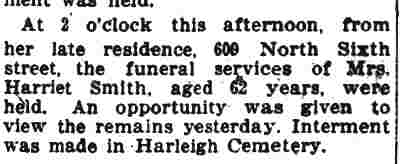
At 2 o’clock this afternoon, from her late residence, 609 North Sixth street, the funeral services of Mrs. Harriet Smith, aged 62 years, were held. An opportunity was given to view the remains yesterday. Interment was made in Harleigh Cemetery.