Introduction
CHRISTIAN TENNER was born in August of 1850 in Saxony (present-day Germany) to Casper and Settonia Tenner. He came to America with his parents, sister Wilhelmina and older brothers George Adam Tenner (born 1847) and George Rudolph Tenner (born 1841), and settled in Camden, New Jersey. Another daughter, Amelia, was born after the Tenners had come to America. Casper Tenner was among the German immigrants in South Camden who organized the Emanuel United Brethren Church.
It should be noted that George Rudolph Tenner appears in different records and publications as G. Rudolph Tenner, Rudolph Tenner, George Tenner, Reuben Tenner, and G. Reuben Tenner. Between that and having a brother named George Adam Tenner, it took some time to sort out the various documents and articles to determine what applied to who. Fortunately, George A. Tenner went “only” by George A. Tenner, George Tenner, and Adam Tenner. Christian Tenner also appears as G. Christopher Tenner.
Both of Christian Tenner’s brothers served with the Union Army during the Civil War. Sister Wilhelmina married Lewis Holl, a carpenter who, with his brother George Holl, became very active in construction and real estate in Camden. Lewis Holl also served briefly with the Camden Fire Department; their son, Arthur Holl became Camden County’s coroner and operated funeral homes in South Jersey for 65 years.
G. Rudolph Tenner had been active as a volunteer fireman and was a charter member of the Camden Fire Department, which went into service December 7th at 6 P.M.
G. Rudolph Tenner made a career of the Camden Fire Department, and was still on active duty as late as 1914. Brother George A. Tenner was appointed to the Police Department in 1874. Christian Tenner was appointed to the Fire Department in April of 1877. He was living at 615 Pine Street and working as an iron moulder at the time of his appointment. Brother George A. Tenner would later join the Fire Department, while Christian later worked as a police officer.
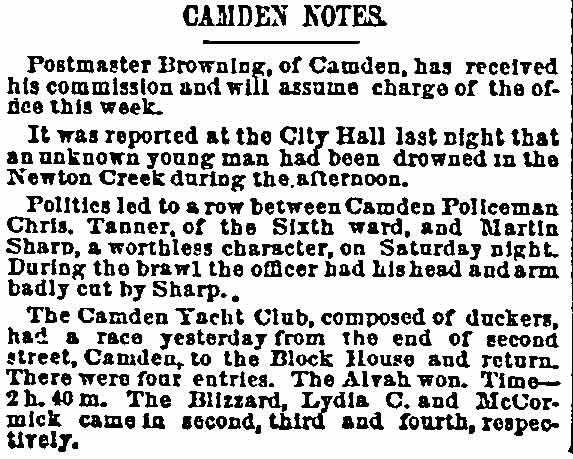
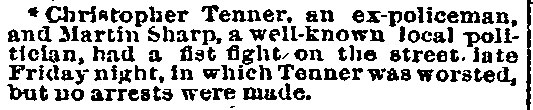
Chris Tenner was reappointed to the Camden Fire Department in 1878 and again in 1879, by which time he had moved to 575 Pine Street. He was not reappointed in 1882, but was called back to the Fire Department in 1884 and served for one year. He left the department that year. Christian Tenner worked as Camden police officer from 1887 through 1889. During this period he engaged in a running feud with a Martin Sharp, the two coming to blows in the street in 1889 and again in 1892. The source of the discord was reported to have been politics, which in Camden was a full contact sport in those times.
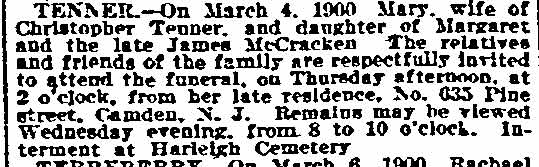
Christian Tenner married Mary McCracken, sister of Camden firefighter James McCracken in the early 1870s. Christian Tenner’s sister Amelia married Camden firefighter Joseph Green around 1877. By 1880 there were three children, daughters Lydia and Maggie, and a son George A. Tenner. The family resided at 575 Pine Street when the Census was taken that year. Another son, Benjamin, was born later in 1888. Sadly, Mary Tenner passed away in March of 1900. Christian Tenner was then living at 635 Pine Street with his four children, and a grandchild, Helen Schwartz, the daughter of Lydia Tenner Schwartz, who unfortunately was already a widow at 27. Christian Tenner was then working as a ship caulker. When the Census was again taken, in 1910, Lydia Tenner had remarried. Her new husband was Camden fire fighter William Hertline. Christian Tenner and his youngest child, Benjamin Tenner, lived with the Hertlines at 530 South 8th Street. This arrangement was still in effect as late as 1920.
Chris Tenner passed away on April 7, 1932.
1860 Census
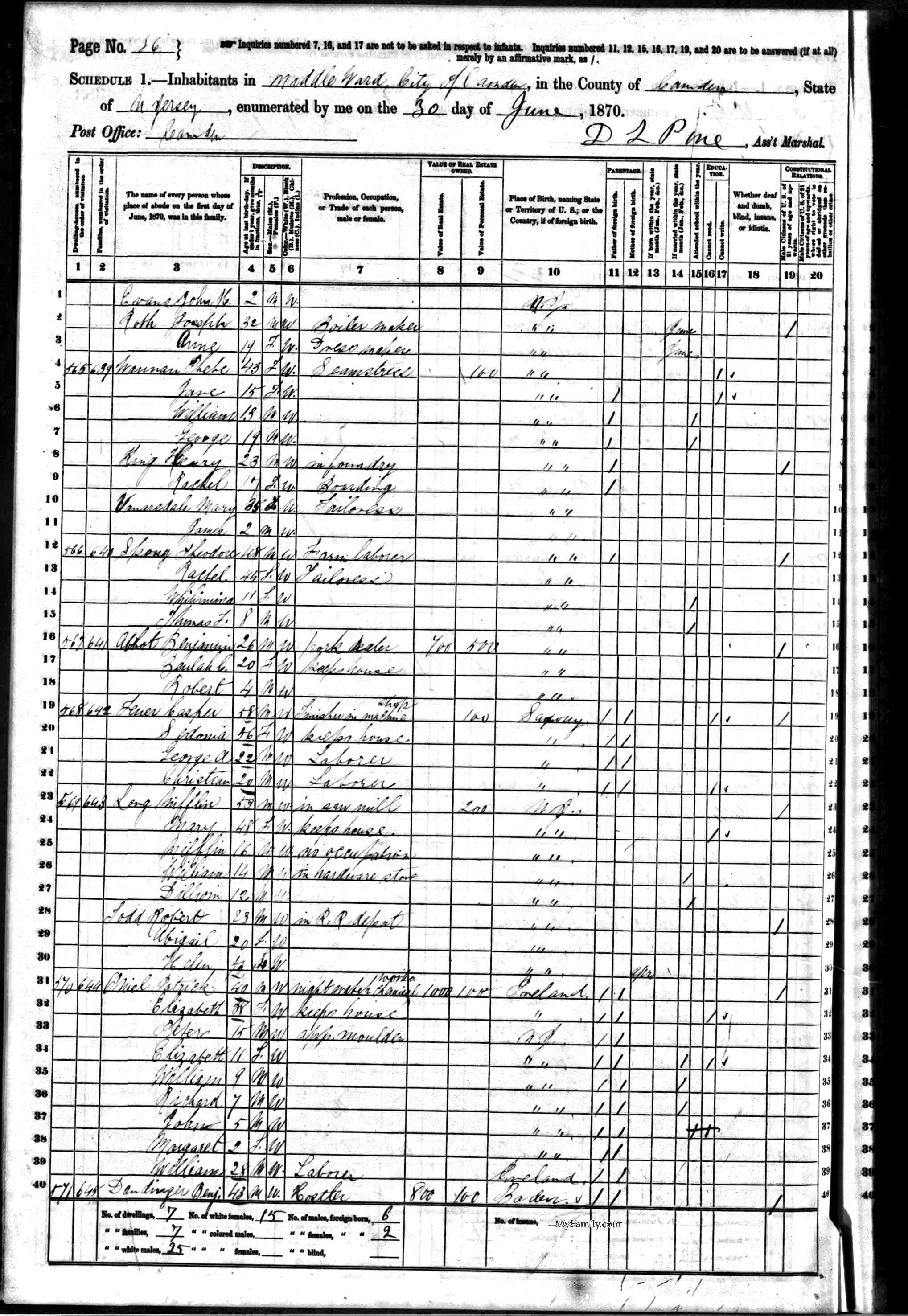
Casper Tenner family in the 1860 census: Casper and Settonia Tenner, with children George Adam Tenner and Christian Tenner.
1870 Census
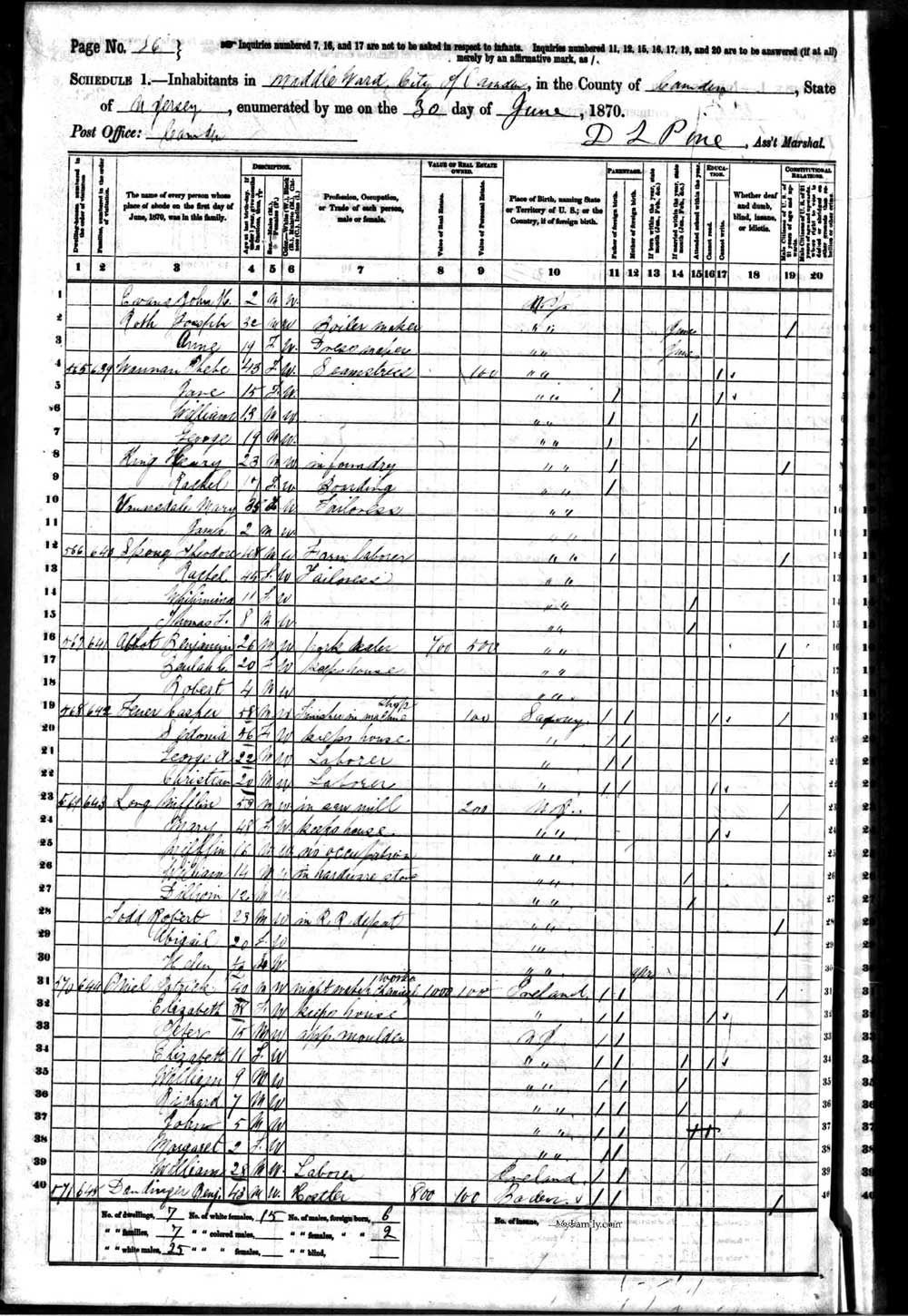
Casper Tenner family in the 1870 census: Casper and Settonia Tenner, with children George Adam Tenner and Christian Tenner.
Photo
Philadelphia Public Ledger —
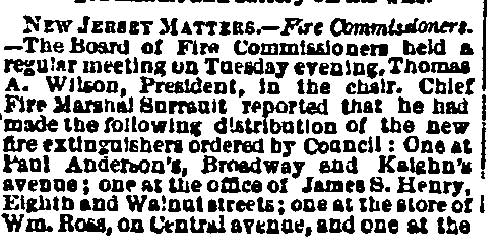
NEW JERSEY MATTERS.—Fire Commissioners.—The Board of Fire Commissioners held a regular meeting on Tuesday evening, Thomas A. Wilson, President, in the chair. Chief Fire Marshal Surrait reported that he had made the following distribution of the new fire extinguishers ordered by Council: One at Paul Anderson’s, Broadway and Kalabn’s avenue; one at the office of James S. Henry, Eighth and Walnut streets; one at the store of Wm. Ross, on Central avenue, and one at the
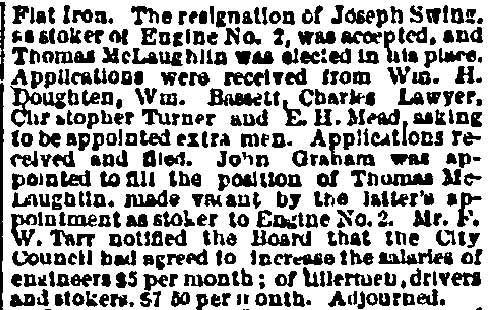
Flat Iron. The resignation of Joseph Swing, as stoker of Engine No. 2, was accepted, and Thomas McLaughlin was elected in his place. Applications were received from Wm. H. Doughten, Wm. Bassett, Charles Lawyer, Christopher Turner and E. H. Mead, asking to be appointed extra men. Applications received and filed. John Graham was appointed to fill the position of Thomas McLaughlin, made vacant by the latter’s appointment as stoker to Engine No. 2. Mr. F. W. Tarr notified the Board that the City Council had agreed to increase the salaries of engineers $5 per month; of tillermen, drivers and stokers, $7 50 per month. Adjourned.
Photo
Philadelphia Inquirer —
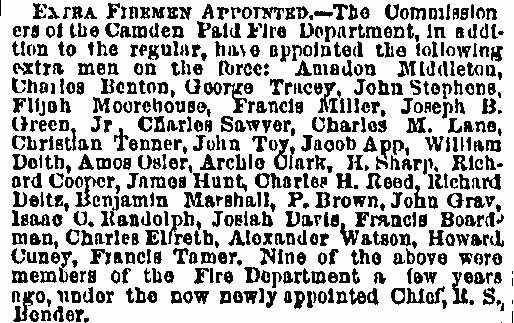
1880 Census
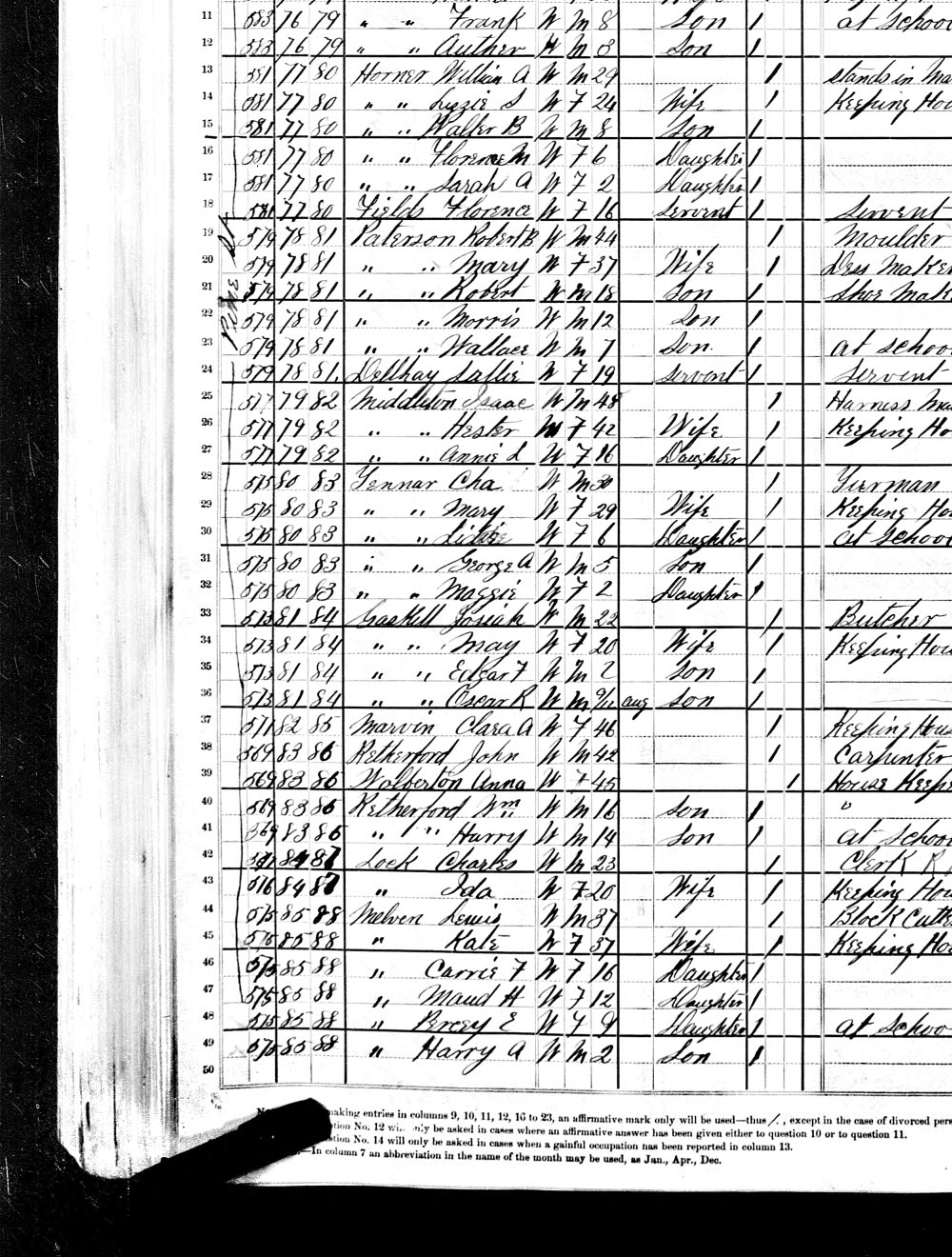
Christian Tenner family in the 1880 census: Christian and Mary Tenner, with children Liddie, George A., and Maggie Tenner.
Photo
Philadelphia Inquirer —
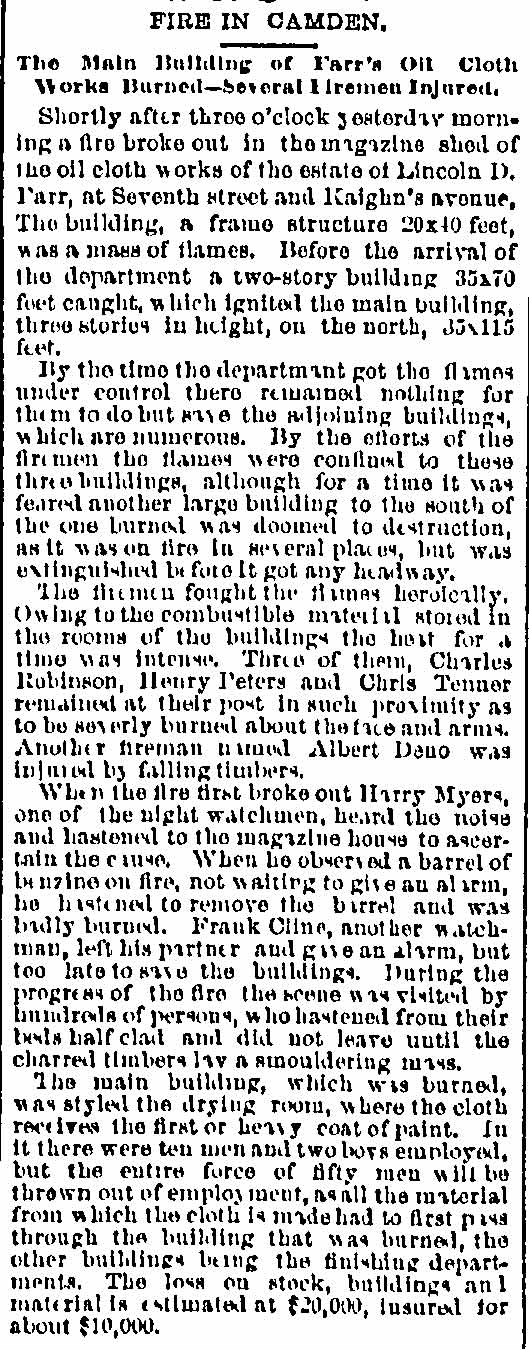
FIRE IN CAMDEN.
The Main Building of Farr’s Oil Cloth Works Burned—Several Firemen Injured.
Shortly after three o’clock yesterday morning a fire broke out in the magazine shed of the oil cloth works of the estate of Lincoln D. Farr, at Seventh street and Kaighn’s avenue. The building, a frame structure 20x40 feet, had a number of flames. Before the arrival of the department a two-story building 35x70 feet caught, which ignited the main building, three stories in height, on the north, 35x115 feet.
By the time the department got the flames under control there remained nothing for the fire to save the adjoining buildings, which are numerous. By the efforts of the firemen the flames were confined to these three buildings, although for a time it was feared that a large building to the south of the one burned was doomed to destruction, as it was on fire in several places, but was extinguished before it got any headway.
The firemen fought the flames heroically. One team, for example, was still stored in the rooms of the buildings the heat at time was intense. Three of them, Charles Robinson, Henry Peters and Chris Tenner remained at their post in such proximity as to be severly burned about the face and arms. Another fireman named Albert Deno was injured by falling timbers.
When the fire first broke out Harry Myers, one of the night watchmen, heard the noise and hastened to the magazine shed to ascertain the cause. When he observed a barrel of benzine on fire, not waiting to give an alarm, he hastened to remove the barrel and was badly burned. Frank Cline, another watchman, lost his nerve and gave an alarm too late to save the buildings. During the progress of the fire the scene was visited by hundreds of persons, who hastened from their beds half clad and did not leave until the charred timbers lay smoldering in ruins.
The main building, which was burned, was styled the drying room, where the cloth receives the first or heavy coat of paint. In it there were ten men and two boys employed, but they were fortunately saved. It will be thrown out of employment, as all the material from which the cloth is made had to first pass through the building that was burned, the other building being the finishing department. The loss on the building and material is estimated at $20,000, insured for about $10,000.
Photo
Philadelphia Inquirer —

Mayor Pratt has appointed the following on the police force in place of the Democratic officers who have resigned: Samuel Lee and W. Pedrick, Fourth ward; Christian Tenner, Sixth ward, and Henry Peters, Seventh ward.
Photo
Camden Daily Courier —

FRANKS SWORN IN AS CHIEF.
THE NEW OFFICIAL AND SIX MEN TAKE THE OATH.
Ex-Chief Matlack Commends the Forty Patrolmen, Thanks Mayor Pratt for His Gentlemanly Conduct and Retires.
It is Chief Franks now. Mr. Matlack, the retiring chief turned over the police department to his successor shortly after noon. All the officers gathered at the hall, as this is the semi-monthly pay day. The six new men who were to take the places of the patrolmen who resigned, came in one at a time and were taken into the mayor’s private office, where behind the closed door they were sworn in by his honor. Chief-elect Franks was also sworn in privately.
All the Democratic officers then assembled in the mayor’s hearing room, at the request of retiring Chief Matlack and it was with evident feeling that he bade them farewell in an eloquent address. He said:
THE CHIEF’S ADDRESS.
“Gentlemen of the police department—The time has arrived for me to turn over the police department to my successor. During my term as chief I have formed acquaintanceships and friendships among you which have been a great pleasure to me, and which I hope to retain. Among us during all that time there has been peace and harmony in the main. I am glad to say that no strifes or bickerings have occurred to mar our peace and good will. At times our actions have been criticised, and aspersions cast against us, but these were only the contingencies of our positions; we must learn to take the bitter with the sweet. No serious accidents or deaths have occurred among us, and for this we should be thankful to the Giver of all good things. We have made some mistakes no doubt—none of us are infallible—but let bygones be bygones, and endeavor to fulfill your duty always.
“There is one thing in particular that I wish to commend you for, and that is your gentlemanly and courteous conduct while I have been connected with the department, and your cheerfulness in obeying orders. For this you have my sincere thanks, and also my best wishes for your futures.”
THE DEPARTMENT TURNED OVER.
The chief closed his remarks to the men with a moral admonition. To Mayor Pratt he returned his thanks for the gentlemanly demeanor of his honor during their brief official association, and expressed the hope that his administration would be one of good government. Chief Matlack then formally delivered the department to his successor and said he trusted it would be more efficient than ever before.
The chief’s remarks were very brief and pointed. He said: “Gentlemen and members of the police department. I hope you will continue in the discharge of your duties as before. I expect obedience to the rules of the department, and the orders of his honor the mayor. Any disapproval or disobedience of orders will be deemed sufficient cause for removal.”
NEW PATROLMEN.
The following is the list of retiring officers and their successors, with their numbers: First ward—John Jacobs; successor, Alfred Summers, No. 5. Fourth ward—Simpson Long, successor, Samuel Lee, No. 17; Charles Peterson, successor, Charles O. Pedrick, No. 20. Sixth ward, Bowman Matlack, successor, Christopher Tenner, No. 29; John Fox, successor, John Dall, No. 30. Seventh ward, Harry Griffin, successor, C. H. Peters, No. 33.
The retiring officers delivered up their equipments. C. H. Peters, who was the first of the new men to be sworn in, had a bran new suit of blue and went on duty at once. John Dall was not present to be sworn in with the others.
Photo
Trenton Evening Times —
Photo
Philadelphia Inquirer —
Photo
Philadelphia Inquirer —
1900 Census
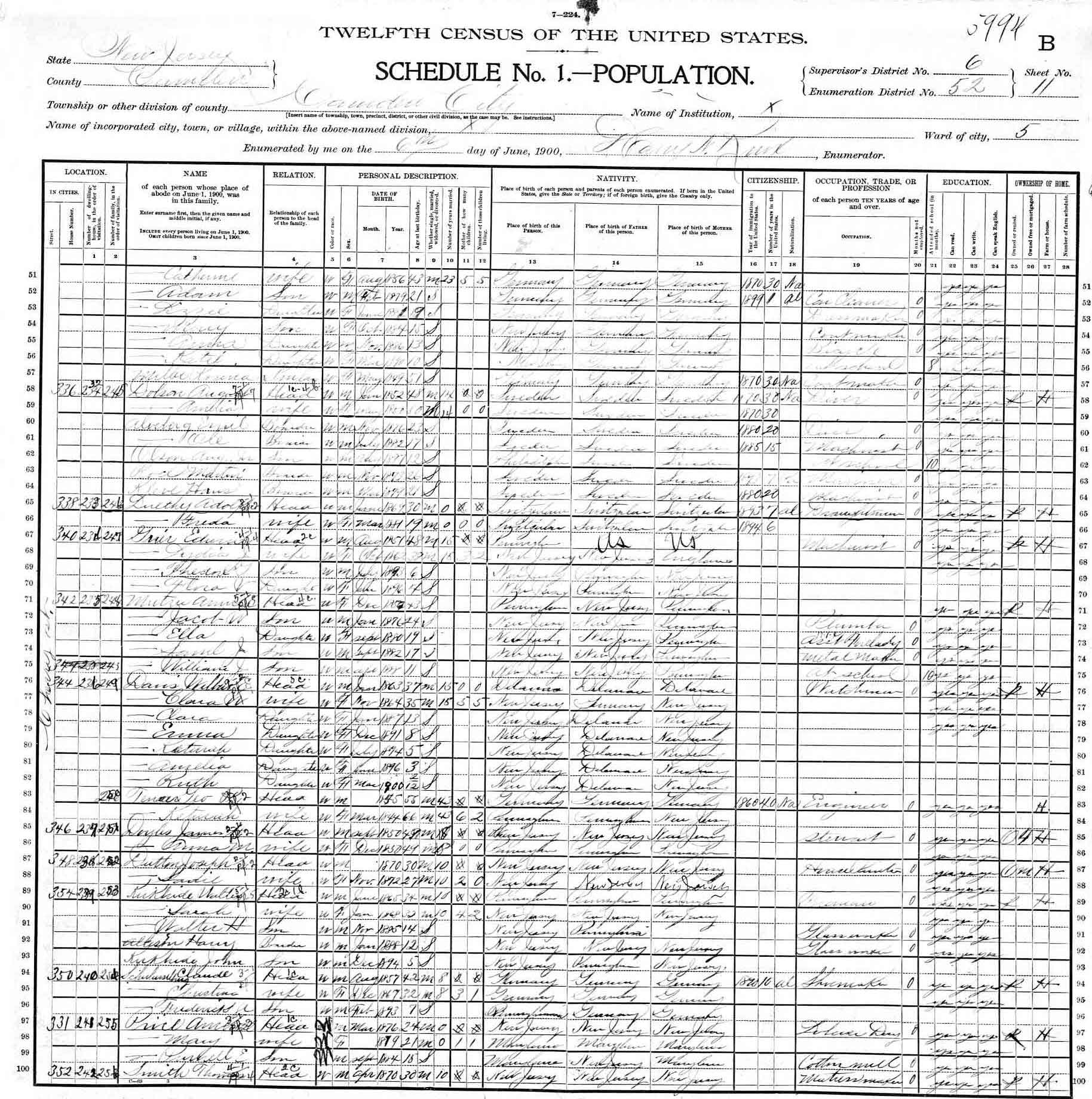
G. Rudolph Tenner, listed as Rudolph Tenner in the 1900 census at 344 Cherry Street.
1910 Census
G. Rudolph Tenner, listed as Rudolph Tenner in the 1910 census at 344 Cherry Street. Household members include George R. and Keturah Tenner, with daughter Clara Tenner and son Casper Tenner II.
1920 Census
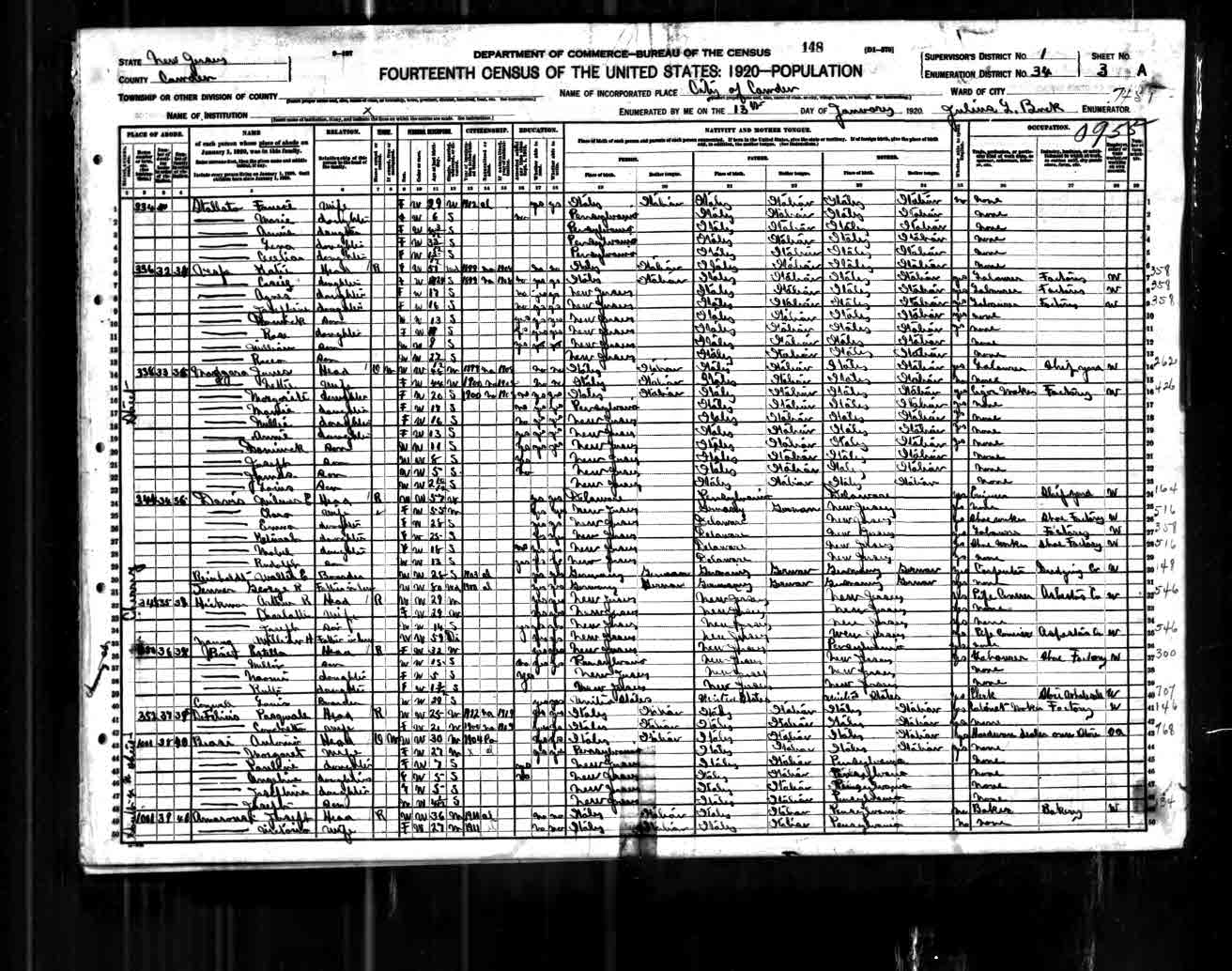
G. Rudolph Tenner, listed as Rudolph Tenner in the 1920 census at 344 Cherry Street. Household members include George R. and Keturah Tenner, with daughter Clara Tenner and son Casper Tenner II.