Introduction
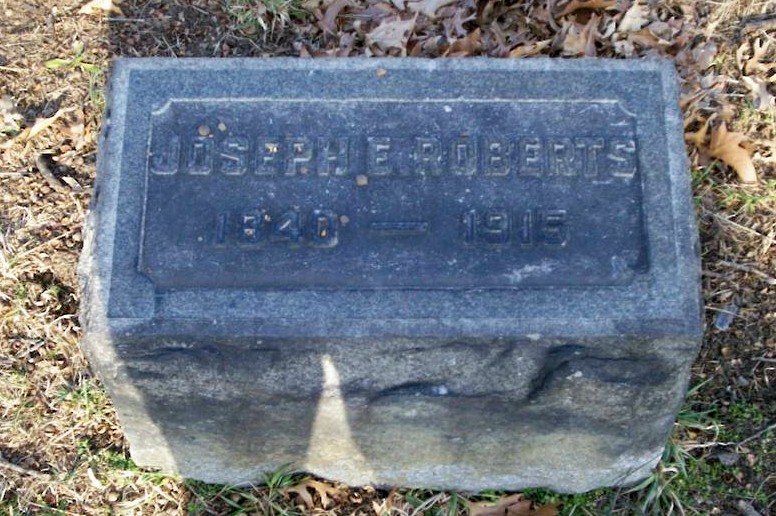
Joseph England Roberts was born in New Jersey in February of 1840 to Jacob and Joanna Roberts. The 1850 Census and the 1860 Census shows the family living in Woolwich Township in Gloucester County. Joseph E. Roberts did not serve in the Civil War.
On January 28, 1868 the Roberts' first child, Eleanor “Nellie” Roberts was born. The family was living in Auburn, in Salem County. The 1870 Census shows him living in Upper Penn's Neck Township in Salem County, where he was a dealer in dry goods. He lived his wife Priscilla and there two daughters, Eleanor “Nellie” and Joanna, his parents and younger sister Emma. The family moved to Camden at some point after the 1870 Census.
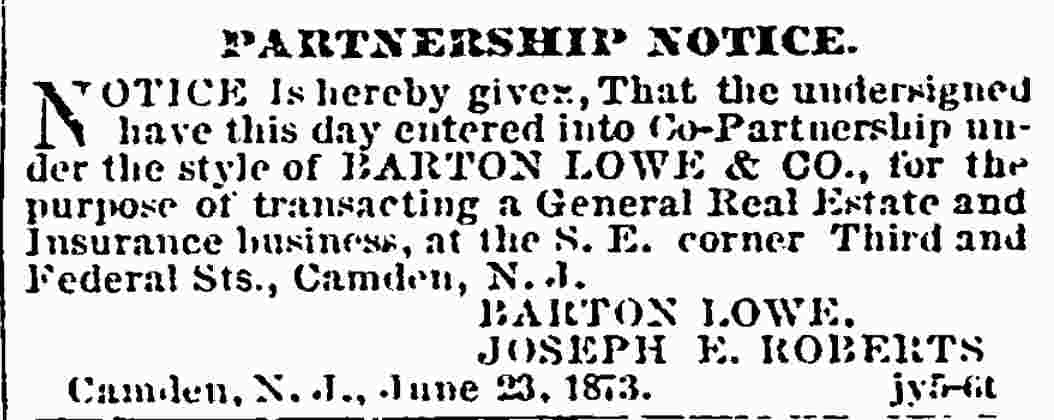
The 1872 Camden City Directory shows Jacob Roberts, a builder, living at Royden and Roberts Street. The Roberts family moving to Camden and simultaneous first appearance of Roberts Street in Camden City Directories cannot be a coincidence. It is likely that this is Joseph E. Roberts and family, with Jacob, his father, being listed in the directory as the head of household and principal in the business. As of this writing Jacob's role in the business is not known. It is known that Joseph E. Roberts went into the construction business after arriving in Camden, and was quite successful. In 1873 he went into partnership in a real estate business with Barton Lowe. The 1874 City Directory shows Joseph E. Roberts in the insurance business at 419 Hamilton Street, which was renamed Berkley Street a few years later. The 1876 City Directory shows Joseph E. Roberts back in construction at 232 Benson Street, along with his ward John Nulty.
By 1877 the Joseph E. Roberts and family were living at 401 Broadway. This would be his address for the rest of his days. The 1880 Census shows Joseph E. Roberts and his wife Priscilla, daughter Nellie, Joanna, and Elizabeth, and sons Joseph Jr. and three-month old Herbert living at the Broadway address. Sadly, Herbert died as a child. Also living at 401 Broadway were wards John Nulty and Amy Batten. Another daughter, Erma, was born in October of 1885. Sadly, Mrs. Priscilla Roberts passed away on February 16, 1889.
Miriam Nulty Finkeldey, daughter of John Nulty, wrote the following about the Roberts family:
Joseph England Robert Sr. lived at the corner of Benson and Broadway in Camden, N.J. The father was a well-known, prosperous lawyer [and builder]. 6 Children: Miss Amy [Amy Batten, apparently a ward], Eleanor and Joanna "Anna" (teachers). Elizabeth "Diddie", Dr. Joe and Erma. The Roberts family spent each summer on the same farm in Auburn, N.J. This farm adjoined the from of Charles McNulty who had 6 children also. The oldest was John McNulty, my father. When John was old enough to go to school, Mr. Roberts investigated the Auburn one-room schoolhouse system and asked Charles if John could come live with them so that he could attend Camden City schools. He came when he was 8 in 1861 and there until he and my mother were married in 1888. When John became of age he changed his name to Nulty.
Joseph E. Roberts' father, Jacob Roberts, had passed away shortly before the 1880 Census. Jacob's wife, Joanna was living with her married daughter Hannah Harbison at 560 Benson Street, a short walk from 401 Broadway.
In 1886, George Reeser Prowell wrote of Joseph E. Roberts in his book History of Camden County, New Jersey:
Among the builders of Camden are several who have erected five or six hundred houses each. The heaviest operators are undoubtedly Cohn & Roberts, wilson ernst, and George Holl. Fine examples of the work of the firm first named are to be seen on Front and Point Streets, between Cooper and Linden. Mr. E.N. Cohn commenced building in 1866, erecting in that year 12 houses on Pearl Street. He then continued putting up blocks and separate structures, operating alone and in conjunction with Charles B. Richard and Asa R. Cox, and building not less than one hundred and fifty houses. He also erected the Pfeil and Galtz building, which was burned. In 1882 he formed a partnership with Joseph E. Roberts, who, individually, had built about two hundred houses, and as a firm they have since constructed at least four-hundred and fifty dwellings, to which line of building they devote themselves exclusively.
As indicated above, Joseph E. Roberts had partnered with Edward Cohn. The Roberts and Cohn real estate firm was located at 105 Market Street. Edward Cohn bought land from John F. Starr Jr. in North Camden, and with partners Roberts and George Holl built many two- and three-story row and frame houses from Cooper's Point to Pearl Street, which they sold and rented out to working class people. By the time the 1890 City Directory was compiled, Joseph E. Roberts had gotten away from construction and was primarily engaged in the real estate business. His business included real estate ventures in Somerset County, New Jeresey and in Cape May. City Directories indicate that this was his profession until his passing in 1915. The 1910 City Directory also indicates that he practiced law, as do the recollections of his granddaughter.
Joseph E. Roberts and his family were active members of Broadway Methodist Church. Joseph E. and Priscilla Roberts' surviving son, Joseph E. Roberts Jr., became a prominent physician in Camden and surrounding environs. Dr. Roberts Jr. was also for many years a trustee of Broadway Methodist Church in Camden. Joseph E. Robert Sr. was one of the original trustees of The Home for the Aged and Infirm of the Methodist Episcopal Church.
Real Estate Business
Camden Democrat —
Petition for Under-drainage
Camden Democrat —
To the Honorable the City Council of the city of Camden, N. J.
WE, your petitioners, residents of the Fourth and Sixth wards of this city, and property owners therein, most respectfully petition your honorable body to construct a culvert for under-drainage, to commence at the termination of the Line street culvert, at the intersection of Line street and Broadway, and to extend outward to the intersection of Line and Sixth streets; thence northward to and to connect with the culvert at the Intersection of Sixth and Royden Streets in the said city. And your petitioners will over pray, c. January, 1874.
Signatures included: Johanna Roberts, 17 houses, 6th ward. J. E. Roberts, 19 houses, 4th ward. F.J. Roberts 22 houses, 4th Ward, among many others.
Building Boom in Camden
Philadelphia Inquirer —
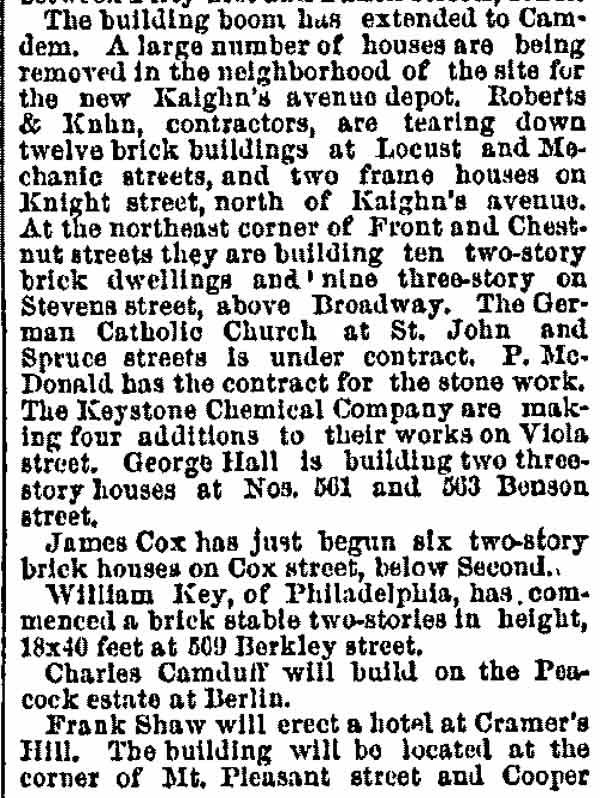
The building boom has extended to Camden. A large number of houses are being removed in the neighborhood of the site for the new Kaighn’s avenue depot. Roberts & Kuhn, contractors, are tearing down twelve brick buildings at Locust and Mechanic streets, and two frame houses on Knight street, north of Kaighn’s avenue. At the northeast corner of Front and Chestnut streets they are building ten two-story brick dwellings and nine three-story on Stevens street, above Broadway. The German Catholic Church at St. John and Spruce streets is under contract. P. McDonald has the contract for the stone work. The Keystone Chemical Company are making four additions to their works on Viola street. George Hall is building two three-story houses at Nos. 501 and 503 Benson street.
James Cox has just begun six two-story brick houses on Cox street, below Second.
William Key, of Philadelphia, has commenced a brick stable two-stories in height, 18x40 feet at 509 Berkley street.
Charles Camduff will build on the Peacock estate at Berlin.
Frank Shaw will erect a hotel at Cramer’s Hill. The building will be located at the corner of Mt. Pleasant street and Cooper
Building Activity
Camden Post —
Building activity in Camden featuring Roberts — Cohn construction projects.
Corporation Elections
Philadelphia Inquirer —
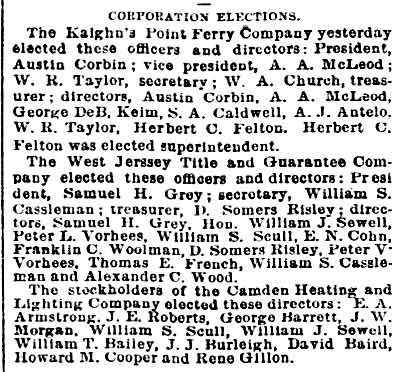
CORPORATION ELECTIONS.
The Kaighn’s Point Ferry Company yesterday elected these officers and directors: President, Austin Corbin; vice president, A. A. McLeod; W. R. Taylor, secretary; W. A. Church, treasurer; directors, Austin Corbin, A. A. McLeod, George DeB. Keim, S. A. Caldwell, A. J. Antelo. W. R. Taylor, Herbert C. Felton. Herbert C. Felton was elected superintendent.
The West Jersey Title and Guarantee Company elected these officers and directors: President, Samuel H. Grey; secretary, William S. Cassleman; treasurer, D. Somers Risley; directors, Samuel H. Grey, Hon. William J. Sewell, Peter L. Vorhees, William S. Scull, E. N. Cohn, Franklin C. Woolman, D. Somers Risley, Peter V. Vorhees, Thomas E. French, William S. Cassleman and Alexander C. Wood.
The stockholders of the Camden Heating and Lighting Company elected these directors: E. A. Armstrong, J. E. Roberts, George Barrett, J. W. Morgan, William S. Scull, William J. Sewell, William T. Bailey, J. J. Burleigh, David Baird, Howard M. Cooper and Rene Gillon.
Marriage Announcement
Jersey Journal —
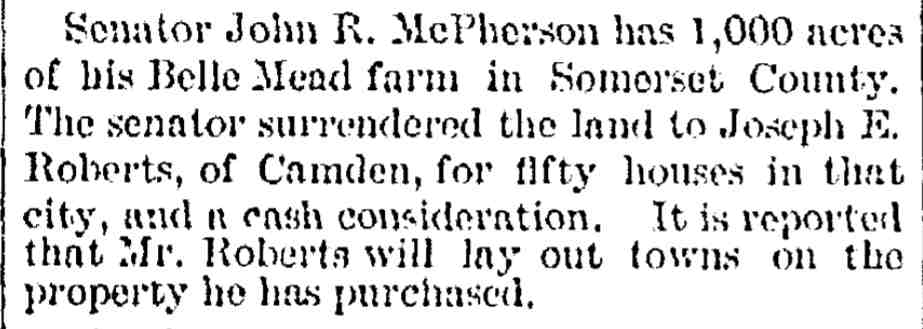
Somerset County Real Estate
Philadelphia Inquirer —
How the Y. M. C. A. Benefits Camden
Philadelphia Inquirer —
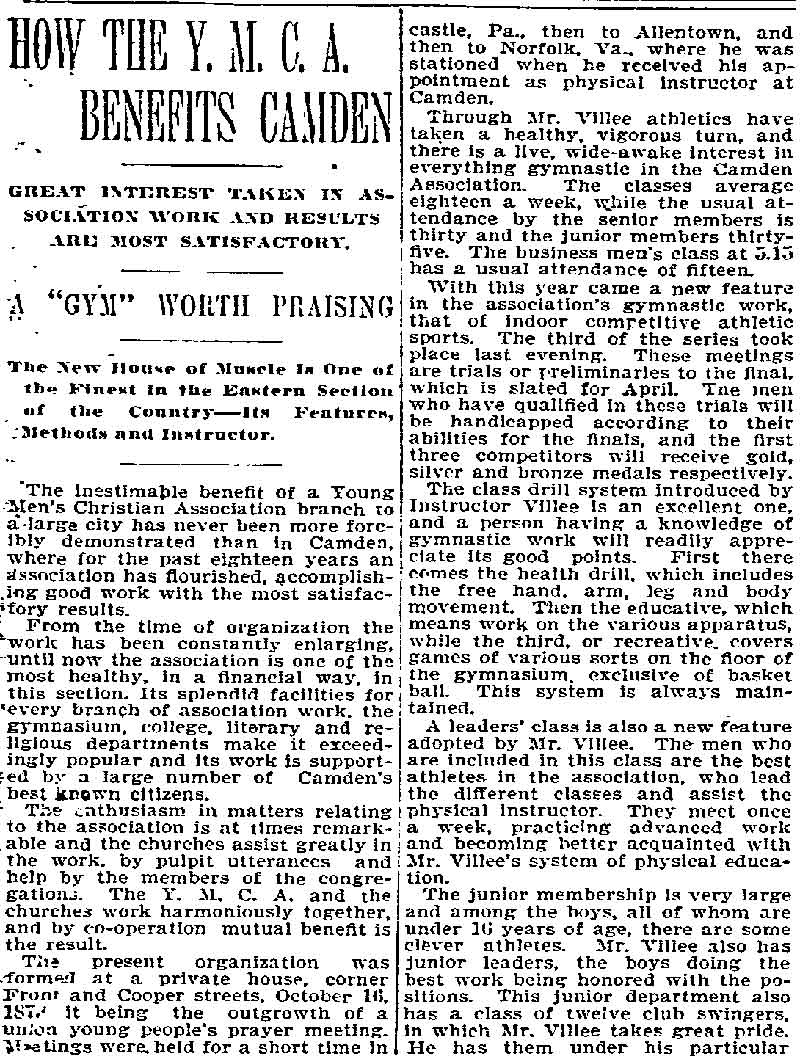
Great Interest Taken in Association Work and Results Are Most Satisfactory.
A “Gym” Worth Praising
The New House of Muscle Is One of the Finest in the Eastern Section of the Country—Its Features, Methods and Instructor.
The inestimable benefit of a Young Men’s Christian Association branch to a large city has never been more forcibly demonstrated than in Camden, where for the past eighteen years an association has flourished, accomplishing good work with the most satisfactory results.
From the time of organization the work has been constantly enlarging, until now the association is one of the most healthy, in a financial way, in this section. Its splendid facilities for every branch of association work, the gymnasium, college, literary and religious departments make it exceedingly popular and its work is supported by a large number of Camden’s best known citizens.
The enthusiasm in matters relating to the association is at times remarkable and the churches assist greatly in the work, by pulpit utterances and help by the members of the congregations. The Y. M. C. A. and the churches work harmoniously together, and by co-operation mutual benefit is the result.
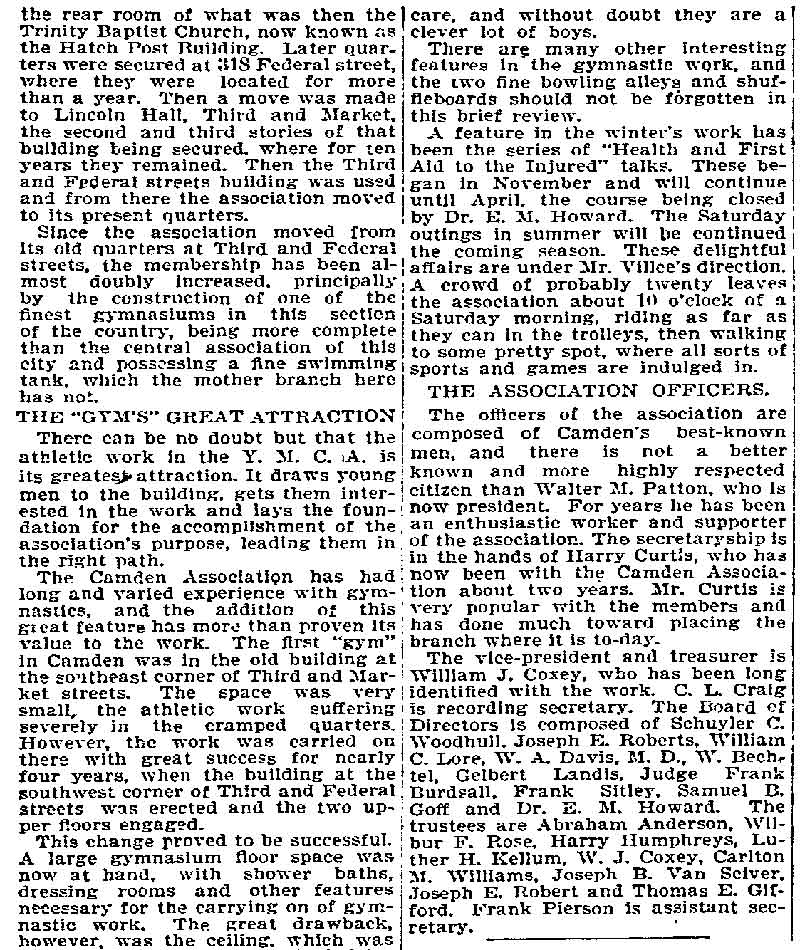
The present organization was formed at a private house, corner Front and Cooper streets, October 1[?], 187[?], it being the outgrowth of a union young people’s prayer meeting. Meetings were held for a short time in the rear room of what was then the Trinity Baptist Church, now known as the Hatch Post Building. Later quarters were secured at [?]18 Federal street, where they were located for more than a year. Then a move was made to Lincoln Hall, Third and Market, the second and third stories of that building being secured, where for ten years they remained. Then the Third and Federal streets building was used and from there the association moved to its present quarters.
Since the association moved from its old quarters at Third and Federal streets, the membership has been almost doubly increased, principally by the construction of one of the finest gymnasiums in this section of the country, being more complete than the central association of this city and possessing a fine swimming tank, which the mother branch here has not.
The “Gym’s” Great Attraction
There can be no doubt but that the athletic work in the Y. M. C. A. is its greatest attraction. It draws young men to the building, gets them interested in the work and lays the foundation for the accomplishment of the association’s purpose, leading them in the right path.
The Camden Association has had long and varied experience with gymnastics, and the addition of this great feature has more than proven its value to the work. The first “gym” in Camden was in the old building at the southeast corner of Third and Market streets. The space was very small, the athletic work suffering severely in the cramped quarters. However, the work was carried on there with great success for nearly four years, when the building at the southwest corner of Third and Federal streets was erected and the two upper floors engaged.
This change proved to be successful. A large gymnasium floor space was now at hand, with shower baths, dressing rooms and other features necessary for the carrying on of gymnastic work. The great drawback, however, was the ceiling, which was not more than fifteen feet in height. This prevented any development of flying and traveling ring work, while horizontal bar work was also handicapped to a certain extent. However, for nearly six years the work progressed there in the most satisfactory manner, the classes being large and interest at times very great.
The Present Quarters.
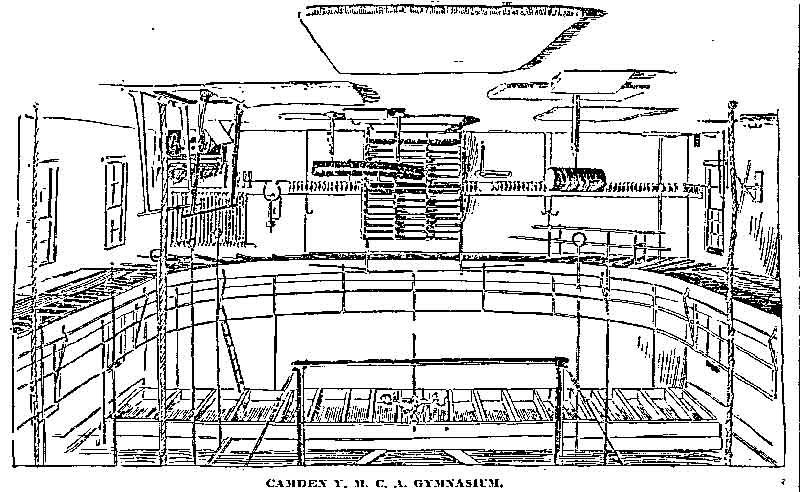
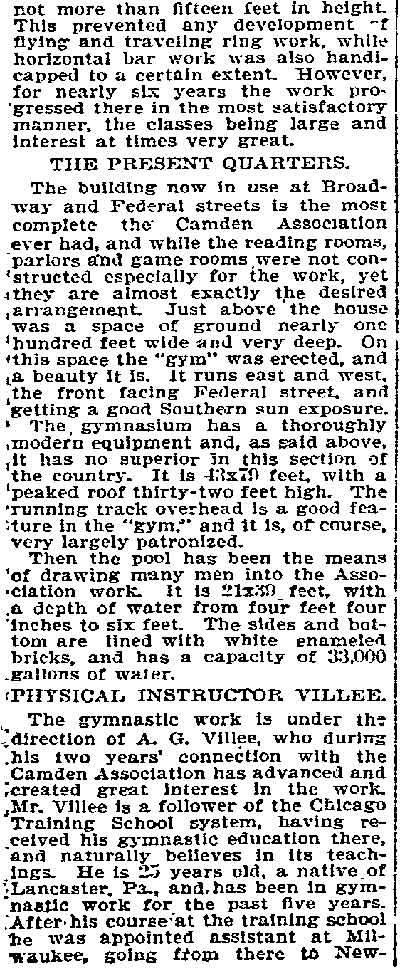
The building now in use at Broadway and Federal streets is the most complete the Camden Association ever had, and while the reading rooms, parlors and game rooms were not constructed especially for the work, yet they are almost exactly the desired arrangement. Just above the house was a space of ground nearly one hundred feet wide and very deep. On this space the “gym” was erected, and a beauty it is. It runs east and west, the front facing Federal street, and getting a good Southern sun exposure.
The gymnasium has a thoroughly modern equipment and, as said above, it has no superior in this section of the country. It is 43x7[?] feet, with a peaked roof thirty-two feet high. The running track overhead is a good feature in the “gym,” and it is, of course, very largely patronized.
Then the pool has been the means of drawing many men into the Association work. It is 21x39 feet, with a depth of water from four feet four inches to six feet. The sides and bottom are lined with white enameled bricks, and has a capacity of 33,000 gallons of water.
Physical Instructor Villee.
The gymnastic work is under the direction of A. G. Villee, who during his two years’ connection with the Camden Association has advanced and created great interest in the work. Mr. Villee is a follower of the Chicago Training School system, having received his gymnastic education there, and naturally believes in its teachings. He is 25 years old, a native of Lancaster, Pa., and has been in gymnastic work for the past five years. After his course at the training school he was appointed assistant at Milwaukee, going from there to Newcastle, Pa., then to Allentown, and then to Norfolk, Va., where he was stationed when he received his appointment as physical instructor at Camden.
Through Mr. Villee athletics have taken a healthy, vigorous turn, and there is a live, wide-awake interest in everything gymnastic in the Camden Association. The classes average eighteen a week, while the usual attendance by the senior members is thirty and the junior members thirty-five. The business men’s class at 5.15 has a usual attendance of fifteen.
With this year came a new feature in the association’s gymnastic work, that of indoor competitive athletic sports. The third of the series took place last evening. These meetings are trials or preliminaries to the final, which is slated for April. The men who have qualified in these trials will be handicapped according to their abilities for the finals, and the first three competitors will receive gold, silver and bronze medals respectively.
The class drill system introduced by Instructor Villee is an excellent one, and a person having a knowledge of gymnastic work will readily appreciate its good points. First there comes the health drill, which includes the free hand, arm, leg and body movement. Then the educative, which means work on the various apparatus, while the third, or recreative, covers games of various sorts on the floor of the gymnasium, exclusive of basket ball. This system is always maintained.
A leaders’ class is also a new feature adopted by Mr. Villee. The men who are included in this class are the best athletes in the association, who lead the different classes and assist the physical instructor. They meet once a week, practicing advanced work and becoming better acquainted with Mr. Villee’s system of physical education.
The junior membership is very large and among the boys, all of whom are under 16 years of age, there are some clever athletes. Mr. Villee also has junior leaders, the boys doing the best work being honored with the positions. This junior department also has a class of twelve club swingers, in which Mr. Villee takes great pride. He has them under his particular care, and without doubt they are a clever lot of boys.
There are many other interesting features in the gymnastic work, and the two fine bowling alleys and shuffleboards should not be forgotten in this brief review.
A feature in the winter’s work has been the series of “Health and First Aid to the Injured” talks. These began in November and will continue until April, the course being closed by Dr. E. M. Howard. The Saturday outings in summer will be continued the coming season. These delightful affairs are under Mr. Villee’s direction. A crowd of probably twenty leaves the association about 10 o’clock of a Saturday morning, riding as far as they can in the trolleys, then walking to some pretty spot, where all sorts of sports and games are indulged in.
The Association Officers.
The officers of the association are composed of Camden’s best-known men, and there is not a better known and more highly respected citizen than Walter M. Patton, who is now president. For years he has been an enthusiastic worker and supporter of the association. The secretaryship is in the hands of Harry Curtis, who has now been with the Camden Association about two years. Mr. Curtis is very popular with the members and has done much toward placing the branch where it is to-day.
The vice-president and treasurer is William J. Coxey, who has been long identified with the work. C. L. Craig is recording secretary. The Board of Directors is composed of Schuyler C. Woodhull, Joseph E. Roberts, William C. Lore, W. A. Davis, M. D., W. Bechtel, Gelbert Landis, Judge Frank Burdsall, Frank Sitley, Samuel D. Goff and Dr. E. M. Howard. The trustees are Abraham Anderson, Wilbur F. Rose, Harry Humphreys, Luther H. Kellum, W. J. Coxey, Carlton M. Williams, Joseph B. Van Sciver, Joseph E. Robert and Thomas E. Gifford. Frank Pierson is assistant secretary.
Camden Y. M. C. A. Gymnasium.
Cape May Real Estate
Philadelphia Inquirer —
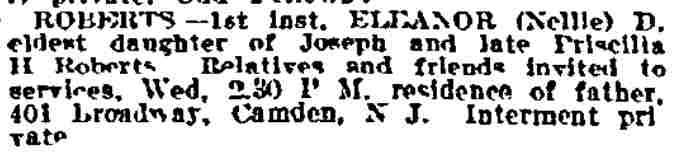
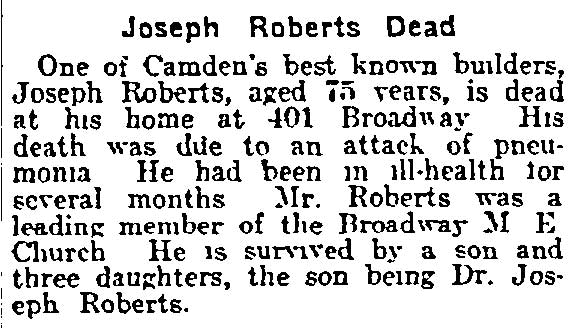
Joseph Roberts Dead
Philadelphia Inquirer —
Funeral Notice
Philadelphia Inquirer —
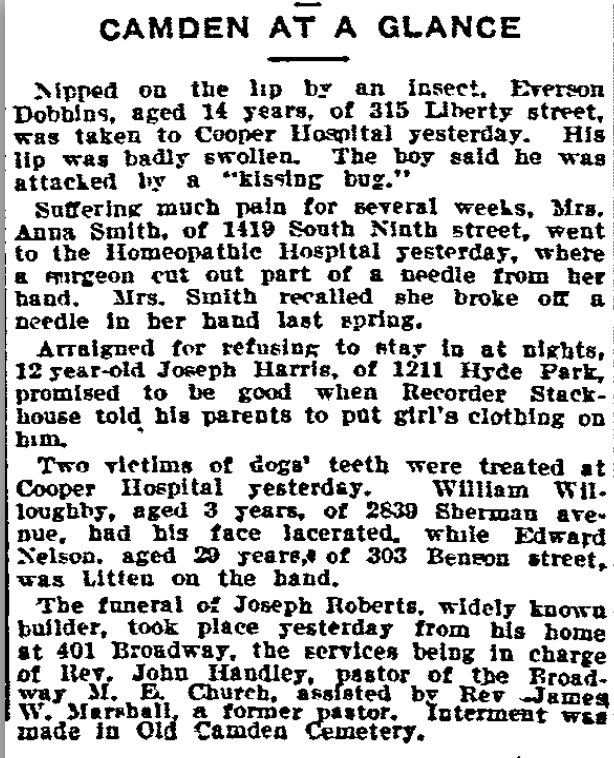
Final Resting Place