Introduction
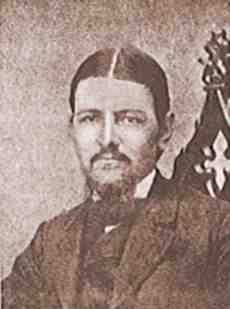
Sergeant Boston Corbett
SERGEANT BOSTON CORBETT is forever known in history as the man who shot and killed John Wilkes Booth, the assassin of President Abraham Lincoln, in April of 1865. Less well known is the fact that Corbett lived in Camden for several years, at 308 Mechanic Street and later on Pine Street below South 4th Street, and served as pastor of the Memorial Methodist Protestant Church on Broadway below Kaighn Avenue.
Much has been written about Boston Corbett. Deeply religious and often described as mentally unstable, accounts by those who knew and served with the man offer a different perspective of him, at least through the mid 1860s. Probably the most accurate and personally revealing account came from Byron Berkley Johnson in his book, Abraham Lincoln and Boston Corbett, with Personal Recollection of Each, published in 1914. Corbett himself is quoted at length. This book can be downloaded as a PDF file by clicking on the link, and frankly is a “must-read.”
After having served as a private in the 12th Regiment, New York State Militia in 1861, Boston Corbett enlisted as a Private on August 4, 1863 at the age of 31, joining Company L, 16th Cavalry Regiment New York on September 5, 1863. He was promoted to Full Corporal on September 6, 1863. Corbett was demoted to Full Private on Feb 26, 1864. Corbett was taken prisoner at Centrevill (near Culpepper), Virginia on June 26, 1864 and sent to the notorious Andersonville camp, from which he briefly escaped. After falling ill at Andersonville, he was paroled on November 19, and after a month’s recovery returned to his regiment. In the meantime, Corbett had again been promoted, this time to Full Sergeant on Oct 31, 1864.
On April 25, 1865 under the command of First Lieutenant E.P. Doherty, Sergeant Corbett was part of a detail seeking to arrest John Wilkes Booth, who had assassinated President Abraham Lincoln a few days before. Although orders had been given to take Booth alive, Sergeant Corbett shot the assassin, who died a few hours later.
I would call the attention of the commanding general to the efficiency of Sergt. Boston Corbett, Company I, Sixteenth New York Cavalry, who was untiring in his efforts to bring the murderers to justice. His soldierly qualifications have been tested before this occasion, and, in my judgment, are second to none in the service.
After his encounter with John Wilkes Booth in April of 1865, Sergeant Corbett mustered out with Company L, 16th Cavalry Regiment New York on August 17, 1865 at Washington, DC.
George Reeser Prowell’s History of Camden County, New Jersey states that Boston Corbett was the second pastor of the Memorial Methodist Protestant Church on Broadway below Kaighn Avenue and was replaced in 1867. Boston Corbett remained in Camden until 1878. The 1870 Federal Census, taken August 2nd of that year, shows Boston Corbett residing in South Camden, lodging at the home of Isaac Boggs, his wife Sarah, and their 12-year old daughter Anna. Corbett’s occupation is listed as “Preach Gospel.” He also worked as a hatter, his pre-Civil War occupation.
An 1877 news article in the West Jersey Democrat states that Corbett was living on Pine Street below South 4th Street. He was still in town in 1878, but not for long. The City Directory for 1878 shows Rev. Boston Corbett as pastor of the Independent Methodist Church at 328 Pine Street, where he also resided. He left Camden for Cloud County, Kansas that year, where he tried his hand at farming, homesteading 80 acres. This did not turn out well.
In March of 1880 Boston Corbett was granted an invalid’s pension for his Civil War service.
The G.A.R. secured Corbett a post as doorkeeper for the Kansas State Legislature. Corbett, whose sanity had been questionable BEFORE the Civil War, became unhinged one day in 1887 and fired twelve shots, fortunately none of which hurt anyone. He was sent to an insane asylum. Boston Corbett escaped the following year, and after visiting a fellow ex-Andersonville prisoner, Richard Thatcher, in Kansas, was never heard from again.
Corbett’s eventual fate is unknown. Sources have him dying in fires in Minnesota and Kansas, leaving the United States for Mexico, and spending his last days in Oklahoma. A number of imposters claimed to be Corbett but were all discredited in time.
From Thomas to Boston: A Street Corner Conversion
Boston Corbett was not born with that name. He entered the world as Thomas H. Corbett in London, England on January 29, 1832. His family emigrated to New York when he was seven years old, settling in Troy. As a young man, Thomas learned the hat-making trade, following in his father’s footsteps. He married, and his wife gave birth to a child — but tragedy struck when both mother and infant died during childbirth.
The grief-stricken young widower spiraled into despair and began drinking heavily. His life seemed destined for ruin until one evening in 1857 or early 1858, when he stumbled upon a Methodist revival meeting being conducted on a Boston street corner. The preacher’s words struck him with such force that Thomas underwent an immediate and dramatic religious conversion.
So profound was his transformation that he decided his very name must change to mark his rebirth. Standing on that Boston street corner where he had found salvation, Thomas Patrick Corbett renamed himself “Boston” Corbett — literally taking the city’s name as his own Christian name. From that moment forward, he insisted on being called Boston, considering his former identity as Thomas to be dead and buried along with his old sinful life.
This level of religious fervor was unusual even in an era known for evangelical revivals. The name change was just the beginning of what would become an increasingly intense and eccentric expression of faith that would define — and ultimately destroy — the rest of his life.
The Mad Hatter: Mercury Poisoning and Mental Decline
The phrase “mad as a hatter” was not merely a colorful Victorian expression — it described a very real occupational disease that affected hat makers throughout the 18th and 19th centuries. Boston Corbett’s trade as a hatter would prove to be one of the defining and most destructive factors of his life.
Hat making in Corbett’s era required the use of mercury nitrate in the felting process. Hatters would brush a solution of mercuric nitrate onto animal furs to mat the fibers together, creating the felt used for hats. This process, called “carroting” because it turned the fur orange, exposed workers to mercury vapors day after day, year after year. The mercury was absorbed through the skin and lungs, accumulating in the body and causing severe neurological damage.
The symptoms of mercury poisoning — known in the trade as “hatter’s shakes” or “Danbury shakes” (after Danbury, Connecticut, a hat-making center) — included tremors, irritability, depression, memory loss, insomnia, and frightening personality changes. Victims experienced hallucinations, paranoia, and violent mood swings. They became withdrawn, suspicious, and increasingly unstable. The tongue, gums, and teeth would deteriorate. Advanced cases resulted in severe mental illness indistinguishable from insanity.
Corbett had worked as a hatter for years before his Civil War service, and continued to work in the trade intermittently afterward. Medical historians examining his case have noted that virtually every aspect of his increasingly bizarre behavior aligns perfectly with the symptoms of chronic mercury poisoning: his paranoid religious delusions, his violent outbursts, his physical tremors, his inability to control his impulses, and his final descent into madness.
When Corbett fired those twelve shots in the Kansas State Legislature in 1887, witnesses reported that his hands shook violently. When he was committed to the Topeka Insane Asylum, doctors noted his trembling extremities and erratic behavior. His fellow soldiers in the Civil War had described him as “queer” and noted his strange mannerisms and shaking hands even in the 1860s.
The tragedy of Boston Corbett was not merely that he was mentally ill — it was that his mental illness was a direct result of his chosen profession. Every day he worked as a hatter, he was slowly poisoning himself, the mercury accumulating in his brain and nervous system, inexorably transforming him from an eccentric religious enthusiast into a genuinely dangerous madman. By the time he shot John Wilkes Booth in 1865, he had already been breathing mercury fumes for well over a decade.
An Act of Desperation: The Self-Castration of 1858
Of all the shocking episodes in Boston Corbett’s life, none is more disturbing or more revealing of his mental state than what occurred in the summer of 1858, shortly after his religious conversion in Boston.
One evening, Corbett was walking through the streets of Boston when he was accosted by prostitutes who made lewd propositions to him. The encounter filled him with overwhelming shame and terror. Having recently committed himself to a life of absolute purity and righteousness, he interpreted his own physical response as evidence of sinful temptation that threatened his very soul.
Corbett returned to his room in a state of religious mania, convinced that his body was betraying him and leading him toward damnation. Opening his Bible, he turned to the Gospel of Matthew, Chapter 19, Verse 12, which reads: “For there are some eunuchs, which were so born from their mother’s womb: and there are some eunuchs, which were made eunuchs of men: and there be eunuchs, which have made themselves eunuchs for the kingdom of heaven’s sake.”
Taking these words as divine instruction, and using a pair of scissors, Boston Corbett castrated himself.
What followed was almost as remarkable as the act itself. After mutilating himself, Corbett calmly ate a meal, then attended a prayer meeting as if nothing had happened. Only afterward did he finally seek medical attention at Massachusetts General Hospital, where shocked doctors treated his self-inflicted wound. When asked why he had done such a thing, Corbett cited the Biblical passage and explained matter-of-factly that he had made himself a eunuch for the kingdom of heaven.
The incident reveals the depth of Corbett’s religious extremism and the extent to which his mental state had already deteriorated — likely aided by years of mercury exposure from his hat-making work. That he could perform such an act and then proceed to dinner and prayer as if he had simply trimmed his fingernails demonstrates a complete disconnection from normal human reactions to pain and trauma.
Remarkably, Corbett recovered physically from the ordeal and never expressed any regret for what he had done. He considered it a righteous act that had freed him from carnal temptation and allowed him to serve God more purely. To those around him, it was clear evidence that Boston Corbett was not merely eccentric or overly pious — he was genuinely mentally unstable and capable of shocking violence, even against himself.
The Shooting of John Wilkes Booth: Controversy and Consequences
In the early morning hours of April 26, 1865, Sergeant Boston Corbett stood outside a burning tobacco barn near Port Royal, Virginia, his carbine raised and aimed through a gap in the barn’s planking. Inside, John Wilkes Booth — the actor who had assassinated President Abraham Lincoln twelve days earlier — was trapped along with his accomplice David Herold. The barn had been set on fire to force the fugitives out, and Corbett had been given explicit orders: take Booth alive.
What happened next would make Boston Corbett famous, but it would also spark controversy that persists to this day.
According to Corbett’s account, he saw Booth raise a carbine as if to fire at the soldiers surrounding the barn. In that instant, Corbett made a decision that defied his direct orders. He aimed carefully and fired a single shot. The bullet struck Booth in the neck, severing his spinal cord. Booth collapsed and was dragged from the burning barn, paralyzed and dying. He would succumb to his wound a few hours later at a nearby farm, whispering his final words: “Tell my mother I died for my country… useless… useless.”
When questioned about why he had shot Booth when orders explicitly stated the assassin was to be captured alive, Corbett’s response was characteristically religious and unrepentant: “Providence directed me.” Later he elaborated: “I saw him in the act of stooping or springing, and concluded he was going to use his weapons, and I thought the time had come… I aimed at his body, but God directed the ball to his head.”
The controversy began almost immediately. Some of Corbett’s fellow soldiers questioned whether Booth had actually been raising his weapon to fire. Others pointed out the suspicious convenience of Booth’s death — alive, he might have implicated others in the assassination conspiracy, including potentially powerful government figures. Dead, he could tell no tales.
More troubling were persistent rumors that Booth had not been shot by Corbett at all, but had instead shot himself. The angle of the bullet wound — entering behind the ear and traveling downward — was more consistent with a self-inflicted wound than a shot fired from outside the barn at ground level. Some witnesses claimed to have heard two shots, not one. Detective Luther B. Baker, who was present at the scene, later stated privately that he believed Booth had committed suicide.
Adding to the mystery, the body identified as Booth was buried in secret, and later exhumed and examined under questionable circumstances. Some conspiracy theorists have argued that the man killed in the barn was not John Wilkes Booth at all, though mainstream historians reject this theory based on multiple positive identifications by those who knew Booth well.
Regardless of the lingering questions, Corbett was credited with killing Booth and was initially hailed as a hero. However, his violation of direct orders could not be ignored. He was called before Secretary of War Edwin Stanton to explain himself. Stanton, notorious for his fierce temper, reportedly berated Corbett for his disobedience, but ultimately no charges were filed. Some historians speculate that Stanton may have secretly been relieved that Booth was dead rather than alive to stand trial.
The financial rewards, however, were decidedly mixed. Congress had authorized a reward of $100,000 to be divided among those who captured Booth and his conspirators. When the money was finally distributed in 1866, it was split among twenty-six soldiers and detectives. Corbett’s share amounted to just $1,653.85 — hardly a fortune for the man credited with killing the most infamous assassin in American history.
Corbett received his reward money in July 1866 and promptly squandered much of it. True to his character, he gave portions away to religious causes and fellow soldiers, and spent the rest on items of little practical value. Within a short time, the money was gone, and Corbett was back to working as a hatter and street preacher.
For the rest of his life, Boston Corbett would be introduced as “the man who shot John Wilkes Booth.” It was a fame that brought him little profit and, arguably, contributed to his continued mental deterioration. He was frequently asked to recount the story, and he told it with increasing embellishments and religious fervor, always emphasizing that God had guided his hand. Whether he actually fired the shot that killed Booth, or whether Booth’s death was self-inflicted, remains one of the enduring mysteries of the Lincoln assassination.
Twelve Shots in the Kansas Legislature
By 1887, Boston Corbett had been living in Kansas for nearly a decade. His farming venture in Cloud County had failed, as had most of his attempts at earning a steady living. His mental state had deteriorated markedly, and those who knew him described him as increasingly paranoid, excitable, and prone to wild religious rantings. The Grand Army of the Republic, recognizing his service and his dire circumstances, managed to secure him a position as assistant doorkeeper at the Kansas State Legislature in Topeka — a simple job that required little more than opening doors and maintaining order in the legislative chambers.
It should have been an easy assignment for an aging Civil War veteran. Instead, it became the scene of Corbett’s final, spectacular descent into violent madness.
On February 15, 1887, Corbett was on duty in the House of Representatives chamber when he became convinced that several legislators were mocking him. Whether they actually were, or whether this was a paranoid delusion brought on by advanced mercury poisoning and mental illness, will never be known with certainty. What is certain is that Corbett’s response was immediate and terrifying.
Without warning, Boston Corbett drew a revolver and opened fire in the crowded legislative chamber.
Witnesses reported that Corbett fired twelve shots in rapid succession, aiming at the ceiling, the walls, and wildly around the room. Legislators dove under their desks. Spectators in the gallery screamed and fled. The sound of gunfire echoed through the capitol building, and for a few horrifying moments, it seemed as though a massacre was underway. Corbett stood in the center of the chaos, firing methodically, his hands shaking but his face eerily calm.
Miraculously — incredibly — not a single person was hit. Not one of Corbett’s twelve bullets found a human target. Whether this was due to divine intervention, as Corbett himself might have claimed, or simply to the trembling hands of a man suffering from advanced mercury poisoning and mental illness, the result was the same: a room full of terrified but uninjured people, and Boston Corbett standing with an empty revolver, ready to reload.
Several men rushed Corbett and wrestled him to the ground before he could fire again. He struggled against them, shouting incoherently about persecution and divine judgment. The man who had once been praised for his “soldierly qualifications” and his service to the nation was now clearly, undeniably insane.
Corbett was immediately arrested and examined by doctors. Their conclusion was swift and unanimous: Boston Corbett was suffering from severe mental illness and was a danger to himself and others. On March 16, 1887, just one month after the shooting incident, he was committed to the Topeka Insane Asylum.
At the asylum, Corbett was observed to have severe tremors in his hands and extremities, a classic symptom of mercury poisoning. He was paranoid, believing that people were conspiring against him. He had violent outbursts alternating with periods of religious ecstasy. He quoted Scripture incessantly and claimed to receive direct communications from God. The doctors noted all of these symptoms in their records but had no effective treatment to offer. In the 1880s, the causes of “hatter’s disease” were still poorly understood, and there was no cure for mercury poisoning once the damage was done.
Boston Corbett would remain in the asylum for just over a year. But the walls and locked doors of the Topeka Insane Asylum would not hold the man who had once survived the hell of Andersonville Prison.
The Disappearance: Theories and Impostors
On May 26, 1888, Boston Corbett simply walked away from the Topeka Insane Asylum and vanished into history.
Accounts of his escape vary. Some reports suggest he slipped away during a transfer or while on supervised outdoor work detail. Others claim he simply walked out one day when guards were distracted, taking advantage of the asylum’s relatively lax security. However it happened, by the time asylum officials realized he was gone, Corbett had disappeared completely.
The last confirmed sighting of Boston Corbett came from Richard Thatcher, a fellow survivor of Andersonville Prison who lived in Neodesha, Kansas. Thatcher reported that Corbett appeared at his home shortly after the escape, seeking shelter and assistance. Thatcher later recalled that Corbett seemed agitated and paranoid, convinced that people were pursuing him. After a brief visit, Corbett departed, heading west. He told Thatcher he was going to Mexico. That was the last time anyone who knew Boston Corbett would reliably see him alive.
And then… nothing. Boston Corbett, the man who shot John Wilkes Booth, the mad hatter who had been famous across the nation, simply ceased to exist in any verifiable way.
In the years that followed, numerous theories emerged about Corbett’s fate:
The Great Hinckley Fire Theory: The most widely repeated account holds that Corbett died in the catastrophic Great Hinckley Fire that swept through Hinckley, Minnesota on September 1, 1894. The fire killed at least 418 people and destroyed several towns in a matter of hours. Some claimed that Corbett had been living as a hermit in the woods near Hinckley and was among the unidentified dead. However, no body was ever positively identified as Corbett’s, and the story may be apocryphal.
The Mexico Theory: Corbett himself told Richard Thatcher he was heading to Mexico, and some historians believe he may have made it across the border and died there, either from natural causes, violence, or the effects of his mental illness. Mexico in the late 1880s was a chaotic place where a man could easily disappear, especially one with no family and no fixed identity.
The Oklahoma Theory: Another persistent story places Corbett’s final years in Enid, Oklahoma (then still Oklahoma Territory), where he allegedly lived under an assumed name and died around 1894. Some local historians in Enid claimed to have identified his grave, but the evidence remains inconclusive and disputed.
The Kansas Fire Theory: A variation on the fire-death theory holds that Corbett died not in Minnesota but in another fire in Kansas, possibly while living as a homeless wanderer. Again, no body was ever confirmed to be his.
The Suicide Theory: Given Corbett’s history of self-harm and his deteriorating mental state, some have speculated that he may have taken his own life shortly after escaping the asylum. His body, if never found or identified, would have left no trace.
Adding to the confusion were the numerous impostors who claimed to be Boston Corbett in the years following his disappearance. At least half a dozen men, at various times and in various places, announced themselves as the famous “Lincoln’s Avenger” and told elaborate stories of their exploits. Some were clearly con men seeking attention or money. Others may have been mentally ill individuals who genuinely believed they were Corbett. All were eventually exposed as frauds, but their appearance kept the mystery alive in the public imagination.
The most notable impostor appeared in 1905 in Texas, claiming to be Corbett and seeking to collect on the government pension that the real Corbett had been receiving. This man’s story quickly fell apart under investigation, but not before generating significant newspaper coverage and reviving interest in Corbett’s fate.
Despite numerous investigations over the years, including efforts by the Grand Army of the Republic, pension authorities, and historians, no conclusive evidence of Boston Corbett’s death was ever found. He was never declared legally dead, though his pension payments eventually ceased. No grave has been definitively identified as his. No death certificate was ever filed. He simply vanished, as if the mercury-addled mind that had driven him to such extremes had finally led him to walk off the edge of the earth itself.
Today, more than 135 years after his disappearance, Boston Corbett remains one of American history’s most enigmatic figures. The man who killed the most famous assassin in American history became, in the end, a ghost story — a cautionary tale about religious fanaticism, mental illness, and the toxic price of 19th-century industry. Whether he died in a fire, in Mexico, in Oklahoma, or somewhere else entirely, Boston Corbett’s final resting place remains unknown.
Perhaps that is fitting. A man whose entire adult life was defined by extremes — extreme faith, extreme violence, extreme suffering — deserved an ending equally extreme: to simply vanish into the American frontier, leaving behind only questions, theories, and the enduring image of a trembling hand aiming a carbine at a burning barn on an April morning in 1865.
Military Documents
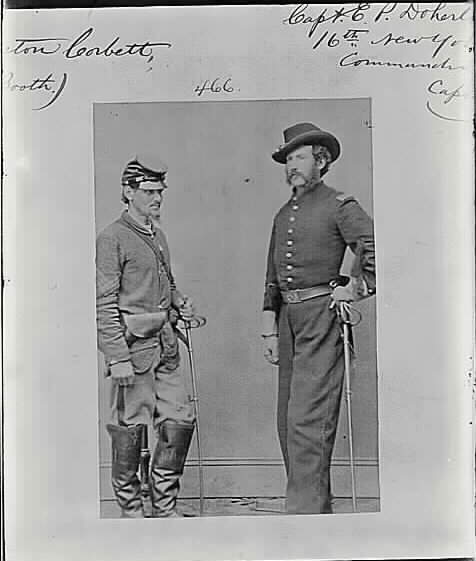
Military service record from National Archives
Historical Photos
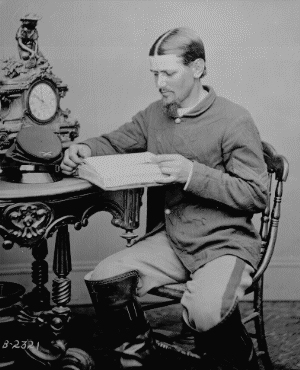
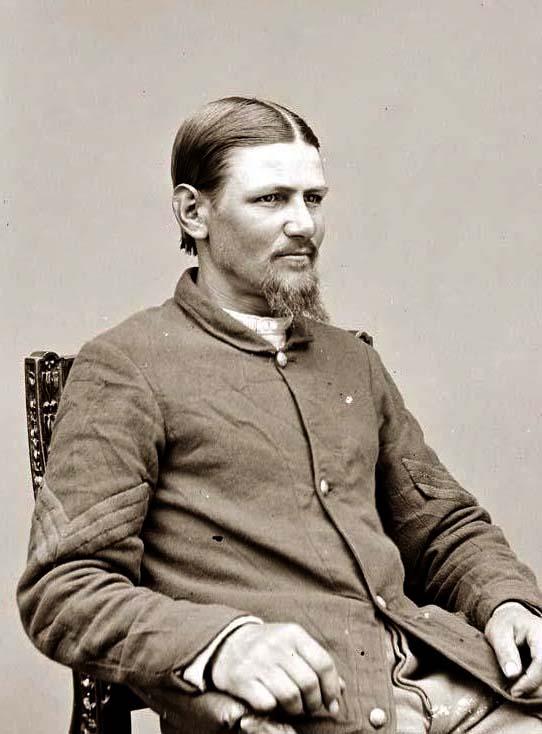
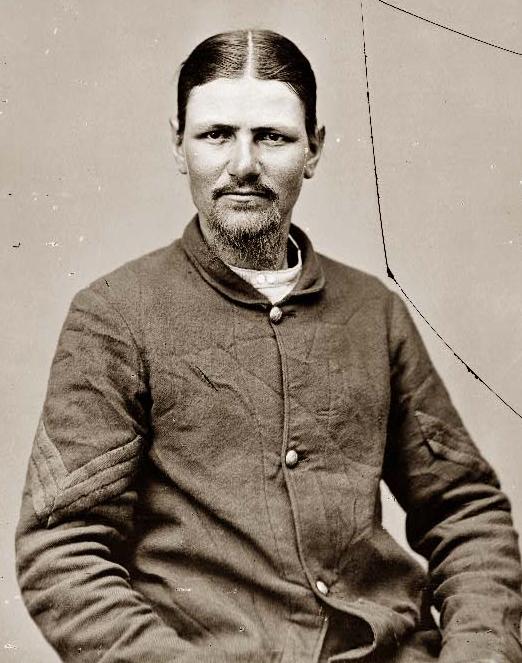
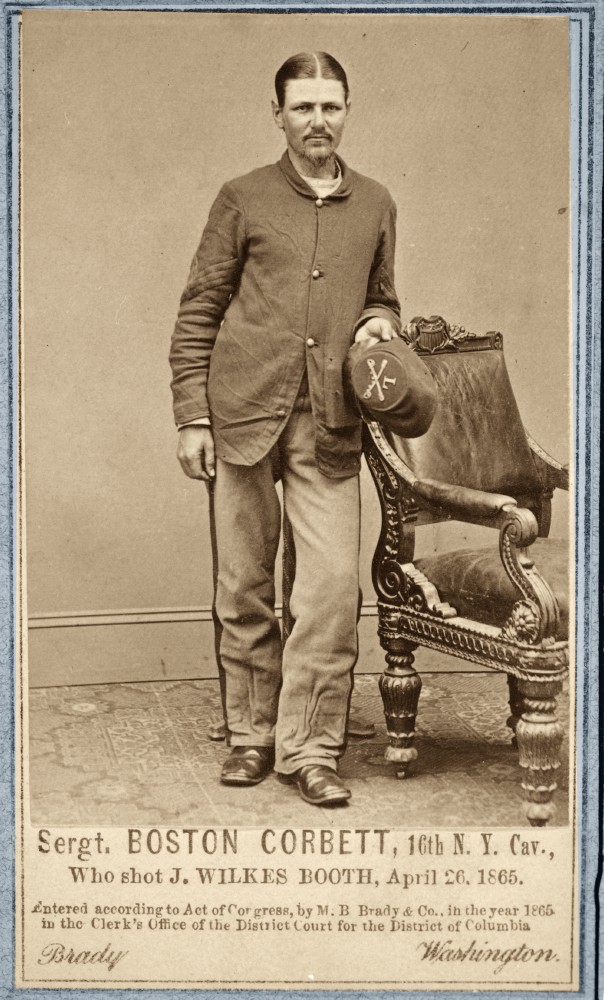
Historical photographs of Boston Corbett
Civil War Pension Certificate
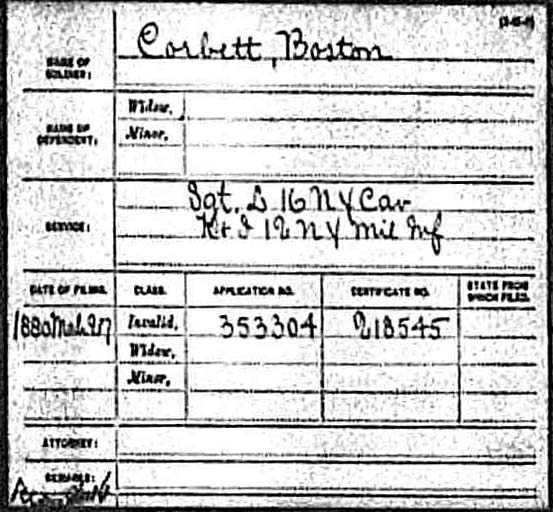
Civil War Pension Certificate
CAMDEN MAN SHOT LINCOLN'S SLAYER
Philadelphia Inquirer —
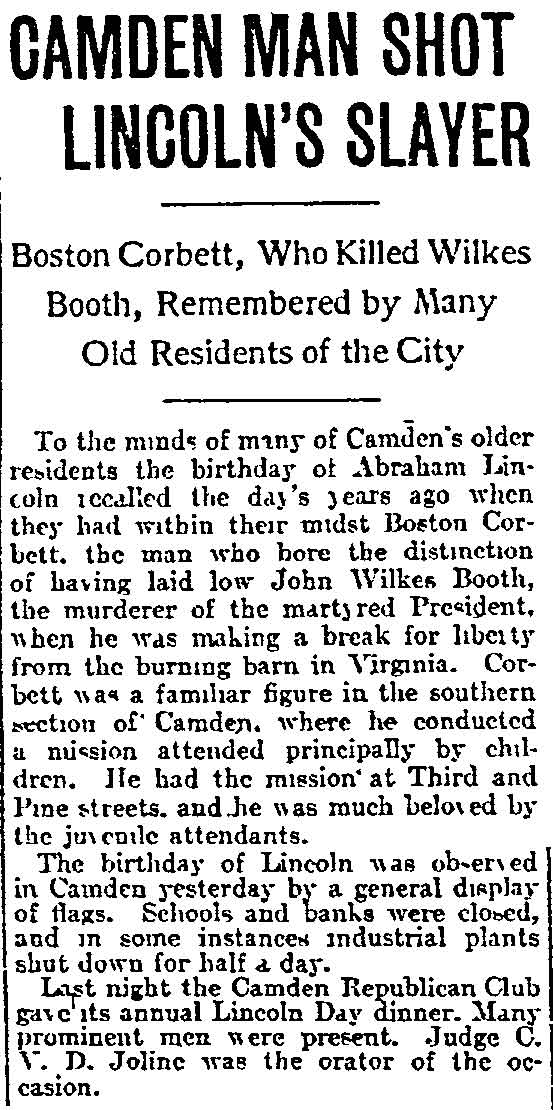
Boston Corbett, Who Killed Wilkes Booth, Remembered by Many Old Residents of the City
To the minds of many of Camden’s older residents the birthday of Abraham Lincoln recalled the day’s years ago when they had within their midst Boston Corbett, the man who bore the distinction of having laid low John Wilkes Booth, the murderer of the martyred President, when he was making a break for liberty from the burning barn in Virginia. Corbett was a familiar figure in the southern section of Camden, where he conducted a mission attended principally by children. He had the mission at Third and Pine streets, and he was much beloved by the juvenile attendants.
The birthday of Lincoln was observed in Camden yesterday by a general display of flags. Schools and banks were closed, and in some instances industrial plants shut down for half a day.
Last night the Camden Republican Club gave its annual Lincoln Day dinner. Many prominent men were present. Judge C. V. D. Joline was the orator of the occasion.
The Lincoln Assassin Mystery
Sunday Supplement —
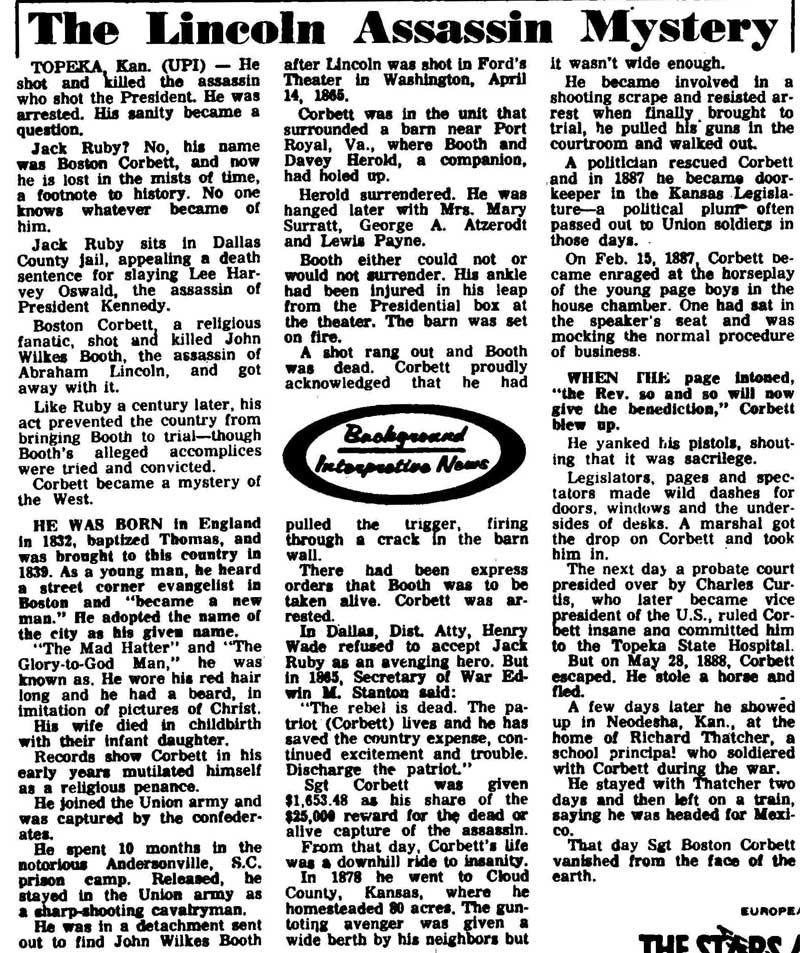
TOPEKA, Kan. (UPI) — He shot and killed the assassin who shot the President. He was arrested. His sanity became a question.
Jack Ruby? No, his name was Boston Corbett, and now he is lost in the mists of time — a footnote to history. No one knows whatever became of him.
Jack Ruby sits in Dallas County jail, awaiting a death sentence for killing Lee Harvey Oswald, the assassin of President Kennedy.
Boston Corbett, a religious fanatic, shot and killed John Wilkes Booth, the assassin of Abraham Lincoln, and got away with it.
Like Ruby a century later, his act prevented the country from bringing Booth to trial — though Booth’s alleged accomplices were tried and convicted.
Corbett became a mystery of the West.
He was born in England in 1832, baptized Thomas, and was brought to this country in 1839. As a young man, he heard a street corner evangelist in Boston and “became a new man.” He adopted the name of the city as his given name.
“The Mad Hatter” and “The Glory-to-God Man,” he was known as. He wore his red hair long and he had a beard, in imitation of pictures of Christ.
His wife died in childbirth with their infant daughter. Records show Corbett in his early years mutilated himself as a religious penance.
He joined the Union army and was captured by the Confederates.
He spent 10 months in the notorious Andersonville, S.C., prison camp. Released, he stayed in the Union army as a sharp-shooting cavalryman.
He was in a detachment sent out to find John Wilkes Booth after Lincoln was shot in Ford’s Theater in Washington, April 14, 1865.
Corbett was in the unit that surrounded a barn near Port Royal, Va., where Booth and Davey Herold, a companion, had holed up.
Herold surrendered. He was hanged later with Mrs. Mary Surratt, George A. Atzerodt and Lewis Payne.
Booth either could not or would not surrender. His ankle had been injured in his leap from the Presidential box at the theater. The barn was set on fire.
A shot rang out and Booth was dead. Corbett proudly acknowledged that he had pulled the trigger, firing through a crack in the barn wall.
There had been express orders that Booth was to be taken alive. Corbett was arrested.
In Dallas, Dist. Atty. Henry Wade refused to accept Jack Ruby as an avenging hero. But in 1865, Secretary of War Edwin M. Stanton said:
“The rebel is dead. The patriot (Corbett) lives and he has saved the country expense, continued excitement and trouble. Discharge the patriot.”
Sgt. Corbett was given $1,653.48 as his share of the $25,000 reward for the dead or alive capture of the assassin.
From that day, Corbett’s life was a downhill ride to insanity.
In 1878 he went to Cloud County, Kansas, where he homesteaded 80 acres. The gun-toting avenger was given a wide berth by his neighbors but it wasn’t wide enough.
He became involved in a shouting scrape and realized arrest when finally brought to trial, he pulled his gun in the courtroom and walked out.
A politician rescued Corbett and in 1887 he became doorkeeper in the Kansas Legislature — a political plum often passed out to Union soldiers in those days.
On Feb. 15, 1887 Corbett became enraged at the horseplay of the young page boys in the house chamber. One had sat in the speaker’s seat and was mocking the normal procedure of business.
“WHEN THE page intoned, ‘the Rev. so and so will now give the benediction,’ Corbett blew up.
He yanked his pistol, shouting that it was sacrilege.
Legislators, pages and spectators made wild dashes for doors, windows and the undersides of desks. A marshal got the drop on Corbett and took him in.
The next day a probate court presided over by Charles Curtis, who later became vice president of the U.S., ruled Corbett insane and committed him to the Topeka State Hospital.
But on May 28, 1888, Corbett escaped. He stole a horse and fled.
A few days later he showed up in Neodesha, Kan., at the home of Richard Thatcher, a school principal who soldiered with Corbett during the war.
He stayed with Thatcher two days and then left on a train, saying he was headed for Mexico.
That day Sgt. Boston Corbett vanished from the face of the earth.