William J. Cooper
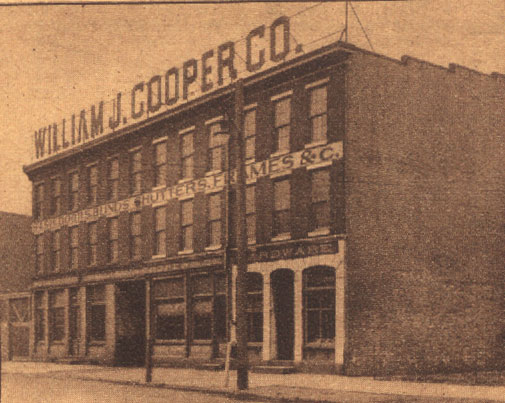
William J. Cooper Company, 215–221 Kaighn Avenue, Camden
Established in 1862, the William J. Cooper Company dealt in millwork, i.e., finished lumber, such as moldings, windows, and doors. Early in the 20th century, William J. Cooper became a principal and officer in the Broadway Trust Bank at 938–944 Broadway, in association with John J. Burleigh and Anthony Kobus.
William Cooper was born at Kaighn’s Point in Camden to John and Mary M. (Kaighn) Cooper in 1851. He was a direct descendant of William Cooper, one of the first Englishmen to settle in the area, and for whom Cooper’s Point and the Cooper River is named.
John Cooper, William J. Cooper’s father, was born in Woodbury NJ, and spent his youth on a farm in that place. When a young man he went to Camden, and engaged in the wood and coal business, building up a large trade. He was in business in Camden many years, with John W. Stone, at 32–34 Kaighn Avenue. John Cooper retired around 1888, and passed away on April 18, 1894 at the age of 80. At that time he was vice-president of the Camden National Bank. Mary M. Cooper was the daughter of Joseph Kaighn and Sarah Mickle, both members of prominent families in early Camden. William J. Cooper’s older brother Howard M. Cooper was a prominent attorney in Camden in the latter part of the 19th and early 20th century.
William J. Cooper made his home at 633 Cooper Street in Camden. The city directories show him there from 1887 through 1891. By the 1920 census he was living, with his wife Emma, at 715 Cooper Street. Having worked in his father’s business, he had moved that enterprise to 221 Kaighn Avenue by 1890. The original business dealt with wood and ice and hardware, but by 1897 William Cooper had specialized in millwork and window sashes.
William Cooper remained a principal in the Broadway Trust after the death of John J. Burleigh in 1916 and Anthony Kobus in 1920. He does not appear in the 1930 Census for Camden. The business was listed in the October 1936 New Jersey Bell Telephone Directory.
The William J. Cooper Company closed in the 1930s. It later reopened under the management of John P. Williams as the Williams-Cooper Millwork Company. By 1947 the Williams-Cooper Millwork Company was gone, and the building had been subdivided for use by two separate businesses.
William J. Cooper & Company
Historical and Industrial Review of Camden, N.J. — 1890
Excerpt from Historical and Industrial Review of Camden, N.J. 1890:
William J. Cooper & Company,
Hardware and Mill-Work of Every Description
221 Kaighn’s Avenue
One of the distinctive industries of every commercial, manufacturing and agricultural center of the country, and which contributes not a little to its material prosperity, is the hardware and building material trade. The vast variety of implements, utensils and materials incidental to this line of trade are indispensable and almost illimitable. Among the houses engaged in this industry in Camden, and which have gained a wide reputation for reliable goods and honorable dealing, and worthy of deserving mention in the pages of this review, is the house this article purposes to sketch.
Mr. William J. Cooper is a native of Camden, and having acquired a thorough knowledge in this business by spending a life’s career in it, he inaugurated this present enterprise in 1888, after a successful connection with the old firm of Cooper, Stone & Co.
The salesroom occupied for business purposes is 20x65 feet in dimensions, heavily stocked with a comprehensive line of Builders’ and Shelf Hardware, Mechanics’ Tools of every description, Spades, Agricultural Implements, Table and Pocket Cutlery, Contractors’, Miners’ and Blacksmiths’ Supplies, Manufacturers’ Tools, Bar, Rod and other Merchant Iron, Cast Steel, etc., Tin, Copper, Zinc and Sheet Iron Ware, Paints, Brushes, and everything in the builder’s line, such as Sash, Doors, Blinds, Shutters, Window and Door Frames, etc., etc. Extensive dealers in Coal, they are prepared to furnish fuel for family and manufacturing purposes, having facilities to fill the largest orders. The original founders of this enterprise were the first concern to deal in coal and wood in the city of Camden. Their yards are eligibly located at Front and Mechanic streets, the Philadelphia and Atlantic City Railroad having a side track running into their yard. In the rear and side of the salesroom are three warehouses, running back 250 feet. Here is stored mill stock and every conceivable article for builders’ use, as well as heavy iron and steel goods.
Six assistants are employed in the prosecution of the affairs of the business and three teams used for hauling purposes. Every facility is at hand for the prompt fulfillment of orders, and no means spared that may in any way foster the interests of the patron.
The subject of this article is a courteous and responsible business man and a public-spirited citizen, universally esteemed by all with whom he forms business relations.
Kaighn Avenue East of North 2nd Street, 1908
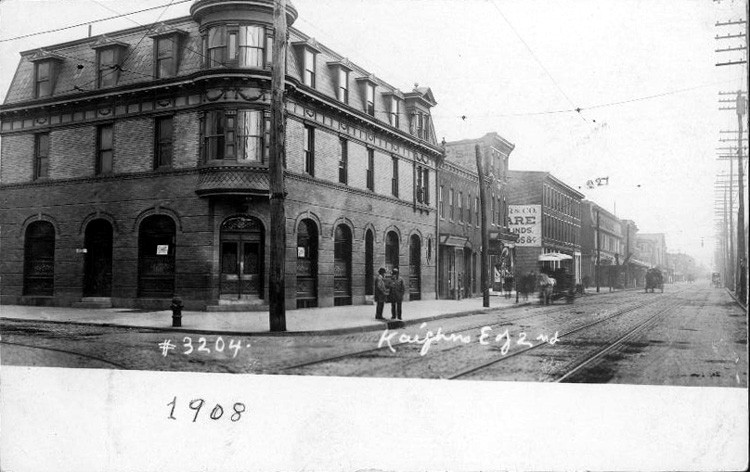
Kaighn Avenue east of North 2nd Street, 1908. The three story building on the corner is The Victoria Hotel.
William J. Cooper & Co., 1912–1913 Camden City Directory

Named: William J. Cooper & Co., Hardware, 217 to 221 Kaighn Avenue, 1912, and 1913 Camden City Directory.
William J. Cooper Company, 1928
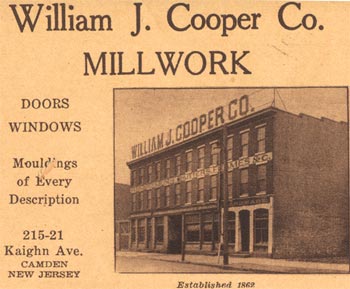
William J. Cooper Company, Kaighn Avenue, 1928
Want Property for Wharves
Philadelphia Inquirer —
Camden’s Board of Trade has received much support from the local business men in connection with the contemplated project for the city to purchase the extensive Dialogue property. Located below Kaighn’s Point and of considerable area, the property is looked upon as ideal for the establishment of municipal wharves. A special committee of the board, including Charles S. Boyer, George M. Beringer, William J. Cooper and Charles M. Curry, has been looking into the proposition and it was stated yesterday that the movement will shortly be brought to a focus. At present the property is in the hands of a receiver and the committee believes it could be purchased at better advantage than if a private corporation was in possession.
Mary J. Ball Home and Day Nursery
Philadelphia Inquirer —
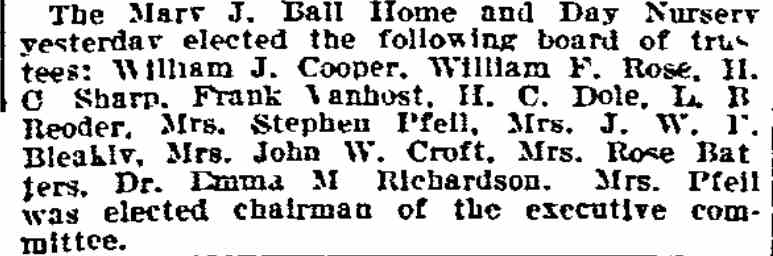
The Mary J. Ball Home and Day Nursery yesterday elected the following board of trustees: William J. Cooper, William F. Rose, H. C. Sharp, Frank Vanhost, H. C. Dole, L. B. Reoder, Mrs. Stephen Pfeil, Mrs. J. W. F. Bleakly, Mrs. John W. Croft, Mrs. Rose Batters, Dr. Emma M. Richardson. Mrs. Pfeil was elected chairman of the executive committee.
Gets Same Sentence as Partner in Crime
Philadelphia Inquirer —
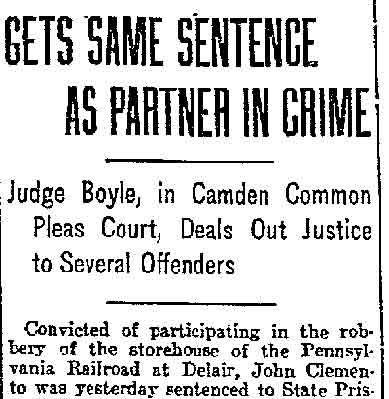
Judge Boyle, in Camden Common Pleas Court, Deals Out Justice to Several Offenders
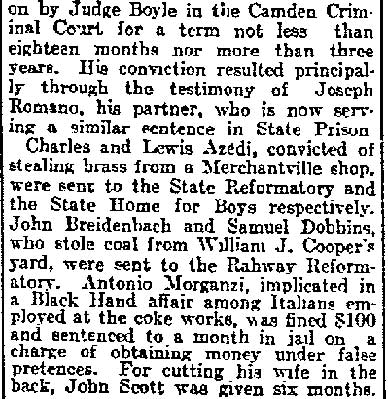
Convicted of participating in the robbery of the storehouse of the Pennsylvania Railroad at Delair, John Clemento was yesterday sentenced to State Prison by Judge Boyle in the Camden Criminal Court for a term not less than eighteen months nor more than three years. His conviction resulted principally through the testimony of Joseph Romano, his partner, who is now serving a similar sentence in State Prison.
Charles and Lewis Azedi, convicted of stealing brass from a Merchantville shop, were sent to the State Reformatory and the State Home for Boys respectively. John Breidenbach and Samuel Dobbins, who stole coal from William J. Cooper’s yard, were sent to the Rahway Reformatory. Antonio Morganzi, implicated in a Black Hand affair among Italians employed at the coke works, was fined $100 and sentenced to a month in jail on a charge of obtaining money under false pretences. For cutting his wife in the back, John Scott was given six months.
215–221 Kaighn Avenue, June 1932
Camden Courier-Post —
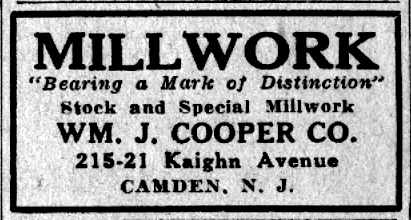
MILLWORK — “Bearing a Mark of Distinction”
Stock and Special Millwork
WM. J. COOPER CO. — 215–21 Kaighn Avenue, Camden, N.J.
Model Kitchens Increase in Favor
Camden Courier-Post —
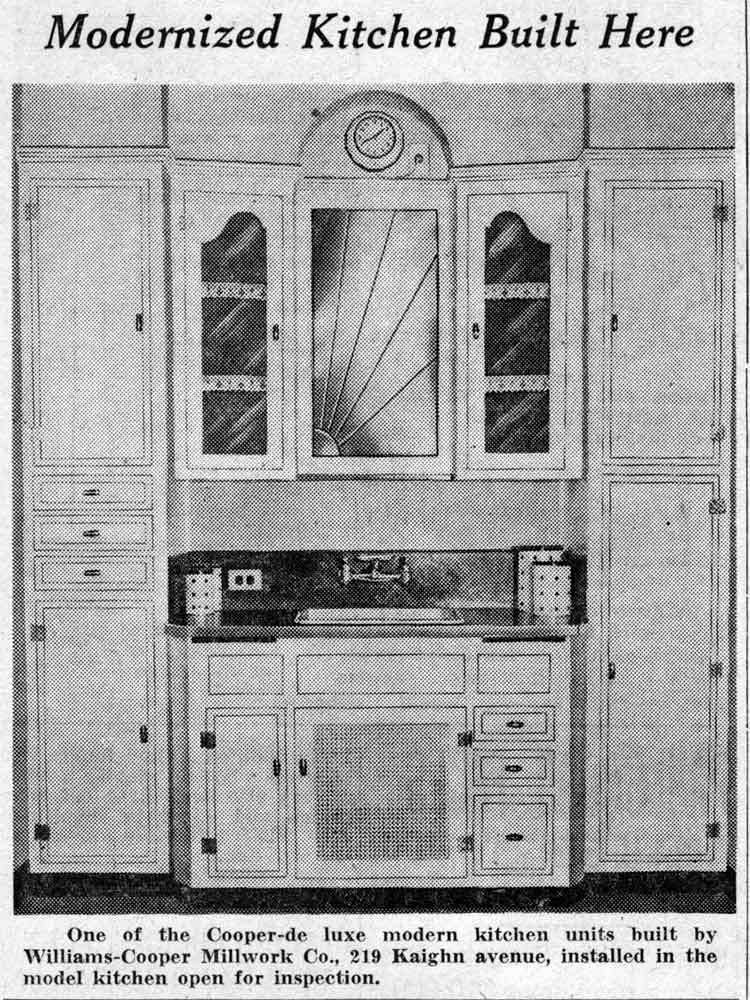
The increasing popularity of modernized kitchens has encouraged many concerns to enter into the manufacture of various styles of cabinets and utility sets. While there are numerous stock styles available, the public seems to favor the custom built styles which are made to fit any size or shape of kitchen and can also embody certain modifications of the individual housewife.
Williams-Cooper Millwork Co., 219 Kaighn avenue, has built and installed a number of these units during the past few months. John P. Williams, manager of the company, designs the units.
Compactness is the keynote of these sets, and it doesn’t matter how many openings, chimney corners, radiators, heating pipes, or other projections, there are in the room to be modernized.
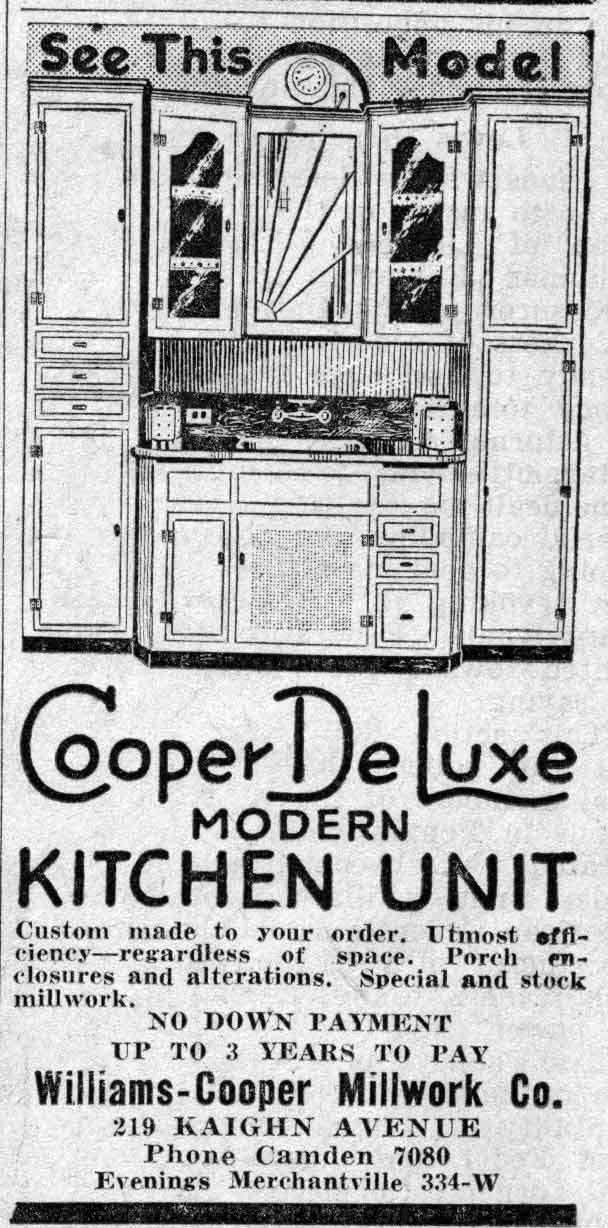
A complete model kitchen has just been completed by the firm and may be inspected. A room within has a full-length mirror tending completely across one end. A stainless steel sink and double drainboard is centered between an upright utility cabinet on either side. A modernistic mirror is placed over the sink in the top center and is flanked on each side by glass door china cabinet. Under the sink is a ventilated cupboard for general storage. Silver drawers and a built-in bread compartment are to the right and an additional storage compartment on the left. Two sliding boards are available for cutting bread or vegetables. The cabinet is designed to provide a space for every kitchen item from the smallest fork or glass to tall brooms, mops and vacuum cleaner.
A pullman storage prop leaf shelf is placed on the left wall. The radiator and heating pipes are covered with an additional cabinet for dishware and several drawers. Linoleum plays an important part in the completion of these modern kitchens. The display has covered ceiling, side walls and floor, all worked out in attractive patterns as executed by William S. Holmes.
Williams was superintendent for the William J. Cooper Millwork Co. for eight years. The company closed down several years ago and was later reopened by Williams. The company manufactures porch enclosures, does alteration work, and supplies special and stock millwork. Convenient arrangements are made on all jobs with no down payment required and upward to three years to pay.