Introduction
SOLOMON CLARK was born in New Jersey in 1842. He appears in the 1850 and 1860 Censuses, living with his mother, Hannah Clark, in Camden’s South Ward.
Solomon Clark appears to have enlisted in the Union Army with the 19th Regiment, United States Colored Troops, and subsequently served in the United States Navy as a Landsman aboard the USS North Carolina.
The first USS North Carolina was a 74-gun ship of the line in the United States Navy.
One of the “nine ships to rate not less than 74 guns each” authorized by Congress on April 29, 1816, she was laid down in 1818 by the Philadelphia Navy Yard, launched on September 7, 1820, and fitted out in the Norfolk Navy Yard. Master Commandant Charles W. Morgan was assigned to North Carolina as her first commanding officer on June 24, 1824.
While nominally a 74-gun ship, a popular size at the time, North Carolina was actually pierced (had gun ports for) 102 guns, and probably originally mounted ninety-four 42-pounder (19 kg) and 32-pounder (15 kg) cannons. In 1845, she had fifty-six 42-pounders (19 kg), twenty-six 32-pounders (15 kg), and eight 8 in (200 mm) cannons, for a total of 90.
Considered by many the most powerful naval vessel then afloat, North Carolina served in the Mediterranean as flagship for Commodore John Rodgers from April 29, 1825 to May 18, 1827. In the early days of the Republic, as today, a display of naval might brought a nation prestige and enhanced her commerce. Such was the case as Rodgers’ squadron which laid the groundwork for the 1830 commercial treaty with Turkey opening ports of the Eastern Mediterranean and the Black Sea to American traders.
After a period in ordinary at Norfolk, North Carolina decommissioned on October 30, 1836 to fit out for the Pacific Squadron, the one other area where ships of her vast size could be employed. Only the Mediterranean and the western coast of South America at that time offered ports which could accommodate ships of great draft. Again flagship of her station, flying the pennant of Commodore Henry E. Ballard, North Carolina reached Callao, Peru on May 26, 1837. With war raging between Chile and Peru, and relations between the United States and Mexico strained, North Carolina protected the important American commerce of the eastern Pacific until March 1839. Since her great size made her less flexible than smaller ships, she returned to the New York Navy Yard in June, and served as a receiving ship until placed in ordinary in 1866. She was sold at New York on October 1, 1867.
Solomon Clark returned to Camden after his military service. He married in the mid-1860s. Solomon Clark was living on Chew’s Court in South Camden when the 1872 City Directory was compiled, working as a laborer.
In November of 1872 Solomon Clark was elected First Lieutenant in one of the companies of the Eight Regiment, Colored of the New Jersey National Guard.
Solomon Clark was appointed to the Camden Fire Department as an extra man with Engine Company 1 on April 8, 1877. He was the first African-American to serve as a member of the Camden Fire Department. Solomon Clark was then living at 918 South 3rd Street. He was reappointed in 1878 and again in 1879. By that time he had moved to 246 Spruce Street.
The 1880 Census shows Solomon Clark and his wife Lydia at 246 Spruce Street, working as a laborer. He was then the father of two daughters, Laura, 14, and Rachel, 6. The family stayed at this address through 1882. The 1883–1884 City Directory shows Solomon Clark running a cigar store and living at 307 Spruce Street. He next appears in City Directories in 1888, when he was working as a laborer again and living at 309 Division Street. Solomon Clark had moved to 312 Spruce Street by the time the 1890–1891 Directory was being compiled. The 1894–1895 and 1895–1896 edition show Solomon Clark at 248 Spruce Street. He was approved for a Civil War pension in 1896 and was granted an increase from $6.00 per month to $8.00 in May of 1898. The 1896 Directory shows him at 842 Locust Street. He is listed at 327 Cherry Street in the 1897 and 1898 Directories.
Solomon Clark last appears in City Directories in 1898. On September 21, 1898 Solomon Clark passed away. He was buried at Johnson Cemetery in East Camden.
Military
Philadelphia Inquirer —
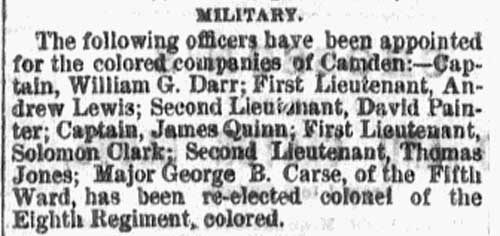
The following officers have been appointed for the colored companies of Camden:—Captain, William G. Darr; First Lieutenant, Andrew Lewis; Second Lieutenant, David Painter; Captain, James Quinn; First Lieutenant, Solomon Clark; Second Lieutenant, Thomas Jones; Major George B. Carse, of the Fifth Ward, has been re-elected colonel of the Eighth Regiment, colored.
Extra Firemen Appointed
Philadelphia Inquirer —
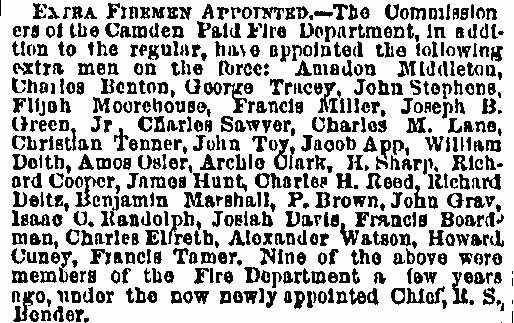
Extra Firemen Appointed.—The Commissioners of the Camden Paid Fire Department, in addition to the regular, have appointed the following extra men on the force: Amadon Middleton, Charles Benton, George Tracey, John Stephens, Elijah Moorehouse, Francis Miller, Joseph B. Green, Jr., Charles Sawyer, Charles M. Lane, Christian Tenner, John Toy, Jacob App, William Deith, Amos Osler, Archie Clark, H. Sharp, Richard Cooper, James Hunt, Charles H. Reed, Richard Deitz, Benjamin Marshall, P. Brown, John Grav, Isaac O. Randolph, Josiah Davis, Francis Boardman, Charles Elfreth, Alexander Watson, Howard Cuney, Francis Tamer. Nine of the above were members of the Fire Department a few years ago, under the now newly appointed Chief, R. S. Bender.
The Primaries.
Camden Daily Courier —
THE PRIMARIES.
MORRIS HALLOCK SECURES A LARGE MAJORITY OF DELEGATES.
His Nomination on the First Ballot Assured—Contest in the Wards and Townships Described.
For months past the voters of Camden City and County have been discussing the claims of the two candidates who are well known and who are contesting for the County Collectorship. Morris Hallock, who is President of the Board of Freeholders, and ex-Mayor William H. Banks, of Gloucester City, are the aspirants.
Last night the Republican voters of the wards of Camden, the townships and the borough of Merchantville met for the purpose of electing three delegates each, to represent them in the County Convention, to be held at the Court House, on next Thursday at 2 P. M., to place in nomination a candidate for County Collector.
In the First, Second, Third, Seventh, Eighth wards, and in the townships of Haddon, Winslow and in Merchantville, the supporters made no fight whatever, there being but one set of delegates presented, and that being Mr. Hallock’s.
Below we print the names of the delegates who were elected in the various wards and townships:
First Ward.—Charles Adams, E. S. King, Jonathan D. Watson.
In this ward Mr. Hallock had no opposition, electing his candidates unanimously.
Second Ward.—J. Willard Morgan, Benjamin F. Sweeten, Thomas Beatty.
Mr. Banks did not make any fight in this ward. Hallock electing his delegates without any opposition.
Third Ward.—Harry H. Franks, James Wilkinson, William Shedaker.
As in the two preceding wards, Mr. Banks did not place any ticket in the field in the Third.
Fourth Ward.—B. Frank Sutton, Benjamin M. Kellum, George W. Johnson.
Mr. Hallock’s friends worked hard for their candidate in this ward, and succeeded in electing their candidate by about 200 majority.
Fifth Ward.—John D. Leckner, John R. McCabe, William Butts.
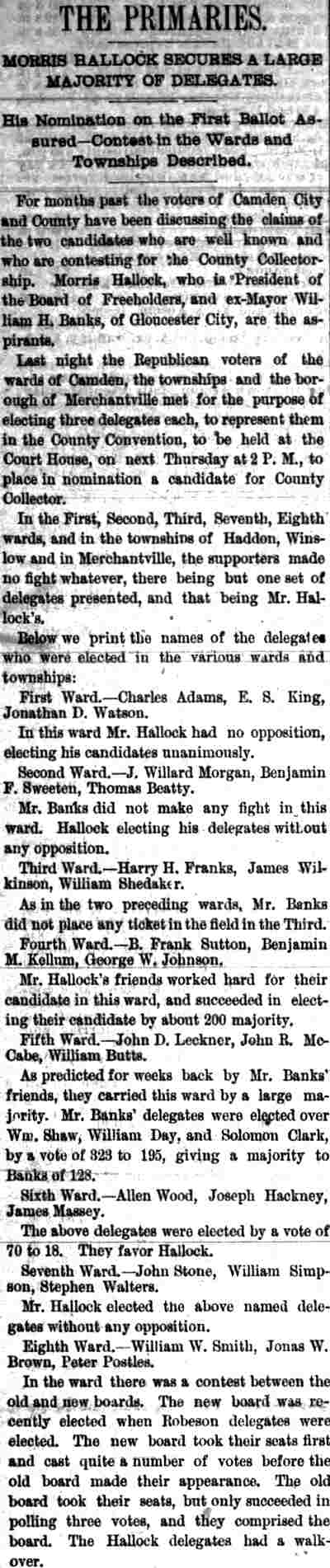
As predicted for weeks back by Mr. Banks’ friends, they carried this ward by a large majority. Mr. Banks’ delegates were elected over Wm. Shaw, William Day, and Solomon Clark, by a vote of 323 to 195, giving a majority to Banks of 128.
Sixth Ward.—Allen Wood, Joseph Hackney, James Massey.
The above delegates were elected by a vote of 70 to 18. They favor Hallock.
Seventh Ward.—John Stone, William Simpson, Stephen Walters.
Mr. Hallock elected the above named delegates without any opposition.
Eighth Ward.—William W. Smith, Jonas W. Brown, Peter Postles.
In the ward there was a contest between the old and new boards. The new board was recently elected when Robeson delegates were elected. The new board took their seats first and cast quite a number of votes before the old board made their appearance. The old board took their seats, but only succeeded in polling three votes, and they comprised the board. The Hallock delegates had a walk-over.