Auburn Street
Auburn Street is a small street that runs from Broadway to South Sixth Street between Benson and Washington Streets. There were 19 homes on Auburn Street, beginning with 558 and ending at 594.
Much of Auburn Street was redeveloped by “urban homesteaders,” private individuals who came to Camden in the 1980s and 1990s. The new homeowners demanded proper city services, and for this reason, they were perceived as a threat by those in charge of the Camden City Democratic Organization during these years. The new homeowners were harassed out of town, and finally chased out of town when, through eminent domain, the City of Camden seized all the properties on Auburn Street.
A recent visit shows more neglect than utilization, other than by those drinking or using illegal drugs.
1946 Map of Camden
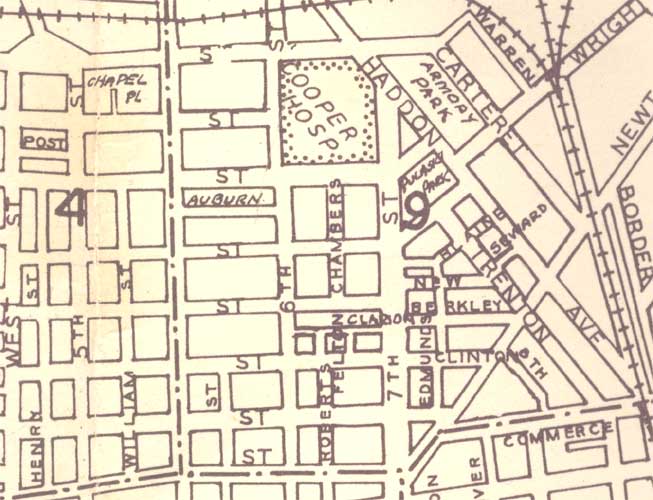
1946 map of Camden. Auburn Street runs from Broadway to South Sixth Street between Benson Street and Washington Streets, just southwest of Cooper Hospital, in the center of the map.
564 Auburn Street — George Zimmerman
Philadelphia Inquirer —

Dogs sent George Farmer, 46 years old, of 978 Woodland avenue, and George Zimmerman, 5 years old, of 564 Auburn street, to the Cooper Hospital yesterday. Farmer was bitten on the arm, while the boy had his wrist torn.
Blackened the Faces of Bride and Groom
Philadelphia Inquirer —
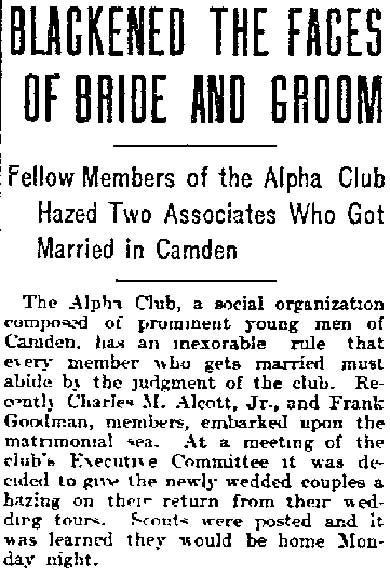
Fellow Members of the Alpha Club Hazed Two Associates Who Got Married in Camden
The Alpha Club, a social organization composed of prominent young men of Camden, has an inexorable rule that every member who gets married must abide by the judgment of the club. Recently Charles M. Alcott, Jr., and Frank Goodman, members, embarked upon the matrimonial sea. At a meeting of the club’s Executive Committee it was decided to give the newly wedded couples a hazing on their return from their wedding tours. Scouts were posted and it was learned they would be home Monday night.
Mr. and Mrs. Alcott had just been installed in their new home at 584 Auburn street when thirty of the members preceded by a fife and drum corps swooped down on the house. Escape was impossible and Mr. and Mrs. Alcott surrendered good naturedly. Mr. and Mrs. Alcott were marched through the streets to the home of Mr. and Mrs. Charles M. Alcott, Sr., 527 Benson street, where the bride was compelled to call Mr. Alcott, Sr., “papa.” On the return to the Auburn street house the faces of bride and groom were blacked with burnt cork.
By this time it was 1 o’clock in the morning, and it was decided to visit Mr. Goodman’s home at 609 Walnut street. Some of the club members got tired of waiting to be admitted and climbed in the second story back window. By this time the bride came down stairs and opened the front door.
An impromptu concert was held in the back yard. The festivities were kept up until the roosters began to crow to the great delight of a large crowd that was attracted by the unusual proceedings.
588 Auburn Street — Luvenia Dolson
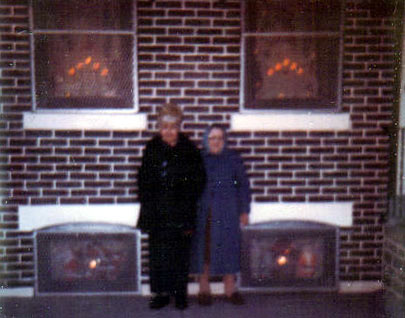
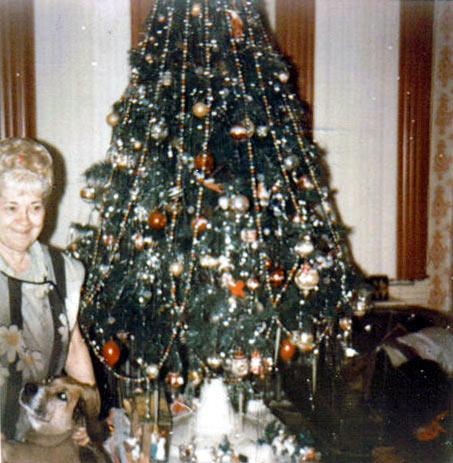
Luvenia “Vennie” Dolson, 588 Auburn Street, 1940s–1970s.
Auburn Street
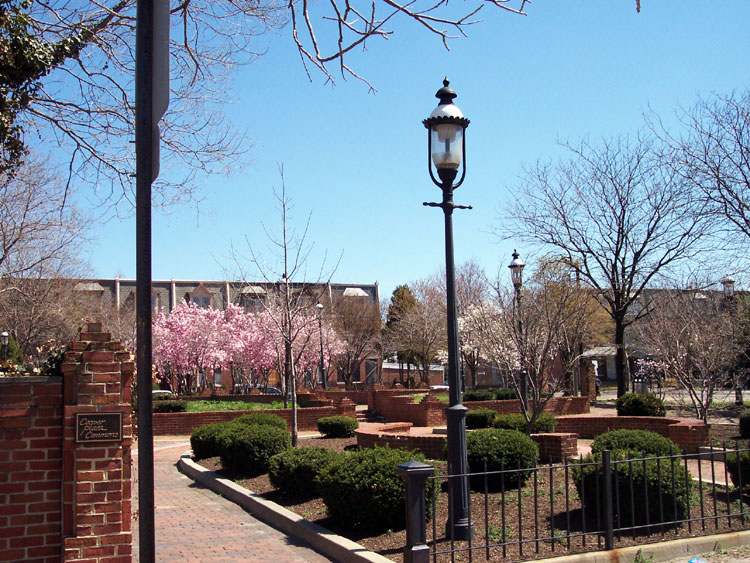
Auburn Street, April 2005.
582 Auburn Street
By Lois McCall (Teer) Seeligsohn —
I was born in Parkside in 1933, and lived there until 1944. I was 11 years old, when our rented house at 1039 Princess Ave., and hundreds of others citywide, were sold to accommodate the workers who poured into Camden for war-related jobs at the N.Y. Ship Yard, RCA, and other defense-connected companies. My parents told me I mustn’t cry, because our house was going to help America win the war. But I sobbed my heart out, as our black 1936 Chevy followed the moving van as though it behind a hearse. My mother’s face was turned resolutely toward the window and my father blew his nose repeatedly, as we moved out. Out of the place where I was born, went to school and church, and played in the back lots. Out from the place where they called my dad “Spike,” because he played a brilliant shortstop on Parkside’s sandlot team. Away from the place where every kid had a dozen mothers, and every mother was home after school. The place where the cop on the corner, the grocer, the huckster, the air raid warden —— EVERYONE — knew my name.
For nearly 40 years, my heart grieved for Camden. But, I always knew that, some day, I would go “home” again. And in 1979, I joined a thin, but hardy stream of naive pioneers who bought and rehabbed abandoned houses in the Cooper Plaza neighborhood — most with their own hands. Divorced, with grown children, I was confident that, between the established residents and the as-yet undiscouraged upwardly-mobile new home owners, our community would be just the beginning of Camden’s inevitable renaissance. I spent my last dime, and mortgaged what was left of my future, on a wreck of a row house at 582 Auburn St. When it was finished, it was the pride of my life and featured in the New York Times and other publications.
I was elected president of the Cooper Plaza Neighborhood Association, whose members relentlessly hounded politicians, police, and public works in organized campaign to force them to do their jobs better. And we pitched right in with them. We formed a Neighborhood Watch to intimidate hookers and hustlers, with our walkie-talkies, cameras, flashlights and dogs for those of us who owned them or loaned them. We initiated Neighborhood Pride Days and awarded prizes for the cleanest, most improved blocks. On Pride Days, public works trucks hauled away hundreds of tons of trash, weeds, junk, beer cans, broken bottles, condoms and dead dogs, all handpicked on blistering hot Saturdays by the hardworking ladies, gentlemen and teens of Cooper Plaza.
Who says Camden people “don’t care?” We gave cash awards to students who exemplified community service in their lives. We gave banquets for public servants and volunteers who went above and beyond their duty to serve the community. We had a newsletter and a crisis telephone tree, so that, in seconds, every call to police became 10 calls — 20 — until eventually they tired of it and came, lights flashing, at the first call. It was the hardest job I ever loved! I was never more exhausted in my life — and never happier or prouder.
But this sudden infusion of optimistic, “can-do” carpetbaggers “stirred things up,” according to city hall power brokers, and made them very nervous. They liked taxpayer malaise just fine, thank you, and they didn’t appreciate us trying to change Camden, even if it were only one house and one block at a time. We began hearing from building inspectors, health and social workers, tax assessors, code enforcement officials — and other city hall drones who hadn’t raised a dozing head off their desks for 20 years. And they were damned cranky about it.
I gutted my house down to the bare brick walls. An award-winning architect redesigned it and licensed contractors rebuilt after obtaining the proper city permits. Every inch of the house was new — built with top-of-the-line building materials, plumbing and lighting, strictly according to code and historic guidelines. When I asked one inspector whether he expected me to pay him money, he signaled his answer with a complacent stare. I told him where he could put his list and, by the time I won the battle I had lost the war. Interest rates went up 6% in three months.
It wasn’t enough that hard-working, public-spirited tax payers couldn’t get any of those low-interest homesteading loans city officials talked so much about. Or that we got stony silence to hundreds — maybe thousands of letters, phone calls, faxes and visits. We demonstrated, rallied, circulated petitions — even held press conferences in front of abandoned houses owned by well-connected politicians (and “overlooked” by code enforcers). We were persistent burrs under the political saddle. And they retaliated by treating us like pariahs, rather than embracing us as new blood.
One-by-one the once enthusiastic pioneers began to walk away broken hearted from their grand experiments. And Auburn Street? Oh, all 26 homes, many owner occupied, were taken by eminent domain and bulldozed into oblivion last year [2001] — part of Camden’s ongoing policy of “urban removal” that forces independent home owners out and keeps the poor and powerless in.
After 15 years of trying, most of the “pioneers” were gone and beaten, I followed like our old ’36 Chevy. Burned out and brokenhearted, I kissed the threshold of my little dream house, locked the door and, sobbing, I walked away from Camden. Again.
Memories of Auburn Street
I remember joyful days visiting Auburn St. frequently in 1957 and 1958. I was about ten years old. Spent time there other years but 57 and 58 were most memorable. Used to visit my Aunt Edna and Uncle Harry Bryant. Spent many days just hanging out on the front step, played outdoor games and Monopoly in the evening. What a gossip mill! You may think today’s e-mail is fast but the gossip passed from one end of the street to the other seemingly at the speed of light. Every one it seemed sat out-front on the steps or porch, if you were lucky. Tragedy struck about 1958, Uncle Harry passed. It happened at work in the Camden Rail Yards, totally unexpected. Left Aunt Edna and Cousin Evelyn and George on their own. No big life-insurance policies in those days. George left home to marry and stayed in Camden at least 25 to 30 years in Fairview. Aunt Edna and Evelyn moved to the Fairview section and lived there until passing. Bryant family were faithful Camden residents. The kind of people who are the backbone of any city. May they rest in peace.
— Eli Conaghy Jr., October 19, 2009
Auburn Street (1 block between Broadway and South 6th) is now a parking lot on the South side and the back of the houses on Benson Street is on north side.
— Craig Campbell, November 2005
Auburn Street — Addresses
City directory records, 1890s–1994.
558 Auburn Street
| Year ↕ | Name ↕ |
|---|---|
| 1947 | John Barr |
560 Auburn Street
| Year ↕ | Name ↕ |
|---|---|
| 1947 | Roy Holshue |
562 Auburn Street
| Year ↕ | Name ↕ |
|---|---|
| 1947 | George M. Arnold |
564 Auburn Street
| Year ↕ | Name ↕ |
|---|---|
| 1912–1913 | Edward Zimmerman & Family — Edward & May Zimmerman, George Zimmerman |
| 1947 | Louis A. Braun |
566 Auburn Street
| Year ↕ | Name ↕ |
|---|---|
| 1947 | Mrs. Mary A. Matthes |
568 Auburn Street
| Year ↕ | Name ↕ |
|---|---|
| 1947 | Winifred Widman |
570 Auburn Street
| Year ↕ | Name ↕ |
|---|---|
| 1947 | Joseph Charizkiewicz |
572 Auburn Street
| Year ↕ | Name ↕ |
|---|---|
| 1947 | Harry K. Bryant |
574 Auburn Street
| Year ↕ | Name ↕ |
|---|---|
| 1947 | John H. McDermitt |
| 1954–c. 1980s | Edmund J. Powell & Family |
| 1954–late 1980s | Tina Powell |
576 Auburn Street
| Year ↕ | Name ↕ |
|---|---|
| 1904 | William Meyer & Family |
| 1904 | Captain Howard J. Meyer |
| 1947 | Homer Kennon |
578 Auburn Street
| Year ↕ | Name ↕ |
|---|---|
| 1947 | Mrs. Lillian Foster |
580 Auburn Street
| Year ↕ | Name ↕ |
|---|---|
| 1947 | George S. Boan |
582 Auburn Street
| Year ↕ | Name ↕ |
|---|---|
| 1947 | Harry Bryant |
| 1979–1994 | Lois McCall (Teer) Seeligsohn |
584 Auburn Street
| Year ↕ | Name ↕ |
|---|---|
| 1907 | Charles M. Alcott Jr. & Family |
| 1907 | Charles & Hazel Alcott Jr. |
| 1947 | Mrs. Sarah Smith |
586 Auburn Street
| Year ↕ | Name ↕ |
|---|---|
| 1890s–1900s | Daniel J. Grimes Sr. |
| 1947 | Fred C. Brunott Jr. |
588 Auburn Street
| Year ↕ | Name ↕ |
|---|---|
| 1947 | Luvenna Dolson |
| 1940s–1970s | Luvenia 'Vennie' Dolson & Emma Miller |
590 Auburn Street
| Year ↕ | Name ↕ |
|---|---|
| 1947 | Irvin Pratz |
592 Auburn Street
| Year ↕ | Name ↕ |
|---|---|
| 1947 | Thomas D. Heinmann |
594 Auburn Street
| Year ↕ | Name ↕ |
|---|---|
| 1947 | Mina D. Butler |