The Rotary Club of Camden

Rotary Club of Camden
The Camden Rotary Club was organized under very favorable auspices. Two prominent residents of Camden City, members of the Philadelphia Rotary Club, Mr. Frederick Himmelein, Jr., and his son-in-law, Mr. William G. Oaks, took the initiative by calling a meeting on December 3, 1912, in Mr. Himmelein’s home. It was the 59th club chartered.
Twenty-five prominent citizens attended this first meeting. The group decided to apply for a charter from the National Office in Chicago, Illinois. At the second meeting, the Charter was received (the 59th Club of Rotary International) and ordered recorded in the proper State and County offices. Under the Charter, formal applications for membership were received from thirty-eight men, including those who were present at the first and second informal meetings. Ralph D. Baker was elected our first President.
The following are some highlights of our first year: The first regular monthly dinner meeting was held on January 7, 1913, at the Hotel Ridgeway. At the April meeting our Club began to “rotate” by holding the monthly meetings at Howard Dudley’s store. The first Club roster was prepared for the June meeting. Our first “Ladies Night” was held on November 11, 1913, with a dinner at Howard Dudley’s store, after which the group attended the Broadway Theater. We closed our first year with a total membership of ninety-one. On August 4, 1914, the first edition of our present publication, “The Hub,” was issued. Another milestone came in February 1917 when the Club decided to establish a Sinking Fund for emergency purposes. A board of Trustees was established to manage the investments. December 1, 1922, was the birthday of the Student Loan Fund started with donations from individual members and $500.00 from the club Treasury.
Charter Members
| F. Stanley Bleakly | Thomas S. Pancoast | Edward Bennett |
| Enos B. Dellmuth | V. M. Fulton | Lewis Goerlick |
| A. F. J. Dorn | Leslie S. Fithian | Oscar N. Hinski |
| William E. Morgenweck | Sig Schoenagle | Dr. Lee E. Griscom |
| Frank J. Hartmann Sr. | William Deputy | Frank Twiner |
| Edward A. Preisendanz | James J. Scott | Dr. A. B. Dewees |
| Earl J. Jackson | William J. Strandwitz | George E. Boyer |
| Ralph D. Baker | John H. Heaton | William Cline |
| William G. Hodson | Frank Peterson | William W. Morton |
| William J. Hussong | Hubert H. Pfeil |
Camden Board of Trade and Civic Organizations
Philadelphia Inquirer —
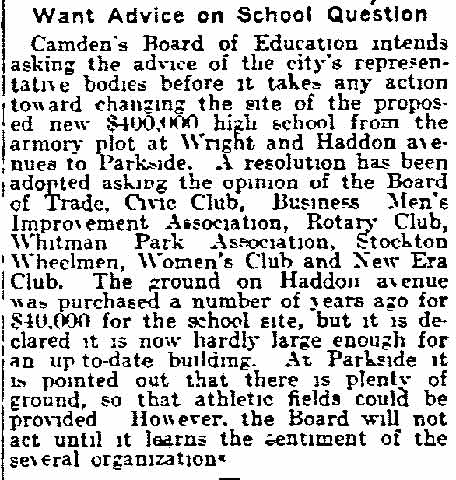
Named: Camden High School, Wright Avenue, Haddon Avenue, Parkside
Camden Board of Trade, Camden Civic Club, Camden Business Men’s Improvement Association
Camden Rotary Club, Whitman Park Association, Stockton Wheelmen, Camden Women’s Club, New Era Club
Click on Image for PDF File of Complete Article, and Philadelphia Inquirer, April 28, 1915.
Rotary Club Told of Industrial Drive
Camden Courier-Post —
C. of C. Secretary Outlines Plan to Make Comprehensive Survey
An industrial campaign for the purpose of inducing new business industries to locate in Camden will be part of the program of the Chamber of Commerce for this year, Loyal D. Odhner, secretary of the Chamber of Commerce, told members of the Rotary Club at a luncheon today in the Hotel Walt Whitman.
Odhner’s outline of the chamber’s program, which included an industrial survey for the purpose of determining possibilities for new manufacturers and improving present business facilities, was approved by Francis B. Wallen, new president of the Chamber of Commerce, who attended the luncheon.
“During these last five years, Camden has had little or no industrial growth. Manufacturers have either chosen other localities in preference to us or else they have not even thought of us. I prefer to believe the latter is the case. Our first step, then is to make our city more appealing to the industrial prospect. This can be accomplished by an industrial campaign with the cooperation of all business forces.
“I am confident that before this year ends you will see the resources of this community mobilized into one of the greatest campaigns for new industries that has ever been waged in America.
“In conducting this campaign,” said Odhner, “we must not lose sight of the fact that port facilities will be a point of leading interest to the prospective manufacturer. The patronage which our present pier is receiving is only a small indication of the value to our city of adequate port facilities. The port improvement program must proceed with all haste.
Urged to Aid Movement
Odhner urged members of the Rotary Club to get behind a movement to organize a force to meet the financial problems that will accompany the advent of new industries.
“With our survey completed,” Odhner continued, “our next step will be to determine the type of industries that can locate in Camden most profitably to themselves and to the community.
“Another important step will be to interest the people of our own city so they will report to us any new firms contemplating a change of location. Most cities which have conducted effective industrial expansion have secured their best leads from their own people.
“Still another step is well-advised selective advertising, confined to those mediums which actually receive the attention of business executives.”
Odhner said that as a preliminary step in the campaign it is the intention of President Wallen to ask all of Camden’s neighboring towns to join with her in this movement.
“Sometime in March,” he said, “it is hoped a meeting of all leaders of surrounding communities will be held for the purpose of forming a Greater Camden Chamber of Commerce.”
Rotary Club Lends to 16 College Boys
Camden Courier-Post —
Eight Camden Youths, Now Graduates, Are Repaying Loans
Eight Camden boys last September were able to continue their studies in college and universities because, back in 1923, a Camden service club established a loan fund to aid worthy students.
Eight Camden boys, graduates of college, now are repaying various amounts of money advanced them from the College Loan Fund of the Camden Rotary Club. Five years ago, the club raised by subscription among its members a fund of $2,500. This has been augmented each year by appropriations from the club funds, and now the college loan fund amounts to nearly $5,000.
College and university students, both boys and girls, from Camden County, are eligible to borrow.
The fund is administered by a board of trustees, including Dr. George M. Beringer, chairman; Arthur E. Armitage, Treasurer; Charles H. Wagner, George Vollner, and Edward A. Mechling.
No interest is charged until one year after graduation. It is the hope of the Rotary Club that loans will be re-paid “first obligation” during the “first year out.”
Of the sixteen students helped by the fund, four have gone to Syracuse University, two each to Gettysburg, Lehigh and Springfield and one each to George Washington University, University of Delaware, Rutgers, Swarthmore, Cornell and the Silver Bay School.
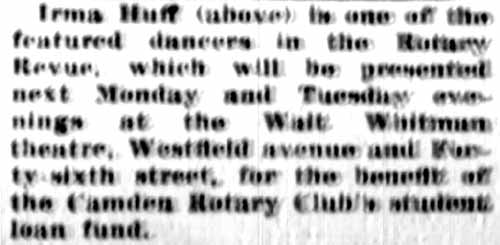
To add to this fund the Rotary Club will produce during the centennial celebration in Camden next month one of the most elaborate semi-professional shows ever staged in this region. This “Rotary Revue” will be staged at the New Walt Whitman Theatre, Forty-eighth Street and Westfield Avenue, February 27 and 28.
William M. Ogden, product of the dramatic school of Syracuse University and a protégé of Miss Lucy Dean Wilson, is in charge of the production. It will feature, among other acts, the Newton Coal Serenaders, who are well known from their frequent weekly radio broadcasts of the Newton Coal Radio Forum. Through the generosity of Charles A. Johnson, president of the George B. Newton Coal Company, Clarence Fuhrman, Camden musician, will be guest-conductor at both performances.
Rotary Club — January 31, 1928
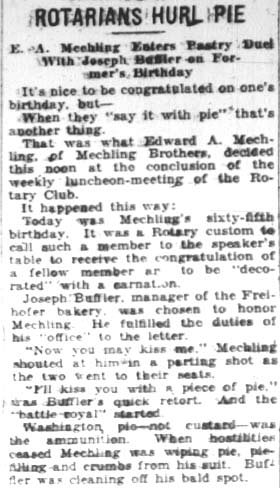
Whitman Vitaphone to Aid Rotary Revue
Camden Courier-Post —
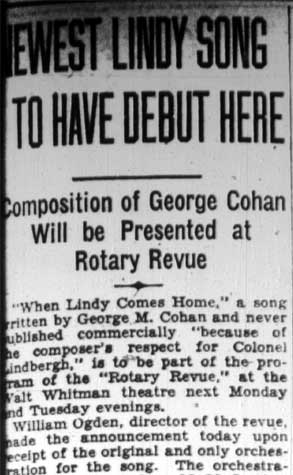
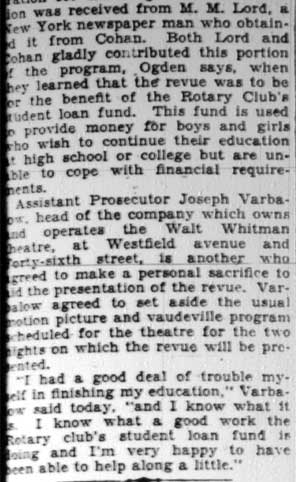
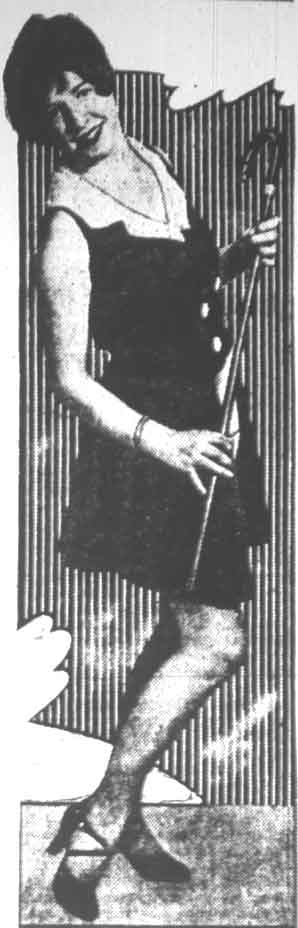
Joseph A. Varbalow — George M. Cohan — William Ogden — Walt Whitman Theater — Westfield Avenue — Camden Courier-Post, February 21, 1928
Whitman Vitaphone to Aid Rotary Revue
Camden Courier-Post —
Varbalow Behind Show, Praises Aims of Club; Fuhrman Will Conduct
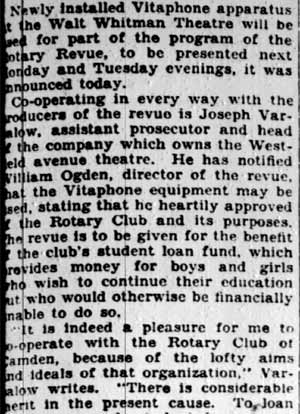
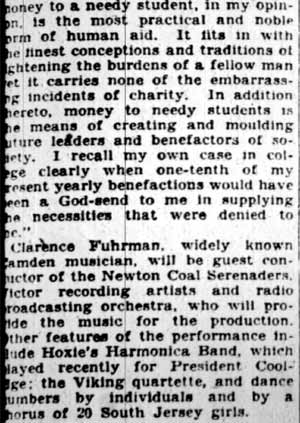
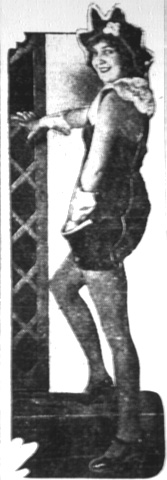
Howard J. Dudley — Rotary Club
Camden Courier-Post —
Howard Dudley Named to Head Rotary Club
HOWARD DUDLEY NAMED TO HEAD ROTARY CLUB
Howard J. Dudley, Broadway furniture merchant, was nominated yesterday as president of Camden Rotary Club at a meeting in Hotel Walt Whitman. He will succeed Arthur E. Armitage. As he is unopposed his election is assured.
The only contest for office will be for the vice presidency. Charles Wagner and George A. Wonfor were nominated for this office. Elections will be held the first meeting in May.
John H. Booth, who has been secretary of the club since its organization, will continue in that post. George Moore was nominated for treasurer, and Sam Biggins was named for the post of sergeant-at-arms. Nominees for directors are Raymond Hance, Thomas W. Pinder and Edward Shelmerdine, with three to be elected.
The club nominated nine members for the six posts of delegates to the district conference at Atlantic City early next month. The six delegates will be elected, from among Lyman Hall, Armitage, Dudley, Moore, Lisbooth, Wagner, Wonfor and Ralph Baker.
Francis B. Wallen — Rotary Club
Camden Courier-Post —
Hotel Walt Whitman — Francis B. Wallen — Camden Courier-Post, August 26, 1931
Camden Rotary Club — June 1, 1932
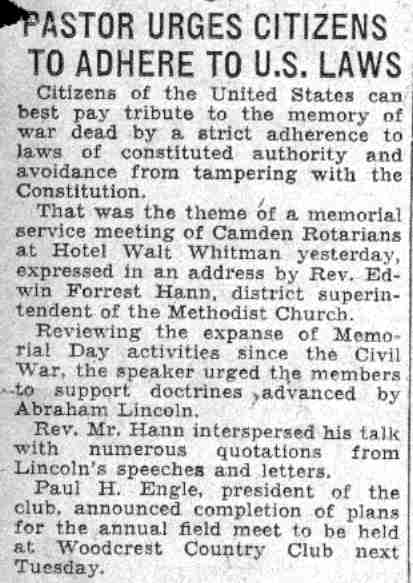
Hotel Walt Whitman — Camden Courier-Post, June 1, 1932
Joshua C. Haines — Rotary Club
Camden Courier-Post —
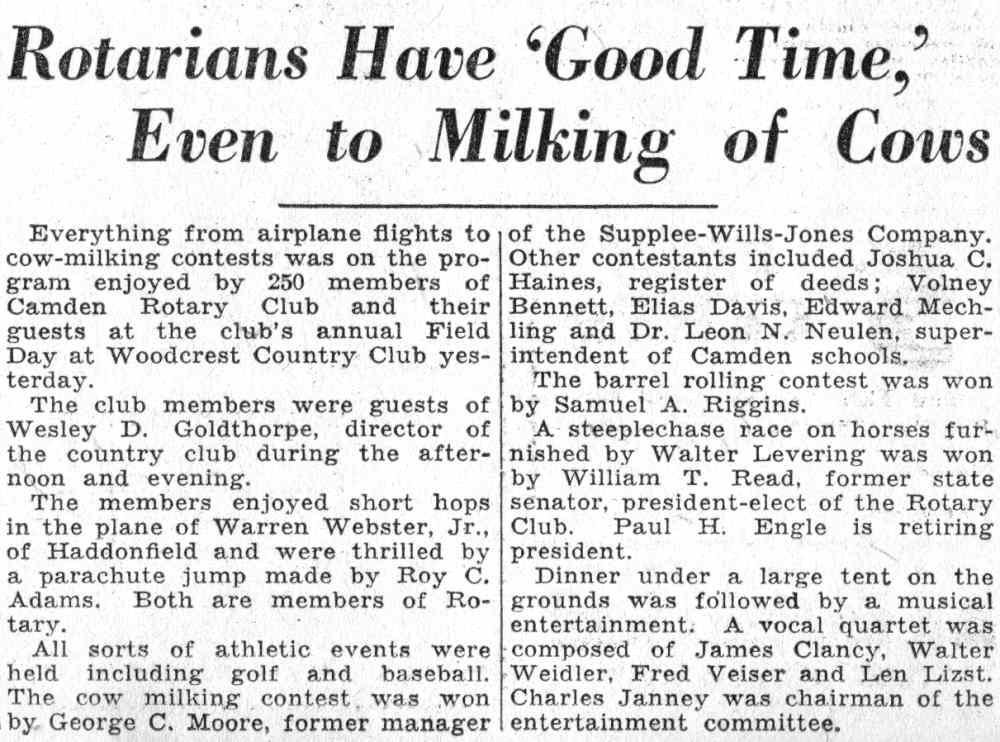
Named: Camden Rotary Club, Joshua C. Haines, Warren Webster Jr., Roy C. Adams, George C. Moore, Volney Bennett Jr., Elias Davis, Edward Mechling, Dr. Leon N. Neulen, Walter Levering, William T. Read, Paul H. Engle, James Clancy, Walter Widler, Frederick C. Veiser, Charles Janney, Len Liszt (Leonardo List), Samuel A. Riggins, Woodcrest Country Club, Supplee-Wills-Jones Company, and Camden Courier-Post, June 8, 1932.
Railroads Cited as Losing Business
Camden Courier-Post —
Cannot Compete With Modern Bus Transportation, Rotarians Told
Railroads have passed the peak of usefulness and practicability; in their place has come the modern highway systems with motorized vehicles. It is vitally necessary to meet the needs and demands of the United States and other progressive nations that the new form of travel be given every opportunity to make good.
So declared Judson C. Welliver, of Philadelphia, former newspaperman, author and publicist in speaking yesterday at the weekly meeting of the Camden Rotary Club in Hotel Walt Whitman.
“The new transportation has solved all the problems that the railroads have been unable to meet,” Welliver declared. “It needs neither rails, low grades or easy curves. It goes wherever business requires it.
“The railroad executives will say that the truck cannot handle heavy traffic. But they also complain that it is taking away their coal tonnage and handling half of the country’s livestock. And yet its very adaptability, responsiveness, flexibility, are the reasons why the railroads oppose it.
“The railroads make a virtue out of their own disabilities. They would have us believe that hardening arteries are the symptom of health. So they demand laws, to restrict motor carriers to particular routes and areas. They would deprive business of the very advantages inherent in highway operations.
“They want the motor vehicle’s rate fixed, and fixed so high that they can’t take business from the railroads.
“The railway age is being succeeded by the highway age. Will our country throttle and hamstring the new facility that everywhere else holds the key to the future? Our great area and long distances make transportation more important to us than to any other.
“A hundred years ago the railroad was given its chance. Indeed it was enormously subsidized with money and with land grants in area equal to Great Britain and the German Empire combined.
“The highway has asked nothing of that sort. Today, its special taxes are $1,200,000,000 a year; railroad taxes are one-fourth of that and the government is lending the money to pay them.”
Political Trading Is Hit by Woodruff
Camden Courier-Post —
Senator Tells Rotarians ‘Deals’ at Legislature Were Disheartening
Political trading at the session of the Legislature by persons fired with personal ambitions was scored yesterday in a speech by State Senator Albert S. Woodruff before the Camden Rotary Club in the Hotel Walt Whitman.
“It is true,” he said, “that there was a great deal of trading during the past session among persons ambitious and desirous of obtaining their own ends.
“This was very disheartening to those who go to the Legislature to work. However, much was accomplished, more than in any year in my experience.”
The senator then recounted the accomplishments of the lawmakers, telling of legislation suspending mandatory salaries and other expenditures for the municipalities; emergency acts before and during the bank holiday crisis, and the plan to aid financially stricken school districts through sale of $12,000,000 in Camden Bridge bonds.
Senator Woodruff mentioned no names when he charged “trading” among legislators.
During the session, Senate President Emerson L. Richards, of Atlantic, candidate for the Republican nomination for governor, was attacked on several occasions for alleged “deals” with Democrats.
Former U. S. Senator David Baird, Jr., and Vice Chancellor Francis B. Davis, of Woodbury, attended the luncheon but neither spoke. William T. Read, former state senator and president of the club, presided.
Camden Rotary Club — May 2, 1934
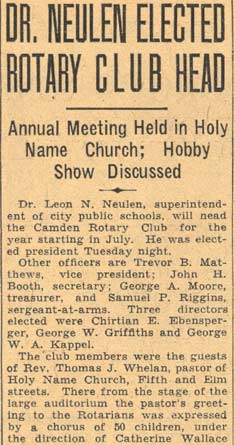
DR. NEULEN ELECTED ROTARY CLUB HEAD
Annual Meeting Held in Holy Name Church; Hobby Show Discussed
Dr. Leon N. Neulen, superintendent of city public schools, will head the Camden Rotary Club for the year starting in July. He was elected president Tuesday night.
Other officers are Trevor B. Matthews, vice president; John H. Booth, secretary; George A. Moore, treasurer, and Samuel P. Riggins, sergeant-at-arms. Three directors elected were Chirtian [sic] E. Ebensperger, George W. Griffiths and George W. A. Kappel.
The club members were the guests of Rev. Thomas J. Whelan, pastor of Holy Name Church, Fifth and Elm streets. There from the stage of the large auditorium the pastor’s greeting to the Rotarians was expressed by a chorus of 50 children, under the direction of Catherine Wallace and Anne McHugh, in song and dance.
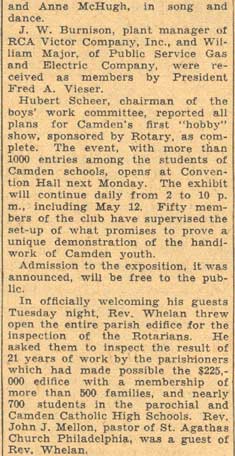
J. W. Burnison, plant manager of RCA Victor Company, Inc., and William Major, of Public Service Gas and Electric Company, were received as members by President Fred A. Vieser.
Hubert Scheer, chairman of the boys’ work committee, reported all plans for Camden’s first “hobby” show, sponsored by Rotary, as complete. The event, with more than 1000 entries among the students of Camden schools, opens at Convention Hall next Monday. The exhibit will continue daily from 2 to 10 p. m., including May 12. Fifty members of the club have supervised the set-up of what promises to prove a unique demonstration of the handiwork of Camden youth.
Admission to the exposition, it was announced, will be free to the public.
In officially welcoming his guests Tuesday night, Rev. Whelan threw open the entire parish edifice for the inspection of the Rotarians. He asked them to inspect the result of 21 years of work by the parishioners which had made possible the $225,000 edifice with a membership of more than 500 families, and nearly 700 students in the parochial and Camden Catholic High Schools. Rev. John J. Mellon, pastor of St. Agatha’s Church Philadelphia, was a guest of Rev. Whelan.
Rotary Club Hears Washington Eulogy
Camden Courier-Post —
Rev. Elwood A. Harrar Reviews Life of First President
An address on the life of George Washington featured a luncheon meeting of the Camden Rotary Club at the Hotel Walt Whitman yesterday.
The speaker was Rev. Elwood A. Harrar, member of the club and pastor of the First Baptist Church of this city.
Reverend Harrar, an authority on Washington, stressed the precepts of character of the first president which are not as well known as those exploits embraced in history books.
The pastor spoke of Washington, the scientist; Washington, the farmer; Washington, the humanitarian and Washington, the reverent, respectful religious man alive to the will of God.
“There were four foundation stones in George Washington’s character,” said the speaker. “These were humility, integrity, self-control and religion.”
Quoting many authorities, Reverend Harrar said: “Washington’s word was his bond. Honesty was his principle. The good of the common man was his concern. Justice was his monitor. We are told that he had a fiery temper but that he held it in reserve.”
“Gracious toward all men, his was a quiet, modest dignity which at once demanded respect.”
“In religion, Washington was ever mindful of the will of God and the highest tributes that have been paid him have brought out his reverence, his interest and his humble submission to the God in whom he devoutly believed.”
Lou Young and Bob Hall Give Rotarians ‘Football Lowdown’
Camden Courier-Post —
Harry A. Kelleher Night Observed by Club at Campbell Soup Co. Plant; Gridiron Motion Pictures Shown by Former Yale Star
“Harry A. Kelleher Night” was observed by more than 70 members of the Camden Rotary Club last night when they gathered in the auditorium of the Campbell Soup Company administration building, Second and Market streets.
Hitler and His Barbarians
Camden Courier-Post — 1934
Adolph Hitler and his “brown barbarians” were accused of aiming to make war the “be-all and end-all of human evolution” in an address by Walter Schoenstedt, native-born German, world traveler and author, before the Camden Rotary Club in Hotel Walt Whitman.
Introduced by Leon H. Rose, Camden lawyer, Schoenstedt told the club members at their weekly luncheon he would not speak against Germany, but would “point out the evils of a dictatorship under Hitler, who is not Germany.”
After the meeting, Schoenstedt explained he came to this country a year ago to aid in preserving German culture and to warn this nation against Hitler, whom he described as a “destroyer of the ideals of great philosophers and teachers.”
Since coming to the United States, he has aided in the organization of German-American Leagues for Culture, he said.
Goethe, Heine Banished
“The aim of the great German philosophers,” said Schoenstedt, “was the happiness of humanity. Today the foremost aim of the dictator is to make war the be-all and end-all of human evolution. Goethe and Heine have vanished from German school readers and the words of the new exponents of German culture have taken their place.
“The fight of the German rulers against thought and reason, against literature and science is not an accident. This hatred which we find in every speech concerning literature is expressed in the work of one of the leaders in the official German world of letters:
“‘When I hear the word culture, I reach for my revolver.’”
“In Germany they tell the young people there is no life without war. When young people in the grade schools or in high schools gather for their graduations, they see as they come into the auditorium huge posters on the walls bearing the slogan that is the spirit of German education today:
“‘We are born to die for Germany.’”
Rotarians to Hear Talk by State School Head
Camden Courier-Post —
George B. Thorn, superintendent of the Vineland State School, will speak at the noon meeting of the Camden Rotary Club in the Hotel Walt Whitman today. His subject will be, “Problems In Connection With the Feeble Minded.”
Many members of Rotary are planning to attend the Rotary convention in San Francisco June 19 to June 24. Special trains and tours are being arranged. Charles Adamson, chairman of the committee, is making plans for the Camden Rotarians.
State Power Plant Declared Economy
Camden Courier-Post —
George B. Thorn, Vineland Tells Rotarians Here of Big Savings
A municipal light plant properly operated can be made to yield big savings and profits to taxpayers, it was declared by George B. Thorn, superintendent of the Vineland State School.
Thorn told members of the Camden Rotary Club in Hotel Walt Whitman the cost of furnishing fuel, light and power for the institution’s population of 1492 was $35,000 last year as compared with $56,000 in 1922. The institution has its own light and power plant.
“Properly operated,” said Thorn after the meeting, “a light plant for Camden or most any community would be a paying proposition. Of course politics must be eliminated to insure efficiency among employees. All employees of our plant are hired by me and must qualify for their jobs.”
The sum of $35,000 for last year’s plant operation, Thorn said, included payment of salaries, maintenance and all other items of expense. Operating expenses were reduced, Thorn explained, when steam which formerly escaped, was utilized for heating purposes at the institution. Later a railroad siding was constructed into the plant facilitating delivery of fuel and cutting the cost of coal $1 a ton. Employees of the plant receive an average monthly salary of $50 and their “keep.”
Camden Rotary Club — July 29, 1941
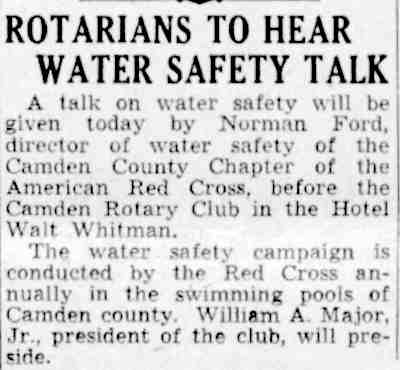
Camden Rotary Club — Hotel Walt Whitman — Camden Courier-Post, July 29, 1941
Rotary Chief Urges World Friendship
Camden Courier-Post —
With peace restored, the world should now become one great community and all men should live as neighbors, Herman H. Hanson, of Dover, Delaware, governor of Rotary District 184, told members of Camden Rotary Club yesterday.
Hanson, state chemist of Delaware, spoke at the club’s weekly luncheon in the Hotel Walt Whitman. He cited the aims of Rotary and defined the organization as “friendship in action.” Everett Smalley presided.